Antietam Rest Publishing
Harpers Ferry, West Virginia
September Suspense: Lincoln’s Union in Peril
Copyright © 2012 Dennis E. Frye
Published in the United States of America by
Antietam Rest Publishing
P.O. Box 246
Harpers Ferry, WV 25425-0246
www.antietamrestpublishing.com
All rights reserved. No part of this book may be reproduced in any manner by any means without the permission in writing of the publisher, except for brief excerpts in reviews or articles.
Dust Jacket Cover Image: “A Gallant Color Bearer” from
Harper’s Weekly, September 20, 1862
Antietam Rest Publishing logo image: “The Signal Officer
Off Duty” by Edwin Forbes, 1864
Endsheet image: Frank Leslie’s Illustrated Magazine
Library of Congress Control Number: 2012938497
eISBN: 9780985411916
Mentors teach and sometimes preach, but most important, they endlessly give themselves to you for your betterment. I dedicate this volume to my mentors.
Dwight L. Scott,
Coach, Boonsboro High School
Millard K. Bushong, Professor, Shepherd College
Donald W. Campbell, Superintendent,
Harpers Ferry National Historical Park
Paul R. Lee, II, Division Chief,
Harpers Ferry National Historical Park
Thomas W. Richards, Chairman,
Association for the Preservation of Civil War Sites, Inc.
Colonel Ben and Alice Cheaney, my in-laws,
The Greatest Generation
John and Janice Frye, my parents,
Generations in Washington County
Sylvia Bento Frye, my spouse,
My companion & Texas Bride
Many people like newspapers, but few preserve them. Yet the most interesting reading imaginable is in a file of newspapers. It brings up the past age with all its bustle and everyday affairs, and marks its genius and its spirit more than the most labored description of the historian.
— Savannah Republican, September 3, 1862
| Introduction | |
| CHAPTER 1 | September Suspense |
| CHAPTER 2 | Abraham’s Abyss |
| CHAPTER 3 | Slavery’s Shackles |
| CHAPTER 4 | Patriots’ Passion |
| CHAPTER 5 | Political Poison |
| CHAPTER 6 | Nominal Neutrality |
| CHAPTER 7 | Divorce Decree |
| CHAPTER 8 | Rebel Roulette |
| CHAPTER 9 | Five Fronts |
| CHAPTER 10 | Invader Intrigue |
| CHAPTER 11 | Quakers Quaking |
| CHAPTER 12 | Fortune Found |
| CHAPTER 13 | Sabbath Surprise |
| CHAPTER 14 | Mars’s Moment |
| CHAPTER 15 | Sunrise Slaughter |
| CHAPTER 16 | Suspense Sustained |
| APPENDIX 1 | The Terms of Peace |
| APPENDIX 2 | General Lee’s Proclamation to the People of Maryland |
| APPENDIX 3 | Counting Confederates |
| Notes | |
| Bibliography | |
| Acknowledgments | |
Americans are addicted to news.
Our appetite is insatiable. We crave it. We demand it. We spend hours absorbing it.
It crawls across our televisions. It streams into our computers. It alerts us on our smart phones. Tablets tantalize us with blogs. It blasts on Talk Radio. It’s 24/7 on cable. The feel and smell and ink of the newspaper delight those who remember a tablet only as a pill.
Anywhere, anytime, the news is there for us.
Instantaneous news is today’s norm. The 21st century has conquered delays in delivering all forms of communications. We need not seek the news. It comes to us. And if we like the news, we share it. Nearly one-seventh of the earth’s population shares news via Facebook. So many people move news through social media — confined only by the speed limit of how fast you text or how well you type — that revolutions have occurred in places where people thought revolution impossible.
I remember one day when I was isolated from everyday news. It was September 11, 2001.
As an associate producer for the Civil War movie Gods and Generals, we purposely selected filming sites removed from modern civilization — especially without cell towers. Director Ron Maxwell wanted to “feel” the 19th century on set; and for the 3,000 reenactors that I managed, we wanted them to “live” in the 19th century.
On September 11, I left our period Civil War encampment and drove to a rural post office (producers were permitted to have cars) somewhere on a back road in the heart of Virginia’s Shenandoah Valley.
I had no idea what was happening in “this” world, as I spent most of my waking hours in 1861, 1862, or 1863 (we moved from year to year, from film day to film day, depending upon which actors were scheduled that day). It was about 8:50 a.m. I turned on my car radio. No music. Only news on every channel. Something had just happened in New York.
I entered the post office to buy a thousand stamps, making the day for the post mistress. The radio was on in the background, and I listened to the news reporters describing the scene at the World Trade Center, as I aimlessly put stamps on reenactor notices. The announcers thought it an obvious accident; tragic, indeed, but an accident.
Then I heard it — the fiery crash into the second tower. I didn’t see it, but I could visualize it through the graphic words and near hysteric voice of the announcer. I’ll never forget those seconds. It was my “Pearl Harbor” moment.
I rushed back to the movie’s base camp. On my car radio, I heard about the plane slamming into the Pentagon. I didn’t know details, but I knew we were under attack.
Because of the movie’s complete isolation, no one knew what had happened. At that moment, I became the equivalent of Wolf Blitzer. Everyone wanted to know the little bit that I knew.
We immediately stopped film production, and huddled around the few car radios we could find. Reception was miserable. We were far from FM stations, and the AM stations kept fading in and out. I didn’t actually see the horrifying spectacle until near midnight, when I returned to my hotel room to watch it on television.
Imagine yourself being isolated from news on the day that changed our modern world.
Americans loved news during the 19th century, too. But it didn’t travel fast. Unless you were a telegraph operator (the 19th century form of texting), nothing was instantaneous. And telegraph wires don’t move the news as quickly as wireless networks.
The newspaper was the only form of news. It appeared daily in the big cities, though many did not publish at all on Sundays, out of respect for “the day of rest.” Local communities boasted their weekly paper, sometimes with more than one paper serving a community. Population didn’t drive the need for competing papers. Politics did. During the Civil War era, newspapers tied themselves to political parties — serving as the party trumpeters to the masses, much like MSNBC versus Fox News (although today’s news channels claim no political affiliation). And, as today, editors weren’t afraid to express their opinions. They used stronger and more colorful language in the days when a duel — rather than a lawyer — settled a defamation case.
Newspapers are the last frontier of Civil War research. Tens of thousands of books have been written on the Civil War and Abraham Lincoln, but newspapers usually are not cited as sources.
One reason has been inaccessibility. Most newspapers are in curators’ collections, and very difficult to locate. Even if you happened to discover a period paper, the original is so brittle, no curator worth the title will let you handle it. The fragile nature of newsprint is another problem for historians. Many of the newspapers are gone, withered away by sunlight, moisture, fire, or bugs. Newspapers, unlike the stone tablets of antiquity, are not designed for eternity.
Then there’s the microfilm or microfiche machine. What’s that? Now it’s in the Smithsonian, but it used to be a roll of photograph negatives that you passed under a magnifier. You stuck your head into a hood to view an image projected onto a black and white mini screen. What person of sound mind would subject oneself to such torture? Most historians, of sound mind, did not.
Then came the invention of digitization, the home computer, and the worldwide web. Curators and librarians figured out how to place their papers on the internet so that historians could utilize them. A research revolution was born.
I like Civil War newspapers. They offer a plethora of new discoveries, fresh perspectives, and frank expressions. Newspapers were the first social media. Their stories represented their societies. Their pages included personalized accounts of women and men; blacks and whites; new immigrants and generational immigrants; slaves and freemen; wealthy and impoverished; laborers and capitalists; mechanics and inventors; farmers and teachers; rural inhabitants and urban dwellers; leaders and followers. Newspapers had their slants, but they were inclusive. Each newspaper freezes each day in time. They offer, for the historian, the best and most comprehensive glimpse into the day-to-day lives of average Americans.
Even better, they often copied articles from one other — especially if the editor disagreed. They never plagiarized, always gave credit; but the wonder is you can often read numerous newspapers by only reading one. My favorite example is the Philadelphia Inquirer. Politically neutral by the standards of the day, it consistently copied accounts from a myriad of city and local newspapers — North and South — often with its own accompanying commentary. This saved me hundreds of hours of researching different perspectives. The 1862 Inquirer editor consolidated the perspectives for me.
You feel history when you read an historic newspaper. It takes you there. It becomes your time machine. You’re living the moment with them, and you experience their drama, their trauma, and their triumphs.
History is people — not dates, not facts, not memorized texts. We must remember that history does not create itself, but people create history. Newspapers bring us closer to people, and allow us to be there when they make their history.
I just shared my philosophy in writing this book. I chose suspense as part of my title because when you read their papers of September 1862, Americans were paralyzed with suspense. Every day, their futures could change, perhaps spectacularly. Drama pervades this volume, because drama invaded their lives. Everyone felt the tension. We were at war with each other. No one knew the outcome, but the newspapers recorded the drama, diligently and intelligently, day by day.
These newspapers, along with diary entries and daily correspondence, tell the story as it’s happening. That was my goal: share their story as it occurs. What did they know at that moment? How did they react to their moment? What were their options? Why did they choose this decision?
Through the use of daily contemporary sources, you not only feel with them, but you begin to think along with them. You become part of their existence — at least momentarily.
The best way to achieve this connection is through use of their own words. Let them tell you their story. They are marvelous story-tellers.
My job in September Suspense has been to discover their stories. I’ll string their stories together, but then get out of the way. Let them speak for themselves.
Civil War historians have a tendency to define a “primary resource” as a person who experienced the action or event that made history. No argument from me. My peeve is with primary sources that chronicled their participation long after the event had occurred.
My good friend Ed Bearss, former chief historian of the National Park Service, once illustrated this point for me. Ed served as a marine during World War II, and was badly wounded in the South Pacific during the Battle of New Britain. I once asked him if he attended his unit’s reunion. “Yes,” Bearss growled, “but I stopped going.” Why? I asked. “Because every year more and more became a bunch of damned liars!”
Memory has its ways of distorting history. Civil War veterans created their own distortions, some through fading recollections, but others through intention. Good historians work hard to discriminate between good and bad sources, but in the field of Civil War scholarship, too often we have accepted the “primary resource” as truth, without careful examination.
One of my favorite examples illustrating this problem was at the Antietam Battlefield. For several decades, a small exhibit welcomed you at Bloody Lane, under the bold quotation, “The End of the Confederacy was in Sight.” The premise was that the U.S. commander could have ended the Civil War right there, and the quote came from a primary source: Edward Porter Alexander, a Confederate ordnance officer, who wrote a terrific personal narrative nearly 30 years after the war.
How much do you remember from 30 years ago? While once conducting some research on nearby Harpers Ferry, I made a startling discovery: Alexander was not at Antietam during the battle. How could he know if the end of the Confederacy was in sight? To the credit of my NPS colleagues at Antietam, that questionable source of interpretation no longer exists.
So, I’ve attempted to avoid “primary sources” of accounts written years after the fact. I’ve even tried to brush away accounts written months afterwards. Too much reflection time can change the historical record, and alter the story significantly.
No historian can attain absolute truth. Even the people who write the very day about their moment in time insert their own prejudices, stereotypes, and interpretations into their memoir. It’s natural — we’re human. We are immediate filters of the historical record, persuaded by our own backgrounds and beliefs.
In September Suspense: Lincoln’s Union in Peril, we will share history’s imperfections together. But we’ll come as close to their reality as we can.
Everything combines to prove that the revolt is culminating in its strength. Upon the next few weeks hang interests of appalling magnitude.
— Baltimore American and Commercial Advertiser,
September 4, 1862
It’s September 11.
The United States is under attack.
Foreboding news bombards the president. Danger stabs Washington. The Army stands at full alert. The Navy patrols the Potomac.
Abraham Lincoln is under siege in September 1862.
The Civil War had been raging across America for 17 months. The summer had been bloody — bloodier than any summer in American history. United States forces had attempted to capture the enemy’s capital at Richmond, Virginia, but they had failed. A stubborn Confederate army under Gen. Robert E. Lee had stymied their efforts.
Lee’s Rebels had inflicted mass carnage on President Lincoln’s army. In seven stunning days, bullets and shells fired by Lee’s Southern gunners had killed and wounded nearly 16,000 U.S. soldiers — equal to half the American casualties in all seven years of the Revolutionary War. Mangled bodies littered the Richmond landscape. New York farmers now were bloated corpses. Pennsylvanians fumbled without arms or hobbled without legs, amputated victims of modern warfare. Massachusetts mechanics bled their puritan blood into Virginia’s bright red clay. Ohioans breathed their last to reunite the divided states of America. Cries of “On to Richmond” — spurred by impatient politicians and an imprudent press — had turned into tears and fears for innocent widows, siblings, and orphans.
Except for the grieving families and growing graveyards in the North, the war seemed far away. The battlefields belonged to the South. The target cities were Richmond and New Orleans and Charleston and Savannah. The states being conquered were Virginia and Tennessee and Mississippi and North Carolina. The conclusion was certain: the rebellious Confederate States of America would submit. The industrial machines and population power of the United States guaranteed victory. No other outcome seemed possible.
Then, astonishingly, the war abruptly moved.
The compass shifted north. Instead of Richmond, Washington became the centerpiece of contention. Gen. Lee raced his army toward the United States capital. He crushed a Union army blocking his path at Manassas, only 30 miles from the White House. Then he diverted. Instead of assaulting fortified Washington, Lee splashed across the Potomac River. Now he invaded Maryland, threatening Washington from the north. The Rebel chieftain frightened Baltimore and Pennsylvania. A Confederate tsunami surged onto the unstained soil of the North.
Invasion!
Pennsylvania’s governor sounded the alarm. “Their destination is Harrisburg or Philadelphia,” Gov. Andrew Curtin wrote in a distressed message to President Lincoln on September 11. “Send here not less than 80,000 disciplined troops…. Order from New York and States east all available forces here at once.” The governor then issued Mr. Lincoln a challenge: “The time for decided action by the National Government has arrived. What may we expect?”
Curtin’s plea to the president ended with passion and conviction. “It is our only hope to save the North and crush the rebel army…. Do not suppose for one instant that I am unnecessarily alarmed.”1
Gov. Curtin was not alone in his alarm. “Citizens of Pennsylvania! Your services are demanded for the defense of your State,” wrote the Philadelphia Inquirer. “Emboldened by real or imaginary successes, the enemy has crossed your boundary line, and now, with expectations buoyant of plunder and rapine, is marching towards your State Capital.”
The Inquirer personalized its plea. “The present and future prosperity of our State, the welfare of our cities, and the safety of our homes and families, depend upon an instant and unanimous response.” The paper exuded urgency. “Before another morn dawns upon us, every military organization in the Commonwealth should have marched against the enemy, and every loyal and able-bodied man should have prepared himself to follow in the glorious path of duty and patriotism.”
The City of Brotherly Love editor finished with this warning: “Let no citizen hesitate in this hour of need. The foe is cunning in his devices, rapid in his movements, and while we hesitate he is advancing.” It was not too late. The Rebels could be repulsed. “It remains for the loyal men of Pennsylvania to crush their hopes and destroy their infamous calculations.”2
Women of the town of York, astride the suspected warpath toward Philadelphia, understood the emergency. Hourly they heard reports of railroads ruined, bridges burned, crops destroyed, cattle driven off, and in some instances, citizens murdered. The violence of war was coming to their doorsteps. No fit and dignified man could stand idle. To ensure against cowardice, the York women bonded, devising a plan to encourage maximum enlistments in the Pennsylvania militia. “When a young man sends up his card,” announced the determined women, “if there be no Lieutenant, Captain, or Colonel prefixed to the name, let the first inquiry be: ‘What regiment does he belong to?’ If the answer be, ‘None,’ refuse to see him until he has enlisted.”3 How could a man of decency sustain such dishonor in the mores of Victorian America?
Certain of Confederate intentions — and desperate for troops to stop them — Gov. Curtin dispatched an urgent request to the Mayor of Philadelphia on September 11. “We need every available man immediately…. Stir up your population tonight.” The governor dictated specific instructions. “Form [your citizens] into companies, and send us 20,000 men tomorrow. No time can be lost in massing a force along the Susquehanna to defend the State, and your city. Arouse every man possible, and send them here.”4
“Here” was Harrisburg. Marching men gathered throughout the streets of the Quaker State capital in response to Gov. Curtin’s state-wide appeal for home-grown troops. Drum beats sounded “to arms!” Fifers whistled Yankee Doodle, remembering the patriots of 1776. Three companies of infantry formed uneven ranks within the State Capitol grounds, while nearby artillerymen practiced loading their polished cannon. Citizen soldiers from all parts of the state converged upon Harrisburg, responding to the governor’s General Orders Number 35. “In view of the danger of invasion now threatening our State … it is deemed necessary to call upon all able-bodied men of Pennsylvania to organize immediately for the defense of the State, and be ready for marching orders upon one hour’s notice.”5
One hour’s notice! From citizen to soldier. From home front to warfront. The governor called for 50,000 volunteer militiamen to rendezvous, bringing with them “the best arms they can secure,” with each man carrying 60 rounds of ammunition. Would they come? “Everyone was whispering some dark forebodings in the ear of his neighbor,” recalled a capital dweller. “‘Pennsylvania is in danger!’ The Rebels are coming on to Harrisburg!”6 The governor’s call solicited a remarkable response. “I met in [Harrisburg] the best men of the city,” observed an out-of-town newspaper correspondent. “Merchants, lawyers, physicians, and all branches of profession, practicing the soldier.” He witnessed determination, stoic seriousness, and “the light of battle upon their faces.”7
East of the Pennsylvania capital, Philadelphia was also in a state of panic. America’s second largest city believed its capture was “a favorite hope of the Rebels.”8 “The invasion of this Commonwealth has long been a proclaimed project of the Southern traitors,” stated the Philadelphia Inquirer, “an infamous cause [for] devastating the farms of Pennsylvania and the warehouses and banks of Philadelphia.”9 The Inquirer righteously reasoned that Harrisburg was “of little importance,” other than disrupting railroad traffic. But Philadelphia — now she was a prize of war. “Philadelphia is an object of intense desire to them,” explained an editorial. The Rebels targeted the city “on account of the immense stores they would secure here, the damage they would inflict upon us, and the prestige which its occupation would give to their desperate cause.”10 Proof that Philadelphia was the target came with a Confederate announcement to dictate terms of peace in Independence Square. “We now know the worst.”11
Philadelphia trembled at its woeful lack of military preparation. “We are lamentably deficient in the elements of self-protection,” complained the Inquirer. No one expected the tentacles of civil war to grasp the birthplace of American independence. “In such an emergency what is our condition?” Not good. The city had no fortifications. No generals. No gunboats. No consolidated forces. No guns in position or plan of defense. “How is all of this to be remedied?” queried the press.12 The Inquirer offered its own solution: Dust off a military engineer’s study from the previous year and impress city workers to build fortifications. “The highway, water, gas, and other branches of the City Government have an immense body of laborers employed on works which, at a time such as this, are idle mockeries.” The paper challenged the City Council to order the temporary discontinuance of all such works “and direct that hands employed should be transferred to the erection of defenses.”13
Mayor Alexander Henry agreed something must be done. He declared, “The critical period of the war, as far as the safety of this city is concerned, is now upon us…. Much may depend on the amount of realization of the impending danger that exists on the part of our citizens.”14
Several prominent citizens decided not to depend upon the local response. Presidents of Philadelphia’s largest banks, worried about their deposits, appealed directly to the President of the United States. “In view of the inadequate organization of its local troops and the deficient means of defense against a hostile army … [we] earnestly entreat Your Excellency to create a military district of this city and the adjacent country, and to assign a general of known capacity to the command thereof, with instructions to adopt whatever measures of security may be needed in the present crises.”15 The calendar read September 11. Anxiously, the bankers awaited President Lincoln’s response.
ABRAHAM LINCOLN HAD PROBLEMS more pressing than Philadelphia. Five hundred miles to the west, another U.S. city prepared for Rebel attack.
Cincinnati seemed shocked. September opened with the Queen City bustling with business, its steamboats transporting tons of trade up and down the wide Ohio River; and its iron-horse railroads blessed by a geographic nexus between East and West. Now Ohio’s largest city was dormant, its stores shuttered, shopping suspended, and its factories closed. Within one week, Cincinnati had transformed from a modern metropolis into a gloomy and deserted place.
A Confederate army had lunged across east-central Kentucky, marching at unfathomed speed, catching Cincinnati and U.S. military authorities by surprise. Sirens sounded when the Rebels arrived within 20 miles of the city. Twenty miles was just one day’s march. Nowhere had the enemy inched closer to a major U.S. urban area. Nowhere was a hub of U.S. trade and commerce in greater peril. Nowhere was a United States city in more danger.
Ohio Gov. David Tod issued an emergency proclamation: “Our Southern border is threatened with invasion…. [Have] all the loyal men in your counties at once form themselves into companies and regiments, to beat back the enemy.”16
Into this dire situation arrived Union Gen. Lew Wallace. Eighteen years before he authored his best-selling novel Ben-Hur, Wallace was writing orders to save Cincinnati from the Confederates. His first words were not poetic, but portending. “[It] is but fair to inform the citizens that an active, daring and powerful enemy threatens them with every consequence of war.”17
Reports circulated in the newspapers that the Confederates were determined to arrive in Cincinnati within the week. “They seemed all to be terribly earnest on this subject, and will, no doubt, fight most desperately for the possession of the city,” claimed a recently released prisoner of war from Indiana. The soldier alleged the Rebels were destitute — “almost naked with the exception of a few rags and tatters” — and desperate for provisions and clothing. Warehouses were their inspiration, he said, and they would “be allowed to sack and plunder at will, when in their hands.” He had heard both officers and privates grumbling that they were “completely tired of the war, and most heartily curs[ing] those who had plunged them into it.” Yet the Confederates exhibited no hints of quitting. “They have been made to believe that the only way in which the matter can be settled is by the complete subjugation of the North.”18
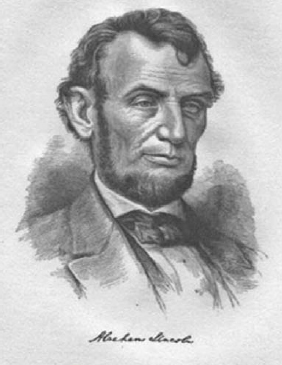
Abraham Lincoln, Frank Leslie’s Illustrated Newspaper)
Gen. Wallace determined such subjugation would not happen at Cincinnati. Confronting the emergency, he issued instructions impressing the local inhabitants into fortification construction. “The labor ought to be one of love,” Wallace contended. Love for your country; love for your city in its hour of peril. The no-nonsense general announced his policy. “The principle adopted is — citizens for the labor — soldiers for the battle.”19
Not every resident was enamored with Wallace’s edict. “None are exempt, from the millionaires to the beggars,” revealed an onlooker. “This, of course, causes some little grumbling among the upper classes.” Noting that even the rich were compelled to perform an equal share of the labor, the observer marveled: “Their threats and growls do no good; go they must…. They who, perhaps never worked before, must work now.”20
To ensure maximum labor was available from the citizens, Gen. Wallace proclaimed martial law, and ordered every business in Cincinnati suspended and closed. Liquor establishments first were forced to lock their doors, and if any refused, “the stock on hand would be confiscated for sanitary purposes.”21 This action enraged “hundreds, almost thousands of dram drinkers and habitual loafers,” and the German portion of the community became indignant that their “supply of lager was so suddenly cut short.” Resistance was useless, however. Laggards were rounded up at police stations and hustled off to help construct the forts. Even the army’s contractors spent every other day “digging for Uncle Samuel’s benefit.”22
With business suspended, soon every shop, store, and grocery was devoid of customers. Even the food markets were extinguished. With doors closed and blinds down, it appeared contagious disease or epidemic had driven the citizens to seek some safe retreat. “Whole families began roaming the streets, with baskets on arms, trying to “buy, borrow, or beg the wherewith to sustain the inner man.”23
As local citizens labored on a circle of fortifications, militiamen from throughout Ohio raced toward the Queen City. Volunteering for 30 days in response to their governor’s urgent plea, they assembled as a special guard for the defense of Cincinnati. Each came carrying his own gun and accoutrements. Some arrived with rifles, others with shotguns; some came equipped with old-fashioned powder-horns and bullet pouches. “It strongly reminds some of the good old days of 1776, when men were gathered from the field and shop without being allowed time to bid farewell.”24 Many boasted they could kill a squirrel at 150 to 200 yards, and though entirely undisciplined in the face of a veteran Confederate army, they looked forward to testing their marksmanship behind the newly built fortifications. “You will no doubt hear a good account of the riflemen of Ohio,” anticipated an impressed journalist.25
Pennsylvanians hoped to emulate the model of Cincinnati. “We see an illustration of what may be affected in a few days,” the Philadelphia Inquirer wrote with admiration. “Lines of fortifications created, an army extemporized, and an entire city placed wholly on a war footing.” The editor concluded the energetic and sudden action in Cincinnati was due to a sense of immediate danger. “The foe is at the door, and the household is alarmed. The work of the last few days is the out birth of near and imminent peril.”
The Inquirer writer discovered “one of the latent reasons why we have allowed this Rebellion to linger so long. We have not thought ourselves to be in danger.” Much had changed, indeed, since the final days of August, when “we saw only the skirts of the war cloud as it spread darkly over the distant sky. We would not believe that it was sailing slowly to our own zenith.”26
Before day’s end on September 11, proposed Confederate peace terms suddenly appeared in Northern newspapers. Sunset found citizens wondering what this portended. Was the country on the verge of permanent division? Were the flag’s 34 stars soon to be reduced? Six days shy of the U.S. Constitution’s 86th birthday, was it destined to become a political artifact? Were the opening words of its hallowed preamble about to face extinction?
We the People of the United States, in Order
to form a more perfect Union …
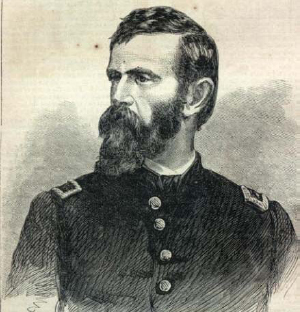
Lew Wallace, defender of Cincinnati. (Frank Leslie’s Illustrated Newspaper)
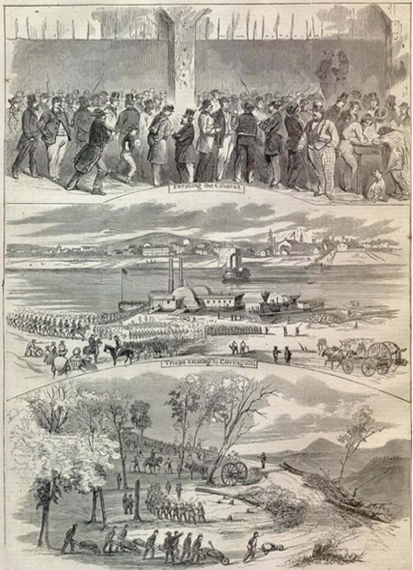
The Confederates threaten Cincinnati, the largest city on the Ohio River. Mustering the Militia (top). Troops crossing over the Ohio to defend the city from Kentucky (middle). Citizens impressed to build fortifications (bottom). (Frank Leslie’s Illustrated Newspaper)
The next sixty days will determine the question whether we are to maintain the supremacy of the Government, or whether the Rebellion will prevail.
—Parson William G. Brownlow, September 8, 1862
September started shamefully for President Lincoln’s government.
Thousands of wounded United States soldiers suffered in Washington, their care limited, their limp bodies crammed into makeshift hospitals throughout the capital.
The Capitol building, with its half-finished dome dominating the city’s skyline, had been transformed from a sanctuary of democracy into a sanatorium to prevent death. The rotunda, Senate and House halls, and corridors of the Capitol, had been converted into hospital wards with “cots and beds being placed in every available place.”27 No American ever envisioned the Capitol “admirably adapted for hospital wards,” yet its large halls and passageways were “well ventilated, easily kept cool or heated, and well supplied with water.”28 Seats formerly occupied by U.S. Senators from the South — men who now headed the Confederate government or served as Confederate generals — served as stretchers for wounded U.S. soldiers. “Only two short years ago who would have thought such ever could have been the case.”29
Work on the Capitol dome ceased. Construction crews traded their hammers and wrenches for rifles and bayonets, organizing into a temporary militia company to meet the emergency — protecting Washington from attack. Clerks from government departments and bureaus dropped their pens and papers and stuffed their hands with powder and bullets. Employees of the Interior Department elected their chief clerk their captain. The Census and Indian bureaus mustered 73 men apiece into the rank and file. The Auditor’s Office of the Treasury Department offered a clerical corps, and a company of nearly 100 recruits in the Patent Office answered the urgent call. The bookbinders at the Government Printing Office began organizing for war, and the Office of the Postmaster General boasted 87 eager enrollees and 30 reserves. All totaled, nearly 1,800 clerks, organized into almost 20 military companies, left their government offices to prepare themselves for the battle to save Washington.30
Noticeably missing were volunteers from the War Department. They, understandably, were “so pressed by [their] current duties as to be unable to answer the call.” In their place arrived an offer from a Washington-based patriotic organization: the veterans of the War of 1812. These wrinkled and grizzled 60-year-olds, who had fought the British 40 years previously, tendered their services to the War Department, where their “proffer was graciously received.”31
Wall Street noticed the capital chaos, and it dampened the ardor of investors. “The nerves of Wall Street were considerably shocked by the alarming rumors,” reported a market observer.32 Uncertain traders whip-sawed stock prices up and down, depending upon the latest telegram that arrived in New York. Market specialists sensed an “unsettled feeling apparent among the operators.”33 All suspected “another great battle somewhere on the line of the Potomac as inevitable, and as upon the result hangs the most momentous issues.”34 Some stocks plummeted. Baltimore and Ohio Railroad stock caved 10 percent as sellers sensed danger from the proximity of the Confederate army. Gold prices also fluctuated, and Street insiders insisted movements in the precious metal “serve now, more completely than stocks, to indicate the momentary changes of public feeling.”35
Washington’s street scenes hardly inspired confidence. The provost marshal scurried about, impressing anything on wheels. “All available hacks, omnibuses and other vehicles, including express and store wagons, were pressed into the service of the government for public purposes.” The principal public purpose was to convey thousands of wounded from the nearby battlefield of Manassas. Over 8,000 U.S. soldiers had been injured battling Robert E. Lee’s Confederate army during the final three days of August, and the mass casualties overwhelmed the army’s ambulances. Surgeons were inundated with the wounded, forcing Washington to plea for physicians. Trains loaded with doctors soon began arriving from New York, Pennsylvania, Massachusetts, Delaware, and Maryland. City police in nearby Baltimore began gathering names of persons who could assist in nursing the Washington wounded, tallying nearly 500 in one day.36
The Ladies’ Soldiers’ Relief Society of Washington worked day and night to prepare lint, bandages, and compresses. “They have made a good use of their linen sheets,” noticed one observer. “Many ladies of the city have made liberal contributions from their private stores. In fact, the people of the District are acting nobly, and not a few men have volunteered as nurses.”37 Churches welcomed the wounded, and residents opened their homes. “Many citizens of Washington have taken convalescents from the hospitals to their houses, so that the wounded could fill their places.”38 The medical department identified one of the largest estates in the city, the palatial residence and grounds of banker W. W. Corcoran, as a location that could accommodate 500 hospital tents. Georgetown’s seminary buildings became the recuperation point for officers.39
Trains brought thousands of worried family members into the city, who wandered Washington’s streets searching for the hospitals of their beloved. Where was Jacob Leonard of the 21st New York, whose shoulder had been injured? Did James Davis of the 3rd Pennsylvania, whose arm had been amputated, reside here?
Can you inform us of the location of Isaac Norrill of the 2nd Maine, who suffered a wound in the neck? Any idea where we can find Robert Fowler of the 25th Ohio, with a debilitated leg? On occasion, a newspaper announced the exact location of wounded soldiers. At Third and C Streets, where Isaac Newton and his wife resided, 14 soldiers from New York, Wisconsin, Ohio, Indiana, and Massachusetts were recovering, as identified in a brief notice in the Philadelphia Inquirer. Mostly, however, the Northern papers reported a daily ledger of casualties that included thousands of names in dozens of columns, with fates and locations unknown.40
At least the wounded still were breathing. Dead men — thousands of Abraham Lincoln’s soldiers — filled battlefield graveyards and hospital cemeteries. Many of the corpses never returned home, moldering in mass graves in their tattered blue uniforms, without individual identification. Men with names became souls now “unknown.” Regiments that had marched from their cheering communities 1,000 soldiers strong now limped along with fewer than 400 still standing. Battlefield casualties and malignant diseases had wiped out two-thirds of the muster rolls. Diarrhea, dysentery, tuberculosis, measles, and small pox had ravaged the ranks, killing more men than bullets. The war, projected to end in three months, now approached its 500th day, and Lincoln’s army was running out of soldiers. Lieutenant John Mead Gould of Maine described the depreciation graphically: “a skeleton Corps, of skeleton Divisions, of skeleton Brigades, of skeleton Reg[imen]ts, of truly skeleton men.”41
Bleak letters home became the norm. “I have set down to write you what to do if I should be so unfortunate as to fall on the field of battle,” Lt. Col. Henry Barton Stone of the 5th Connecticut Infantry informed his wife. “If I am killed, I wish to have [my executor] settle my affairs, pay all my debts, and with the remainder buy a small place for you and the children, where you could live comparatively comfortable with the pension you would receive from the Government.” Sensing a premonition, Stone explained. “You must not think strange that I write you thus, for it is my duty to you all; as it could not be done after I am killed.” Then he calmly comforted his spouse. “Be of good cheer. If it should please the Lord to take me from you, He has promised to be the widow’s God, and Father to the fatherless.” Col. Stone concluded with a vision. “And if we meet no more on earth, I hope to meet in heaven, where there shall be no more wars, or rumors of war, and the weary are at rest.” Stone was slain two weeks later, at a place named “Slaughter Mountain.” His portending letter appeared in newspapers throughout the North.42
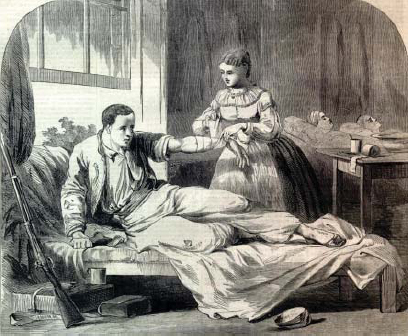
Women offered care in unprecedented numbers at Northern hospitals in Washington, Baltimore, and Philadelphia following Union defeats in the late summer of 1862. Previously, women nurses seldom were permitted to treat men due to strict Victorian mores. (Harper’s Weekly)
A mournful song that symbolized the war’s relentless losses chorused in churches and parlors throughout the land. The Vacant Chair evoked the emptiness of the seat at the daily dinner table.
We shall meet but we shall miss him.
There will be one vacant chair.
We shall linger to caress him
While we breathe our ev’ning prayer.
When one year ago we gathered,
Joy was in his mild blue eye.
Now the golden cord is severed,
And our hopes in ruin lie.43
Despite the remorse, the depleted ranks of the army needed more men. President Lincoln called for 300,000 volunteers on July 1; but fearful of failure, the Congress adopted a measure never before employed in the United States — the draft. Many citizens considered this to be a usurpation of individual liberties and contrary to the Constitution. It appeared an act of desperation by a despotic administration. Men of drafting age began to run to escape registration. The Lincoln government reacted by imposing martial-law regulations that restricted travel from city to city or across state lines. The London Times mused that “the land of self-government and unlimited freedom is now ruled by a force that is creating terror.” Referencing the draft, and comparing it to a type of Northern slavery, the British paper ironically perceived, “Involuntary servitude is now the lot of the white race.”44
Commentary from the Mother Country was not the principal concern Abraham Lincoln faced from across the Atlantic. British and French leaders considered the United States so weakened by the war that they contemplated intervention, not with their armies or navies, but with their mediators. The London Times argued that “the North cannot conquer the South … and the time for compromise of some kind has arrived…. The worst settlement of the dispute cannot be so fatal as the continuance of the war.” The Times drew an analogy between the frail position of England during the Revolutionary War and the uncertain future of the U.S., and exclaimed, “It is time the North followed the example of England.”45
Such suggestions were anathema to President Lincoln. How dare the English! How could they consider the United States incapable of victory? Yet current evidence sided with the South. The Southern capital had been saved. The Southern army had defeated Lincoln’s legions just outside of Washington. Southern offensives had kicked the Federals out of Virginia and Kentucky and much of Tennessee, and were threatening invasions of Ohio, Pennsylvania, and Maryland. “If such reverses do not teach the North to reconsider its course,” opined the London Times, “we do not see how political wisdom can be learned or political error retrieved.”46
Politics at home presented more of a problem for President Lincoln than politics from abroad. Election season had arrived, not for the Chief Executive, but for members of the U.S. House of Representatives. Here Lincoln’s Republican Party held a majority, but now came the first large-scale election since the war had commenced. All knew it would be a referendum on the war. Democrats anxious for a return to power pointed to reverses on the battlefield as proof of Republican mismanagement and incompetence. Peace Democrats, derisively coined “Copperheads,” campaigned aggressively on a platform of immediate negotiation, with some even advocating a cease fire. Important governorships and state legislatures, too, were facing voters — the local results crucial to Lincoln’s ability to continue the war. Early results from Maine, the home state of Lincoln’s vice president, did not herald hope. As votes were counted during the first week of September in the “I Lead” state, Lincoln’s Republican allies saw their tallies diminished by thousands.47
Even the president saw signs of defeatism. Near the White House, a journalist spotted a regiment of U.S. cavalry “who presented the most miserable and outré appearance I ever witnessed…. In plain phrase, they were a disgrace to themselves and to the army.” He described the men as “in want of uniformity of equipment,” and sorry specimens of soldiers. “In the dirt and disarray of their uniforms and accoutrements, there were all the painful evidences of absence of discipline and of inefficiency.” This absence of discipline particularly offended the observer. “There was hardly a man who did not lounge upon his horse instead of sitting on it; scarcely two who carried their sabers alike, and certainly not one who showed a decent presentable soldierly appearance.” His diatribe continued with respect to the horses. “If the men looked bad, their horses were worse. Such a collection of spavined, half starved equines I never saw together before. There was not an animal in the lot that would have sold at the horse market for ten dollars — the majority [was] only fit stock for a [residue] factory.”
The analyst then identified a systematic problem. “As for the men whose appearance provoked these remarks, they must, in the dirt and disarray of uniform, and mounted upon such miserable animals, have lost their own respect and held their officers in contempt.” He concluded by offering the army his advice: “Learning men to take pride in their appearance, and to present a neat soldierly appearance, may appear to be a very small thing, but it is the corner-stone of discipline and efficiency.”48
Efficiency was not the army’s present forte. “The men would have starved today had it not been for the sutlers,” recorded Lieutenant John Mead Gould in his September 3rd diary entry. “We rec[eive]d no rations. Funny thing it is and very creditable to our Quartermaster’s Department that we starve in sight of our Capitol.”49
Weariness was another worry. Three consecutive days of fighting, followed by a fourth when the Confederates pursued the withdrawal from Manassas, had regressed into nerve-racking nighttime retreats, exacerbated by an untimely rainstorm and miserable mud — all conspiring to deprive the soldiers of sleep. Many marched despondently in the darkness, experiencing “confinement, privation, discomfort, and torture.”50 When orders finally arrived to “stack arms,” Lieutenant Gould recalled his men “actually dropped as if shot and were instantly asleep…. Cold, hunger, and sore limbs were nothing.” Gould exclaimed, “Sleep, sleep!” hypnotized the brain and body so much that he “didn’t care if all creation fell into the hands of the Rebels.”51
Fatigue further weakened the army’s constitution. Chaos ensued in the ranks during the retreat from Manassas as tired men slowed, separated from their commands, and suddenly found themselves marching astride strangers. Confusion reigned. Where is my colonel? Where has my sergeant gone? Why can’t I find my regimental flag? What’s become of my mates? “The whole movement was in confusion,” recounted a Baltimore correspondent. “Regiments were separated from their brigades, divisions lacking whole brigades, batteries straying from the commands to which they were attached, cavalry cutting columns in two, and making no end of mischief in all directions.” He concluded, “No circumstances could have made such a march — a retreat from a Rebel army upon the capital — anything but gloomy.”52
Many soldiers simply dropped by the roadside during the retreat, no longer able to continue. This brought them disparagement and discouragement. Branded as “stragglers,” they were chastised as weak and ill-disciplined, regardless of their physical exhaustion. Some stragglers had reputations of immoral hellions, charged with battlefield cowardice or laziness, but these were the minority. Most simply were lost. “Large crowds of stragglers continually line the roads in the rear of our army,” revealed one observer. “The sidewalks, stoops and yards of houses in [Washington] and its neighborhood being filled with them every night.”53 This produced a most negative impression. A writer with the New York Post labeled straggling “an evil so great that it most dangerously affects the very safety of the army.” The reporter directed his blame, however, not at the stragglers, but at its root cause: the army’s absentee officers.54
Officers in the all-volunteer army often considered themselves privileged, and often came from privilege. Most officers in the Union ranks were not West Point graduates, and most had no previous military experience. Town mayors now were leading infantry companies. Local bankers, who purchased uniforms for neighborhood patriots, now commanded regiments. Fire chiefs and police chiefs now had commissions in the army. Most were dedicated to the war effort, but many resisted or ignored the discipline necessary in their novel martial roles.
“If we want to succeed in the field, we must have strict discipline in our armies,” opined the New York Post. “Our soldiers are brave, and the majority of them fight well; but they fight under the most serious disadvantages.” Disadvantage number one was an ill-disciplined officer corps. “The first evil which the Government and the people must unite to check at once is the absenteeism of officers,” declared the PostPost55