ISBN: 978-1-6319253-9-9
TABLE OF CONTENTS
1. PIECES OF A PUZZLE
2. SIMPLE SOLUTION
3. STABLE, UNSTABLE AND NEUTRAL EQUILIBRIUM
4. E PLURIBUS UNUM, OUT OF MANY ONE
5. A SIMPLE, SELF-CORRECTING, DEMOCRATIC ECONOMY
6. THE POLITICAL SPECTRUM
7. DISCONNECT BETWEEN VOTERS AND POLITICIANS
8. UNITING AND VOTING
9. POLITICAL CAMPAIGN AND POLITICAL MESSAGE
10. DIVING CENTRAL ISSUES
11. SHOULD NOT BE SOLVED LEGISLATIVELY
12. EVEN FLAWED, THE SYSTEM STILL WORKS
13. WHAT IS WORKING - ECONOMIC BALANCE
14. SYSTEM IS GOOD, BUT NOT OPTIMUM
15. FOUNDATION OF AN ECONOMY (COLONIAL LIFE)
16. PRODUCTIVITY AND QUALITY OF LIFE
17. AN ECONOMY DRIVEN BY OR LIMITED BY THE POLITICAL CODE
18. INEFFICIENT USE OF DEBT
19. UNPRODUCTIVE TAX POLICY
20. STABLE ECONOMIC POLICY
21. REDISTRIBUTION OF WEALTH
22. INSIDE ADVANTAGE
23. WHAT WENT WRONG?
24. EVOLUTION OF COMMUNICATION
25. APPLICATION OF COMMUNICATION TECHNOLOGY
26. VOTER UNITY
27. THE NUMBER IN THE MIDDLE
28. CRITICAL MASS
29. POWER MUST BE USED WISELY
30. CREATING AN IDEA FACTORY
31. BRINGING IT TOGETHER
32. BALANCED, COUNTER-BALANCED, AND POLITICALLY BALANCED
33. DESTRUCTIVE CHANGE IS UNNECESSARY
34. OPTIMUM TIME FRAME
35. CHALLENGES OF THE PAST
36. THE GREATEST THREAT (FUTURE)
37. BUILDING A PRODUCTIVE SOCIO-ECONOMIC SYSTEM
38. SELF-PRESERVATION IN TAX POLICY
39. SELF-PRESERVATION IN UNIONS
40. GOVERNMENT INTERVENTION AND UNINTENDED CONSEQUENCES
41. THE POLITICAL-INDUSTRIAL ECONOMY
42. EFFICIENT COMPENSATION
43. DEFINE WEALTH
44. COMPETITIVE TAXES
45. SUBSIDIZED UNEMPLOYMENT
46. MARKET STABILITY AND MARKET EFFICIENCY
47. EMPLOYMENT MARKET-PROTECTING WORKERS
48. ALWAYS WIN
49. AN ELEMENT OF HUMANITY
50. A BRIGHTER FUTURE
AFTERWORD
CHAPTER 1
PIECES OF A PUZZLE
The purpose of this book is to motivate and inspire voters to work together toward the goal of advancing great ideas, productive ideas that will guarantee the continued political, social, and economic superiority of the United States. It creates a picture of the current condition of our nation and pieces together the factors that prevent politicians from promoting positive change; it will show why no amount of drive or leadership by elected officials can reverse the negative forces acting on our society. It will demonstrate why only voters have the power to lead our nation and will lay out a blueprint to make this happen.
Each chapter is designed to cover a specific factor of this equation. The chapters do not provide a complete discussion of each topic, only an outline of the key points as they relate to this book’s purpose. Each chapter is part of an assembly, a piece of a puzzle, designed to build a new perspective and to inspire action.
While each chapter is as short and succinct as possible, it still may not be necessary to read the full chapter. Chapters have been written in a way that the most important details will always be on the first page and, when possible, in the first paragraph. The moment a reader feels comfortable with the point being made, he or she is welcome to jump ahead to the next chapter. Nothing will be lost by quickly skimming to the end. This book seeks to unite individuals who are beginners as well as experts; information on later pages of a chapter is only meant to support the point that was already made.
This book is written for those who can sense the urgent need to correct the political, social, and economic dysfunction that exists today; it is for those who believe in the power of an open democracy and a free market to move us forward and to bring necessary positive changes to our nation. The flaws that exist today can easily be solved through our democratic process, a process that was established when our founders forged our nation. This book outlines a simple, commonsense solution that will move our political system and our nation in a positive direction.
CHAPTER 2
SIMPLE SOLUTIONS
Most Americans are satisfied with the structure of our democracy; they know how this system works and they have seen the outcome. But in the earlier days of our country, Americans could not draw from this experience; they needed faith. They needed to believe this vision of equality and justice was possible. And for this to happen, they needed to understand this vision. It is impossible to believe in something you do not understand. And while it would have been reasonable to place certain limitations or restrictions on rights such as speech or assembly, our nation’s founders instead made these rights absolute. Our founders made their vision the most powerful by presenting it as a clear and simple vision. And even though there are flaws in this simplicity, there is greater power in a system that the majority can understand.
It is always possible to make things more complicated, to use expansive wording, to create more conditions, to add various layers, alternates, and exceptions; this is easy. True power exists in clarity. There is nothing more powerful than “Thou shall not kill,” “All men are created equal,” or the proclamation that we are all born with an “inalienable right to life, liberty and the pursuit of happiness.” This clarity united a nation toward a single goal, a common purpose. Simple, clear, powerful statements are the core of our successful American democracy.
All people, from childhood to adulthood, have an innate understanding of right and wrong; we all understand fairness. This is universal. The original vision of our nation, one where everyone was considered equal, where everyone was represented, where everyone was given a right to trial by an impartial jury of peers, was a vision that everyone could embrace. And even though many times this vision of equality has not been fulfilled, the fact that we, as a nation, are always striving for this simple, clear vision of equality and fairness is enough to keep even the most neglected among us on the same path. Even in our moments of inequality, we are certain we live in the fairest and most equitable nation in the world.
In contrast, complex systems and bureaucracies are frequently the cause of lost ambition and lackluster motivation. Whenever we are faced with a seemingly or intentionally complicated system, we feel discomfort and dissatisfaction; we feel a sense that the system is set up to benefit others at our expense. The more complex the system, the greater our feeling that we are not being treated fairly. This is healthy; when a person purchases a product or service that they do not understand, they always feel they are paying too much; people who do not understand automobiles always fear the salesperson at an auto dealer or the auto mechanic; people who do not understand home repair always fear calling an electrician or plumber.
When large corporations have a complex accounting methodology, they will always use this to hide the truth. Financial fraud is always hidden in complex layers of financial management. People who seek to manipulate, or gain an otherwise unfair advantage, will always use complexity. When government creates programs, tax systems, or bureaucracies that are too complex to be understood by the voting public, this will always be the source of government waste, mismanagement, and fraud.
When all of the people of our nation share in a vision, that vision is the strongest. Simple ideas create unity, and within this unity is power. Our country has flourished for 240 years because we all know our system is both fair and equitable. In our daily lives, we have a sense of acceptance, of both our successes and our shortcomings, because we know we live in a community where we are all living by the same rules, that we all are given the same opportunity. This simple vision of a democracy that strives for true equality is the very core of our success.
CHAPTER 3
STABLE, UNSTABLE, AND NEUTRAL
EQUILIBRIUM
It is obvious that a set of clear, broad rights set the framework for the growth of our great country. These simple ideas were embraced by our nation and demanded of our leaders. It is only because any politician who acts against our rights is swiftly removed from office that these rights have persisted. This is the way our country stays in balance; this is stability; this is the self-correcting nature of our democracy.
The balance of power in our democracy is a stable balance, a stable equilibrium; it continuously moves to find the middle. By giving everyone the right to vote, the right to access information, and the right to share and express ideas in any way we choose, our founders ensured that our election process would always move our representation back to center. If information were limited, then this representation would be skewed to the left or right. But, in the United States, there is no central control of the media; there is no director or committee responsible for planning our society or choosing who will represent the people of our nation. It is the people, through regularly scheduled elections, who choose their representatives. If politicians or political parties act against the collective wishes of the people, they will not survive the next election cycle.
When an object or system is in balance, all of the forces acting on the object are equal; the forces are said to be in equilibrium. In nature, there are three primary (fundamental) ways an object can be in balance: stable, unstable, and neutral. This concept is commonplace in all areas of our society. Products that we use, especially the features we rely on for our safety, are always designed to maintain a stable balance. Cars are designed with a natural tendency to drive straight; airplanes have a natural tendency to fly level.
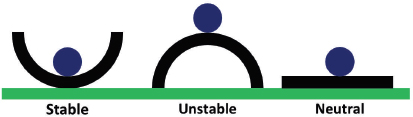
Our local economies also exist in a stable balance. If we look at our local restaurants, we see how the number and types of restaurants always self-correct to meet the needs of the community. If the wait for a table is too long at most restaurants, an investor will inevitably open a new restaurant to meet the needs of the community. Existing restaurants also routinely change the menu or décor, or sometimes completely reinvent themselves, to match changing tastes. There is no government agency or committee directing this change; this stable, self-correcting response occurs automatically through what Adam Smith called the Invisible Hand of a free market economy.
Stability is also prevalent throughout nature. For example, the population of deer in a forest exists in a stable balance. If the population becomes too large during the spring and summer, there will be a shortage of food in the colder months and more won't survive the winter (reducing the population). If their numbers are low, there will be plenty of food for more to survive and reproduce. Other mechanisms also act on this population; a large population of deer in a specific region will attract a large number of predators (and hunters). Or, when this population continues to grow, it can reach a point of “overcrowding” where a natural tendency toward sickness and disease will reduce the herd. And while all of these factors exist in a dynamic balance where there is always movement, there is constant pressure or a constant tendency toward the middle, toward maintaining the optimum population.
In evaluating our democracy and our economy, this book will look at these systems from the view of the type of balance that exists within each system. It will seek to determine whether the current system is stable, unstable, or neutral and will consider the benefits of shifting toward a different form of balance.
CHAPTER 4
E PLURIBUS UNUM, OUT OF MANY ONE
Democracy, our system of government where the people decide the direction of our nation, has been proven to be the most stable and effective form of governance. By giving democratic rights and power to all the people of our country, our nation’s founders cemented the rise and success of America. This demonstrates that the collective belief, the consensus, of an informed population is the best determinant of the optimum direction to advance our nation.
The core of democracy, the power of this form of government, exists in the power of each individual. It is our freedom to express our ideas (our freedom of speech and freedom of the press) and our right to join together and be represented as a group (our right to assemble). It is these rights to share our ideas, to assemble people with similar views, and to speak out in any way we choose that form the very core of this American Power. This right, this ability to influence and decide the direction of our nation, which is granted equally to all people, gives us a sense of ownership in the direction of our nation; this is our country.
What makes this system even more remarkable is that our democracy is effective even when the majority of voters is misinformed or unqualified to make the important decisions related to running a country. Through elections, voters routinely influence decisions regarding public health, war and defense, and economics even though very few have ever studied or even read a book about these important subjects. This system still works because, when the electorate is composed of a very large number of people, the decisions made by unqualified voters tend to cancel out as an equal number will vote for an issue as will vote against it, nullifying most of the effect. It is only because good ideas will have slightly better support that these are the ideas that are promoted.
The only requirement is that these voters be informed, that they have access to information about their government, their country, and their world. This is why our freedom of the press is such a crucial part of our society. Even speech that spreads misleading or incorrect information is still protected because, just like voters, incorrect information tends to be equal on both sides of an argument. Just as an equal number of uninformed voters will vote for an issue as will vote against it, an equal quantity of misinformation exists for and against most issues. It is truly remarkable that a system that follows the direction of a population with a large number of unqualified, misinformed voters has been so successful.
While our democracy benefits when voters take the time to learn about issues and make informed decisions, this is not required. In fact, it would be impossible for a single voter to be fully informed about all of the topics elected representatives influence. So, in many ways, the primary driver, the greatest determinant of the direction of our nation, is our intuition, our “gut feeling,” about the truth and our feeling of right and wrong. Our innate sense of fairness drives our nation. And because our nation is fair, because our opinions and feelings have value, because we are free to speak out, to assemble, and share our ideas to bring about change, we accept the decisions of our leaders. Even when we completely disagree with an elected official, we agree to abide by their decisions and only act through the democratic process to enact change.
CHAPTER 5
A SIMPLE, SELF-CORRECTING, DEMOCRATIC ECONOMY
We live in a simple, self-correcting, democracy, a country with a clear and simple system that gives all citizens influence over the nation’s direction. Every citizen is given the right to speak, the right to vote, and the right to act in any way to influence the direction of our nation. These elements build a perfect system, a framework of government that is fair and equitable. This same framework is present in almost every area of our lives with which we are satisfied, and it is almost always absent in the areas of dissatisfaction.
The national economy of the United States has become a source of great dissatisfaction. The reason for this is that it no longer resembles the principles of our nation; it has become a complex, unstable system that gives a select few undue power and influence (un-democratic). It is a complex and confusing entity that is not understood by most voters and companies. Our national economy has established a neutral balance; it requires constant input and action by politicians—to prevent catastrophic damage—caused by the input and actions of politicians. Our economic system has evolved into an endless cycle; it has become a system that requires constant regulation and legislation.
To understand how our political system failed in supporting the interests of our nation requires a look at the motivating factors in our political process and the dynamics of getting elected. Our politicians have never succeeded in limiting our rights to life, liberty, and the pursuit of happiness, and they have never succeeded in limiting our freedoms of speech, assembly, or religion, but they have somehow succeeded in manipulating and controlling our economy and using this influence to advance their political aspirations.
We have the power to demand a simple, self-correcting, democratic economic system—one that ensures the greatest productivity and prosperity for our nation. Our democracy responds with swift and certain judgment any time a politician makes an inappropriate statement; a racially motivated or sexually charged remark will usually end a politician’s career. If we responded with the same speed and certainty every time a financially irresponsible policy was advanced, we would not have the problems that exist today.
The primary reason we have been subject to increasingly destructive economic policy is that elections can no longer influence or promote positive economic decisions. Our elections have reached a point where we can only choose between two parties and both parties embrace flawed policy. When both parties promote the same flawed policy, elections no longer bring a positive result. To bring about positive change, voters must understand the forces that drive our political discussions and take new action to drive this change.
CHAPTER 6
THE POLITICAL SPECTRUM
As individuals, we all have a unique blend of beliefs built around our upbringing and life experiences. In politics, this scale of beliefs is “simplified” such that each individual is defined by a point on a political spectrum. In an election, politicians stake out a position on their side of this spectrum and campaign to attract the most voters to their collection of ideals. They lay claim to a specific set of beliefs and seek to attract voters to embrace their view.
This representation is a terrible over-simplification of the reality of our human experience; we are all far more diverse than can be defined by a point on a line. While politicians, and even entire political parties, define themselves based on a single point on this spectrum, most individuals have a broad range of ideals and beliefs that are far more complex. Most individuals have beliefs of varying intensity, range, and importance, usually spanning the political divide.
Even a two-dimensional chart of beliefs and intensities is still insufficient to describe our human experience. Our political positions can be further described by how they can be affected by current events or the opinions of others, how strongly they can be influenced by the prominence of an opposing opinion, or by the personal convictions that produce that belief. It is possible for two people to have identical political beliefs built on an entirely different set of personal convictions.
But even with all of our human complexity, if we bring together the different views and beliefs of all the people in our nation and plot them as a spectrum, we would see a balanced, normal distribution. This is the natural state of a society. Today, this distribution might be shifted and skewed through the perversion of political influence, but this is only because political parties, and not the people, define the political conversation; they define the divisive positions of their parties. If we look at the true nature, the collective beliefs of all individuals, we would see there are centrist, common beliefs and ideas that are shared by the majority; we would see how the more distant an idea is on the right or left, the more “extreme” the view, the less popular support that idea receives.
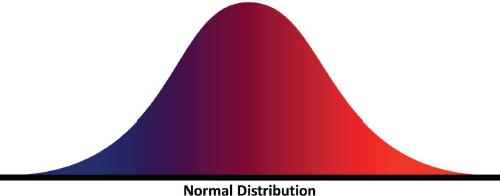
However, every election season, we are forced to choose a candidate who represents a very limited, fringe position on this political spectrum. In present-day politics, our options have been further limited as the views of candidates in the two major political parties are so well orchestrated that everyone in the party will almost act as one. These representatives show very little flexibility in their message, clinging to the party line on almost every issue and voting in unison to ensure party power.
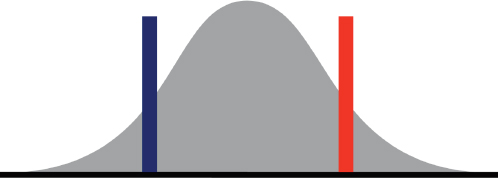
It is rare, almost unreasonably so, that an individual would match a politician’s limited view, that the individual could accept all the points of a political doctrine without some personal ambiguity or conflict. Therefore, our decision regarding for whom to vote often requires an evaluation of our own beliefs with respect to candidates when neither is a match. We try to determine which person represents us best or, more frequently, the person who misrepresents us least. This is why, in most elections, voters are generally dissatisfied with their choice of candidate. The narrow views that a politician takes cannot possibly reflect the broad range of beliefs that exist in our society.
CHAPTER 7
DISCONNECT BETWEEN VOTERS
AND POLITICIANS
Our country was founded on the principle of a republic, a representative democracy; if the distribution of beliefs among politicians does not match the distribution of beliefs of the voting public then we do not have a democracy. We have 536 elected “representatives” in Washington, but if they all choose to act the same way, to follow the same script, we do not have the representative government our founders intended.
The model that politicians have followed is that of a polar democracy. Similar to the north and south poles of the earth, polar political parties act as complete opposites of each other. Political parties have taken our founder’s vision of a representative democracy and turned it into a duocracy, a government run by two ideologies with little or no balance or middle ground.
This is not how it is supposed to be; the intent of our nation’s founders was to have a representative government, one that is as equally diverse as the people of our nation. They believed that by choosing candidates from the general population, through regularly scheduled elections, these representatives would act in a manner that most closely matched the community, that the actions of these representatives would be the same as if all Americans were directly involved in all political discussions.
But through the well-orchestrated actions of politicians and political parties, groups that have perfected their approach and strategy for elections, the system has evolved to give politicians the most power with which to serve their personal ambitions. They have perfected a strategy where every member of the party presents the same beliefs and message. By each presenting a unified message from the fringe of the political spectrum, politicians and political parties have the most control over, and receive the greatest benefit from, our political system.
The days of “Mr. Smith” going to Washington as a regular citizen to represent regular citizens are over. Politicians today are highly intelligent, highly knowledgeable, highly motivated individuals. To succeed, they must belong to or associate with one of the two entrenched political parties, both with the finances, logistics, and influence to maintain control over all future elections. Politicians act according to a carefully crafted script and follow a clearly defined plan. Lost are some of the idiosyncrasies and randomness that were intended when our democratic government was founded. Today, we have a methodical, efficient machine that ensures the greatest power and benefit for politicians and their political parties. They have turned our founders' model of a representative democracy into one which best serves the interests of politicians.


