

A Light in the Wilderness by James D. Snyder.
©2006 by James D. Snyder. All rights reserved.
Published by Pharos Books, 8794 S.E. Riverfront Terrace, Tequesta, FL 33469. Phone: 561-575-3350.
All rights reserved. No part of this publication may be reproduced, stored in a retrieval system, or transmitted in any form or by any means—except for brief quotations in printed reviews—without the prior permission of the publisher.
Cover by Ron Parvu.
Inside cover photo by Jim Johnston.
Design and production by Jim Johnston.
Library of Congress Control Number: 2006902971
Publisher’s Cataloging-in-Publication (Provided by Quality Books, Inc.)
Snyder, James D.
A light in the wilderness : The story of Jupiter Inlet Lighthouse and the Southeast Florida frontier / by James D. Snyder.
p. cm.
Includes bibliographical references and index.
LCCN 2006902971
Print ISBN 09675200-1-0
eBook ISBN 978-1-61850-024-3
1. Jupiter Inlet Light (Fla.)—History—19th century.
2. Lighthouses—Florida—History—19th century.
3. Atlantic Coast (Fla.)—History—19th century.
4. Florida—History—19th century. I. Title.
F317.P2S69 2006 975.9’3203
QBI06-600124
Preface
PART I: A LIGHT
Chapter 1. Nowhere
The lonely coastline in the mid-1800s. Old Fort Jupiter and the Seminoles. Digging at Jupiter Inlet. Congress authorizes a lighthouse.
Chapter 2. Reefs
Navigating the Florida coast. The rise of shipping. Key West and its wreckers. Courts and cargo auctions. America’s “richest” city.
Chapter 3. Lights!?
Early lighthouses and lightships. Low bids lead to shoddy workmanship, short towers and weak lights. Fresnel’s revolutionary lens. Congress creates a Lighthouse Board. South Florida targeted for construction projects, including one at Jupiter Inlet.
Chapter 4. Meade
A young aristocrat designs lighthouses in Florida. The army’s Topographical Engineers. George Meade’s early projects. Where to locate the Jupiter light? Why it was the most difficult to build. Establishing the “new” Fort Jupiter. The Seminoles revolt again. The attack at Cape Florida. Meade’s transfer and Raynolds’ arrival.
Chapter 5. Outpost
The Seminole threat halts lighthouse plans. Building a bridge at Fort Jupiter. Another whack at the sandbar across Jupiter Inlet. A soldier’s letters home. The Third Seminole War limps to an end.
Chapter 6. Progress?
“Stinging insects,” Yellow Fever and bureaucratic delays. Raynolds heads West and Hartman Bache takes over key lighthouse post. Civil War clouds loom. Jupiter project endangered. Bache finagles a reprieve.
Chapter 7. Yorke
The mystery man who built Jupiter Light. Escaping the ice and into the sea. A roller coaster ride down the coast. Arrival at “Jones Hill.” The tower rises. Preparing the lantern and calibrating the light signature. The search for a keeper. The crew departs and the light shines.
Timelines: 1716-1860
PART II. A WAR
Chapter 8. Separation
A beacon in the wilderness. Florida and the “Black Republican.” The state’s woeful wartime economy. The Union’s Anaconda Plan and the first blockade runners. Nassau becomes the Confederacy’s general store and playground.
Chapter 9. Vigilantes
The Blockading Squadron tightens the noose. Florida concedes its coastline. “Kidnapping” the light at Jupiter. The destruction of Cape Florida Lighthouse.
Chapter 10. Gunboats
The Union holds onto Key West. Destroying salt works. A young officer’s personal log. Gunboats take aim at Jupiter Inlet. The lighthouse as Rebel storehouse and lookout tower.
Chapter 11. Crane
The Sagamore gets “volunteers” to chase blockade runners upriver. Henry Crane and James Armour. The number of captures escalates. Towing “prizes” to Key West. Raiding on the river and the recovery of the Jupiter light apparatus. The Charm and its cotton cargo. The shelling of New Smyrna. Death on the Sagamore.
Chapter 12. Breakup
Success dissolves Crane and his volunteers. New Smyrna revisited. Adjudication trials in Key West. The Charm found guilty and its cargo auctioned off. Traffic into Nassau harbor dwindles. The war winds down in South Florida.
Confederate Ships Captured
A list of rebel blockade runners sunk or captured from Jupiter Inlet to Indian River Inlet.
Chapter 13. Escape
Confederate leaders John Taylor Wood and John Breckinridge make their way down the Indian River. Eluding the guard at Jupiter Inlet. Capturing a boat. Bargaining for provisions in a “pirates den.” Escaping to Cuba under a hail of bullets.
Timelines: 1861-1889
PART III: A SETTLEMENT
Chapter 14. Restoration
Re-lighting Jupiter. The first keepers. Lives of isolation. The light keeper’s routine. Supply problems.
Chapter 15. Armour
Bringing a woman’s touch. Wrecks on Jupiter’s reefs. Henry Titus’ complaint. Did James Armour plunder the Victor? The first settlers on Lake Worth. The lighthouse becomes a center of activity – and help. The keepers’ quarters improved and expanded. Photography comes to Jupiter.
Chapter 16. Settlers
Land of plenty – and of exploitation. Beginnings of mail and transport systems. Hauling crops up the Indian River. The railroad-steamboat connection. A trip down the river. A Fourth of July celebration in a young settlement called Jupiter.
Epilogue
A later look at the fates and fortunes of George Meade, Hartman Bache, Augustus Lang, Earl English, Walter Scofield, John Taylor Wood, James Armour and many others featured in this book. And this question: do spirits still visit the lighthouse?
Acknowledgments
Endnotes
Resources and References
Copyright Page
In 2003, when completing Five Thousand Years on the Loxahatchee, the history of Jupiter-Tequesta, Florida, I had an uneasy feeling that I’d shortchanged readers when it came to the construction and first years of Jupiter Inlet Lighthouse. Solid bedrock information was sorely lacking.
The early lighthouse data I used were mostly yellowed newspaper clippings. The problem with old press clips is that the first thing a reporter does upon getting a new assignment is go to the “morgue” (the file cabinet of old stories) and read what another reporter wrote on the same subject the last time around. This becomes the new starting point, and if it is full of inaccuracies, it gets handed down to another generation of readers – all of which is how we got ingrained with tales like George Washington chopping down the cherry tree and tossing a silver dollar across the Potomac.
The people of South Florida deserve to know a lot more than they do now. For one thing, Jupiter Lighthouse is southeast Florida’s oldest public building in continuous use and the light that drew the first settlers. When the wick was first lit in 1860, the lighthouse was applauded by ship owners and their insurance companies on three continents, deplored by the wreckers of Key West, and watched warily by southern leaders. Abraham Lincoln, excoriated as the “Black Republican” by the southern press, was gaining ground in the 1860 presidential campaign and the air was acrid with talk of secession. Officials in slave-owning Florida wondered whether this new light to promote commercial shipping and safety at sea would help or harm their own cause.
And in their new tower, a half-mile inside Jupiter Inlet, three keepers wondered whether they could survive in one of America’s most forlorn outposts when they would be supplied only two or three times a year by a passing Lighthouse Service tender – usually by leaving crates on the beach.
Little did they know that their beacon in the wilderness would soon become a lookout and storage depot for Confederate blockade runners headed to and from Nassau, or that the tower would also help patrolling Union gunboats track down and capture more than fifty rebel ships and several secret storage depots on land.
In a research effort that ranged from the National Archives in Washington to U.S. district court records in Key West, my biggest joy was in finding so many documents intact. Military personnel may grumble about bureaucratic paperwork, but it certainly did help reconstruct a wealth of background knowledge about when forts were manned, how lighthouses were built, and where ships were stationed.
My biggest disappointment was the fire of 1920. That’s the year in which a blaze swept through the Commerce Department in Washington, destroying many original records of the old Light House Board. Thus, for example, we have only a one-sentence scrap reporting that the gunboat Sagamore recovered the kidnapped lighthouse parts in 1863. Likewise, we have three complete letters accusing lighthouse keeper James Armour of major malfeasance, but only a one-sentence summary exonerating him. And we might have learned more about Edward Yorke, the mystery man who built Jupiter Light.
What we do have in the aggregate is a new perspective on the settlement of southeast Florida and how interdependent and interconnected the early pioneers were – from Titusville at the tip of the Indian River, to Cape Florida and the Miami River. The story of Jupiter Lighthouse is their story as well.
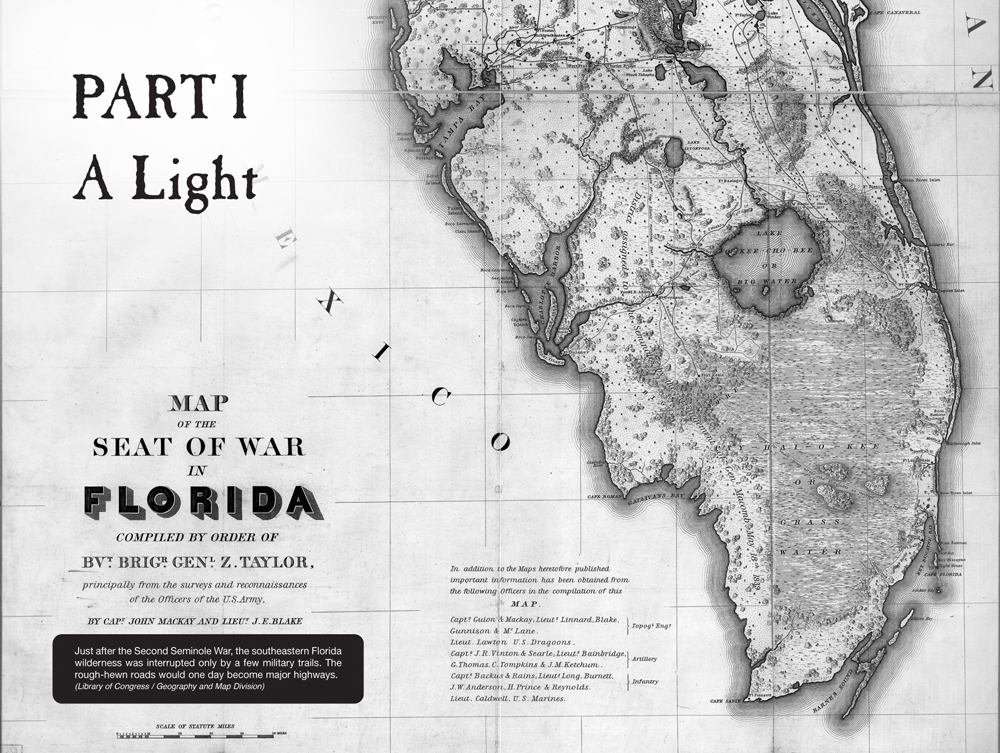
Just after the Second Seminole War, the southeastern Florida wilderness was interrupted only by a few military trails. The rough-hewn roads would one day become major highways. (Library of Congress / Geography and Map Division)
From Cape Canaveral to Key Biscayne, Florida’s sandy southeast coast stretches over 250 miles. It covers seven counties that together take up nearly 10,000 square miles – bigger than the state of Vermont.
Today that corridor contains nearly seven million residents and who knows how many tourists and vacation homeowners.
In 1845, when Florida became a state, scarcely anyone lived there at all. To be sure, the Ais, Jeaga and other offshoots of the powerful Calusa Indians had walked and canoed all over the place for some 5,000 years. But by the mid-eighteenth century, the Spaniards and English, with all their guns and poxes, had wiped out the last of the indigenous Indians. After fifty or so years, a few thousand Seminole Indians would filter in from southern tier states, but by 1845, they, too, were on the verge of extermination.
At the southern end of the coast, what is now Miami consisted of an abandoned U.S. Army outpost once called Fort Dallas. Five miles away on Key Biscayne stood the crumbling, charred husk of the Cape Florida Lighthouse, the only other man-made structure of any consequence in South Florida. It had been built and lit in 1825, but had provided only flickers of safety to passing ships. Soon after its construction, reports from mariners reached Washington City that the keeper preferred to live on the mainland, allowing the lighthouse to be run by slaves when he didn’t need them for other chores. In 1836 the lighthouse was torched by marauding Seminole Indians, and afterwards no one felt safe enough to venture out in that no man’s land to try rebuilding it.
At the northern end of the corridor, where the salty lagoon took on two channels as it swept by Merritt Island, the only inhabitants were a few hermits who lived in bug-infested shacks made of driftwood and roofed with palmetto leaves. In 1848 the federal government would build a 60-foot lighthouse on Cape Canaveral, but it was so short that mariners often ran aground on the shoals looking for it. After a while, no one gave it much thought.
At Jupiter Inlet, in the middle of the corridor, there was absolutely no one.
Unless you count ghosts. In January 1838 Major General Thomas S. Jesup and 1,600 soldiers tracked some 300 Indian warriors to an obscure riverfront about 9 miles west of Jupiter and finally wore them down in a battle that was supposed to end the Second Seminole Indian War. There, on the upper Loxahatchee River, they built a crude stockade of sorts so the troops could lick their wounds, bury their dead and await new provisions from army headquarters in Tampa.
Fort Jupiter also served as a corral in which to round up some 500 exhausted Seminole men, women and children so they could be herded off to newly-created reservations in Oklahoma.
Perhaps the first “tourist” to write about life in Jupiter was Jacob Rhett Motte, an army surgeon who had slogged through the swamps with Jesup’s foot soldiers as they nicked their limbs on the razor-like sawgrass and filled their boots with swamp muck in their dirty, dreary pursuit of the elusive Indian. Motte was a Harvard-educated blueblood from genteel Charleston society who rued the day his youthful imagination was dazzled by the glitter of an officer’s sword. As he recalled, after spending $300 for his own uniforms and medical instruments, “I had to find lodging, board, clothing and washing on a monthly paycheck of $54.”
Motte most lamented the separation from his books, longing for “even the sight of an old almanac to refresh my eyes with something in print.” His only solace, only contact with anything literary was in keeping his own journal. Here is what he wrote about Jupiter and South Florida:
It is in fact a most hideous region to live in; a perfect paradise for Indians, alligators, serpents, frogs and every other kind of loathsome reptile. The whole peninsula is alluvial, having been formed by successive encroachments on the Atlantic; and offers but feeble allurements to an agricultural population, the only land fit for cultivation being on the margin of the rivers, and inconsiderable as to extent, and barely sufficient to raise the ordinary subsistence for small families.
The only resources are ranges for cattle, wrecking and the fisheries. The sea beach is constantly enriched by the misfortunes of the enterprising, which I believe [accounts for] the strong attraction of the Indians to the country. Such can be the only allurements to emigrant adventurers. Then why not in the name of common sense let the Indians keep it?1
Indeed, the weary, wretched, nearly starved Seminoles had clustered around Fort Jupiter, beseeching General Jesup to plead with the Great Father in Washington (the role being played at the time by Martin Van Buren) to let them stay in this unhealthy swamp rather than leave the spirits of their forefathers and perhaps die on the trek to alien Oklahoma. Jesup, who would have agreed with his surgeon’s journal entries, finally decided to send a young lieutenant to Washington for a decision by President Van Buren and/or his secretary of war, Joel Roberts Poinsett.
While the Indians waited, busying themselves playing ball games and mooching whiskey, Motte was stricken with a crushing headache that forced him into a crumpled heap in his soppy, bug-infested tent for two weeks. “My sickness produced at the time the feelings of perfect disgust for Florida and the life we led there,” he would write later. “Oh that I could only have escaped this detested soil, thought I. That I might once more live as a human being.”2
After he recovered, Motte’s only pleasure would be an occasional two-and-a-half mile row down to Jupiter Inlet, where he and fellow officers would walk the beach and “gather the beautiful shells and other marine substances thrown up by the sea.”
On his last visit to the inlet, Motte was amazed to find it “completely closed up, a dry sand bar across its mouth in one night.” The previous day, he wrote, “we had left it a broad, deep channel, capable of admitting the smaller vessels that sail the ocean.”
That was in February 1838. On March 20 the army messenger returned to Fort Jupiter with a response from Secretary Poinsett. After spending $8 million to hound what began as 3,500 Seminoles to the ends of Florida, (or $3 million more than the government had spent to buy the state from Spain), Poinsett was damned if he was going to allow the last ragged, wretched survivors even an alligator-infested swamp that no white man wanted. He sympathized with Jesup’s logic, but he stated that any leniency would contradict the recently-enacted Indian Removal Act. Poinsett also ruminated that observers abroad might conclude that the up-and-coming United States capitulated to a ragged band of savages.
Well before the presidential proclamation arrived, some 200 Seminoles had melted away after deciding not to bet their lives on the Great Father’s leniency. As soon as the messenger arrived from Washington, the 300 remaining Seminoles were invited to a sort of hootenanny, with promises of whiskey to enliven the dancing. In the early morning hours, their libations having produced what Motte called “profound sleep,” the snoring Indians were aroused by the poking of gun butts to find themselves surrounded by soldiers. Only then were they told that the Great Father had insisted on unconditional surrender.
By May 1838 the last of the Indian captives had been shipped west. Motte had gone off with the rest of his comrades toward Fort Lauderdale in pursuit of the 200 phantoms who now dwelled in the swamps and hammocks to the south.
In 1844 a federal land surveyor passed by the abandoned Fort Jupiter and reported it a “burned out carcass.”
That same year, William Davis decided that it just didn’t seem right that the Loxahatchee River would flow eastward for 14 miles, only to have its rendezvous with the sea blocked by a slender sandbar. At the time, Davis, who would one day be the keeper who re-lit the Jupiter Lighthouse after the Civil War, was a soldier at Fort Capron (just west of the Fort Pierce Inlet) who delivered the mail to Cape Florida. According to a young officer who heard about the sand bar when visiting Fort Capron, Davis persuaded five other men to pack tents and shovels and accompany him as far south as Jupiter Inlet on one of his mail runs. Wrote Lieutenant Andrew A. Humphries:
After digging for several hours, they succeeded by nightfall in starting outward a stream of water four inches in depth. Upon this they desisted from labor and went to their camp, which was some fifty feet from the ditch.
The river inside was unusually high from a freshet [overflowing of water] in the Everglades, and a strong north wind was blowing. At night, the sleeping party were awakened by a flood of water and had to abandon their camp equipage and run for their lives, barely escaping being carried out to sea. The next day there was a channel nearly a quarter of a mile wide, and the rush of water could be traced far out into the ocean.3
The inlet had remained open when Lieutenant Humphries himself visited it a few years later, prompting him to report back to Washington that the inlet entrance, “protected from the north wind by a ledge of rocks” and having “admitted vessels drawing eight feet,” might just “render the harbor one of the best upon the eastern coast.”
The inlet was still open in 1852 when lighthouse planners in Washington decided that Jupiter Inlet needed a beacon.
The bureaucrats had no idea what they were getting into.
So……why build a lighthouse where nobody lived?
There was no one, but there was every reason to do so. A lighthouse was wanted by everyone from the navy, which had to provide safe supply to its vital Key West base, to sea captains, insurance companies and the merchants of young, trade-starved Florida. And in the minds of visionaries, the lighthouse one day would be part of a coastal chain ensuring that no sea captain would ever be out of sight of a beacon.
Besides, the whole Florida coastline had always been a navigational nightmare. A captain heading south would sail inside the Gulf Stream, which flowed northward from two to ten miles offshore. The Stream began to get its power when the sea waters were squeezed into an eighty-mile channel between Cuba and the Florida Keys. But when it rounded Cape Florida, its speed increased to 5 or so knots an hour as the water was compressed into a 45-mile-wide stretch between Grand Bahama and the Florida Coast. In midstream off Jupiter, for example, the Gulf Stream, driven by a steady southeast wind, could push a southbound sailing ship all the way back to the islands of Georgia.
On a clear day the ship’s navigator could easily discern the cobalt blue of the Gulf Stream to his port. To his starboard he could make out the light green waters around reefs and the mottled brown and pale orange of coral heads below. But by night these color coordinates were turned off. Unlike a shoreline with mountains or a populated place with lights twinkling in buildings, the Florida coast was a flat gray enigma that dissolved into the horizon.
One thing more: Florida had fickle winds that could bedevil a sailing vessel. When winds were becalmed, sailors whittled while they waited helplessly for the return of their only source of power. But too often the winds raged, battering the beams of ships towards reefs and sandbars. And if a captain tried to escape into an inlet for shelter, he was rolling the dice that he could dodge reefs to get inside and avoid sandy shoals once he did.
Ever since the Spanish settled South America, ships have sailed through the Cuba-Key West gap, around Cape Florida and into the Gulf Stream, which would propel them towards ports in Europe. As the number of galleons laden with copper, silver, gold, tobacco and indigo increased, so did the number of pirates chasing them. But the reefs claimed even more ships than pirates. No wonder that the Florida Keys were known in the 16th century as Las Islas de los Martires, or Martyr Islands.
But now, in the 19th century, shipping through the Florida Straits was increasing exponentially. After the United States acquired the Louisiana Territory in 1803, Gulf ports began to flourish. Cotton, lumber and farm produce were carried down the Mississippi River in flatboats, loaded onto ocean-going ships in New Orleans and sent around Cape Florida on their way to Europe, Canada and eastern U.S. ports. They joined other ships carrying logwood and cochineal from Campeche, coffee and rum from Jamaica and sugar from Cardenas and Matanzas. And headed back the other way was a steady stream of provisions and luxury goods for the planters of the Caribbean and Gulf of Mexico.
In 1819, when Spain ceded Florida to the U.S., many a Spaniard unloaded property to bargain-hunting Americans before sailing off to Cuba. In 1821 one of them sold an island just 90 miles north of Cuba to John Simonton, a well-connected New Jersey businessman, for $2,000. By then its Spanish name had become Cayo Hueso (“Bone” Key), but Americans were already calling it Key West. It was only a sun-bleached, two-by-four-mile outcrop of dead coral, but Simonton had himself a bargain. He had bought himself the only deep water harbor in the United States from there to Charleston.
One end of the island was already home to a couple hundred squatters who fished and sponged and recognized no landowner, or no government, for that matter. Simonton seemed scarcely to notice them as he sliced his new land into four large plots and sold off three to some equally successful entrepreneurs from New England.
But all this was secondary to his main purpose. Simonton envisioned the island as an ideal wrecking center. At the time, almost all the salvaging of stricken ships off southern Florida was done by crews from Nassau who brought their largesse to friendly English courts that would grant them 50 to 75 percent of a ship or cargo’s value at auction. At the same time, Simonton, who had business contacts from New Orleans to New York, began lobbying the Monroe administration to take advantage of his deep harbor and establish America’s southernmost navy base.
In 1822 Navy Secretary Smith Thompson persuaded President James Monroe to back the idea. “We are, at this time, dependent on the wreckers of New Providence for the protection of our property in case of shipwreck,” Thompson wrote. Moreover, “it is intended to make [Key West] a depot for provisions and supplies for the expedition against the pirates [as] lately authorized by Congress.”1
A home for wreckers, but not pirates? There was indeed a difference, although definitions varied from man to man.

Wreckers. Even the rescuers called themselves by that name, but at a time when there was no Coast Guard and absolutely no one living along the Florida coast, grounding a ship could be tantamount to death. It wasn’t until the 1870s that the federal government began building a series of life saving stations every fifty or so miles. Before that, the shipwrecked were dependent on the good graces of small-rigged boats that were outfitted primarily for fishing, sponging and turtling. But when the “Wreck Ashore!” call spread through the crew’s quarters – invariably at a time of gale winds and high seas – they often put their own lives in peril even to approach a ship twisting violently in the clutches of a reef. In 1842 even the shipper-friendly Hunt’s Merchants’ Magazine editorialized that “wreckers,” for all the negative connotations of the name, “have never refused to listen to the calls of humanity, even when doing so has been to their loss.”2
But ah, once the passengers and baggage had been safely accounted for, the sport could begin! Author Vincent Gilpin captured the scene surrounding a reefed ship bound for Havana with a “huge general emporium” containing everything from lace and silk to liquor and fine furniture:
On deck two crews of fifty each manned great tackles, their faces alight with joy, their mellow voices ringing out, adrip with glory, as the grand old chanties rolled across the waves, timing their pull on the cargo nets. How their eyes gleamed as each load swung out on deck, and followed every item on its way to the schooners alongside! How they laughed and joked in the intervals! How the joy of life fairly lit up the scene! It was the fun of wrecking at its best.3
Although some Key West lore – such as the tales of putting lanterns on cows and moving them around to confuse navigators – is probably a hangover from 18th century pirate days, some early wreckers “sailed pretty close to the wind,” as one of them recalled.
Bradish W. “Hog” Johnson, for example, specialized in probing abandoned hulls. Some weeks after a stricken ship’s cargo had been collected and auctioned off, Johnson’s schooner would loom over the sunken vessel with a team of Bahamian divers who could last two minutes underwater purely on lung power. Diving naked, they would glide through the ghost ship, removing expensive fixtures and prying into lockers for valuables hastily left behind.
In one instance, Johnson was paid to tow a damaged cargo ship onto a shoal and pump her out so as to gauge her chances of repair. But try as he might, Johnson’s powerful wrecking pumps couldn’t displace the water in the hull. “Worms must have ruined her bottom,” he sadly informed the owner. When another man came along and offered $200 for the hulk, the distressed owner accepted it and caught the next north-bound schooner for home.
But saints be praised! No sooner had the owner departed when it was discovered that the pumping problem had been caused by a missing plank in the hull. As luck would have it, Johnson had one exactly the same size in his ramshackle warehouse! Once the plank was hammered into the hull, the boat was raised, refitted and sold to another shipper for $5,000.
It seems that the $200 “buyer” had used Johnson’s money and gotten a $50 “consulting fee” for his trouble.4
When the U.S. acquired Florida from Spain in 1821, it was a signal to grab the wrecking business from the English in Nassau. The Legislative Council of the Territory of Florida was so inclined, but powerless to do what was clearly the prerogative of Congress. So wreckers in Key West soon took matters in their own hands, refusing en masse to furnish fresh water and other provisions to Bahamian salvors.
In 1825 Congress did act, ruling that no vessel salvaged within the jurisdiction of the U.S. could be taken to a foreign port. It meant that all wreckers had to take salvaged property to Key West or make the arduous trip to St. Augustine. Soon, writes Dorothy Dodd in her enviable treatise on wrecking, “Every person in Key West, excepting possibly those in the navy, was interested in the business, and the territorial law placed the adjudication of salvage entirely in local hands. Sometimes,” she adds, “the presiding magistrate was the judge who condemned, the auctioneer who sold, and the purchaser of the same property.” With salvage awards running from 75 to 93 percent (Key Westers seemed to be out-grabbing their rivals in Nassau) no wonder that the New York Mercantile Advertiser would lament that “special little is therefore left for the underwriters.”5
In 1828 Congress established a federal court at Key West covering everything south of a line extending from Indian River west to Charlotte Harbor. Its sole judge was also given special powers to license wreckers and disqualify any found to be in collusion with the master of a wrecked vessel. From that time until 1863 the court was headed by two men – James Webb, and his successor William Marvin – who between them created the case law that evolved wrecking into a well-regulated business. It all revolved around the court’s power to revoke licenses. The causes, as Judge Marvin put it, could include “embezzlement of wrecked goods; voluntarily running a vessel aground under the pretense of piloting her; colluding with the master of a vessel wrecked or in distress; or corrupting him by an unlawful present or promise.”6
The court recognized the intense competition that ruled the reefs by allowing that wreckers should be admitted to attend a stricken ship in the order in which they arrived. The first boarder was required to hand the captain a copy of his wrecking license. The latter had the right to refuse all help or to employ any other vessel he chose. But with both the seas and his passengers probably heaving as the ship wobbled atop a reef, the odds were that the captain would welcome the first to arrive. If so, the boarding captain would become the “wreck master.” He could exclude other salvors as long as he had the resources to save the property. However, the typical wrecker – a fisher or sponger just hours before – probably couldn’t handle a large cargo ship without help.
Under the court’s guiding hand, the number of licensed vessels grew from 20 in 1835 to 57 in 1858. Most vessels, owned by New England whalers and commercial buccaneers, were fast-sailing, clean-rigged sloops and schooners, ranging from ten to a hundred tons, with an average value of about $2,500. Against that investment, the average annual salvage for all vessels during 1844-59 was $114,378. But there were also indirect profits. Because wreckers also owned wharves and warehouses, they quickly created what would today be called an “aftermarket” of commissions and fees from handling the ships and goods brought into Key West by their crews.
Under the system that evolved, half the total salvage allotted to a vessel by the court went to the wrecker-owner(s). The other half was divided among the crew. If the wrecker vessel were over 30 tons, the master received 3 shares, the mate 2, the cook 1.25 and ordinary seamen 1 each. Boys under 18 got half shares.
And so, in a typical case, the James was beached between Cape Florida and Jupiter in 1836 with a cargo of cotton. Captain John H. Geiger of the schooner Hester Ann learned about it in Key West and soon formed a consortium with the masters of the Caroline, Amelia and Splendid. When the four schooners arrived at the wreck scene, their crews became one team as they began to unload the James. After 16 hours, the 38 crewmen from the 4 wreckers, aided by 8 men from the stricken James, had off-loaded 519 bales of cotton, which, at 180 pounds each, would require a good dram of rum to relieve an aching back. For its services the court awarded the wrecking consortium $12,313.55, based on 40 percent of the cargo rescued. The crewmen got their shares in the form of cotton, which pitted them against each other in selling at auction.
When wrecked property was taken to Key West, storing and selling it meant employing another group of islanders. The captain of the wrecked vessel was required to consign the cargo to a local resident, who became its business agent. Usually that person was a merchant who also owned wharves and warehouses. The agent was entitled to five percent of all sums he spent for unloading and storage. Both salvors and ship owners had to be represented in court by lawyers, called proctors, at a standard fee of $20 plus 3 percent of the salvage value.
If salvage were awarded in kind (such as bales of cotton), the goods had to be properly valued, meaning a $10-per-day fee for the appraiser. If salvage were paid in money, the goods were sold by a U.S. marshal, who got two percent for “costs.”
With a legal system now entrenched for licensing wreckers and setting salvage values, Key West attracted both capital and captains from the northeast’s most established fishing fleets. By the 1850s the island city was flourishing with more than 50 wreckers, who could count on 2 or 3 ships per month hitting reefs as if on some sort of pre-ordained schedule. In the 16 years ending in 1859, the court awarded them about $1.8 million as their share of salvage value and another $1.4 million in reimbursed expenses. The $3.2 million total was based on the salvaged vessels’ combined cargo value of $25.4 million. Thus, the wreckers got a combined 12.5 percent for their efforts.
The community sharing in that largesse had around 500 residents in 1838 and 2,241 by 1860. No one argued when Key West was described as America’s wealthiest town on a per-capita basis. No wonder that the large Victorian homes of wreckers were known for sporting the most cosmopolitan collection of fine furniture, linens and china in the hemisphere.
Everyone was happy but insurance companies. Stunned by loss after loss, marine underwriters initially pointed to Key West’s monopoly on wrecking as the chief cause. Lamented Hunt’s Merchant Magazine in 1842:
The marshal advertises the goods…the auction sale comes on, and thirty to forty thousand dollars worth of goods are sold on an island containing five to six merchants, nearly a hundred miles from any inhabited land. The day of sale arrives. Who are the bidders? The aforesaid five merchants! How easily might these merchants agree not to [compete with] each other on their bids. And thus a whole cargo, worth thirty thousand dollars, might be divided among them at a cost of two thousand dollars each or less.7
For underwriters, it always seemed a case of their agent learning about a wreck too late and arriving on the scene after all the goods had vanished. In 1838, for example, insurers didn’t know that the ship Bombay had run up on a reef near the Tortugas until twenty days later. When their agent finally reached Key West, he found that the captain of the Bombay had sold her hull for $1,400 to wreckers, who bought her salvaged rigging in Key West for $3,000. They had already refitted the freed ship and sold it to a New Orleans company for $12,000.
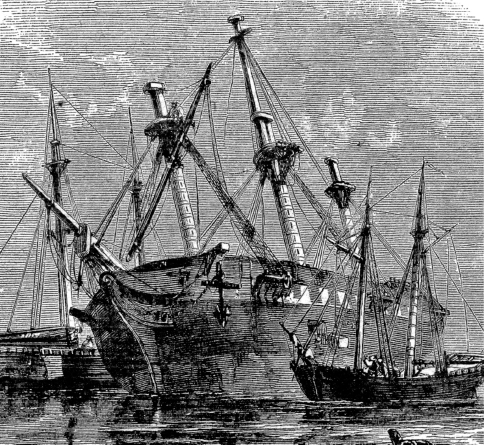
Fishing boats from Key West converted instantly to wreckers when a passing ship piled up on the many surrounding reefs. And ships did so with amazing regularity. (Illustration from Harpers New Monthly Magazine)
By the late 1840s underwriters had learned their lesson and many had stationed resident agents in Key West, as had several European nations. But they still hadn’t made a dent in insurance rates. In 1849 the prevailing rate on merchantmen bound for the Florida Straits was 1.5% of the combined ship and cargo value – the same as for vessels sailing around the more treacherous, tumultuous Straits of Magellan for the hemisphere’s western coast.
Before long, complaints began to center on aids to navigation – or the lack thereof. Until the middle of the nineteenth century, no complete survey had been made of the Florida reef. Nautical charts were based on Spanish works, which were often copies of slapdash efforts made by the British during their brief reign between 1763 and 1783. In 1849, after the collector of customs in Key West pointed out that three-fourths of all the vessels bound for the Florida Strait were owned by northern firms, Congress finally authorized a major effort to chart Florida’s coast and reefs.
Lighthouses were in equally shabby shape. Congress had acted in 1824, but the first results were dismaying. Plans were laid for lights at Cape Florida, Key West, Sand Key, Carysfort Reef and the Dry Tortugas and all were expected to be completed by the end of the following year. However, the contractor, who sailed from Boston in August 1824, was reported lost at sea along with all his materials. The lighthouses, when eventually built, were all about 65 feet high and instantly ridiculed by captains that they weren’t tall enough to be seen until one was almost on the reefs they were supposed to guard.
The only architectural exception was a lightship that was to be stationed outside the dangerous Carysfort Reef (off Key Largo). Not long after being tethered to its mooring, the lightship broke away, wandered into the Gulf Stream, got stuck on Key Biscayne and was hauled off by wreckers. Once reclaimed and repositioned, Carysfort Lightship fell into disrepute amidst charges that captains of leaky old tubs often arranged for the keeper to dim his light so they could run into the reefs and claim full insurance value.
When the Colonies became a nation in 1789 the government inherited a jumble of navigational aids. Lights and towers came in a mishmash of sizes, financed by private pocketbooks, lotteries and general taxes. The only constant factor was that the actual beams were fixed (steady) white lights that left skippers wondering where they were on black stormy nights.
On August 7, 1789, in just the ninth bill passed by the first Congress, the federal government took responsibility for all navigational aids, to be financed from the general treasury. Alexander Hamilton, the first treasury secretary, personally supervised the lights. Archives show that presidents such as Washington, Adams and Jefferson all involved themselves in selecting lighthouse construction sites and appointing keepers.
In 1820, with the number of lighthouses now up to 55, the Treasury Department assigned their supervision to the commissioner of revenue. Why? Because a collector of customs was often stationed by a lighthouse or at the harbor from which revenue cutters would sail out to meet and board an arriving ship. The inbound vessel would be denied entry unless its cargo was first inventoried and the proper import duties paid. One good result was that the cutters – seven at the turn of the nineteenth century – were outfitted with extra stores and given an extra mission. Instead of remaining snuggly at wharf side until ships hove outside the harbor, revenue cutters now spent whole winters patrolling the seas for troubled ships in need of help.
Beginning in 1820, the fate of lighthouses would be linked with that of one man for 32 years. In that year their jurisdiction was assigned – still within the Treasury Department – to one Stephen Pleasanton, who held the title of Fifth Auditor.
Pleasanton, with his craggy features and studious frown, could have served as Charles Dickens’ inspiration for Ebenezer Scrooge. And Scrooge would have approved of the labels people applied to him: “zealous,” “hard-working,” and a “conscientious guardian of the public dollar.”
Despite his mundane sounding title, Stephen Pleasanton was one of nine principal fiscal guardians for the U.S. government, and his platoon of clerks oversaw spending for a cluster of agencies such as the State Department, Patent Office and Census Bureau.
The Pleasanton era arrived just as the young government was making a major effort to bring its system of navigational aids in line with its role as an emerging sea power. By 1832 the Fifth Auditor was overseeing 256 lighthouses, 30 lightships and nearly 1,000 buoys. In the mind of the maritime world, this office-bound accountant was the de facto czar of lighthouses and the era was as much associated with his name as was the F.B.I. under J. Edgar Hoover a century later.
Pleasanton’s powers were delegated broadly. Except for the appointment of keepers, made by the Treasury Secretary, the Fifth Auditor deputized the various collectors of customs to construct and maintain all navigational aids in their districts. They handled personnel matters, conducted annual inspections, and for their troubles received a 2.5 percent commission on all lighthouse disbursements. The collectors, in turn, relied heavily on private contractors for everything from building lighthouses to keeping them provisioned.
Pleasanton rode herd on this network of supervisors by mandating his personal approval of all outlays over $100. All contracts were rigidly reviewed to be sure they had gone to the lowest bidder. The Fifth Auditor’s greatest achievement, in his own eyes, was his efficiency and economy, often claiming that he had returned more money to the general treasury each year than any other auditor. Indeed, in 1842 he testified proudly at a congressional hearing that he operated American lighthouses at half the cost of his English counterpart.1
But there was another side to the coin, of course. Each revenue collector who supervised lighthouse keepers in his district was himself a political appointee, and lighthouses soon became pawns on the chessboard of politics. Keepers came to expect that when a new political party assumed power, a replacement would show up with an “Extinguished Service Check” – a printed form about the size of a bank check. It bore the signature of the local collector of revenue and stated coldly:
“You are suspended as keeper of ______________ light
station on (date)_________by__________________, the
bearer of this notice.”
The bearer had a snug patronage job for the duration, but it also meant that most keepers were keener on attending meetings of their local political clubs than attending to the grinding routine of a lighthouse.
Even so, the system’s greater shortcoming was in the design and construction of lighthouses themselves. It began with the aforementioned lack of height brought on by parsimonious construction policies.
Except for the light at Key Biscayne, in 1825, the government took no action to build lighthouses on the east coast of Florida until ten years later. What happened then typified a maritime malaise on a national scale. The next light, at Mosquito Inlet (today’s Ponce Inlet) never functioned. The keeper was still awaiting his first shipment of oil when a storm sent seawater rushing over the base, sucking out the sand and collapsing the tower. Rebuilding, slowed by Indian hostilities, would wait until 1886.
When the 65-foot Cape Canaveral tower went up, engineers had recommended the strongest light available, but the one that arrived was so ineffectual that many ships ran up on the surrounding shoals looking for it.
Continuing problems with the somewhat older lights in the Florida Keys illustrated the downside of hiring contractors. In 1837 a team sent to examine the effects of the Indian attack on the Cape Florida light at Key Biscayne found that whereas the specifications had called for solid brick walls five feet thick, they were “hollow from the base upwards,” meaning that “one-half of the bricks and materials required to erect a solid wall were saved to the benefit of the contractor.”2
The inspection team also learned that the contractor’s bricks originally came from demolished buildings in northern cities. The mélange assembled by masons at Cape Florida – varying greatly by strength and age – had been bought by the contractor at a yard in Boston that sold used bricks cheaply for use as ballast in ship bottoms. And yet on December 17, 1825, the district customs collector had sent the Treasury Department a letter certifying that “the lighthouse and dwelling-house on Cape Florida are finished in a workmanlike manner, agreeably to the within-written contract.”3
Stephen Pleasanton’s most dubious legacy was in the outmoded, ghostly lights that flickered in the precarious towers. Lighthouse historian F. Ross Holland Jr. wrote that “one wonders how many ships that wrecked during Pleasanton’s 32-year administration would have been saved had more effective lights been available.”4
Actually, there was a better light and Stephen Pleasanton was aware of it even in his landlocked office in the Treasury building. By then almost everyone in the maritime world had heard of the Frenchman Fresnel and his marvelous lens.
Augustin-Jean Fresnel was born in 1788. His father was an architect who managed major building projects for nobles in the courts of Louis XV and XVI. Besides being an ardent royalist, both father and mother were Catholics and Jansenists – followers of Cornelius Otto Jansen, who taught that God predestined everyone to eternal damnation except for a select hardworking, virtuous few.
When the republican revolution erupted in Paris with all its tumult, Fresnel whisked his family away to the quiet Norman village of Mathieu, where Augustin-Jean was raised. Frail and quiet from his earliest years, Fresnel could barely pass his reading lessons, yet showed a remarkable talent for science and math. Because of his delicate health, he couldn’t qualify as an officer in Napoleon’s army, the goal of most promising lads. Instead he became a civil engineer, to be employed in building roads and bridges.
Fresnel hated road-building. But worse than that, “I hate to lead men,” the introverted young man would write. Every spare moment he had was spent in solitary research on scientific inquiries.
One of his interests was light and how it travels. At the time, the conventional view of light had been formulated by Isaac Newton 150 years before, namely that beams were really swarms of “corpuscles” moving through “ether.” Newton theorized that each light corpuscle had a different mass that varied according to its color. When Newton’s corpuscles exhibited themselves as rays of light, they were either refracted or reflected depending on their mass and color.
The lenses used in lighthouses at the time were catoptric – usually a “bull’s-eye” that drew light to a central target area. However, it also dissipated a beam’s power by allowing some of the light to escape from the top and bottom of the lens.
Later came the dioptric lens, which bent light and directed it to the desired point.
What Fresnel did in between his reluctant road building projects was to combine the two former systems into a single lens called catadioptric. As explained by maritime historian Dennis L. Noble, “the lens contained a central reflecting bull’s-eye surrounded by a series of concentric prismatic rings and refracting prisms. In very brief terms, light is directed by prismatic rings to the central bull’s-eye where it emerges as a single concentrated shaft of light traveling in one direction.”5
Or, as Hans Christian Adamson explains in his Keepers of the Lights, “The effect is similar to the flow of water through a well-nozzled hose. The bull’s-eye is the hose. The refracting prisms and glass rings that bend and direct the beams corresponds to the nozzle that directs a solid column in only one direction – outward.”6
Perhaps the best thing that happened to Fresnel as a research scientist was the return of Napoleon from Elba in 1815 and another (albeit short-lived) military dictatorship. Known as a staunch royalist, Fresnel was forced from his engineering position, but suddenly found himself with time to focus on his light experiments. Although his health was failing, he seemed driven on by an even greater sense of urgency. “All the compliments I have ever received never gave me so much pleasure as the discovery of a theoretic truth or the confirmation of a calculation by experiment,” he once said.7
In 1821, still only 33, Fresnel was named temporary secretary to the Commission for Lighthouses. Soon his lenses were installed in the most important lighthouses on the French coast. But in 1827, on Bastille Day, Fresnel’s frail health failed him.
Fortunately, his technology was adopted by at least four major optical manufacturers, all clustered around Paris. Together they would go on to produce hundreds of lens systems in six orders ranked according to size and brightness. For example, the sixth order lens, which was earmarked for use on piers or breakwaters, weighed 220 pounds and its lamp was calculated to burn 3.15 ounces of rapeseed or colza oil per hour. At the top of the hierarchy, the first order lens, designed for major seacoast lighthouses, weighed 12,800 pounds and its lamp consumed 26 ounces of oil per hour. In terms of relative brightness, the first order outshone the sixth order by a factor of eighteen.