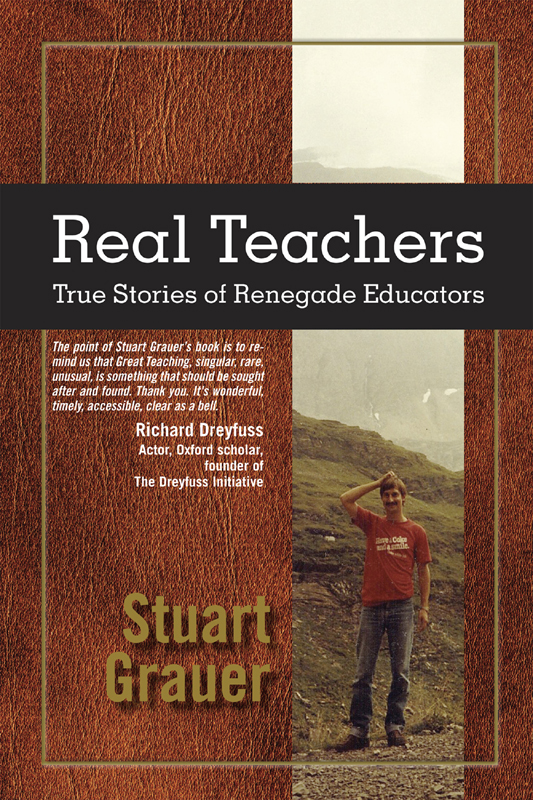
“The point of Stuart Grauer’s book is to remind us that Great Teaching, singular, rare, unusual, is something that should be sought after and found. Thank you. It’s wonderful, timely, accessible, clear as a bell.”
—Richard Dreyfuss
Actor, Oxford scholar, founder of The Dreyfuss Initiative
“Stuart Grauer brings joy, courage, and imagination to the dialogue on education. His stories add inspiration to our sense of possibility.”
—Vicki Abeles
Director/Producer, nationwide film Race to Nowhere
“A book of wonderful news—a breath of fresh air for classroom teachers and educators. This book evokes the heart of teaching in a clear, compelling, and soulful way. It will help teachers to reinvent the system, find their passion, and stay in the teaching profession.”
—Paula A. Cordeiro
Dean, School of Leadership and Education Sciences
University of San Diego
“For the real teacher, the growth is in the plant, not the gardener. In his wise, lyrical, and liberating book, Stuart Grauer shares the harvest of his lifetime in education that truly matters.”
—Richard Lederer
Host/originator of NPR’s A Way with Words
Author of A Tribute to Teachers
“Stuart Grauer is a rebel and education is his cause. His beautiful book is both revolutionary and revelatory. Real Teachers is a joy-filled adventure that will inspire you to action.”
—Jeff Salz
Corporate Anthropologist, Adventurer,
Author of The Way of Adventure
“Just what the doctor ordered: a book reminding us what is possible in schooling, and how much it depends on freeing teachers to think big. It’s a book full of wonderful tales from the field.”
—Deborah Meier
MacArthur Fellowship Recipient, New York University Senior Scholar,
Author, School Founder, Founder of the “Small Schools Movement”

Copyright © 2013 by Stuart Grauer
All rights reserved. Published in the United States of America. No part of this book may be reproduced or transmitted in any form or by any means, graphic, electronic, or mechanical, including photocopying, recording, taping or by any information storage or retrieval system, without the permission in writing from the publisher.
Real Teachers™ is a trademark of Stuart Grauer
This edition published by SelectBooks, Inc.
For information address SelectBooks, Inc., New York, New York.
First Edition
ISBN 978-1-59079-954-3
Cataloging-in-Publication Data
Grauer, Stuart.
Real teachers : true stories of renegade educators / Stuart Grauer.
p. cm.
Includes bibliographical references.
Summary: “Head of private secondary school in Southern California explores the meaning of an authentic education. In his stories of discoveries about teaching, he hopes to inspire students and teachers to transcend the common belief that efficient delivery of a standardized core curriculum is the essential value of educators--and to expect much more from themselves and their schools”--Provided by publisher.
ISBN 978-1-59079-954-3 (pbk. book : alk. paper)
1. Teachers--Conduct of life. 2. Teaching--Anecdotes. I. Title.
LB1775.G675 2013
371.1--dc23
2012032852
Preface
Introduction
1. Real Teachers, Oil on Canvas
2. Digging a Hole
3. Leaving the John Muir Trail
4. Hostile Indians Attack Schoolhouse
5. The Seventh Generation
6. Chief Tayuk, Guy the Bear Hunter, and Me
7. The Awakeners
8. Men in Decline
9. Single-Handing It in an Age of Fear
10. Who Gets Grandpa’s Tools
Appendix: Key Issues for Educators, by Chapter
Notes
Bibliography and References
Acknowledgments
About the Author
Security is mostly a superstition. It does not exist in nature,
nor do the children of men as a whole experience it. Avoidance of
danger is no safer in the long run than outright exposure.
Life is either a daring adventure, or nothing.
—Helen Keller
The Open Door (1957)

As a college student of economics, I was struck by the concept of economic determinism: that no matter what happened in the world it could be interpreted in terms of economics. I came to understand that becoming an economist would entail developing that specific worldview. I did not become an economist, however; I chose teaching, a choice for which I have been richly rewarded.
As we sift through the endless skill set that great teaching requires of us, ultimately we realize that, as with any other complex task, without a compelling perspective and a sense of the whole, our work cannot be fully mastered. More than a skill set, teaching is a way of seeing. In becoming a teacher, I eventually discovered that the great teachers see the entire world in terms of education. For the true teacher, essentially any event, from trivial to universal, can become valuable, regardless of its origin, when viewed fundamentally in terms of its ability to connect us in a lasting way with our students. Over time, a new concept arose in my mind: educational determinism. This perspective entails viewing and analyzing life through the eyes of a teacher. But who has those eyes? And where can we get them?
The essays in this collection were gathered in the first decade of the new, third millennium. They were developed and drafted over a seven-month period in relative isolation at Martha’s Vineyard, Massachusetts; The Pine Ridge Indian Reservation, South Dakota; Teahupo’o, Tahiti Iti; Maui, Hawaii; San Juanico, Baja California Sur, Mexico; the Caribbean Sea; Park City, Utah; Whidbey Island, Washington; New York City; and Encinitas, California. Following conventions in creative nonfiction, some names and places were changed as appropriate.
The onset of the third millennium figures so largely for me that this new era seemed to take on the qualities of a character in some of the stories. Youths growing up during this time are referred to as Millennials. Elsewhere in literature they are referred to as Gen Y. The terms come with some baggage, too, often implying enormous changes in ways of thinking and working. It is the generation of the digitally augmented mind.
The essays pay homage to the sensibilities most at risk in an overcrowded, over-institutionalized, “wired” world. There are sensibilities without which we could not aspire to great teaching, that is: as a teacher, your efforts matter, personally and as a member of a team. The stories in Real Teachers cover Socratic teaching, regional education, revered teaching traditions, and a general consideration of what characterizes great teaching. The authentic connection between all living things, and in particular, between teacher and student, is the basis for the compassionate education conveyed in these stories. The advancement of this connection has been achieved by people in a variety of roles: religious and spiritual leaders, great organizational and business managers, national leaders, community activists, and many others. But certainly among the foremost of these connectors, awakeners, and leaders has been the teacher. Teaching is a great and noble profession, a profession sought out by those of the highest accomplishment in every civilization throughout history. Let us celebrate teachers and great teaching!
As educational research and practice has shown for many years, the teachers whom students treasure are those who see their purposes as freeing rather than controlling, and they find their work and ideas to be ever connected with larger meanings. Teachers who practice this model long enough find joy and love in their work. The stories in Real Teachers are filled with metaphors and images to bring this model to life.
If a specific subject area or profession only practices self-study, its findings may be clever, but it is unlikely that they will be true advances. Solutions to problems that seem entrenched or intractable must come from both within and without. The stories in this collection come from all over the world and from many disciplines, some from unlikely and surprising sources, and yet they each have something essential and enriching to add to our educational practices and perspectives. What my research associates and I found most striking in compiling these essays, was that the majority of topics covered were historically among the most core, essential elements of educational systems, and yet are now largely outside the scope of most formal research being conducted in the United States or addressed in scholarly literature.
Movements in university schools of education and large school district offices indeed suggest new, non-traditional roles for teachers, for instance as reliable deliverers of a modern standardized curriculum and guides of student technology as it is used in a “classroom of the future.” Neither of these roles is covered in this collection. These two, incipient models would redefine what it means to become a classroom teacher. In particular, they promote the concepts that a teacher should be more of a sideline coach than an inspirational leader or student mentor, that one is a teacher by virtue of a specific skill set as opposed to the true, traditional value of teaching, which transcends skills and is a cast of mind and heart. Predominant but never, ever stated in teacher education as it stands at the start of a new millennium is the buried presumption that the teachers we need are essentially efficient bureaucrats working within a controlled system. As naturally as this transition is being treated, we can find no precedent for it in the history of education—these are not roles to which we would have historically assigned the name teacher.
I will state my perspective up front. I believe if something which is not a machine becomes too much of a system the best challenge we can take on is in throwing it out. Such systems can only originate in the fear of relying on real people, and this can be expected to happen once systems get too big. Although there may be value in the new, systematized roles of teacher as technology assistant and deliverer of standardized curriculum, neither of these roles can be successful in establishing what is most meaningful about scholarship, learning, and educational artistry. Neither role imbues us with the educational deterministic view which has infused the following stories and has been the work of the many teachers whom I have come to know as masters of the Socratic method and educational leaders.
Neither of these two, key roles is inspiring a new generation of educational connoisseurs or aficionados. What we are discovering instead, is that the average new teacher drops out of the profession within five years as a result of being uninspired, frustrated, or simply overwhelmed. This we can now predict clearly: school design that caters to these emerging roles will lead to still more impersonal, bureaucratic schools with even bigger classes. Neither a reliable curriculum nor expertise in a skill set is enough. We will have to look elsewhere and find new visions.
As tempting as it is, we need not bemoan progress, technology, standardization, or the evolving role of the teacher. But give a great student and even a great laptop computer to two teachers—Socrates and a novice teacher—and the student of Socrates will learn better every time. Reflective experience, depth of meaning and relationships, along with the chance to cultivate the imagination are products of real teaching. For this reason, I suggest that before we deem the traditional role of teacher an anachronism, we honor, study, and reward, beyond technology and standardized curriculum, what real teachers must deliver even more of: the growing sense of purpose we get through the development of meaningful human relationships. We are granted this sense of purpose by real teachers, unforgettable in our lives, and it is real teachers whom we encounter in these stories.
In our school, we use the slogan “Learn by Discovery,” yet there are always board members, strategic planners, and parents who question this—it sounds too much like elementary school. In the essay “Single Handing It” I ask us to “imagine a world where ‘discovery,’ the work of Magellan, Einstein, and NASA, are viewed as a better fit for kindergarten and Cub Scout troops—certainly not for high school where we have real tests to pass!” My point here is, the path of “discovery”—and, ultimately, joy—is easily overwhelmed and derailed by huge educational bureaucracies, interest groups, and corporations marketing high stakes, high profit instructional and testing programs. A shift in perspective is needed. With this, we can restore joy, fearlessness, discovery, and authenticity in schooling.
Wonderfully, the interactivity with both teachers and with the natural world around them is still comparatively high in the elementary grades and still seen as feasible by many at this level. However, once students reach secondary school, the need for real teachers becomes increasingly acute. In these upper grades, much in the way of authentic, constructivist, and expeditionary learning is tossed out as non-college preparatory or unmanageable. An insurance risk. A transportation headache. We live in an age of the hidden teen. In my town, parks are routinely built and developed specifically so that they will be utterly unappealing to teens. Even parents seem afraid of them. A good number of them have not had regular, meaningful conversations with an adult, including with a teacher, in years.
I have met a great many teachers at home and abroad. I brought the first American student delegation to set foot on the Shanghai University Attached Middle School, a $20 million rotunda. The principal had gathered a huge U.N. style circle of dignitaries, sat me at the front, and announced to the rapt audience, “Dr. Grauer will now deliver a speech.” (To you wishful travelling educators, I can share that carrying with you even a quickly assembled stash of quotes from Confucius, Plato or Socrates, Lincoln, Einstein, Mandela, and the Buddha should take you around the world.)
I’ve traveled to meet the head of a school for AIDS orphans in northern Botswana, the head of a remote Alaskan village reinstituting native language and culture after twenty years with no salmon, a school high in the Swiss Alps, and the school heads of several desperately poor Indian reservations. I have flown peace kites with students in schools on both sides of the Israeli-Palestinian border. I have shared classes with the heads and founders of these schools in addition to participating with the many ingenious teachers who have taught under the same roof as me throughout the various stages of my career. I have taught sixth graders at the Paopao School in French Polynesia and graduate education courses at two universities. I have chaired school accreditation visits at schools all over the Southwestern United States. I now believe that what makes real teachers is not merely the efficient delivery of an entire curriculum, or even the high scores their students may achieve. Teachers are real, and great, by virtue of their ability to see themselves and their students as mutually connected to the whole of creation. As a result, it often seems as though literally anything can be woven into their teaching.
The real teachers illustrated in these stories find that their classrooms and their students—wherever the setting, rich or poor, ugly or beautiful—are “enough” and not lacking. They find real teaching opportunities and resources wherever they are. They are teachers in the classroom, but they remain teachers at home and at parties, in the desert or out to sea, in retirement or in utter isolation.
These stories are delivered without apology (a claim that could change later), but I confess a bias towards local and regional input into the curriculum and programming of all schools. This is in no way intended as criticism of national, global, or multicultural perspectives, which I have pursued for many years. It is, however, in support of a timeless side of education that, almost suddenly, appears to have little advocacy or political stature, at least at the secondary school level. Hence, all essays are set in local communities, where regional differences are cherished. My goal in taking on this issue is not to lend advocacy to any one perspective, but for the restoration of balance between them.
The main issues facing national educational efforts are not new, nor are they hidden from view. Institutionalization, the over-consolidation of schools and districts into massive entities, overcrowding, the conflict of standardization versus individuality, and so on, all in a giant, often unspoken war between the needs to standardize education to serve the needs of many versus special interest groups that keep gaining in strength—and of course special needs only gain in salience when systems become harder, larger, and more standardized. What’s usually missing in the search for answers to these issues is a sensitivity to the values of local communities and, even further under the radar, individual learners of unique and extraordinary capacities. How did we arrive at this system of schooling? What if class size and school design were based on something real—something consciously, intentionally meaningful, something that does more than just augment or reevaluate the thing before it, the thing that we don’t really know how it got this way?
I wrote these stories because I believe that we all have an outlier in us, and this outlier will provide us with new perspectives and the regeneration of our faith in teachers. Even in our over-augmented school systems which largely attempt to be all things to all people, where standardization appears to be a core value, and where teachers and students can easily feel the constant turning of the competitive treadmill, we can seek our authentic selves. Our secondary school teachers need not act like any of the teachers in these stories to be, in some way, more real. They may be inspired by them to recall that they, too, can be just as real. Nor does it matter if the reader agrees with the conclusions I form, since our beleaguered field will benefit more from passionate disagreement than passive acceptance. To simply be Socratic is an authentic form of activism among teachers because it opens us up to the process of discovery, a process we cannot always control. Hence, these essays, just like the real teachers they portray, will almost certainly be provocative.
Methodology must be well married to content. As a teacher, when you refuse to put a score on an achievement, when you refuse to draw straight lines to the process of discovery, you cannot help but provoke your best students to smiling insurgency, perhaps even of a tribal nature. Data does not really move us, but empathy, the true currency of a real teacher, does. For this reason, this book consists not of controlled empirical research studies, but of true story narratives.
To the empirical researcher, think tank, policy maker, or critic, I have this to offer: I have spent most working days for the past nearly four decades in classrooms and on campuses, interacting personally with students and frontline teachers. This experience includes both teaching and evaluating in public and private settings; United States and abroad; elementary and secondary schools and universities; on faculties and as an outside hired gun.
One of the welcome outcomes of this work would be follow-up studies on any of the many issues suggested, in particular studies on smaller schools and classes and on community-based education. In fact, our organization (Coalition of Small Preparatory Schools) has grant money available for this, and we invite inquiries from students and researchers.
A word on intuition. As it stands, neuroscientists studying primary consciousness are attempting to build computer networks which, by the year of this publication, should approach in capacity the number of neuronal connections of a common octopus, but still remain orders of magnitude from the complexity of the human mind. While the developing capacity of artificial intelligence has accelerated empirical research into new realms, no form of quantitative study yet rivals the human intuition in its ability to provide meaningful associations and conclusions. The reader will find, throughout the collection, associations made—from the obvious to the unexpected and the bewildering. It is these associations and the sometimes unexpected parallels therein which our trial readers, researchers, and editors have appreciated and relished as much as anything in these stories while they were being developed and finalized. At least to us, parallelism in life, when based upon direct human experience, is both more fascinating and more fortuitous in its capacity to provide imaginative leadership in education than the correlations found in formal research. As stated, we welcome experimental researchers to create follow-up in the form of data-driven studies on any of the findings herein, and we hope they will.
A final assumption breathing life into the essays is that people are good. We’ve known all along that those special people, the teachers who students admire most and learn the most from, have a penchant for viewing people in general as able and friendly, and that they feel connected both to their students and to the ever larger purposes in their lives. If we create or develop a social system or institution and a group or individual is not doing well in it, let us not make the assumption that there is something wrong with the group or the individual. These essays honor the individual first and assume that institutions exist to honor them (not vice versa, as teachers, parents, and students may find in larger systems and classes). Although there is a substantial body of work to support it, I hold this assumption to be self-evident—therefore, for the most part, beyond referencing throughout. Like real teaching, it is nothing more than a way of seeing the world.
The great teachers through the ages have often emphasized that the purpose of life is to awaken happiness for oneself and others. If you set out in search of joy in education, where would you go? Education at its best has often been referred to as “enlightenment.” When was the last time you experienced enlightenment? When was the last time you experienced great joy or great listening? Is there time for this in our schools?
In our troubled and busy world, questions like these are easy to give up on. I invite you to revisit them as you read Real Teachers. The ten narrative essays in this collection were written for savoring and for inviting open space into your days. The stories in Real Teachers are intended to bring teaching to life and to raise stimulating, provocative questions whenever people gather together to discuss schooling. Icons are smashed with love, intractable issues are unhinged, and many questions are set in the balance, demanding our thought and action. They are stories of discovery and possibility rather than of limits and boundaries.
Real teaching is not always so easy or practical. The steady shift to big systems education (bigger classes, bigger schools, etc.) has been accompanied by a shift in the educational research and literature, which has resulted in a dearth of storytelling in the field. Storytelling is a basic part of the creation and continuance of identities, cultures, and traditions. In these narrative essays, we experience communities from around the globe intimately as their purposes, sense of place, and visions of the future are revealed. As well, the stories in Real Teachers raise and illustrate compelling issues. I hope these stories will be the subject of great conversations that you will have about great education. I hope you will gain new appreciation for your own stories and journeys.
You will get through this book most easily if you are not multitasking or keeping a close watch on your digital devices. We all benefit from disconnected downtime in our tech-dominated lives, even those of you reading this through a glass screen. I invite you to unplug. Go a little out of bounds as we attempt to rediscover what matters in education and how we can restore authenticity, joy, and gratitude in our roles as educators, students, parents, and concerned community members. Think of these stories as spring break.
On the way to the museum, walking through Central Park, my wife and I were having a conversation about real teachers, about what that meant. We were meandering, taking the long way, and covering the whole idea of authenticity in teaching. (One thing my wife and I share is that we both married a teacher.) We were trying to create verbal paintings, descriptions of those special ones who connect to us in ancient and classic ways, the ways which made the concept and term teacher evolve in the first place. It was March, a fair coverage of snow was on the ground, and the day was hazy and dull and beautiful, like a glaze had been brushed over it.
Manhattan Island is where I was born and where, thirty-five years ago, I took my first “straight” job, teaching art history at the Dwight School, not far from the location of our stroll. What a town in which to teach art history!
We had returned to the city for our twentieth wedding anniversary. We stopped for brunch in a delicatessen near the Frick Collection, an old haunt of mine, where they were featuring our all-time favorite artist. Anticipating Rembrandt, we finished up our bagels and lox and were on our way. As though on cue, a man outside on the sidewalk clothed in a shiny suit said into a cell phone, “My people can get those same shirts for $160 and $190.” So we were back in New York.
The show at the Frick was entitled Rembrandt and His School. We were struck by the concept of Rembrandt as teacher. So, we were discussing what to call those special ones. Did teacher have the same meaning now as it did in the old days? All the same baggage? Was there a better term that conveyed real teachers? “Mentor,” “facilitator,” “leader,” “professor,” and “coach” all came up. “Trainer?” (Ughh!) “Educator?” (Not bad).
Guru is a Sanskrit word long used for those regarded as having great knowledge, wisdom, and authority, and that word came up, too. (“What does guru mean?” we had once asked a Hindu friend, hoping for enlightenment. “Guru?” she considered. “Well, that means: teacher.”)
Jesus of Nazareth was called rabbi, so we looked up the meaning (I had an iPad). It means, in translation, “teacher.” Sensei has an exotic tone to it: teacher, or master, is what it means. Master is used much in Europe and South America, as in the Italian word maestro, meaning teacher. What about the word Lama, which is used in Tibet? It also refers to a teacher (of the Dharma)—maybe a tall order.
Forsaking the chance to be called “His Excellency” as is common among African heads of state, Tanzania’s president Kikwete took the revolutionary step of placing the esteemed title “Mwalimu” before his name: teacher.
Who are the real teachers in these uncertain times of competing agendas? Are they in our schools? What do they do? Teach like gurus in the old days? Teach as instruments of the state or of bureaucracy?
We interview a number of teachers each year and it can be disappointing meeting the ones who present themselves as curricular delivery systems. “I see you love gardening,” we said recently to a young lady interviewing as a biology teacher. “Would you be able to use this expertise with your students?” “If it is part of the curriculum,” she answered, as if her own personal skills and loves ought naturally to be segregated from her development as a teacher and regulated by the state. Many young teachers we met took pride in this passive, subservient role because they believed it would make them appear reliable and trustworthy. While these are excellent traits for a young teacher to have, at some point the authentic life of openness and discovery and the need to conform and be reliable must synthesize.
I read hundreds of articles on teaching every year and most of them are, by far, about the same thing: the effort to replace real teachers with a system or program. Often, school teachers do not appear to be masters, but rather workers who carry out the expectation of the real experts from afar. In our world of accelerating systematization, I get the sense that Teaching for Dummies, would easily outsell Teaching for Experts.
I know there is good cause for some aspects of this shift. But I also know there are many maestros still in our classrooms, continuing to search and ask questions. These are people who create open environments where students can deepen their inquiries rather than race through them; these are the connoisseur teachers who understand the fearless role models who inhabit our vision of the past, but are also adaptive, creative, and visionary. It is up to us to become both.
What does it mean to be a member of this noble or once noble profession? Who practices such an art and science? Is the title teacher earned from below or assigned from above?
Research has identified the manager teacher, the planner teacher, the standards-based teacher, the teacher as judge, the subject area expert teacher, the didactic teacher, the Socratic teacher. These incredibly giving people are in a wide-open, historically rich field, each one fulfilling their given purpose in life. There is even a field of research that studies teacher research. But there is scant research on those real teachers who understand that their job, and its value, is intergenerational and that their teaching practice is inseparable from their free and independent life and the way they live it. Just as Socrates conducted his teaching practice around questions, we can learn that the real teacher exists independently of the curriculum and course content.
In finding teachers, we hardly know what to look for. They are flexible or unyielding, disciplined or wild, and they rarely appear to have a lot in common. How does my history teacher compare with Aristotle or Socrates? And why are the most famous teachers in history men from over two thousand years ago? In every other field these iconic figures are being regularly replenished.
Sometimes nothing is the best teacher, as in Zen, or in a green grotto filled with the white noise of a stream falling down and through and not a soul around for miles. Teachers tend to fill in our unexpected moments, as though a rock cracked open in our minds or hearts and a ray of light came through from some world we had never thought of. Sometimes the greatest teacher is the one who gets out of the way and allows his students to learn. Great teachers embrace not only discourse but silence. Just as medicine has a Hippocratic Oath, “First, do no harm,” teaching needs a Socratic Oath, “First, do not prevent learning.”
If you are a teacher, you have chosen a noble profession, possibly one of the world’s oldest professions. Perhaps our dreams of our achievements will be widely lauded, since our labors may be unfulfilled. Yet history convinces us that perseverance and courage shift the odds greatly in our favor. Another name for teacher, historically, is “lord,” described in the Gospel of Luke in the Bible as one who has disciples, those who must remain alert and awake for His coming. In this sense, to be a real teacher, guru, rabbi, or mentor is such an esteemed thing as to be almost unattainable. From this point, when we become aware that everything and everyone has the potential to be a teacher, we start to become real students. This is the window into becoming a real teacher.
Studies conducted in the field of brain research have revealed that humans have a negativity bias. Watch a teacher or parent scan down a student report card. Their finger will stop at the lowest (not the highest) grade practically every time. But my own observations reveal that real teachers may not have this bias. The greatest teachers see first and primarily that which is good and worthwhile in their students. They listen their students into goodness, they are kid whisperers. The simple but profound capacity to listen, notes William Isaacs, is very difficult to achieve on an ongoing basis. This is the heart of Socratic dialog. That white noise of empathic listening seems to filter out all the pathology flowing into discussions, so that what real teachers hear from their students and fellow teachers is that which is hopeful and worthwhile. How do they do it? They just do it. I’ve observed great teachers doing this with students thousands of times. Maybe they have taken the Socratic Oath and don’t even know it.
The Frick exhibit was called Rembrandt and His School. A featured painting was a former Rembrandt. This painting had recently been downgraded from an authentic work of the master and reattributed to the “School of Rembrandt.” The downgraded painting was called “Old Woman with a Book,” which is a painting Henry Clay Frick himself once exalted as “one of the finest Rembrandt’s in existence,” and it is also a work that the curator of this new show called “a work by one of Rembrandt’s minor pupils.”
Hence, a painting that had been labeled a Rembrandt for over three centuries is at last attributed to one of his students, a member of his school. One question never asked is: is this a downgrade or an upgrade? Through some formula, art historians have determined that, although Rembrandt certainly had a hand in designing “Old Woman with a Book,” and even added some brush strokes to the old woman, a student had done most of the work. At last students were getting the credit they deserved.
I wonder how Rembrandt would feel about this. Would he be happy for the work of his school? I hope so. Despite the attraction of the Great Man Theory, it is never the lone genius who advances civilization. The great ideas of these “great men” advance civilization only to the extent to which they are taught. In great schools, scholarly research bears out in such a way that ideas proliferate so naturally that oftentimes no one can even identify their source—not the principal or the marketing department. (Although sometimes certain people believe it was their idea from the start.) In the good, at best organization, the attribution of good deeds and ideas is fought over or claimed privately in small pockets or dyads; in the great ones it is embraced and understood as a shared product of the whole.2 These schools must have great and humble teachers to allow this distinction between the role of teacher and student to be genuinely shared if not entirely blurred. And indeed in the presence of great and transcendent masterworks, it can feel ridiculous to call ourselves teacher or master—we can only be student.
In this way, Rembrandt’s sketches and etchings mimicked the masters before him (Titian, for example). In the same way, Rembrandt’s studies eventually became the model for his students, who copied him and his copies. When we give an honest account of all the passing along, copying, and competing, we can only lose sight of the difference between the students and the teachers. Notwithstanding the paradox and pervasiveness of plagiary, we can identify real teachers as people of curiosity and gratitude, people who share, and who pass along wisdom.
Ultimately, no one owns wisdom. As the teacher withdraws his or her role as an individual, the teacher is no more; there is only the teaching relationship and mentorships. The teacher and student are vital in an organization where there is constant flow, and such an organization would be called “school” if the name “school” wasn’t already taken.
Rembrandt and His School challenges our presumptions about what it means to be a teacher and how to define a school.
Always up for a challenge, the next morning we sat at Café Sabarsky drinking thick Viennese coffee, feeling Old World, and planning our approach to the Metropolitan Museum of Art; the Met. By opening time, we were caffeinated and prepared to view what we thought might be the greatest portrait ever painted—of a teacher. We entered the Met and set out on the labyrinthine path towards the Dutch rooms. En route, almost as if on script, we passed right by the famous Jacques-Louis David painting, “The Death of Socrates,” possibly the most famous portrait ever painted of history’s most fearless teacher. My hero. But David could never do what Rembrandt could. The depth is not there. (I could copy the image of “The Death of Socrates” herein, but you could probably Google a view of it more easily.) We pressed on.
My pulse quickened as we sensed the dark tones of the Dutch Masters through a doorway. We reached the Rembrandt room, and I began to study the eyes of each piece. There were all sorts of eyes: anxious, scrutinizing, nondescript, or empathic; sadly inquisitive eyes. Eyes of pure delight. (Later, a quick scan of several glossy magazines at a corner stand in Columbus Circle would prove that even the top supermodel’s eyes were nowheresville compared to Rembrandt eyes.) There was even a Rembrandt with the exact same slight smirk as the Ben Franklin portrait in the other wing—each pair of eyes and each expression revealing a distinct world, like a Shakespeare play. Then, through a doorway and across the next gallery room—so dark you could miss it—perhaps the most revealing, alluring expression we’d ever seen on a teacher: Aristotle.
Contemplating a bust. A mouth that faintly smiles. The melancholic yet egocentric, lost-in-thought eyes that slant down and into the eyes of the blind poet. Homer. Homer’s vacant eyes, slanting up towards Aristotle and slightly to the side—a hint of skepticism, as though hinting: “This means nothing.” Then, at an equal downward slant—as if reflecting off of Homer’s eyes—a medallion on a thick, intricately carved gold chain draped about Aristotle and hanging to his waist. On the medallion is the likeness of a hero, believed to be Alexander the Great. We think: Imagine being Alexander the Great’s teacher, imagine teaching the great warrior-emperor! But the blind Homer cares no more for Aristotle’s medallion than he does for his hubris. He is in equal parts blind and unimpressed.
Communing with the scene in the dark richness of oil and canvas, in this room virtually inhabited by Rembrandt, the mind begins to wonder: How can Homer be so unmoved by the great Aristotle? How can he be so utterly unimpressed by the greatest, most fabled student-teacher relationship in the history of civilization? It is as if the great poet’s reserve reminds Aristotle, the rock-star teacher, that neither his epic success as a teacher of emperors, nor the successes of his great warrior-conqueror student are real. They are great, and yet at the same time they are merely stories. The painting’s plot is formed by a geometric relationship, a reunion of the broken parts of this epic triad. The constellation of poet-scholar, teacher-philosopher, and epic warrior-student is complete. The triangle is nature’s power formation (basic feng shui) and we see in this teaching triad that no part has depth without the other. Rembrandt has constructed a master lesson on the essential quality of the Socratic teacher, played here by Homer: he is a cornerstone of humility.
This geometry is probably as old as humankind. Through time, coinciding with or subsequent to their greatest achievements, history’s geniuses, as a matter of personal evolution, have become teachers. Einstein attended the Polytechnic School in Zurich to study to become a teacher and, only after a failed, two-year search for a teaching position, began work at the Bern patent office. It was only after his greatest work as a physicist that he at last became a teacher, and he remained so for the rest of his days. Socrates, Jesus, Confucius,—all infuriated people or terrified them with the magnitude of their life questions and, after their great quests, as a final culmination of their life’s work, eventually became teachers. After Confucius’s great work as a state magistrate reached wide acclaim, he left office to travel throughout China, teaching. Sitting Bull, after his youth as a warrior, would also later accept the role of teacher. Because of his renown as a teacher, Rembrandt’s studio was filled with pupils. None of these real teachers wrote much down, but their followers did; an example of how great teaching, once delivered, takes on a life of its own. In this way, we may never know the world’s great teachers; we can only know how their teaching refracts through their students, and the students of those students.
Like real teaching, real art is an agent of transformation. Real teaching is what resonates between the teacher and the student. It does not reside in an individual, it resides in a relationship. As teachers, our impact can be measured in the transformation of our students as they transform and redefine us.
The concept that teaching cannot be embodied in an individual but only as a relationship between the people may not be desirable or acceptable to some, and I spent considerable time journaling about it back at the hotel. Consider the case of Rembrandt.
Over the past generation, emerging scholarship and cataloguing techniques have caused art historians to determine that hundreds of “Rembrandts” were indeed drawn by the hands of others. The reason for all the confusion: Rembrandt had one of the largest teaching practices in his day, with at least fifty pupils studying closely alongside him in his sprawling Amsterdam studio. Rembrandt taught his students to draw in his style, as they sketched side by side.
Fifty is a relatively large student count for a school with one teacher. As the head of a school, I currently employ around thirty-five teachers. Although I can feel sure that most are within my sphere of influence and that we share common values, there is always some teaching being done that represents neither me, nor any unified school of thought of which I know. In some cases, young teachers establishing their independence and trying out their own theories or the theories of their graduate school professors are not ready to contain themselves or their energies within a specific school of thought or practice, perhaps for the better!
It takes time to understand what a school is, what it stands for, and what its methodologies are. Some teachers learn these methodologies only to realize that they do not want to live with them. Some of these teachers stay and some go. As a young teacher in the 1970s in a public high school with seventy-five teachers, I confess I was not even remotely influenced by the philosophy or practices of the principal of that school. I don’t remember a word he said, only that one day I showed him how to fillet a trout. To me, his interest in this demonstrated a kind of philosophy, but I had no idea what larger purposes he had in his role as a principal or what his school meant to him. In that school, I informally placed myself under the mentorship of an assistant principal, but belonged to no suborganization, tribe, or even subculture. I have never taught, much less sketched, side by side in the classroom with any principal or educational mentor beyond a semester of student teaching almost forty years ago.
On the contrary, in my current school, I have spent many years teaching side by side with promising teachers in training, often for a year at a time, and stay in dialog with them thereafter. Some have been receptive and furthered our mutual efforts. Some have become better mentors than I have. Some have, of course, left disenfranchised. Some have subsequently started their own schools or studios. Over time, a core group of educators has developed, advancing a shared and identifiable style of education right on our campus: a school.
In the 2012 New York art scene, the artist Damien Hirst staged a show of formulaic art (consisting of simple dots) wherein he claimed, as though it were a concept transcending the oil and canvas he used, that few of the paintings in this show were actually executed by his own hand and brush. Instead, they were done by “employees”—not even “students.”3 I hope this is not a futuristic metaphor for the diminishing role of real teachers, or for a passionless American teacher filling in the state and district mandates almost as if by proxy.
4