Book Publishers Network
P.O. Box 2256
Bothell, WA 98041
425-483-3040
Copyright © 2013 by John Shimer
All rights reserved. No part of this book may be reproduced, stored in, or introduced into a retrieval system, or transmitted in any form, or by any means (electronic, mechanical, photocopying, recording, or otherwise) without the prior written permission of the publisher.
10 9 8 7 6 5 4 3 2 1
Printed in the United States of America
LCCN 2012947162
ISBN 978-1-937454-51-7
Digital ISBN 978-1-937454-70-8
Senior Editor: Gary Jasinek
Editor: Julie Scandora
Cover Designer: Laura Zugzda
Typographer: Stephanie Martindale
eBook:Marcia Breece
Uganda © Olira Dreamstime.com
Set of African pattern © Axusha Dreamstime.com
The content of “Turn Right at the Dancing Cow” is the independent expression of the author and his personal experiences and opinions. While written with the permission of African Hospitality Institute and Maggie Josiah, this book does not represent the views of AHI. The ultimate purpose of AHI is that Jesus would be glorified, and that His perfect love would leave no life unchanged.
This book is dedicated to the students and staff of
African Hospitality Institute
Past, Present, and Future
I returned
From my sojourn
To the Other Side
As if ripped awake
From a dream.
The pain was searing,
Excruciating,
But my heart
Was overflowing
With Joy!
I had seen the Light!
It was real!
And I believed
Like never before.
“Napkin Notes, On Returning from The Other Side”
An Unpublished Journal
of Poems, Thoughts, and Wisdom Offered from My Friends
During My Recovery
By John Shimer
Introduction - The Heart of Darkness
African Hospitality Institute Timeline
About Ekitangaala Ranch
Chapter 1 - In Search Of Lost Treasure
Chapter 2 - How It Began
Chapter 3 - Burning My Bridges
Chapter 4 - Spiritual Inventory
Chapter 5 - Two Brains, One Fragile Soul
Chapter 6 - Dangerous Roads
Chapter 7 - Difficult Lessons
Chapter 8 - Strength In Numbers
Chapter 9 - Rejoice In Small Victories
Chapter 10 - Graduation
Chapter 11 - Elephants Among Mice
Chapter 12 - The Long Road Home
Chapter 13 - The Word Is Love
How To Motivate The People You Want On Your Thrive Team
Meet the Author
Do not fear
The darkness
It is nothing.
Without darkness
There could be
No Light.
And the light
Is Everything!
“Napkin Notes, On Returning from The Other Side”
An Unpublished Journal
Of Poems, Thoughts, and Wisdom Offered from My Friends
During My Recovery
By John Shimer
Some believe that from time to time Satan takes up residence in specific places on Earth, where he poisons the human spirit of all who reside there and reaps a great harvest of destruction and death. Residents of the Luwero Triangle, an area north of Kampala in Uganda, will tell you Satan was alive and a full-time resident in the eyes of their neighbors for decades under the rule of Idi Amin and his predecessors and after Amin’s fall from power during the Ugandan civil wars (also known as the Luwero War). Day and night, gangs of semi-humans roamed the bush, raping, torturing, and killing. This was pure insanity, humans gone completely mad. Even today, the Luwero Triangle is struggling to recover from the unbridled rampage of evil that occurred between 1962 and 2006.
Many believe the insanity never actually stopped. Remnants of Uganda’s legacy of carnage still stalk villagers in the form of people like Joseph Kony and his Lord’s Resistance Army.
So how is it that this dark place would become the ground on which the seeds for healing change would be planted, nurtured, and grown for harvest? And how could it be that the planter of those seeds would be a woman from the United States whose first thirty years of life were steeped in unspeakable abuse?
And yet, God’s involvement in the lives of human beings always confounds the human mind.
A college professor of mine tried to drive this point home with a couplet that states: “How odd of God to choose the Jews.” The point he was making is that God’s choices are frequently a conundrum and ironic. After all, the Jews were a ragtag, minor tribe in the Middle East all those thousands of years ago and had been thoroughly kicked around and bullied by nearly everyone in the region. Why in the world would God select them as his “chosen people”?
In a modern example of his penchant for irony, God appears to have aligned forces with a lady least likely to curry his favor in a spiritual war taking place in one of the darkest places on the planet. Her name is Maggie Josiah.
Maggie Josiah founded and directs African Hospitality Institute (AHI) deep in the bush of Uganda. AHI is a vocational school where young adults learn to master skills that offer them a lifetime of employment in Uganda’s exploding hospitality industry. The hotel/retreat center/vocational school that is AHI is a living definition of the word “miracle.” Maggie describes AHI as a “thin place,” where the distance between this life and the spirit world is often narrow indeed.
That concept has special significance for me and ties my life forever to AHI, its staff, and students. I visited my own thin place in July of 2010 when a violent headfirst tumble from my mountain bike sent me briefly over the wall that separates the living from the dead. That profound, near-death experience transformed me and was part of what sent me off to Africa in search of deeper spiritual meaning in the bush of Uganda while visiting my friend and mentee, Maggie Josiah.
This book includes edited-for-publication excerpts from the journal I kept during that quest in late 2011. The intent of this book is to give readers an unfiltered glimpse at what is happening on the front lines of a great spiritual war in the middle of the Luwero Triangle. Hopefully my readers will also see how Maggie’s “radical Christianity” is bringing real hope to people whose courage to survive each day should be an inspiration to us all.
This story began for me in 2001 when I met Maggie Josiah purely by chance in the hallway of a condominium building in Kirkland, Washington, where my wife, Cay, and I lived. It became a more important story for me after a spiritual epiphany from my near-death experience, and it ends at a recent AHI graduation ceremony that represented a glint of light in a very dark place eight thousand miles away.
Decide for yourself after reading this travel adventure if you don’t conclude as I have:
How odd of God
to prefer her.
And so you speak of accidents,
Seemingly unconnected events
Weaving a fabric
Of stories, tales, sagas, and epic dramas.
But is any of this an accident?
And how would you know?
What absolute test would prove it so,
Or not so?
“Napkin Notes, On Returning from The Other Side”
An Unpublished Journal
Of Poems, Thoughts, and Wisdom Offered from My Friends
During My Recovery
By John Shimer
| 1981: | Maggie Josiah runs for her life from a world of prostitution and pornography when her father dies suddenly. Over the next twenty years, Maggie struggles to find meaning from the suffering and abuse she endured during the first thirty years of her life. Her newly found faith in Christ is the cornerstone of her spiritual rebuilding process. |
| 2001: | Maggie and John Shimer meet by chance in a condominium hallway and develop a friendship that on the surface has no special significance. John is a well-known fundraising consultant, but Maggie has no knowledge of this, and John knows nothing of Maggie’s former life. |
| 2002: | After eighteen years of therapy, paid for from her wages in various capacities in the hospitality industry, Maggie seeks a radical change in her life. Her personal faith has grown to a point where she feels called to find something more than just leading a quiet and safe existence. |
| 2002: | Maggie Josiah volunteers with African Children’s Mission (ACM) in Uganda, East Africa. She is inspired on this first trip to create a vocational school and guesthouse facility on Ekitaangala Ranch where she can train a handful of students in hospitality industry skills and care for guests who visit the ranch on a regular basis. John Shimer volunteers to be Maggie’s fundraising consultant. Maggie returns to Uganda for five weeks every year for the next three, caring for volunteer teams working in the community and developing the vocational program and guesthouse facility. When in the States, she works to develop a “thrive team” to support her idea through prayer, planning, and financial help. |
| 2003: | First two guestrooms are constructed at what is now called African Hospitality Institute. |
| 2005: | Field director’s home is constructed, and that house is used as school, kitchen, and dining room for the budding AHI project. |
| 2006: | Maggie Josiah moves full time to Uganda, and the first class of twelve students/staff is recruited from the local bush and village area. Two more guestrooms are built, and additional staff quarters are constructed. |
| 2007: | ACM Conference Center is remodeled, allowing Maggie to move AHI kitchen and dining facility to that location—approximately two hundred yards from the guestroom facilities. |
| 2008: | Staff quarters for six families and two more guestrooms are built. Staff begins training to become teacher/trainers of all new incoming students. First official class of students begins in February. AHI partners with Rotary Club of Kirkland, Washington, to install solar facilities in all staff quarters. Nintendo donates twelve laptop computers for teaching and training. AHI incorporates as a USA 501(c)(3) charitable organization under Cornerstone Development, Africa, as its in-country NGO (non-governmental organization). |
| 2009: | Eight students graduate, and seven of them are offered jobs within a month of graduation. |
| 2009: | Construction of four more guestrooms begins, bringing the total to ten. |
| 2010: | Eleven new students start in February. Solar systems at the conference center and guesthouse are upgraded. Four new guestrooms are constructed. |
| 2011: | Two more solar water heaters are installed, and a guesthouse lounging porch with outdoor fireplace, barbecue, and outdoor kitchen is completed. Second class of ten students graduates December 1. All ten students graduate with honors and secure employment before graduation. John Shimer makes first visit to AHI to teach and is keynote speaker at graduation ceremonies. |
| 2012: | Eight new students start in February. |
“Where there is no vision,
The people perish.”
Proverbs 29:18
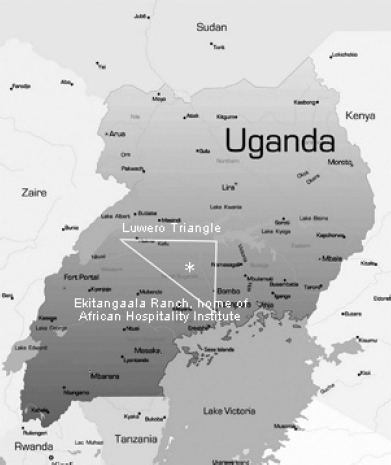
Ekitangaala Ranch, home of African Hospitality Institute, comprises 1,272 acres seventy miles north of Kampala, within the area known as the Luwero Triangle. The isolated area has a deep history of cannibalism and witchcraft. There are no public utilities for water or electricity, and communication services are unreliable and erratic. But in spite of these challenges, Ekitangaala Ranch is where Christian missionaries are bringing light to the Ugandan people.
Bugandans are the predominate tribe here, but as a community striving to model unity, the ranch has members of every tribe within Uganda as well as a few muzungus (white people) living and working together.
The ranch is actually a working dairy farm, owned and operated by Cornerstone Development Africa. The ranch produces and sells six hundred to seven hundred liters of milk each day from nearly five hundred cows that range over the ranch’s property. Sixty percent of the ranch’s gross income goes directly to operate Cornerstone Leadership Academy, which trains young Ugandans to be future leaders. Here the brightest young men, all of whom would be college eligible in the United States, are given an excellent education. (Young Ugandan women are provided the same education and training at another location closer to Kampala.)
African Children’s Mission joined the ranch in 1996 to support the country’s many orphaned and destitute children. ACM offers child sponsorship programs for more than two hundred children and feeds more than two thousand children lunch at many of the village primary schools. ACM also provides a medical clinic on the ranch that cares for ranch residents and the outlying community of three thousand people twenty-four hours a day. The nearest hospital is an hour’s drive away in an area with little to no transportation.
African Hospitality Institute joined these organizations in 2006 to serve as a hotel/resort for the many visitors to the ranch as it trains young people in the hospitality industry as cooks, maids, waiters, hotel managers, and maintenance/repair technicians.
To learn more about any one of these organizations visit their websites, provided below:
Cornerstone Development Africa
African Children’s Mission
African Hospitality Institute
Is this the Treasure
Sought forever,
By all who came before me,
Known by many names,
Shrouded in fame,
Mysterious, glorious,
Meant for all of us,
Ours
Simply for the asking?
“Napkin Notes, On Returning from The Other Side”
An Unpublished Journal
Of Poems, Thoughts, and Wisdom Offered from My Friends
During My Recovery
By John Shimer
August 22, 2011
On July 26, 2010, I left this Earth for a period of time and went somewhere I had heard others talk about but never really believed in. While mountain biking that morning, I became dehydrated, passed out, and crashed, hitting the earth at thirty miles per hour—headfirst. A jogger found me unconscious. When the paramedics arrived, they began the drama of saving my life. But the drama of losing my life had just ended for me.
While away from “here,” I experienced something truly indescribable. That’s why it’s so hard to write about it. Others who have gone “there” will tell you they felt completely surrounded by unconditional love. It’s true. I felt it, too. I also experienced an inner peace and harmony that was beyond anything I had even imagined up to this point in my life. While the paramedics fought to bring me back to consciousness, I fought to remain where I was.
Where was I? Where had I just been? Here’s what I can tell you with certainty. I was not unconscious. I was very much aware of myself. I could see a bright light off in the distance, and I was traveling toward it. There was no fear and no panic. Just peace and a type of happiness I have never known on this Earth. I was also aware that my body was down there somewhere, and I was speeding away from it. I didn’t even want to look back at it. And then, with a tremendous shock, I was pulled back by the voice of someone asking me if I had a cell phone. That’s when I became unconscious and was yanked back into my badly damaged earthly body.
Weeks of ambivalence followed. I did not want to be here. I wanted to go back “there.” At times, I would actually experience my spirit leave my body. The medical team working with me said I had a severe brain injury. I was pretty sure I would never persuade them that what I had experienced was real. So I buried my thoughts and feelings about dying and what came afterwards to avoid repeated putdowns. It was frustrating enough to remember the experience of being “there.” Out-of-body episodes plagued me for weeks, and they were driving me crazy all by themselves. I didn’t need my medical team and family members piling on by reminding me I was brain-injured. So I avoided the topic after a few tries and seeing their skeptical reactions. Only my wife proved someone I could talk to without judgment.
***
This world’s stories about the search for hidden treasure have always stirred my imagination. I loved the Indiana Jones movies and have always read with relish books about ancient civilizations and their lost treasures. I never have known why. Then, this accident happened, and I discovered pure gold in a spiritual experience that no one really wants to hear about and I can’t even begin to adequately describe. Secretly, I wake up every morning still wistful to reconnect with “there.” “There” is now my lost treasure. “There” is really where I want to be. Not here.
But here I am. And I believe I am supposed to be here for a reason.
***
“We’ve been waiting for you.”
Even in her soft-spoken and welcoming words, I sensed a gently chiding, unspoken question: “What took you so long?”
I had just told Maggie Josiah, my friend and ten-year mentee, I was coming to graduation at African Hospitality Institute in Uganda, her amazing healing community. It was August 22, 2011.
“How far is African Hospitality Institute from Kampala?”
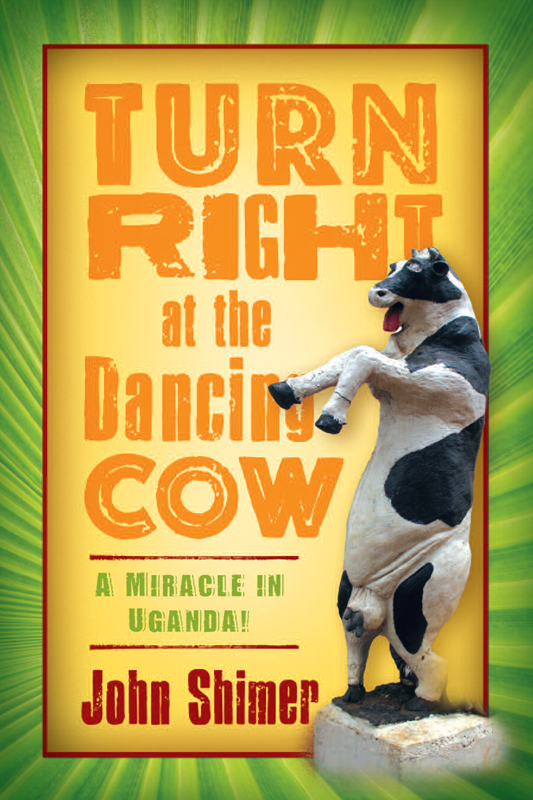
Maggie thought about this before answering. “About two hours by car or truck,” she said. “The first forty miles or so are on a fairly good road, but then you come to the dancing cow and have to make a right turn, traveling on a bumpy dirt road for about eleven miles. It’s really not a bad road, but it’s a little rough and takes awhile.”
I wondered if I was biting off more than I could chew. What was I doing taking this detour from my luxurious lifestyle? I have the option of traveling first class and staying in five-star hotels anywhere in the world anytime I wish. This trip would be, at best, a back-to-basics adventure. Besides, at the age of sixty-eight, wasn’t I just one step away from being put in the “home”? Or was my hesitation a natural but universal reluctance to take risks and venture into unknown territory?
Oh yeah! Letting go of the security and predictability in my life was definitely sending a few shivers of concern through me, as it would for most. The hardest part about living is facing decisions that force us to leave our comfort zone and venture into unknown territory. We all spend a huge amount of energy trying to make and keep ourselves comfortable. I’m not talking about a cultural definition of comfort here. I’ve traveled the world and spent time with people of many societies and cultures, so I know that everyone has his or her own personal definition of comfort. A culture and its norms may influence that definition, but everyone’s comfort zone is unique and somewhat unappealing to others. With the vast differences in comfort-zone boundaries, I often wonder how any of us communicates successfully or gets along with each other.
When was the last time you spent two weeks consciously making yourself uncomfortable? Of course, if there were someone you really loved, really cared about, and the situation called for it, you might do something that would otherwise make you uncomfortable. Why do we take big risks and make big sacrifices for the people we love but avoid doing the same for ourselves?
A friend who sells insurance confirmed this truth about human nature recently. An amazing success in his field, he told me that he never tries to sell life insurance to anyone who doesn’t really love someone else. People who don’t love someone don’t spend thousands of dollars on life-insurance premiums. Paying for life insurance is a sacrifice. If you love only yourself, you will want to spend all of your money on yourself and really enjoy it because on your deathbed, you won’t care about anyone else. You certainly won’t care about who gets your life insurance benefits.
I thought a lot about that when I told Maggie Josiah I would visit her at African Hospitality Institute in Uganda, East Africa. At this stage of life, I realize I’ve traveled as many places as I’d ever hoped to. The urge to travel and see the world isn’t as compelling as when I was younger. Even luxurious travel can make me a little uncomfortable now. I like sleeping in my own bed. I like knowing I can use my own bathroom. And I like knowing I can choose my own food, or at least know what I’m eating.
Even though I’ve never been a couch potato and have done a few things in my life that could be considered adventurous, they never really took me out of my comfort zone.
I’ve backpacked through the Sierra Mountains in California and in the Olympics and Cascades of the Pacific Northwest. I’ve had two face-to-face grizzly-bear encounters, one in Glacier National Park and one in Yellowstone. But in each case, my courage was bolstered because I had a can of grizzly-bear spray in my hand and I had been thoroughly trained about how to handle the situation. Anytime you really know what you’re doing because you’ve been well trained and you’re fully prepared, you are still in your comfort zone. Since I love the great outdoors (see, there’s that love thing again), my backpacking days were a joy, and I prepared diligently for every possible contingency. Maybe those grizzly encounters were experiences at the outer limits of my comfort zone, but I felt no emotional panic in those moments or even afterward when the danger had passed. That’s what love and real preparedness can do for you.
I have also spent a lifetime as a professional consultant, organizing multimillion-dollar fundraising campaigns for charities. Once again, this kind of work is very uncomfortable for the unprepared. The best in the field trained me from the time I was in my early twenties, and my psyche was perfect for this work. I was in my comfort zone throughout my career.
But I was also like a ghost. My volunteers were the ones out front, doing all the really hard work. I was in the woodwork where no one could see me, guiding them, training them. My specialty was human motivation, and my volunteers were taught my secrets so they could go into battle with enormous advantages. Frankly, when I was called in to organize a fundraising campaign, it was no contest. I was going to succeed if my volunteers believed in and were devoted to their cause.
And there it is again. My volunteers always loved something they wanted to preserve or to advance. I was more like a midwife helping them give birth. That role as midwife to worthwhile projects was my love and my joy. And it was not just my comfort zone—it was my zone.
But this trip to Uganda is different. Ravaged for decades by AIDS, war, and economic collapse, the country is anything but a comfort zone.
So what is motivating me to go?
In 2001, I met this woman named Maggie Josiah. Our meeting was accidental, inauspicious, and odd on several levels.
Maggie cleaned the hallways of our condo building. I didn’t think of her as “the cleaning lady” because I don’t like labels. Labels don’t define people; they confine them. Maggie Josiah is a perfect example of what I mean. It’s true, the activity she was involved in at the time I met her was cleaning hallways. But she was so much more than a cleaning lady. Maggie was, and is, a bundle of possibilities, just like everyone else. I owed her respect as a fellow traveler on this journey called life, and I gave it to her.
Maggie had a dream, something she believed in with all her heart, and she needed to raise money to make that dream come true. She chose me as her fundraising mentor. Now it’s ten years later, and her dream has come true. I have grown to admire Maggie for her courage and her faith. Few have demonstrated so eloquently the essence of that admonition contained in Matthew’s Gospel—“I tell you the truth, if you have faith as small as a mustard seed, you can say to this mountain, ‘Move from here to there’ and it will move. Nothing will be impossible for you.”
Brave, powerful, visionary people have repeatedly shown me what can be accomplished in every fundraising campaign I directed. When you’re powerful, incredibly wealthy, visionary, and truly believe in your power to change the world in positive ways, almost nothing can stop your progress. A story about any one of my campaigns might demonstrate that.
But in those days, Maggie Josiah wasn’t wealthy, powerful, or brave.
When I met her, Maggie Josiah was poor and frightened and had never been to Africa. I think her story is more instructive about the power of faith than any other I could tell. For certain, her story has affected my life more than any other project I ever worked on. Maybe it has changed me. Maybe I have come to understand through Maggie what Jesus meant when he talked about the mustard seed’s faith. Maybe I love what Maggie has made of her life in spite of her pain and suffering, or maybe I love something much more mystical and spiritual I discovered in Maggie through mentoring her.
Or maybe I’ve lost my mind over this project, and I’m going to Uganda to try and find it again.
But on a very deep level I know why I’m really going to Uganda. I’m seeking lost treasure.
***
Exactly eight weeks after my accident, still feeling torn about “there” and “here,” I read a front-page story in the Seattle Times about an attorney who was a veteran bike rider suffering an accident just like mine. He is still alive as I write this, but he is quadriplegic. He will never walk again, nor will he be without around-the-clock care. He faces a mountain of challenges every day. I have completely recovered and can do anything I want whenever I want. For some reason, there’s a part of me that can’t ignore these contrasting outcomes. That passage from Luke keeps playing in my head in a continuous loop. “From those to whom much is given, much will be required in return.”
The one thing I won’t be doing anymore is riding a bicycle, an activity that has been prohibited by my doctors and caring family members. They won’t let me do anything that requires wearing a helmet since they know that even a slight head injury might send me into a permanent coma or end my life. But all of them are willing to let me totter off to Uganda to visit Maggie because they know how badly I want to go.
***
“African Hospitality Institute is a ‘thin place.’”
Maggie is telling me this not knowing the details of what I had experienced in the early hours of July 26, 2010. We are sitting in our backyard on the shores of Lake Washington with my editor talking about this book. I can no longer bring myself to talk about what happened to me—not to Maggie nor to anyone else. But she has my attention.
“A ‘thin place?’ What does that mean?” I ask.
“The people in our area believe there are places in the world where a very thin curtain separates this life and the spirit world. All of us who live and work there have actually felt this in some way.”
That seals the deal for me. I am booking my trip and heading off to Uganda and African Hospitality Institute as soon as I can arrange it.
Word has it that there is a spirit of community at African Hospitality Institute that is rich with grace and love and mutual respect, unlike anything I have ever known here in the United States. I would like to discover for myself if this is true. But secretly, I want to experience this “thin place” and maybe rediscover the treasure I believe I held in my hands that summer day when an early morning bike ride in the mountains took me to another dimension and exploded my spirit with new possibilities.
You could say I am feeling called to make this trip.
Because I’ve spent a lifetime creating, organizing, and rallying communities around various causes, a part of me loves what the spirit and power of community can accomplish. And now, in my desire to rediscover what I experienced on that summer day in 2010, I am curious to learn whether an even deeper sense of community might open a portal back to my lost spiritual treasure.