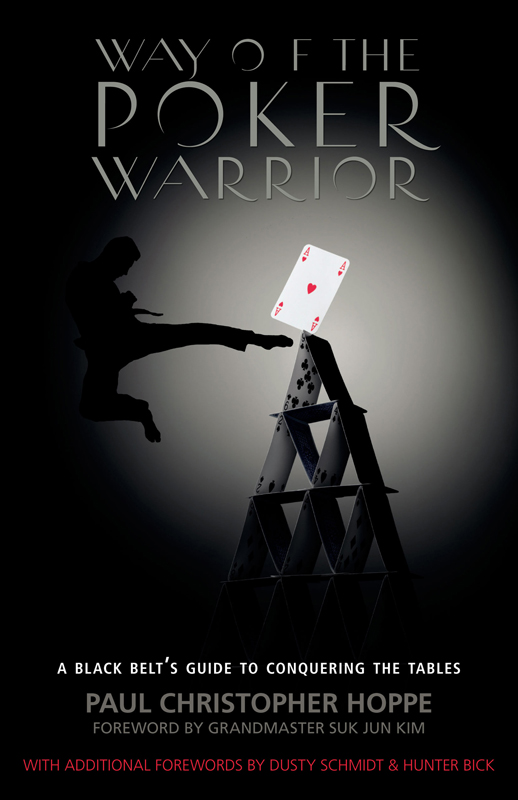
Way of the Poker Warrior:
A Black Belt’s Guide to Conquering the Tables
Paul Christopher Hoppe
Forewords by Grandmaster Suk Jun Kim, Dusty Schmidt & Hunter Bick
Edited by Scott Brown
Imagine Media, LLC
(Copyrights)
2010 Imagine Media Trade Paperback Edition
Copyright © 2010 Paul Hoppe
All rights reserved
Published in the United States by Imagine Media, LLC
Imagine Media is a trademark of Imagine Media, LLC
Library of Congress Cataloging-in-Publication Data
Hoppe, Paul Christopher
Way of the Poker Warrior, by Paul Christopher Hoppe
ISBN XYZXYZ
Printed in the United States of America
www.giantbuddhapoker.com
Book Design by Tracy Hopper
Site design by Larry Sawyer and Jeff Seese
To all of my teachers and students
May we never stop learning
Acknowledgements
For their patience, guidance, and assistance, I would like to thank Hunter Bick, Scott Brown, Brent Courson, Li Ting Deng, Douglas Goetsch, Diana Granat, Logan Grendel, Judith Kocela Hawk, Mateel Hoppe, Emil Jonsson, Grandmaster Suk Jun Kim, Kevin Lyons, Brent Mills, Shaun Morris, Reese Newell, Matts Quiding, Philipp Sauer, Dusty Schmidt, Jared Tendler, Master Kathryn Yang and Mary Yost. Without all of them, this book would not be what it is.
About Paul Hoppe
Author Paul Hoppe is a skilled martial-arts practitioner as well as an acclaimed poker player and coach.
Hoppe is a fourth-degree black belt with Taekwon-Do International, which qualifies him as a “master.” He has taught martial arts for nine years — roughly as long as he’s been a black belt. For two years, he was the head instructor of a Dojang in Times Square.
As a poker professional, Hoppe is known for his very detailed and efficient combo analysis. He played live poker professionally from 1999-2000. This included $20/$40 Limit Holdem and Seven Card Stud, some Omaha 8 and Stud 8, and $5/$10 No Limit. After several years away from the game, he returned to poker in Feb. 2006 with a $100 deposit bonus. He built his bankroll from that free $100 into a six-figure income, going from $.50/$1 to $10/$20, $15/$30, and $30/$60, which he plays today.
Hoppe has maintained a very solid 1.5BB/100 win rate over the last 30 months. His Heads Up win rate is 5BB/100. In 2007, 2008 and 2009, he was able to double his poker income from the previous year. He’s known as a versatile player, mixing Limit, No Limit, Omaha, Stud, and Triple Draw.
In Spring 2010, Hoppe staged a 28-day Grind-a-thon, during which time he played poker, then recorded a Hand of the Day video and a video blog every day. He made $30,000 in profits and raised $3,000 for cancer and autism charities.
He has coached poker for more than two years, including about 50 private students, and is an instructor at DragTheBar.com, for which he has made more than 50 videos.
As a writer, Hoppe has published an article on Internet poker legislation and legal issues. He authors a popular blog, Wandering Path of a Zen Madman, which he has now moved to giantbuddhapoker.com. His also a popular strategy-forum poster.
Hoppe is also a talented musician, and currently plays guitar for the New York band Villain’s Lament, for which he writes music and lyrics. He lives in Manhattan.
Table of Contents
Foreword: The Path, by Grandmaster Suk June Kim
Foreword: How To Win, by Dusty Schmidt
Foreword: You Had Me At Metallica, by Hunter Bick
INTRODUCTION
Two Paths, One Discipline
The Making Of A Poker Player
Empty Your Cup
SECTION I: TRAINING
Chapter 1: White Belt
Hand No. 1
Chapter 2: With Respect To Learning
Hand No. 2
Chapter 3: Share Your Passion
Hand No. 3
Chapter 4: Teaching To Learn
Hand No. 4
Chapter 5: Discipline and Motivation
Hand No. 5
Chapter 6: One Thousand Punches
Hand No. 6
Chapter 7: The Devil’s In The Details
Hand No 7
Chapter 8: Let’s Go To The Videotape
Hand No. 8
Chapter 9: I’m Not Left-Handed, Either
Hand No. 9
Chapter 10: Sweat Now So You Don’t Bleed Later
Hand No. 10
Chapter 11: Never Let Your Towel Dry
SECTION 2: COMBAT
Chapter 1: Prepare For Battle
Chapter 2: Zen-Lite
Chapter 3: Hurry Up And Wait
Hand No. 11
Hand No. 12
Chapter 4: Get Over Yourself
Hand No. 13
Chapter 5: Go With Your Gut
Hand No. 14
Chapter 6: Any Given Sunday
Hand No. 15
Hand No. 16
Chapter 7: Fight From The High Ground
Hand No. 17
Chapter 8: Pick Your Battles
Hand No. 18
Chapter 9: Target Weakness
Hand No. 19
Chapter 10: Don’t Die Without Knowing What Killed You
Hand No. 20
Chapter 11: Twelve Moves Away
Hand No. 21
Chapter 12: Tell Them What You Want Them To Hear
Hand No. 22
Chapter 13: He Knows That I Know That He Knows …
Hand No. 23
Chapter 14: War Games
Hand No. 24
Chapter 15: Don’t Get Mad. Don’t Get Even. Get Better!
Hand No. 25
Chapter 16: Show No Fear
Hand No. 26
Hand No. 27
Chapter 17: Show No Mercy
SECTION 3: CONDUCT
Chapter 1: The Tenets of Taekwon-Do
Chapter 2: Stay In Shape
Chapter 3: Deal With It
Hand No. 28
Chapter 4: Hope For The Best, Prepare For The Worst
Hand No. 29
Chapter 5: Ten Feet Of Cotton
Chapter 6: The Cost Of Making It Your Job
Chapter 7: Black Belt
Foreword
The Path
By Grandmaster Suk Jun Kim
There is one essential truth that Taekwon-Do and poker share: they are both more than they appear.
To the uninformed eye, Taekwon-Do looks to be a furious sport bent entirely on self-defense. But the truth is that it’s a mental process more than a physical one. It’s a spiritual challenge that involves physical aspects.
Similarly, poker appears on its surface to be a simple pursuit of money; in fact, success at poker has more to do with mental endurance and a willingness to continually grow.
Taekwon-Do and poker are living, breathing things that are constantly changing shape. In both, one is never finished learning.
The two disciplines also involve conflict that can swallow us whole if we are not careful. I come from South Korea, a very unsettled part of the world mired in endless political turmoil and extreme poverty. It is not unusual there for people to rely on violence to survive, myself included. This is why I took up martial arts: I wanted to learn to fight. I employed my knowledge as a means of getting by and setting things straight when kids would inevitably do something stupid.
Years later, I used my Taekwon-Do in an adult conflict, one that ended badly for my adversary. I was faster and stronger, and he did not have a chance. You’d think this would have made me feel powerful, but it didn’t. My immediate reaction was that I regretted the violence tremendously. Damage was done. At the time I thought I was being righteous, but who am I to determine that?
Poker is similarly a sport of extreme conflict, one in which words are exchanged along with money — and those words are often unpleasant. By diminishing our opponent, are we strengthening ourselves? Do we walk away stronger, bolder? No. We are smaller for it. When we hurt another, we give away a piece of ourselves. Our conscience never forgets what we’ve done, and little by little this erodes the soul. As humans we have a physical and psychic tendency toward both fire and water. As time has gone on, I’ve found water to be far more advantageous than fire.
In Taekwon-Do, there is a standard greater than victory. How you went about winning is what matters. With this book, I believe Paul is applying that same standard to poker. Yes, he teaches you to be a more profitable poker player. But the process of winning is his priority.
Paul understands this as well as any of the roughly 4,000 students I’ve taught. When I first met Paul, he was 17 years old, tall and very skinny. He was fragile and needed muscles. There were far stronger students, and more talented ones as well. But by and by they lost their passion and left Taekwon-Do; meanwhile, Paul has managed to get better and better, day after day after day. Despite not being the strongest or most gifted, he is today one of the best practitioners of Taekwon-Do that I know — so much so that in 2001 I asked Paul to run my Times Square school for me. He is exceptionally gifted at one thing, and that is keeping his fire lit within.
Paul knows that in poker and martial arts, when we do actual combat, we are taking chances. If I’m free fighting, I have to trick my opponent. I need my opponent to make the first mistake so I can react. If we go kick for kick, punch for punch, we’re both losers. But if he falls into my strategy, he alone is going to end up losing.
Attacking is a gamble. It’s a game of deception and intuition. I’ve never attacked someone in a straight line. I pretend I’m attacking low and then hit high. I pretend I’m going right, and I go left. Meanwhile, I must read my opponent. I look him in the eyes. If he looks away and then looks at me again, I know I have him. It’s a tell. If they’re wondering what I’m doing, trying to follow my eyes, then it’s over.
A wise martial artist once said martial arts “is like a finger pointing at the moon. If you concentrate on the finger, you’ll miss all the heavenly glory.” In poker, a loser will concentrate on his own cards while paying little attention to those around him. He is only watching his finger. But a winning player sees everything. Sensing what your opponent has, and what he thinks you might have, can be vastly more important than what you yourself are holding.
Taekwon-Do is a living thing. You can’t expect it to stand still. You must be practicing, visualizing, researching, and more than anything else, addressing your own weaknesses. You must look at yourself honestly and be open-minded to everything. You have to be fluid, constantly changing form lest an opponent know your next step before you do. Poker is the same. Sometimes you must be the fire of aggression; other times, you must be water, using your opponent’s own aggression to sink him.
In this book, Paul will show you how to win and make money. What I think you’ll ultimately find, though, is that these are the least important things Paul has to teach.
Born in South Korea, Grandmaster Suk Jun Kim, 59, is one of the world’s only ninth-degree black belts to continue a teaching practice. He has taught Taekwon-Do for more than 30 years, and owns and operates his internationally renowned academy in Manhattan. In 1974, Master Kim won the Masters Association Open Championship and the South Atlantic Championship in free fighting. Between 1975 and 1980, he performed annual Taekwon-Do demonstrations at Madison Square Garden. In 1976, General Choi Hong Hi, who is one of the discipline’s forefathers, added Master Kim to the prestigious International Taekwon-Do Federation Demonstration team. His website is www.sjkim-taekwondo.com.
Foreword
How To Win
By Dusty Schmidt
It was the mother of all slumps.
For the year I was running $100,000 behind EV; for the previous 28 months I was $400,000 behind EV. My first, second and third instincts were to just keep doing what I was doing.
We all agree that poker is a game of skill, and the basis of skill is knowledge. The thing about knowledge is that it constantly evolves, and I had stopped evolving. As Paul writes in this book, I’d “let my towel go dry.” I suppose I had good reasons for this: having a new family; writing a book; starting a new business. All of these things took me away from concentrating on poker as I had previously.
My game was on autopilot, and at first I managed to do just fine. Whereas I’d maybe made $100,000 a month back when I was really grinding, I was down to making $60,000 playing part time — still a great haul.
But soon that $60,000 was down to $30,000. Now I had a sense of urgency. I started playing more, yet my income was plummeting toward zero. I came within inches of experiencing the first losing month of my career. What was happening? Had I lost my touch? Was it the games? It had to be the games, right, because I was so far behind EV?
For the first time in my poker life, I was really, really scared. I was scared because I had no idea how to fix myself. The games were harder, the fish were fewer, and I didn’t know one thing to do about it.
Then I thought of what Paul wrote in the first few pages of Way of the Poker Warrior: “empty your cup.”
Empty your cup.
I had to forget what I thought I knew about poker and my own game, and start fresh. That began with me coming to terms with my weaknesses, another of Paul’s axioms in this book.
My honest assessment was that I wasn’t practicing effectively — in fact, most of the time I wasn’t practicing at all. I’d always made so much money per hour that time spent practicing felt like an opportunity cost. The result was that I was making adjustments while I played — a time when my state of mind was at its most vulnerable. Rather than implementing strategy, I was adjusting to new players on the fly, trying to counteract what they were doing without a real basis for my actions.
I looked in the mirror and realized I was making classic mistakes: playing too many hands, misjudging people’s ranges, playing emotionally, and getting into too many spots where I shouldn’t have been involved. I was still grinding, but I was working long rather than working smart.
When I first read Way of the Poker Warrior, I appreciated that it spoke to fundamental truths about the game. I wondered, though, if it would apply much to an advanced player like I am.
What I found was days later I was still thinking about the book. Then days became weeks. The standard Paul sets stayed on my mind, and I compared myself to it. It was then that I felt the burden lift. I felt as though I’d found a roadmap home.
I had to go back to basics — “become a white belt,” as Paul says. Following Paul’s advice from “We Sweat Now So We Don’t Bleed Later,” I began spending 20 percent of my time practicing. I looked over old notes I’d taken, and went back to reviewing my game when I was playing better, just as Paul says to do in “Let’s Go To The Videotape.”
As Paul suggests, I found new teachers, swallowing my pride and asking for friends to analyze my game. I “taught to learn,” explaining to them what I was trying to do and why. I even applied some of Paul’s more idiosyncratic thoughts, including his advice in “I’m Not Left-Handed, Either” where he suggests dropping down a few limits and playing like a fish. All of it got me back on a winning path.
Way of the Poker Warrior reinforced for me something I’ve long believed, which is that mastery is its own skill. Once you’ve mastered one thing, it becomes much easier to master another. I was a pro golfer before getting into poker, and my ramp-up for the latter was much quicker because of my experience with the former. Paul clearly had the same experience with Taekwon-Do and poker. I think the essential truths Paul speaks to in this book would put someone on the path toward mastering anything, not just poker.
I always admired Paul because he’s the person I want to be some day: martial-arts badass, plays guitar in a rock band, lives in Manhattan, does what he wants, gets the girl. I live vicariously through the guy. But I never thought I’d be thanking him for helping me enjoy again the process of playing winning poker.
Yet that’s just what I’m doing.
Dusty “Leatherass” Schmidt is a member of Team PokerStars Online. He is also a lead instructor at DragTheBar.com, and author of the book "Treat Your Poker Like A Business." In his five-year online-poker career, Schmidt has played nearly 7 million hands and won more than $3 million, without ever having a losing month. He blogs several times a week at www.dustyschmidt.net.
Foreword
You Had Me At Metallica
By Hunter Bick
Metallica is one of my favorite bands; they have been for 15 years. For the unfamiliar, they’ve been around since 1981 and are generally considered to be the most musically talented and technically proficient of all hard rock and metal groups. They inspire tremendous fan loyalty by literally never playing a bad or even repetitive concert. Their music is intense, determined, ambitious, unrelenting, and often foreboding in subject matter, but they also have their softer moments and have never been afraid to experiment by taking it in different directions.
I first heard them when I was 14 in a friend's car. He had the Black Album playing. When I heard that thunderous voice of James Hetfield's booming out about nightmares, forsakenness, and tragic irony, combined with Kirk Hammett's brilliant guitar work, I was hooked. Shortly thereafter, I discovered their earlier albums to be even darker, scarier, and faster, and Metallica became my go-to music for anything that required extra energy, focus or determination.
I admire Metallica's work ethic as much as the music they create, and it is a part of what makes them so incredible. They have a fanatical attention to detail. Furthermore, their dedication to their music and their fans is nearly unsurpassed.
Consider this example: In 1992, James Hetfield suffered third-degree burns up and down his left side after a pyrotechnics accident during a show. Just two weeks later, he was back on stage singing with a full-arm cast and undoubtedly still in pain, while his guitar tech handled his guitar role.
I recently got to see Metallica play in Charlotte. The set was almost all material off their new album plus a lot of their early work — songs you'd probably never expect to hear live. This was their heaviest and fastest material, and they brought it 100 percent for almost three hours, then played the "Seek and Destroy" encore with all the house lights on. They were relentless, and we left the show exhausted.
How does Metallica relate to Paul Hoppe? I’ll explain.
In January, Paul and I discussed his becoming a coach at DragTheBar.com, the poker-training site I co-founded. The site had only been open for two months, and quite frankly Limit Hold'em was not even on the radar. (Look no further than our name: There's obviously no bar to drag when you bet and raise in a Limit game; you just click a button.)
But I ended up talking to Paul for a couple hours. He compelled me to look at his previous coaching videos, which were brilliant.
From the outset, Paul’s drive to become a better player and coach at every opportunity was very evident. He took me through his lofty goals as a coach, player and author, and I found it impossible to say no to a person with the kind of determination and drive that Paul has.
One of the first things he told me was, "I'd really like to be able to manage the direction of the Limit content and help with hiring future Limit coaches. Would that be a possibility?" I’d never had a request remotely like this one, and his tone was absolutely serious.
While fist pumping, I quickly replied, "Absolutely." He had a vision and wanted to be a part of creating something special, and I knew right away he'd be a big asset. I hired him on the spot.
A couple weeks later we were chatting on Skype. I knew Paul played music seriously, and I’d been looking forward to talking about it with him. I was telling him about some really good concert recordings I’d come across and said I could send them his way. I started listing them and the second was Metallica. "You can stop right there,” he interrupted. “You had me at Metallica." That line stuck with me, and I figured we were going to get along pretty well.
Fast-forward to three months after I’d hired Paul, by which point he’d already released nearly 50 videos on DragTheBar. Fifty. Five-Zero. For those unfamiliar with online poker coaching, the standard number of videos for that time period would be around six.
In fact, Paul made a video every single day of his famous 2010 Grind-a-thon, a grueling challenge he put himself through where he played 80,000 hands in 28 days, forbade himself from leaving his apartment building in New York, and leveraged the publicity to raise money for charity. (I sent him some good grinding music that hopefully kept him company.) Paul recorded these videos at no monetary benefit to himself, but simply to help the site and give our members some bonus content.
Soon after Paul joined our site, Limit Hold'em was our second most-popular forum, despite it having zero posts before Paul came on board. Now we’ve added a second Limit coach, and I consider Limit to be a real strength of ours.
I was recently watching one of Paul's videos and thinking of his line, “You had me at Metallica.” It was then that it dawned on me: Paul is Metallica.
A serious intensity underscores everything Paul does. In fact, every trait that distinguishes Metallica also distinguishes Paul: the work ethic, the ambition, the drive to be the best, the confidence to explore new projects outside a comfort zone, the complete and total devotion to a task — they all line up.
When you watch Paul's videos, you see a never-ending attention to detail in his approach to the game. (Specifically, you should watch the ones where he talks about “combinatoric analysis.”) His intensity in improving his game and his students' games is unmatched.
No matter how good you are, you can always get better at poker. Paul understands that as well as anyone, and his drive is evident to everyone who knows him.
Hunter “BeachJustice” Bick is co-CEO of the poker instruction site, DragTheBar.com. Once a corporate banker, he’s been a successful coach and No-Limit mid-stakes pro since 2007.
Introduction
Two Paths, One Discipline
NEW YORK CITY – April 2003 – I surveyed my opponent as we bowed to begin the last round of the men’s heavyweight final. His uniform pants were torn and he was covered in sweat, but there was still fight in his eyes.
“Chung: 2, Hong: 4,” the center ref shouted, calling the score by the color of our chest guards.
Four? I couldn’t recall getting hit, but now I saw red. I would have to see more of it if I wanted to win the match. I was in my third fight, while my opponent was only in his second. Who needs a bye? I was physically exhausted, but a two-point deficit going into the final round was enough to get my blood up. I wasn’t losing without a fight.
’