

Copyright© 2007, 2014
by Robert J. Torrez
Rio Grande Books, an imprint of LPD Press
Los Ranchos de Albuquerque, New Mexico.
All rights reserved. Printed in U.S.A.
No part of this book may be reproduced or transmitted in any form, or by any means, electronic or mechanical, including photocopying, recording, or by any information retrieval system, without permission.
For information:
Rio Grande Books
925 Salamanca NW
Los Ranchos de Albuquerque, NM 87107-5647
Telephone: (505) 344-9382
www.nmsantos.com
Book and cover design by Paul Rhetts & Barbe Awalt
ISBN 978-1-890689-50-6 (pb. : alk. Paper)
ISBN 978-1-936744-63-3 (ebook formats)
Library of Congress Control Number: 2006937764
Cover photographs: US. Army Corps of Engineers Survey Map (1873-1878), expedition conducted by 1st Lt. George M. Wheeler. Section 84- New Mexico and The Daily New Mexican, January 12, 1877.
Contents
Introduction
Part I The Rio Abajo
Part II - On Horseback Through Rio Arriba, 1877
APPENDIX A
APPENDIX B
Notes, New Mexico in 1876-1877
Selected Bibliography
About the Author
Introduction
The New Mexico of the 1870s must have been an exciting place. Although the territory had been settled by the ancestors of the Pueblos hundreds of years earlier and the Spanish had colonized the region in 1598, the population was small and vast areas remained unsettled. New Mexicans were obviously intimately familiar with the land and its resources. Spanish and Mexican officials regularly compiled reports on the land and its people. At the mid-nineteenth century, however, very little published information was readily available to immigrant Americans who came to New Mexico and viewed the vast unsettled portions of the territory as a land of unlimited opportunities. Many newcomers became unabashed promoters.
The interests of these promoters were, of course, blatantly self serving. Two prominent promotional books of that period were Elias Brevoort’s New Mexico, Her Natural Resources and Attractions.... (the title continues for several lines)1 and William F. M. Amy’s New Mexico: Its Agricultural, Pastoral and Mineral Resources...2 Brevoort’s book, for example, published in 1874, promoted the availability of Spanish and Mexican land grants in which Brevoort had substantial interests. Arny, whose book was published a year earlier, did not have the extensive financial interests as Brevoort, but he may have been New Mexico’s most unabashed promoter. Arny emphasized that some of the best land in the territory was considered Indian land and advocated removal of the various tribes to reservations established in areas where they would not impede the process of opening New Mexico’s vast frontiers to new settlement.
In the 1870s New Mexico’s population had not yet reached one hundred thousand. Most of that population was concentrated in the major settlements and pueblos along the Rio Grande and the rest scattered in irrigable mountain valleys from Taos to the Manzanos and in the Mesilla Valley. As late as 1880, less than twenty per cent of the population lived in the southern and southwestern portions of the territory that constituted the counties of Dona Ana, Grant and Lincoln. To promoters such as Brevoort and Arny, the potential was unlimited. The problems and turmoil of Lincoln and Colfax counties were still in the future; in their eyes the “Indian problem” was on the verge of being solved, and above all, THE RAILROAD WAS COMING!
This excitement was doubtless stirred by arrival of the steel rails to southern Colorado and the numerous military surveys conducted throughout New Mexico by the United States Corps of Topographical engineers between 1873 and 1878. The coming and going of government officials and reports published by the expeditions conducted under the likes of George M. Wheeler and numerous others were eagerly anticipated by both civic leaders and private promoters, all of whom took great delight in predicting that the railroad would be coming soonest to their town or location. The extraordinary excitement generated by the advancing railroad mounted year by year and even day by day as the rails came closer and closer. ‘’Almost here;’ declared the 3 April 1880 issue of The Albuquerque Review as construction crews worked their way to within two miles of the city. The day the train finally arrived (three weeks later), the paper optimistically predicted, would be “the day from which Albuquerque may reasonably expect to date the commencement of her material prosperity and the beginning of her existence as the Queen City of the Rio Grande:’ Every town along the railroad route undoubtedly felt much the same.
The information compiled by these expeditions was eventually compiled into a series of maps by George M. Wheeler. These maps, generally referred to as the “Wheeler maps;’ were published and made widely available several decades after the expeditions took place, but undoubtedly, the information provided at the time proved invaluable in expanding the public’s knowledge of and interest in New Mexico and its resources.
An example of the promotional maps of New Mexico produced in this period was one published under the auspices of The New Mexico Livestock and Agricultural Association of Chicago, Illinois. This company was incorporated in 1872 with the expressed purpose of recruiting among and encouraging the immigrant population in the Chicago area to emigrate to agricultural settlements the company planned to establish in New Mexico. This particular company managed to entice and defraud a small group of mostly Scandinavian immigrants to northern New Mexico, where a short lived colony named Park View was established between 1876 and 1877.3 Among the promotional materials produced by the company was a magnificent color map of the territory drawn by Augustus Z. Huggins. While Huggins was promoting this agricultural colony, he was also an employee of the Office of Surveyor General. We can only speculate if there was a formal, if not illicit, relationship between the Surveyor General and private promoters at this time.
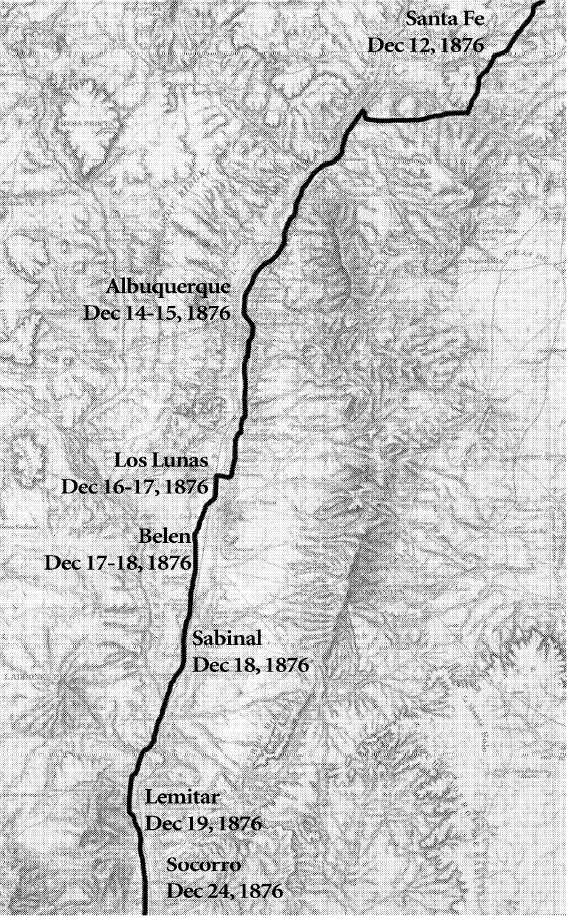
US. Army Corps of Engineers Survey Map (1873-1878), expedition conducted by 1st Lt. George M. Wheeler. Section 77-New Mexico. Santa Fe to Socorro: The Rio Abajo, December 12, 1876-December 24, 1876.
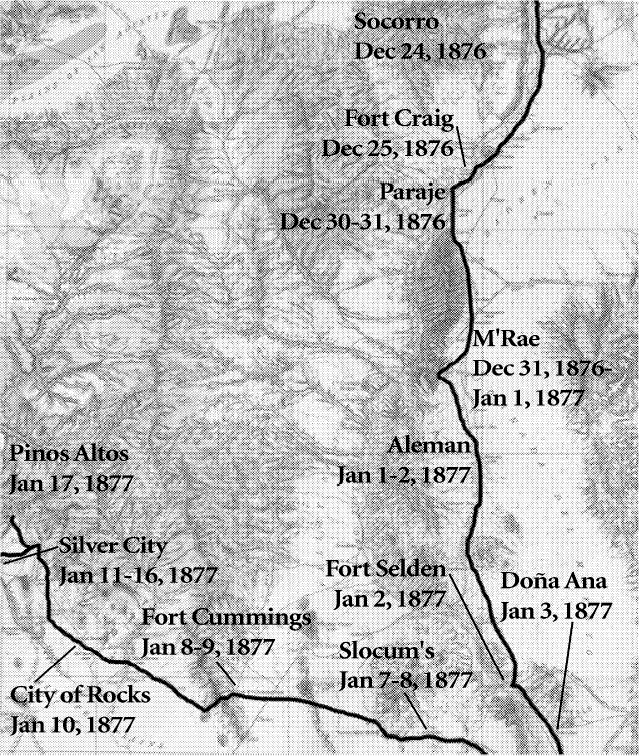
US. Army Corps of Engineers Survey Map (1873-1878), expedition conducted by 1st Lt. George M. Wheeler. Section 84-New Mexico. Socorro to Pinos Altos to Santa Fe: The Rio Abajo, December 24, 1876-February 14,1877.
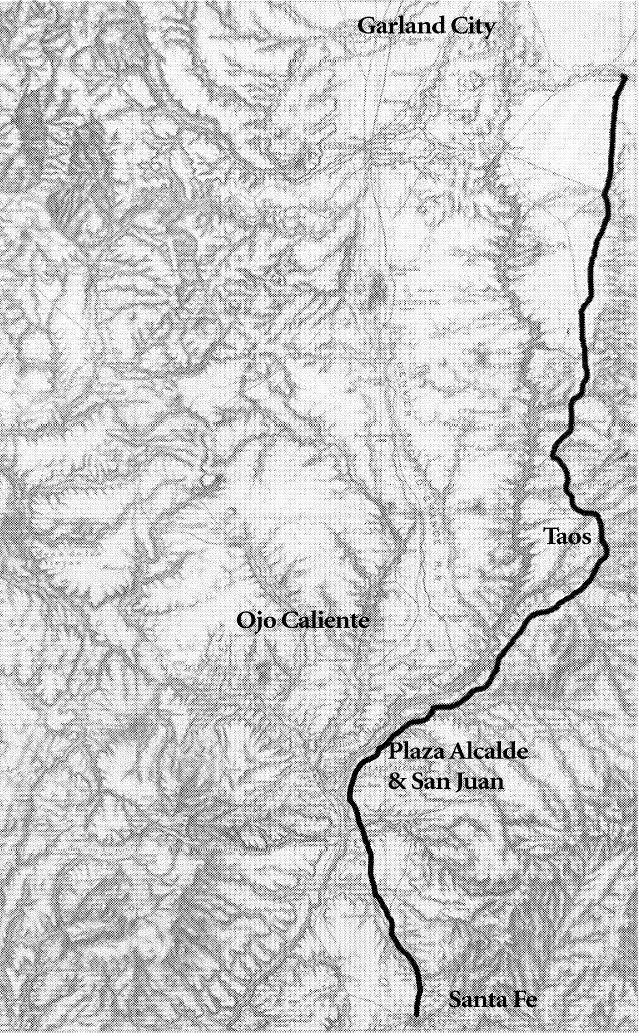
US. Army Corps of Engineers Survey Map (1873-1878), expedition conducted by 1st Lt. George M. Wheeler. Section 69-New Mexico. The Rio Arriba, September, 1877.
Despite the many expeditions and promotional books, reliable information about New Mexico and its resources remained relatively scarce. This scarcity of information was occasionally alleviated by New Mexico’s newspapers. Papers of the time eagerly solicited and published letters and reports from anyone who managed to write about their visits and observations of even the most remote parts of the territory. When they could not obtain information from their readers, the papers sometimes arranged to obtain it more directly. Prominent among these efforts were New Mexico’s leading newspapers of the time, The Daily New Mexican and its companion publication, the Weekly New Mexican.
In its 11 December 1876 issue, owners of the Daily announced that the following day, William D. Dawson, one of their editorial staff, would embark on a trip of at least six weeks, during which the reporter would travel from Santa Fe to Silver City. Along the route Dawson would submit reports describing “his experience and observations:’ The paper suggested that Dawson would gladly receive and communicate”any information beneficial to the country and of interest to the general public...:’ Almost as an afterthought, the notice indicated Dawson would also accept subscriptions for the paper and advertising from businesses along the way.
William D. Dawson is a prominent but little known figure in the history of northeast New Mexico. It is not certain Dawson is related to the family after which the ranching and mining community of Dawson in Colfax County is named, but he shows up in the 1870 census of Elizabethtown. That same year he is a party in a Colfax County civil suit in which he appealed a $1,000 judgment made against him for damages related to possession of a placer mine at Grouse Gulch in Colfax County. Court records do not show final disposition of the case, but indications are the County Sheriff had confiscated his property and sold it off to satisfy the earlier District Court judgment. Colfax County assessment records show he retained property in the county at least through 1875 but he is not found in the 1880 census in Colfax County, an absence that may be explained by his presence in Santa Fe in 1876 as a reporter for the New Mexican.4
Regardless of where Dawson was from or where he ended up, his trip and the reports he submitted to the paper made a significant contribution to our knowledge of New Mexico’s landscape in the 1870s. Between 20 December 1876 and 15 February 1877, the newspaper published twenty two of Dawson’s reports under the pen name, “Your Reporter:’ These reports constitute an extraordinary description of the entire Rio Grande valley from Santa Fe south to the Mesilla valley and west to the mining region of Silver City in southwest New Mexico. If one reads his reports and keeps the earlier mentioned Wheeler maps handy, his trip can be followed step by step.
In September 1877, seven months following completion of his rio abajo5 trip, Dawson undertook another sojourn into the New Mexican countryside. Writing under the pen name of “W. D. D:: he turned his attention to northern New Mexico and southern Colorado, a trip that took him from Santa Fe north along the Rio Grande to the Taos Valley and through the San Luis Valley of southern Colorado to Fort Garland, then the terminus of the Denver and Rio Grande Railway. In the course of one year, he had traversed the entire length of New Mexico.
Dawson left Santa Fe on his trip to southern New Mexico late the morning of 12 December 1876. He was accompanied by, or more correctly Dawson went along the major portion of this trip with, Sergeant M. Frost (this may have been Max Frost, who later gained prominence in New Mexico territorial affairs and served as Adjutant General) of the United States Signal Corps, William R. Smith, the telegraph operator, and M.A. Yeager, the driver. Their little caravan consisted of a wagon loaded with telegraphic wire and supplies and a coach that carried Dawson, Frost and their baggage. Dawson does not state so, but it is likely he submitted his reports to Santa Fe by telegraph along the route.
After leaving Santa Fe on the 12th, the group made successive stops at Pino’s Ranch, Bernalillo and Alameda, and arrived at Albuquerque three days later. Dawson spent some time in Albuquerque describing a few of the local sights and attractions and demonstrates a peculiar affinity for selecting what his readers may have found interesting. A significant portion of his report from Albuquerque is spent describing a “vegetable sauce” served at Ed Branford’s hotel. He found Branford’s concoction “fully as good if not superior to the famous Worcestershire [sauce]:’He also found it important to comment on the”exceedingly fine flavor”of Branford’s pickle relish. Upon leaving Albuquerque, they attempted to cross the Rio Grande but managed only to get both of their vehicles stuck. It took more than three hours for several teams of oxen to pull them out of the mud and sand. This experience, noted Dawson sarcastically, provided him and his companions the unforeseen opportunity for “a very cold morning bath.” For the next several days, the journey took them through the agricultural regions of the central Rio Grande. Dawson describes the extensive cultivation of the land around the Pueblo of Isleta, Los Lunas, Belen, and as far south as Socorro. At every stop, they enjoyed the legendary hospitality of the rio abajo and at each of these settlements, he takes special note of the local wine. At the point where the caravan ventured south from Belen towards Sabinal, they entered a region that Dawson called “our first commencement of camp life:’ Here, the promotional nature of this venture comes to the forefront, as his reports begin to emphasize the open and unsettled nature of the country.”Oh;’ he waxes poetically, “for a railroad along this beautiful river to bring population and infuse new life and energy among the quiet inhabitants along its banks:’
After a delay of several days at Socorro, they proceeded south through San Antonio,Valverde and San Marcial to Fort Craig, which he describes in great detail. They spent a delightful Christmas at the fort, enjoying the comforts of the Valverde Hotel and attended a party held to celebrate the birthday of the postmaster’s daughter.
They then proceeded into the legendary jornada del muerto.6 Here, Dawson’s interest is drawn to a number of facilities recently developed along this much dreaded portion of the ancient camino real. He noted a number of water tanks and John Martin’s “experiments” with water wells in the vicinity of Aleman. His description of these stops and the site of Martin’s Well does not invoke the popular image of the region’s desolation. Rather, he seems to describe a very pleasant oasis where hotel rooms equipped “with a good class of furniture;’ a stage stop and post office could be found.
Upon leaving the jornada, Dawson and his companions arrived at Fort Selden the evening of 2 January 1877. After an overnight stay at the residence of the post trader, they proceeded south and spent several days visiting Las Cruces, Mesilla, and Doña Ana. Here too, Dawson took time to describe the agricultural resources of the region with great emphasis on the vineyards and orchards of several individuals. He was suitably impressed by the vast vineyard and 2,000 gallons of wine produced by John D. Barncastle at his farm south of Doña Ana. He indicated Barncastle’s wine was sweeter than the wine produced in the north, but nonetheless was “considered to be of superior flavor:’ Here too, he emphasized the role that a railroad would play in the region. At such time as the railroad did arrive, he noted, “it would be difficult to predict the astonishing impetus that will be given to every branch of trade and industry as well as immigration:’
On January 7, the group left behind the “wide spreading agricultural land and...shade trees” of the Mesilla Valley. They paused to fill their water barrels at the Rio Grande, crossed the river uneventfully, and began the final leg of their journey west to Silver City along what Dawson described “as complete a desert as ever was laid down:’It may be interesting to readers that he did not use words as remotely harsh to describe the historically dreaded jornada they had crossed several day’s earlier. A hard days travel brought them to Slocum’s where they made camp. That evening they received a welcome surprise visitor in the person of John Chisum, who indicated he was on the trail of cattle thieves. With only minor prodding from Dawson, Chisum apparently regaled his admiring, if small audience with a number of adventures and tales of the “wild west” variety.
Over the next two days, the journey continued past the ruins of Fort Cummings and on to Mowry City and Warm Springs, where they availed themselves of the hotel facilities of Hudson and Stevens. The following day they took some time to explore the nearby”City of Rocks:’The relaxing trip to these natural formations had apparently been prompted by the presence of a young lady by the name of Ida Runyon. Miss Runyon’s charms must have made quite an impression, as before the day was over, several of the rock formations had been named in her honor.
acequias
William D. Dawson’s published reports have a number of problems that readers may find troubling. Conspicuous by their absence are the Hispanics of the Rio Grande valley. Dawson does take the time to mention a few prominent individuals such as Felipe Chavez of Belen and Estanislao Montoya’s hospitality and business enterprises at San Antonio and Fort Craig. But these are exceptions to what Dawson set out to accomplish. He was clearly addressing his words to potential emigrants from “the States;’taking great pains to describe successful examples of ‘’American energy and enterprise” that he encountered along the way.
Readers may notice that Dawson expressed this opinion on several occasions. It was after all, a relatively common attitude held towards New Mexico’s native population at this time in our history. Many observers looked at New Mexico’s vast undeveloped resources and unsettled regions and perceived the natives to be, if not outright indolent, at least underutilizing the region’s resources. Some of this attitude was clearly racist, as exemplified by a writer for the Pueblo, Colorado Chieftain in a series of reports that described a trip through northern New Mexico published in that paper the summer of 1876 One of the kinder statements made by this unnamed Colorado correspondent indicated that, “The native Mexicans compose the greater part of the population, and stubbornly fight the spirit of modem improvement:’ A segment of these Colorado newspaper reports is reproduced in Appendix B of this publication.
Official government reports also tended to get caught up in the entrepreneurial spirit of the time. An 1877 report by Lieutenant C. A. H. M’Cauley of the U.S. Corps of Topographical engineers, upon noting the vast timber, pastoral and other natural resources of north central New Mexico, could not restrain himself from remarking that “until ranchmen of American energy take hold of this region, its resources...will never be developed.”7 William D. Dawson said much the same thing.
Despite these shortcomings, which we can comfortably analyze with the benefit of hindsight and contemporary political correctness, Dawson’s reports remain a vivid and often entertaining window to our past. They tell us much of what New Mexico may have been like during this critical time in our history, and for that, we are grateful to this newspaperman for his view of New Mexico in 1876-1877.