
Abandoned
in Search of
Rainbows
A. K. Driggs
Book Publishers Network
P.O. Box 2256
Bothell, WA 98041
425-483-3040
Copyright © 2016 by A. K. Driggs
All rights reserved. No part of this book may be reproduced, stored in, or introduced into a retrieval system, or transmitted in any form, or by any means (electronic, mechanical, photocopying, recording, or otherwise) without the prior written permission of the publisher. A portion of proceeds from the sale of this book and all music goes to various animal, ocean, marine, and land conservation causes in the United States and globally.
All songs by A. K. Driggs can be found at:
www.AbandonedInSearchOfRainbows.com
10 9 8 7 6 5 4 3 2 1
Printed in the United States of America
LCCN 2015946830
ISBN 978-1-940598-77-2
eISBN 978-1-940598-82-6
Editor: Julie Scandora
Cover designer: Laura Zugzda
Typographer: Melissa Vail Coffman
eBook: Marcia Breece
Your talent is God’s gift to you; what you do with it is your gift to God.
—Leo Buscaglia
Table of Contents
Acknowledgments
Preface
Act I
On the Road with Mom
1 - In the Beginning
2 - Moving Up
3 - Always Have Health Insurance
4 - Betty and Bob
5 - The Sensitive One
6 - Play Time
7 - The Dark Side
8 - Defining Myself
Act II
On the Road with Mom
9 - A Date, a Friend, and Inklings of Love
10 - Moving Up . . . and Out
11 - College Quitter
12 - London for Longer
13 - Beginnings of True Independence
14 - Following My Music Muse
15 - Shaky New Start
16 - New Career
17 - Good-byes
18 - Opening New Doors
Act III
On the Road with Mom
19 - Viva Las Vegas
20 - My One and Only
21 – Downers
22 - Life Is Too Precious
23 - Filling the Last Holes
24 - Outflowing to All Living Creatures
A Note from the Author
The mere willingness to reconstruct the dramatic journey from where I began to where I am now called for a huge commitment and at times an overwhelming one. I needed guidance. So I phoned a dear friend, Gail Provost Stockwell (a.k.a. Nushka), a published author but also co-founder of a nationally known writer’s program, the Writers Retreat Workshop. After I told her a shortened version of my story, without hesitation, she agreed it needed to be told, that I could do it, and that she’d coach me. Thanks to her guidance and mentoring, not only have I managed to bring this project to fruition, but I have also learned to focus on you, my reader. Nushka, you are an angel to me, and I am eternally grateful for all you have given me throughout this journey.
Thank you, Dr. Tappen, whose soul resides in heaven now. Without your guidance and belief in me, I might never have stepped out on that high school stage. You were and are with me always.
Hailie, my beloved heart-adopted child, my little pumpkin, you are such an inspiration to me and a huge reason why I decided to write this book. Your precious comments so often struck me as uncannily in sync with whatever topic I was writing about on that particular day. You couldn’t have known—and yet you did. I no longer question our extraordinary soul connection. I simply accept the blessing and thank Spirit for sending you into my life.
I also count as blessings my hanai ohana family and friends across the pond from coast to coast and here in Kona. You have all supported me and cheered me on, and your enthusiasm has energized me more than you may realize.
Thank you to Mom and Dad for their undying love in taking in an emotionally broken child and loving me as if they had created me. They gave me the strength, love, and support to pursue my dreams and instilled in me the work ethic and professional integrity that has stayed with me my entire life. Without their love, I might never have made it. I miss you both every day.
Jae, you are my best friend, my spouse, and my love. You have been my rock, as you unwaveringly stood by me throughout this process, enduring each emotional challenge with either a smile and encouragement or a good ol’ kick in the pants to show your tough love. It is your strength that’s given me the courage to see this project through, despite all the tears and fears. Had you not come into my life back in 1994, this story could never have been written. It’s just that simple. My true love, I thank you.
For the last forty years, my closest family of friends have been pushing me to write my story. Each time I declined. I didn’t understand then what I do now, that my ego was in control of my reaction. After all, I wasn’t a professional writer. But then, in the fall of 2012 while I was dreaming, I heard a voice as clear as any I’d ever heard: “Kim, you have to tell your story.”
Upon awakening, I agreed the time had come, despite my ego’s fear of ridicule. I had to just plain do it! But how? And when?
My clients, my company, and tending to their needs—they could not be abandoned because they were and would always be my highest priority. So, with miraculously acquired additional energy, I became the one doing the pushing. I spent Saturdays and Sundays from seven in the morning until three or so in the afternoon hiding out in what became my little writing room, just doing it, getting the memories down on paper.
And so my beloved readers, here is my story. I hope it reaches into each of your souls and finds a place that resonates with you.
Naples, Florida is behind us now. It’s the summer before my fortieth birthday, and Mom and I are driving cross-country in her car with the stuff she chose to keep with her rather than send along with the moving van. We’re heading to the Vegas condo I found for her in The Lakes, only ten minutes away from the rental house I share with Shannon and Kyle.
It’s a busy time for Avatar, my company, but I’m not concerned about being away from it. One thing I know for sure about myself is that the busier I become, the more I can take on. And right now, what matters most to me is that I convinced Mom to make this move. I need to watch over her, be there for her. God knows she’s always been there for me. Well, except for that one time. I look over at her and take in her sadness, her aches and pains.
I want so much for her to be happy. And because I’m in the driver’s seat right now, I’m working some magic. We’re singing together. I glance over and catch a little sparkle gleaming from her baby blues that once upon a time dazzled every beholder. To see her smile like that still takes my breath away.
Mom reaches over to my arm and suddenly asks, “You still have it? The article?”
“Not on me,” I tell her. “But I still have it. At home.” I decide not to mention that I also still have it in my head. Without realizing it, I had memorized effortlessly every word of it. I know where Mom’s going with this, and it makes sense. Mom wants to talk now, not sing. She wants to go down memory lane while we’re on this trip.
“Go ahead, honey,” she says. “You start.”
I look over and see she’s tearing up. “Okay if we start at the beginning again?” That’s usually where we start because the truth is we both know I can never hear her tell these stories often enough, even though by now I know all of them not only by heart but also backwards and forwards.
Mom leans against the passenger window, closing her eyes. “My God, Kim,” she says, and though I’m passing a truck, I can hear her smile. Mom continues. “I’ll never forget that moment,” she says, “the moment I turned the page, and there was your precious little face. And I’ll never forget what happened after that, every step of the way.”
January 25, 1954, in upstate New York was another gloomy and frigid winter day. In downtown Rochester, piles of icy snow, filthy from automobile exhaust, road salt, and sand, lined the sidewalks.
As Mrs. Slora, owner of Saeger’s Grill, the neighborhood bar and restaurant located at 218 Clinton Avenue North, tended to her chores inside, she saw a young woman enter through the bar’s side door. Dressed in a long, black coat and a flowered kerchief tied around her head, she appeared very tired. As the young woman headed directly toward the restroom, Mrs. Slora noticed that she was carrying a brown paper bag.
After several minutes had passed, Mrs. Slora realized she’d not seen the woman come out of the restroom. Thinking there might be a problem, Mrs. Slora hurried over to find out if she could help. But when she opened the restroom door, the woman was not to be found.
What she did find, however, was the paper sack the woman had been carrying. It had been placed on the lid of the toilet seat. Mrs. Slora walked over and peered inside the bag. To her utter dismay, she saw a tiny infant, sleeping peacefully.
Bits of dark brown hair flared out from beneath the blanket in which the child had been wrapped. As gently as possible, Mrs. Slora removed the tiny bundle, unwrapped the blanket, and saw that the abandoned infant was a baby girl.

The police came quickly after Mrs. Slora’s phone call. Detective James Martin immediately sent the foundling to Genesee Hospital. Nurses took over. The baby, they reported, appeared to be in good health. In a few days, they would turn her over to the Society for the Prevention of Cruelty to Children. Soon, SPCC director, Guy D. Harris, reported that his agency would be joining in the police investigation to find the foundling’s mother.
Although not front-page news, the abandoned baby rated high in human interest and ran in the following day’s paper.
While reading the January 26, morning edition of the Democrat and Chronicle newspaper over breakfast, Betty blurted out, “Bob, look, here in the paper.” She pointed with enthusiasm to an article. “Now there’s a little girl that needs a home. Why can’t we have her?”
Bob leaned over his eggs and toast and quickly read the article showing a photo of an infant girl with dark brown hair resting in the arms of a nurse. Somewhat emotionless, he replied, “Why, that is quite a story. Honey, I don’t know why we can’t have her.” And he went back to reading the business section.
Betty looked at him with frustration. Was that it? He had nothing more to say on the matter? She was distraught and pulled the paper back to her chest. She sat in silence staring at the little face of the baby being fed a bottle by a nurse. Betty’s heart sank as she thought of herself. Will I ever have a little girl of my own? And she felt sad for the little girl. Who would abandon such a beautiful child?
She continued drinking her black coffee and turned the page to read an article that the Supreme Court had ruled that race-based segregation in schools is unconstitutional. That was the only thing that pleased Betty that morning.
The article said the infant had been crying “lustily.” The caption of the photo of the baby being fed read: “WHOSE? Foundling girl, abandoned in rest room, finds solace in bottle offered by Nurse Ruth Lyon in Genesee Hospital. Investigators seek baby’s mother.”
At the hospital, doctors identified Mediterranean traits and ordered numerous blood tests to see if they could verify the baby’s nationality. The results were inconclusive. The authorities determined that the female baby was approximately two to four days old, so when they created her birth certificate, they dated it January 23, 1954. They named the foundling Jane Churchill.
So there it is, my entrance into society! Oh, but wasn’t I one lucky babe! I had a birth mother who so clearly wanted me to be found. I shudder to think of all the unwanted babies who in those days would be discovered in a trash barrel or, if that was not despicable enough, weighted down by a rock at the bottom of a body of water.
Not only had I been found alive and sleeping peacefully in a dry, warm place, but also, the authorities had blessed me with quite a distinguished last name. (I later learned that the great Sir Winston Churchill, UK’s prime minister at the time, turned eighty years old the same year I was born. It’s interesting to me that he died exactly ten years later on January 24, 1965.)
I assume the children’s welfare authorities chose the name hoping it might be an asset to counter some of the negative issues associated with me, which came to light once I was placed with the SPCC for foster care and eventual adoption. For one thing, a mysterious rash developed all over my body, and it would not go away.
For another, I had two visibly unappealing red birthmarks. One showed from my left temple across my left cheek and over my nose to my right cheek and then all the way down to the bottom of my chin. The second, a thick, dark birthmark, rose about a quarter of an inch off my left shoulder.
These visual factors along with the auditory ones—the fact that I cried not only “lustily” but also most of the time—were defects they believed only a mother could love in her own child. They deemed me unadoptable.
Oh, and as for the search to find my birth mother? Well, that trail just ran icy cold.
Betty and Bob Driggs of Rochester had always loved children. For years, they had tried to have their own, but after several heartbreaking miscarriages, they decided to adopt. Embracing their Plan B, the prospect thrilled them. They’d adopt first a baby boy and then a baby girl.
In 1947, six years and four months before I was born, they found their first child—a six-month-old baby boy, whom they named Robert Parker Driggs II (after Bob) but nicknamed “Chip,” as in chip off the old block.
Unfortunately for the Driggs, the trial period that began the adoption process was indeed a trial. Because Chip was such an adorable baby, his birth mother had difficulty deciding whether or not to keep him for herself. She’d put him up for adoption and then, during the trial period, change her mind and take him back. Finally, when this happened one time too many, the authorities at the adoption agency had had enough of her shenanigans. She was told that this was her last chance and that if she changed her mind again they were going ahead with the adoption. The baby would belong to the Driggs, permanently.
Devastated, Bob and Betty Driggs could not fathom that she’d let him go again, not under these final terms. Now they believed they would never see their little boy again.
At this time, Chip had begun to say a few words. The one word he repeated again and again came out sounding like “jig,” and so his birth mother was sure he was saying “Driggs” because he had bonded with them. Guilt set in, and she knew he’d be better off with them, and so, she decided to let her baby go.
The adoption went through. And now Chip was permanently with Bob and Betty Driggs... and their pet, Jiggy, a funny little cocker spaniel that Chip absolutely adored.
By 1954, when Chip was in second grade, Bob and Betty were ready to find their baby girl. Betty contacted the Monroe County Children’s Services, inquiring about a baby girl to adopt. She was told no, there were no baby girls for her to see. So she waited a few months before calling again. Again she was told no. Every six months, she called, and every six months she was told the same thing: no girls for her to see.
The wait was becoming agonizing not only for Bob and Betty but now also for their son, Chip, who was impatient for the little sister he’d been promised.
One afternoon, about fifteen months later, Chip walked into the kitchen, loaded down with shopping bags. They’d just come back from town. It had been a rare, beautiful, fifty-degree day, blue skies and sunshine. For early April, spring was definitely in the air that day, and like everyone else, they were eager for winter to end. While Chip unpacked the bags, Betty put the groceries away listening to Chip rattle on about the upcoming baseball season and how he could hardly wait to find out who his Little League coach would be this year.
Then the telephone rang.
Chip, closest to the wall phone, picked it up quickly. Betty noticed his eyes widen. “It’s Mr. Hanson,” he said, holding the phone out toward his mother, “from Monroe County Children’s Services.”
Betty closed the fridge and for just a moment leaned against it. Dare she believe this would be the call she’d been praying for, for so long? Then, with her heart pounding, she walked over to take the phone. “Hello?”
“Elizabeth,” Dave Hanson said, “I’m happy to say that we have a little girl for you to look at, but….”
The next afternoon, the weather returned to cold and cloudy. Betty had arranged for Chip to go to a friend’s house after school and for Bob to leave the office early for their three o’clock appointment to meet their little girl.
When they arrived right on schedule, Dave was there to greet them. He ushered Betty and Bob upstairs and into a wood-paneled room with four large windows that let in little light due to the dark cloud cover outside.
There was something cold and unsettling about the moment. Most chilling of all were the heart-wrenching sounds of a child’s misery that was emanating from a crib at the back of the room.
My mother’s recollection of that moment is that she saw Dave roll his eyes and nod as if to say, Yup. That’s the baby! That’s the one you’ve come to see. He then motioned for them to go ahead, saying, “See for yourself.”
Bob took Betty’s hand, and as they approached the crib in the far corner under the window, they saw me, a fifteen-month-old baby girl, lying on her back, rubbing her eyes, and shrieking to beat the band. They had dressed me in a simple, off-white dress. I had on one pink bootie but had already kicked off the other.
“Oh the poor darling,” Betty whispered as tears dripped from her eyes.
Bob took charge and immediately tried to calm me down by removing his wristwatch and swinging it in front of me. But it didn’t work. I wailed even louder.
From behind them, Dave proclaimed, “I told you.”
Betty spun around. “Please!” she snapped. “Don’t talk like that!”
“Well, I tried to warn you on the phone.”
“Yes you did, and I told you we don’t care about all of that. We want her. She’s our little girl, and we don’t care where she came from or that she doesn’t look like us or anything else!” Then Betty turned her attention to me again. “It’s okay, honey,” she said. “We’re here now. You don’t need to cry.”
So then Dave backed away, and even though I was still kicking and screaming, Bob lifted me from the crib, and before handing me over to Betty, he planted gentle kisses all over my birthmarks. When I was nestled in Betty’s arms, she began to sing a lullaby.
I was still bawling my eyes out at first, but as she continued to sing and to sway me from side to side in a nice wide arc, my sobbing lessened, and then, when I was merely whimpering, I finally opened my big brown eyes and looked up at her. When our eyes locked, the crying abruptly stopped. Just like that! And, just like that, I gave her a great big smile.
In that magical moment between mother and child, Betty and I forged a bond that was nothing short of unbreakable, the kind of bond that simply had to last for… ever.
As is always the case, a mandated trial period took place before the official adoption could occur. This trial for Betty and Bob was going well, unlike the period with Chip. Betty was elated to be at home with me, and Bob was always itching to get home from the office to spend as much time as possible with his children. It was a bonus too that Chip acted so protective of me—his soon-to-be little sister. I apparently idolized Chip because the moment he came home from school, I followed him everywhere.
Soon after the trial period had commenced, my rash began improving. Even so, Betty and Bob complied with the instructions to have me get steroid shots and be fed primarily orange foods, and they included the details of both in their regular weekly and monthly progress reports to the authorities, as they’d done during Chip’s trial period.
Poor Betty had to take me for my shots, and each time, even before we’d leave the house, my fears set in, and I’d be crying. By the time we were at the pediatrician’s office, I’d be screaming in abject terror at the mere sight of a lab coat, never mind the needle.
It didn’t take Betty and Bob terribly long to become convinced of three things. One, the amount of steroids I was getting couldn’t possibly be good for me. Two, all those orange foods my previous captors had me on were doing nothing but causing the bizarre orange darkening of my skin. I guess they thought all that beta-carotene would clear up the unsightly phantom rash. And three, the only medicine that would truly benefit me was their unconditional love and the security that being with them would provide. And so, the shots were soon suspended, a decision made by Bob and Betty, and I was put on a normal healthy diet. That diet did include orange foods—but only within reason.
Week after week, month after month, my issues were getting better and better. In fact, everything was getting better because we were getting closer to the trial period being over.
August 30, 1956, arrived a steamy hot day with intermittent rain, drizzle, fog, and thunder, and it couldn’t have been more beautiful. I’d been with the Driggs family since I was about fifteen months old. Although now only a two-and-a-half-year-old child, I could fully grasp the monumental importance of this day.
Betty and Bob had bought me a special outfit, a pretty pink dress with matching socks and patent-leather shoes. And they too were all dressed up because it was so special an occasion.
After we piled into Bob’s car, he turned on the windshield wipers, and Betty turned on the radio. Doris Day was singing her new hit song, “Que Sera Sera,” and they both happily sang along with her. By the time we pulled into the parking lot next to the county courthouse, I had learned the song and was chiming in.
When we first walked into Judge Fritch’s office at the county courthouse, Betty and Bob couldn’t hold me back. I dashed over to him, exclaiming, “Hi, Judge! Hi, Judge! I’m getting adopted!”
He was such a warm, friendly man. While Betty set aside her umbrella and Chip and Dad took seats, the judge led me over to his big swivel chair behind his desk.
He invited me to sit on his big chair behind his big desk while he gathered up papers for Bob and Betty to sign. Mom told me I was jumping up and down on his chair, chanting, “I’m getting adopted, I’m getting adopted!”
The judge looked over at Bob and Betty. “Guess I already know how Jane feels about this topic.”
“Oh, yes. We’re all so happy, Judge Fritch,” Betty said. “Finally, we have our little girl!”
Bob was beaming. “She’s everything we dreamed of,” he said, “and more.”
Betty called me over to sit on her lap as soon as the conversation turned to the documents to be read and then signed. The reading went on for quite a while. Of course, to me it all sounded like gobbledegook, but still I tried to tune in every now and then. Mostly, I just loved cuddling up to Betty. I remember smiling at her the whole time and looking into her dancing blue eyes.
In the Matter of the Adoption of Jane Churchill... upon reading and filing the petition... duly acknowledged Agreement... written report of the investigation... and it appearing that the... interests of said child, Jane Churchill, born January 23, 1954, in Rochester, New York, will be prompted by said adoption... are in all respects satisfactory and proper persons to adopt said child and that no objections exist thereto... ordered, adjudged and decreed that the said Jane Churchill shall be raised and treated in all respects... lawful child of Robert P. Driggs and Elizabeth L. Driggs, his wife, and shall henceforth be known... Ann Kimberly Driggs.
“So,” the judge finally was asking, “everything seem in order?”
“Perfect,” Bob and Betty agreed.
I watched Bob—now my official daddy—place his copy into his briefcase, handling it as though it were an injured bird. Then he looked over at me with raised eyebrows. When he reached for his hat and umbrella, he looked over at me. “Kimmy,” he said, “thank the judge now.”
I bounded over to the judge and then raised my arm to shake hands with him, though I’d never done that with anyone before. “Thanks, Judge,” I said. He held onto my little hand and gave me a good, firm handshake.
With true joy in his voice he said, “You are most welcome, Miss Kimberly Driggs. Most welcome.”
“You too,” I said, and they all laughed.
Once we were outside again, it was only drizzling. I remember skipping along between my parents and holding their hands, with Chip marching ahead of us. In a singsong sort of way, I kept repeating, “I am adopted, and you’re my mom and dad!” How I must have adored the sound of those words.
As I was about to get into the car after Chip, the clouds above were just then parting, letting in some sunshine. Daddy and I both looked up. He knelt beside me and pointed to a tall building one street behind the courthouse.
“Look, Kimmy. See that big building?”
“Uh huh.”
“Now look up, up in the sky. Do you see those colors, honey? That’s a rainbow. That’s a rainbow.”
“A rainbow!” Mom said, happily.
“A rainbow,” I whispered to myself. “A rainbow.”
I learned quickly that by being an adopted child I had been chosen. Although I didn’t comprehend the distinction from how Chip and I were chosen but other children were not, I sure loved the sound of that word, “chosen,” especially the way my mom said it.
One night shortly after the adoption when Mom tucked me into bed, she recited a poem to me.
Not from my womb
Nor bone of my bone,
But still, miraculously, my own.
Don’t forget for a single minute,
You didn't grow under my heart, but in it.
As she said the words, she moved her hands to touch either her heart or tummy. It was then that I came to understand the true meaning of the word “chosen.”
The original poem, I have since discovered, began with the words, “Not flesh of my flesh,” and its author is Fleur Conkling Heyliger. But for me the words and phrasing as my mother recited the poem are what feels right. To this day, I recite it the same way in my mind when feelings of insecurity begin to sneak up on me, threatening to set off ye olde phantom rash.
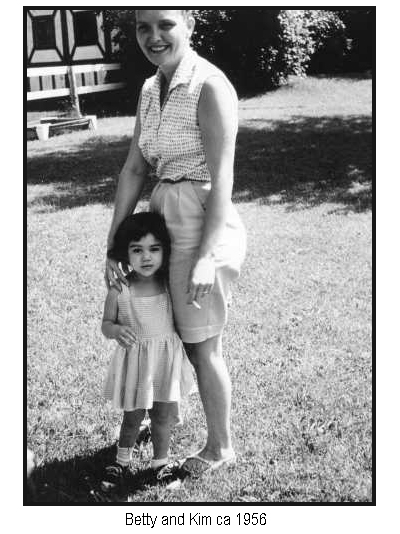
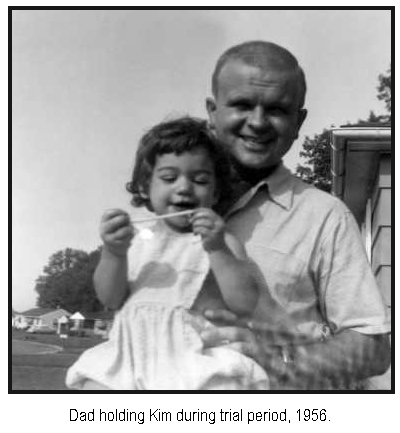
During the trial period for my adoption, Mom had experienced a few unnerving experiences with strangers who had recognized me when she’d be taking me for a walk in my stroller. The final straw had come one day when a woman we were passing on the sidewalk had blurted out, “Hey, wait a minute. Stop! I know that kid!”
Without losing a beat, Mom had called over her shoulder, “Sorry, but you’re mistaken. This is my daughter.” She had continued pushing me forward with no further drama.
Later that day, though, when Dad had come home from work, she had urged him to hurry along the process of finding a house away from the city. So they had begun their search in earnest.
A few months after the adoption was official, my dad came home with a carload of old flattened cartons, which he’d been collecting for weeks. And at supper that day, my parents informed my brother and me that we were going to move out of our small ranch house in Rochester to a small colonial house they’d found in the suburbs.
We were moving because of my father’s latest promotion at the R. T. French Company (maker of French’s mustard) where, from the time my brother was about a year old, Dad had begun in their advertising department. In no time at all, he had been promoted to assistant advertising manager, then to sales promotion manager, and then to group marketing manager. I believe my dad was promoted so rapidly because of his high standards and work ethic as much as his big personality and talent.
Now, Dad was being promoted to marketing director for the company and was expected to maintain a certain lifestyle, one unlike what we had been used to. This meant socializing with the upper middle class and living in a more upscale neighborhood where my parents could belong to a country club, play bridge, and most important, play golf with other members of the club.
The up-and-coming town of Pittsford—a charming colonial village along the Erie Canal with the requisite country club and golf courses—seemed to perfectly fit all the requirements.
During the entire period of packing up all our stuff, the actual move, and then the unpacking of everything, my mother and I engaged in a new and favorite activity. She taught me new songs. My favorites at the time were “How Much Is That Doggie in the Window?” and “Frère Jacques.”
I may have sung those two songs to death, I think, because about then my mother purposely set down her freshly brewed cup of black coffee, took me by the hand out of the kitchen and into the living room of our cute two-story house, and asked me to sit on the sofa and to be still. As she struggled with a few unopened cartons, looking for something in particular, I could barely wait to see what it was. Soon she had kitchen shears in her hand to cut through the packing tape of two of the cartons. I ran over and discovered piles of record albums.
Dad and Chip had already set up the stereo system the day before, so now Mom chose a few albums, removed the records from their paper sleeves, and stacked them carefully on the record player. She told me to go back to the couch and to stay there and listen to the music while she continued putting things away.
I heard a variety of recording artists—Frank Sinatra, Nat King Cole, Ella Fitzgerald, Johnny Mathis, Tony Bennett, Andy Williams—each with his or her unique sound and style. When the last record was ending, Mom waltzed back into the room—she loved to dance—turned the records over, and restacked them into the player.
Day after day, this would be part of our routine. I would listen to a stack of albums and memorize the words and tunes, so on the next go-round, I’d be able to sing along. Mom wasn’t surprised with how quickly I learned the melodies and lyrics because even Dave Hanson had reported I’d been a fast learner. What surprised her was my perfect pitch and ability to recall each singer’s phrasing, dynamics, and register. But what really blew her mind was that even at my tender age—I was only about three years old—I intuitively had begun to harmonize.
I could see all this in my mother’s eyes. Whenever I sang, her baby blues sparkled, her gorgeous smile widened, and because she loved to dance, she always swayed and twirled around the room. Boy, oh boy, did I love seeing my mom happy like that. Nothing meant more to me.
And to ensure her happiness, I learned, all I needed to do was what I loved to do anyway—sing. I’d sing; she’d be happy. I’d see her happy; I’d be happy. It was that simple. Or so I thought.
Whenever we were in the car on our way to visit Grandma Flossie and Grandpa Joe, I’d wonder if Grandma would serve burnt pork chops again for dinner. Then I’d wonder what song I’d sing that day because I always would perform for them after jumping out from behind their musty living room drapes. “Ta da!” I’d shout. “I’m going to be a singer!”
Around the time I turned seven, though, that all changed. I’d only agree to sing for them if they promised not to look at me. So, at my grandparents’ house, I did my singing from behind their curtains. At home and at Uncle Earl and Uncle Bud’s place, I’d sing only from behind their sofa.
One day when I was twelve years old, Uncle Bud stopped me in the middle of singing, “Leaving on a Jet Plane.” “Hold it right there!” he said, leaning over the couch and looking at me. “You wanna be a singer, kiddo? Ya gotta get out from behind the couch!”
“But I don’t want people to look at me.”
“Sorry, kid, but ya gotta let them. That’s just the way it is. C’mon. Out front. Let’s go.”
“Fine! I’m coming... but I’m not singing.”
“Suit yourself,” he said taking my hand as though we were dancing. “Sooner or later, you’re going to have to do it, Kimbo,” his nickname for me. “Think about it at least, okay?”
I said I would, but I didn’t mean it. At the time, I already had too many other things to worry about, two of them dealing with speaking.
For one thing, I had developed a stuttering problem that embarrassed me greatly. Mom suggested a few coping strategies. For example, if I answered our telephone and had trouble getting out the word “hello,” she recommended I just laugh at myself and say something like, “Please wait a second. Let me try that again.”
She assured me the day would come when I’d be able to say whatever I wanted without stuttering, that my stuttering problem would eventually end. As it turned out, stuttering in terms of a serious problem did end but not until I was in my junior year of high school. To this day, a stutter here or there might take me by surprise but only if I’m extremely fatigued or if I try to get too many thoughts out at one time.
Also, I had a difficult time overcoming a speech impediment, mostly with the letter s. Mom and Dad hired a speech therapist to work with me, and surprise, surprise, I had to practice the tongue-twister you probably said just for the fun of it. Well, try repeating “Sally sells seashells down by the seashore” or “Betty’s blue beach bag” a zillion-katrillion-bazillion times, and see how much fun that is for you. No matter what, though, if you do it, you’ll probably learn what I did: Practice makes perfect.
My father’s responsibilities at work continued to increase, and soon the company added business trips to his already crammed schedule. As it was, because of his diligent work ethic, exceptional management style, and high standards, he tended to be the first person to get to work in the morning and the last to leave at the end of the day.
One night after he had finally returned to Pittsford after having been away on a three-week business trip, he was supposed to be in my room tucking me in for the night. But he wasn’t.
“I know you’re disappointed, honey,” my mother said as she smoothed out my comforter. “Your daddy’d be here if he could. You know that, don’t you?”
“But why can’t he be? He said he would.”
“I already told you that he had no choice. He had to stay late again because his team counts on him to straighten things out when they go wrong.”
“Yes, but so do I.”
Mom touched my face. “What’s going on at work is an emergency, Kimmy. What’s going on here in this room isn’t.”
“What’s ‘emergency’?”
“That’s when something needs to be done right away to fix something that’s happened. Maybe something doesn’t work anymore, or something broke, or someone got hurt. If nothing’s done right away, the problem will continue to get worse.”
“Oh, like when I cut my finger.”
“That’s exactly right.”
“But—“
“Look, Kimberly, your daddy wishes he could be in two places at one time, but that’s just not possible, is it?”
“Well... maybe he could.”
“Aw c’mon now, you’re just being silly.”
“But, Mom, I want him to see what I got!”
“I know you do, and you know what? I bet you’ll get to show it to him tomorrow night. Know why?”
“Why?”
“Because Daddy’s project must be finished by noontime tomorrow to meet the deadline.”
“What’s that?”
“That’s when time’s up, ready or not.” She reached under my chin and tickled me. “Get it?”
For those giggling moments before Mom kissed me goodnight, I actually forgot about all the birthday presents, cards, bows, and ribbons that I’d kept neatly piled at the foot of my bed for weeks.
From as far back as I can remember, Dad gave us kids three pieces of advice: “Always do your best, always be honest, and always have health insurance.” He taught me to give 100-percent effort to whatever I was doing and to tell the truth. But, as a little kid, that last part about health insurance? I could never understand what in the world that had to do with the two other pieces of advice, so whenever I’d hear him say that, I’d just laugh myself silly, certain he was just kidding around.
It never occurred to me—me, the big questioner, the big wonderer—to ask the question, Why? Why always have health insurance?
In some ways, though, even in those first few years in Pittsford, I worried that Daddy was being stretched in too many different directions at the same time. Work, all day long. Us kids in the evening. So much stuff to do on the weekends. So much this, so much that.
Both of my parents now were leading an active social life. On weekends, if they weren’t entertaining other couples at our house, my parents were being entertained at someone else’s home. Or they were having dinner out at a restaurant. Or they were at the country club. Or playing bridge. Or playing golf. Or playing golf. Or playing golf. And a lot of booze was being poured and consumed. A lot of cigarettes were being purchased and smoked.
Somehow, as much as I hated the stench of that cigarette smoke, I got used to it. In time, the swirling smoky veil in every room became invisible. Although I never said a word about their smoking—and almost all their friends smoked as well—I thought my wrinkled up nose and flailing arms would tell them for me.
No such luck.
By the time Elvis Presley had appeared on The Ed Sullivan Show for the third time, I was singing along with “Don’t Be Cruel.” My rash continued to lessen. The ugly reddish birthmark was fading. Even the bumpy birthmark on my shoulder was beginning to shrink. With the love and security of my parents and my big brother, I was in the right place, in more ways than one. The 1950s was a great time to be a kid growing up in Pittsford, especially in such a friendly, safe neighborhood.
Our house was situated at the corner of Rand Place and Jefferson Road. Gorgeous, big old elm and maple trees lined both sides of Rand Place, whereas Jefferson Road was actually a major thoroughfare. I wasn’t allowed to go out onto Rand Place by myself when I was little. So, I watched the older kids swoosh past our house on their bikes and then screech to a halt at the corner of Rand and Jefferson.
The girls tended to ride by more slowly, and when they reached the corner, they would either get off their bikes and turn them around or make a wide, slow turn before heading back in the direction they’d come from. The point of all this, I learned, was that Rand Place was safe, just as long as you knew enough to steer clear of Jefferson Road. I guess you could say it was an unwritten law.
The neighborhood itself was safe, though. Back then, neighbors left their doors unlocked, and when they said, “Please drop by,” they meant it. In many ways, our neighborhood was more than just safe. It was like one big, happy family.
During the day, which Chip spent at school and Dad, at work, Mom and I enjoyed many lively mornings or afternoons visiting with neighbors either at our house or theirs. In those days, with no shortage of stay-at-home moms, I had plenty of friends to play with. Loneliness was never a problem. That is, as long as my mom was within eyesight or within range of my voice. If that were true, I felt like the happiest kid on the planet.
With each new person I met in Pittsford—child or adult—I proudly announced, “I’m adopted!” Not that anyone had asked me and not that anyone seemed to care about that one way or the other. On separate occasions, though, I heard a few of my mother’s new friends ask her if I’d been foreign-born. She always answered by saying, “No.” That was all, just, “No.”
The truth of the matter was that being adopted was on no one’s radar. And before long, it was not even on my own.
The one thing I had trouble adjusting to in our new home was falling asleep at night. The trucks on Jefferson Road were terribly noisy. Finally, I stopped seeing in my mind’s eye what was out there, those eighteen-wheelers speeding along the asphalt highway on their way up state and down state. Instead, I saw something magical in my private eye: the ocean. And the thunderous noise I was hearing was the ocean’s waves coming in and going out and crashing against slick, giant boulders.
And it worked.
While Mom and Dad had their jobs, I seemed to have my own. I liked giving 100 percent effort to my job: being happy. It was easy, living on Rand Place. I loved our house, inside and out. Becoming bored was not one of my many issues.
Outdoors, all I had to do to be amused was look closely. I’d find amazing things happening right under my nose. Another world existed that I otherwise would never think about. The little creatures scampering, crawling, hopping around our house, entertained me to no end. Chipmunks, squirrels, caterpillars, worms, ladybugs, ants, grasshoppers, fireflies... birds! Birdsongs.
One day after spotting a yellow bird in one of the cherry trees at the side of our house, I thought instead of the bird singing to me, I would sing to it.
“I left my heart in San Fran...,” I sang, but darn it, I didn’t even get through the first line before that bird flew away. That was one of mom’s favorite songs; she’d play it all the time. With hurt feelings, I ran to my house, but by the time I got inside, I was wondering what would have happened if I’d sung a different song.
For such a little girl, I was a great big wonderer. That’s what my mother always said about me.
Our backyard sloped down to a little creek that wiggled its way through other backyards and neighborhoods on its way down to the Erie Canal. Some days, Mom would dress me in dungaree overalls so I could explore down by the creek to my heart’s content without her worrying about getting out stains from my good clothes.
If I were lucky—which I always seemed to be, especially after a good rainfall—I’d find a slew of pollywogs. Mom would allow me to keep them in jars of water so we could observe their evolution.
The most fun I had after a rain was spotting a frog and chasing it. I knew that if I could catch it, I’d be able to keep it for a pet. But only for a few days. After that, I’d have to let it go. Mom explained that frogs couldn’t be happy if they were cooped up. They needed to be free.
Even only a few days of having a frog for a pet was worth the effort. While that frog was mine, I sang to him all the time so I knew he was happy before I let him go off to be on his own.
I think I loved catching frogs almost as much as singing because whenever I caught one I’d turn around to show it to my mom. She would always be smiling proudly.
Whether she’d be there beside me down at the creek or watching me from the kitchen window, I always knew she was there.
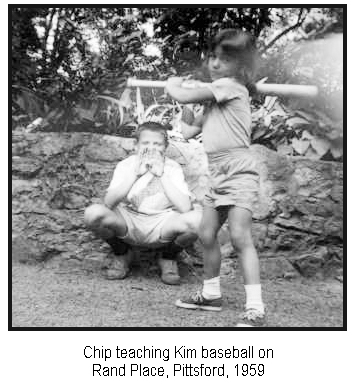
I was three and a half years old the day Dad rushed home from work early. He snatched some of my toys, grabbed my hand, and rushed me over to a neighbor’s house. At the door I heard him say to Mrs. Pitkin, “Sorry to trouble you, Nora. Can you watch Kimberly? I have to take Betty to the hospital.”
“Of course,” she said. “Whatever you need, Bob. Whatever you need! Go! She’ll be fine with me.”
It had all happened so fast. Mom hadn’t been feeling well all morning, and then by the time Chip got home from school, she was doubled over in agony. It was the scariest thing I’d ever seen. I couldn’t stop crying. I didn’t know what to do, but Chip knew to call Dad. Now, here he was, obviously upset beyond belief yet speaking calmly and trying his best to keep things together for my sake, but at the time, I certainly wasn’t thinking about that. I wasn’t thinking about him.
Through my tears, I begged him not to leave me at Mrs. Pitkin’s house. But he did. It was like a nightmare, watching my daddy run back to our house where Chip was in the car waiting with Mom. The car sped away. Mrs. Pitkin took me by the hand into her kitchen. That’s about all I remember.
It wasn’t until many years later that my father shared what had happened at the emergency room. Because Mom was writhing in pain, the nurses whisked her off in a wheelchair to be examined by the doctors. A doctor came out to talk to Dad and gave him the horrifying news: His true love, his one and only, was in critical condition. They needed to operate on her. Immediately.
After my father and Chip were left in the emergency waiting room to absorb what was happening to my mother, Dad led my brother over to a quiet corner. He asked Chip to pray with him. He said they had to pray during her surgery because there was nothing else they could do. They had to pray for the woman they adored, for the operation to go well, for her to get through it, for her to be well again, and for her to come home to them. And, of course, to me.
“Your sister needs her even more than we do, Chip. She won’t survive without Mom, you know?”
And with that, the two actually knelt and prayed, which was extremely difficult for me to visualize because Dad had never been a religious man before that day or afterwards.
The doctor informed him that an ovarian cyst had ruptured. Peritonitis had set in, and the poison had spread throughout his wife’s female organs. During the surgery, she had flat-lined for several minutes before they were able to resuscitate her. In order to save her life, they performed a radical hysterectomy, and that meant that all of Betty’s female organs, including her cervix, had to be removed.
“I’m sorry to say that your wife’s recovery period will take some time. Months,” the doctor said. “Perhaps years.”
“I see,” Dad said.
“And there will also be serious side effects after that.”
“Side effects?”
“Severe mood swings, for example,” the doctor said. “Menopause.” He reached out and touched my father’s arm. “I’m sorry,” he said. “She’s so young. But there was no other choice. I hope you understand.”
After my mother’s hysterectomy, she had to stay in the hospital for weeks. So, Dad, Chip, and I stuck to a routine. Each morning after Dad got Chip off to school, Daddy would walk me to Mrs. Pitkin’s house, kiss me good-bye, and say to have fun. Then he’d go on to the office, and I would stay all day long and play with Jeannie Pitkin, who was three years older than I was. After school, my brother would go there, too. And then, at some point Dad would come to take us home.
Each day, all day, I wished with all my might that when Daddy came back to pick us up I’d hear him announce that Mom was coming home.
Whatever happened between when Dad dropped me off and when he came back to get me is still a blur. I remember only that each day and each night that passed without him saying those magic words I grew more and more terrified that my mother might never come home again. The thought always made me feel sick to my stomach.
During that third week, when Dad still hadn’t said the magic words, my miserable phantom rash returned with a vengeance. Each day while I pretended to be having fun on the outside, inside, it was as though I were numb in one way and on fire in another.
At night, when Dad tucked me in, I tried really hard to be brave. But I usually cried myself to sleep.
One late afternoon during that third week, Dad came into the Pitkins’ house with the biggest surprise I’d ever had.
“Guess what, children!” he said. “Your mother’s home!”
“Already?”
“Now?”
“Yes, she is!” he said, smiling brightly for the first time in weeks.
Right then and there, I started jumping up and down like a little maniac, and Chip ran to the back room to gather up all his homework and baseball stuff.
Dad reached down to hold me still. “Kimmy,” he said, “I want you to listen to me.”
“What, Dad?”
He explained that Mom was at home in bed, that she would need plenty of rest, and that it was up to the three of us to help her with her recuperation.
“What’s recuperation, Dad?”
“That’s the time it will take for her to feel all better.”
“Oh.”
He knelt down and took my face in his hands, turning it so he could look me in the eye. “Kimmy,” he said, “when you cut your finger, remember how much it hurt and how the doctor fixed you up but then how long it took to heal?”
“Uh huh.”
“Well, that was for just a little finger. Mom’s operation was really big, wasn’t it?”
“Inside her whole tummy.”
“Right. So that’s where Mom still is very, very sore.”
“Still?”
“Yes, so we have to be extremely careful around her. Gentle. Okay?”
“Okay. I will be.”
His strong hands held me in place when I turned to leave. “So, Kimmy, there’s to be no jumping when you’re with Mom.”
“Okay.”
“You understand?”
“Uh huh.”
He gave me a hug. “That’s my big girl!”