Critical Acclaim
“A charming book….Shows readers, with humor and zest, how to live in the now and change our futures. For most collections.”
—Library Journal
“Zen and the Art of Happiness is enthusiastically recommended and ‘user friendly’ reading for anyone seeking to enhance their spirituality, deal with life’s stresses, and improve their physical, emotional, and spiritual well-being.”
—Midwest Book Review
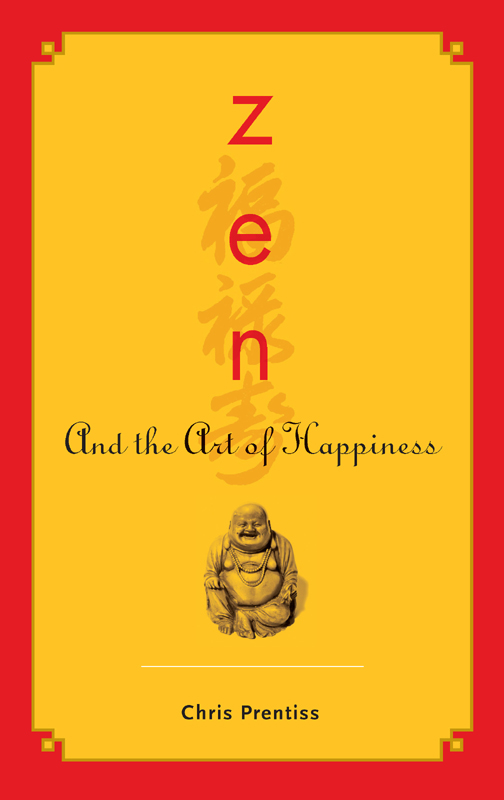
“The big-bellied, somewhat eccentric laughing Buddha on the cover tells it all. The author does not believe that happiness depends on being the same size as models in the fashion magazines, finding the perfect mate, filling one’s house with cutting-edge electronic gadgets, or studying meditation with the current ‘it’ guru….
“The book reflects a long-standing esoteric maxim: We create our own reality. What makes this work different from so many others is the personal energy, knowledge, and insight with which he communicates. He draws on Eastern and Western philosophy, modern science, and personal—sometimes catastrophic—experience to explain why believing circumstances will benefit us is what will, ultimately, cause this to be true.
“His life has been filled with challenges he has turned into opportunities. He does not lecture to us from a pedestal as an enlightened being. Instead, he speaks as one who has survived the muck and mire and retained his childlike wonder and enthusiasm. Prentiss beckons us to see the world through his eyes and share his joy. It is easy to believe it is possible.”
—New Age Retailer
“Happiness can be a fickle thing. It can be a snug, magnetic garment, attracting more and more of the same, or it can be an ill-fitting gossamer veil flitting here and there. It all depends on one’s psychology, karma, and attitude. This wonderful little book shows that we can overcome the obstacles to happiness. It’s for those who want and need change—in expectations, habits, and outlook. Chris Prentiss teaches us how, with a joie de vivre that obviously comes from experience. Use his practical wisdom to get in the habit of being happy—every day. Put this book by your bedside and the Zen of happiness can be yours.”
—ReverseSpins.com
Library of Congress Control Number:
2006903540
Copyright © 2006 by Chris Prentiss.
All rights reserved. Printed in the United States of America.
No part of this book may be used or reproduced in any manner whatsoever without written permission except in the case of brief quotations embodied in critical articles or reviews.
For information, address:
Power Press
6428 Meadows Court
Malibu, California 90265
Telephone: 310-392-9393
Email: info@PowerPressPublishing.com
Website: www.PowerPressPublishing.com
ISBN: 978-0-943015-53-8
(paperback)
ISBN: 978-0-943015-57-6
(hardcover)
ISBN: 9780943015620
10 9 8 7 6
Cover design: Nita Ybarra
Interior design: Roger Gefvert
For Todd
Happiness
The three Chinese characters pictured on the cover and throughout the interior of this book are often used together. Collectively, they denote “happiness.” Individually, these characters mean:

good luck
prosperity
longevity
The jolly “Laughing Buddha” on the front cover is a depiction of the endearing and compassionate Buddha known in Japan as Hotei and in China as Pu-tai. Some say the jovial figure is based on an eccentric, wandering Zen beggar monk who lived over a thousand years ago and who is believed to be an incarnation of the bodhisattva Maitreya (the Future Buddha), called the “Loving One” or “Friendly One.”
The Buddha’s large pot belly symbolizes happiness, good luck, and abundance and he graces all with his joy and playful spontaneity.
Contents
1 The Way
2 We Are the Authors of Every Next Moment
3 The New Experience
4 The Inner Road
5 Mindful Happiness
6 What’s True in the Universe
7 Adapting to Change
8 Stress and Your Imagination
9 Healing Your Past
10 The Language of the Universe
Notes
Acknowledgments
1 | The Way
Perfection is everywhere if we only choose to recognize it.
—OKAKURA KAKUZO
There is only one way to achieve lasting happiness. That way is simply: Be happy.
After reading that, you might be having some or all of the following thoughts: “It’s stupid, and I’m beginning to feel very unhappy about buying this book. I hope it gets better.” “It’s too simple.” “The author has lost his mind and has taken to mumbling inanities.” “It doesn’t tell me enough about how I get to be happy.” “Things just don’t work like that.” “It doesn’t take into account the times when I’m decidedly unhappy because of the inevitable mishaps and problems that arise in my everyday life, not to mention the tragedies.” “You can’t just be happy.” “The author must be getting old.”
All of that may be true. Being happy much more of the time than you have been is an incredibly complex and difficult task—not in the doing of it once you know how but in coming to know how and then in keeping aware of what you have discovered. Yet, I still say you can do it, and by the time you finish this little book, if you are willing to give what you have read a chance to be true, you will do it.
The path that has led to your current condition and situation was not a few days or months in the making, but a long and arduous path that has spanned many years. Actually, it has taken you as long as you’ve been alive to become the way you are. It has also taken you that long to achieve what you’ve achieved, to possess what you now possess, and to arrive at your current condition.
Your life today is the result of a series of decisions you made that have caused you to arrive where you are.
If who you are and what you have is what you want, if you’re satisfied with the conditions of your life, congratulations—do more of what you’ve been doing and you’ll get more of what you already have. But if who you are, what you want, what you have, and your current conditions are less than what you want or are different from what you want, you have to make some changes—basic changes, inner changes. Failure to make those changes will find you fruitlessly continuing to seek the things you desire as the years pass by.
In this book, you may see statements that are contrary to what you believe, contrary to what your experience has taught you, contrary to what others have told you, contrary to the spiritual traditions you grew up with, and even contrary to your own common sense. That is to be expected. If it were not that way, you would have already achieved the art of happiness.
Because some of what you will read may seem impossible or foolish, even ridiculous, it may at first offend your sensibilities, causing you to scoff at it, ridicule it, and reject it. Each time you come upon a statement that has that effect upon you, I suggest that before rejecting it, you ask yourself whether or not you would want that statement to be true—and then give yourself the chance to see it as true.
Simple Questions
The truth is always near at hand, within your reach.
— D. T. SUZUKI
With your permission, I would now like to take you beyond the limits of your customary thoughts and experiences. This new way of life begins with two simple questions.
First, answer truthfully the following question. Would I want this to be true: “Every event that befalls me is absolutely the best possible event that could occur.”
The second, more difficult part, is to truthfully answer the question: Will I give that a chance to be true?
Imagine that God appeared before you this instant and said: “I promise you that everything that happens to you from this moment forward will be of the greatest benefit to you and will bring you the utmost good fortune.” Suppose God went on to say: “Even though what happens will sometimes appear unfortunate or hurtful, in the end your life will be wonderfully blessed and hugely benefited by whatever happens.”
How would you feel about that wonderful news? Happy? Perhaps even joyful? Wouldn’t it be the best piece of news you could hear? Wouldn’t you heave a deep sigh of relief and feel as if a great burden had been lifted from your shoulders? Wouldn’t you then respond to the next thing that happened—even if it was hurtful or took something from you or seemed bad or unlucky—as though it was going to be wonderfully beneficial for you, the best possible thing that could have happened?
If you did not enthusiastically answer yes, perhaps you have mistaken what I am talking about in the above paragraph. I am not talking about the phrase we commonly hear, “Try to make the best of it,” which means “The situation or event really is bad and terribly unlucky, but do what you can to salvage some good out of it.” Nor do I mean that within even the worst event possible, there can be found a tiny bit of good.
I am not thinking in terms of such limiting ideas. I am thinking in unlimited terms, where every event that befalls you is absolutely the best possible event that could occur—that there is no other event imaginable that could benefit you to any greater degree.
So, again, wouldn’t that be the best piece of news you could hear? Wouldn’t you heave a deep sigh of relief and feel as if a great burden had been lifted from your shoulders? And wouldn’t you then respond to the next thing that happened—even if it was hurtful or took something from you or seemed bad or unlucky—as though it was the best possible thing that could have happened?
If you are willing to give this new concept a chance and to actually believe that everything that happens to you is the best thing that can possibly happen to you, you will start to act in accord with that belief and, as a result of natural law, bring about that end. It takes some getting used to and it takes presence of mind, which is the more difficult part, but the price is small considering the reward: a lifetime spent in the sunshine of happiness.
Zen
Zen is simply…that state of centeredness which is here and now.
—ALAN WATTS
Zen is too vast a subject to be dealt with in its entirety in this small book, but I will explore how the essence of Zen, its method, and its approach can be used effectively by us to achieve our goal of happiness.
Zen is a Japanese word that is derived from the Sanskrit word meaning “meditation” (dhyana in Sanskrit, ch’an in Chinese, and zen in Japanese). Zen is a journey of exploration and a way of living that, in and of itself, does not belong to any one religion or tradition. It is about experiencing life in the here and now and about removing the dualistic distinctions between “I” and “you,” between “subject” and “object,” between our spiritual and our ordinary, everyday activities. It is about seeing into, directly experiencing, and expressing one’s true nature.
The Zen approach fosters a natural awareness and centeredness in our daily life. As D. T. Suzuki, the Japanese scholar and leading spokes-man of Zen in mid-twentieth century America, said of Zen, “It merely enables us to wake up and become aware. It does not teach, it points.”
Here is the heart of it:
The Zen of doing anything is doing it with a particular concentration of mind, a calmness and simplicity of mind, that brings the experience of enlightenment and, through that experience, happiness.
This book is about the Zen of happiness, which is another way of saying it’s about the art of happiness, the essence of happiness, the inner game of happiness, the inside track to happiness.
Done correctly, happiness is an inevitable end.
In their efforts to experience enlightenment, yogis spend years and decades in meditation. Students of Zen concentrate for years on koans, or Zen riddles. The enlightened ones who attained their goal have attested that often the experience came in a flash and lasted only an instant, but it was so powerful that it changed them forever.
What did they experience that was so powerful? Their oneness with the Universe. That is what enlightenment is: knowing that everything in the Universe is created from and is part of the same energy, and knowing in what way we relate to it all. Once that awareness is obtained, all else falls into place, everything makes sense, and everything can be understood. As the Zen master Do-gen taught, “To be enlightened is to be intimate with all things.”