Pseudonyms have been used to protect the identity
of some people mentioned in this book.
Horrible Man : Sinister Secrets and Truths Untold : The Portland Hair Salon Murders / Leonie Wallace.
Copyright © Leonie Wallace 2012
ISBN: 9780980672985
2012 ebook edition 1.0
Published by Fontaine Press
P.O. Box 948, Fremantle,
Western Australia 6959
www.fontainepress.com
Apart from fair dealing for the purposes of private study, research, criticism and review as permitted under the Copyright Act 1968, no part of this publication may be translated, reproduced, or transmitted in any form or by any means, in whole or in part, electronic or mechanical including photocopying, recording, or by any information storage or retrieval system without prior permission in writing from the publisher.
This book is available as a printed book: to purchase, visit: http://www.fontainepress.com/horribleman

Leonie Wallace is a former newspaper and television journalist who teaches English to secondary school teenagers. In 1991, while a cadet reporter in Geelong, she heard about the baffling murder of two women in Portland. When it remained unsolved, the mystery inspired her decision to one day research the case for the purposes of writing a book. That time came in late 2008 while juggling the demands of parenting her two pre-school children. ‘Horrible Man’ is Leonie’s first book.
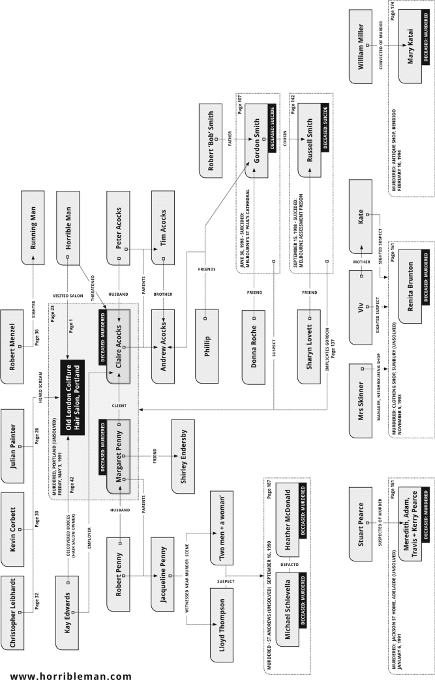
- Links between the characters and events -
CONTENTS
Prologue
1 The ‘Horrible Man’
2 Portland
3 Leaving Home
4 The Crucial 90 Minutes
5 Discovering the Bodies
6 The Early Police Investigation
7 Becoming Involved
8 Suspects and Theories
9 Portland Man, Gordon Smith
10 Melbourne Man, Russell Smith
11 Murder at Sunbury
12 Murder at Bendigo
13 Adelaide Man, Stuart Pearce
14 Murder at St Andrews
15 Inside the Criminal Mind
16 Claire Acocks
17 Margaret Penny
18 A Cold Case
Epilogue
Acknowledgements
PROLOGUE
5.11.2011
Beep beep. I was half asleep as I reached for my mobile phone on the bedside table, but with each word quickly became wide-eyed.
“Saw your article in 2days Standard I know who killed those women I have a story that has never been told”
I threw back the covers and my feet hit the floor. Was this serious? Or, more likely, were these the words of a crackpot seeking a thrill? While the text did not contain a name, the number had not been blocked. Taking note of the phone number, I nervously keyed each digit. A woman answered.
* * *
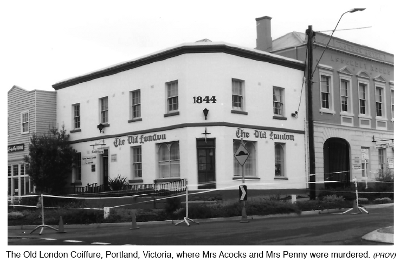
It was a Friday afternoon when two women were butchered to death at a hairdressing salon in one of Australia’s worst unsolved crimes. The seaside regional centre of Portland in Victoria’s South West unwittingly played host to this disturbing double homicide. For more than 20 years it has remained a mystery. No motive. No weapon. No known offender. The scene was the shampoo room of a hairdressing salon known as the Old London Coiffure, housed inside an historic bluestone corner building overlooking a busy T-junction. Pedestrians and motorists passed by, oblivious to the merciless torture and slaughter going on only metres away. Adjoining businesses continued their trade as the wind-down to the weekend began. Meanwhile a callous killer was holding two middle-aged grandmothers captive – 49-year-old hairdresser Claire Acocks and her client, 58-year-old Margaret Penny. The walls and floor would be sprayed and soaked with the victims’ blood, their bodies battered and bruised from repeated stab wounds and rough handling. Their throats cut. It was May 3, 1991.
Two independent witnesses would provide crucial information to police within days of the murders that most likely held the strongest clues to the offender’s identity. However, in circumstances that undoubtedly impacted on the inability of police to solve this crime, both witnesses were not interviewed until about three years later. In the meantime, the same police who had failed to follow up these eyewitnesses began interviewing and investigating suspects. To be a suspect in any murder, culprit or not, is highly damaging to a person’s social standing. This is magnified when it occurs in a small community. One suspect, a young Portland man, later hanged himself in a Melbourne church. The stain of being a suspect in this crime would never wash off.
Eventually – two years and nine months after the murders – police took a statement from one of the witnesses they overlooked, resulting in the creation of a computer-generated image of the potential killer. The image was compiled by a Portland businessman and former town mayor, who saw a man running from the footpath near the back entrance of the salon. Upon first hearing news of the murders and realising the importance of what he had witnessed, the former mayor had immediately volunteered details to police at an information caravan positioned near the scene and again during a police doorknock of businesses in the area. Years later his meticulous memories of this running man provided compelling evidence. The identikit photograph was released to the media Australia-wide. This description was confirmed by another witness; a young Portland woman who was walking her dog about a block from the crime scene. She encountered a bloodied, barefoot man who attempted to engage her in conversation about her pet. Her experience was relayed to the Portland police station on the night of the murders. But again, this critical eyewitness was not immediately interviewed.
There is no doubt that homicide detectives worked tirelessly pursuing a plethora of possibilities in their determined attempts to nail this killer. But how many hours of overtime can these homicide detectives be expected to clock? After all, this crime added two more deaths to the overburdened murder in-tray on their desks. It is also important to remember the context of the time in which this crime occurred. DNA technology was still in its infancy. According to the original lead investigator, his team initially followed paper trails without computers. Add to that a tsunami of information from a frightened public and you do not need the advantage of hindsight to realise the police were under pressure. It all amounts to cold comfort for the victims’ families, but provides a setting in which this crime was investigated. Nevertheless, something went wrong. So who or what is to blame? You can make up your own mind. Meanwhile, a sadistic killer was and still is, getting away with murder. Surely, this crime is solvable.
The crime scene suggests the killer may have taken his time terrorising his victims. An hour-and-a-half exists between when one of the victims was last seen alive and when the bodies were discovered. Between 3.05 and 4.35pm two lives were lost and many others were changed irreversibly in the process. With each minute the killer risked detection, strengthening the possibility he may have been cool and calm under pressure with a high threshold for anxiety. Both women suffered defensive wounds, suggesting they attempted to fend off their attacker. At some stage, both women had been made to sit upon the chairs, to which their lower legs had been bound with electrical cord. The bindings represented flimsy attempts to gain control, but more importantly symbolised power and authority. But while the bindings appeared escapable, it seemed the circumstances were not.
Autopsy reports led police to believe the killer wielded two weapons. A knife most likely created the slashing and stab wounds. The women were attacked differently, with Mrs Penny taking a larger share of their killer’s fury. Although Mrs Acocks was stabbed fewer times, her wounds were deeper than those of Mrs Penny. The offender covered both women’s heads with black hairdressing wraps before fleeing, cloaking the pained lifeless expressions, later captured by crime scene photographs.
According to the detective who led this investigation during its first six years, advances in forensic technology are now considered the main hope in solving this mystery. He indicated that samples of hair, blood, sweat and fingerprints were collected from the salon along with bloodied shoe impressions. Advances have been made and hopefully, this new technology will eventually unlock the answers.
So, was this offender mad or just plain bad? Also, what was the resultant fallout for the victims’ families and the wider community given grief, fear and confusion often partners unsolved murder? These are just some of the questions explored in this book through interviews with witnesses, members of the victims’ families, police connected to the case along with insights from a criminal psychologist and a forensic pathologist. There is no doubt this is a disturbing tale, however, it is not merely a book about murder. It is also a story about extraordinary people and their capacity for great courage, love and resilience in the face of extreme adversity. There is no doubt this crime generated a powerful ripple effect across the broader community. Haunted by heartbreak, the families directly affected continue to slowly move forward with varying degrees of success. The pain of losing a loved one to murder is a constant bad companion. The Acocks and Penny families want answers. They need answers.
This book names some of the men who were investigated for this crime, and explores their backgrounds. Other murders that for different reasons became linked to the Portland case have also been examined. They are presented for your assessment and judgement. It is up to you to decide what weight they deserve. It is highly possible the killer has a friend, a family member or an accomplice who knows what happened. It has been a long time to carry such a shocking secret.
1
“I don’t like hairdressers. I’ll be back.”
– The ‘Horrible Man’.
Just over two weeks prior to the savage slaying of Mrs Acocks and Mrs Penny, a strange event foreshadowed trouble. Mrs Acocks was between customers when a grubby man with frightening eyes crept silently into the Old London Coiffure. Given the momentary lull in clientele, she thought she was alone. A bell, crudely tethered by an elastic band to the internal handle of the front door, usually jingled when clients entered the waiting area. However, on this occasion the bell failed to alert Mrs Acocks to the man’s presence. He was standing close behind her when she first noticed him, triggering a terrible fright. His creepy demeanour unsettled the usually calm and confident hairdresser. The sinister stranger, who did not have an appointment, requested a trim. Unprovoked, he made disparaging remarks to the polite and inoffensive woman, but most disturbing of all were threatening comments that he disliked hairdressers and planned to return to the salon. Reports were conflicting as to whether Mrs Acocks cut his hair or if she fabricated an excuse by bluffing a booking was unavailable. Either way, as soon as he left, she took the uncharacteristic step of locking the doors, hastily telephoning her mother, Portland resident Violet Mayfield, for a reassuring lifeline. She relayed fears the hostile individual would soon return, requesting her mother attend the salon either as backup or to give the impression she was busy with a customer. Mrs Mayfield pacified her daughter, instructing her to call again if he reappeared and she would arrive immediately. He did not return; at least not that day. It was Wednesday April 17, 1991.
Over the next few days Mrs Acocks described this nameless man to family and friends. He left an indelible impression on the hairdresser, who for professional reasons, rarely spoke about her clients. His details were not recorded in the salon appointment book and it appeared Mrs Acocks did not know who he was. This man could not be eliminated as a suspect from the ensuing murder investigation as his identity was unknown. For the last 20 years he has been known simply as the ‘Horrible Man’. Devastated by her daughter’s death, Mrs Mayfield would remain burdened with regret for not attending the salon that day, reasoning that she may have seen the Horrible Man in the area, increasing the possibility of later identifying him. She took this remorse, along with her grief, to her own grave.
Several of the conversations Mrs Acocks had about the Horrible Man, occurred on the day of his visit. That evening she was at the home of good friend, Kevin Corbett, who worked in an office overlooking the courtyard at the rear of the Old London Coiffure. Mr Corbett had invited a small group of close companions to his home for dinner and drinks. He recalled discussing the Horrible Man with Mrs Acocks. “At about 6pm on the evening of the 17th we were having pre dinner drinks at my residence,” Mr Corbett wrote in his police statement. “During the course of the conversation Claire Acocks stated that she had this customer in the salon,” he wrote. “I think she said that day, but I’m not sure and that he had terrified her to the extent that as soon as he left the salon she shut the salon and went home. Claire stated that she was on her own in the salon and he just walked in off the street with no appointment and asked for a haircut. She stated that he had the most frightening eyes and she told me that he stated to her that he did not like hairdressers. Claire stated that she had never been so frightened in her life. Claire was very upset and disturbed as she was obviously very worried about this man. This was very much unlike Claire to be so concerned as she is not one to panic or exaggerate. During the course of this conversation Claire made no mention of this person’s identification except to state that he had horrible eyes.” Sixteen days later, Mr Corbett became one of the witnesses to hear screams from the Old London Coiffure as he worked in his office.
Mr Corbett’s daughter-in-law, Karen Corbett, was among the guests who discussed the Horrible Man with Mrs Acocks that evening. “I recall that we were sitting in the family room and Claire made a comment about a horrible customer that had been into the salon,” Mrs Corbett wrote in her police statement. “As I recall, Claire said, ‘I had this horrible customer…. He was a horrible, rude, disgusting, dirty and abusive man’…I am sure that she said that the customer had chains. I don’t think she said where he was wearing the chains. I also believe that she mentioned that he had long hair. She didn’t tell us who the customer was, so I am assuming that she hadn’t seen him before and wasn’t a local. Claire had a very calm disposition and it would have taken a lot for this man to upset her in the way that it obviously did. Claire certainly wouldn’t talk about her customers in general conversation.” Mrs Corbett is the last person known to have spoken with Mrs Acocks after telephoning the Old London Coiffure for a hair appointment most likely within minutes of the murders.
Prior to the Corbett function, Mrs Acocks discussed the Horrible Man at her home with daughter-in-law, Linda Acocks. In her police statement, Linda recalled: “Claire brought up the topic about this horrible man who had been into the salon...She asked me not to tell Peter, her husband, because he would just worry.” On the afternoon of the murders, Linda made a couple of unsuccessful telephone attempts to contact her mother-in-law at the salon to confirm babysitting arrangements for that night. The first time it rang out, the second it was engaged.
In a Warrnambool Standard newspaper report almost three years later, Mr Acocks revealed his wife “told me that she was in the salon one day and that there was this guy standing right behind her and she got a hell of a fright. The average person does not do that sort of thing. But she never told me much more about it. I did not know that she had said he would come back or that he hated hairdressers. Maybe she didn’t tell me because I was recovering from a heart by-pass operation. I wish she had said because I would not have allowed her to be there on her own. I would have kept in closer contact with her while she was there.” Mr Acocks’ police statement also referred to a burglary, which occurred at the salon in the weeks prior to the murders just before the Horrible Man’s visit. “Claire was worried about this and she said it must have been kids,” Mr Acocks wrote.
The salon business owner, Kay Edwards, recalled arriving for work on the morning of the burglary, but was not sure which day of the week it had been. About $20 to $30 in coins was stolen from the salon register and the chair behind the counter was pushed back out of the way, but otherwise nothing was disturbed, damaged or stolen. Peculiarly, there was no sign of a break-in, but Mrs Edwards was unsure if the offender accessed other parts of the building. “It was just an odd thing to happen...It was as if someone had a key,” Mrs Edwards told me. Both the door to the main building and the door to the salon were locked when Mrs Edwards arrived for work. “I came to work and the till was open and I was thinking that was odd,” she said. Her first reaction was to telephone police. It raises an important question - is the thief, the Horrible Man and the killer the same person? An electrical cord used to bind Mrs Penny originated from the salon’s reception storage area - did the burglary allow the killer to gain prior knowledge of the cord’s existence and location? The break-in was never solved and was considered a minor event, but in retrospect would appear major if the two events were connected.
Reference to the Horrible Man was also made by Detective Senior Constable Geoffrey Beanland of the homicide squad in his statement tendered to the coroner’s inquest in 1995. He wrote: “Investigators have established that approximately two weeks prior to the deaths of Claire Acocks and Margaret Penny, that the deceased Acocks voiced her fears and concerns about a male person that had apparently attended at (the) Old London Coiffure and received a hair cut from Mrs Acocks…All avenues of enquiry have been explored in an attempt to identify this male, however, the identity of the male person described as being the horrible man, despite numerous enquiries, is not known. The appointment book, used to record names of clients that receive haircuts at the salon, does not appear to reveal his name. We are unable to say that this person is involved in the deaths of Claire Acocks and Margaret Penny, however, we are unable to exclude him from the investigation.”
It is possible the Horrible Man’s visit had nothing to do with personal grooming and everything to do with evil intent. Perhaps he was assessing his murder scene, gauging the vulnerability of his potential victim or victims, reducing the unknown variables and building confidence to take his plan to the next level. Part of his homework may have been to note the salon routine and physical configuration including entry and exit points. Did the Horrible Man make good on his promise to return to the salon or is he simply a red herring? Is he an innocent person blending somewhere in the community too embarrassed by his unflattering moniker to come forward or too afraid he may be wrongly suspected of double murder? Other questions also remain. Was there more than one offender? Did the killer have a lookout? Was the perpetrator a woman? What motive could exist to obliterate the lives of two defenceless and harmless women? Was it the work of an opportunistic psychopath or a robbery gone wrong? Could it have been an organised hit as payback for events in which both victims had no direct involvement? Was the offender known to either of the victims?
Both women were Portland residents. Mrs Acocks had lived in Portland since 1976, while Mrs Penny had retired to the town only seven months prior to the murders after having previously lived in the area. Mrs Acocks was employed part-time on Wednesday mornings and Friday afternoons at the Old London Coiffure. Mrs Penny was a regular client at the salon with a weekly Friday appointment. These movements represented two separate routines both easily monitored if the perpetrator had focused either woman in his cross hairs. Or, is it merely a tragic case of wrong place, wrong time? Who killed Mrs Acocks and Mrs Penny and why, may only be known to the offender, but how do you keep such a vile secret? Irrespective of whether or not the Horrible Man was the killer, there is no doubt the person responsible for this crime was a highly disturbed individual who committed a truly horrible act.
2
PORTLAND
“Every crime is solvable, it’s just a matter of finding the right key – that lucky break to open the door – the right suspect and everything fits in. But homicide investigations are rarely as simple as that. There are usually hundreds of keys.” – Former Victoria Police Homicide Squad Detective Senior Sergeant, John Morrish.
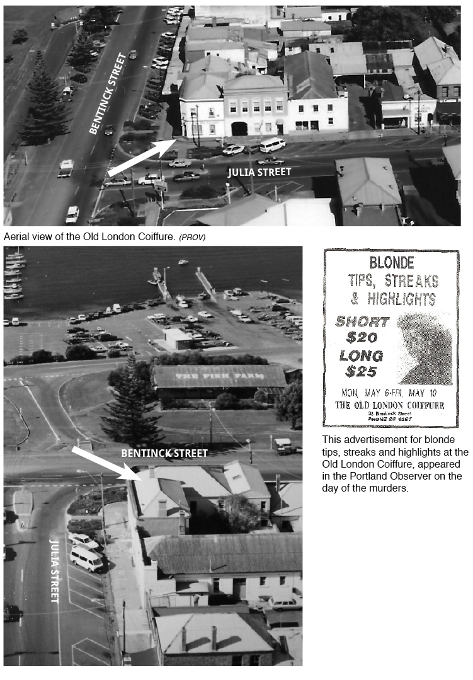
News that two women had been slaughtered at a hairdressing salon spread quickly across Victoria’s South West like a fast-moving nauseating fog. Located about 360 kilometres west of Melbourne, Portland was used to being buffeted by strong winds sweeping off the Southern Ocean, but was not prepared for a grisly double slaying. Residents were temporarily paralysed in disbelief that such a horrific and unexpected crime could occur in their peaceful part of the State. They were stunned by its brazenness. The Old London Coiffure was one of several businesses housed inside an historic bluestone building overlooking picturesque Portland Bay. The building is considered the oldest stone structure in Portland with the town itself Victoria’s first permanent European settlement. The corner location of the building on the intersection of Bentinck and Julia streets – two busy thoroughfares – placed the killer or killers at extreme risk of detection. People strolled along the footpaths; employees filled adjoining workplaces on a ‘regular’ Friday afternoon. Perhaps the killer had banked on this element of surprise.
Another puzzling aspect of this crime was the killer’s choice of victims. Mrs Acocks and Mrs Penny had no known enemies or cause for concern. They should have, and would have, felt safe at the salon until that chilling moment the killer’s face appeared, shattering any sense of security. We can only imagine how the women felt, their minds undoubtedly racing to decide the best way to handle the surreal situation; should they negotiate or reason with their attacker, should they submissively co-operate and comply with any demand or rise against him? Were their minds a blur with thoughts of when to chance an escape or risk further injury by screaming for help? Keeping them quiet and contained would have been a priority for the killer with so many people around. Exactly how long he remained inside the salon is not known, however, in that time he stole the lives of two women, traumatised and shattered their families and left a community reeling in terror.
Determined to sift out the perpetrator, who may or may not have been living among them, Portland’s close-knit community quickly mobilised, rallying to assist police. Local residents inundated Portland Police Station with information reports forwarding details of potential suspects or vehicles spotted that afternoon, hoping at least a fraction of their recollections would be of relevance to the investigation. They wanted an explanation for this sickening crime. They wanted it to make sense. They wanted an offender apprehended quickly so they could sleep soundly at night blanketed by an assurance that good ultimately prevails over evil. The balance of normal society needed to be restored, but it was not to be. Until the killer is apprehended, Portland will remain troubled by a baffling and brutal blight in its history. For self preservation, locals gradually suppressed fears of another attack in order to function rationally in their daily lives. Many of the witnesses to the town’s emotional collapse still live there, carrying memories of that dark day and its ensuing difficulties. Newcomers oblivious to this scar on the town’s social landscape happily make it their home and the wheels of existence continue to turn. Of course, one of the harshest cruelties of unsolved crime is inflicted upon the victims’ families. These are the people who are denied the dignity of knowing who is responsible for their perpetual anguish.
The hunt for the killer centred close to home before extending its reach across Australia and overseas. Hundreds of people, who had ever visited the Old London Coiffure, were fingerprinted for elimination from the investigation. Witnesses and suspects were interviewed and reinterviewed. Alibis were corroborated where possible. A shortlist of potential killers remains – some since deceased, but others still roaming our communities – perhaps innocent, perhaps not. Investigators lifted the lid on the full spectrum of humanity in their pursuit for the murderer. The hardened old-school Victorian homicide squad detective who initially led the investigation was Detective Senior Sergeant John Morrish – a veteran of matching disturbing crime scenes with their creators. He has maintained a strong gut feeling about who he believes committed the Portland murders, but without sufficient forensic proof, his intuition, experience and circumstantial evidence would not be enough to satisfy reasonable doubt. Therefore, no one was charged during his watch or on anyone’s watch since.
“There were people who I thought were strong suspects,” the now retired Mr Morrish told me. “There are ifs with every suspect,” he said. “But if I’ve got a doubt, the jury would have a doubt. That’s the standard we work on. I have to be satisfied in my own mind on the evidence available someone has committed a crime before I charge them. There was never enough evidence to say any of the suspects committed the murders – there were doubts.”
Unable to determine a nexus between the victims and the alleged offender, Mr Morrish was convinced he was dealing with an unbalanced individual who had acted without obvious motive. The Portland investigation stands out as one of his most unusual and perplexing cases. “This one was different – it affected the whole town,” Mr Morrish said. “It affected the police down there. It was difficult to keep emotions away from your investigation.” Detectives worked around the clock, without sleep for the first few days, prioritising lines of enquiry and would spend extended periods away from home in their endeavour to crack the case. “Every crime is solvable, it’s just a matter of finding the right key – that lucky break to open the door – the right suspect and everything fits in,” Mr Morrish explained. “But homicide investigations are rarely as simple as that. There are usually hundreds of keys.”
Eventually, it became apparent that screams were heard by three people in separate nearby workplaces, who without knowing the source of the cries, did not deem them serious enough to contact police or venture beyond their offices to investigate further. Hindsight can be cruel.
At the core of the chaos were two families both tainted by the same horrific circumstances, but who reacted in contrasting ways. The Acocks family remained unified in their loss, while the Penny family became fractured. The shared experience did not bring the two families closer together, as I assumed would have occurred. From the outset, there has been little communication between them and the two widowers did not bond in their grief. Both families dealt with their pain privately. Mr Acocks has never remarried; Mr Penny married 16 months later attracting some criticism from his extended family. There is, of course, no rule book about how people should respond to crises.
Then there was the town. I wanted to get to the heart of the social impact this crime had on its residents – to explore the nature of the initial fear that gripped many about who may be next. This manifested itself in a preoccupation with personal safety leading to increased sales of home and business security systems. Husbands working nightshift found themselves telephoning their wives at all hours to check they were safe at home. A support network mushroomed as women took self-defence classes, local counselling services were themselves counselled about how to advise others in this foreign environment and Portland’s volunteer radio station hosted a town debrief.
Those closely connected to this crime have bravely relived painful memories to allow this awful event in the history of South West Victoria to be documented. Hopefully, some good will come of it. As Mrs Penny’s daughter, Jacqueline Penny, explained, “You never get over it. There’s not one day where you don’t play detective in your own head. It just never goes away.” For Mrs Acocks’ son, Tim Acocks, – a policeman specialising in crime scene analysis – his determined search for answers has never faltered. “The last thing I can and need to do for Mum, is to witness justice being carried out,” Tim said. “Until then we will always be wondering. Who? Why? What if?”
Portland is one of those places where families live and work for generations. Many of the people contacted for the purposes of this book remain in the area. So profound was the impact that many associate 1991 with the murders. For others, 1991 was defined by events in sporting, entertainment or political arenas. It was the year successful punters backed ‘Let’s Elope’ to win the Melbourne Cup and Australian Football League fans cheered or commiserated as Hawthorn celebrated a 53 point win over the West Coast Eagles to claim the premiership flag. That year the TV Week Logie Awards’ highest honour for Most Popular Personality was won by Steve Vizard of Fast Forward fame. Musically, the 1991 Australian Record Industry Awards applauded Midnight Oil as best group. Politically, the Australian Labor Party was at the helm on both a national and state level with Bob Hawke and Joan Kirner in power.
The population of Portland has not changed greatly in 20 years with about 10,000 people still calling the town home – small enough that most know their neighbours and can readily sort the natives from the tourists. Understanding what made Portland tick in 1991 was central to grasping some of the complexities of the police investigation and to generate a feel for the setting of this crime. Portland is a town rich in industry, tourism and maritime history. At the turn of the nineties Portland boasted various employment industries with a small handful providing the major source of income. Detectives would eventually sort through the payrolls of various businesses to see who was absent from work that day. Part of that process focussed on Portland’s deep-sea port, which is central to the ports of Melbourne and Adelaide. In 1991 the Port of Portland Authority, as it was then known, co-ordinated the exporting and importing of commodities with the berthing of about 150 ships; some of these stops were made by the same vessels returning to port. Today, shipping is managed by the Port of Portland following privatisation in 1996.
The town’s economy received a major boost when Portland Aluminium opened in 1986. By 1991 the smelter, managed by Alcoa, was the town’s main employer with a direct workforce of more than 600 and a further 200 contractors. At the time of the murders one of Portland’s major industries was an abattoir. Thomas Borthwick and Sons sold the meatworks to Australian Meat Holdings in 1988 and the plant closed permanently in 1996. Despite the sale, the plant was always referred to by locals as ‘Borthwick’s’. Hundreds were employed during peak seasonal production periods. Portland History House researcher, Ann Grant, worked at the abattoir as an industrial nurse from 1980 to 1988. Part of her job was to bandage the various cuts and burns employees regularly sustained – an occupational hazard when working with sharp knives and hot water. Mrs Grant recalled nursing one man who accidentally poured boiling water down his gumboot. She had memories of up to 1300 people working at the plant during what was known as the ‘killing season’ between October and April involving the slaughter of mostly sheep, but also cattle. “Every man and his dog worked out there at one point,” she told me. These included seasonal workers such as school leavers after extra cash before university resumed and farmers supplementing their incomes. “Most of the guys who worked out there had properties or something else on the side,” Mrs Grant said. Workers were usually locals often involving more than one member of a family at a time over two or three generations, she said. Commercial fishing is Portland’s longest established industry with activities focussing primarily on rock lobster, king crabs, abalone and deep-sea trawl fishing. About five weeks prior to the murders, Greenpeace’s flagship, the Rainbow Warrior, berthed in Portland after interfering with BHP Petroleum’s seismic testing in the Otway Basin off Warrnambool.
Historically, Portland is considered Victoria’s birthplace. The town was established in 1834 and began as a sealing and whaling port. Various heritage-listed buildings dot the streetscape serving as a reminder of the town’s historic past. This includes the Old London building, which housed the Old London Coiffure. In its early days, the original corner building was known as the London Inn and served as a hotel with accommodation. A carriageway provided access to the hotel yard off Julia Street at the rear of the building and is possibly the route taken by the offender in this case as he fled the scene. Today most of the building is a private residence with the area formerly occupied by the hairdressers now a shipping agency.
The town has its own tri-weekly newspaper with the Portland Observer published on Mondays, Wednesdays and Fridays. As the murders occurred on a Friday, editorial staff had two days to work their local contacts to collate a comprehensive coverage for Monday’s edition. The headline stated flatly, ‘Murders unsolved’. The weekend press had already spread the staggering news together with the bush telegraph, which was in overdrive across the district. The following Wednesday, the Portland Observer headline begged the question, ‘Two weapons, two killers?’ Two days later it led with ‘Portland in mourning’. Death notices flooded in from family and friends of both victims. Juxtaposed with the death notices were advertisements by florists for Mothers’ Day orders. The irony seemed unintentionally cruel. Newspaper coverage was provided of both funerals including detailed obituaries. One Melbourne media outlet speculated the murders were part of a wave of violent crime triggered by the recession. Eventually, as with most events, the murders gradually became old news and faded from print. Reporters had other crimes to write about. Over the years the case has momentarily resurfaced as the investigation continues and something new sparks public interest. This included the coroner’s inquest in 1995, which concluded that the motive for the murders and the identity of the person responsible both remained a mystery. A financial carrot had earlier been dangled by authorities, to encourage someone in-the-know to give up anyone involved. The State Government offered $100,000 for information leading to the apprehension and subsequent conviction of the person or people responsible. The City of Portland chipped in an additional $5000. The money is still yours – if you know who did it.
3
LEAVING HOME
“She was my best friend.” – Peter Acocks
“We were good friends and we had a lovely life.”
– Robert Penny
Friday May 3, 1991. Portland was expecting a cool and cloudy autumn day with a maximum temperature of 16 degrees Celsius. The district forecast predicted isolated showers, however, the sun played hide and seek with the cloud cover, permitting occasional spurts of warmth. That morning, Mrs Acocks allowed her husband, Peter, to sleep in while she fed their pets including their dog, cat, and budgie. It was her morning ritual to ensure the animals were all fed. The couple owned a two-and-a-half acre rural block along Derril Road, on Portland’s southern fringe bordering the golf course. Their 40 square brick-veneer home was set behind their private wetland including a large pond with an island in the middle accessible across a timber bridge. The gum-treed wetland was home to visiting swans and their signets, wild ducks, cormorants, turtles, kookaburras and koalas. Yellow belly perch casually cruised the pond. At 7.05am Mrs Acocks made her husband breakfast in bed. She then strolled with her corgi the 100 metres to the letterbox to collect the morning newspaper. The dog scooped the rolled package in her mouth, delivering it inside the house. It was a peaceful setting they had worked hard to create. Life was good and the Acocks were a devoted couple still very much in love after 28 years of marriage.
The previous night one of Peter’s mates, Bill Naughton had stayed over. He was a former Portland car dealer and neighbour who had returned to the town for a visit. When Mr Naughton woke, he took a morning walk. Mr Acocks declined to join him, preferring to read the newspaper and watch television. Upon Mr Naughton’s return, he and Mr Acocks drove to Reynolds Holden to see their mate, Rod Heinze, for a coffee. Mr Naughton and Mr Acocks then drove to the Port of Portland Authority to see another mate, Geoff White. The four friends, Peter, Bill, Rod and Geoff, were playing golf together that afternoon in an annual ‘grudge match’ at 1pm. Prior to the game, Peter and Bill returned home, where Mrs Acocks served the men vegetable soup for lunch at 12.25pm. After a hearty meal, the two men were busy organising their golf gear as Mrs Acocks strolled out of the house, kissed her husband goodbye and drove to work in her blue Datsun 280C sedan. She was due to start work at 1pm, just as Mr Acocks would be teeing off. As the two mates walked the short distance to the Portland Golf Club drinking a stubbie of beer along the way, Mr Acocks did not realise he had just seen his wife alive for the last time. He was still at the golf club later that afternoon when police broke the devastating news. “She was my best friend,” Mr Acocks wrote in his police statement.
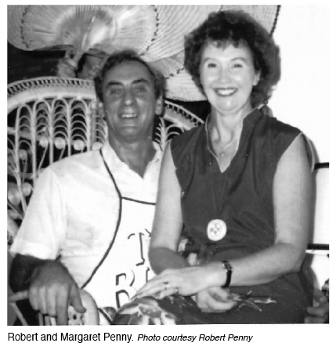
For Mrs Penny, the day began about 10am after she and her granddaughter, five-year-old April, slept late. April had been staying with her grandparents for three weeks and was due to return home the next day. Mrs Penny’s husband, Robert, had been up much earlier that morning, having made himself breakfast and read the paper. As Mrs Penny and April slept, he had busied himself with various chores including some pruning in the front yard of their half-acre property in Must Street, a short drive from Portland’s retail centre. Mr Penny had also been down the street to fill the car with fuel and had tried about six outlets to find his granddaughter a new car seat. Not having any luck, he decided he would have to repair the old seat. He was outside the house making some wire leaders for his fishing rod, when Mrs Penny and April started preparing their breakfast. April helped her grandfather for a few minutes to rake leaves and then went back inside. It was soon lunchtime and Mrs Penny had prepared sandwiches.
During lunch, they discussed a small gold ring Mrs Penny had on her little finger, which they thought April had lost. According to Mr Penny’s police statement, his wife then told him, “By the way, April’s not coming with me today (to the hairdressers). I think she has a project for Grandpa.” This project involved building a swing in a tree in the back yard. Mr Penny wrote in his statement: “I knew my wife had an appointment at the hairdressers, which I thought was 2.15pm and I recall when I was eating my lunch that my wife made a comment that she felt like she was the March Hare, ‘I’m gonna be late, I’m gonna be late’.” Mrs Penny disliked being late for appointments and was always on time.
Mr Penny moved the car from the garage into the driveway for her. “My wife came down the steps and said to me that April was inside. I don’t recall what time this was, but I believed when I had finished my lunch the time was about 2.05pm. My wife walked straight up to the car and yelled goodbye to me in the garage, hopped in the car and drove off,” Mr Penny wrote. “Prior to my wife leaving, sometime during the day, I recall my wife saying something about meeting Shirley Endersby and something about shopping, but to be honest I hadn’t really taken that much notice.” Mr Penny and April worked on the swing project for the rest of the afternoon.
Later that day Mrs Penny’s friend, Mrs Endersby, telephoned Mr Penny and he recalled the following conversation: “I spoke to Shirley and she asked me where Margaret was and said that she was supposed to have afternoon tea with her and I automatically said, ‘Yes, she’s coming up’. Shirley said, ‘No I was supposed to meet her at the coffee shop’ and I said, ‘She might have gone shopping’ thinking that she may have been trying to find some braiding she needed to finish off the curtains in the house. Shirley said, ‘I might have missed her, I’ll go back down and see if I can find her’. I hung up and never thought any more about it and I went outside again and continued to work on the swing. It started to get a bit cold and I said to April that we should go inside, so we went in and I think April put a video on. I wasn’t worried about my wife because I thought if she got together with Shirley and they were talking that she could be home at any time.” Sometime later, Mrs Endersby and her husband, Alan, knocked at Mr Penny’s door. “I’ve got something dreadful to tell you,” Mrs Endersby said. The Pennys had been married for almost 37 years. “We were good friends and we had a lovely life,” Mr Penny wrote in his police statement.
Part of the deal of living of course is that we never know if it will be our last day and it is impossible to live entirely on the basis that it will be. As Mrs Acocks and Mrs Penny drove independently to the Old London Coiffure that fateful day, they both had arrangements that did not include leaving their families behind just yet. Both were wives, mothers and grandmothers and their immediate plans for the future centred on family. Mrs Acocks was saving furiously for what the family jokingly called her ‘running away’ fund. Her daughter, Catrina, was heavily pregnant and Mrs Acocks planned to ‘run away’ to spend time with her new grandchild in Melbourne. Part of this fund, about $500, was in an old wallet in her handbag at the time of the murders. The money was extra cash intended for baby clothes and other special treats, but it was the killer who ‘ran away’ with her savings. Mrs Penny was planning to meet her daughter, Jacqueline, in Melbourne the day after the murders when she would return April. She intended to spend a week with Jacqueline, before travelling north to Cobram to see her sister, Valerie. But after leaving home that day, these future plans for both women ceased to exist. Catrina would cope with the challenges of first-time parenting without the support of her mother. For Jacqueline, who was adopted, it meant the loss of the woman who raised her and whom she considered her best friend.
Witnesses were able to piece together both women’s movements between leaving home and reaching the salon. Before starting work at 1pm, Mrs Acocks parked her car in Bentinck Street in front of the Richmond Henty Hotel bottle shop. A bottle shop employee recalled seeing Mrs Acocks park her car. The witness, who made her statement to police on February 21, 1994 – almost three years after the murders – estimated the time was somewhere between 1 and 2pm. The witness told police Mrs Acocks often parked in the same space when she worked at the Old London Coiffure. “I saw her get out of her car, she waved to me and I last saw her walking towards the Old London building,” the witness wrote. “I just assumed that she had come back from a dinner break and was going back to work at the salon. I did not see Claire Acocks again that day.” Another witness who also made a statement to police on February 21, 1994, wrote that she saw Mrs Acocks about 12.45pm on the day of the murders at ‘Wendy’s Snack and Chat’ – located in Bentinck Street about 20 metres south of the hairdressing salon. The witness was a shop assistant who ironically sold Mrs Acocks a packet of Lifesavers. The shop assistant told police that after Mrs Acocks left the shop, she observed her walking along Bentinck Street towards the hairdressing salon. “Mrs Acocks seemed to be in a bit of a hurry, as if she was going to work,” the shop assistant wrote in her police statement. “I knew that she was working in the hairdressing salon in the Old London building.” A third witness completed a police statement on the night of the murders indicating she had a brief conversation with Mrs Acocks at a Bentinck Street bakery about 1pm that day.
Hairdresser, Kay Edwards – the proprietor of the Old London Coiffure – only had one employee. She employed Mrs Acocks on a casual basis usually on Wednesdays from 9am to 1pm and Fridays from 1 to 5pm. This gave Mrs Edwards, who was a young mother, a break from the salon, but it meant only one hairdresser was ever there. Mrs Edwards told police that on the day of the murders, Mrs Acocks came in to work at 12.50pm. “I spoke briefly to Claire, then left by the back door which leads on to a courtyard into Julia Street,” Mrs Edwards wrote in her police statement. During Mrs Acocks’ shift that afternoon, four women were booked for appointments in the diary, which rested on the front counter next to the telephone. They were:
1.00 pm Mrs Hallinan
1.30 pm Mrs Flack (Norma Walls)
2.00 pm Mrs Penny
4.30 pm Mrs Fletcher
Mrs Edwards had planned to return to the salon that afternoon to have her hair tipped, but her toddler son fell asleep while at home so she didn’t bother. According to Mrs Edwards, Mrs Hallinan was not a regular client and she did not know who she was. If Mrs Hallinan made a police statement, it was not part of the inquest file I accessed and other sources were unable to confirm if she had attended her scheduled appointment. I considered telephoning Hallinan families in the area, but decided against it. Mrs Acocks’ younger sister, Pam, who did not want her surname used, had made tentative arrangements to have her hair coloured at 2.30pm that day if other commitments allowed. This loose arrangement was not documented in the appointment book. Mrs Acocks had encouraged Pam to come in that afternoon as she felt her sister should have her hair done before an important social engagement that weekend. Pam tried to clear her schedule, but as the day progressed she realised she would be unable to make it. She blames herself for not being there to fend off her sister’s killer.
An additional client that afternoon was Elizabeth Campbell. Ms Campbell called into the salon without an appointment on the off chance she could receive a trim. She had been a regular at the salon for about two years and had known Mrs Acocks for this period. She wasn’t sure what time she arrived at the salon, but it was after lunch. Ms Campbell was in the salon for about 15 minutes and no one else came in while she was there. There was, however, one telephone call that resulted in Mrs Acocks booking a client for an appointment. “I went inside the Old London Coiffure via the front door and the only person in the salon was Mrs Claire Acocks,” Ms Campbell wrote in her police statement. “I reckon that Mrs Acocks was out the back somewhere because I had to wait a minute before Mrs Acocks came to the front counter to serve me,” she wrote. “I asked Mrs Acocks if she was too busy to trim my hair and she said that she was waiting for an elderly lady or an elderly client to come. Mrs Acocks said that the elderly client was going to have her hair permed and she didn’t know if she could fit me in. After I told Mrs Acocks that all I wanted was a trim, she said that she would do it. I cannot remember what we talked about. I would describe Mrs Acocks’ demeanour as being not sad, not happy, but rather as a bad day at the office. I have seen her happier. Anyway, when Mrs Acocks finished my haircut, I went and paid for it at the cash register. I remember that it cost $11.00 and I gave Mrs Acocks a $50.00 note. Mrs Acocks didn’t have the right amount of change in the cash register, so she only charged me $10.00.”
Norma Walls, who used her partner’s surname of Flack when booking the appointment, arrived for her 1.30pm appointment. “I entered the salon through the front door,” Ms Walls wrote in her police statement. “When the front door opens it rings a bell, but Claire, the other lady who works there, didn’t come into the salon from out the back for about a minute,” she wrote. “There were no other persons present in the salon when I arrived. I have been to the salon casually over a number of years and it was usual to find Claire working there on a Friday afternoon. Claire gave my hair a wash at the wash basin area first. We chatted together about nothing in particular. She appeared to be very well and there was nothing out of the ordinary.” Claire then trimmed and blow-dried Ms Walls’ hair. “At some stage whilst at the mirror I suppose about 15 minutes after I arrived or so, a male person entered the salon through the back door,” Ms Walls wrote. “I didn’t see who this person was as he was behind me and I couldn’t see him in the mirror. Claire had a very short conversation with this person. She remained beside me whilst she spoke to him and just turned towards him. I remember Claire saying to the person, ‘She’s gone’, or something similar. I didn’’’”’––