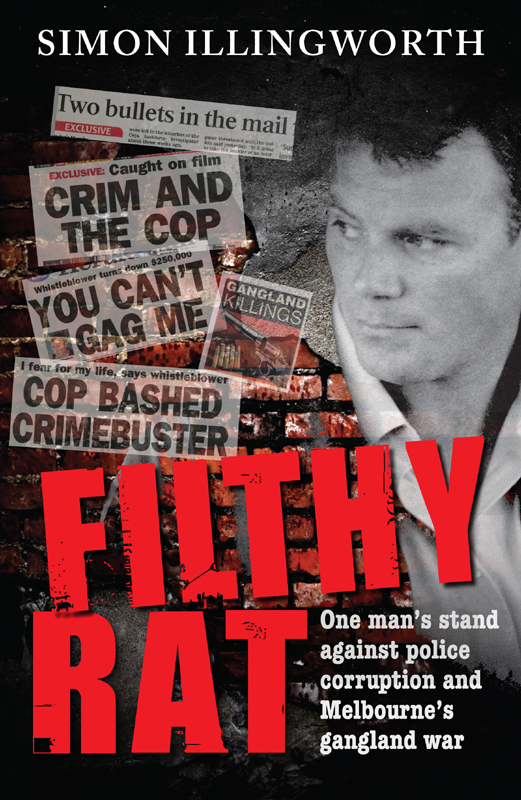
ISBN: 978-0-9806729-9-2 (ebook)
Published by Fontaine Press, Australia
P.O. Box 948, Fremantle, W.A. 6959
www.fontainepress.com
Copyright © Simon Illingworth
To purchase the printed book, and for further information, please visit:
http://www.fontainepress.com/filthyrat
No part of this publication may be translated, reproduced, or transmitted in any form or by any means, in whole or in part, electronic or mechanical including photocopying, recording, or by any information storage or retrieval system without prior permission in writing from the publisher.
To my former colleagues, honestly slogging it out against the odds, twenty-four hours a day, picking up the pieces of shattered lives and wrestling through an impossible system of justice while trying to keep their own integrity intact.
And to the truly brave whistleblowers, witnesses and their families, who, like me, have risked their lives in the fight against organised crime and corruption.
A sickly culture refers to these people as ‘rats’, but they are heroes.
Foreword
Introduction
Prologue
1 From patriotic panache to penniless poachers
2 Baptism of fire
3 Caging crims: early days
4 In the giggle
5 The rat trap
6 Organised and disorganised crime
7 Hooray for Collingwood
8 The courage of a coward
9 Homicide Squad
10 Professional practices
11 Ethical standards
12 Pot luck
13 Change of heart
14 Collecting the mail
15 Just the birthday present I wanted
Appendix 1: Glossary
Appendix 2
Appendix 3
Appendix 4
Those of us fortunate enough to know of Simon Illingworth realise that this brave man certainly has a story to tell. Many of us were touched by his Australian Story program in 2004. If you haven’t seen it — get a copy. Meeting and working with him has been one of the proudest experiences of my life. Anyone who has ever been a whistleblower knows how difficult your life can be. I was the deputy general manager of finance at HIH Insurance. In 1999 and in the following year, I went to the authorities to alert them to the company’s problems. It was a difficult decision to make, and I guess you could say I wasn’t too popular. Anyhow, the authorities did not listen to me, and as a result, the company went broke in 2001 with estimated debts of $5.3 billion.
When Simon first blew the whistle he was in his early twenties and from this time on he became a marked man. No one would have begrudged him if he’d quit, but he didn’t; he stuck at it. Being a whistleblower in the HIH tragedy was hard; many people were affected by the collapse, including me, but in Simon’s case the danger to him personally was magnified many times. His story brings home how bad things can get.
This is a remarkable book of one man’s courage in a sleazy underworld very few people ever see. Simon wants to change our culture, and for everyone’s sake I hope he achieves his ambition.
Jeff Simpson
Our community expects so much from our police officers. Sometimes they just can’t deliver; no police budget will ever satisfy everyone. But police integrity stands alone. It is not part of a community wish list; it is absolutely non-negotiable
This book will take you into the underworld, a stinking dog-eat-dog environment that left Melbourne reeling from a spate of killings and rampant police corruption. The last of the murders attributed to the Melbourne gangland wars took place in February 2006. Most people clearly thought it was all over in May 2004, but history tells us it is not because it never is. Crime and corruption will never end, not ever. At best we can control it and minimise it. At worst it will consume the spirit of the good people and entrench itself in our culture.
We were warned decades ago that if our mobsters were left to operate unchecked they would infiltrate legitimate business: that has happened. Now, if Australia’s mateocracy stays loyal to the real rats — the bent cops and underworld crooks who prey on our most vulnerable people — a new Australian culture will be born, a culture of business chaos and corruption where our wealthiest people will undoubtedly also be the most corrupt.
I have studied organised crime and corruption internationally, and I have been up to my neck in this shit for a long time, and I warn you, we are dangerously poised for yet another era of gangland violence with cunning bent cops and crooks the likes of which we’ve never seen before.
I know, I’ve watched it escalating; it’s never been as bad as it is now. No one seems willing to admit it — society has been blindfolded. Well, enough is enough; it’s time someone told the truth. Albert Einstein was right when he said, ‘The world is a dangerous place, not because of those who do evil but because of those who look on and do nothing.’ Today the people who stand against evil are persecuted. But despite the hardship they face, they know what they stand for. Criminals, on the other hand, live a slimy existence, they pretend to be legitimate, some have flash cars and houses, but they are never satisfied. A large portion of our community is made up of spineless jellyfish. Those poor insipid souls never know who they are, or what they stand for, they live life in a perpetual vacuum. They tumble down the road like a foam cup in the breeze — they just go with the flow. Meanwhile, morally, our community degenerates to the lowest common denominator.
When parts of cities become overcrowded slums, approximately 5 per cent of the residents develop a lifestyle based on crime. In the 1950s US scientist John Christian studied the overcrowding of nonaggressive animals. He found that some overcrowded deer literally gave up and died. But perhaps more important for this book are the findings of researcher John Calhoun who, according to Colin Wilson in his book True Crime, studied the overcrowding of a more aggressive species — the rat. Calhoun found that the rat’s response to overcrowding was violence, including rape and cannibalism. In the late 1980s, another young man unwittingly began studying the effects of overcrowding in the poorer areas of Melbourne, but his research was based on the human species. That young man was me.
I am thirty-eight years old and too young to be writing an autobiography. But every time I look in the mirror I am reminded of the seventeen-year war I’ve waged with the true rats of our society. I don’t feel thirty-eight. I feel much older.
You might think that criminals have no values, principles or skills, but they do. Their values are just different to those of most people. Most criminals understand and like greed, deception, blind loyalty, rape, blackmail, extortion and frenzied, unrelenting violence. But most of all, criminal behaviour is about power. The egotistical swagger along a crowded city street in the best suit money can buy may be just as lawless as an open display of brutal violence.
There are many kinds of power. There is the power of blackmail: the intimidation of hard-working civilians, combined with the fear of financial or physical repercussions, creates a business environment in which a gangster cannot lose. The power of invincibility and lawlessness, the solidarity of men with little if any self-control, provides a criminal with the ability to make someone an offer they can’t refuse. And last, there is the power of cultural knowledge, in which a criminal group preys on their own expatriated folk. For these people crime knows no boundaries and immigrants are easy picking no matter where they settle. Interestingly, many gangsters are likely to be first or second generation immigrants themselves.
Traditionally, policing agencies obey geographical boundaries, but organised criminals and extortionists don’t; this is the cold, hard reality for some of Australia’s most vulnerable people. Most gangsters delight in displaying the power of their wealth. Recently, a Melbourne gangster and reputed hitman was buried in a gold-plated casket. The sickening and often tacky display of ill-gotten gain demonstrates two significant things about mobsters: the police either can’t or won’t catch them, and they’re proficient at what they do. I’ve endured intimidation and fear in many different ways and for many reasons. I am neither a deer nor a rat (although some may dispute the latter). I am human, the same flesh and blood as we all are, yet I’m different to most because I’ve fought the criminal underworld in many forms and I’m still here to tell the tale. I’m sure I need to write this more than you need to read it.
My inadvertent experiment is almost over now and so I should describe to you who I am. I am a solidly built bloke, 1.8 metres (six feet) tall, with fair hair and blue eyes. I scrub up OK despite some telltale scars on my head, face, hands and knuckles. I suffer bouts of insomnia and stress and probably unhealthy doses of paranoia. I trust very few people.
I’ve risked my life many times. My friends and relatives have also risked theirs, not because they wanted a Russian roulette gamble, but simply because they know me. Unwittingly, I’ve been searching for my Holy Grail in life: the key to a good ethical community. In trying to find this end, I’ve lived a lifestyle that I now believe is unachievable for one person to endure long term, either mentally or physically. I’ve hit the wall; I can’t do it any more.
I’ve been called a ‘give-up’, a ‘lagger’, a ‘rat from the filth’, a ‘filthy rat’ and many other things, some of which are unprintable. Effectively, I’ve been a crime and corruption investigator, having previously been a whistleblower. I’ve been a member of the ‘police police’, Internal Affairs. When I speak of corruption in this book sometimes it’s in general terms; at other times I nominate the specific offences, but you need to understand that corruption takes many different forms in many different contexts.
Generally, most international anti-corruption bodies deal with, or attempt to deal with, the receipt of bribes (graft), extortion, shady dealings, cover-ups or fraud by public officials. Public officials include police, council workers and politicians. A number of Australian anticorruption agencies also consider that acts performed by private firms working for public officials come under their umbrella of public corruption. Many countries take this view, but not all. When I use the word ‘corruption’ I take in all these definitions, not any particular one. I write of corruption holistically.
I also suspect that, when I mention my lifestyle, I mean something different from what you may be familiar with. My lifestyle has involved security doors, sensors, video surveillance, revolvers and security fences. The taxpayer has funded the large percentage of these necessary expenses. Tragically, this security I have at home is the ‘reward’ that the taxpayer gives people like me for our dedication, honesty and courage in taking on corruption, being bashed and threatened and putting our necks on the line over a number of years. I know I am not the only one who has made personal sacrifices for the good of our community. There are many others.
Today’s newspaper will probably have about ten pages devoted to our courageous sporting champions, some of whom donate their spare time visiting the sick and frail or helping worthwhile charities. These actions are worthy of praise, yet it is relatively easy to donate your time when you are paid excessively well and have television cameras ready to show the rest of us what a community-minded person you are. Most people are like you and me. We have to work hard to make ends meet and, if we’re one of the few with any spare time left to be community-minded, we receive little if any recognition for our charitable work. In the same way, a cop’s charitable work is rarely warm and fuzzy — it’s a hard slog that often involves blood, violence and a personal war with your conscience. No one can claim to be perfect in a world of cops and robbers.
A helicopter hovering above a sports star’s head provides an unusual camera angle for the viewers at home; a helicopter hovering over my head for the last seventeen years usually meant someone had been murdered, raped or mugged. It’s not easy to forget the thud of the police helicopter’s rotor blades.
Most people think a hero is somebody who acts courageously in white-hot moments, but to me there is far greater courage in making an ethical decision when detrimental consequences are known. It is far tougher than taking a risky gamble. I know because I’ve done both many times. During my career as a detective I’ve seen plenty of unsung heroes, people performing selfless and courageous acts for the good of our community. Most have received nothing in the way of recognition. In some cases, they’ve actually suffered for standing up for what is right. These people haven’t chosen to be involved in life-changing events. They just happened to have been there and seen, heard or known something and have chosen to do the right thing. People achieve incredible things when they are encouraged and supported; indeed, the lack of support for these heroes just makes their courage all the more precious.
A friend once quoted to me that ‘Reasonable people change themselves to suit the world, unreasonable people change the world to suit themselves’. Only the unreasonable person can change the world. Given the right circumstances, I can be one of the most unreasonable people you’ll meet. But I don’t necessarily want to change the world — it’s just that I can’t accept the disgraceful treatment of some of Australia’s true heroes. Australians need to change.
Like other honest cops, I’ve worked for you, assessing facts and evidence, doggedly tracking down and incarcerating the underworld people you fear. Most of us are tough and we try to do the job as ethically as possible, not just within the rules. It isn’t easy dealing with notorious criminals or corrupt cops in real life. You’re lucky, you just read about them in the newspapers or see versions of them on TV or in the movies. This is the kind of crime that most people see.
People’s craving to be given a head on a stick when a heinous offence occurs is always satisfied in fictional television shows. Many TV programs have a rogue cop character, someone who, much to the delight of the audience, bends a few rules to get the job done. That’s OK on TV, but this behaviour cannot be tolerated on the street. In real life, police misconduct has lasting effects. This type of corruption is counterproductive to lasting and effective policing. In essence it’s tackling wrong with wrong, and nobody wins. Most people think movies show them what it’s like working within the underworld. They don’t. Being a cop tracking the worst of the worst is a hard slog. For a detective to play by the rules, while investigating underworld gangsters or corrupt police who clearly don’t, isn’t easy. Add to this the public’s cultural acceptance of police cutting corners, as they have seen on television, and the Australian culture of blind mateship, and you’ll see why we have big problems.
Cops often turn a blind eye to colleagues who cheat or take short cuts and this has led to many large voids and grey areas in policing. But the perception that a detective who acts unethically is somehow more effective in cleaning up crime is wrong. When Clint Eastwood played the fictional detective Dirty Harry Callahan he carried a monstrous handgun called a 44 auto–mag. Harry often reminded cowering crims of its power, ‘When this is used properly it doesn’t leave fingerprints …’, but the simplistic idea of meeting fire with fire in the real underworld creates an inferno, not peace. Corrupt detectives are the ones who cut corners, disregard rules and rely predominantly upon information from informers. These are the same police who often become willing to cut shady deals with criminal informers to get another easy pinch, and later to make a quick buck for themselves. These detectives rarely put in the hard slog. Most of them couldn’t track a bleeding elephant through the snow, but they can track down a freebie, a part timer or an ‘earn’ very well.
Some police have tacitly allowed informers to take part in the same crime as that of the criminals they inform on. This of course is counterproductive but makes the detectives’ arrest rate look impressive. The net result is that you, the community, gain nothing from the socalled successful arrest.Worse still, the community loses; as one crook gets a red light another is given a green. I’ve never met an underworld crook who has wanted to help me in some way without wanting something in return.
It’s very tempting to run an informer and get easy pinches, but resisting the insidious compromise makes the true ethical champion and, indeed, the best detective. My investigations speak for themselves. I’ve been responsible for incarcerating criminals for combined sentences of well over 100 years. Very few of my arrests have relied solely upon informers. It’s too dangerous; information is a good start to an investigation.
This autobiography is my life’s story, the way I heard it, saw it, smelt it and lived it. I’ve changed many names to protect the innocent, some not-so-innocent and others I don’t want to name for legal, personal or safety reasons. This book is about the big picture, although I expect some of the intricate detail will blow the lid off some of the spin that you’ve been fed over recent years. All is not well in this country. I’ve done a great deal of research to ensure that any of the events not personally witnessed by me or by other reliable sources are corroborated with evidence or are based on court convictions, news reports or facts. Otherwise the event doesn’t appear in this book, despite the temptation.
I respect the law of defamation and the rights of others, so I’ve edited out a tragedy or two from what I’d originally written. I’ve done this to protect other people, not myself. I’ve never shied away from being a completely fallible human being, as we all are. Like you, I’ve made mistakes and done some stupid things, so if you’ve purchased this book with the intention of reading the story of a shining white knight — stop reading, wrap it up and give it to a relative for Christmas. Hopefully, he or she likes true stories, not fiction.
It should come as no surprise that some don’t want the system fixed: they’ll say it’s OK the way it is. Clearly, I don’t agree, but that’s my opinion — and, as Dirty Harry Callahan says, ‘Opinions are like arseholes, we’ve all got one’, so I’ll leave it to you to make up your own mind. I would like to thank my loving wife Sarah, as well as Milly, Mum, Chris, Bin, Poss, Ross, Caitte, the old man, Gran, Jim, Merilyn, Lee Flanagan, Sandy Robertson, Bill, Dawn, Con and the lads, Steve, Sharon, Damien Morgan, Dave Goodrich, Dan, Lauren, Darren, Dr D. Morrell, Dr D. Barkley, Jeff Simpson, Robert Doyle, Kim Wells, the Liberal Party of Victoria, Neil, Toni O’Sullivan, Billy, Mick and Pete, Nick and Jo, Old Scotch Football Club, Port Campbell Community, Scotch College, Simon, Graeme, St James Ethics Centre. Belinda Hawkins and ABC’s Australian Story, radio stations 4BC and 3AW, journalists on the Australian, Herald Sun, Age, Ballarat Courier, Neil Mitchell, Padraic Murphy, Katie Lapthorn, Nick McKenzie, Brian Hansen, Jeremy Kelly. And 97 per cent of the Victorian Police Force.
Simon Illingworth Melbourne 2006
I ran to the shed and fumbled with the well-used lock. On my tail was an old foe, his face red with fury; despite being almost out of breath he kept telling me I was a goner. I quickly opened the shed door, entered and managed to lock it, just as my enemy slammed against it. I was safe, but only temporarily — the lock was sure to give way. Then I grabbed the gun resting behind an old war chest next to a dusty World War II leather pilot’s hat.
The gun was rusty but once I’d opened the lever and forced the spring action back I could see it still worked. This was to be the day I took a stand and won some respect. I donned the pilot’s hat and loaded a small berry into the breach. I opened the door wearing the hat and pointed the gun at my enemy. My overweight older brother Rossco stared at me, a nervous smirk on his face, and began to use his negotiation skills to avoid being shot, but alas, to no avail. I pulled the trigger and the purple berry slammed into his stomach. Purple juice stained a star design on his favourite white T-shirt. He was mad, really, really mad.
Once I’d pulled the trigger and let my brother take the berry in the guts, I found my own negotiation skills developed quickly. Unfortunately, I hadn’t created sufficient distance between my older brother and me at the time of impact. This was not a personal development course that I wanted to put myself through; it resulted directly from my inability to reload the gun fast enough. Rossco, stained with purple juice, was about 2 feet behind me as we ran around the backyard of our grandparents’ house when, stupidly, I threw the gun away. Ross simply stopped, armed himself, found some camouflage among our grandmother’s lush garden and waited for me to return. Despite the danger, this situation was a turning point, an early lesson in life: how to negotiate with a madman.
Ross was, and still is, one of the hardest people around to negotiate with, hence his success at stockbroking and his ability to make serious returns for his clients. I learnt that negotiation often requires the need to accept the inevitable, though one should allow room to finesse the finer points if possible. Once I had thrown away the gun I had to resign myself to the fact that I was going to be shot, so eventually, I stopped hiding and began negotiating with him on which body part he could shoot and the distance from the end of the gun to that body part. This worked, and after some intense negotiation, Ross shot me in the butt from a distance of about 6 metres. A berry travelling at speed into any part of the body hurts, but not as much as a shot into the guts from about a metre away, so I figured I’d had a win.
On 17 January 1995, eighteen years later, I negotiated with another gunman, but this one, though he was as angry as Rossco had been, was real. I was working at a nearby CIB in Melbourne at the time, and had heard the urgent police radio message: ‘Man in his fifties firing shots from a residential house, one, possibly two, hostages …Any unit clear?’
My blood began to pump faster: I was nervous but I wanted to give my negotiation skills a go. This attitude was very distressing to Brad, my police partner, who made it very clear that he was quite happily seated in his bargain-priced $10 ex-Salvation Army recliner. ‘It’s not in our patch,’ he told me.
I was desperate to go and convinced him that the local CIB would respond first, as well as promising that I would drive slowly and not radio in until they arrived. Not radioing ensured that police base didn’t know we were out and about, and hence we wouldn’t be called upon for any major role-playing (work). I promised that the locals would do the paperwork and all we needed to do was to prop around the corner and lend a bit of a hand.We knew we didn’t have to go because it wasn’t our region; as my partner delicately put it, ‘Crikey, this dickhead could be there for fucking days!’ But something draws police to these events and we were no different. Brad didn’t take too much convincing. He and I were old heads when it came to violent incidents and both of us knew the value of experience in these situations.
I wanted my first big role as a detective. So I got my kit together and was fully armed and ready to go in a couple of minutes. Brad, on the other hand, walked so slowly to the gun safe that I actually thought he was moonwalking. He was a seasoned detective who had seen it all before. I had assured Brad that we would be so slow in getting out of the office that the scene would be swarming with coppers by the time we arrived. Of course we pulled up to find that we were the first crime unit there. Brad wasn’t impressed.
The inspector at the scene began briefing us. The guy had a pistol. ‘Do we have this bloke’s phone number?’ I asked. ‘Yep, and his name’s Sam,’ the inspector told me. The boss handed me the phone number. At the time it seemed like a good idea to just dial this bloke up and try to talk him around. This is how the initial phone conversation went.
‘Hello!’ screamed a very angry Sam.
‘Sam, my name is Simon. I am from the police and I would like to talk to you.’
‘I don’t want to talk to you!’ Sam slammed the phone down.
Well, hot shot, nice try, I thought. Meanwhile, Brad was peeling off decisions and organising the uniform troops to cover the address; he loved all that, and he was an expert.
‘How’d you go?’ asked the inspector.
I explained that Sam had hung up and that I intended to call him back. I dialled the number again.
‘Hello!’ yelled Sam.
‘Sam, these police mobile phones are shit! Sorry, mate, we must have been cut off last time … Anyway … my name’s Simon.What’s going on?’
A lengthy pause.
‘That’s all right, Simon,’ said a more subdued Sam.
I knew that the more time I could spend on the telephone the easier it would be for the street to be cordoned off and the neighbours evacuated under Brad’s instructions.
Soon the area immediately around the house was coated in plainclothes police, later assisted by the Special Operations Group. Cameras from channels 2 and 10 turned up, followed by smartly dressed news reporters nervously waiting for the live cross to the siege from the newsroom. Age and Herald Sun photographers arrived looking for action, as did Radio 3AW. The boss handled the media well.
I sat on the footpath with my mobile telephone to my ear and began a long phone call with a gunman. Sam had fired some shots, had a loaded gun and was holding his ex-girlfriend hostage. He was so stressed and upset that I felt the situation had the potential to end up as a murder–suicide. He was an Italian in his late fifties and, as the phone call began in earnest, I had to think of something to talk to him about. I took a punt and chose fishing.
As we talked a stranger walked over to me and handed me a foam cup of instant coffee, something I was used to drinking after ten years in the police force. I spoke to Sam for almost two hours before I felt confident the incident could be concluded safely. By then, we had come to an agreement that our shared passions for fishing and cooking were worth living for. (I left the cup on the pavement next to the car; litter was someone else’s problem.)
Sam released his ex-girlfriend after I interrupted our cooking discussion with a simple request to let her go; I then explained how he could do this. Soon afterwards, Sam surrendered himself. No further shots were fired, the guns were seized and Sam was taken into custody by the Special Operations Group. I can’t remember Sam’s beer batter recipe now, but it sounded good over the phone. No matter how bad life gets, it’s still worth living.
A number of police put their necks on the line that day. Brad had courageously evacuated the residents from the immediate area, the other detectives at the scene had made the arrest and taken the hostage to safety and, with no formal negotiation training, I had talked him into surrendering without the loss of life.We were all exhausted, none more so than me.
Some time later Brad and I received a congratulatory letter from the Deputy Commissioner of Operations for our work in what was a ‘potentially life-threatening incident’. It was a form letter three and a half lines long. In the police culture reward and recognition just weren’t seen as important to operational detectives and police so we received nothing else. There seemed to be plenty of certificates and other marks of recognition for the police who created policy, as distinct from those who risked their lives to keep the peace.
I was born on 10 November 1967 at Geelong hospital, ten months after a notorious criminal named Ronald Ryan became the last man ever hanged in Victoria and a few weeks before Australian Prime Minister Harold Holt disappeared without a trace in swirling seas off Portsea.
My father, Adrian ‘Horse’ Illingworth, was good-looking, quickwitted and spoilt rotten by his wealthy parents. Dad reckoned he was called Horse because he kicked a bloke at school; he was a boarder at Geelong College from the age of ten. It’s a good school but any boarding school would have been a tough place for a kid of that age. It should come as no surprise that Dad ended up a big drinker, a champion at handling a shotgun and a bloke’s bloke. He spent excessive time with his mates and often enjoyed one too many pots of beer at the pub, but he also managed to snare my mother, Jenifer Searle.
Jenny Searle was a much sought-after young blonde with a slim sporting physique. She was an exceptional tennis player and swimmer and a real catch. Mum was the daughter of Bill Searle, a well-known bricklayer. Bill was one of ten, six boys and four girls, and his was a family you wouldn’t want to mess with. He and four of his brothers fought in World War II; the sixth brother missed out for medical reasons. Bill’s brother Lloyd was almost 2 metres tall (6’4” on the old scale) and built like a brick shithouse; like many other men in the family he was known for his bravery. But Lloyd was the toughest of the lot. He spent a great deal of time behind enemy lines during the war. One time a mortar landed between his legs as he slithered on his stomach. He heard and felt the thud, but kept moving without looking back. Luckily the explosive was a dud.
Lloyd’s luck didn’t end there. In Crete a bomb landed on the other side of a large rock next to him and exploded: all he got was a bruised leg. In Borneo, as he removed a tree over a Japanese-made track, he saw a glimmer of silver under his foot. Lloyd knew he was standing on a landmine. It was an antitank mine, not the conventional human variety. Lloyd had missed standing on the plunger and was able to slide his foot off safely. He was reported to have thanked the Lord. I imagine that what he actually said was a fraction more colourful, knowing the Searles.
Lloyd and my grandpa Bill lost one of their brothers during the war, and obviously thought about him all the time; they knew, of course, that they were lucky to be alive, and taught me that we should never take our freedom for granted. When I was a kid, the incinerator that Bill used to burn leaves in the backyard was actually an old sea mine with the bomb part removed. The war was always part of Grandpa’s life.
Mum and Dad married in Geelong in the mid sixties and Mum soon gave birth to my older brother Ross, whom I affectionately call ‘Junior’. Two years later, I followed.
Ross and I were snowy-haired kids who were always up to something.We spent our first few years in Geelong, which was a small town then. Most days we heard a constant knock, crack, knock coming from our neighbour’s garage. We were told the noisy neighbour was practising batting. It was Ian Redpath, relentlessly hitting a cricket ball suspended from the garage roof in a nylon stocking. Not that my best mate Adrian and I cared that I was living next door to Australia’s opening Test batsman; our focus was on collecting live spiders in the backyard and drowning them in the dog’s water bowl.
Redpath wasn’t the only highly successful neighbour we had; not far away lived an actor whose husband, also an actor, ended up winning an Oscar for his starring role in the movie Shine. He followed this up with a few more awards after that. I wasn’t nosey about him: all I remembered was his name, Geoffrey something.
My brother’s nickname Junior was much easier to remember; I’d created it when I outgrew him in our late teens. Unfortunately, the nickname backfired and now that’s what many of my brother’s friends and associates call me. This perpetual one-upmanship continues to this day: it must be more frustrating for him because he’s one of Melbourne’s stockbroking big hitters.
Rossco was always going to be a successful entrepreneur.When we were young kids playing in the sandpit at the back of our house, Ross divided the sandpit in half and took charge of all the toy trucks, graders, shovels and equipment, hiring the trucks and equipment to me on a bucket of sand per minute used basis. This process ensured that fifteen minutes later Ross had all the sand, trucks and equipment and I was left sitting on dirt; a good argument against dictatorship and monopolies, perhaps. It sounded fair when we divided up the pit — I had a fraction more sand on my side, and he got the trucks. I should have checked the fine print.
Our parents separated when Ross and I were three and five years old. After that, Dad only came to see Ross and me a couple of dozen times. I was twenty-seven years old when, on 24 November 1994, he died of cancer in the Royal Melbourne Hospital; he’d been living in a caravan park on the shore of Lake Mulwala in New South Wales.
Dad’s drinking accelerated after the separation, as did his disrespect for the drink driving laws. He often pushed the limit of how much he should drink before getting behind the wheel. The number of times he was charged with drink driving gave no indication as to how many times he did it. In Dad’s defence, drink driving was considered more of a social offence then, rather than the true menace it is on the roads — now we’re all better educated about its pitfalls. This cultural change is a prime example of education and penalty working together to change a societal attitude.
Dad was a speculator, property developer and car salesman. He was a likeable fella who had a knack for getting things cheap. He spent quite a bit of time in pubs so I suppose he had plenty of mates who could get things even cheaper. He was also a light sleeper and often took his boat out for a spin in the early hours. It should come as no surprise that the boat engine he bought from a group of gypsies malfunctioned and Dad found himself in the Corio Bay shipping channel treading water in the midnight fog. As Dad was treading water in the foggy silence, he thought he was stuffed until he heard a boat coming towards him. Dad began calling out before realising it was his boat circling him with the gypsy engine stuck in low gear. After the boat did a number of laps around him Dad managed to climb back on board the moving boat and made it safely back to shore and eventually made his way back to bed. His girlfriend awoke next to him none the wiser, although she wondered why all his fishing clothes were wet. Dad saved the story for the boys back at the pub.
Dad was an entrepreneur of sorts; he once proudly showed us how he’d turned his garage into an illegal bar for old men. It even had a poker machine and beer taps in it. Dad said, ‘It’s my own RSL.’ It looked more like ‘Dad’s Army’ but they were all happy enough.
After the divorce Mum married the man who became our stepfather, Chris, and we moved from Geelong to Melbourne. Chris’s parents, who were quite upper class, were a little suspicious that Chris was to marry a divorcee with two children, and I remember arriving at their address in Toorak and being shown, with Ross, into the backyard. Mum had dressed us like pansies and combed our hair before we arrived to be greeted with a glass of lemonade and a packet of fruit LifeSavers. Ross, aged seven, and I, aged five, amused ourselves in the backyard by changing our hairstyles from Mum’s spit and comb-over to something more modern while Mum impressed her future mother- and father-in-law. This was quite a feat, as she had two young brats with new Mohawk hairstyles who were fighting over the last LifeSaver. Unfortunately, the packet contained an odd number. But she survived, she and Chris married soon after and Chris’s parents shared a great relationship with us from this day on.
Chris’s father Gideon was a very successful businessman, a legendary real estate agent, shoes that Chris found hard to fill, but he did it and showed how a university graduate could cut it in the real world. Chris had suffered polio as a child and with immense grit and determination became a Melbourne school sports champion. He took over the real estate business from his father and still writes many books on commercial real estate. He influenced the way I carved my future in policing. Some things were worth fighting for — he taught me that.
Ross and I were also budding entrepreneurs from an early age.We made our childhood fortunes diving in slimy larvae-infested water hazards on golf courses looking for lost balls, shining people’s shoes, digging through an old rubbish tip for antique bottles and selling paintings we collected from discarded goods people put out during rubbish collections; we had little time for indoor activities. We were always covered in mud, grease, boot polish or slime.
Chris taught us a great deal about investing money, negotiation and real estate, but we found out the hard way that Chris’s measure of discipline was drastically different from what we had been used to. He was a hard disciplinarian, necessary for two rogue lads like us, and something that stood us in good stead for any tough situations later in life. Ross and I had become accustomed to Mum’s token wooden spoon on the rump for most of our serious misdemeanours, occasionally having our mouths washed out with Palmolive soap if we used unsavoury language or if other verbal offences crept into our vocabulary.
I preferred the taste of the cheaper no-name brand soap, but unfortunately, Mum always had Palmolive handy.These mouthwashing incidents inevitably ended in roaring laughter as Mum pretended to work the soap into our firmly shut mouths.
Chris had a different type of character adjustment that involved somewhat more pain. This was a blessing in disguise as I later found that physical and mental pain were regular features of my gainful employment with the Victoria Police. The only fundamental difference was that in the Victoria Police I received the physical beatings for doing the right thing. My lateral mind and self-discipline developed in the years with Chris. If I felt the urge to employ any questionable language or unruly behaviour, I made a mental note to assess the immediate geography around him, avoiding any large piece of sporting equipment that could be a handy instrument of pain. This ensured that the nearest apparatus was no more than a badminton racquet, but Ross was slow on the uptake in this regard and had a brittle hockey stick disintegrate on his well-rounded posterior before he caught on.
Very occasionally, Dad turned up at home to take us camping along the Murray River. Mum always gave Dad a not-so-subtle snapshot of what was, and was not, appropriate behaviour in front of two impressionable young boys. Needless to say once she was out of sight parental guidance became somewhat more relaxed. The car trip camping was always the same — a slow journey that involved Dad stopping for supplies at most major towns. The country publicans knew Dad well and they had his supplies ready: a fresh pot to cleanse the palate and two icy cold stubbies of beer to take away. Dad whipped down the pot with the locals and got the heads-up on the fishing spots and any traffic snags (police), then we made tracks. Each stop had a turnaround time of about twenty minutes.
I always had the worst car seat, cramped up in the back with Dad’s shotgun at my feet and a couple of boxes of cartridges sliding around the floor. Ross was older, which had its privileges as he constantly reminded me, so he always got the front seat, despite my claims of carsickness. This situation changed after I once vomited down the back of Dad’s neck.
Dad wasn’t one to relieve the boredom in the car by playing kids’ music or games such as ‘I spy with my little eye’; he constantly reminded us to keep an eye out for toppies and woodies. Dad spent the city part of the drive drilling us on the specific characteristics of any native bird life that tasted good in a camp oven. From a young age I knew that toppies were a protected pigeon species and woodies were a species of duck, and that they both tasted good. Unfortunately, I also realised that neither species was smart enough to avoid the combination of two young boys’ sharp eyes and Dad’s trusty Winchester twelve-gauge.
So, en route to our camping spot, Dad exchanged his half-full stubby of beer for the shotty I’d load for him and he’d have an impromptu blat at some type of passing birdlife that Ross and I identified as a potential feed. More often than not, the old man’s renowned skill with a gun would have us plucking birds for dinner, which was just as well; Dad never went overboard with the groceries apart from ice, gaspers and his favourite type of liquid gold.
At the campsite we met up with Allan, a mate of Dad’s in his forties. Allan was thin, had flaming red hair and a perfect set of teeth; he was quite scruffy-looking. In hindsight I think his teeth were dentures. There was no time to sit around; Ross and I went straight to work helping Dad and Allan set their illegal gill nets and a few crayfish pots along the river. Dad’s style of fishing took most of the luck out of it, and, especially for a young boy worried about getting busted, a great deal of the relaxation as well. These activities were recreational for the old man. Allan, on the other hand, was a poacher by occupation. Not that Ross and I knew what that really meant, although we gathered it wasn’t necessarily an occupation one’s mother would be happy with, nor one that would have involved the taxation department. So only a matter of hours after Ross and I had left the discipline of our inner-city household with Mum and Chris, we’d find ourselves sitting around the campfire eating a protected bird species, illegally caught fish and freshwater crays while Dad and his poacher mate drank cans of beer and smoked coffin nails.
Every time we camped, Allan and Dad talked about a staged horse race that took place at a country picnic race meeting. Apparently, they knew ‘someone’ who hatched a dodgy plan to win some cash. A city racehorse was sent to their mate’s property for a spell before the Spring Carnival. But rather than rest the horse, he trained it for the local picnic races. They selected a name for it and picked a local female jockey for the ride. Allan said she was a tiny girl and had been given one instruction: ‘Pull the horse up; don’t let it win by too much.’
On the big day, the jockey did as instructed, but the horse pulled ahead early and bolted home by eight lengths despite the jockey doing her best to pull it up. Allan and Dad’s mate panicked with the monumental win, so it was just as well the horse was back at the farm shortly after the race finished. Dad and Allan loved to brag about their horse race earn after a few cold ones in front of the campfire. Dad said there had been a late plunge and gave us a wink, adding, ‘Someone must have made some good coin out of that race.’ Allan and Dad rolled backwards and both had a huge belly laugh.
On our camping trips with Dad he always brought the aluminium fishing boat he called ‘the tinny’. This was a leaking, unseaworthy boat equipped with one token life jacket, a corroded ten-year-old flare and an exhausted 25hp engine. Dad reckoned the boat had a few years left in it. Perhaps so, but I thought it was unlikely to take too many more rip crossings in heavy seas. The tinny did come in handy once when we were stopped on the highway by the traffic cops; the road was under 2 metres of water in some spots and the neighbouring market gardens were flooded. We sat in the car for a few minutes at the roadblock before Dad told us to get out and help him take the boat off.
‘We’re goin’ vegie fishin’,’ the old man explained. ‘It’s a supermarket with no checkout.’
Shortly afterwards, Ross and I were hanging off the front of the boat as Dad put the boat engine through its paces over the flooded farms and highway. Before long, we had scooped up a boat full of fresh vegetables that had floated down from the flooded market gardens. Dad later swapped them for a couple of slabs of Victoria Bitter at the pub. Like most of Dad’s deals, it was unlikely to have been a transaction the taxation department was ever privy to.
When our parents split up they agreed not to worry about child maintenance. Instead, Dad agreed that we would be sent to Scotch College in the leafy Melbourne suburb of Hawthorn, a school where many of the rich and famous send their boys. I have no doubt that the decision was quite an easy one for Dad because he wasn’t going to pay; he was bailed out again by his parents.
Our education was paid for by my father’s wealthy parents, Lancelot and Marjorie Illingworth. Dad didn’t even buy us Christmas or birthday presents, nor did he ever call us on the phone and we often went years without seeing him. But I’m not going to go on about how this affected my childhood and development, because it didn’t. I had plenty of male role models in the family, so catching up with the old man every few years was just a bonus. Not everyone is made for marriage and parenthood — we often forget that.
Lance Illingworth was a successful banker in his own right, as well as having very sound financial backing from his wife Marjorie. Her wealth came from her father Charles Herbert Smith, who invented a machine in the late 1800s that cleaned fleece without causing it any damage and enabled lanolin to be extracted from the wool. This invention mightn’t sound overly technical these days, but at a time when Australia rode on the sheep’s back it was a huge success. Charles Herbert Smith purchased an immaculate mansion named ‘Edgecombe’ in Skene Street, Geelong. The house still stands, renovated to its former glory. C.H. Smith also built one of the first beach houses in Torquay, now known for its world-famous Bells surf beach.
Lance, a lowly bank clerk from the small Victorian country town of Casterton, married Marjorie Smith on 14 April 1934. He co-founded Geelong’s Apex business group and was a director of the Pyramid Building Society. Lance and his predecessors built Pyramid into a large organisation; it lasted many years after Lance had ceased to be involved in its operation, but, like many other people, he lost much of his life savings when Pyramid crashed. Lance and Marjorie had intended to pay for our education, but after Pyramid crashed they were left with virtually nothing.
The riches to rags in three generations saying rang true in this case, except that in my family the riches didn’t quite last through the third generation.When Pyramid crashed Ross had one year of schooling to go and I had three. But we weren’t taken out of Scotch College. Without prompting, an associate and former business colleague of my grandfather’s stepped in and paid for our schooling until we finished. Our family had helped his family many years ago. (Ross and I knew nothing about this at the time.) My ancestors considered it bad taste that their philanthropy was ever made public. For better or worse, this is a principle that a few of us still like to follow.
Lance had a huge repertoire of stories, especially after Alzheimer’s set in. He occasionally broke out of his nursing home and made his way back to the old ANZ Bank he had managed decades before. The pleasant bank staff allowed him to sit in the manager’s seat while they contacted my brother to have him collected. Meanwhile, Lance could be heard giving the current manager some tasks to do.
Despite the ups and downs, Ross and I had a fairly privileged childhood. We went to a private school and lived comfortably and enjoyably with Mum, Chris and two younger half-sisters, Belinda and Anna, better known as Binny and Possy. The girls were two of my greatest supporters with things that counted and two of my greatest critics with things that didn’t.