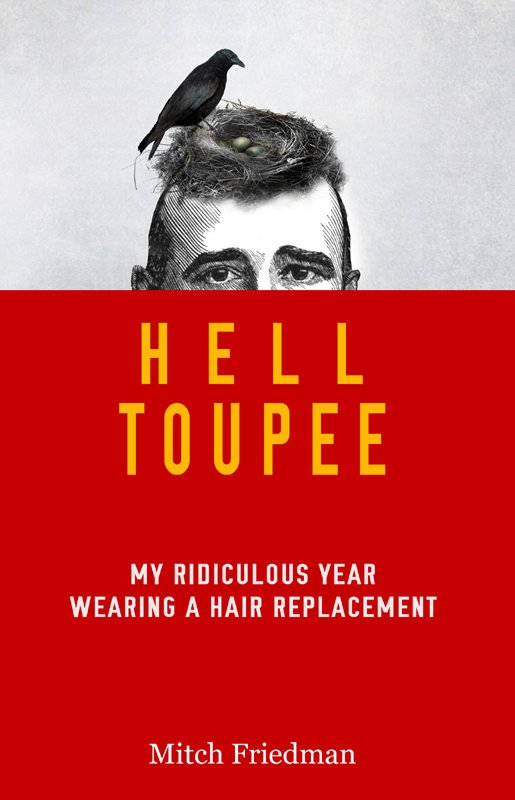
This book is based upon the author’s memory of events. However, names have been changed, and some time frames have been compressed.
Cover design by tatlin.net
Author photograph by Doug Miller
Published by Lewis Avenue Books
lewisavenuebooks@gmail.com
Hell Toupee Copyright © 2014 Mitch Friedman
All rights reserved.
ISBN: 0-9863008-1-0
ISBN-13: 978-0-9863008-1-3
For Morris, Harris, and tsuris.
Contents
Preface
The System
Emergency Broadcast System
House of Toast
The Battle of All Mothers
Hy
Low School
System Maintenance
Schenectady
A Royal Pain In the Ass
Cliff Dweller
Electrolux
Losing My Hair … Again
XTC and The Agony
A Room With a View
I Left My Head In San Francisco
Where’s Baldo?
Ship It!
That’s Entertainment?
New York Shitty
Up In The Air
Stages of Grief
All Systems Go
Ahead
Acknowledgements
About the Author
Preface
This is a book about hair, or lack thereof, and faulty reasoning. In other words, trouble above the eyes.
It took nearly 20 years to write. Not the physical act of slaving over a hot word processor, but the time needed to pass before I was comfortable enough to tell the embarrassing tale to total strangers. I had plenty of practice in the interim, carefully honing my delivery in front of a cringing audience of new friends, and potential girlfriends. One might wonder about the wisdom of injecting such self-mocking shenanigans into possible romance. It’s certainly a valid point. Spectacular lapses in judgment are the culprit behind many of the ludicrous situations I find myself in throughout the pages that follow, only some of which begin on a cold day in 1993. Slip-ups of common sense on such an enormous scale don’t just happen in a vacuum; they take years to gently germinate. Hence the inclusion of some hefty backstory, in which I don’t so much learn from my mistakes as improve on them.
Did my luck eventually take a turn for the better? Well, few in the past 20 years who heard the head-scratching horror story were scared off, and one eventual girlfriend found it entertaining enough to suggest I spin it into a memoir.
I’m thankful I’ll never have to tell the story out loud again. You’re about to see why.
Mitch Friedman
December 2014
CHAPTER 1
The System
On a small metal tray resting disturbingly close to my eyes sprawled something inexplicable. How could this possibly be the key to reversing my lifelong genetic destiny? It could pass for a muskrat riding a doily. Or the codpiece of an embarrassingly smooth caveman. A yarmulke Chia Pet wasn’t out of the question. As far as I knew, horseshoe crabs didn’t wear mink. No matter how I looked at it, this monstrosity was on the verge of being fastened to the top of my head. Maybe permanently. Where I used to have hair, now I would have a “hair system.”
“Okay, Mistuh Friedmin. Are yiz ready?” asked Lenore, the gum-chewing hair technician from Brooklyn, resplendent in bright red lipstick and an acid-washed jeans ensemble.
Staring at my terrified reflection in the mirror of the Head Restart for Men styling room, second-guessing myself for far more than the second time, I tried to remain calm. There was no pressure, or so I was led to believe. If I didn’t like the way it looked, I could opt to have it removed immediately and get half of my nearly $1,500 back, no questions asked. Oh, but there were questions …
•••
How did I get to this point? On the cusp of turning the big three-oh, I was about to accessorize my cranium into the realm of pathetic middle-aged man. At ten years old, I resembled a young Gene Wilder, with gigantic, wild swoops of a wavy, light brown mane. By the time junior high school rolled around, my facial features were dwarfed by a clownishly large natural Afro, or Jew-fro in Long Island Hebraic cliché speak.
“You have the most gawjuss curly hair!” said any number of elderly female relatives, or friends of my mother, as they leaned in close to play with my ringlets, enveloping me in a sickening cloud of perfume mixed with breath that hinted at cheese blintzes just lunched on.
My father was a bit less fawning. “You look like an armpit with eyes.”
My parents’ recent, tumultuous divorce left me rattled and emotionally raw. When I was a self-conscious teenager, replete with a pimply complexion and an even spottier amount of confidence about my appearance, my hair was the best thing I had going for me. It was a calling card, of sorts.
A summer job on the beach during college turned my skin tan and my ’fro blond. It also turned me into an ex-virgin, with the help of my first girlfriend, Tracey. She found me funny and cute. I found myself truly happy for the first time in forever.
The end of our relationship one year later coincided with the beginning of my baldness. Following Tracey out the door, follicle after follicle decided to bid me adieu from that point onward. The tiny spot of visible scalp on the back of my head gradually spread, akin to a patch of dead grass on a healthy lawn giving way to an eventual need for a large shipment of sod. If I once owned the equivalent of a sturdy Brillo pad above my eyes, now it had much more in common with a dainty powder puff.
In recent years I’d become resigned to accepting the nickname “Baldwin,” coined by a few of my co-workers/friends. It was a clever concoction composed in equal amounts of a popular brand of piano, the name of a town near where I grew up in Long Island, and my now increasingly reflective noggin top. In retrospect, perhaps the amounts weren’t so equal.
All those early ’90s late nights, often home alone because I was perennially girlfriendless, led me to become quite a connoisseur of the budding trend of cheesy infomercials. Nestled repeatedly between onslaughts of amazing sweater machines, food dehydrators, no-money-down real estate schemes, and Ricardo Montalban hawking “The Grillerie” was the omnipresent pitch from Mr. Dick Silver of Head Restart for Men. “I’m not just the head of the company. I’ve also got the company on my head.”
“Wouldn’t you like to get your real hair back, and with it, your confidence and sex appeal?” asked the persuasive announcer’s voice, over before-and-after images of sad, balding men, now newly hairy, smiling broadly, often with a large-breasted female admirer by their side.
As dubious as the claims were, after sitting through repeated viewings over the years, I found that my resolve was finally broken. I certainly wouldn’t have minded getting my hair back, but I never really felt that I had sex appeal or confidence in my looks to begin with. Why not try to reboot the outside and inside of my head all at once?
I should have been more astute about the power of advertising, because I spent my days employed as an assistant film and video editor, working on television commercials, but I was as vulnerable as everyone else. Did I believe that my appearance would be vastly improved by suddenly seeming to be years younger like the men in the infomercial? Not really. Did I think there was a chance that I might simply look a little bit better than I did normally? Perhaps. Did I have the perfect amounts of naivety, poor judgment, and self-esteem just low enough to give it a go? You bet.
•••
One month prior, on a bitingly cold December morning, I made my way into the nondescript lobby of a nondescript office building somewhere on fashionable Madison Avenue in Manhattan. Scanning the tenant directory, I eventually spotted the letters “HRM.” Clearly Head Restart either valued the anonymity of their clients or it was hoping to keep its presence in the building as undetectable to the public as it claimed its hair systems would be. After a few minutes sitting entirely by myself in a vast waiting room, surrounded by water-stained wallpaper, stacks of significantly outdated People magazines, and numerous potted plastic plants, unintentionally symbolic of something else fake that was meant to appear alive and growing, I heard my name called. I was welcomed into a drab office by two well-dressed older men, both of whom had heads of hair as impressive as they were unlikely.
“Just take a seat and we’ll measure you for your system,” said the older of the two, as he stretched a piece of clear plastic wrap across the top of my now defrosted skull, and made exacting notations for the size and shape of my impending system with the liquid squeaks of a black Sharpie. The other man snipped off a few bits of what remaining hair I had and placed it in a plastic zippered baggie, which was then officially certified with my name and case number, also in marker ink.
“We use your real hair to find the perfect match from our extensive database of donors. Then our system specialists will weave the hair, one strand at a time, into our patented Derma Follicle-Bond and style it to look just like your hair used to look. You’ll be amazed by how great it will turn out.”
The fact that they never requested to see a picture of how my hair actually used to look left me with a whiff of skepticism about how well my custom-made system would help turn back the clock on my current scalp. They were right. I would be amazed if it turned out great. But I needed to be proven wrong if there was any chance at putting a stopper on the steady trickle of embarrassment that threatened to burst into a torrent of desperation if this scheme failed to put my baldness in the past.
“The moment you walked in, we knew you would be a perfect candidate for one of our products,” said the older of the two, as he held up a chart with clip-art aerial views of the entire range of male hair loss scenarios, and pointed to my counterpart..
After their vicious volley of tag-team sales pitch and coercion landed crushing blows on my common sense, already weakened by years of rapid-fire self-consciousness upper cuts, I delivered my own potential knockout punch by signing on the dotted line, right next to my credit card information. Though it was a hefty price for something I was deeply suspicious of, at least I could afford it financially. The emotional cost worried me far more. Exiting the prep session, I was overcome with an uneasy sense that I wasn’t going to get what I asked for, but I was certainly asking for it.
•••
The day I had been looking forward to, and also dreading for weeks, finally arrived. It was March 27, 1993, a date now scorched into my memory, not far from the location of other long-lasting damage about to be inflicted on my head. Head Restart advised me to have a friend or family member tag along. Whether this was for purposes of giving an opinion, offering moral support, or preventing a possible homicide/suicide was unclear. My choice was Karen, the girlfriend and eventual wife of my best friend Glenn.
Karen had several qualifications for the task. She was an attractive woman—i.e., a member of my hopeful target audience once I was no longer one of those not-so-desirable balding types. She was honest, and would not shrink from offering her thoughts on the results if I requested them. Finally, she understood that I might need a slight grace period before being ready to receive withering ridicule, at least until I got home from the procedure and removed the hat I planned on donning no matter how it turned out.
This time, as we sat nervously in the now much busier waiting room, I noticed something odd. There were men of every shape and size, age, and ethnicity waiting for their appointments. None of them appeared to be apprehensive. They had already undergone the procedure I was destined for. As I glanced from one to the next, it dawned on me that they all had a trait in common. Something that wasn’t quite right. In much the same way that members of an inbred family appear to have loved one another a bit too much, each of these men looked slightly awry in the way their hair didn’t seem to completely belong to their heads. In a matter of minutes, I would become a member of their club. What the hell had I gotten myself into?
•••
“So Mistuh Friedmin, this is yaw very own hair system,” proudly proclaimed Lenore, as she held out her upturned hands. In her palms rested a clump of wet, dark brown hair that had been expertly adjoined to the top side of an oval-shaped piece of vinyl mesh, bearing a resemblance to canvas one might do needlepoint on. Flipping it over to reveal its seedy underbelly, one could see that the mesh template was fortified with a solid strip of approximately one-inch wide plastic around its perimeter.
If I had been tentative before this day, now I was positively mortified. This so-called system looked more like some kind of Halloween version of road kill than the key to my future self-confidence. The hair on it, although still wet, was unquestionably much darker, straighter, and longer than the hair already on my head, into which it was supposed to be seamlessly incorporated. This was a bad enough omen to make me consider changing my mind before we went any further. What I found additionally skeevy was the idea that part of my future hair had been washed remotely, away from the rest of my body, content to be primped and fawned over as if it were some kind of pampered hair actor getting ready to play a part in the fictional story of my life as a non-bald guy.
“Just relax, Mistuh Friedmin. It will look great,” comforted Lenore, as I looked up to catch Karen’s gaze behind me in the mirror. I couldn’t quite read her expression, but one thing it was not was relaxed.
As nervous as I was feeling, I knew I still had the option to play the “give me half the money back right now and get this thing off me” card. After a deep breath, I braced myself and let Lenore do her thing.
The first thing Lenore did was grab an electric hair clipper and immediately shave off a U-shaped moat of hair from the top of my head, obviously intended to correspond with the solid plastic strip on the underside perimeter of the system. My heart sank, and this time I could read Karen’s wide-eyed expression clearly. It read “horrified.”
Some fairly stinky epoxy glue was quickly slathered around the plastic perimeter, followed rather suddenly by Lenore placing the system onto the top of my head for the first time. I thought it instantly looked very, very unpromising. Cousin It from The Addams Family was not what I had in mind. But I was willing to let her finish the process with the hopes I would come around and be amazed by its miraculous transformation into something that looked oh-so-right.
In a dazzling sweep of hot pink fingernails adorned with cartoon mushroom decals, Lenore cut the long strands down to size, and expertly styled the system. I watched in the mirror as she took great pains to tweak and swirl individual clusters of hair for maximum realism and panache. Amid determined snaps and clicks of chewing gum, she gently blurred the border between the system and my own skeptical strands with precision brush and comb work. She then completed her master class in attempted deception with a display of blow dryer technique as refined and graceful as a performance by a theremin virtuoso. As I gazed in awe and rapidly increasing doubt, realizing that I would need to duplicate her performance on my own if I wished to have any chance of pulling off this elaborate masquerade from now on, she instructed me on how I was to fasten a small lima bean–shaped chunk of double-sided tape to the top of my forehead that would also adhere to the bottom front lip of the system to hold it in place, every day.
“So, whata yiz think?”
“Um, well, um … Karen, what do you think?” I asked, deflecting the question transparently.
“I think, well … it’s really up to you, Mitch. You have to be happy with it,” she replied, expertly deflecting it back to me at a speed fast enough to knock it off my head, if I were lucky.
I was amazed at how awful, unnatural, and frankly ridiculous I looked with this thing resting on my scalp. I’d never seen the guy in the mirror before in my life. The thick hair on top of my head was a slightly wavy dark brown. Halfway down my ears was a line of demarcation clearly visible, where my new hair ended and my old hair began. The hair below the line was a bit lighter and much curlier. It also appeared to bear some relation to the rest of my head. As unhappy as I had grown with the balding view of myself each morning before that day, I’d be damned if I was ever going to warm up to the creepy weirdo staring back at me now. It felt like I was wearing a low-budget disguise after being whisked into the Baldness Protection Program, following a very public committing of follicular manslaughter.
Even worse was the stark reality that if I wanted to have it removed right there and then, and I surely did, what was now underneath it would look equally humiliating and inexplicable. Weighing my options of either sporting a U-shaped bald moat speckled with glue or walking out with this hair contraption was unfair. My choice would have been none of the above.
Eventually I decided that having additional hair, no matter how phony and clearly grown on some other guy or woman’s head, was a slightly better plan than having even less hair than I had the day before. Even more troubling was the realization that to have this gruesome interloper pried off me for good surely meant that my entire head would need to be immediately shaved to destroy all evidence of the traumatic process I had just endured. My master plan was to disguise my baldness, not celebrate it. I was in no way psychologically ready to commit certain hairy-kari.
“Don’t forget to set up yaw next appointment on yaw way out,” advised Lenore. “As yaw hair underneath grows, the system will start to get loose and yiz have to come back to get it taken off, washed, and glued back down about once a month. It’s just like goin’ to get a nawmul haircut, and it only cawsts about fifty dolliz, so don’t worry. We made a second system exactly like the one you got now, so when you come in faw yaw appointment, we’ll already have it washed and ready to go faw yiz.”
Perhaps the term “hair system” wasn’t so ludicrous after all? It was becoming blisteringly more clear by the second that for me, this was a system that would drain my bank account, degrade my self-worth, blot out my individuality, and decrease my romantic options, all accomplished with the simple combination of hair and advertising. Ingenious. Maybe their location on Madison Avenue wasn’t just a coincidence.
•••
The subway ride back to my apartment with Karen was quietly hellish. Few words were spoken, but inside I was in a state of panic.
What have I done? I should have told them to take it off when I had the chance. How will I ever be able to look anyone in the eye with this thing on my head?
If Karen was looking at me, I wouldn’t have known because I only stared down at the dirty floor of the train as a steady stream of passengers came and went on their merry, non–hair system way. There was plenty of head shaking on my part, but gently, so as not to dislodge the unwelcome creature now residing under my baseball cap.
CHAPTER 2
Emergency Broadcast System
Like most people, I do not look my best first thing in the morning, especially after a night of very little sleep. Tumbling clumsily out of bed, stumbling over to the bathroom mirror to get a bleary-eyed glance at the inevitable image of red eyes, spotty whiskers, and a cacophony of hair, while unappealing, isn’t usually shocking. But another thing not fully in working order at the crack of dawn is memory. Like the proverbial cat that jumps out at the perfect moment to scare the hell out of viewers of a lame horror movie, suddenly there in my reflection was something lame that instantly filled me with horror. Lounging across the top of my head, sprawled like a member of the rapidly growing, unwelcome, unwashed homeless population of 1993 New York City, was my one-day-old hair system. What the system and a homeless person had in common was the triggering of a sudden urge to look away. The major difference between them was that most people knew their options when encountering a street person: ignore them, give them money or food, or help them find shelter. I had no idea what to do when I encountered my brand-new homely tenant, but a sudden urge to render it domeless did cross my mind.
Reality quickly reared its ugly head, the longer I stared at my own ugly head. What had appeared vaguely believable as I sullenly walked out of the Head Restart offices the day before, but only to those with really bad eyesight, now seemed more like the aftermath of a cruel practical joke. All of Lenore’s handiwork had been destroyed by a night of relentless fidgeting, trying in vain to find a comfortable position against my pillow that did not cause a painful yanking of my real hair underneath. It was cockeyed, tangled, flipped up at the front, and now my responsibility to fix. Good thing I had two hours before I needed to leave my apartment.
After a tentative shower, terrified that I could somehow accidentally cause it to look even worse, if that was at all possible, I gently towel-dried both parts of my head. Try as I might, my hairbrush technique was no match for the task at hand.
“Sonofabitch!” I yelled in the mirror, repeatedly unable to get it to lay down flat. It made me want to tear my hair out in frustration, but I couldn’t because there was glue in the way.
Enraged, I grabbed a can of aerosol hair spray and more than liberally doused my entire head, as if it was insect repellant and my opponent was a swarm of bloodthirsty mosquitoes. Once everything was suitably helmet-ish, I stuck a piece of double-sided tape to the center of the top of my visible forehead, and locked the front lip of my nemesis in place.
I’m gonna have to go through this every day? Goddammit, I thought, as my face devolved into dread.
In a few minutes, I would receive the first taste of what might await me from then on when I went over to Glenn and Karen’s. We had plans for Sunday brunch, but as far as I was concerned, all bets were off at the moment.
Glenn had been my best friend since ninth grade, but actually we had been in the same first-grade class together. We weren’t well acquainted with each other at that tender age—the possible reason being that he successfully faked a speech impediment, and was sent part time to a special reading class. He did this to avoid some of the regular schoolwork the rest of us had to suffer through, like being able to correctly identify a goldfinch or a scarlet tanager from all the other pictures of birds that ran across the longest wall in our classroom. Decades later, he was still the more brash and opinionated of the two of us.
No doubt Karen had filled him in on the previous day’s details. I imagined there was special emphasis on the results. I walked the five blocks to their apartment, fully expecting to be pelted with semi-amusing put-downs.
“Holy shit,” said Glenn, as he opened the door to let me in and began to shake his head slowly back and forth in shock.
“Yeah, I know,” I said, as I rounded the corner into their living room, where Karen was sitting.
“Oh, Mitch,” added Karen, who was also shaking her head, perhaps because my system somehow managed to look even worse than it had the day before.
“I don’t know what to say,” said Glenn. “It looks horrible.”
“You knew enough to say that.”
It was so obviously, pathetically out of place on me that even Glenn, a guy who almost never had a problem ridiculing anyone in a good-natured way, thought it best to just keep quiet for a bit instead. In my fragile emotional state, I actually felt guilty about him having to be sympathetic.
“At least we can’t call you Baldwin anymore. What do you think about Syssy System?” he said, bringing the very short grace period to a screeching halt.
“C’mon. Already? Can’t you tell that I might not be in the mood just yet?”
“Okay, sorry. You’re right. I won’t call you that. At least not out loud for a while.”
“You’re so considerate.”
He wanted to make a video, documenting my staggering transformation. A few days before I had become systemized, he had me stand in front of a big sheet of black cardboard and slowly spin around, then he finished up with a few other vérité shots just for fun. Now “with system,” I wore the same coat and scarf, stood in front of the same cardboard and spun around in the same way. This was footage I had little interest in watching back.
Sensing that I was legitimately troubled by what I had done to myself, Glenn volunteered to go out and pick up bagels and cream cheese for all of us, rather than force me to sit in a crowded diner, full of cool people. I was grateful for the brief reprieve from the flood of anxiety I was slowly drowning in.
•••
The next morning, after I struggled to make myself look even marginally presentable, it was time to begin the gradual campaign of having horrified eyes feasted upon me. Two days earlier, I was your garden-variety young adult male in the waning days of his youthful hairiness. In my mind, everyone was staring, noticing my retreating hairline. In reality, almost no one gave it a second thought, other than me. Around my one-trillionth thought on the matter, I convinced myself to opt for the baldness kryptonite of disguising my “malady” using some other guy’s hair. Almost instantly, as if shoved into a drastically malfunctioning Superman-style phone booth, I emerged as Conspicuous Man! Able to want to leap off tall buildings, head first, system bound.
Embarrassment is the great equalizer. It tears away the glossy sheen of ego that the rich, powerful, and beautiful people rely on to separate themselves from the rest of us mere mortals. In the case of beautiful people, another great equalizer is farting. As Glenn liked to point out, even Christie Brinkley farts. True, farting is embarrassing, but I chose to think of farting and my hair system as being in separate categories. Whether or not a foul odor would follow me around from time to time, I was certain I’d always be embarrassed in private and public with this new addition holding on to my head for its dear life, at the growing expense of my own dear life.
Not many people, other than my close friends and family members, knew about my plan before it was put into action. Co-workers had received vague hints of a “procedure” that was about to take place, but scant other information was dished out. I had no illusions of anyone being unaware of the drastic change once it occurred, but my hope was that everyone would be pleasantly surprised by the outcome. Whatever skepticism festered in the minds of those who were expecting it would be brushed away immediately upon seeing the new me. I had dreamed of the rush of compliments to come my way:
“You look ten years younger!”
“You should have done this a long time ago.”
“If I hadn’t known, I would never have suspected you had anything done.”
“Is that you, Mitch?”
Yup, it was me. Unfortunately.
On the ground floor of my three-story walkup on West 11th Street in Greenwich Village was a laundromat and dry cleaner. The elderly Asian woman who ran the place spoke little English and did not have a great memory for names. I plodded nervously down the steps, entered the shop, and walked up to the counter to drop off my bag of dirty laundry. Not looking up immediately, she grabbed her receipt pad and a pen, then met my gaze.
“F …?” she asked, as she did each time I brought in my laundry, because she could remember only the first letter of my last name.
“Friedman,” I said, trying not to make eye contact as she looked quizzically at the top of my head. I was expecting her to ask, “What the F?” next.
“What you do? Haircut? Look different!”
“Yeah, something like that,” I answered with receipt in hand, then burst out the door as soon as possible to avoid any further interrogation.
It was a windy, cold late March morning, but I wouldn’t dare put on a hat for the long walk to the subway. Thanks to my curse-filled shower and styling session having run way overtime, I was close to being late for work. Picking up the pace of my normally rapid walk was difficult any time I was facing directly into the wind, but now this had the added peril of being dangerous to my psyche.
As I waited for the light to change at the corner of Hudson Street, a tall brunette woman who resembled Geena Davis walked right by me. For a moment, I thought it was Geena Davis, as there was an autographed snapshot of her on the wall of the corner deli, but I soon realized it was just the woman who lived down the block. Not that she ever noticed me any of the other times that I hoped she would as she walked by—but this time I couldn’t help catching her sneaking a brief glimpse my way. I cringed slightly, and despaired about how I had managed to find myself in a position of wishing a beautiful woman would not look at me.
When the light finally changed, I caught the hour on a clock in a shop window across the street and decided the only way I’d get to work on time would be to grab a taxi. It would also serve the added purpose of allowing me to avoid feeling stared at on the subway.
Hudson Street was generally coursing with cabs at this hour. There was a bit of a taxi lull as I stood on the curb and held my hand up, while several occupied cabs whizzed past. The whipping wind blew horizontally across my head, causing the right side of the system to subtly separate from the hair below it, and begin to gently flap in rhythm. An inundation of hair spray was no match for nature’s fury. My hand jutted down from its taxi-hailing position to smack the flap back into position, timed perfectly to miss flagging two empty taxis.
“Shit!” I hissed to myself. There’s no way those cabs didn’t see me standing here with my arm raised. Maybe they didn’t want to pick me up because of how weird I look?
On this, only the third day of what might be the rest of my life, I already felt like screaming, “I am not a ‘hair system’! I am a human being!”
“Forty-sixth and Second Avenue, please,” I said, as I was finally, mercifully able to escape the rapt imaginary gaze of morning commuters and seal myself inside a car. For the next fifteen minutes, I felt somewhat free. Free from suffocating self-consciousness. Free from evil system-lifting winds. Free to muster up what the hell I was going to say when I arrived at Bennett James & Associates, the busy television-commercial editing company I worked for.
A typical New York City taxi ride can make you feel like you’re inside a dangerous video game, with sudden obstacles that seem to pop up out of nowhere, and drivers aggressively cutting off other motorists. As a safe driver myself, I was naturally inclined to keep my eyes peeled on what was happening directly in front of the windshield, even though I was powerless to do anything about it but reflexively hit an imaginary brake pedal, or duck and brace for impact. My driver’s quick glances into his rear-view mirror weren’t as quick as they should have safely been, thanks to his attention being diverted by the hair wreck above my eyebrows. This ugly head mess was dangerous to my mental and physical well-being.
While the frantic city blurred past the windows, my mind was a similar blur of confusion and crisscrossing thoughts. I could barely handle the way I looked. How was I going to handle the way everyone looked at me? Aside from Bennett himself, there were roughly thirty associates with whom I’d been working for almost two years, and they had grown quite accustomed to my occasional playful quips. But playtime was over, at least until my shell shock (and likely theirs) wore off.
“Ten bucks,” said the cabbie. I handed him thirteen, oblivious to the symbolism of the number, and exited into the howling wind. It didn’t help that, almost vibrating with nervousness now, I saw him turn his head to stare at me as he started to drive away. If I were grateful for anything this day, it was that there was no doorman in the lobby of the office building as I scooted into the already waiting elevator and hit the button for the sixth floor.
With a large gulp, timed precisely with the ding of the opening doors, I slowly walked into the office, gave a quick “hello” to the receptionist, and went straight down the hall to the communal assistant editor’s room. The eight guys already busy at work glanced up.
“Hey … Mitch,” said Vinny, the amusingly crass but good-hearted middle-aged head assistant editor. “How was your weekend?” His carefree smile was gone in a flash once he focused on me. “What the fuck did you do to yourself? Is this some kind of early April Fool’s joke?”
“Yeah, Kinch (my other soon-to-be-retired nickname), what the hell is that?” asked Tim, my best friend of them all.
“It’s a long story, and I’m kinda not ready to tell it just yet,” I said. “Later.”
“Okay, all you dirtbags, leave him alone,” said Vinny. Some of the other guys mumbled, “Sorry,” but had a really tough time not glancing over at me, over and over, with confused expressions on their faces, then whispering to the guy next to them.
In the best of situations, when you’re in a room and people whisper after looking at you, you start to feel paranoid. Strangely, because I was already so uncomfortable and paranoid, their whispering didn’t have much of an effect. There was no need to start to feel paranoid. I already knew for sure that they were talking about me, and whatever it was they were saying couldn’t be worse than what I was telling myself.
For the next hour, I had to practically hold my breath to keep my composure. Every single person in the office took an extended look at me and tried to make believe they hadn’t. Some asked what I had done, and some knew better than to ask, based on the pained expression I wore. It was time to spill the beans to Tim, and to Brian, my other good friend there.
“So, remember the little procedure I told you guys I was going to have? It was to do this to myself,” I said, as I waved my hand in a vague circle around the top of my head while I rolled my eyes and frowned.
“But … I don’t … why?” asked Brian.
“Yeah, Kinch. What is that thing?” asked Tim.
“Well, you know those Head Restart for Men commercials? This is what you look like after signing up,” I said.
“But is it a toupee? Can you take it off? I hope you can—it looks, um, weird,” said Tim, whose disturbed appearance was a perfect match with my now constant grimace. “I thought you looked fine before.”
“It’s not a toupee. It’s a ‘hair system.’”
“A hair system? C’mon, that’s ridiculous. It’s a toupee, right?” said Brian.
“Okay. First thing is that it’s kind of a toupee. It’s really sort of like a yarmulke with hair woven into it. They literally glued it down to a horseshoe-shaped trough of my scalp that they shaved from my hair in order to put this thing on me,” I detailed.
“Holy crap, Kinch,” said Tim.
“Oh man,” said Brian. “Did you know they were gonna do that?”
“No! They told me I was getting a hair weave and I could have it removed right then and there if I didn’t like it, and get half my money back. But they never mentioned it would be glued to my head,” I said.
“How much did you pay for that thing?” asked Tim.
“Fifteen-hundred bucks, and apparently I have to go back once a month to get it washed and glued back down again for about fifty more bucks each time, because it gets loose.”
“I’d say you got ripped off. Majorly,” said Brian.
“I’d like this goddamn thing to get ripped off my head right now!”
For clarification, my nickname being Kinch had nothing to do with the character on Hogan’s Heroes. Our receptionist once misunderstood my name when someone called for me, paging me as Kinch instead. The nickname Kinch fluctuated with Kinchbald, patterned after a foam rubber ball we tossed around near my desk that was called the kinchball. I wondered how long it would be before they’d be calling me Syssy System.
As this appropriately hated Monday drew to a close, it was off to another potential bit of fresh hell. My improv/sketch comedy classes were starting up again after a hiatus.
“Fuck,” I said out loud, alone in the restroom when I got a look at myself for the first time since the morning. In the neon light, the dividing line of hair colors was much more vivid. The dark rings under my eyes matched the dark hair on the system perfectly. It had been a long, unhappy ten hours, and I was exhausted from the work and the worry.
Following a few more minutes of fruitless adjusting and cursing at myself in the mirror, I was running late for the second time that day. This running late business would become a regular occurrence, causing me even more stress. Normally, I was either always on time or stupidly early. The last thing I needed was to have everyone wonder where I was, and then pay extra attention to me when I finally did arrive.
Knowing there was a brisk, twenty-minute walk to West 42nd Street ahead of me, I jumped right into the open elevator, hoping for a few moments of solitude to collect myself.
When I started working in the building in late 1991, I was pleasantly surprised to share the elevator one morning with Jennie Dennis. Jennie had been, by far, the most beautiful and desirable girl in my high school. She was blue-eyed, blonde, statuesque, and pretty friendly, as far as knowingly knockout high school girls could be expected to be. If Cheryl Ladd from Charlie’s Angels and Cheryl Tiegs in her see-through fishnet from the 1978 Sports Illustrated swimsuit issue could have a love child—and what teenage guy wouldn’t want to see that process—she would look like Jennie. Every attractive woman I saw, from high school on, would be measured against Jennie, and few came close. Twelve years later, she looked even better. We were in the same art class one semester, but otherwise had no occasion to interact in any way other than me tripping over my own feet whenever she walked by. On the bus to our senior year picnic, fate brought us together when she took the empty seat next to me. She was deeply tanned and wore a tight white T-shirt and tiny black nylon shorts over a skimpy bikini that was clearly visible through the shirt. Even if I wanted to speak to her at that moment, I would have been rendered mute. However, on that first morning when we found ourselves in the elevator, she initiated the conversation and asked me if we had gone to high school together. We had a relaxed chat, during which she told me she was working at the architectural firm a few floors above me. As I got out, she waved goodbye and said she hoped we’d bump into each other again sometime soon, which we occasionally did. Today, of all days, was not one on which I had hoped to bump into her, but there she was.
“Hi Mitch!”
“Hi Jennie. Nice to see you again. Forgive me, I’m not feeling great, so please don’t take it personally if I’m kind of quiet,” I said, looking away.
“Oh, I’m sorry to hear that, Mitch. You do look a little off today. Feel better.”
“Thanks,” I said, and rapidly left the elevator before she could fully grasp what was a little off.
As I hurried toward class, doing sidewalk slalom through chaotic Times Square, now half-Disney and half-porn, it seemed to me that everyone was looking at the top of my head. I began to sympathize with what large-chested women must endure, and wanted to shout, “Hey, my eyes are down here!” But to expect people to not look at my head was as realistic as having a sensitive stomach, drinking a prune/jalapeno/olive oil/buffalo-wing sauce smoothie before a long trip in a car with no air conditioning in the summer, and being surprised when you suddenly had to vomit.
Gotham City Improv was the East Coast branch of Los Angeles’ famed Groundlings company, the launching pad for comic actors such as Paul Reubens, Laraine Newman, Jon Lovitz, and my current favorite SNL cast member, Phil Hartman. I had enrolled myself in their improv/sketch comedy classes a year earlier, for a variety of reasons. It might be fun. There would probably be women there. I had always been quick-witted, and was told I was very funny, but I could be painfully shy and wanted to force myself to become more extroverted. In the previous six years, starting with my college senior thesis, I’d written and recorded three cassette albums of experimental, oddball pop songs filled with clever wordplay, and was stuck in a rut of only being able to write things that rhymed. Most crucially, I signed up so that I could have an excuse to leave work at a reasonable hour at least twice a week, when every night seemed to end in abusive overtime.
This was the beginning of the fourth-level class; the highest level there was before possibly being chosen to perform in their junior company, Far Beneath Gotham. I was never the most comfortable actor, and thought that if I eliminated a large amount of my self-consciousness by hiding my baldness, my chances at advancing would be even greater. Not all of my calculations appeared to be accurate.
I ran up the stairs and into the rehearsal space to find some familiar faces, and a few new ones. As soon as they all turned to see me, every face was a perplexed one. This would be the third class I took, taught by the elfishly enthusiastic Rob Walters. He was a fine writer, director, and performer as a cast member of Gotham City’s main company. He was also now a friend—a friend who instantly found out he didn’t know me that well.
“Hey Mitch. Great to see you. But, wow.”
“Hi Mitch,” said Mary, another friend from all three previous class levels. She ran over to hug me but had the look of someone who suddenly smelled something odd.
The others, whom I was meeting for the first time, had less forensic evidence on which to evaluate my skewed appearance. That didn’t stop them from reflexively doing a double-take at the top of my head, then just as quickly looking away when they realized I had seen them do it. This phenomenon, which I like to call the double-take take-back, began to happen so often in my presence that I should have considered filing for a patent on the term.
After I spent a few painful moments recounting what I had done and why I had done it, we were able to start class. Given that we had all taken some time off, our improv skills were rusty. The normally quick associations and nabbing of pop culture references out of thin air didn’t come so easily. What did come with relative ease, and alarming repetition, were sudden mentions of barbers, hairbrushes, and Halloween, causing discomfort for everyone involved. It seemed to concern us all that my new incarnation might cast an unbreakable spell over the proceedings for the discernible future. But that concern lay largely unspoken.
I could tell they sympathized with what I was going through, and genuinely wanted me to be happier and more relaxed, for my own sake. Their caring grew to mean a great deal to me—but at the same time, it resulted in increasing pressure to do something about it.
CHAPTER 3
House of Toast
I’ve always had a somewhat tumultuous relationship with being the center of attention. If I were to declare what the status of that relationship was on Facebook, I’d click “It’s complicated,” but then realize that all of my friends, and perhaps friends of friends, would notice I’d just done that, causing me to delete it immediately. You get the idea.
Things got off on the right or wrong foot right away. In the race against my cousin Stuart to determine who would be the first grandchild born, on September 21, 1963 I was victorious in a baby-photo finish by a mere three days. Two months and one day of nonstop doting later, President Kennedy was assassinated, putting a major crimp in my baby majesty for the time being.
When I was nearly three, my sister Mindy joined the crew. Months later, after four years in an apartment in Forest Hills, Queens, my family moved on up to a house in the chichi suburb of Woodmere, on the south shore of Long Island.
My mother, Susan, was an attractive brunette housewife who dedicated herself to taking care of my sister and me. As far as motherly duties were concerned, there was no one better. She never failed to make us breakfast, do our laundry, and be sure our clothes were presentable, even when she also had a full-time job. No doubt, her strong sense of responsibility and resolute determination was inherited from her father, a very religious, very old-fashioned Russian immigrant named Sheldon.
“You know vat y’are? You’re the senior of the juniors,” my grandfather often declared to me. He expressed his fondness, as well as his hopes that I would make him proud by following in his very Jewish footsteps, each time he leaned in close to my face, bathing me in the aroma of that day’s whole onion he ate as if it were an apple. It certainly got my attention, but it was only persuasive enough to remind me to religiously brush my teeth.
My father, Herb, played a large part in making me what I am, and perhaps an even larger part in what I’m not, today. He took over his father’s corrugated box company after graduating from the prestigious Wharton School, and turned it into a successful business. With all certainty I can say that I inherited none of his talents or enthusiasm at being a salesman or executive, but appreciated the unlimited supply of boxes whenever I needed to move. The fact that on his business cards he referred to himself as “The Corrugated Fox” should be a tip-off that he had a huge ego, probably directly related to a, um, sizable endowment as it were, both of which he was mostly unsuccessful at bestowing upon me. With his ever-present combover, for a long time my dad looked like a potbellied cross between Dick Van Patten and Bob Newhart, infused with the politically incorrect worldview of Archie Bunker, ever-present smelly cigar included.
None of that mattered to me as a little kid, because he was all about having fun. With his quick sense of humor, and a fondness for the silly, every boy thought he was hilarious. He entertained us with his famous “meat grinder” routine. Using a mouthful of mashed potatoes and the turning of an imaginary crank on the side of his head, he slowly propelled them through his teeth. At one of his favorite spots, on the beach, he performed another popular bit, hiding a piece of rolled-up seaweed in his hand and then faking a huge sneeze, causing the seaweed to tumble down from his considerable nose, the bottom tip of which he was also able to touch with his tongue.
“C’mon, Mitch. Wake up,” he whispered to me at four in the morning, causing me to spring out of bed with excitement. We were off to go fluke fishing on a party boat out of Captree on Long Island, with a stop at Dunkin’ Donuts on the way to grab a jelly donut for me and a coffee for him. It felt like a special treat to be up before the sun rose, standing next to all the men prepping their rods with hooks and sinkers, while I sat on a wooden bench still a little moist with condensation, getting powdered sugar all over my sweatshirt, while my dad munched on a hard-boiled egg.
Though he’d been a fisherman his whole life, it seemed like I was always the luckier one on these trips. But if ever there was a long dry spell without even a bite, he’d sneak his arm behind me and quickly shake the end of my rod, briefly fooling me into thinking I was about to hook something, causing both of us to laugh.
According to his high school newspaper, he was the “fleet afoot” standout center fielder for the school’s baseball team, the Far Rockaway Seahorses, who wore castoff uniforms formerly donned by the beloved Brooklyn Dodgers. My dad had Pee Wee Reese’s old attire, but thankfully not his antiquated cup, or I might not be here today. After college and the army, he became a pitcher in a weekend slow-pitch softball league. I spent many a Saturday morning as a kid watching him confound opposing batters as a member of the Sportstown Clowns, a team sponsored by a local sporting goods store whose logo was an Emmett Kelly–esque clown with giant baseball mitts instead of giant white gloves. He kept at it, playing for a variety of teams for decades, even after laughing at being taunted by opposing fans with the ever-so-clever chants of “Throw the ball, you old fart!” and “The pitcher has no hair!”
My father’s baseball-related talents were passed down to me. Like high school–aged father, like elementary school–aged son, I was also fleet afoot. Hours spent out in the street, running frenetically to skillfully catch flying tennis balls that my dad whacked toward me with a stickball bat, helped me develop into quite a good outfielder too. Through some fortunate blessing bestowed on me by the God of Torque, I also had the wrist-snapping mechanics to be able to throw a ball with great accuracy, speed, and when required, distance.
I may have become the sports-obsessed kid my father was steering me toward if it wasn’t for discovering Charlie Chaplin. In the winter months, I spent late Sunday afternoons sprawled on the couch under a toasty afghan blanket, watching endless Chaplin shorts on public television. For my Hanukkah present, I demanded a tall, hardcover book called The Films of Charlie ChaplinModern Times