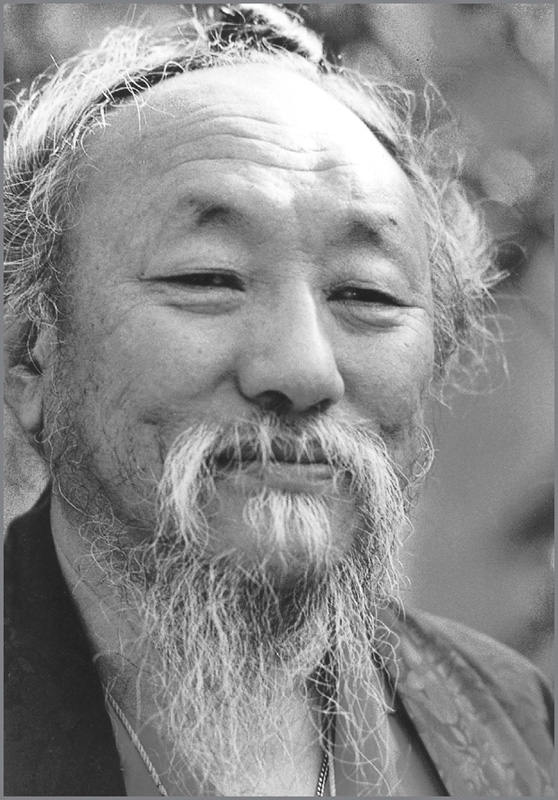
HIS EMINENCE CHAGDUD TULKU RINPOCHE
Published by Padma Publishing
P.O. Box 279
Junction City, CA 96048-0279
www.tibetantreasures.com
© Padma Publishing 1992
© Revised Edition 2014
eBook 2015
All rights reserved. No part of this book may be reproduced in any form or by any means, electronic or mechanical, including photocopy, recording, or any information storage or retrieval system without permission in writing from the publisher.
Printed in the United States of America
Library of Congress Cataloging-in-Publication Data
Chagdud Tulku, 1930–2002
Lord of the dance : the autobiography of a Tibetan lama
1. Chagdud Tulku, Rinpoche, 1930–2002 2. Lamas—China—Tibet—Biography. 3. Lamas—United States—Biography. I. Title.
BQ946.A345A3 1992 294.3’923’092—dc20 [B] CIP 92-23341
ISBN 978-1-881847-25-0 Paperback
ISBN 978-1-881847-46-5 eBook
I have no wings, but still I fly in the sky;
I have no magical power, yet like magic
I journey throughout realms of illusory display,
here and there, in nine directions,
exploring the connections of my karma.
Written in Mürren, Switzerland by Gargyi Wangkhyug (Chagdud Tulku),
whose given name means “Powerful Lord of the Dance”
Contents
FOREWORD
PREFACE
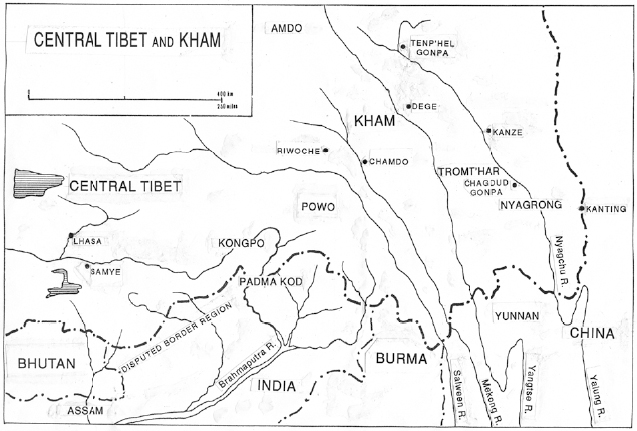
MAP OF CENTRAL TIBET AND KHAM
PROLOGUE
1 DELOG DAWA DROLMA
Tromt’har · The threshold of death · Journey to unseen realms · Drilo · Revelation of a treasure · My father · My conception
2 TULKU
Childhood battles · A delegation from Chagdud Gonpa · A fiery argument · The move to Tenp’hel Gonpa · A nun from Lhasa ·My tutor · Visions · Manjushri practice · False accusations · The terrifying Lama Wanga
3 THE ARCHER
The vision of P’hadampa Sangye · Chod, p’howa and an unusual transmission of Hayagriva · A target missed ·The birth of my sister
4 RETREAT
An inauspicious beginning to my three-year retreat · Daily schedule · My mother’s death · My first major decision · A terrible death · Dreams and visions · A test of inner heat · Pride and its downfall · First encounters with the great Jamyang Khyentse Chhökyi Lodrö and Dilgo Khyentse · Debate
5 CHAGDUD GONPA
History of Chagdud Gonpa and its former tulkus · Procession to the monastery · My divination · A shower of burning coals · Resumption of formal training · Sechhen Kongtrul’s blessing and a wrong turn in meditation · Difficult vows · Retreat with my stepfather
6 CONFLICT AND RETREAT
Theft of my most precious dharma items · Robes abandoned and exit from Tenp’hel Gonpa · Gunfights in Tromt’har · My second three-year retreat · A visit from Tromge Trungpa ·Trungpa’s death · The Chinese · A request
7 PILGRIMAGE
Pilgrimage with the monks of Chagdud Gonpa · Ekadzati’s prophecy · A massacre · The tightening Chinese vise · Chamdo · Monks or highway rogues? · A vivid vision and mysterious warning · A thwarted trip to Padma Kod · More roguery · A momentous meeting with an ancient nun · Mindroling Monastery ·An unhappy parting from my monks
8 MY LAMA
Journey from Mindroling to Samye · Meeting with His Holiness Dudjom Rinpoche · Mind nourished, body famished · Lhasa · My root lama Khanpo Dorje · Forebodings about the Chinese · Resettlement in the Kongpo region · Two drubchen ceremonies · Padma Kod at last · Marriage negotiations · Khanpo Dorje’s visit to Kongpo · Chinese summons · The walk toward prison · Escape into hiding · An interlude with my new bride · Chinese attack
9 FLIGHT
Divination ignored · Nagaland · Confrontation at the border · Protection by the Indian army · Chinese attack on the camp · Twelve days in the jungle · A near drowning · Safe refuge at the Indian military post · Dream of America
10 IN EXILE
The camp at Missamari · At death’s door · Liaison to Dudjom Rinpoche · An Indian train trip · A miscarriage of justice · Retreat at Tso Pema · Red Tara · On the road in India · The Orissa camp · Birth of my son · Divisiveness
11 PARTINGS
Splendid isolation in the high Himalayas · A strange cure by an oracle · Song and sacred substance · Decision to leave Chamba · Chhöling Rinpoche · Dissolution of my marriage · Delhi and the poorest refugees · Western connections · Malaria
12 NEPAL
Empowerments from Dudjom Rinpoche and Khyentse Rinpoche · An important prophecy · Jane · A conversation with Dudjom Rinpoche · Khyentse Rinpoche · California time change
13 RETURN TO TIBET
Letter from my sister · Chinese policy transitions · Tibetan Reception Committee · Reunion with my monks · Tenp’hel Gonpa and reunion with my sister ·Attempted execution · Forbidden teachings · Tromt’har and Tulku Jigmed Namgyal ·Tulku Arig · Chagdud Gonpa · Protectors · Enthronement ceremony · The oldest monk’s words ·Pilgrimage · Wu Tai Shan
EPILOGUE
GLOSSARY
PHOTOS
Foreword
CHAGDUD TULKU RINPOCHE CAME TO AMERICA in 1979 and has resided here ever since. But from the time of his birth in Eastern Tibet, in 1930, to his arrival in the States, a story has unfolded as remarkable as any I have ever heard. This book is that story.
First, I want to set Rinpoche’s story in some sort of context, for there are many things he simply will not tell you, even though this is his autobiography. He will not speak of his seemingly boundless compassion, a compassion that to us, his students, defines his very being. He will not talk of his profound awareness of the absolute nature of mind, an awareness he seems to be living and transmitting twenty-four hours a day. He will not tell you of the thousands and thousands of people whom he has served as teacher, spiritual master, physician and friend. He will give little hint that he is renowned as a scholar, artist and poet. Few of his remarkable accomplishments over the past decades—especially those in the West—will you find in this autobiography, and you cannot know from his narrative that this man has enhanced the lives of an incredible number of people through his profound transmission of the spiritual path.
When Rinpoche arrived in Los Angeles on October 24, 1979, he and his wife-to-be, Jane, first went to San Francisco. In mid-1980 he was asked to visit Eugene, Oregon, in order to teach an overview of Tibetan medicine to a group of American doctors. At the request of His Holiness Dudjom Rinpoche he remained in the Eugene area as a resident lama of Yeshe Nyingpo, the name given to Dudjom centers in the United States. Several years later, responding to students who wanted to ensure that there would be a seat in the West for future Chagdud incarnations, Rinpoche established the Chagdud Gonpa Foundation.
The original Chagdud Gonpa, founded in 1131, is one of the few monasteries in Eastern Tibet to have survived the Communist Chinese invasion. Chagdud Tulku Rinpoche, as the sixteenth incarnation of the original founder of that monastery, set up the first seat of Chagdud Gonpa in the West at River House (later renamed Dechhen Ling) in Cottage Grove, Oregon. There, as in all Chagdud Gonpa centers, instruction was offered in the methods and wisdom of Tibetan Buddhism, including the arts, philosophy and meditation practices of the Vajrayana Buddhist tradition.
In the fall of 1988 Rinpoche and his students acquired 286 acres in northern California’s Trinity Mountains, and Rigdzin Ling, Chagdud Gonpa’s main center, was born. The heart of the development at Rigdzin Ling will be a traditional Tibetan Buddhist temple, or lha khang (literally, abode of deities), which will include an extensive display of Vajrayana sculpture and decorative arts.
Presently, the Chagdud Gonpa Foundation has seven centers on the West Coast as well as centers in Brazil and Switzerland. Rinpoche’s other projects include the Mahakaruna Foundation, which provides support for poor and infirm Tibetans in the refugee communities of India and Nepal; the Tibetan Library, which purchases and preserves rare and irreplaceable Tibetan texts; and Padma Publishing, dedicated to making the works of the Nyingma tradition available in English, as well as translating and editing Rinpoche’s own teachings. He has also created major Buddhist statues in the United States and has trained several Westerners in Tibetan art.
Rinpoche travels constantly, stopping only to lead retreats. To those who urge him to slow down, he explains, “I am still gathering my students. Perhaps some of the dharma seeds I plant now will ripen in future lifetimes. Vajrayana bonds are very strong and are not dissolved by the illusory displays of death and birth. We meet and meet again until ultimately we recognize that we are inseparable in enlightened buddha nature.”
When Rinpoche’s family, students and friends began asking him to write down the experiences that make up this volume, he saw no reason to record his life. He said that he did not want to write the usual Tibetan namtar, an account of a lama’s life in which human failings are glossed over by the sheen of spiritual attainment. Although Rinpoche is a tulku, a recognized incarnation of a highly realized lama, he himself teaches that tulkus, being born into the realm of humans, must deal with very human issues in establishing the continuity of their spiritual path from one life to another. The essential attributes of a tulku combine a powerfully directed intention to work for the welfare of all living beings with the meditative realization to sustain this intention throughout this life and through the turmoil of the intermediate state between death and rebirth.
The combination of pure intention and great realization that produces a tulku also produces an extraordinary life, as Rinpoche demonstrates, and the requests that he write his story persisted until he finally yielded to them and began this book. He did not emphasize the achievements that have so defined his experience, but mostly his human foibles and his mistakes, using these to make teaching points, essentially at his own expense.
Anybody who knows Rinpoche will realize that he would write his story in no other way. Never mind that he is one of the greatest living masters of Dzogchhen, the Great Perfection, the highest Buddhist teachings. Never mind that he took the ground-breaking step of fully ordaining a Western woman as a lama or that he is one of the first Tibetan masters to take Westerners completely into his confidence and trust, and to train them according to the teachings of the Great Perfection. Never mind that all of his students have unlimited access to him literally twenty-four hours a day. None of this has made its way into the following pages. Although Rinpoche teaches many categories of Vajrayana Buddhism, his realization of the Great Perfection informs his presentation of every level of teaching and is at the heart of his transmission.
Of the three major categories of the Buddha’s teachings, the first, Hinayana, emphasizes the basic meditation practices of concentration and insight, and sets as its goal liberation from suffering through renunciation and cutting all attachment. The second, Mahayana, emphasizes the path of compassion and selfless motivation to work for the benefit of sentient beings until all are enlightened. The third, Vajrayana, emphasizes the revelation of mind’s true nature, using many skillful methods of which the Great Perfection is the highest and most direct.
Rinpoche’s life demonstrates how Great Perfection realization becomes thoroughly integrated with the conduct of daily activities. Mind’s boundless, absolute nature, nakedly apparent to him in moments of visionary experience as a young child, became the central thrust of his spiritual path thereafter in finding teachings that would allow him to stabilize those glimpses. Throughout his last turbulent period in Tibet following the violent conquest by the Chinese communists and during the difficulties of being a refugee in India and Nepal, there was a profound continuity in his spiritual perspective and a deep, powerful current of compassion. In one of his published teachings he says:
The key to all is pure-heartedness, one’s own selfless aspirations, one’s pure motivation. Your actions and those of another may not be so different; the difference is in the heart, in the motivation for what you do. And that’s what makes all the difference in the outcome of your actions in the world. You must have the purity of your own heart, the purity of your own stance and intentions toward others and the world around you. This is the seed of all inner peace.
When one is in the presence of Chagdud Rinpoche, one is aware that this is a large-scale human being, a man of great qualities, humor and sincerity. As one of his students put it:
Sometimes he flashes forth with words that have a stunning impact, like a lightning bolt. Then, after the shock comes a freshness, like the clean air that follows a thunderstorm. The whole environment of one’s being feels purified. As for Rinpoche, he is immovable. His love is still there. His kindness is still there. The incomprehensible vastness of his mind that holds all the phenomena of our own is still there.
Asked why he finally wrote his autobiography after ignoring requests to do so for many years, he replied, “My life is a lesson in impermanence, and impermanence is the foremost teacher of the spiritual practitioner.” Chagdud Tulku’s story can be read on many levels—as a colorful, often humorous adventure story; as an inner, spiritual journey; and as a teaching on how one person attains the perspective of absolute truth amid life’s uncertainty. As such it is both inspiring and encouraging, and highly relevant to anyone who seeks ultimate meaning in this time of dire prediction.
Ken Wilber
Boulder, Colorado
1992
Preface
TIBETAN CONVERSATIONS AND EVEN dharma discourses are filled with stories, stories to pass time, stories to illustrate points. The stories of Tibet that I told to my Western students fascinated them and they often urged me to write them down.
After entreaties from many people, the writing of this book was catalyzed by Lisa Leghorn. I told my stories on tape, and Tsering Everest, my interpreter, rephrased my English, which is still not perfect. My wife Jane Tromge then reworked the transcriptions of the tapes so that the oral narrative became this book. She received encouragement and editorial assistance from Lisa, Mary Racine, Bob Tajima, Linda Baer and many other people in a process I thought would take a few months but in the end has taken almost four years.
Now I am preparing for another journey into Tibet, again uncertain about Chinese permissions and the conditions we will find. At home—for the United States is really my home and I am a citizen—I have numerous students, many well grounded in spiritual practice. Artworks are being created, texts are being published and an enormous prayer wheel in California spins the blessings of hundreds of millions of mantras in all directions. Though the play of impermanence will gather and disperse, may any virtue endure and benefit forever.
Prologue
THE LAMA HAD TRAVELED SEVERAL days by horseback from his monastery, along the narrow Nyagrong Valley with its deep forests and turbulent river. He had crossed the jagged mountains and the long, treacherous boulder-strewn ridge to this alpine valley and had honored the request of its leading family to do a wealth ceremony. Now he would return to his monastery, and these people would make their dangerous and costly pilgrimage to Lhasa, hopefully better able to afford it by virtue of this ceremony.
He took another sip of fiery arak and looked around the vast, black felt tent. Several hundred persons were eating, drinking and talking merrily in the total relaxation that follows the intensity of a great ceremony. And again he looked at the young woman.
She was very beautiful, not more than seventeen, and seated on a throne among the high lamas. In his meditation she had appeared to him as the deity White Tara, with eyes on the soles of her feet and her palms and one in the center of her forehead. Even now, through less visionary eyes, she did not appear ordinary.
He summoned her, and as curious faces turned their way, he handed her an exquisitely wrought reliquary box, a gau. “You and I have had only a brief connection in this lifetime,” he said. “But in the future our connection will be very deep. Please accept this gau as a sign.”
As the young woman took the gau, the lama’s attendant monk took note. Some sixty years later he would say to the assembled lamas and monks of Chagdud Gonpa, “I never doubted that this Chagdud Tulku is who he is, because I was with him in his last life when he gave Delog Dawa Drolma, the one who became his mother, that gold and silver gau.”
1
Delog Dawa Drolma
MY MOTHER DAWA DROLMA was remarkable for her beauty, her fierce temper and her unconditional generosity. When she was a child, the family found this last quality most disturbing. “Venerable people, I am old, penniless and very hungry. Please, do you have something for a poor unfortunate one like me?” A plaintive plea by one of the numerous beggars who wandered up to the family tent would set off a flurry of activity. Someone would rush to the beggar with some tsampa, a bit of butter and perhaps yogurt; someone else would dash to Dawa Drolma to divert her from attending to the beggar herself. Others would station themselves protectively by the precious shrine objects and the various repositories of the family’s wealth.
If relatives and servants couldn’t restrain Dawa Drolma in time, or worse, if the beggars called when they were away, inevitably she would seize some valuable item from the family coffers—the silver offering bowls, a piece of Chinese silk, an auntie’s favorite turquoise hair ornament—as her offering to the incredulous mendicants. Her compassion was limitless and she wept over their predicament. Her attachment to the family’s wealth was slight, so they took to hiding it, even though they commented among themselves that the child’s spontaneous generosity was definitely a sign that she was extraordinary, surely an emanation of the deity Tara herself, an embodiment of enlightened wisdom and compassion.
Our family, the Tromges, was a large clan that lived in the Tromt’har region of Eastern Tibet. Tromt’har is a high plateau, probably more than thirteen thousand feet in elevation. Pilgrims making their way from Tromt’har to Lhasa, which is at eleven thousand feet, used to complain about the heaviness of the lowland atmosphere. It is a region of glittering lakes, green meadows, alpine flowers and resplendent skies, and there the family’s thousands of sheep and yaks were pastured. Our family, like most in that region, lived in black yak hair tents. Ours was a prosperous clan, and one of our tents was large enough to hold four hundred people. There was only one other tent that large in all of Eastern Tibet. Occasionally, when lamas and monks were assembled to conduct great ceremonies, the tent would be filled to capacity. The assembly sat in long rows on Tibetan rugs and sheepskins, with the high lamas on thrones at the far end, and everyone drank salt tea and made jokes until the ceremony began. Then, as the warm glow of butterlamps and the smoke of cedar incense filled the atmosphere, the deep chanting of the liturgy would commence with its awesome accompaniment of cymbals, drums, oboes, conches and horns, resonating far beyond the tent until it dissolved in the stillness of the thin air.
There were several highly realized lamas in each generation of the Tromge family, and my mother was the most famous in hers. She was one of Tibet’s five great wisdom dakinis—female emanations who spontaneously benefit beings by their activities. Terton Jigmed Khakyod Wangpo had prophesied her birth as an emanation of the longevity deity White Tara and an incarnation of Yeshe Tsogyal, Tibet’s most revered female practitioner and the spiritual companion of Padmasambhava, the Vajrayana master who propagated Buddhist teachings in Tibet in the eighth century.
Dawa Drolma was also a delog, one who has crossed the threshold of death, traveled in realms of existence beyond those visible to us as humans and returned to tell about it. One day, when she was about sixteen, Tara appeared to her, not in a luminous vision but in person, and told her that she would soon fall ill and die. However, if she followed certain instructions explicitly, she would be able to revivify her dead body and benefit others by teaching about her experience. Soon after, Dawa Drolma had a series of bad dreams that revolved around three demonic sisters who were robbing all beings of their vitality. With black lariats and silk banners they tried to ensnare Dawa Drolma around the waist, but the deity White Tara prevented them from doing so by surrounding her with a protection circle. Eventually, however, the menace in the dreams was so strong that Dawa Drolma knew it foretold her imminent death. She went to her uncle, the great Tromge Trungpa Rinpoche, and with his help made the necessary arrangements, just as Tara had instructed. Then she became extremely sick and died, despite the efforts of the many doctors who were summoned.
Exactly as she had stipulated, in the presence of an attendant named Drolma her corpse was washed in consecrated saffron water and dressed in new clothes. It was carefully laid out in a room without a morsel of food or a drop of water. The door was draped in blue cloth, padlocked and sealed with the sign of the wrathful fire scorpion, and a man dressed in blue stood guard outside. Everyone was warned to refrain from any ordinary chatter, to recite only prayers and mantra. For the next five days and nights Tromge Trungpa, along with several other lamas and monks, did prayers and ceremonies continuously in the adjacent room. At the completion of this vigil, Tromge Trungpa entered the room where the corpse lay, cold and pale as he had left it, and recited powerful long-life prayers to summon Dawa Drolma’s mindstream back into her body. In the account she dictated several days after her return, she described her reentry into her body:
When the consciousness reentered my physical body, I sneezed violently and experienced total disorientation. An instant later, I was in a state of faith and joy at the visions of the pure realm, and horror at the karmic visions of the hells. I felt as though I were waking up from sleep. Uncle Trungpa was standing in front of me, holding a longevity arrow and looking at me with concern in his bloodshot eyes. I was unable to say a word, as though I were a bit shy. Everyone was crying and excited, and saying things such as, “Wasn’t it difficult?” “You must be hungry!” “You must be thirsty!” They were almost pouring food and drink over my head. Although I protested, “I feel absolutely no discomfort due to hunger or thirst,” they didn’t believe me. Everyone was saying, “Eat! Drink!” They all felt joy as immeasurable as a she-camel who has found her lost calf. We all partook of a feast to celebrate.
DURING HER FIVE-DAY JOURNEY AS a delog, my mother’s consciousness, unhindered by the constraints of a physical body, traveled freely through all the realms of mind, from the hell realms with their ceaseless, unbearable suffering, to the most exalted purelands of the wisdom beings. For the rest of her life, whenever my mother taught, she drew from her experiences as a delog. Her descriptions of the misery of the other realms were very vivid, and tears came to her eyes as she spoke. “No matter how difficult your life is in this human realm,” she would say, “there is no comparison between the difficulties here and those in other realms.” No one doubted that she spoke from direct experience, and her credibility was enhanced by the messages she brought to people from their deceased relatives.
In particular there was a very wealthy businessman named Drilo whose sister had died and was now in a state of torturous suffering. By chance she encountered my mother and begged her to relay a message to Drilo, telling him the whereabouts of certain valuables she had secreted. “Tell my brother to use those things for ceremonies and dedicate the prayers to me so that I may find release from this terrible suffering more quickly.” When my mother returned to the human realm, she sent a message to Drilo, but he was busy shearing sheep and refused—rather rudely—to meet with her. So she sent him a letter telling him where the valuables were hidden. Drilo was astounded, for only he had known that these things were missing. Upon finding them by the letter’s instructions, he decided it would be worthwhile to meet my mother. Their meeting produced a second startling revelation when she informed him, “Unless you take certain steps, you will join your sister in the realms of hell.”
Drilo replied, “If you can tell me exactly what to do, I will do it, but only if it prevents me from going to hell altogether. I won’t do anything just to go to hell for less time, and I won’t meditate. I’m a businessman, not a practitioner, and I won’t devote my time to practice.”
“Then I will be very direct,” she said. “Each day you must sponsor at least a hundred butterlamps, each year you must sponsor a reading of all one hundred and eight volumes of the Buddhist canon and in your lifetime you must sponsor the building of a mani wall.” A mani wall is built of stones carved with the mantra Om Mani Padme Hung.
As a businessman, sponsoring these devotions seemed to Drilo a good bargain, a relatively easy way to buy his way out of hell. But when my mother told him that he needed to recite the mantra Om Mani Padme Hung daily, he balked. “I won’t do it. I don’t have time.” Almost every Tibetan recites this mantra of the lord of compassion, Avalokiteshvara, many times a day, and some very virtuous practitioners go into retreat to recite one hundred and eight million. Drilo stubbornly refused to do even one hundred and eight until another demonstration of my mother’s extraordinary abilities changed his mind.
My mother was asked to do seven days of long-life ceremonies for a lama named Tonpa Tulku. At the beginning of the ceremonies, as was customary, an arrow decorated with silk streamers was put on the altar and a piece of string was cut the same length as the arrow. If the length of the arrow increased in the course of the ceremonies, it would be an indication that the length of the lama’s life had correspondingly increased. My mother gave Drilo the piece of string and told him to keep it until the conclusion of the ceremonies.
Usually my mother was a perfectionist about every aspect of ritual. There are monks living today who remember occasions when she flung her bell across the room or whacked them on the head with her bone trumpet because they weren’t mindful and made a foolish error. However, during these long-life ceremonies she herself seemed distracted. On the last day she actually slept through the morning session, but upon awakening, she told her attendant that she had had a wonderful dream in which a wisdom being had brought a blessing. “Go look on the altar.”
He went, but found nothing unusual. Thinking it a very bad sign to come back empty-handed, he gathered up some black mustard seeds. Seeing them, my mother was puzzled and said, “I don’t think this is it. Go look again.”
This time the attendant found hundreds of small pills sprinkled everywhere. Such pills hold the essence of long-life blessing, and their spontaneous manifestation was regarded as an indisputable sign of the effectiveness of the ceremonies.
My mother then called Drilo and they measured the string he had kept against the arrow on the altar. The length of the arrow had increased by an inch, another sign that the ceremonies had borne fruit.
Drilo’s faith in my mother became so strong that he could no longer refuse to say Om Mani Padme Hung one hundred and eight times a day. He wouldn’t buy a mala (rosary) for counting, so he counted the recitations on his fingers. No one ever suspected him of making a mistake and saying one hundred and nine. He did, however, walk around murmuring, “Delog Dawa Drolma Chhen”—“Great Delog Dawa Drolma”—and he became the sponsor of many of her dharma projects, including the construction of a huge and costly prayer wheel filled with the mantra of the deity Vajrasattva.
Throughout her life people came from great distances to receive my mother’s blessings as a healer. She melded the compassionate intention of her mind into various substances, most often by blowing into pure water after reciting mantra. The effectiveness of the healing water depended on the sick person’s faith and my mother’s power to invoke the purification of wisdom and compassion.
NOT LONG AFTER MY MOTHER RETURNED from her journey as a delog, the family decided to make a pilgrimage to Lhasa. This was a major and very expensive undertaking, so my family sponsored an extensive wealth ceremony to help support the journey.
During a wealth ceremony, one invokes wisdom beings to gather and return one’s merit—one’s positive, virtuous energy—in the form of prosperity. The intention is to offer the wealth generously and thus to contribute to the well-being of others. If one’s motives for performing such ceremonies are selfish, one’s accumulated merit is simply used up and one can become more impoverished than before.
Dawa Drolma sat in a place of honor at the ceremony. At this time, she was already famous as a delog and recognized as a siddha, a person of extraordinary spiritual attainment. The young lama who led the ceremonies was Chagdud Tanpai Gyaltsan, the abbot of Chagdud Gonpa and my previous incarnation.
He was twenty-seven years old and famous as a wild siddha who drank prodigious amounts of arak and on occasion bent heavy iron swords into folds. Chagdud Tanpai Gyaltsan, like the incarnations of Chagdud before him, had an extraordinary realization of the essential insubstantiality and mutability of the phenomenal world.
In recognition of his deep connection with my mother, at the conclusion of the ceremony he gave her a precious reliquary box and told her that their connection would soon come to fruition. Tanpai Gyaltsan died not long after.
After the ceremony, the family left on its pilgrimage, their caravan of yaks and horses loaded with tents, utensils, a year’s supply of food and the many offerings for high lamas that would be necessary in Lhasa. Relatives, lamas, monks, servants and herdsmen were all a part of the caravan. Because of the ever-present threat of attack by brigands, my family, like most pilgrims, traveled in the relative safety of large numbers and with armed men.
For many months the caravan of pilgrims wended its way through the high, craggy mountain passes, the long valleys and deep forests that separate Eastern from Central Tibet. Sometimes they stopped at monasteries, but usually theirs was a nomadic existence, with all the pleasures and hardships that involves.
One day as the entourage passed through a valley, my mother suddenly pointed and exclaimed, “Over there is a terma that must be revealed now!” The caravan immediately changed direction and traveled until it came to the rock face of a mountain. At my mother’s direction, a man struck the rock with one strong blow of a hatchet and a large slab fell off, exposing a p’hurba, or ritual dagger, embedded in stone.
This p’hurba, like other sacred objects and teachings Tibetans call termas—“treasures”—had been hidden in the eighth century by one of the teachers most revered in Tibet, Padmasambhava. In propagating the Buddha’s teachings amid the shamanistic society that dominated Tibet at that time, Padmasambhava saw clearly that some teachings would have to wait for a more appropriate time to take root. He concealed them until certain great practitioners such as my mother would reveal them and bring them to fruition. These practitioners became tertons, “treasure discoverers.”
Instead of seizing the p’hurba, my mother turned abruptly to her sister, who out of jealousy had continually disparaged her accomplishments. “You doubt my abilities,” she said, “so demonstrate your own now. You pull this p’hurba from the stone.”
Her sister, too proud to refuse the challenge and risk losing a moment of glory, grasped the p’hurba. With a shriek, she released it. Hot as molten iron, it had seared her hand. My mother stepped forward and pulled the p’hurba from the stone as easily as a knife from butter. Inside a hole in the center of the p’hurba was a scroll inscribed in the secret language of the “sky goers,” the wisdom beings known as dakinis. The script, indecipherable except to one with profound wisdom, was revealed by my mother.
At last the caravan crossed the high, semi-arid plateau where Lhasa is situated. Inside the city the family made pilgrimages to the Potala Palace, the Jokhang and numerous other holy places. They visited the high lamas who lived in Lhasa at the time, including Jigdral Yeshe Dorje, Dudjom Rinpoche, the future head of the Nyingmapa tradition of Tibetan Buddhism.
During her stay in Lhasa, my mother established a connection with a very high lama of the Gelugpa tradition, Sera Kharto Tulku. He had been a terton in his previous life, and was now a very powerful meditator and the abbot of a monastery near Lhasa. There were many prophecies about him in the texts of Padmasambhava. One stated that when he and his closest friend encountered imprisonment or untimely death, Tibet would soon fall.
Many years later, unfortunately, this prophecy was fulfilled. Kharto Tulku’s closest friend, a lama known throughout Tibet, became inadvertently ensnared in a political intrigue and was assassinated. Kharto Tulku was imprisoned for two years because of his friendship with this lama, and died shortly after his release. At the moment of his death, he stood up, took the threatening posture of a wrathful deity and held that pose for two weeks. Exactly as the prophecy had foretold, the circumstances of Kharto Tulku’s imprisonment and his friend’s death signaled disintegration in Tibet, which would leave the country vulnerable to the Chinese takeover.
Although in the Gelugpa tradition it is not permissible for lamas to marry, secret trysts are not unheard of. Near the end of my mother’s stay in Lhasa, she conceived a child by Kharto Tulku. The two did not marry. Instead she returned to Tromt’har with her family. Three years had passed since they left.
Soon after, a sealed letter arrived for my mother from Dzogchhen Rinpoche, a lama respected throughout Tibet. He wrote, “In your womb there is a great tulku who will be known as T’hubtan Geleg Palzang. Take special care, keep very clean and eat only the purest food for the full term of your pregnancy.”
Tulku is a word with many levels of meaning in Tibetan, but usually it refers to a being of extraordinary spiritual attainment who has intentionally taken a specific rebirth in order to benefit others. Before birth the tulku directs his or her consciousness toward the union of specific parents so that the circumstances of birth and upbringing will be an auspicious beginning for spiritual activity.
A second letter arrived from Kharto Tulku, which accurately foretold many events in the life of his child in my mother’s womb. My mother took these letters to heart and was very careful during her pregnancy. I was born in the Iron Horse Year, 1930, on a mountaintop named T’hurgan Lhakhang—“Abode of the Gods.”
2
Tulku
DESPITE MY BEING A tulku—or perhaps because of it—I was a terror as a child. Tibetans sometimes say that tulkus are wild and willful as children, but that this same energy propels them toward spiritual accomplishment if it is properly harnessed. To this high purpose, Tibetans spare no effort with the rod. My mother and I lived in Tromt’har until I was three. I retain wisps of pleasurable childhood memories—nestling inside my mother’s sheepskin coat and holding on to her back as we rode on a horse; watching my grandmother’s servants churning milk into butter by shaking it in a yak skin; my beautiful auntie with her pink cheeks, turquoise ornaments and belt made of pierced silver coins—but these memories are as tenuous as a half-remembered dream.
More tenacious and vivid are the memories of my childhood dramas of sorrow and conflict, the incidents that were grist for my development and training. Tibet is in the flyway of migrating birds, and in the fall countless varieties flocked in the meadows there. Fascinated, I wanted to capture one and keep it for a pet. The older children told me how a bird could be trapped, and with this method in mind, I set out with a basket, a stick, a bit of string and a handful of barley. After many failed attempts, I finally trapped a swallow under the basket. I reached in carefully and caught it in my hand. Stroking its feathers delighted me, and I coached it to eat a few kernels of grain. When I showed the adults my new pet, however, their reaction spoiled my pleasure.
“You must let it go, T’hubga. A wild bird won’t survive unless it can fly free. It isn’t like a dog or a lamb. You can’t make it a pet.” Their admonishments only provoked my fierce will. I loved my little bird. It was mine and I would care for it; their words couldn’t wrest it from me. Instead of releasing it, I slipped it into my chuba, the wraparound robe that Tibetans wear as an outer garment. That night before I fell asleep, I cradled my cherished pet in my hand one more time and gently tucked it back into my chuba. In the morning it was dead. I cried bitterly, inconsolably. This was the first great loss I ever experienced.
I was always very protective of children smaller or younger than I, though I would take on anyone else. This meant I was frequently engaged in battles. One day my maternal grandmother intervened in a fight between me and another child, and pinioned my arms. “Now all of you teach him not to fight!” she commanded. She held me as five or six children jumped on me, pummeling me with their fists. Sobbing and furious, I felt as if I would suffocate under the pile. Suddenly I found my hand on my little knife. Yanking it from its sheath, I stabbed blindly. One of my cousins, an older girl, emitted a piercing scream. The children scrambled off me and stared in stunned silence as my cousin, wailing in pain and indignation, revealed her wound. Since she, like all of us, wore a tough sheepskin chuba, my knife thrust had not done much damage. Still, it had punctured her side and caused enough bleeding that everyone was shocked. The children would never play with me again, and made a game of scattering and shouting fearfully whenever I approached. I became very lonely, but in the immediate aftermath of the stabbing, I was sullen and truculent, as I fully expected an unmerciful beating.
The beating never came, probably because of the intervention of the girl’s mother, my beautiful auntie, who was always gentle and calm. My own mother must not have been home, because I cannot imagine her allowing me to go unpunished. There were days when she would beat me not once, but three or four times. Each time my anger would escalate, I would yell more abusively, and when she released me, I would repeat whatever I had been doing wrong with more fervor. It was an immense and exhausting clash of wills, but in her compassion my mother could not let me grow up wild and ungovernable. Although eventually I would experience deep regret that I had inflicted so much trouble on my mother, so much suffering on one who was an emanation of Tara, there was no residue of bitterness between us. Sometimes, as soon as she had punished me, we would embrace and the conflict would dissolve. For my grandmother, though, I harbored a grudge that lasted for almost two decades. Its origin was not in her setting me up to be trounced by the other children, but in her not sharing evenhandedly a little nub of sausage.
One day I and several other children were in our family tent while my grandmother was eating a large link sausage. At the end of it was a balloon where the sausage casing had expanded in the hot fat. Each child coveted this end piece, and each begged for it. “Please, Amala, please give it to me!”
“No! To me!”
“To me! To me!”
“Please, Amala …”
The innocence and single-mindedness of our desire made us extremely vulnerable to her decision, and when my grandmother gave the balloon to her favorite child, perhaps each of the other children felt as I did—deprived and unloved. I proceeded to make myself more unlovable by saying terrible things to her and later, when my mother and I lived in a different region, by stationing myself by the road and throwing rocks at her horse as she arrived to visit with my mother.
The special affection children usually feel for their grandparents I reserved for my great aunt. She was a wonderful meditator who seldom lay down to sleep. I would come and nestle against her, and as she murmured her mantras, I would drift off in her lap. She radiated warmth, peace and the deep comfort I longed for as I chafed against the obstacles in my childish mind. When dinner was brought to us, I fed her from my bowl and she fed me from hers, and she would stroke my head.
WHEN I WAS THREE YEARS OLD, a delegation of monks from Chagdud Gonpa arrived in Tromt’har to search for the reincarnation of Tanpai Gyaltsan, the previous Chagdud Tulku. They had consulted a number of high lamas, who had indicated that his incarnation had been born in the Tromge clan as the son of Dawa Drolma.
In addition, there had been the monk from Chagdud Gonpa who had witnessed the singular exchange between Dawa Drolma and Tanpai Gyaltsan and the gift of the reliquary. Thus, when the delegation arrived, there was little doubt about where to look for the child; the suspense lay in whether the child—that is, whether I—could pass rigorous tests verifying that I was the incarnation, the tulku, of the abbot of Chagdud Gonpa. Without hesitation I identified the objects that had been Tanpai Gyaltsan’s, and when a monk who had been close to Tanpai Gyaltsan came in, I greeted him by name. Nevertheless, a dilemma arose, because my mother was not home and my grandfather had to receive the delegation and accept the recognition that I was Chagdud Tulku. Not to accept, according to Tibetan custom, might create obstacles to the fulfillment of my life’s purpose. To accept, however, traditionally meant that I would be returned to my monastery to be trained. My grandfather took the middle course. He accepted a set of monk’s clothes, but he made no agreement about my return to Chagdud Gonpa.
My Tromge relatives rejoiced in my being formally recognized as Chagdud Tulku, and although there may have been those among them who looked forward to my being sent away to the monastery, they thought my grandfather had been adroit in his handling of the situation. Everyone was amazed, therefore, when my mother returned home and became enraged when she was told what had occurred. She berated her father fiercely. “Are you tired of feeding my son and me? Are you tired of providing our clothes? Or is it that your home has become too small for us? Never mind, for soon you will be free of us.”
She began making preparations to leave. My grandfather, a fine, vital man, had no means to counter her arguments because in any ordinary sense they were irrational. He came to me with tears in his eyes. “You always have a home with me,” he said, “and you needn’t worry about food and clothing as long as I have anything at all.” I knew what he said was true, and I loved him very much.
To say my mother’s behavior was inexplicable and irrational is not to say it was egotistical or wrong. Her awareness was beyond the limitations of time, space and apparent circumstances, and her actions arose spontaneously from wisdom. Later the family would understand that it was necessary for her to leave them in order to fulfill an aspect of her destiny that had been prophesied long before, that she should stabilize the health and life of Tulku Gyurmed Namchag Dorje, a very old, frail lama who was the abbot of Tenp’hel Gonpa. This had been foretold by Padmasambhava himself. Whatever else necessitated her furious stance in regard to my recognition as a tulku, her break with Tromt’har and her move to Tenp’hel Gonpa cannot be ascertained now, more than fifty years later. Perhaps by exiting from the center of fiery conflict she caused her father less heartache; perhaps the conflict arose from the need to protect me. My grandfather visited us at Tenp’hel Gonpa soon after we moved there, and my mother and he were completely reconciled.
For me the move to Tenp’hel Gonpa, about a week away on horseback, marked the beginning of my formal training as a lama. For the next seven years, until I went into three-year retreat at the age of eleven, my life would alternate between periods of strict discipline in which my every move would be under the surveillance of my tutors and interludes in which my suppressed energy would explode. Throughout, I had many visions, many clairvoyant experiences, many extraordinary dreams, and within these, I sometimes had glimpses of absolute open awareness. My mother and my teachers took note of these as indications of special abilities I had developed in previous lifetimes, but they never wavered from their intention that I should go through the rigors of Buddhist training in this lifetime, or from their certainty that only through effort would I reestablish the effortless realization I had attained previously.
IN THE DREAM I WAS PLAYING INSIDE the stone fence of my mother’s front yard. A dog came and slowly transformed into a deer. The deer transformed into a lama, and the lama into a dragon. Wondrously, I beheld the dragon as it rose, took flight and disappeared into the clouds. I could hear its roar echoing in the vault of the sky. When I asked a lama about it, he said, “I think it was a dream about your own life, which you have begun as a very naughty child.”
TENP’HEL GONPA IS NORTHEAST OF Tromt’har, on the other side of a towering mountain range. It is in the region of the kingdom of Gesar, the epic warrior of Tibet, and it is clear why Gesar saw this land, with its rolling hills, grassy meadows and sparkling rivers, as well worth winning and defending. The elevation is more than twelve thousand feet, but the landscape is gentle and expansive.