With the last loud blast of the whistle, the train pulled away and Morris’s father began his long, difficult journey. Three uncomfortable train trips, miles and miles of walking, and six bumpy wagon rides later, he would reach the harbor in Bremen, Germany. And there he would board an enormous ship bound for Baltimore in America.
As the train disappeared from sight, Morris wondered how long it would take his father to save enough money to send for the rest of the family. Then, listening to the call of the train’s distant whistle, Morris made just one wish: for time to speed by.
But for now, he and his family — his mother, Sarah Mindl; his sister, Freydel; his bubbe, Machlia; and his zeyde, Avram — would go back to Aroshka. Back to one of the dozens of drab wooden houses on one of the many dirt roads that led to the marketplace and the shul in the center of town. Back to Aroshka, to his cousins and friends — Chaikeh, Rebekah, Yosef, Yudis, Devorah, Ruti, and Shai — and to their parents: Herschel, the scribe; Gitel, the baker; Daniel, the carpenter; Sima and Menuchah, the dressmakers; Shmuel, the teacher; Binyamin, the cobbler; Velvel, the peddler; and Efrayim, the shopkeeper.
Back to Aroshka, to live and to wait.
Each weekday was the same as the one before: Morris worked hard in school. Then, after supper, he taught his little sister the names and the sounds of each letter of the Hebrew alphabet.
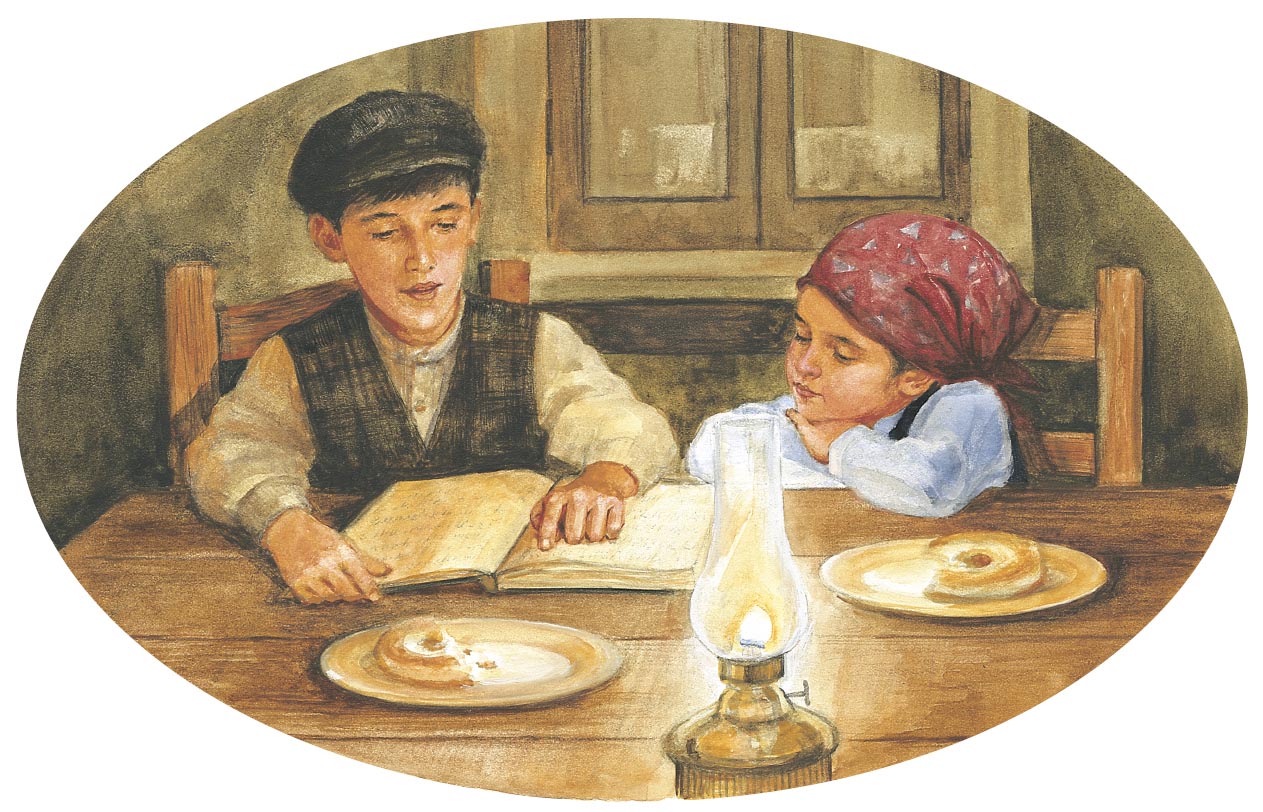
“This letter is named shin,” Morris said. “It has a “shuh” sound. The word shalom, which means “peace,” begins with this letter. Now you try, Freydeleh.”
“Shin!” she repeated loudly. “Shalom!” she exclaimed, so fascinated was she by this world of words.
“Very good,” Morris said, rubbing his ears.
Grandpa Avram looked up from his book and smiled. “Menashkeleh certainly is a patient teacher,” he thought. “And Freydeleh! What an enthusiastic student she is!”
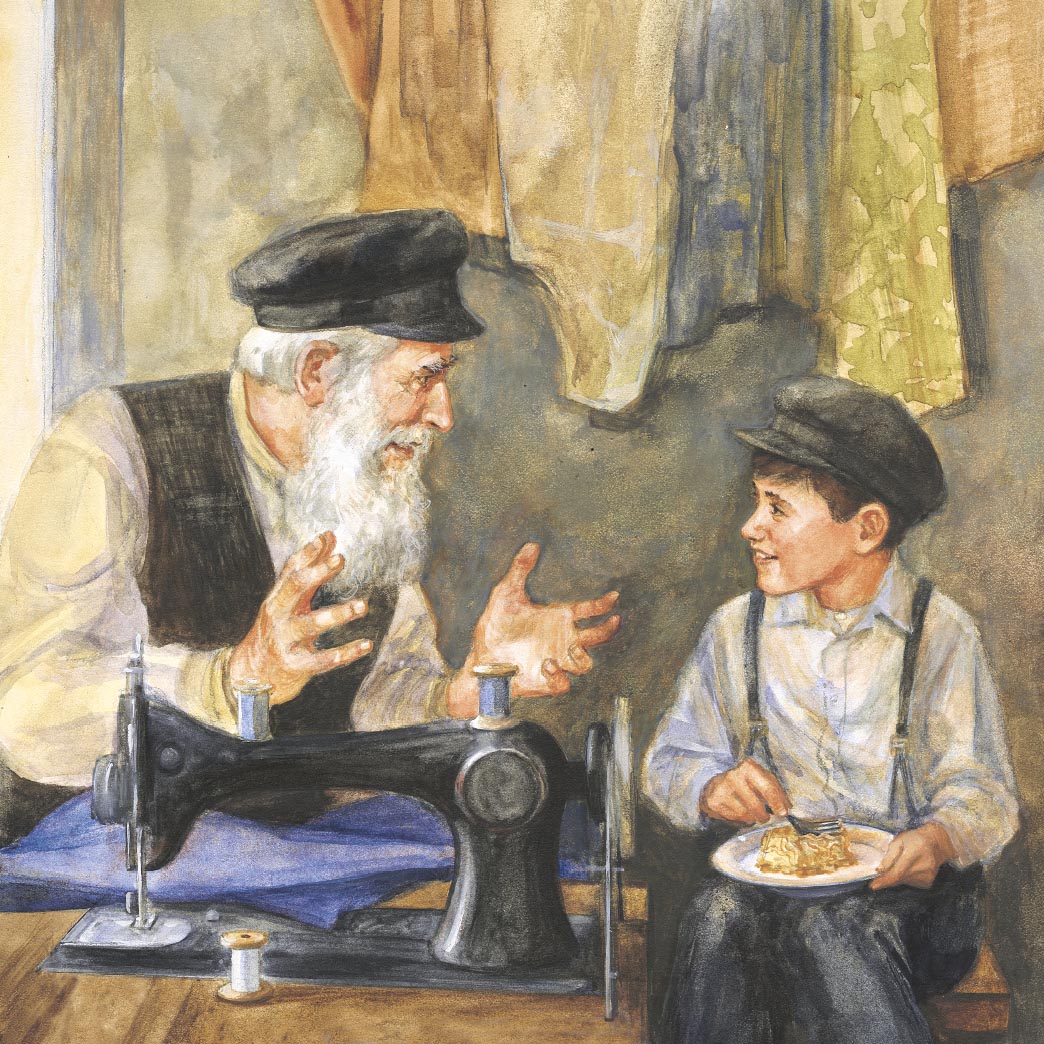
With each passing week, Morris grew to miss his father more and more. But because he had the rest of his family around him, he never felt sad for very long. His mother and his bubbe were as warm as their delicious noodle kugel. And his zeyde, Avram, was as lively as his stories. Indeed, Morris’s most happy hours were spent eating noodle kugel while listening to his grandfather.
“Which story shall we hear this afternoon?” Grandpa Avram would ask as he got up from his worktable to join Morris on the bench.
Sometimes, Grandpa Avram made up his own exciting adventures. And other times, he told legends from the Bible. Morris especially liked the one about Joseph and his coat of many colors. Then as soon as Grandpa Avram finished telling a story, it was Morris’s turn. How he loved to hear his grandfather laugh at his jokes or ask “What happened next?” whenever he told him a story with a cliffhanger.
“I’ll tell you tonight, Zeyde!” Morris would answer, running out the door. Lunch was over. It was time to get back to school.
These were some of Morris’s most joyful moments.
But the most sparkling thread in the spindle of life in Aroshka was Shabbat.
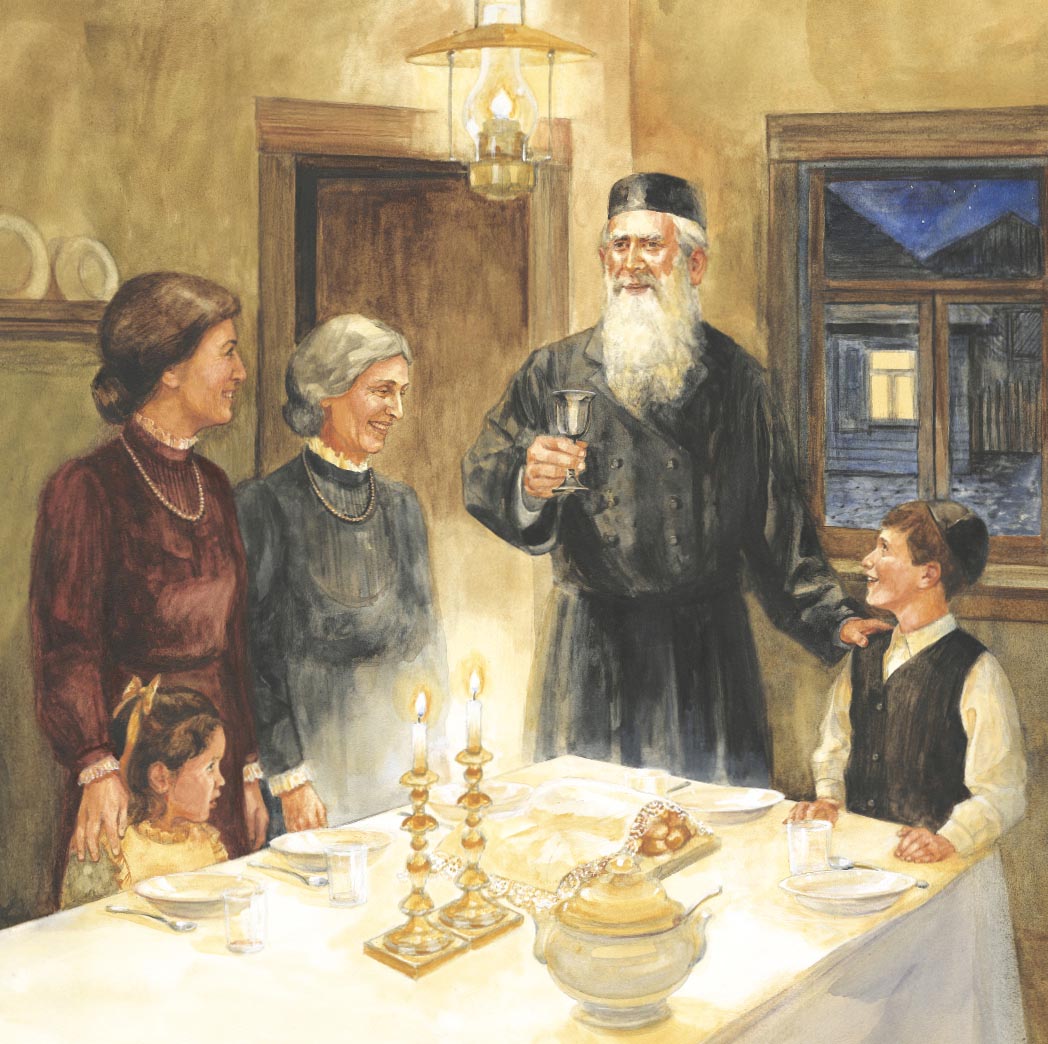
To welcome this magical time into their home, Morris’s mother, bubbe, and sister drew close to kindle the Shabbos candles. Then, after Grandpa Avram and Morris returned home from shul, the family gathered around the table to hear Grandpa Avram sing the blessings over the wine and the challah. Sometimes, just the five of them would enjoy the special meal of fish, soup, and chicken that followed. But more often than not, Morris and his grandfather would invite a hungry traveler or a poor student to join them. For as Grandpa Avram liked to say, “Sharing Shabbos doubles its sweetness.” And he was right.
When morning came, Morris once again accompanied his grandfather to shul. On the way there, Grandpa Avram delighted Morris by answering all of his questions about trees and flowers and clouds, anything and everything that Morris could think of. And as for the rest of the day, it was spent blissfully with family and friends — resting, playing, listening to stories, singing, studying, and enjoying the warm afternoon meal of cholent — meat, potatoes, and beans.
Finally, after the sun had set once more, Grandpa Avram and Morris stepped outside. Looking up, they talked quietly so as not to disturb the sounds of evening while searching for three medium-size stars.
“Is that medium-size, Zeyde?” Morris asked, pointing toward one particular star.
“Yes, I believe you’ve found a good one, Menashkeleh,” Grandpa Avram answered.
“And how about that one over there to the left? Do you see it? Do you think that one is a good match?” Morris asked.
“Perhaps that is a bit too big. We’ll see. Let’s keep looking,” he answered.
One by one they found them, and then, slowly — “Don't rush, Menashkeleh” — walked back inside to tell everyone that Shabbos was over.
The bright flame of the Havdalah candle used during the evening service to separate Shabbat from the new week had been extinguished. And the wine had been blessed. But the sweet smell of the spices would linger in Morris’s memory as a reminder of just how perfect the day had been.
“A gute vokh, kinderlakh,” Morris’s mother and grandparents would say with a hug as the flame went out. “A good week, children.”
Always the same wish ... in Aroshka.