

Kifani, Incorporated
Published by Kifani Press
6 W. G.E. Patterson Avenue, Suite #104, Memphis, Tennessee 38103, USA
www.thekifanicorporation.com
Copyright © 2013 by Kenrya Rankin Naasel
Cover design by April Foxx
Cover photo by ASSOCIATED PRESS/Jacquelyn Martin
Author photo by Kea Taylor/Imagine Photography
All rights reserved. Without limiting the copyright reserved above, no part of this publication may be reproduced, transmitted, or stored in or introduced into a retrieval system in any form or by any means electronic or mechanical, including photocopying, recording or other methods, without the prior written permission of both the copyright owner and the above publisher of this book.
Excerpts from Dreams From My Father: A Story of Race and Inheritance by Barack Obama, copyright © 1995, renewed 2004 by Barack Obama.
“My Baby Just Cares For Me”
By Walter Donaldson and Gus Kahn
©1930, Renewed 1957. Donaldson Publishing Co., LLC
and Gilbert Keyes Music Co.
All Rights for Gilbert Keyes Music Co. Administered by WB Music Corp.
International Copyright Secured. All Rights Reserved. Used by Permission.
Printed in the United States of America
Library of Congress Cataloging-in-Publication Data
2013951084
ISBN 978-0-9891925-3-8
To my Daddy, Henry Rankin, for showing me that everything is possible.
Thanks to my Daddy, Henry Rankin, for being my foundation. Thanks to my husband, Tahad Naasel, for being my future. Thanks to my children—Saa The Wise, Amara the Generous, Tylijah the Hilarious—for being my inspiration. Thanks to my sister Ka’Leena Rankin for sharing my life’s shorthand, my bestie Erica Young for her constant support, my frequent writing partner Ayana Byrd for her steady stream of advice and my fab copy editor and roll dog Norell Giancana for her discerning eye. Thank you to President Barack Obama for advocating for responsible fatherhood; my publisher, Ashley Foxx, for her fanatical belief in this project; and Kenneth Braswell and Jeff Johnson for believing in Bet On Black enough to put their names on it.
Thanks to the talented women who share their stories in these pages, and the fathers who moved them to write: Keisha-Gaye Anderson, Lakeia Brown, Harriette Cole, Corynne L. Corbett, Hillary Crosley, Michelle Duke, Amber Efé, Rochelle Tillery-Larkin Ford, Maya K. Francis, Chee Gates, Ayren Jackson-Cannady, Stefanie Brown James, Tara Pringle Jefferson, Thaisa Eileen Jones, Yanick Rice Lamb, Karen Good Marable, Chidimma Ozor and Charli Penn.
I’d also like to thank the Rankin and Brown families, Thabiti Boone, Jewel Bush, Marcia Clinkscales, Marcia Cole, April Foxx, Shon Gables, Norell Giancana, Tiffany Gillespie, Susan Hall, Asuncion “Sunny” Hostin, Peter Lawson Jones, Jamilah Lemieux, Erika Mason, Tanya McKinnon, Chandra McQueen, Ashley Northington, Marcia Pledger, Tennille Robinson, SekouWrites, Akiba Solomon and Debyii Sababu-Thomas for their help along the way.
—xoxo, K
Introduction | By Kenrya Rankin Naasel
Two Chicken Dinners (Or the Holy Bird and the Last Supper) | By Corynne L. Corbett
Fightin’ Words | By Tara Pringle Jefferson
What the Spirit Knows: Love and Resistance | By Keisha-Gaye Anderson
Great Expectations | By Michelle Duke
Generations | By Lakeia Brown
A Marriage of Family | By Karen Good Marable
Number One Fan | By Thaisa Eileen Jones
Superman | By Ayren Jackson-Cannady
Rock and Roots | By Stefanie Brown James
Good Times: Breaking the Cycle | By Ashley Foxx
The Light | By Kenrya Rankin Naasel
The Persistence of Memory | By Hillary Crosley
Like Father, Like Daughter | By Harriette Cole
Green Elephants | By Amber Efé
My Double-Duty Dad Saved My Spirit | By Charli Penn
A Firm Foundation | By Rochelle Tillery-Larkin Ford
Man in Transition | By Chee Gates
Let it Be From Today | By Chidimma Ozor
Other Side of The Game | By Maya K. Francis
Daddy, My Brother Barack and Me | By Yanick Rice Lamb
About the Editor
Whether you call him Daddy, Father, Pops, Dad or Henry Lee (actually, I think that’s just my little sister), there’s somebody out there who looks kinda like you, with shorter hair and bigger ears. And chances are he’s pretty much like Rodney Dangerfield—he gets no respect. Sure, he gets the biggest piece of pie, but he definitely doesn’t run the show. How many times have you asked his permission for something only to have him sigh and say, “Go ask your mother”?
And forget about being thanked for his hard work. There are a million songs and movies and books out there about mamas, but it’s the rare artist who waxes poetic about Daddy’s ability to help conjure up the mortgage payment each month or take out the garbage on the coldest day of the year.
The picture is even bleaker when it comes to Black dads. Not only do they not get credit for what they do, but as a group, they are characterized as deadbeat, sex-crazed sperm donors who don’t care how many babymamas they leave in their wake. And art does a wonderful job of reinforcing this picture of Black home life. I see it every day; as a freelance magazine writer, I am an avid reader, devouring everything from blogs and chick lit to historical fiction and how-to manuals. There are tons of books that approach Black fathers as some quandary to figure out, examining the sociopolitical reasons why they are unable to stand by their offspring. I’m not saying those men don’t exist—there are guys of all races who father children and opt to not take care of them—but I know firsthand that there’s more to the story.
Take my own daddy. He was always a competent father, active and engaged from the day he carried my little brown, wrinkly self home from Booth Memorial Hospital in Cleveland, Ohio. I may have looked like my mama spit me out, but I was Henry’s child from day one. Even then, I had a contemplative spirit and the unblinking stare to match, and I was more than happy to drool over his shoulder whenever he would have me. But when my mother proved to be incapable of caring for her children, he flourished, becoming the most understanding and sensitive (if over solicitous) dad I know. This man did things no father should be forced to do, from buying my first pack of maxi pads to letting me cry over the phone after my college boyfriend bust my lip for talking back to him. And he’s not the only one; many of my friends’ dads are their own kinds of amazing, working their special magic to shape the beautiful women I love.
But it wasn’t until I married a man who already had two daughters that I realized how important it is to share these positive stories. The ones that depict Black dads far outpacing the expected as they run toward their children’s futures, Father’s Day ties flapping in the wind, eyes red with hours unslept. I expect my husband to be an amazing dad because I have one of my own; but what about the little girls who can’t look to their daddies for support and guidance, who often settle for less than love when it comes to their own children? Or the grown women who continue to date losers because they think they are doomed to repeat the patterns worn ragged by their parents?
It’s a topic that weighs on President Obama’s heart, too. On Fathers Day 2008, he gave a speech at Apostolic Church of God in which he talked about why it’s important that Black fathers develop strong relationships with their children. “So I resolved many years ago that it was my obligation to break the cycle—that if I could do anything in life, I would be a good father to my children; that if I could do anything, I would give them that rock—that foundation—on which to build their lives. That would be the greatest gift I could offer them,” he said. “Life doesn’t count for much unless you’re willing to do your small part to leave our children—all of our children—a better world.”
Those words, President Obama’s words, get at the heart of the need for this book. This is a man who didn’t come from a perfect background, but works hard to be a thoughtful, loving, hands-on dad to his two little girls, Sasha and Malia. As he writes in Dreams From My Father: A Story of Race and Inheritance, his father wasn’t a regular fixture in his life from the age of two on, but having his own children gave him a chance to break the cycle. Just as voters around the country identified with his struggle to make it to the White House, his endeavor to be a “good father” mirrors that of dads everywhere, Black, white and in between. How lucky we are to have a committed father in the White House who knows the importance of showing our country, and indeed the world, what it means to be a good Black dad. He even created the President’s Fatherhood and Mentoring Initiative to encourage and support men who want to be strong, responsible fathers. Look closely, and you’ll see they can be found everywhere, from the suburbs of Ohio to the streets of New York to the universities of Illinois—everywhere, that is, but the pages of modern literature.
Until now. Bet on Black: African-American Women Celebrate Fatherhood in the Age of Barack Obama aims to wrestle back the much-maligned image of the Black dad and expose it as something that, while not perfect, is a human, loving presence in the lives of his children. In turns insightful, clever and laugh-out-loud funny, the 20 Black women writers featured on these pages share deeply personal stories that prove the stereotypes wrong. More than just love letters, their essays spin truths that examine the positive/complicated/bittersweet/hilarious/awe-inspiring relationships they share with the fathers in their lives. From the woman whose dad pulled double duty to fill the space left when her mother died, to the girl whose brother has successfully raised six children from behind bars, to the young mother who knew her grandfather truly loved her when he threatened to beat up her boyfriend, the stories in these pages will shift the dialog about what it means to be a Black father in the United States. Our very future depends on it.
“As I follow my father into the sound, he lets out a quick shout, bright and high, a shout that leaves much behind and reaches out for more, a shout that cries for laughter.”
—Barack Obama, Dreams From My Father
On a Saturday afternoon in 1998, my two-year-old niece Zoë stormed through the front door of my parent’s Cape Cod-style home in St. Albans, Queens, as if she were on a mission from God. She didn’t stop to acknowledge her Nana, her mother, or me. Instead, she made a beeline from the front door to the back of the house and turned left to face the door leading to the basement. Her tiny hands gripped the knob and she yelled down into the darkness. “Pop-Pop, I hungry! Eat!”
Zoë wasn’t much of a talker yet, so her urgent plea got everyone’s attention. I was seated at the black marble table in the kitchen, where the walls were a cross between lemon and marigold yellow and an engraved Chinese screen hung prominently on the wall. My mother, younger sister Cassandra (Zoë’s mother) and I were immersed in a catch-up conversation when my niece made her presence known. My elder sister, Carolyn, followed her through the door, but we were so taken aback by my niece’s outburst that we hadn’t even gone through our ritual greeting—the hugs, the fashion approval, the jewelry review. We were equally astonished that hunger was the first thing on Zoë’s mind. She had just returned from a trip to Maryland where she had spent her first week away from her parents, but food took precedence over running into her Mommy’s arms.
A beat or two later, we heard the creak of the well-worn stairs, which signaled that my father, J. B. Corbett (otherwise known as Pop-Pop) had been aroused from his sports-induced trance down in his sanctuary (otherwise known as the basement) to answer his granddaughter’s urgent petition. His name would have literally been “JB” if my grandmother, Hattie, had remained in Norfolk, Virginia, where she lived prior to moving to New York City. But at Harlem Hospital, where my father was born back in 1927, Grandma Hattie was told that the “J” and “B” had to have actual names attached to the initials. She begrudgingly settled on James Blake, but she called her youngest child JB anyway. Depending on how people knew him, however, my father was also known as Jim, Jimmy, Uncle Corbett, Black Caesar (that’s a whole different story) or Corbett, which was the name my mother and father affectionately called one other.
Smothered chicken and yellow rice was already warming in the oven, and Daddy prepared Zoë a small bowl of his signature dish. She joined us at the table and promptly ate every bite as my father hovered over the high-backed black lacquer chair, which had a seat cushion my mother had covered in African fabric. She licked her fingers and had to be stopped before she licked the last remnants of gravy from the bowl. It was then that she glanced up at my father and said “more,” a feat for a picky eater. As my dad prepared her second helping, the rest of us took the cue to prepare our own plates, and the whole family sat to enjoy a casual meal together.
The Three Corbett Girls (or Three Cs) as we were referred to by most of the adults of our parent’s generation, had secretly agreed to meet at our parent’s house because we were certain that our father would make something special if we told him we were coming. Needless to say, we were not disappointed. Plus, there was always more than enough for each of us to take home plastic containers brimming with leftovers.
Although she was a toddler, Zoë, too, instinctively knew that her Pop-Pop was the best person to fulfill her appeal for food. Somehow she understood that food was how he expressed his love for us. The whole thing was sort of ironic, because outside of our home, my father was seen as an imposing figure. I don’t know if it was his height (6’2”), his large frame (200-plus pounds), his facial hair (full mustache and beard) or his voice (booming baritone), but the total package inspired fear and demanded respect. He worked at Spofford Juvenile Detention Center in the South Bronx—where underage offenders were sent upon arrest—and everyone in the neighborhood knew it. Word got out after those who got caught dabbling in criminal activities literally ran into him when they arrived in the Bronx. One doesn’t generally forget an encounter with my father; he could condemn you with a single look, and if he did have to engage in a heated discussion with you, he’d clearly and succinctly make his point (leaving you with your mouth hanging open). Needless to say, those who were truly up to no good made sure to stay clear of him (and us).
Good food had always been a commodity far more valuable than cash to my Dad. Not that lots of extra cash was ever an option for us, except for the occasional windfall when he hit the number or when my parents cleaned up betting on Jai Alai (a Spanish racquet game) in Milford, Connecticut.
“I’m going to put a pot on,” he’d say, before experimenting in the kitchen. These concoctions were often created with no recipe. Instead, dad used a pinch, sprinkle and dash of this and that and bestowed names like “slumgullion” on the end result—making a dish created from leftovers sound like an exotic treat, instead of something more mundane like old chicken. A visual learner, he picked up techniques by observing his mother and grandmother—living among a bunch of women was nothing new to him. And it wasn’t just about the taste; the presentation was important, too. He sliced meats, and even onions, with surgical precision, applied BBQ sauce as if painting a masterpiece, and carefully laid out his creations on platters in perfect symmetry.
He was serious about educating himself (and others) about cuisine. Once, he saw his grown niece Stephanie in the supermarket buying a jar of gravy and he couldn’t stop talking about it. “She knows how to make gravy,” he kept saying, shaking his head. Some days I would happen upon him watching Julia Child or Justin Wilson, the Cajun country chef, whip up yummy dishes on PBS. “Just trying to pick up a few new ideas,” he’d say.
His gifts in the kitchen were always offered to anyone invited into our home. Cassandra’s high school friends filled the house waiting for him to make them burgers at least once a week. If my mother stumbled upon these impromptu gatherings, she was quietly annoyed. All that extra cooking wasn’t part of her budget. A few years later, Val, one of Cassandra’s friends from college, called the house with the express purpose of speaking to my dad about his chicken Parmesan recipe, which she still has more than a decade later, written in his hand.
My sisters and I didn’t actually think of Dad’s cooking as a gift when we were young. His delectable dishes were just there and as reliable as clockwork, every Sunday except during football season, plus the occasional treat “just because.” By college, we appreciated what we had; after each of us moved out, we took turns enlisting his help in making the baby showers, cookouts and gatherings at our own homes better by supplementing them with his creations.
But my Dad also knew how to use food to bridge the gulf that started to widen between us when I became an angry, sullen teenager. When he mentioned that he was going to miss the family celebration for my thirteenth birthday, I mumbled something snarky (apparently I didn’t mumble low enough, because he heard me). Instead of calling me on it, he took me to Manhattan for dinner at Benihana’s—starting what would become a tradition for us: the father-daughter date. I was mortified when my mother made me go on the first one, and I vowed to be miserable all night. But the hibachi chef’s knife skills combined with the whimsical non-alcoholic drink in the huge ceramic Buddha made me forget I was a jumble of hormones who didn’t know why she was mad at the world. That meal in some ways served as an entrée for him to be a constant presence during my high school and college years. My friends would even stop by because they knew he was coming to the football games, too, and I was no longer embarrassed about it. Years later, after he retired, he’d come to Brooklyn to join me for breakfast at Mike’s, a coffeehouse near my home, at least once a month. Sometimes he’d even let my mother tag along. He established similar rituals with my sisters; they, too, involved the two things he loved: food and sports.
Smothered chicken was a popular choice in his repertoire because it was tricky to prepare and it didn’t require any special recipe alterations to accommodate my many food allergies. The chicken was partially pan-fried and gravy was made from its drippings before the whole thing was moved into the oven to cook and marinate for about an hour. When it emerged, the chicken was so tender it fell off the bone. The golden brown gravy provided a surprising kick because he added a healthy dose of white wine to the sauce. The rice was flavored with a proprietary selection of seasonings that included bijol, an orange powder that came out of a homemade tin he got from a bodega in the Bronx.
In August 2000, we had another memorable meal featuring that same dish. The Three Corbett Girls were once again gathered at our parents’ home in Queens. Carolyn was in town after returning from a vacation in Brazil, and Zoë was running around enlisting us to play her favorite game, dress-up. Our godmother, Millicent, and her youngest son, Brent, were there, too. But the mood was decidedly different from the day Zoë summoned her Pop-Pop from the basement. Now, we were official members of the walking wounded. For eleven months, grief had been our constant companion after my mother’s whirlwind illness and subsequent death took us all by surprise. We had a hard time believing that she died from lung cancer when she didn’t even smoke. Moving forward after her death seemed impossible, so we spent as much time as we could in that house where we each found a bit of peace. The most dramatic difference was in my father. He became an imprint of his former self—going from a huge, outgoing figure to a gaunt, reclusive one right before our eyes. The only time we saw signs of life was when he cooked. But he no longer enjoyed his own creations; that day he insisted we take all the leftovers. This was the first time we didn’t have to call Cassandra out on her flagrant violations of our democratic divisions. Although overwhelmed by sadness, we still managed to have something resembling a good time simply because we were together.
A few days later, memories of the playful banter were washed away in a sea of agony. A neighbor noticed that one of the doors to the house was open all day, but her calls to my parent’s home went unanswered. About 8:00 that night, another neighbor called Cassandra to alert her to the situation. I lived the closest, so I made the drive to Queens, filling the car with the alternating sounds of my prayers and bargaining with God as I drove down Atlantic Avenue to the Belt Parkway. When I arrived, I discovered my father sprawled on the kitchen floor. He was no longer breathing, the last of his spirit stolen by a broken heart—he could no longer bear living without my mother. A few days after his death, his doctor phoned: dad had missed his appointment and he was calling to check on him. When Carolyn told her that our father had died, he said, “Well, he had prostate cancer, but that’s not what killed him.”
Looking back, I wonder whether my father knew what lie ahead when he prepared that perfect dinner. I believe his actions where akin to those of Jesus, who offered his disciples symbols of his body and blood before his death. Take. Eat. These communion directives now have a different meaning for me, but instead of his body and blood, we had the chicken infused with his love. This was our last supper.
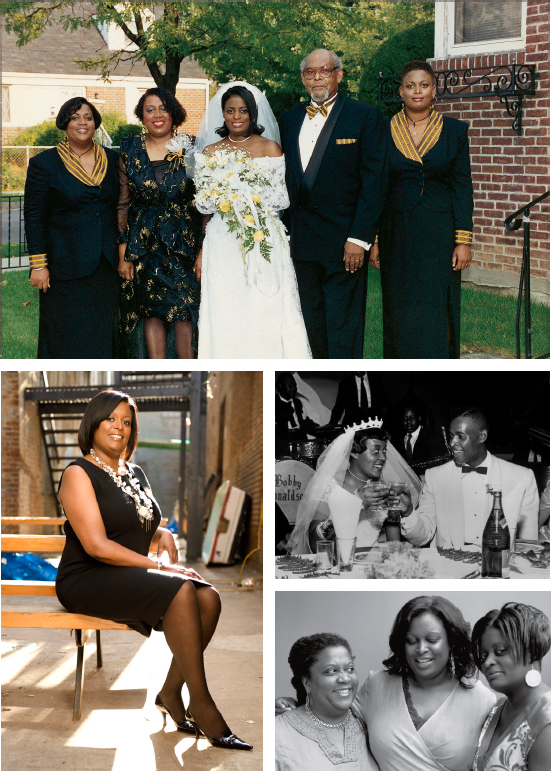
Dad / Family: Courtesy of Corynne Corbett; Headshot: Rayon Richards
Corynne L. Corbett has spent more than 20 years encouraging and empowering women to look good and live well across a variety of media platforms. She has held prominent editorial positions at Essence, Real Simple, Heart & Soul, Mode and Elle. In addition, Corynne has written for Town & Country, Self and Ebony among others. She is also the founder of thatblackgirlsite.com. She is a graduate of Pratt Institute and a member of The National Association of Black Journalists and Cosmetic Executive Women.
“I think that any young man who has the guts to get through Secret Service deserves a hearing.”
—Barack Obama, On Air With Ryan Seacrest, November 6, 2012