Copyright © 2015 by Margaret Reynolds
All rights reserved.
Printed in the United States of America.
No part of this publication may be reproduced or distributed in any forms or any means, without the prior permission of the publisher. Requests for permission should be directed to permissions@indiebooksintl.com, or mailed to Permissions, Indie Books International, 2424 Vista Way, Suite 316, Oceanside, CA 92054.
Neither the publisher nor the author is engaged in rendering legal or other professional services through this book. If expert assistance is required, the services of an appropriate professional should be sought. The publisher and the author shall have neither liability nor responsibility to any person or entity with respect to any loss or damage caused directly or indirectly by the information in this publication.
ISBN-10: 1-941870-42-2
ISBN-13: 978-1-941870-42-6
Library of Congress Control Number: 2015941332
Moneyball for Business, 3D Breakthrough Solution and “Whac-A-Mole Management” are trademarks of Breakthrough Masters Unlimited. Whac-A-Mole is a registered trademark of Bob’s Space Racers, Inc.
Designed by Joni McPherson, mcphersongraphics.com
INDIE BOOKS INTERNATIONAL, LLC
2424 VISTA WAY, SUITE 316
OCEANSIDE, CA 92054
www.indiebooksintl.com
To my family: Rick, Drew, Riley and Alison
You make me whole.
TABLE OF CONTENTS
SECTION ONE: The Everyday Company Growth Challenge
Chapter One: Redefine the Challenge
The Moment of Awareness
Are You Skinny-Dipping?
Is it Time for a Strategic Change?
The All-Too-Common Business Plateau
“Whac-A-Mole Management” Causes More Problems than it Solves
Chapter Two: The Leadership Mandate
Find the Spark Before the Burnout
The Change Starts With You
The Personal Breakthrough
Reigniting Growth
The Truth Shall Set You Free
Chapter Three: The 3D Breakthrough Solution for Reigniting Growth
Discovery
Development
Delivery
SECTION TWO: Discovery: Identifying Opportunities for Next-Stage Growth
Chapter Four: The Personal Breakthrough
The Value of Market Knowledge
The Case for Better Data
Technological Change
Economic Change
Demographics and Values Change
When Should Your Company Change?
Strategy Doesn’t Change, but the Way it’s Implemented Does
Are You Making the Right Changes at the Right Time?
Get Granular
Chapter Five: Outside-In Thinking Identifies Growth Opportunities
Chapter Six: Moneyball for Business
Moneyball Isn’t Just for Baseball
What You Don’t Know Can Hurt You
Chapter Seven: Do You Think or Do You Know?
The ROI of Thinking
The Customer’s Perception is Reality
Blind Side: You Have One—Where Is It?
SECTION THREE: Development: Selecting the Growth Spark
Chapter Eight: The Leadership Breakthrough
Recognize the Sweet Spot
Focus on Strengths
Me-Too Solutions Don’t Reignite Growth
Chapter Nine: Do You Have a Good Strategy?
Think Big to Grow Big
Make a Choice
Be Specific
Chapter Ten: Determining the Target Customer
Chapter Eleven: From Strategy to Action
The Mix Change Phenomenon
Making Money
Effective Decision Making
SECTION FOUR: Delivery: Reignite Next-Stage Growth
Chapter Twelve: The Company Breakthrough
Value is Created or Lost in Strategy Implementation
The Implementation Challenge
Increase the Odds of Success
Chapter Thirteen: Achieving Next-Stage Growth
Critical Path: Not All Initiatives Are Created Equal
The Resource Allocation Dilemma
Communication: The Secret Weapon of Effective Leaders
Measure What Matters
Who is Accountable?
SECTION FIVE: The Growth Journey
Chapter Fourteen: Success Is a Journey
Light the Spark
Align the Workforce
Adapt as You Go
Chapter Fifteen: Stay the Course
The Value of Quick Wins
Chapter Sixteen: Masters of Reigniting Next-Stage Growth
Getting Unstuck: Plastic Enterprises Co., Inc.
Pushing Past a Plateau: Vanderbilt Commodores Baseball
The Double Whammy: Tractor Supply Company
Mastering Acquisitions: Cramer Products Inc.
What Do Masters of Growth Have in Common?
Resource Section
Recommendations for Additional Reading
Notes
Acknowledgements
Index
About the Author
SECTION ONE:
The Everyday Company Growth Challenge
CHAPTER ONE
Redefine the Challenge
The Moment of Awareness
No matter the size or the industry, growing the business has become more challenging for the everyday company. Everyday companies have a solid history, good people at the helm who care deeply about the performance of the business, and provide quality goods and services to their customers. We are not talking about well-financed industry startups or the big powerhouse companies who lead by a wide margin. Everyday companies are everybody else; the businesses that work hard, enjoy a few wins, and struggle to stay ahead of rising costs and customer demands the rest of the time.
The last few years have been rough. Economic cycles loom large—the dips seem bigger and the peaks shorter. Technology is constantly battering the traditional ways of working in the industry; it is impossible to keep up, let alone get ahead. Customers are buying with greater caution and expecting the moon for yesterday’s prices, lengthening buy cycles, and crushing margins. New opportunities aren’t returning the expected ROI. What happened? The product is still made with quality, you have dedicated experienced people, and it isn’t your first rodeo.
Couple that with the fact that over half of businesses today are reaching maturity and that accelerates these issues. Maybe it is time to change the questions, look at the company differently, and accept that the demands of the market are the new reality. That means not just fixing what you have, but reexamining the business from the ground up; not through the eyes of past experience, but rather through the lens of today’s market place to see what they see and understand what they want so that the organization can deliver profitably.
In today’s fast paced markets, every leader needs to understand when they reach that point in time when the current business model crosses that fine line from relevance to run-of-the-mill headed toward becoming a commodity. It is the point when a leader needs to look at the world differently, to not only find new solutions, but redefine the challenges being solved. The key to reigniting the business and sparking next-stage growth is to identify new paths to growth that still deploy existing capabilities while not being restrained by them.
———
The key to reigniting the business and sparking next-stage growth is to identify new paths to growth that still deploy existing capabilities while not being restrained by them.
———
Unfortunately, some leaders never do realize that moment—they continue to base decisions on past experiences and live within the confines of habits bred by previous success. In those cases, the downward slide driven by business gravity and the amalgamation of limiting practices and beliefs continues. The dramatic difference in the resulting growth curve creates an ever-widening gap between growth and gradual decline as illustrated in the diagram below. While the choice may seem obvious, it is not easy to determine that the decision point has been reached; nor is the alternative course always clear.
How often does your team really examine the fundamental assumptions on which the business is based? Are you aware of early warning signs that indicate larger issues are looming? When I visit with business leaders around the country, many cite the same common business challenges. Do any of these prevalent issues sound familiar to you?
• “Our competition has lowered their price and we must match them, eroding our margin.”
• “We are working harder than ever while waiting for the economy to bounce back.”
• “We have a lot of new initiatives in place—we are trying everything—but so far none of them are working.”
• “We have a great new idea but no money to fund it.”
• “We know this works because we have always done it this way. Not sure why it isn’t working now.”
• “Our people are always complaining about having too much to do.”
• “We are doing everything our competitors are doing. I wonder why we aren’t growing.”
These may sound like common issues that every business experiences from time to time. Yet, they are often early warning indicators that there is a more serious problem lurking: a worn out business model, struggling to drive the company forward the way it used to. If the goal is to change the course of the organization, it is time for you to look closely at the alignment of company practices with market needs.
While some of the above issues have external causes, and as such, are seen as outside the control of the organization, that is irrelevant. Regardless of the source of the problem, it still needs attention. It is always within the leader’s tool kit to ask how the business can be run differently to overcome the challenges.
Leaders often find it difficult to take a step back from running the day-to-day business and fighting fires to thinking about how the overall business strategy is working—where the business is going, where it should go, and how to get there. Yet, if as a leader of the organization, you aren’t asking those tough questions, who is?
Are You Skinny-Dipping?
One of my favorite quotes, attributed to Warren Buffett, is: “You only find out who is swimming naked when the tide goes out.” In good times, business looks good, things are running smoothly and we are thinking we are doing pretty darn well. Maybe it is even time for a raise. On the other hand, when things get tough, resources are scarce, revenue is not flowing, and we encounter one hardship after another—are we as leaders equally responsible for the blame? Is it possible the business has been giving off some indicators of stress and because results were acceptable, we missed them? Was high tide masking the symptoms and we didn’t realize that we were headed for trouble? By regularly studying the market and the company at a granular level, leaders can recognize symptoms of big challenges but also big opportunities, can retool their businesses to reignite growth and accelerate performance, changing the trajectory of the company—in good macroeconomic times and bad.
When I worked at Hallmark Cards and was in charge of strategy development, I represented Hallmark on the Corporate Strategy Board, a well-respected member-driven research house comprised of Fortune 500 companies. I am a believer in research—facts matter and increase the odds of success—but one finding that was shared with us brought us quite a shock. In a study performed over two decades ago, seeking to correlate actions to growth, the results found that the top predictor of growth was—drum roll please—luck. There you have it. No point to doing anything but sit around and wait, right?
Compound that with the fact that growth is often driven by industry tail winds, i.e., it is easier to post big numbers for revenue growth when the industry tide is high. According to Patrick Viguerie et al., in The Granularity of Growth: How to Identify the Sources of Growth and Drive Enduring Company Performance, favorable tailwinds derived from strategic choices of markets provide more growth than better executional steering.
Does that mean that company growth is out of your hands and subject to the winds of fate? Not at all. Rather, the external forces at play force us to regularly evaluate how market shifts guide our business strategy and subsequent day-to-day decisions. You have heard the cliché, “Luck is nothing more than the intersection of opportunity and preparation.” Preparation is another way of saying strategic business management. Times will change and markets will shift; business leaders must be able to evolve their businesses to take advantage of the opportunities and circumstances created. Reigniting your business is less about changing the need the organization meets and more about changing the way in which those needs are met. If your company is in an industry with a headwind, if your company has changed little over the last decade or if technology has not been leveraged in the organization’s business model, be forewarned that industry trends are not in your favor and the need to revamp strategy and its associated business model is high. Indeed, when the tide goes out you may find that you are skinny-dipping.
———
Reigniting your business is less about changing the need the organization meets and more about changing the way in which those needs are met.
———
Is it Time for a Strategic Change?
If your organization is growing and all is well, chances are that it has little to do with you. In fact, it may be growing in spite of your organization’s or team’s efforts due to industry strength or pure luck. Not a comforting thought. On the other hand, any leader who can drive growth by overcoming roadblocks during times when there are tough economic cycles or when the industry is simply not growing, is a leader that has determined how to turn challenges into opportunities, sees things others don’t, and is able to mobilize the collective brain trust of the organization to achieve what others have not. Rarely do they do that by following the industry norm or standard; rather, they rethink the way things work and how they can be done better or differently to satisfy customer needs more effectively. That approach to leadership and organizational growth works regardless of the strength of the overall economy.
Consider the following:
• Fifty percent of companies have been around ten years or more and those companies employ over 70 percent of the work force. While they are well-established firms, not changing as markets do will challenge their long term viability—and a lot has changed in the last ten years.
• In the last decade, firm births just barely exceeded firm deaths. Many companies are not able to sustain themselves and are replaced.
As leaders, it is rare to question the status quo when business is good. And yet, maybe you should. Remember the growth curve from years ago in business school? It looked something like this:
GROWTH CYCLE
Business startup is self-explanatory. Adaptation is when the market is learning about you and you are expanding the reach of the business from early-stage adaptors to mainstream markets. High growth signifies a coming of age—a time when revenues and profits are reaching record highs, but so are new competitors who want to play in the sandbox that looks so rewarding. Over time, the market becomes saturated and maturity sets in, often accompanied by stagnation, slow if any innovation, and an emphasis on productivity to increase profit-ability. And then, finally, decline.
———
The time for reigniting is in late-stage growth or early-stage maturity—usually earlier than most businesses even realize that they are in trouble and in need of a change, which is why it slips by so many leaders unrecognized.
———
What stage is your business in? By sheer numbers, the business is more likely to be in maturity than any other stage. The high-dollar question is at which point on the growth curve does it make sense to start rethinking—and rejuvenating—your business? If you said growth, you are right. Every company needs to plan for the next growth stage before the current one ends. Trying to fix something that is clearly not working—which is the case by the time a company enters decline—is much more difficult than keeping a strong market hot. The time for reigniting is in late-stage growth or early-stage maturity—usually earlier than most businesses even realize that they are in trouble and in need of a change, which is why it slips by so many leaders unrecognized.
Apple may be the best illustration of a company able to stay on top, reigniting growth with the next new product before the sizzle from the current one fades. First, the iPod, then the iPhone, then the iPad, and now the Apple Watch. What’s next? One product has hardly cooled off before the next one is out. Apple has been able to create a “must-have” group of products with broad appeal and it keeps customers in a buying frenzy during any economic climate. They are inventing and developing next-stage opportunities while the last one is still strong. That schematic—inventing next-stage growth while still in the growth stage with current business—is referred to as the S curve. Compare the S Curve chart to the more traditional growth curve. Decline is inevitable without some form of reinvention or re-thinking of the prevailing business model.
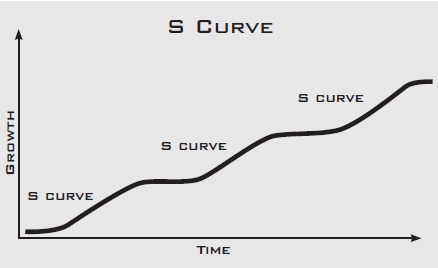
Far too many businesses don’t realize they need to shake things up until they are already in decline. It may seem counterintuitive, but when your business has seen multiple years of double-digit growth and has hit record revenue and profits—that is the best time to begin thinking about the next big breakthrough. Where is your company on the growth curve?
Great growth requires an inquisitive leader and a vigilant effort. It is important to track the performance of the company and its industry to understand what is driving growth. While hopefully it is the result of stellar performance and superior leadership, don’t assume. That is when companies get caught off-guard and fall hard when the tide goes out. Regardless of whether growth numbers are good or bad, they may not be as good as they can be.
How does a leader determine that there is more opportunity and it’s time to get more out of the organization—attitudinally and operationally? You might be bumping up against a growth ceiling if:
1. The organization is growing at or under industry pace.
2. There is uncertainty about the most viable direction to take.
3. Forecasts are routinely being missed or forecasts are built on an assumption that growth will continue without a specific rationale to justify it.
4. There are too many projects on the radar.
5. Fewer than three-quarters of new initiatives are returning value.
6. Staff needs constant direction, clarification, and/or complain about being overwhelmed.
7. Margins are shrinking.
8. The customer mix is changing and you have more customers with declining order sizes than those increasing orders.
9. New competitors are coming on the scene and doing things differently.
10. The sales cycle is getting longer.
11. There is more pressure to make more decisions and make them more quickly.
These issues suggest that an organization lacks strategic clarity, is operating at a tactical level without a unifying direction, and is struggling to determine its future course. You don’t have to have all of these issues to signal a concern. A few of them at the same time speaks volumes about the need to rethink the current approach to business growth. As a leader of the organization you are uniquely suited to sound the alarm if necessary and communicate that the time has come to stop skinny-dipping, spinning wheels, or running in place and start getting traction by embracing market changes to make the organization better. Rather than deny the organization really needs to recalibrate, enthusiastically engage to develop a better, more sustainable approach to the marketplace, looking not to your competitors for insights, but to customers and consumers to see what they need and want but don’t know how to ask for.
The All-Too-Common Business Plateau
Every company faces challenges. Show me a company without any and I will show you an organization that has either stopped trying or just doesn’t care. The obstacles that businesses find most challenging are those that require the organization to change what used to work. An organization’s success becomes challenged when the industry faces disruption, such as a competitor with a new business model, technological evolution, economic down cycles, or entry into the mature business stage with designation as a commodity that strips away margin. Conversely, growth may have come too fast and sent the company into turmoil, causing balls to be dropped and customers to be lost because the company simply wasn’t prepared to scale up so fast. The latter may be a hardship you would love to be faced with, but it can put companies out of business just as easily as too little revenue can.
If you have been a leader for a while you have probably been around the block a few times, dealing with some of the issues listed. They are not uncommon and are the reason that startups falter and businesses go bankrupt. As my good friend and respected colleague, the late David Thomson shared in his book Blueprint to a Billion, only one in 20,000 businesses reach a billion dollars of revenue. The odds are against any organization sustaining itself long term and even fewer are able to generate consistent growth. According to Chris Zook in Beyond the Core, only 13 percent of businesses of the 1,870 they followed over ten years were able to achieve modest single-digit growth for that period. Each industry only has one leader. If you strive to be the best, to own a leadership position, or just to not be at the back of the pack, it takes a commitment to keep the organization’s strategic engine tuned up, regularly maintained, and able to perform.
There have been many published studies and books written that attempt to explain why certain companies outperform others. Interestingly, years later, the companies profiled in these works often fall on harder times. As an avid reader, I have read books that explain how to lead a company to greatness and what is required of the leader, as well as books on what it takes to grow at a rate faster than the market. I have learned something from each of them. Yet, I have not found a book that connects leadership concepts with growth principles or that helps leaders diagnose what holds them back from being able to successfully implement the concepts they read about. Simply having the knowledge is not enough. It is important to be able to apply it to your business. This book seeks to marry strong principles of growth with clarity about what gets in the way of effective implementation.
———
Simply having the knowledge is not enough. It is important to be able to apply it to your business.
———
Achieving growth is an outcome. It doesn’t happen in a vacuum or as a result of wishful thinking. It certainly isn’t a strategy. It comes about when we know where we are going and we get all the stars aligned—the hundred million little things that it takes to run an organization or a team every day. As a leader in your organization, you are responsible for most—if not all—of the following:
• Keeping day-to-day operations running smoothly
• Trouble-shooting when things go wrong
• Increasing performance
• Building relationships with internal and external customers
• Managing budgets
• Providing support to other employees professionally and often, emotionally
• Improving your own financial prospects through a well-managed career
• Contributing to your family’s security and well-being
Your list might even be longer. Undoubtedly, you are spending 110 percent of your time trying to keep all of those balls in the air without dropping one. In addition, it is likely you have a number of new programs or growth initiatives that you, or your company, are driving forward to improve performance year-over-year. Maybe some of the initiatives are even the result of the last book you read. Yet, rarely do we achieve the outcome that was planned—the results don’t reflect the effort.
In the last decade, business as we know it has changed. Business models are being reinvented every few years, rather than every few decades, largely due to changes forced on us by evolving technological capability, which allows new entrants to change how business is done—faster, better, or cheaper. Since the beginning of time, new ways have replaced old ones—airplanes replaced cars for long distance travel, which replaced trains, which replaced horses and buggies. Technological evolution will someday allow space travel for private citizens and self-driving cars, maybe even space cars similar to the Jetsons. What used to be unfathomable is now a possibility. Change is inevitable and anticipating it and preparing for it is a leadership imperative.
The single biggest problem I have seen in my decades of business experience is when leaders don’t respond to trials by changing. Rather, they respond to the challenge by working harder—doing more of what they know how to do. That might mean working longer hours, adding a product extension, trying a new marketing campaign, or building better relationships. Certainly those things may help. However, these are operating performance changes and rarely do they get at the heart of the problem. Market cycles are speeding up and the lifespan of a given business model is shortening. There is less time to relax and enjoy the ride after each success. Encountering hardship is inevitable and in itself, not the problem.
———
The single biggest problem I have seen in my decades of business experience is when leaders don’t respond to trials by changing. Rather, they respond to the challenge by working harder—doing more of what they know how to do.
———
With market-driven changes so prevalent today, many companies seem stuck—not able to grow significantly or sustain growth. Why? The short answer is that most companies don’t understand what keeps them stuck. In Chapter 2, we examine the specific causes. For now, let’s discuss how everyday companies get stuck. Many believe that growth is limited due to the external forces that are pressing down on them and relentlessly eroding margins and stunting growth. There is no doubt that companies and product categories go through cycles, and eventually can enter the phase of maturity and decline. The industries in which printing plays a large role can attest to that. The digital age has changed the competitive landscape and technology has redefined operating models for those players in the book, greeting cards, calendar, stationery, newspaper, and printing businesses. Information and personal expression can be shared in new, faster, and cheaper ways. That requires those who rely on print to adapt their business models.
HALLMARK CARDS, INC.
Founded in 1910 by J.C. Hall, Hallmark Cards became a $4 billion company before the end of the century. A pioneer, Mr. Hall created a new form of communication which became known as the “personal expression” industry, a $7 billion market according to the Greeting Card Association. Hallmark became the industry share leader. Known for exceptional product, Hallmark is the brand consumers turn to “when they care enough to send the very best.” As the business grew, the brand became one of the most respected and well known in the United States with substantial consumer trust and permission to expand Hallmark’s reach deep into the social relationship market. Over time, Hallmark added many more products to their offering, organized around social customs like gift-giving and parties. As the baby boomer generation garnered an increasing share of domestic wealth throughout the second half of the twentieth century, Hallmark flourished.
Although developed in 1982, it wasn’t until 1995 that Internet protocol was standardized, enabling unrelated networks to connect, and effectively commercializing the Internet. It had a revolutionary impact on just about every form of communication, culture, and commerce in a very short period of time. It is estimated that 1 percent of the information flowing through two-way telecommunications networks in the year 1993 was through the Internet, which rocketed to 51 percent by 2000, and to more than 97 percent of all telecommunicated information by 2007. By 2000, Hallmark was well aware of the challenges created for their core product category—greeting cards—but was unsure how to react. Communication could now be instantaneous. It was no longer only one-to-one but also one-to-many, with the advent of social media, and most troubling to the company, it was free. How does a company walk away from the product that has been compared to minting money—selling paper greeting cards for two to five dollars each?
Throughout its growth in the 1980s and 1990s, Hallmark had been able to leverage their success to build buffers between themselves and the market, protecting them from natural market forces and thus masking symptoms of trouble. Many store owners were independent owners without buyers’ clout to demand change or performance; big box stores opted for single-brand packaged departments, thus products didn’t have to compete with others in their categories. The company had always been very smart with cash and was incredibly strong financially and able to ride out small bumps in the road. As Hallmark soon found out, the Internet and social media were no small bumps.
They have had modest success applying technology to some existing formats such as musical greeting cards, recordable books, and lighted/moving ornaments. The volume and margins of these new products may never be able to duplicate the success of printed greeting cards in its heyday. Clearly, Hallmark has had its share of disruption.
But, it is a company of smart people. With a combination of cost cutting, reinvention of how they approach the market and personal expression occasions, global expansion of their Crayola brand and a growing commitment to the television industry—with the Hallmark Channel and ownership of a significant archive of content—they are seeing some success as they move from tweaking the business to altering their trajectory with a massive change in market served and sources of revenue streams. They were pretty far along the growth curve when they realized their position had slipped to the decline side—possibly further along than they wanted to be—so the immediate trajectory change may not start out as rapid. However, they are on a new path of significant change and I suspect they will gain more traction as they are able to figure out how to redeploy and better leverage their most valuable asset: brand equity. How far it will take them and how the next chapter of the story ends remains to be seen.
Technology has plagued other industries, particularly those playing a role as “middleman,” reducing or eliminating the need for them as content becomes more available to end users. Trip Advisor, Expedia, and Kayak have encouraged many of us to book our own travel. Consider how Trulia, Zillow, and FSBO have changed real estate. What is the future of insurance brokers in our new world of healthcare? Consumers have direct access to aggregated information and tools to help them decipher it that were previously only available to experts. Technology is bringing buyers and sellers together in new ways that will require that the financial models change. Buying a car is a wholly-different experience today and car dealers have had to adjust. Individual companies can maintain their path and try to hang on or they can develop a new business model and find themselves reengineered for growth. Do you have a good understanding of the market shifts in your industry that will reshape the future of your business?
When speaking with executive groups, I often ask them to write down the amount of their time they currently dedicate to thinking about and planning for the desired future state. Many give me a sheepish grin and record a number. Next, they are asked to capture how much time they feel they should devote to preparing for the future. Rarely is the number the same. Most executives currently spend 0-25 percent of their time on strategic thinking—with most at the bottom of that scale—yet desire to spend 25-75 percent of their time on it. While there is no right answer as it varies greatly by organization and industry status, few leaders feel they give this responsibility adequate time. At the end of the day every leader must ask whose decision it is to determine how much of their time is devoted to the long-term health and success of the organization. For most, it is their own.
What gets in the way? We get caught up in the immediacy of the day-to-day and believe we have no time to improve the situation in a sustainable way.
“Whac-A-Mole Management” Causes More Problems than it Solves
Many of you are familiar with the arcade game Whac-A-Mole. To play, you stand ready with a mallet to hit any pesky mole that pops up out of its hole. The longer you play the game, the faster the moles pop up and the more challenging it becomes to get them. That sounds a little bit like daily life in your company, doesn’t it? We play Whac-A-Mole daily by battling the hundreds of little things that pop up and distract us from doing what matters. The problem is that using that approach to problem-solving is not a winning strategy—if we handle one-off problems in a one-off way, we tend to see more problems. Without knowing it, when we tackle challenges in a linear and functional manner, we often create problems for others upstream or downstream.
There is a better way, a more productive way, a way that leads to greater return. It requires leadership, a plan, and a purpose. It is time to stop reacting to challenges and start leading the organization toward a future that embraces hurdles by recognizing them as an opportunity rather than a problem. Trace problems back to their cause and don’t just react to the symptoms. Understand that your organization needs to work in an aligned and unified way to solve issues permanently, and in a holistic way. If you are asking the tough questions on a routine basis and searching the market place for answers, you will find that you will be in a position of advantage as the organization approaches maturity and better able to more successfully navigate through it if you are already there. You will have anticipated the need to alter the course, have developed a systematic process for staying in touch with shifting needs and key customers’ requirements, integrate data into decision making, establish and maintain alignment, and move faster in pursuit of significant growth opportunities. As you move to the top of the growth cycle, take a hard left and lead your organization to reigniting profitable growth.
CHAPTER SUMMARY:
• Change is inevitable and should be regarded as an opportunity, not an obstacle.
• Every leader needs to understand when their business is approaching or entering maturity on the growth curve. Because it is often a gradual process, it can be difficult to diagnose. It is at this point, or ideally before, while still in growth mode, that an organization needs to look at the world differently to not only find new solutions but redefine the challenges they are solving. The key to reigniting the business and sparking next-stage growth is to identify new paths to growth that still deploy existing capabilities while not being restrained by them.
• Leaders need to know the early warning indicators that they are approaching maturity and need to change the course of the organization. When fighting fires becomes more the rule than the exception it is critical to start thinking about the overall plan for the organization—where it is going, where it should go, and how to get there. If, as the leader of the organization, you aren’t asking those tough questions, who is?
• Ensure your organization is not skinny-dipping, benefitting from the waves of macroeconomic cycles, which may have little to do with its inherent strategic strengths or current business model. If your industry has a headwind, has changed little over the past decade, or if technology has not been fully integrated into operations, the need to embrace change is high.
• The time to find the spark for next-stage company growth is in late-stage growth or early stage maturity. While it is counterintuitive to reinvent while the business is strong, it keeps the company strong and sustainable with no significant performance dips.
• It is too easy to assume credit for the good times and deflect blame for tough times to uncontrollable factors; effective leaders have a realistic understanding of how to maximize performance under any market circumstances.
• The single biggest problem is when leaders don’t respond to repeated trials by changing. Rather they respond to the challenge by working harder—doing more of what they know how to do—which fails to address the heart of the problem: changes in the market they serve.
• Leaders generally desire to spend more time on strategic thinking and need to recognize that they are in charge of how they spend their time and responsible for committing appropriate time to envisioning and leading the company for long-term success—not just day-to-day performance.
• Avoid playing Whac-A-Mole with business problems. Don’t default to one-off solutions for individual challenges; rather take a holistic strategic view of how to approach the current market and achieve success.
KEY QUESTIONS:
1. Does your company experience any of the symptoms that indicate it may be time for a tune-up to the strategic engine? If so, which ones?
2. Where is your company on the growth curve?
3. How much time do you spend on shaping future business success? How much time do you believe you should spend on it? If you would like to spend more time on it, what gets in the way?
CHAPTER TWO
The Leadership Mandate
Find the Spark Before the Burnout
As a leader, it is important to recognize that tough times and adversity are to be expected. The issue isn’t whether you will face them; it is how to lead the organization to success in spite of them. In fact, challenges can be the catalyst needed to rethink the business in a way that leads to startling new insights and opportunities for growth. Sometimes undesirable situations can lead to very favorable outcomes. How can you transform negative market situations into positive growth opportunities?


