

Life and Death on the Loxahatchee : The Story of Trapper Nelson by James D. Snyder.
© 2002, 2004, 2007 by James D. Snyder.
Published by Pharos Books, 8657 SE Merritt Way, Jupiter, FL 33458-1007
Cover Illustration: Painting ©Ron Parvu; Tequesta, Florida. See page 157.
LCCN 2002190070
Other books by James D. Snyder:
All God’s Children: How the First Christians Challenged the Roman World and Shaped the Next 2000 Years —The Tumultuous Story of AD 31-71
(1999, 680 pp., ISBN 978-0-9675200-0-1)
The Faith and the Power: The Inspiring Story of the First Christians and How They Survived the Madness of Rome — A First Century History
(2002, 416 pp. ISBN 978-0-9675200-2-5)
Five Thousand Years on the Loxahatchee: A Pictorial History of Jupiter - Tequesta, Florida.
(2003, 217 pp. ISBN 978-0-9675200-4-9)
Black Gold and Silver Sands: A Pictorial History of Agriculture in Palm Beach County, FL.
(2004, 217 pp. ISBN 978-0-9675200-5-6)
A Light in the Wilderness: The Story of Jupiter Inlet Lighthouse & the Southeast Florida Frontier.
(2006, 288 pp. ISBN 978-0-9675200-1-8)
Publisher’s Cataloging-in-Publication
(Provided by Quality Books, Inc.)
Snyder, James D.
Life and death on the Loxahatchee : the story of Trapper Nelson / James D. Snyder. -- 3rd ed.
p. cm.
Includes bibliographical references.
Print ISBN 978-0-9675200-6-3
eBook ISBN 978-1-61850-023-6
1. Nelson, Trapper. 2. Zoo keepers--Florida-Biography. 3. Trapper Nelson’s Zoo and Jungle Garden. 4. Jupiter (Fla.)--Biography. I. Title.
QL31.N45S69 2002 590'.7'3092
QBI02-701380
The Story of Trapper Nelson

Dedication
Preface
Chapter 1: Natulkiewicz
Chapter 2: Depression?
Chapter 3: Wartime: Reluctant Soldier, Happy Scout
Chapter 4: Celebrity Hermit
Chapter 5: Alone Again
Chapter 6: Who Shot Trapper Nelson?
Chapter 7: Restoration & Rebirth: 1968-
Epilogue: The Suitcase in the Attic
Another Postscript: March 2004
Appendix
Endnotes
Acknowledgements
About the Cover
About the Author
Copyright Page
To Kyle, Melinda, Jessica, Rachel and Codey.
I hope this will help you keep the Loxahatchee and its story alive for your grandchildren as well.
This book is a tribute in part to a unique group of people, who still stay in touch and still celebrate their common heritage at yearly Pioneers of Jupiter reunions. Most are in their eighties or nineties as this is written, but there isn’t one among them who isn’t sharp of tongue and memory. For offering their friendship to and sharing their experiences with an outsider who has lived on the Loxahatchee a mere dozen years, I thank Dave and Agnes Brooker, Carroll Little Dorsey, Louis and Margie Freeman, Dodie DuBois Hawthorne, Wilson Horne, Ruby Fortner Lanier, Beau Mayo, Jim Minear, Roy and Patricia Rood, Ray Swanson and Carlin White. My salute embraces such latter generation collaborators as Eric Bailey, John R. DuBois III, Nathaniel P. Reed, Sylvia Pennock and her mother Ramona Pennock Stark.
Others contributed in many ways. My late wife Sue, as always, was the first to blow the whistle on shoddy workmanship. Bob Schuh, a Jonathan Dickinson State Park ranger, read the manuscript with an eye for accurately depicting Trapper Nelson’s camp. Patricia Magrogan did so because she has been president of Friends of the Loxahatchee and has Life & Death on the Loxahatchee lived here for forty-plus years. Her neighbor Bill Wood, an attorney and local historian, lent the same critical eye. Others invaluable to this project were Milda Enos, local bookstore proprietor and painstaking proofreader; Richard Procyk, a homicide detective-turned-archeologist; Catherine Dosa, friend and Loxahatchee River Historical Society docent; and artist Ron Parvu, Jupiter’s own incarnation of Andrew Wyeth (see cover and page 157).
Most of all, I’d like to thank the few family members of Trapper Nelson I have been fortunate to know. They are Lucille Celmer (the wife of his sister’s son) and her son Philip Celmer III and daughter Marcie. During our interviews it was obvious that they loved Vince Nelson and revered his memory. Despite some initial misgivings that an outsider might try to invent a tawdry tale, they gave me the freedom and the family records necessary to present Trapper Nelson as I saw him — warts and all.
To Lucille, Phil and Marcie, I hope you find your trust has been justified.
JDS
This third edition incorporates more information learned about Vince Nelson since the first printing. Another Postscript is an amalgam of the many new stories and murder theories told to the author by many people who knew Trapper Nelson, who had read the first edition, and wanted to add their contributions to the “legend of the Loxahatchee.” Finally, the new edition includes a few new photos of Trapper Nelson, thanks to the discovery of his personal scrap-book in the files of the Florida Park Service.
Four times a day the aluminum pontoon boat Loxahatchee Queen II churns its way up the river with sightseers from the 11,000-acre Jonathan Dickinson State Park just northwest of Jupiter, Florida. Its destination on the 45-minute ride upstream is the park’s centerpiece, the restored compound once occupied for more than 35 years by Vince “Trapper” Nelson.
Of course the best way to go is the way Trapper did back in 1934. Paddle a canoe up Florida’s only federally designated Wild and Scenic River and you’ve soon left all visible civilization behind. At first the Loxahatchee is brackish, a hundred feet and more wide, with tall mangroves leaning over the sloping banks. In a mile or so the river narrows and begins to curl like a snake’s crawl. Saltwater intrusion from the Atlantic Ocean six miles eastward now wanes and gives way to a freshwater ecology. Large ferns, saw palmettos, pond apple trees and stunted maples are joined by battered old cypress trees that form the retreating rear guard against the continued saltwater invasion. As the river depth declines, you see catfish and mullet wiggling over the sandy bottom in the tannin-stained water. Turtles sun on fallen logs, herons stand Life & Death on the Loxahatchee motionless on the shore as they stay focused on the serious business of spearfishing. Overhead, an osprey vectors in on a fish from a dead cypress branch and turkey buzzards hover higher up in the constant breeze.
After another mile your arms start to ache a bit. The current against you is stronger because you’re that much closer to its powerful aquifer source, the Loxahatchee Slough. At this point the river is but thirty or so feet across and you’ll scrape bottom if you don’t stay in the meandering channel. Hyacinth begins to clog your way in spots, and little rivulets beckon like sirens wanting to lure you to a dead-end marsh — and perhaps home to one of the park’s sixty or so gators.
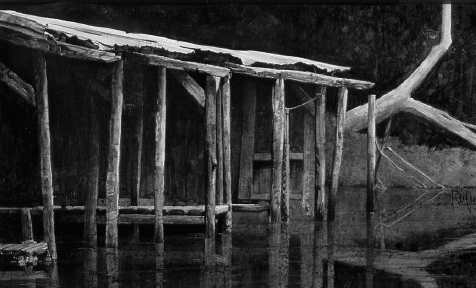
Then just as you round another identical bend you’re staring squarely at a hundred feet of boat dock, all hewn together from “fat-lighted” pine logs (so full of natural turpentine when they were cut that they still ward off worms and rot). Most of the dock is topped with a crude, corrugated metal roof.
Welcome to the remains of Trapper Nelson’s Zoo and Jungle Garden. As you stride past abandoned animal cages or stop at a tin-roofed chickee hut that now serves as a picnic area, the only sounds may be the faint hum from Interstate 95 and the Florida Turnpike, the aorta of Southeast Florida’s three million residents and a million more tourists.
Vince Nelson picked this place to live the rest of his life until his mysterious death in 1968. In fact, “mysterious,”—or better, “mystique” — are words that followed him all his life. Perhaps it’s because he was so much like his beloved Loxahatchee. Both have many dimensions. Neither has allowed anyone to peer deep within them. And each has remained a symbol of the last stubborn resistance to the relentless incursion of asphalt, concrete and cable that advances on South Florida each day.
Above all, Trapper Nelson was a man who lived life on his own terms. This is his story — and, of course, the drastically different world of early Jupiter.

Natulkiewicz |
I |
|
1908 - 32 |
“Wake up, Charlie, John! Have a look at this!” The freight train was rolling to a near stop, probably to pick up a load of logs on its way south to Miami. Vince Nelson had been squinting through a slight opening in the sliding door of their box-car, and now he rolled it wide open with a bold shove so the other two stowaways could see what he’d been gawking at.
The early morning sun streamed into the boxcar as the train barely crawled over a low bridge across a river maybe a football field wide. Below them an incoming tide had brought in a swift current the color of aquamarine. Their mouths hung open as they studied mounds of live oyster beds, then deep pools of clear water with the slender tops of large fish stacked like cordwood against the bridge’s wooden pilings. Every few seconds the surface would break with the leap of a frisky fish that they would soon come to know intimately as mullet. On the north side of the river was a handsome red lighthouse and a few outbuildings. On the south or right shore were several docks and frame houses sitting behind a shallow sand beach. Well beyond them to the east they could make out silent whitecaps surging in from the Atlantic Ocean.
In a few minutes they could feel the train start to lurch forward again. It was time for a quick decision. “Who needs to go to Miami?” boomed Vince. “Look at all that land and water. You’ll never go hungry living in this place.” As soon as the train reached the other side of the bridge, the three young adventurers from Trenton, New Jersey had swung to the ground with their bags of clothes, knives, guns and trapping gear.
At age 23, Vince had already ridden the rails so long that he didn’t think twice about walking atop a freight train swaying along at sixty miles an hour. He was already an experienced trapper, tanner and hunter. Today “survivalist” usually means someone who keeps a gun and tins of C-rations in his basement. In 1931 Vince was a seasoned survivalist in the acute sense that he had faced starvation with no money in his pockets. And now, as Depression gripped the nation some two years after the worst stock market crash in history, others were learning what it meant as well.
He was born Vincent Natulkiewicz in Trenton on November 6, 1908,1 the second youngest of five children. The name and family were a mixture of Polish and Russian. His father had come to America in 1903 and had found a job in a ceramics factory. He spoke only Polish, and when Vince was a child he would accompany his father shopping to make sure local merchants didn’t get the best of him. In fact, Vince was a very bright lad who excelled in mathematics when he graduated from eighth grade.
But there the formal education stopped — perhaps because it was also about that time that the family itself began to unravel. Vince’s mother had died when he was 13. When his father remarried, Vince and his older brother Charlie couldn’t accept their new stepmother. They had already spent long summer days trapping groundhogs because the state paid a bounty on them. Then they’d trapped muskrats and otters around Lake Carnegie outside of Trenton. Soon the days away from home stretched into fall and winter.
At age 17 or 18, Vince Natulkiewicz got a job on a road gang building the Pulaski Skyway in New Jersey. It paid 50 cents an hour, and he wouldn’t have liked it had it paid ten times that much. Something else added to his misery. He had leapt from adolescence into the world of romance by falling in love with a married woman. When she ended the affair — whether torrid or tranquil isn’t known — by announcing that she was going back to her husband, the young man was crushed. “That was the day he also smashed up the family car,” his sister Marcie would say.
Soon afterward, Vince, his best friend John Dykas, and his brother Charlie — eight years his senior — were off to see the U.S.A., relying on the rail system with thousands of other hobos and job seekers. By the time they reached Colorado, they’d already trapped along the way, selling hides and shooting craps in boxcars for enough cash to stay alive. They rode the rails all the way to southernmost Texas. One day, after they’d wandered across the Rio Grande to the Mexican side, Vince was setting traps when he looked up to find himself surrounded by Federales. The Mexican civil war was raging and the government troops thought the husky young American was probably running guns across the river to Zapata and his rebels.
So it was several weeks in a rat-infested, adobe Mexican prison while the authorities pondered what to do with him. They had no firm evidence, but what they did know was that the prisoner was eating so much they couldn’t afford to keep him. By then young Vince had filled out to 220 pounds on a barrel-chested, six-foot-two frame.
He also had deep blue eyes and movie star looks. Once released from jail, Vince hopped aboard another freight train headed for California, but Hollywood wasn’t exactly waiting at the other end. After setting traps for weeks in the unfriendly, unproductive Mohave Desert, he found himself penniless and near starvation. Years later he would tell friends in Jupiter that he might have died if he hadn’t stumbled into an orange grove. “The oranges were huge, almost like melons, and they tasted awfully sour, but they saved my life,” he would say. It was some time before he realized that he’d been gorging on grapefruits.
It was back to Trenton for a rendezvous with Charlie and John, but all three soon got the travel itch again once they compared the snow and ice of the New Jersey winter with what they’d sampled in sunnier climes. This time they decided to head southeast for, maybe West Palm Beach, maybe the Everglades or even the Florida Keys. The Jupiter that the trapper trio landed upon in September 1931 consisted of about 250 souls, and only if you counted the little knot of Afro-American families that had their own close-knit community further to the west. Three years before, a landmark hurricane — the kind where everyone remembers just what they were doing the night it struck — had battered the little wooden homes, and people were just now completing the long rebuilding process.
But the essence of Jupiter and its “first families” were still there. Anchoring the town just off the ocean inlet was the fish camp, boat dock and restaurant run by John and Bessie DuBois. Behind them on Jupiter’s only hill was the old frame home built in 1898 by John’s parents, Harry and Susan DuBois, when they were newlyweds. The “hill” was actually the same Indian shell mound that Jonathan Dickinson and his family found in 1696 when they were shipwrecked in a hurricane and captured by the hostile Jeaga (sometimes called Hobe) Indians before beginning a harrowing northward journey that led to their rescue by the Spanish at St. Augustine several months later.
Dickinson’s journal recorded the ease with which his capturers were able to spear and scoop fish from the inlet to feed the village each night. Snook, tarpon, sea trout, mutton snapper, mackerel, pompano, giant jewfish, oysters, blue crabs — all still teemed in the waters around the DuBois fish camp, and wealthy sport fishermen helped make it the hub of Jupiter life. The DuBois dock was also where the School Boat came to pick up and drop off kids from across the river who attended Jupiter’s school house near the railroad tracks on Old Dixie Highway.
If Jupiter had an “industry” at the time, it was probably the growing of asparagus ferns for commercial nurseries up north. In fact, the same Miami-bound train the young trappers jumped from would probably stop on its return trip to load crates of ferns so that florists up north would have a nice green backdrop when they prepared their bouquets. A mile or so upriver families cultivated ferns on five to ten acre plots that now fetch a million dollars an acre. Best known among them was Pennock Plantation (also a dairy and nursery serving the West Palm Beach market), which provided Depression-era jobs for many families that would eventually make their marks in other ways. Amos Bassett ran the fernery, Lloyd Minear the dairy and Harry Jackson the company finances. Families like the Roods and Wilkinsons all worked first at Pennock Plantation before saving enough to start their own businesses.
Others had their own homegrown, hardscrabble enterprises. Kenneth Horne raised chickens and cows when he wasn’t being school janitor. The Bowers ran the general store and traded with Seminole Indians for some of their goods. The Carlins, who boasted of having Jupiter’s oldest house (circa 1889) rented guest cabins and looked after the Western Union outpost. John and Bessie DuBois took in boarders along with running a fish camp and restaurant. The Youngs raised tomatoes, beans, peppers, potatoes and onions. Across the river, the Seabrooks took care of the lighthouse. Ray Roebuck moved up from West Palm Beach to become the area’s only lawyer.
The three trappers slipped into town without much notice, just as scores of drifters and campers did on their way up and down Florida’s east coast in search of elusive jobs. It was also about this time that the two Natulkiewicz brothers decided that a new start in life deserved a new surname. It would now be Nelson — and for no other reason than that it was easier on the ears. As Vince would later explain, “It just seemed to me that if people have a hard time pronouncing your name, you ought to do something to make it easier for them.”
“Home” in Jupiter was a crude hunting-trapping camp in a largely uninhabited hammock just south of the Inlet and near the weather-beaten town beach pavilion. One day it would become Carlin Beach Park and the Ocean Dunes condominiums, but then it was just a stretch of wind-bent scrub pines a few yards behind the dune line. The squatters bored a well and set up a crude lean-to. “I can remember seeing their animal skins hanging from boards,” recalls Dodie Hawthorn, a daughter of John and Bessie DuBois.
The DuBois family saw a lot of Vince in the early months because their fish camp was the nearest destination when he would cross the Intracoastal to the mainland. Grandson John DuBois III, who became president of the Florida History Center and Museum in 2000, recalls that many of his grandmother’s favorite stories centered on the young man from Trenton and his soon-to-be-legendary appetite. “At one point she and my grandfather were boarding a small, prim man who was involved in running the wireless machine for the lighthouse across the river,” he says. “One night this scrawny fellow and the very muscular Vince were eating dinner at the same table. When they asked what was for dessert, my grandmother brought out a large lemon meringue pie. The little guy sliced off a sliver. Vince’s piece was the rest of the pie.”
Trapping by the beach may have been profitable — enough to garner a few hundred dollars and buy an old car — but pleasant it was not. According to Charlie Nelson, Dykas wasn’t much of a trapper to begin with, yet wanted to be paid a full one-third of what they got from selling pelts to wholesalers. Worse yet, it seemed that Dykas was coming between him and his little brother — the kid he’d taught to trap and had looked after through all their scrapes and travails out west.
On December 17, 1931, John DuBois, who also served as Jupiter’s seldom-used constable for the West Palm Beach police, was ordered by phone to go to down to the trapper’s camp and watch over a dead body until detectives could arrive to begin an inquiry.
What happened? Charlie Nelson had driven the old car 15 miles to the West Palm police station, parked it right in front with a shotgun lying on the back seat, and matter-of-factly told the desk sergeant that he’d just shot a trapper named John Dykas. Hit him right between the eyes with his shotgun. Killed him instantly.
Why? According to Charlie’s written confession, it happened around 8:30 that morning while Vince had been off checking his traps. Dykas was sitting on an upended wooden crate holding a fork and stirring a pan full of pancakes and grits. Charlie came out of the lean-to, stretched, and announced that he’d decided to strike out on his own. Somehow Dykas had become camp treasurer and held all the money they’d gotten from selling pelts up north. Charlie asked for “my share of the business” right then and there.
Dykas thought about it and agreed, but he wouldn’t give Charlie more than $50.
“Finally I’d just had enough,” Charlie told the detectives. “So this morning I told Dykas he had 15 minutes to give me my fair share or I was going to kill him.”
When Dykas continued to stir his skillet in silence, Charlie walked inside the lean-to, emerged with his shotgun and announced that the time was up. One of the twin barrels hadn’t worked for years, but Charlie fired the good one.
If John Dykas could have taken the witness stand, he might have said something like this: Charlie Nelson was a wild and free spirit — sometimes too much so for his own good. He’d already been arrested for drunken driving back in Trenton and had continued his boozing in Jupiter. He boasted too much, talked too loudly and acted like a big boss when he should have shown a man a little respect.
In any event, the murder of John Dykas was big news all the way from Palm Beach to Stuart. Both Nelson brothers were jailed. When Charlie surprised everyone by inexplicably pleading not guilty, a first-degree murder trial was set for January 20, 1932. As circuit court judge Curtis E. Chilling-worth began interviewing 43 candidates for a jury, Vince was released on a $500 bond. Charlie went on being Charlie, quickly becoming top dog in the jailhouse and deciding who slept where and who did what chores.
He also became news fodder for the Palm Beach Post, whose reporters seemed to have easy access for interviews. Looking jaunty in hunting boots, knee breeches and a sporty khaki shirt, he told a reporter, “When I go to the stand, I may say nothing and I may say anything.” Yes, he regretted what he’d done, “but what good does it do to cry about it?” In fact, Charlie’s biggest worry seemed to be running out of roll-your-own smokes. As the Post of January 7 told it:
Just before going back to [his jail cell] Nelson called a reporter over and thrust a $1 bill into his hand.
“Go to the store and get me some more of that R.J.R. tobacco, will you buddy?” he said. “Go to a grocery and get me one of them big one-pound packages. They cost 40 cents.”
He refused to let the reporter stand treat.
“Be a sport and take the money,” he said.
“You know, I think he’s happier than I am,” remarked Jailer T. P. Riggs in court this morning with an expression of wonder on his face.2
The first trial date came and went because the court couldn’t find two material witnesses. Two hunters (also from Trenton) had been tenting not far from the Nelson-Dykas camp and they’d come running when they heard the shotgun blast. But both had since gone off hunting in the Everglades on the assumption that Charlie’s own confession had made their court testimony unnecessary. In time, sheriff’s deputies produced the witnesses. Then came delay number two. The day before the trial a U.S. immigration inspector showed up to demand that Charlie face deportation charges on grounds that when he was four years old in 1904, he and his parents had been illegally smuggled into the United States from Vilna, Poland (recently annexed from Russia). Charlie was quick to swear it the truth, but the judge found the whole scene a bit too contrived or coincidental.
The trial finally began in early February. Until then the only testimony against Charlie — aside from his prior confession — was that of his own brother. Vince had calmly stated that Dykas, in fact, had done his share of the work and that it was Charlie who constantly baited him. But Vince had always told John Dykas never to let himself get sucked into an argument with Charlie.