
CHAPTER 1
EL RÍO DE LA CRUZ
Fort Santa Lucea / Shipwreck and Plunder / Dickinson’s Invaluable Diary / A Tidal Change Brings the English
CHAPTER 2
A BEACON IN THE WILDERNESS
If You Build It, They Will Come? / The Lighthouse Makes a Brief Debut / The Fickle Jupiter Inlet
CHAPTER 3
ALWAYS AT THE CENTER OF THINGS
Mail, Jupiter Style / Rescue and Refuge: The Lifesaving Station / Riverboats: Bringing Commerce to the Customer / Jupiter’s Mini-Railroad / Hub of the Hemisphere? / Jupiter Meets Morse and Marconi
CHAPTER 4
TURN-OF-THE-CENTURY LIFE IN JUPITER
Harry and Susan DuBois Start a Family / A New ‘Watch’ at the Lighthouse / ‘Indian River’ Country / ‘West’ Jupiter / Black Pioneers Make Their Mark / Jupiter Gets a ‘Downtown’ / Jupiter’s Floating ‘School Bus’ / Down by the Riverside / The ‘Wild West’ / That Elusive ‘Stable’ Economy
CHAPTER 5
1920-1940: BOOM, NO. BUST, YES.
Prohibition: How Dry We Weren’t / The Perils of a Backwoods Doctor / Little Boom, Big Bust / The Big Blasts / Jupiter’s Bygone Landmarks / When Jupiter Needed Noah’s Ark / Pennock Plantation: An Oasis of Stability / Other Businesses Gain a Foothold / Eking Out, Making Do / Tarzans in the Wild / Finally, A ‘Real’ Town / Helpful Holes in the Outfield / Stepping Out / Trapper Nelson: Jupiter’s Own Tarzan / Shorty’s Gold
CHAPTER 6
1941-1945: A VERY PERSONAL WAR
Rescues at Sea / The Tide Turns / Jupiter’s Big Secret / “Soldier, Soldier Will You Marry Me?” / War or No War / Disappearing Acts / Postscript
CHAPTER 7
1945-1980’s: SNAPSHOT OF A TOWN IN TRANSITION
‘An Awesome Place to Grow Up In’ / Slammed and Slimed in ‘49/ Why It’s Not Called ‘Jupiter State Park’ / New Economy Meets Old Economy / Tequesta: The ‘Other’ Side of the Tracks / The Chamber: ‘Answer Every Letter’ / How the
Government Grew Up / We Wuz Robbed / Riding Shotgun with the Constable / Salhaven, Or How Jupiter Medical Center Got Its Start / Jupiter Gets a Newspaper / A Little ‘Jet Propulsion’ from Pratt and Whitney / Civic Clubs: From the Service to ‘Service’ / The Camp That Refused to Buckle in the Wind / The Arts: Putting Jupiter-Tequesta on the Map / Jupiter Celebrates Centennial—Twice! / Trapper Nelson: The Mystique and the Mystery / The Seventies: Still a Small Town / Riding The Range in Jupiter / ‘You Keep Your Distance, I’ll Keep Mine’
CHAPTER 8
THE LAST BATTLE OF THE LOXAHATCHEE
A Generous, Forgiving River of Plenty / Bulldozers and Bunglers / Fighting Back / The Turning/Tipping Point / How Trapper Nelson (Sort of) Saved the Loxahatchee / Loxahatchee: Three Key Questions for Today / Poem: I Am the Loxahatchee
Dedication
From the Author
Acknowledgments
Resources and References
Copyright Page
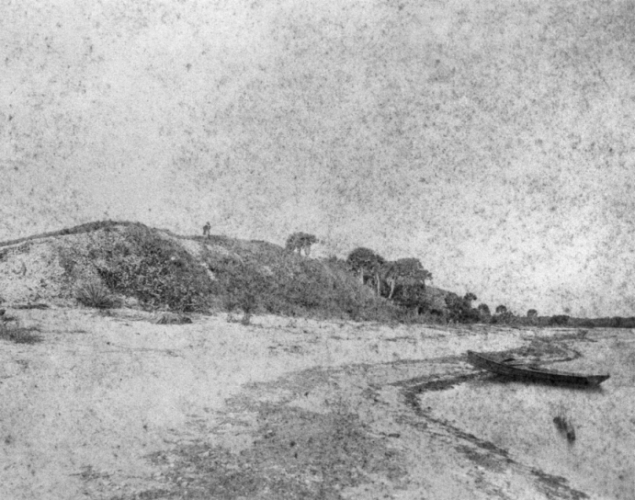
Except for the boat and man’s figure, this nineteenth century photo of Jupiter Inlet’s south side appears as it did to the Jeaga/Hobe Indians who lived on it from at least A.D. 750. Most of the shell-rich mound, or midden, was trucked away for roadbed in the 1920s. (Loxahatchee River Historical Society)
John Cabot or Ponce de Leon? It’s undecided as to who was the first European to sail into Jupiter Inlet. Because the English explorer Cabot tacked down the North American shoreline in 1496–97 and produced a rough map of Florida’s east coast, his proponents insist that he couldn’t have resisted the deep, sheltered Jupiter Inlet as a stop for taking on fresh water and firewood.
But the case for the Spanish explorer is better documented. Juan Ponce de Leon had been along on Christopher Columbus’ second West Indies expedition in 1493. He had lived for years at the first permanent Spanish colony on Hispanola and later on Puerto Rico. In February 1512 he gained a commission from the King of Spain to discover and govern a legendary island named Bimini (not the one off Miami) and set off with three ships.
After crisscrossing the Bahamas seeking the elusive Bimini, Ponce de Leon sighted the coast of Florida on April 2, 1513, and sailed up as far as the mouth of the St. John’s River. There he landed long enough to claim everything he’d seen for the king and to name it Florida because he’d discovered it on Pascua Florida, the Passover Feast of the Flowers.
A week later Ponce headed south to see just how long his newfound continent stretched. On April 21 he reached Jupiter Inlet and stayed for several days. Before continuing south and around Cape Sable, he named it Río de la Cruz and planted a stone cross that has never been recovered.
Indeed, the Río de la Cruz would have made for a compelling interlude. The inlet at the time faced to the south, a quarter mile down from the present man-made cut. Precisely where the speedy Gulf Stream carried ships closest to the mainland, a captain could quickly veer off towards the shoreline, dodge a few reefs, and glide into the inlet. In a few minutes a bend to the left would bring the ship westward into a small bluewater cove that teemed with fish, shrimp and oysters. The cove lay at the end of a marshy estuary that extended well into today’s Carlin Park. Across the broad blue-green river to the northwest, and perhaps forming the other wing of the rough cross that Ponce may have envisioned, was the mouth of a shallow waterway that wound all the way to today’s Titusville.
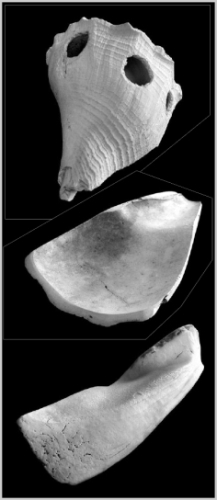
During 1990-92, a group of Florida archeologists and anthropologists burrowed into the shell mounds in DuBois Park and unearthed 241 bone, stone and shell artifacts (plus nearly 3,000 pieces of ceramic shards) that were carbon-dated back to as early as A.D. 750. Large whelks with holes (at top) may have been fastened to sticks for hammering or pulverizing. Smaller ones were strung and worn as necklaces. The two busycon shells below (cousins to the conch) were probably adzes, or cutting tools. Once worn down, they could have served for scooping food. (Loxahatchee River Historical Society)
The busycon shell at bottom, the size of a small shovel, was discovered in Jupiter Inlet. (Florida Bureau of Archeological Research)
Just west across that ribbon of water (which would became known as Jupiter Narrows) was a hill nearly fifty feet high that one could climb to survey the table-flat wilderness on all sides. Some 350 years later it would support a lighthouse.
Standing on that sandy dune with a spyglass, one might spot another hill a few miles to the north that was twice as tall. Four hundred fifty or so years later, a ranger tower would be built on its crest and “Hobe Mountain” would become one of the main attractions at Jonathan Dickinson State Park.
Still, the first and most impressive sight that Europeans would notice on their first arrival is not there today except for one hill that supports the Harry and Susan DuBois home in the park that now bears their name. As soon as a ship cleared the original inlet and turned west, it would pass a stretch of lumpy sand hills on the southern shore of the river. They ran for some six hundred feet and stood over twenty feet high. These mounds, or middens, were, in part, deliberately created to provide high ground for dwellings—probably for tribal leaders. In time they would rise as successive generations erected new huts and scattered refuse.
And their descendents were still there to meet the first European explorers when they arrived in the early sixteenth century.
How long had the Indians been there? An archeological team from Florida Atlantic University dated various findings back to A.D. 750, but speculated that the site could have been occupied from as long ago as 5,000 B.C.
Other archeological digs indicate the same age for villages that once dotted the headwaters of the Loxahatchee River. Robert S. Carr, executive director of the Archeological and Historical Conservancy, says the evidence indicates a network of trade and a “well-integrated social life” along well-traveled waterways that wound from the inlet to Lake Okeechobee.
What did these Indians look like? They left no carvings, no imagery. But in 1970, a group of historians and anthropologists discovered a mound containing more than one hundred Indian burials on Hutchinson Island, just 25 miles north of Jupiter Inlet. They concluded that most of the Indians ranged from five feet, eight inches to six feet tall. They had large bones, high cheekbones and heavy-set jaws. The teeth showed an almost total lack of cavities, but many were worn down to the gum-line—due perhaps to the sand that came along with a heavy diet of oysters and clams.
How many Indians were there? Chances are, Jupiter Inlet never contained more than a village of three hundred. But Indian settlements permeated the entire peninsula of Florida. Published estimates of their total numbers by scholars range from 5,000 to 100,000—a further indicator of how little is known.
If only Ponce de Leon had an archeologist aboard, he would have been able to find most of the available information in the middens that lined the south shore of the Río de la Cruz. Unearthed centuries later by both archeologists and curio seekers, they produced a cornucopia of artifacts on daily Indian life, from the residue of meals to jewelry to broken and discarded tools.
By far the biggest portion of the repository consisted of oyster and clam shells. But also included were bones of fish, turtles, birds, raccoons and deer—in short, anything that swam, ran or flew.
Pottery shards were crudely fashioned and poorly fired, with no decorations or marks of ownership. But they were remarkably similar to those found thirty miles southwest in Belle Glade, indicating that these inhabitants were related to or traded with the Indians who lived around the rim of Lake Okeechobee.
Tool remnants abounded. Small animal bones were split lengthwise and sharpened for use as awls to punch holes in animal hides. Large busycon shells were used for breastplates and small ones fashioned into scoops and dippers. Stingray spines were sharpened into fishing spears, and sharks’ teeth became carving tools. Flat stones were collected to open shellfish and crack animal bones.
One never knew what the mounds would give up. One day in the 1920s Susan DuBois, whose home still rests atop the last midden, reached down after a storm and picked up a stone ax head. A few hundred feet away and days later, her husband Harry stooped down and picked up a large black stone pendant—jewelry perhaps worn by the wife of a chief, or cacique.
Chances are that today’s archeologists know much more than Ponce de Leon. He and his men probably had scant opportunity to ask many questions, because the Indians wanted no part of them. Antonio de Herrera, the first official crown historian on the West Indies, used Ponce’s logs in 1592 when he wrote,
Juan Ponce went ashore here, called by the Indians, who promptly tried to steal the launch, the oars, and arms, so as not to provoke the countryside. But because they struck a seaman in the head with a club, from which he was knocked out, they had to do battle with them, who with their arrows and armed shafts, the points of sharpened bones, and fish spines, wounded two Spaniards. The Indians received little injury.. Juan Ponce regrouped the Spaniards with great difficulty.
He departed from there to a river, where he took on water and firewood [whereupon] sixty Indians massed to harass him. One of them was taken for a guide and so that he (the Indian) might learn the language. He gave to this river the name of La Cruz and he left at it a cross hewn from quarry stone with an inscription [but] they did not finish taking on water because it was brackish.
Ponce de Leon had another problem as well. The Spanish ships, in attempting to head down the Florida coast, had found the Gulf Stream such a powerful reverse current that only two of the three had been able to break free of its clutches and veer into Jupiter Inlet. The third vessel actually had slid backward until it disappeared over the northern horizon. A few days later, when the struggling sister ship suddenly hove into sight again, Ponce reasoned that it was best to hightail it out of the inlet and get on with the remainder of the coastal expedition.
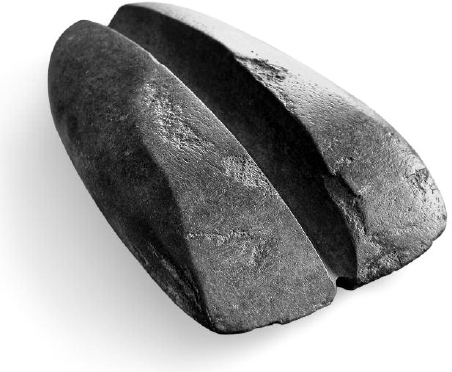
This black “celt,” found in the DuBois Park Indian mounds, was probably used in ceremonial trades between tribes. The hard ebony rock is the same as that found in Georgia and in Indian archeological sites around Miami. (Loxahatchee River Historical Society)
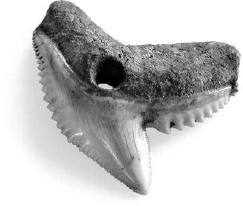
One of 96 sharks’ teeth uncovered in the DuBois shell mounds. They made excellent tools for carving in detail, but were just as often strung around the neck as jewelry. (Bureau of Archaeological Research, Division of Historic Resources, Florida Department of State)
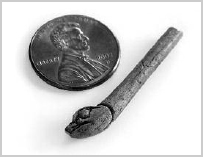
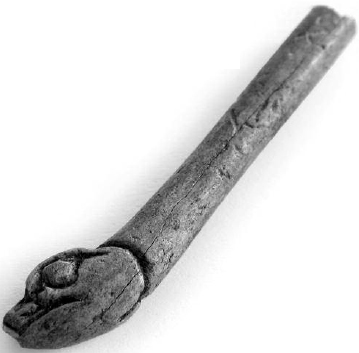
One of the few examples of artistic carving at the DuBois Park site is this fragment of bone with an eel’s or turtle’s head. Archeologists agree that it was originally long enough to be stuck through a warrior’s hair. (Department of Anthropology, Florida Atlantic University, Boca Raton, No. A2672)
Ponce de Leon never returned to his river of the cross. Eight years later he was attempting to colonize another group of Indians on Florida’s west coast when he was mortally wounded by an arrow, probably made from a splintered fish bone.
Soon it was no longer a novelty for east coast Indians to see Spanish sails billowing along the Gulf Stream. Captains knew the inlet as Barra de Jobe, but whether any stopped there is unknown except for one probable, tragic episode. Pedro Menéndez de Avilés, the man most responsible for founding St. Augustine in 1565, was also ordered by Philip II of Spain to establish settlements along the Florida coast to protect trade routes and convert the local Indians to Catholicism. But after a year or so, the little bands of settlers were sick and starving for lack of sustainable crops. With some of the outposts already in the throes of mutiny, Menéndez decided to consolidate the ones on the southeast coast in a place called Santa Lucea while he sailed to Havana in hopes of bringing back food and supplies.
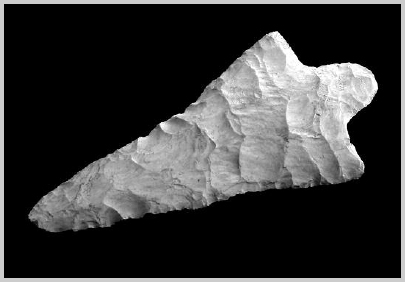
Large spear point or projectile found in the DuBois Park Indian mounds. Under the nearly-microscopic focus of today’s computer technology, one can see each stroke that went into sharpening the tip. (Loxahatchee River Historical Society)
Some historians have assumed that Santa Lucea referred to today’s St. Lucie Inlet because of the similarity in names. However, logs show that the largest garrison, located at Ays Inlet (now Fort Pierce), marched and floated “twenty-three leagues” down the Indian River to found the new settlement of Santa Lucea. Twenty-three leagues is about 66 miles, which would have taken them into the Río de la Cruz. And this, of course, emptied into the inlet called Barra de Jobe, which also offered a more dependable harbor than the shallow and treacherous St. Lucie Inlet.
What was a good geographical choice proved exactly the opposite in terms of hospitality. At first the Jeaga (sometimes called Jeaga) Indians seemed at least passive, but soon their harassment and thievery was so incessant that it became impossible to forage for food. The arrival of Menéndez’ first supply boat eased the crisis somewhat, but when the second one tried to come ashore, a mutinous faction seized it and headed south, probably reaching Spanish-held Cuba.
Bad decision. The Spanish soldiers were so hungry and miserable that they decided to head north and try their luck at Santa Lucea.
Another bad decision. As the remaining settlers there chewed on bitter wild berries and cowered behind a flimsy fortification of palmetto stalks, they could not have been thrilled when a ragged band of their countrymen fought their way past angry Jeaga Indians and asked “What’s for dinner?”
Not much. According to a diarist named Barrientos,
Provisions... were so low during those almost daily encounters with the Indians that no more than a single pound of maize was issued to ten soldiers. When this supply was gone, a palmetto was sold for one ducat, a snake for four [and] a rat cost eight reales—excessive prices because there was very little money. The soldiers began to fall from hunger, and in the end only thirty men were left to bear arms. The bones of animals and fish dead for years were barbecued over the fire and then picked, as were swords, belts and shoes.
Had they stuck it out, Jupiter might have been the second continuous European settlement in the U.S. But despite the occasional relief ship from Cuba, the withering hostility of the Jeaga Indians was too overwhelming. The settlement was abandoned after only three months.
The underlying reason for both the Indian hostility and the abandonment of Fort Santa Lucea was simply that the Jeaga had no reserve of food they could share with anyone. They caught fish and shellfish and searched the adjoining scrubland for roots and berries.
No further European arrivals in Jupiter were recorded for more than a hundred years afterward, but the Indians at Barra de Jobe surely felt the ripples of growing activity. By the mid-seventeenth century an estimated 150,000 Spaniards had settled in the Americas and towns like St. Augustine and Pensacola were bustling in Florida. Ships laden with silver and gold rounded the tip of Florida, then used the six-knot Gulf Stream for added thrust before cutting across the Bahama Channel on their way to Spain.
The above suggests more activity for the Jeaga Indians. When hurricanes struck ships or ships struck reefs, the villagers were undoubtedly on the coast to plunder cargo and exploit the survivors for whatever gain they could.
Just what the latter meant is subject to conflicting accounts. In 1987, after Jupiter lifeguard Peter Leo discovered the remains of a Spanish wreck in ten feet of water just off the inlet, the archives of colonial Spain identified the ship as the San Miguel de Archangel, sunk in 1659. Logs showed that the 33 survivors lived with local Indians on the “River Jeaga” (amicably, one assumes), until picked up by a rescue vessel from St. Augustine.
And yet, just up the beach, something altogether different happened a year later. In 1570 a ship laden with hides from Spain was seized at sea by an English privateer and its occupants put ashore on Jupiter Island. The Jeaga/Jobe Indians received them by murdering all of the stranded Spaniards except for a mother, her three children and a badly wounded sailor. The five were exchanged for six Indians who had previously been captured by Spaniards to the north.
In 1575 Spain was titillated by the newly published memoirs of one Fontaneda, a shipwrecked Spaniard from Columbia who had been captured as a teenager and held captive for 17 years. On one page he wrote: “The king of the Ayes [in the Fort Pierce area] and the king of the Jeaga are poor Indians, as respects the land; for there are no mines of silver or of gold where they are; and, in short, they are rich only by the sea, from the many vessels that have been lost well laden with these metals…”
But Indians were already beginning to pay a price for their contact with Europeans and their gold and tools. Some historians speculate that the not all wrecks were caused by hurricanes or pirates. Some ships, they say, probably floundered on the reefs along the Jupiter coast because the entire crew was stricken with plague or other communicable disease. They simply became too weak and short-handed to navigate their ship. If so, each chest the plundering Indians opened on the shore literally would have brought a pox upon them.
When England bested the Spanish Armada in 1588, it weakened Spain’s foothold on the New World and opened the door to colonial competition from the British, French and Dutch. Again, there is no record of anything but sporadic contact with the Jeaga/Jobe Indians. But by 1650 the estimated population of the English in North America was 52,000, and it would only be a matter of time before they left their mark on Jupiter.
It came in 1696. Jonathan Dickinson was the 33-year-old son of a well-placed English Quaker family that had been granted a thousand acres near Port Royal, Jamaica, for its service to Oliver Cromwell. On August 23 he set sail from Port Royal for Philadelphia on the barkentine Reformation with 25 passengers. Besides Dickinson they included his wife Mary, his six month old son Jonathan, a captain, eight sailors, eleven slaves, an elderly missionary who had been serving in Jamaica and a distant kinsman (perhaps a cousin). Loaded among the farm animals to be slaughtered along the way was £1,500 worth of furniture and tools that were to be the basis of a new family import-export business in flourishing Philadelphia.
The Reformation began its voyage as part of a convoy of similar merchants who banded together for self-protection, but rough seas soon scattered the fleet so that one would get only a glimpse of another ship from time to time. Anxiety aboard the Reformation turned to angst on the night of September 23 when the wind and waves became violent. Around 1 a.m. the huddled passengers felt the vessel hit something with a thud. It floated free for a few minutes, then rammed another object and stuck fast. Seas rushed over the listing ship, and for another 15 minutes everyone thrashed about helplessly in the cabin as water rose around them. Outside, the skies were black and no land could be seen.
After another petrifying three hours, daylight began to break. Surprisingly, water receded from the cabin. A clamber up to the quarterdeck quickly revealed that the ship had come to rest on a beach and the tide was going out, leaving it high and dry. The hull’s planking was ripped and punctured, and would surely become worse when the tide returned.
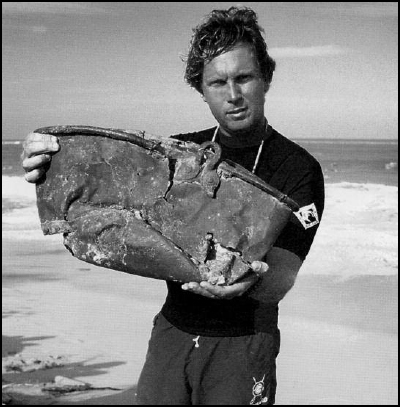
In July 1987, just after a storm, Jupiter lifeguard Peter Leo was taking his usual morning ocean swim just south of the inlet when he noticed a dark object in the water below. A quick dive in the ten feet of water showed it to be an old ship’s cannon.
Months later, after forming a treasure hunting company, obtaining a state license and pouring through the archives of colonial Spain in Santo Domingo, Leo and his team brought up some 12,000 coins and artifacts ranging from swords to cannons to the copper bucket (crushed when a cannon toppled on top of it) he’s holding in the above photo. The mother load came from the aviso (ore-hauling) ship San Miguel de Archangel, sunk in 1659 during a storm just off what the Spaniards called the “River Jeaga.” The San Miguel was a special find because its coins bore the stamps of five colonial mints: Bogotá, Cartagena, Lima, Mexico City and Potosi (Bolivia).
One “bonus” find from Leo’s years of excavations off Jupiter beach is evidence that the ancient Indian midden that ran along the south side of Jupiter Inlet extended for several yards into the ocean. Says Leo: “We found the same black muddy soil, tannic acid and oyster bars underwater that ran along the old shoreline in DuBois Park.” (From Diving for Treasure, by John C. Fine, with permission from Richard C. Owen Publishers Inc., Katonah, N.Y.)
For centuries, the Indians who lived at the inlet called their village “Ho-Bay.” It seems they were a branch of the Jeaga, a sub-tribe whose domain stretched north perhaps to the end of Jupiter Island. The earliest Spanish visitors wrote the word for the village as Jobe. When the English came along in the seventeenth century, they assumed that Jobe was Spanish for the Roman god Jove. So they simply made it the English variant, Jupiter.
Despite near exhaustion, the bone-chilled band began herding the animals that hadn’t been washed away and loading boxes of cargo and clothing onto a longboat so they could be brought onto the beach. Despite the continued rain and wind, Dickinson got a fire started and began tending to the many in his party who had broken bones or raging fevers. At the time, he had no idea where he was in Florida. In a few days he was able to place the shipwreck location on today’s Jupiter Island—about five miles north of Jobe Inlet.
And it was there history records the first meaningful description of Jupiter’s local sons.
About the eighth or ninth hour came two Indian men (being naked except a small piece of platted work of straws which just hid their private parts, and fastened behind with a horsetail in likeness made of a sort of silk-grass) from the southward, running freely and foaming at the mouth, having no weapons except their knives; and forthwith not making any stop violently seized the two first of our men they met with who were carrying corn from the vessel to the top of the bank, where I stood to receive it and put it in a cask.
The rest of the passengers also ran or limped to the scene, bringing their wet muskets and asking if they should open fire. This was a pivotal decision for Dickinson. Had he chosen violence, another two hundred Jobe Indians were getting ready to descend on them. Instead, he listened to the aging missionary, Robert Barrow, who urged everyone to remain calm and put their trust in the Lord and their deliverance in the hands of Spaniards— if they could find a Spanish settlement. The two assailants, their hair in a roll with ornamental bones and pins stuck through, kept up their “wild, furious countenance,” but Dickinson coolly opened one of the chests that had come ashore and handed them some tobacco and pipes. “Making a snuffing noise like a wild beast, they turned their backs and run away,” he reported.
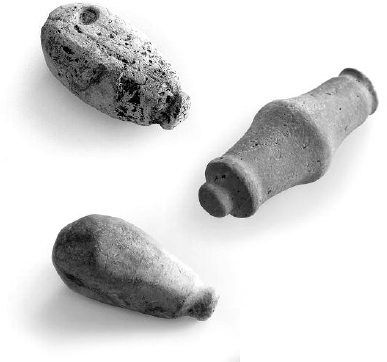
These plummets, or pendants, carefully honed, may have been used for weights around fishing nets, for looms, or simply as ornaments worn around the neck.
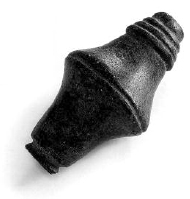
The black plummet (right) was found in 1927 by John DuBois when he was removing “shellrock” from the Indian midden for road construction.
(Loxahatchee River Historical Society)
About three hours later, just as a little sun was finally beginning to warm the beach, the busy salvagers began to hear whoops and shouts. Soon “a very great number” of Indians stormed onto the beach, climbing onto the stricken vessel and “taking forth whatever they could lay hold on, except [unexplainably] rum, sugar, molasses, [dried] beef and pork.” Next, the “Casseekey” (as Dickinson called the cacique, or chief) and about thirty of his fiercest warriors “came down to us in a furious manner, having a dismal aspect and foaming at the mouth. Their weapons were large Spanish knives, except their Casseekey, who had a bagganet that had belonged to the master of our vessel. They rushed in upon us and cried ‘Nickaleer, Nickaleer.’”
Dickinson was to hear the word often. He soon realized it was the Jobe word for Englishman, and the venom accompanying the name left no doubt that these Indians hated anything or anyone English.
“Espania?” the chief asked next. “Si, si!” they all chorused. “Espania!” One of the seamen spoke a little Spanish, and he was enlisted to convince the “Casseekey” that the group wanted to head north immediately in search of a Spanish settlement that would give them shelter. No matter that England had warred off and on with Spain for a century. They’d take their chances.
By now the Indians had formed a menacing circle around the beleaguered survivors. “No Espania!” they shouted over and over. “Nickaleer! Nickaleer!”
At this point only the chief stood between them and the smothering circle of his warriors. Recalled Dickinson: “All had their arms extended with their knives in their hands, ready to execute their bloody design, some taking hold of us by the heads with their knives set against their shoulders. In this posture they seemed to wait for the Casseekey to begin.”
But the order to butcher them never came. For a long minute the warriors continued their feverish pitch—“words which we understood not,” Dickinson wrote. “But on a sudden it pleased the Lord to work wonderfully for our preservation, and instantly all these savage men were struck dumb,” and within fifteen minutes “their countenances fell and they looked like another people.”
Obviously, something had compelled the chief to take the forlorn strangers under his wing. Perhaps it was partly because most of the beached chests were locked and the castaways had the keys. In any case, he demanded that all of the chests, trunks and boxes be unlocked and their contents emptied, with the most fetching of prizes going to the chief himself. Next, the Indians clawed and pulled at everyone’s clothing, so that all were nearly stripped naked. When the castaways still continued to beg that they be allowed to head north immediately, the chief refused, insisting with vivid sign language that “when we came there, we should have our throats and scalps cut and be shot, burnt and eaten.”
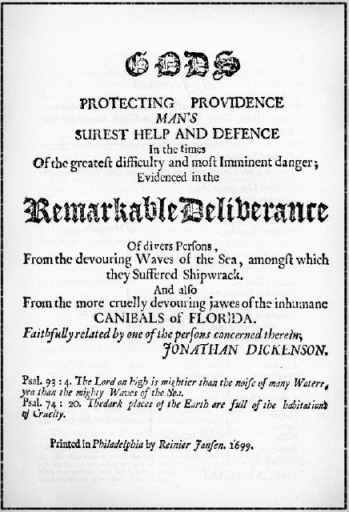
The hair-raising “Journal” compiled by Jonathan Dickinson after his safe return to Philadelphia was soon printed on a shopworn press from London and distributed to Quakers as proof that God protects the faithful in perilous times. Little did Dickinson know that others would scoop up the dramatic tale and that it would be reprinted 22 times in the eighteenth and nineteenth centuries.
The cacique’s actions in the next several hours would seem to cast further light on his motives. First, it became evident that he knew too much about Europeans for this to have been an initial contact. After all, he and his men were brandishing Spanish-forged swords. Moreover, he must have known the value of cash, having demanded at the outset that all of the survivors’ money be collected and given to him personally. Finally, he must have known more of the language than he was letting on. At one point when Dickinson was denying the Nickaleer claim for the umpteenth time, the chief sneered at him and spat out, “English son of a bitch!”
Second, even if the chief knew he had ersatz Spaniards on his hands, he still seemed to trust them more than his own men. During that first night on the beach he allowed the party to erect their tents. The chief then hauled all of his personally selected chests inside the Dickinson family tent and slept on top of them. A day later he took two of Dickinson’s slaves off into the thicket to help him bury his cash cache, making sure his own men didn’t follow.
| HISTORICAL HIGHLIGHTS | |
| ____________________________ | |
| 10,000 B.C. | First archeological indications of Indian life in southeast Florida. |
| A.D. 750 | Carbon dating of earliest Indian artifacts found at Jupiter Inlet. |
| 1492 | Columbus discovers the West Indies. |
| 1513 | Ponce de Leon sails into Jupiter Inlet. |
| 1565 | First permanent Spanish settlement at St. Augustine. |
| 1565 | Adm. Pedro Menéndez de Ávilas briefly establishes Santa Lucea at or near Jupiter Inlet. |
| 1588 | Defeat of Spanish Armada by England. |
| 1659 | Spanish ship, San Miquel de Archangel, sunk off Jupiter Beach. Indians take in 33 survivors. |
| 1670 | Charleston, S.C., founded. |
| 1696 | Jonathan Dickinson and household shipwrecked on Jupiter Island. |
| 1763 | Spain cedes Florida to England. Last Indians taken to Cuba. |
| 1764 | Present Jupiter Lighthouse site probably visited by English travelers. |
| 1773 | Boston Tea Party. |
| 1776 | Declaration of Independence. |
| 1780 | First migrations of Yamasee (Seminole) Indians to north Florida. |
| 1783 | Treaty of Paris returns Florida to Spanish control. |
| 1789 | George Washington becomes president of U.S. |
| 1789 | French Revolution begins. |
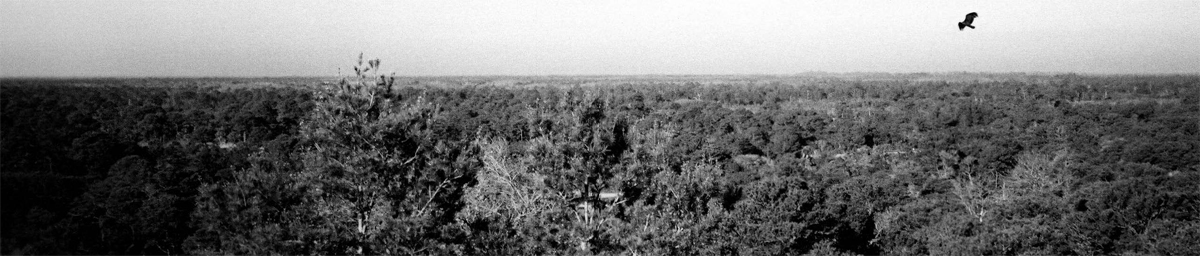
Looking west from atop the ranger platform on Hobe Mountain, the landscape of Jonathan Dickinson State Park remains much the same as when its namesake first visited in 1696. (Sue S. Snyder)
Reconciled to a five-mile southward journey to the chief’s village, the exhausted and threadbare party was grateful for even the smallest of favors. Before trekking in the sand, the chief went down to the wrecked ship and returned with some wet, wooly coats for the Dickinson family. Once they were ferried across the inlet to the Indian village, the cacique took pains to give them sleeping mats and erect a makeshift three-foot fence of palmettos to ward off the incessant wind. A local woman even took Dickinson’s infant and nursed him when his mother was too exhausted and dried out from her ordeal.
Dickinson’s journal remains the only reliable description of life in the village at Jobe Inlet where DuBois Park and Jupiter Beach stand today. He writes of people living in “little wigwams made of small poles stuck in the ground, which they bended one to another, making an arch, and covered them with a thatch of small palmetto leaves.” The Casseekey’s wigwam, he adds, “was about man-high to the top.”
As the weary and shivering captives lay down to sleep in their first night at the village, the chief “went into his wigwam and seated himself on his cabin cross-legged, having a basket of palmetto berries brought him, which he ate greedily.” Later, when Dickinson was offered some, he described their taste as “rotten cheese steeped in tobacco.”
In a few days he would crave the berries like manna and miss them even long afterward in Philadelphia.
As the moon rose and the weary guests tried to sleep, Dickinson recalled that the village shaman stood before the moon “making a hideous noise, crying out and acting like a madman for the space of a half hour.” This prompted a chorus of males to make “a fearful noise, some like the barking of a dog, wolf and other strange sounds.” Then the women chimed in, “making the noise more terrible,” and continuing until midnight.
When the fitful party awoke the next morning (their third since the wreck) fires had gone out and they were in “extreme cold.” Taking pity, the chief sent his son to the inlet “to strike fish for us” and provided the first glimpse of why thousands of northerners would eventually come surging down to Jupiter:
... for some of us walked down with him, and though we looked very earnestly when he threw his staff from him, could not see a fish at which time he saw it, and brought it on shore at the end of his staff. Sometimes he would run swiftly pursing a fish, and seldom missed when he darted at them. In two hours’ time he got as many fish as would serve twenty men. There were others fishing at the same time, so that fish was plenty.
That afternoon Dickinson was shocked to see smoke from a great fire billowing over the trees a few miles to the north. He knew that the Reformation had been set ablaze and feared that it signaled his party’s imminent demise. That night the warriors, as they had on the beach, pressed about them with bows and arrows drawn, and again they thought that their time had surely come. But just when the tension was at its worst, the missionary Robert Barrow rose and read loudly to them from the Bible amidst the din of Indian voices. Soon he had replaced the castaways’ dread with an inner calm that “it was His blessed will [that] he would preserve and deliver us from amongst them, that our names might not be buried into oblivion…”
The next morning Dickinson again beseeched the chief to let the party head north, but this time his plea was unexplainably granted. The cacique even produced a longboat from the Reformation that the survivors assumed to have burned up with the mother ship. With some in the boat and some wading in the marshes, the still nearly naked party of 24 (a slave girl had died in the storm) set off along the shallow Jupiter Narrows in search of a more friendly civilization.
Along the way they would endure freezing nights, scorching sands by day, searing hunger and more torments at the hands of other Indian villages. Nearly everyone would become seriously ill and five would simply give up the ghost along the way. The emaciated, blistered survivors finally staggered into hospitable St. Augustine on November 15 after an ordeal of 54 days.
Jonathan Dickinson was convinced that his odyssey was proof of God’s divine intervention on behalf of those who prayed and persevered in His name. He published his diary in 1699 as Jonathan Dickinson’s Journal, and it immediately became popular in the Quaker stronghold of Philadelphia. But it struck a responsive chord elsewhere, too, being reprinted 22 times during the next two centuries. Dickinson, who rose to become mayor of Philadelphia and speaker of the Pennsylvania Assembly, seems to have been undaunted by his harrowing adventure. He passed the Jupiter coast and village of his one-time tormenters many more times on sailing trips between Philadelphia and his Jamaica plantation before his death in 1722 at age 59.
More than 60 years would pass without a hint of European activity anywhere around Jupiter Inlet. At the same time, the native Indian population continued to be thinned by disease, internal warfare and raids by slave traders. Of these, diseases brought in by the white population surely took the greatest toll. As just one example of how severely a pox could sweep through a civilization, consider the plight of the Lucayan Indians in the Bahamas. Archeologists estimate the population at about 50,000 when Columbus arrived. In 1513 Spanish explorers couldn’t find anyone.
It took a far away group of “statesmen” to remove the remaining south Florida Indians altogether. In 1763 the terms ending the French-Indian War ceded all of Canada and America east of the Mississippi to England. Soon afterwards, the Spanish razed their forts in South Florida, snatched up what they believed to be all the remaining Indians—about eighty families—and shipped them to Cuba to work in the sugarcane fields.
Alas, what might have triggered a surge of activity by Florida’s new masters was offset because the British were overwhelmed trying to govern their vast new territory to the north—and later overrun by angry colonists because they tried to impose taxes to help offset their mounting costs.
Curiously, a few eighteenth century English maps show Jupiter Inlet as Grenville Inlet. George Grenville was First Lord of the Admiralty in 1762–63 and then served as Prime Minister from 1763–65. Merchants and explorers often named New World discoveries for their patrons or those who granted their charters. The Grenville family was known to have investments in Florida. When the Jupiter Lighthouse was renovated during 1999–2000, project archeologist Jim Pepe found pieces of English clay pipes buried around the base.
However, any “Grenville” settlement in Jupiter would have been brief or sporadic. Some speculate that one of London’s many merchant companies might have sponsored an unsuccessful attempt to farm the area, or that the first British Bahamians used it as a camp during periodic visits to hunt for game and salvage. Ironically, the only real population “boomlet” came in late 1782 when nearly 12,000 Loyalists from Charleston and Savannah were evacuated to Florida, the only North American territory not wrested from the British. But again world politics would intervene. In 1783, as part of the Treaty of Paris ending the Revolutionary War, the British handed Florida back to Spain in exchange for the rights to retain their stronghold on Gibraltar. And so the Loyalists were soon packing again and sailing for safer places such as the Bahamas and Jamaica.
Spain, burned once, wasn’t about to invest seriously again in Florida. The lands south and east of Lake Okeechobee were as sparsely peopled as they may have been 5,000 years before. In 1786 a survey of all Florida east of the Apalachicola River reported only 1,700 residents. The census of 1800 showed only 21 towns in all of Florida, many of them but a lone trading post in the wilderness. In 1825 the government estimated the population of “south Florida” at 317.
But footsteps from the north would soon break the lull.
Just when the last of the original tribes were fading from south Florida, a much different Indian had begun filtering into the state’s northern tier—due to a hard shove from the relentlessly expanding colonists of Alabama, Georgia and the Carolinas.
While conflict over land was surely the biggest factor, two others made the political pot boil over. First, Indians of the southern states had often found themselves on the “wrong” side. Many had fought for the English in the Revolutionary War. After 1783, when Spain regained Florida but lacked the resources to rebuild a stronghold there, it encouraged Indian tribes to raid the new Americans.
All that might have been forgiven except for the second factor. When Spain owned Florida, it proved a prosperous haven for an ever-growing stream of escaped slaves. A plantation owner would bristle at learning that runaways had blended beautifully with the Indians in their newfound Florida and that a black man who had cost him perhaps $1,000 now farmed his own spread under the protective wing of an Indian chief. He’d become apoplectic at learning that other runaways had joined the Spanish Black Militia or had formed the first “free” black community at Fort Mose near St. Augustine. The last straw would have been the War of 1812, when hundreds of fugitive slaves signed up to fight for the British.
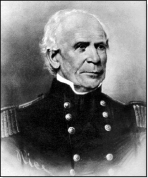
Maj. General Thomas S. Jesup (above) reluctantly led the U.S. Army’s heavyhanded roundup of the Seminole Indians in Florida. His commander in chief: the pro-slavery Andrew Jackson. (U.S. Army Quartermaster Museum)
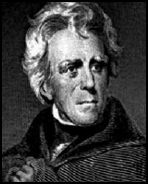
Just who were these unique, vibrant people? “Seminoles,” said the white southerners. The term began with a sloppy pronunciation of cimarrone—Spanish for runaway or fugitive— which initially applied only to slaves escaping to Florida. The Indians never accepted the term on grounds that being bullied off one’s land at gunpoint isn’t the same as running away. But by the early 1800s the two cultures had become so intertwined that Seminole became the white’s convenient handle for everyone. Indeed, the typical Seminole by then was a mix of African, European, and one of the Creek or Hitchiti tribes. He or she might speak both Indian languages as well as English.
In their first years on the northern tier of Florida, the Indian contingent tried farming—and might have failed without help from runaway slaves who had learned their skills on plantations. In the early 1880s another push southward came as emboldened white settlers forced the Seminoles into the less fertile, open spaces of the interior. But this time luck was with them. Before the Spaniards abandoned Florida in 1783, they turned loose all the cattle and horses they couldn’t board on ships for Cuba. Within a generation or two, thousands of range animals were roaming the central grasslands and blacks with their plantation skills were showing Indian chiefs how to round them up into valuable herds.
As Richard Procyk notes in his Guns Across the Loxahatchee, “the first American cowboys (vaqueros) were not in the far West but were descendants of the early Spaniards, Indians or blacks, slave or free, in Florida.” As for the Indians, Procyk adds that some chiefs “had herds of cattle of well over a thousand head. These Indian ranchers rode fine ponies and...owned many slaves who herded these cattle and grew the crops.”
Slaves? Technically, some Indians were indeed slave owners. Occasionally they’d even buy more slaves on the market in exchange for livestock. Yet, the Indian-slave relationship afforded more freedom than in the white South. Blacks usually lived in their own clusters within a tribe’s orbit. Since the Indians tended to shun farming, a Negro’s only acknowledgment of servitude was supplying a certain percentage of his crops to the tribe. In time, even this distinction would blur, as blacks excelled in special skills, intermarried and became part of tribal councils.
But the Seminoles had scant time in which to enjoy their prosperity. By 1816 white slave owners were livid at the escalated rate of runaways into Florida. At a time when a typical annual wage was $700, a slave could cost $600 to $1,000, and masters were demanding that the federal government help them reclaim their runaway “property” and remove the offending Indians to reservations in Arkansas and Oklahoma. To make a political statement, the U.S. Army crossed into Spanish territory for the first time, sending an armed boat up the Apalachicola River. Its destination was an abandoned earthen fort that had become a center for sheltering black runaways. An estimated three hundred lived there at the time. The ship’s gunners scalded cannon balls so that they glowed red and then lobbed them inside the fort. As hoped for, one of them hit a magazine containing seven hundred barrels of powder.
The blast killed 270 people. It also ignited waves of raids by white planters and Seminole ranchers on each other’s property so that the combined episodes gradually became known as the First Seminole Indian War. White settlers clamored for more reprisals and, fortunately for them, an ambitious army general was willing to ride the issue all the way to the presidency. He was Maj. Gen. Andrew Jackson and he came from slave-owning Tennessee.
Eventually, he would bring his crusade all the way south to Jupiter until it dissipated ingloriously in the swamps south of Riverbend Park.
Even though Jackson was to write President Monroe in 1817 that “I have long viewed treaties with the Indians as an absurdity…” treaties became the order of the day. When Spain sold Florida to America in 1819 and it became a Territory two years later, the U.S. military found itself with more power to muscle the Indians into one-sided agreements. In the Treaty of Moultrie Creek, for example, the Indians secured some money, livestock and tools in exchange for some central Florida land (along the Peace River south of Ocala) that was scenic but incapable of yielding enough food to live on.
In 1829 Jackson became president and American policy now focused solely on transporting every last Seminole (there were never more than 5,000) to the Wild West. On a gut level, Jackson never forgave the Indians for fighting with the British in 1812. On a more practical level, the U.S. had strained the treasury by paying $5 million to acquire the last lands from Spain and couldn’t hope to recoup its investment through land sales until it could assure new settlers their personal safety.
Little did he know that this supposed “housecleaning” of no more than 2,000 Seminole warriors and their black allies would embroil the young nation in its longest war—until Vietnam—and cost more than eight times what it had paid Spain.
By 1835 the lines had been drawn and the leading characters sharpened. On February 16 President Jackson addressed a letter to “My Children” asking them to listen to the “voice of friendship and truth” that they be evacuated. And if not, they would be “removed by force.” Jackson’s chief Indian agent at the trading post where the letter was read to 150 chiefs and warriors, was Gen. Wiley Thompson, who was already loathed for his overbearing ways. Also present was the handsome 31-year-old son of a Creek woman named Polly and an Englishman named William Powell. He had already risen to be the charismatic symbol of resistance, and his answer to the latest proposed “treaty” was to stab his knife into the parchment. His given name was Billy Powell, but as the Seminoles’ fiercest fighter, it would become Osceola.
By 1837 around 4,000 of the U.S. Army’s 7,130 active troops had already slogged through sand and slough in the battles of the Withlachoochee River and Lake Okeechobee. Nearly always the Seminoles more than held their ground, for example, 7 dead and 11 wounded at Okeechobee vs. 25 and 112 for the army forces. But because the Indians couldn’t draft replacements like the army, they decided never again to engage the enemy in direct combat.
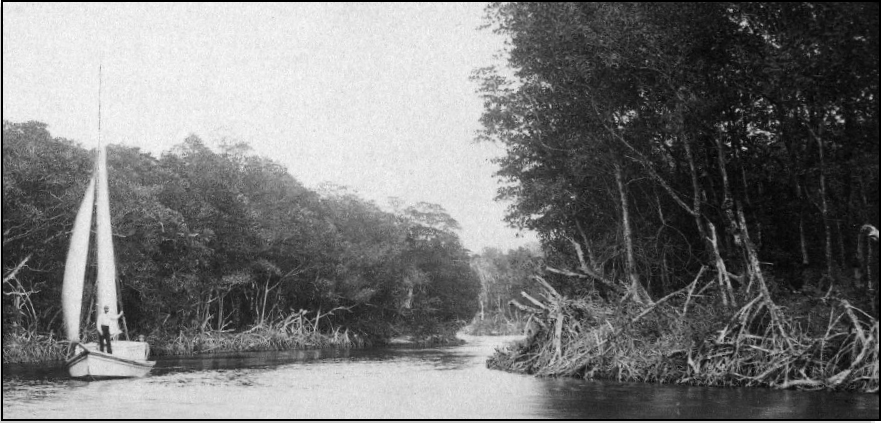
Seth Shear, a renowned 19th century photographer, captured the eerie stillness of Jupiter Narrows, which lay at the southern end of the meandering, trip from Titusville to Jupiter. (Skip Gladwin Collection, photo by Seth Shear)
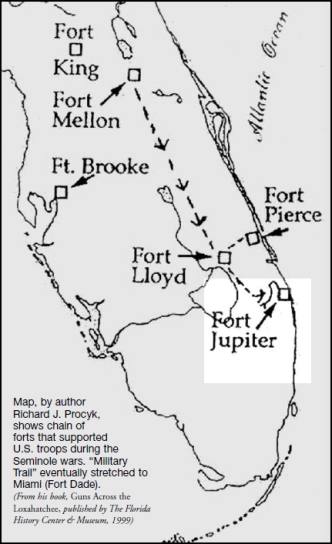
In December 1837 army reconnaissance reported that 150 or so remnants from the Battle of Okeechobee had made their way south to an Indian village along the Loxahatchee. Perhaps 250 to 300 Indian and black warriors were now camped “on a high hammock” a few miles upstream from Fort Jupiter.
By January 1838, 1,535 already footsore soldiers were hacking and wading their way south in one of the most excruciating marches in military history. Horses broke legs and wagons lost wheels. Soldiers howled as the saw palmetto cut their arms, then cursed as the muck of the cypress swamps sucked in their shoes and left over four hundred barefooted. Suddenly on January 24, when they had reached today’s Riverbend Park, scouts came upon the Seminole force and officers decided to waste no time in opening fire.
This battle was clearly on the Indians’ terms. They had carefully chosen their high ground with an escape route through a dense swamp behind it. They’d chopped the saw palmetto in front of them to have a clearer look at their quarry and they’d even carved notches in tree trunks to steady their muskets. But it was the army who advanced with guns blazing.
After retreating to a second well-rehearsed spot across a narrow finger of the Loxahatchee, the Seminoles unleashed another shower of musket balls before carrying out their new strategy. They vanished into the swamps.