
Other books by Swami Muktibodhananda Saraswati,
Swara Yoga the Tantric Science of Brain Breathing
Commentaries on Hatha Yoga Pradipika,
the Light on Hatha Yoga.
Both published by the Bihar School of Yoga.

A BOOK ABOUT YOGA AND
PERSONAL GROWTH FOR MEN AND WOMEN


The yogic information given in this book is based on well-established yoga
techniques. However, it is not intended to be taken as a replacement for personalized
tuition and guidance from an expert. Not all yoga practices are suitable for everyone.
Please consult your health care practitioner before commencing the yoga programme.
The instructions and advice presented are not intended as a substitute for medical
guidance. The writer and publisher of this book do not accept any responsibility for
any injury as a result of following this yoga programme.
© Copyright 2006 Mukti Saraswati.
All rights reserved. No part of this publication may be reproduced, stored in a retrieval system,
or transmitted, in any form or by any means, electronic, mechanical, photocopying, recording,
or otherwise, without the written prior permission of the author.
Note for Librarians: A cataloguing record for this book is available from Library and Archives
Canada at www.collectionscanada.ca/amicus/index-e.html
ISBN 1-4120-6930-0

Printed in Victoria, BC, Canada. Printed on paper with minimum 30% recycled fibre.
Trafford’s print shop runs on “green energy” from solar, wind and other environmentally-friendly power sources.

Offices in Canada, USA, Ireland and UK
Book sales for North America and international:
Trafford Publishing, 6E–2333 Government St.,
Victoria, BC V8T 4P4 CANADA
phone 250 383 6864 (toll-free 1 888 232 4444)
fax 250 383 6804; email to orders@trafford.com
Book sales in Europe:
Trafford Publishing (UK) Limited, 9 Park End Street, 2nd Floor
Oxford, UK OX1 1HH UNITED KINGDOM
phone +44 (0)1865 722 113 (local rate 0845 230 9601)
facsimile +44 (0)1865 722 868; info.uk@trafford.com
Order online at:
trafford.com/05-1841
10 9 8 7 6 5 4 3 2 1
|
Acknowledgements |
|
Introduction |
|
Pronunciation of Sanskrit vowels and consonants |
|
A Meditation |
Chapter One |
The Universal Goddess: Energy |
Chapter Two |
Healthy Attitudes |
Chapter Three |
Yoga Cleansing Practices |
Chapter Four |
Body Stabilization: Asana |
Chapter Five |
Breath Utilisation: Pranayama |
Chapter Six |
Muscle Squeezing: Bandha |
Chapter Seven |
Energy Gestures: Mudra |
Chapter Eight |
Mind Absorption: Meditation |
Chapter Nine |
Food and Health Tips |
Chapter Ten |
Relationships and Family |
|
Further Reading |
|
About the Author |
Special acknowledgements go to my mother, Virginia Hayward-Nash (Nityamuktananda), for enabling me to pursue yoga, and for her positive input towards publishing this book; to my teacher, mentor and Guru, Paramahansa Swami Satyananda Saraswati; to Swami Sambuddhananda for the lovely painting used on the covers of the book; to Sakshi Winning for her constructive comments; to Joss Guin, a dedicated sadhaka aspirant, who was my yoga model; to Suzi Tooke for her editing; to my Uncle and Aunt, Rod and Liz Nash and their design student intern Anil Singh (Nash & Nash Ltd., Canada), for their design and artwork that helped turn the manuscript into a user-friendly book; to all the people I have taught and for their input in my life as a teacher; and to you for being interested in your own self development.
I remember as a child telling my mother that I would write a book when I was 40. Actually my first two books were written in my twenties when I was inspired to delve into the deeper aspects of yoga and advanced practices. But after teaching many aspects of yoga in Australia over the last 20 years I found a need for a different style of yoga book that integrated the profound knowledge of yoga with a Western lifestyle.
There are plenty of yoga books these days that can instruct you in the correct art of yoga posture or books that discuss yoga philosophy. So how do you integrate this knowledge with your day-to-day life? Is your spiritual life separate from your worldly life? I have noticed that many people have a conflict between their understanding of what is spiritual and what is physical. If you have this inner conflict you need to find a method that enables you to experience your mind, body and soul/consciousness as a complete being. When you realize the expression of soul/consciousness in every cell of your body, you can experience true joyousness. Personally I have found yoga can assist with this realization. Yoga does not interfere with your religious beliefs. As you do the practices you will have your own inner realizations about your self, the other people in your life, and your environment. This book is the product of my heart-felt need for all yoga teachers and aspirants to imbibe the essence of yoga, and its practical application in life. It is the culmination of my past 30 years of teaching in the east and west, and is a unique book incorporating the fundamentals of yoga with a western understanding.
May your heart sing and inner vision be clear.
(Muktibodha)
The traditions of tantra and yoga were originally recorded in the ancient language of Sanskrit. Sanskrit is written in the deva nagari script. Unlike English, sanskrit is phonetic. When reading a translation of Sanskrit in roman script, which is how we read English, there can be some confusion of the exact pronunciation.
Sanskrit is an unadulterated language. It was realized in deep states of meditation. Each sound has an influence on your mind and body. It is, therefore, useful to repeat the sounds and understand the concepts. Each sound is an aspect of the Universal Goddess and manifests within everything animate and inanimate. By repeating these sounds, we trace our journey back to the Universal Goddess.
To assist you with correct pronunciation of the terminology used, here is a list defining each sound. The vowels with a line underneath indicate a long vowel sound. Consonants followed by an ‘h’ are aspirated. For example, in Sanskrit there is no ‘th’ as in ‘the’; the sound is ‘t’ with an aspiration from the throat following it. Some sounds in Sanskrit are not used in English and it can take a little practice to become familiar with these new sounds.
Vowel pronunciation
|
a as in sun |
|
a as in faster |
|
i as in it |
|
e as in eel |
|
u as in bull |
|
u as in school |
|
ri rolled r sound followed by i |
|
ri rolled r sound followed by ee |
|
lri l +rolled r followed by I |
|
lri l +rolled r followed by ee |
|
e as in aid |
|
ai as in bye |
|
o as in jog |
|
au as in how |
Consonant pronunciation
In the Sanskrit alphabet, consonants are automatically pronounced with an ‘a’ sound (sun) following the consonant, e.g. ka, unless otherwise indicated. The following list describes each consonant without the ‘a’ sound and, therefore, to be technically correct each Sanskrit consonant has a small line beneath it, e.g. k.
k.
|
k |
as in junk |
|
kh |
k followed by an aspirated h, as in blackhead |
|
g |
as in bag |
|
gh |
g followed by an aspirated h, as in doghouse |
|
n |
nasal sounding n, as in hunk |
|
ch |
as in chew |
|
chh |
ch followed by an aspirated h, as in lunch habit |
|
j |
as in jug |
|
jh |
j followed by aspirated h, as in cage him |
|
ny |
as in onion |
|
t |
pronounced on the palate, i.e. palatal t, as in tea |
|
th |
palatal t followed by aspirated h, as in fit him |
|
d |
palatal d as in dog |
|
dh |
palatal d followed by aspirated h, as in bad hand |
|
rn |
as in burn |
|
t |
dental t sound, pronounced behind the front teeth |
|
th |
dental t sound followed by an aspirated h |
|
d |
dental d sound, pronounced behind the front teeth |
|
dh |
dental d sound followed by an aspirated h |
|
n |
as in non |
|
p |
as in jump |
|
ph |
p followed by an aspirated h, as in trap him |
|
b |
as in jab |
|
bh |
b followed by an aspirated h, as in job hunt |
|
m |
as in mum |
|
y |
as in yet |
|
r |
as in bear |
|
l |
as in will |
|
v |
as in vase |
|
sh |
as in shut |
|
s |
half way between sh and s |
|
s |
as in sat |
|
h |
as in hungry |
|
ksh |
as in book shop |
|
gy |
as in sang you |
Aum bhur bhuva swaha
Tat savitur varenyam
Bhargo devasya dhimahi Dhiyo yo naha prachodayat
(Gayatri Mantra)
We meditate upon
the radiant divine light
of that adorable sun of spiritual consciousness.
May it awaken
our intuitional consciousness.
I am hurt.
I am angry.
I’m happy, I’m sad.
I’m in pain, I feel sorrow and grief.
I’m ecstatic, elated and over the moon.
I’m quiet and peaceful and still.
What am I?
(Muktibodha)
The Spark Of Life
As this book has caught your attention you must be seeking deeper expression in your life, consciously or unconsciously. Perhaps you feel hungry at some inner level and can’t quite pinpoint what you need. Maybe life has thrown you into difficult circumstances and you are trying to make sense of it all. Or you could be in a situation where you feel unsupported in your life and wonder where to turn. Life has a tendency to put you in a situation where you can grow. These situations are often difficult because it is not easy to change old habits or adjust to new challenges or see yourself objectively. However, the right answers for you will be there when you search for them. And so this book can be a stepping-stone towards fulfilling your personal goals.
In order to understand yourself and your world you need to realize that life is not only a material manifestation. The physical world and your expression in it are both an important part of your experience but not your total existence. There are subtler aspects of which to become aware. Whether you are atheist, agnostic or theist you need fulfillment on all levels from the physical, to mental, emotional and intuitional layers. A theist will search for meaning in life through a personal understanding of God, the scientist searches for meaning through the intellect and scientific evidence or theories of quantum physics/mechanics, an atheist will search for meaning through evidence in the material world and a yogi or tantrik comprehends this directly through meditation. Perhaps you have perceived it through your own inner knowing or inner faith or intuitive experience. If you haven’t found it yet then you may even doubt your ability to ever find the true meaning. However, after reading this book and following the practices you will have a better understanding of yourself and your personal process of inner fulfillment.
First it is essential to realize that you are a conglomerate of physical and energetic components that give you life. While you can see and feel your physical body there are subtler forces that endow you with life. The standard model of cosmology today describes that the visible universe contains approximately 5% ordinary matter, 25% dark matter and 70% dark energy. The true nature of this dark matter and energy is a big mystery in cosmology. Tantra and yoga describe this dark energy and matter as the primordial goddess known as prana, shakti or prakriti. This goddess is the vehicle of universal consciousness known as chit, shiva or purusha.
According to tantra and yoga philosophy the universal goddess energy and consciousness coexist as polarities in both the manifest and unmanifest world. And so it is in within each individual. Your consciousness is a force more subtle than your brain and mind or anything you may perceive in the physical realm. The view of modern medicine is that consciousness is a product of the brain, that a baby is born and thereby endowed with consciousness. Yoga describes that form of consciousness as mental consciousness. Science also explains consciousness as the subtle form of energy, and energy the subtle form of matter, just as gas is the subtle manifestation of liquid and solid. The subtle point or seed of consciousness within you is the reflection of the universal consciousness. Some call this the Spark of Life. Because it is a form of energy, the feminine principle, it is called the goddess. The goddess manifests consciousness and life force in the material world.
Every human being is made of the same atoms as stars. That which endows you with individual consciousness is the goddess consciousness. When you came into the world your inner goddess was possibly dormant waiting to be nurtured to full maturity. Maybe your goddess had already manifested but was later sadly suppressed, being forced to retreat deep within. Set your goddess free. Your goddess is not subject to duality, time or space, night or day, male or female, opposites or polarities, health or disease, pain or pleasure. The goddess is always there for you, always ready with endless love and light irrespective of who and how you are in the world. The goddess is nameless, give whatever name suits you it does not change the goddess. What does change is your perception, experience and your relationship to yourself. To experience this goddessness within you, first understand your inner makeup.
What constitutes mind
An individual mind is known as an inner organ antah karana. It has many facets. Ahamkara, the external personality and ego is one aspect of the mind. You were born with an immature ego which developed according to your circumstances, parents, social and religious conditioning. These are the factors that mould your personality. Another aspect is the mental content chitta that includes the subconscious and unconscious layers. It consists of your ability to cognize, concentrate and remember. It is the store of all your memories, including unconscious memories inherited from your ancestral gene pool. The next aspect of mind is intellect buddhi, i.e. your ability to analyze, assess, evaluate and to be practical. Sometimes mind as a whole is referred to as manas and mental energy as manas shakti. To be very specific, manas is the aspect of your mind which constantly chatters. The four mental aspects operate in conjunction with your indriya senses of smell, taste, sight, touch or sensation and hearing. The subtlest aspect of your mind is intuition, pragya. Your intuition knows without external stimuli, without your senses or any other part of your mind. It is the closest aspect of you to goddessness. Intuition is the first to perceive Self and allows goddessness to be felt by every layer of your being.
Generally people only use one tenth of their total brain capacity. So what is the remaining nine tenths capable of? As you practice yoga you may find you are capable of achieving much more than at present. Some of the essential practices are elucidated here in this book.
What constitutes the body
Modern science can explicitly explain to you the chemical and anatomical structure of your physical body. However, these chemical components can only manifest because of a decrease in the frequency of the inherent consciousness. Now it is your endeavor to realize this process by retracing your goddess’ descent into your body.
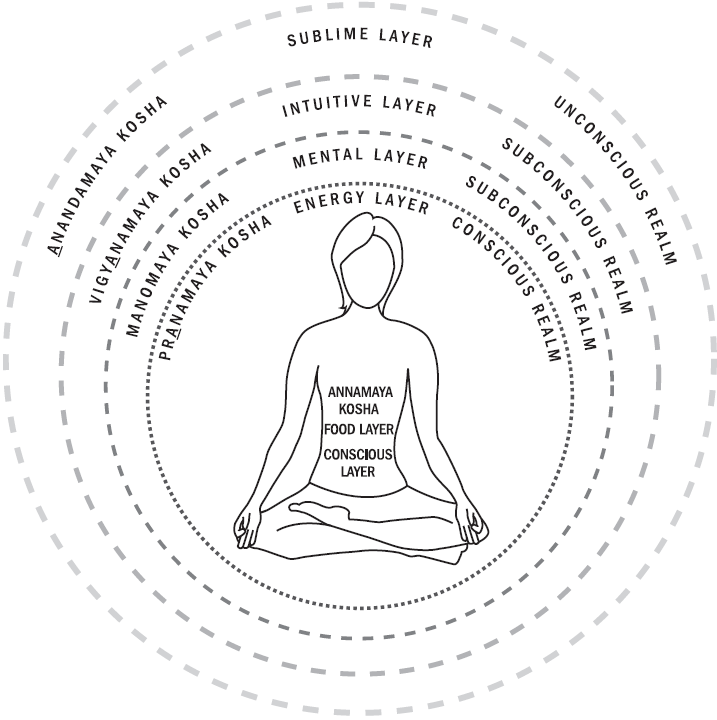
Yoga and tantra describe human existence to consist of five layers. Each layer, known as kosha, is interactive with the other. They do not function independently; they are symbiotic.
The first and most subtle layer is comprised of ecstasy or bliss ananda-maya kosha; next is the intuitive layer vig-yana-maya kosha; third layer is the mental covering mano-maya kosha consisting of the four aspects of mind discussed previously. The fourth layer consists of subtle pranic energy prana-maya kosha and the fifth layer is made of food anna-maya kosha. According to the authorities on yoga and tantra, pranamaya kosha consists of 72,000 nadi energy pathways, 10 vayu energy currents, and seven main chakra energy/consciousness centers. The fifth and last layer anna-maya kosha is made of the food you eat. When there is an imbalance in one of the kosha layers the other kosha layers are also affected. Therefore, to heal a problem it is important to employ methods that assist the different layers. By practising specific techniques of yoga and tantra, that influence your pranamaya kosha, you can directly affect your experience of goddessness in the anandamaya kosha
Your body is also made up of five tattwa elemental components:
Prithvi tattwa earth element:
the force which creates cohesiveness and binds all the components of the body together, the infrastructure, skeletal system, marrow and blood.
Apas tattwa water element:
body fluids.
Agni tattwa fire element:
the power of the digestive fire and ability to sleep.
Vayu tattwa air element:
muscle expansion and contraction, emotions and passions.
Akasha tattwa ether element:
the force which is space giving and which separates each different part and organ.
There are also subtle energy currents that motivate various areas of the body known as prana vayu. Vayu literally means flow of air. Prana vayu is a general term referring to five main currents of subtle energy that flow in different directions through your body:
Apana vayu:
the force of expulsion below the navel which enables a bowel motion and birthing.
Prana vayu:
the upward moving force above the navel which enables breathing.
Samana vayu:
the middle force, which equalizes apana and prana vayu.
Udana vayu:
the force functioning the throat, speech and facial expression.
Vyana vayu:
the force which circulates energy throughout the body regulating circulation and the exchange of nutrients.
There are also five subsidiary prana vayu, upaprana, complementing the above mentioned functions, causing blinking, hunger, thirst, sneezing, coughing and the remaining cellular life after death.
Goddess consciousness and energy are also conducted along three specific channels in your body known as nadi energy flows. The word nadi literally means river. These three flows have a positive or negative or neutral charge. The subtle energy powering your mind is considered to be the negative charge called manas shakti and travels through the pathway known as ida nadi.
The subtle energy powering your body is considered to be a positive charge called prana shakti and flows through the pathway known as pingala nadi. The neutral energy is divine and flows through the central axis of your spine known as sushumna nadi.
Chakra vortices
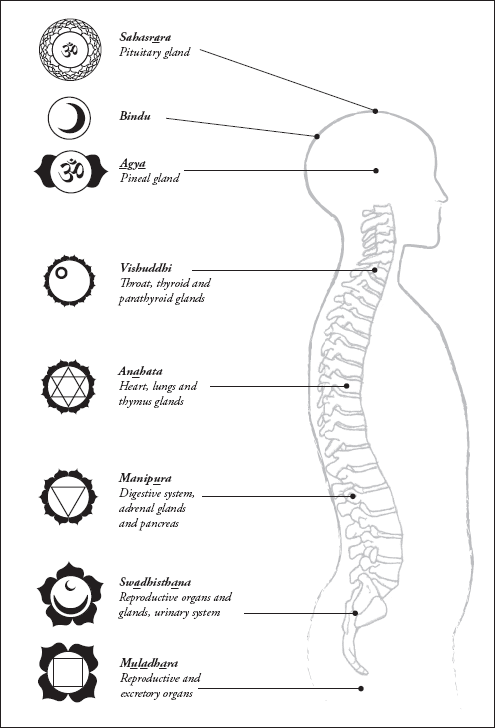
Within your body the subtle energy pathways of ida and pingala meet along the axis of sushumna. These meeting points are known as chakra junctions. Each chakra junction is a swirling mass of vital prana and mental manasik energy. Seven chakra vortices located along the central axis of your body are most significant. While the chakra system is perceived within the pranamaya layer, each chakra is a trigger point and portal between the physical, mental and psychic realms. Each chakra has an influence over associated organs and senses, resulting in certain physiological and psychological experiences. Likewise, the action of a specific organ or gland can influence a chakra and even your thoughts can affect a specific chakra.
There are five main chakra vortices located in proximity to the spinal column and nerve plexus. At the south polar base of your spine is the slowest vibrating chakra and at the north polar top of the spinal axis and crown of the head is the fastest vibrating chakra vortex. Chakra vortices are often depicted as flowers, usually the lotus because of its spiritual significance.
The lotus’s roots go deep into the mud, the stem grows straight up through the water and the flower blooms upward facing the sky, just like the consciousness moving from the physical earth plain and on towards heaven, the subtler realms and beyond. Muladhara and sahasrara’s orientations face downwards because they are gateways between different realms while the other chakramuladharasahasrara


