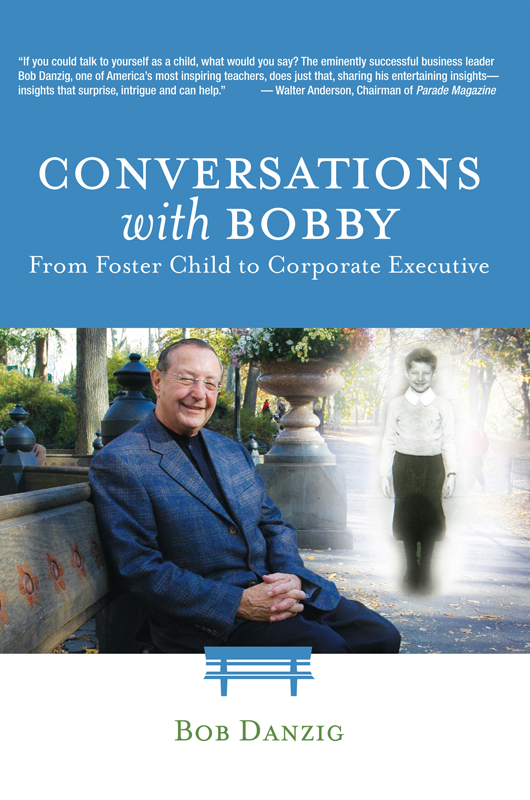
Conversations with Bobby
Published by Danzig Insight Services, Inc.
Copyright © 2012 by Robert J. Danzig
Print Edition Original Copyright © 2007 Robert J. Danzig
All rights reserved. No part of this publication may be reproduced, stored in a retrieval system, or transmitted by any form, electronic, mechanical, photocopying, recording or otherwise, except for the inclusion of brief quotations in a review or article, without written permission from the publisher or author.
First Edition eBook
Electronic ISBN 978-0-9855129-2-7
Paperback ISBN 978-0-9855129-3-4
Cover Design by Sarah E. Barr,
sarahebarr@gmail.com
Author Website
http://www.bobdanzig.com
http://www.youareworthwhile.com
To every foster child caught in circumstances they did not create and cannot control. May each such child know that he or she is worthwhile and full of promise. –Bob Danzig
Foreword: Adversity Invites Opportunity
Chapter One: A Day Of Doors
Chapter Two: The Conversation Begins
Chapter Three: Fair Treatment
Chapter Four: New-Shoes Outlook
Chapter Five: Hearts Do More Than Beat
Chapter Six: Fragrance Of Friendship
Chapter Seven: Fault Lines
Chapter Eight: Joining the Big Leagues
Chapter Nine: Gray Is Not A Rainbow
Chapter Ten: A Father Figure
Chapter Eleven: Camouflage
Chapter Twelve: Second Breath
Chapter Thirteen: Moments of Shining “And Family”
Chapter Fourteen: Purposeful Persistence
Epilogue
About The Author
Books & eBooks
For two years I collected ideas, materials, tidbits, thought starters—all to be part of a new book idea on the theme Nothing Happens Until Someone Sells Something. Toward the end of those two years, I took a trip to my Florida home to relax in the winter sun. I brought the folder with all of those elements with me. During that trip, I planned to start writing my book.
One day, I brought that folder to the swimming pool along with that day’s newspaper. After reading the paper, I was joined by a neighbor who sat in the chair next to me. I put the newspaper down on top of the book idea folder and began a long chat. When I returned from the pool, I tossed what I thought was just the pile of used newspapers into the trash. Unwittingly, I had also tossed out the complete file of book idea materials. A harsh adversity. A few days later, I was in the middle of a frantic search for the folder when I realized I might have inadvertently thrown my book materials out with the long-gone trash.
Later that day, I told my pal Larry about the incident. He said, “You have already written several light, inspirational books. You should do a more serious book reflecting your childhood in foster care homes and how often those varied and different lessons became later strengths in your business life.” He paused and then added, “You should develop a theme and title the book, Conversations With Bobby.”
My reply to him was instant and negative. I had worked too hard to erase my memories of those childhood years. It was too hard and painful to link my childhood experiences with my business career.
Ever the advocate, my friend reminded me that over the years I had shared many of my childhood memories with him—and had often alluded to lessons that had added value during my business career. As is his way, Larry was optimistic. He knew that by reminding me of those memories, he would beckon more to rise to the top.
•••
Thus began the journey of recollections. Larry gave me a ‘memory’ starting point. I let that simmer and gestate in the hope it would bring clarity of recall—as well as identify links to business insights.
That process was imperfect. Long-buried personal pain—adversity—was simply too difficult for me to call back to mind with precision. Although the emotions associated with the different memories were crystal clear, the same can’t be said about the conversations and timeline of some of the events that took place. While some conversations were remembered word for word, others were cloudy.
For this reason, throughout the book, the quoted sections are paraphrased. I remember the context, but not necessarily the exact quotes as some of these events took place so many decades ago.
Once I became comfortable with that mix of facts—and my best effort at paraphrasing of conversations and some event, the doors to business lessons opened with sharp clarity and easy precision. Those are pure fact.
I then decided I should have the “conversations” between the child, Bobby, and the adult, Bob, take place on park benches in Central Park, New York City.
Central Park is a few long blocks from the Hearst Corporation headquarter building at 300 West 57th Street. When I had a free lunch hour, I would often buy an apple and a bottle of water, and stroll through the park and discover the wide variety of park benches that provide comfort to many park strollers.
As I began to write the book, I sensed how severe a struggle I had with language for the child, Bobby. Slowly it dawned on me that, typical of foster children, my own childhood was rarely with other children, but rather mainly with foster home adults.
Foster children often have a distorted childhood. They speak as adults, more than as children, since most of their incessant moving from foster home to foster home has them with social workers and foster parents—all adults. That is the language they adopt. When I finished the early draft of the first few chapters and asked Larry to review them, he told me that he liked how the childhood experiences were recalled, but felt there was too much of an adult tone. When I was recalling my early childhood memories through Bobby, he observed that I was doing it as an adult, rather than through the eyes of a child.
That new ambition seeded my mind to be open to what might be the ingredients of such a feast.
Now to the Noble Purpose of the Book…
Foster children deserve caring foster care social workers and foster parents. They deserve adoption. They deserve understanding that they all have had to walk a path of adversity. Moreover, when foster children receive understanding, encouragement, inspiration, and love—then they each have the prospect of being the CEO of their own lives. They can convert the lessons of tough childhoods into a brighter prospect for fulfilled adult lives. Your empathy, understanding, care—even informed concern for a foster child—just may be the launching factor to invite that child to become the CEO of better life choices.
Every foster child is caught in circumstances he/she did not create and cannot change—alone. Each foster child deserves an opportunity to learn how to “plow through” the pain, let that pain become secondary, and be helped to choose wisely.
Every foster child—indeed, every child should hear the constant echo in his or her mind’s eye: “You Are Worthwhile. You Are Full of Promise.”
On a cold Monday morning in January 1978, I left the Essex House Hotel in New York City and began my five-block walk to Hearst Headquarters on 57th Street and Eighth Avenue. The Central Park-facing hotel was my temporary residence while I house hunted for a permanent home for my family.
The previous Friday I closed the door to the office I had occupied for seven years as publisher of the (Albany, N.Y.) Times Union. I had walked the entire building—opening and closing department doors as I made a final round of handshaking and hugs of farewell to the colleagues with whom I had worked for twenty-seven years.
I had entered the Times Union as an office boy and through the next twenty years worked my way toward the publisher’s position. I had opened and closed a lot of doors in those years. The last door I closed as I walked away was to the plant I had opened in 1970, when it became the Times Union’s new home.
I pictured all those doors as I walked toward Eighth Avenue. When I approached Hearst Headquarters, I noticed the massive bronze framed doors majestically centered in the art deco building, with massive gargoyle statues on each corner of the exterior—silent sentries since 1932.
I stood there, stranded in a slow-motion movie. While everything around me moved at real-time paces, my world had slowed down. I noticed the lingering fog in front of my face, from my breath meeting the cool air, and was overwhelmed by a sense of melancholy.
I stared at those bronze doors, with their invitation to step inside and begin the final chapter in my newspaper career. I was the new CEO of the Hearst Newspaper Group and vice president of the Hearst Corporation, responsible for all Hearst newspapers nationwide.
I mentally compared those privileges and joys of the doors in my career to the many doors of uncertainty, disappointment, repudiation, and emotional scars that opened and closed during my childhood in a series of foster homes. I could recall no door in the blur of multiple foster home doors that was welcoming, warm, embracing and hinting of promise for a better tomorrow.
Beginning at age two and continuing through age sixteen, the doors of my childhood represented entrances to spirit prisons. As I walked through the many doors in the series of foster homes, a portion of my spirit was locked away.
It wasn’t until I graduated from high school and left the foster care system, and first joined the Hearst Newspaper Group as an office boy at the Times Union, that I had the opportunity to choose the doors I would open and close—doors that offered opportunity and growth.
Those early childhood doors had so many limitations. The doors I faced as a child were a stark contrast to the doors I faced that January morning, which offered an adult promise of achievement and opportunity. I was confused, emotionally bruised, and unable to understand my life’s direction during my younger years.
It has taken almost thirty years from that day in front of the Hearst Corporation building to find the courage to re-enter the spirit prisons behind the dark doors of my childhood. Conversations with Bobby is my reflection on how my childhood experiences in the foster care system became nuggets of instructions by which I would lead the rest of my life.
I crossed Eighth Avenue, with an open mind and heart, ready to face the promise and challenge ahead. I pushed that corporate bronze door open, stepped into the handsome lobby, and took the elevator to the floor where I opened the door of my new office. At that moment, I began my deeply rewarding twenty-year chapter as national CEO of the Hearst Newspaper Group.
I now realize, that when I walked through those doors, the lessons of a young, bruised, and sad foster child became a priceless possession. Although I had tried to forget him, that child still lived within me. It took writing this book to realize how often that child, Bobby, spoke to me during my Hearst career, and how often I leaned on Bobby’s earlier experiences when I faced adversity. I had tried to closet Bobby, but he had never gone away. He was always there to remind me of where I came from and how important it was to remember the lessons of my youth.

It was long after dawn and yet night refused to leave. Though the light was stifled, morning left its breath upon all that its rays should have touched. The heavy fog challenged the bulky darkness, and I remained still on the park bench, scared to disrupt the conflict. Dampness rested next to me and together we looked out at a seemingly deserted park.
Draping clouds ushered in a warm stickiness that sat upon my black slacks and loafers like thick syrup. I bent down to wipe the maple droplets from my shoe, and, in that motion, saw a black figure in the misty distance. It moved toward me, its hulking human form slowly becoming visible. Yet, the nearer it drew, the more golden in hue the hair and face grew. The closer it came, the smaller the body shrank. I could see that, what from far away appeared an aged man, was really just a small child. The boy walked toward my bench, unaware of the mystifying morning. With his head bowed, he dragged a small bag behind him. The sack lapped up the syrupy dew, leaving a clear impression in the grass of where he had been.
When he finally approached my bench, it seemed as though dampness greeted him before I had the chance, for his moist, light hair stuck to his forehead.
Looking up at me he asked, “May I sit here, mister?”
As I stared into his eyes, I saw something familiar. Perhaps I caught dawn’s confusion, but I felt as if I knew the boy well, too well, though we had never spoken before.
“Um, mister?”
“Sure, sure, of course. Sure, sit down, sit down.” I tried to give the bench a quick brush with my hand, but the boy didn’t want to wait. He looked tired and frail and thankful to have a place to sit. “You’re out early, son. Where are you off to in this fog?”
“Nowhere.” His voice, almost inaudible, whispered in the mist.
“Well, where did you come from?”
“Nowhere.”
“Everyone has to come from somewhere and is going someplace. What about your folks? Where are they?”
“Nowhere.”
I felt as if his seemingly simple answers were more complex than childish timidity. We sat in silence until I could think of a question that would render a different response. “What’s your name, kid?”
“Bobby.”
“Good name.”
“What’s yours?” he asked, squinting up at me.
“Bob, but I was called Bobby, too, when I was your age. How old are you?”
“Nine and a half.”
“So what brings you here, Bobby, to the park?”
“I dunno. I was just walking n’ I thought I heard someone calling my name. Was it you?”
I was stunned. I didn’t think I had spoken aloud. “What do you mean someone was calling your name?”
“Like they were looking for me. Was it you?”
My breath became shallow. I had been thinking … right before the boy arrived … about how I couldn’t remember. Could it be me that I called? No. Granted, it was true that I couldn’t remember my childhood … but it was the weird morning; it was a delusion-inducing morning. Prior to age sixteen, I had little or no recollection and I wanted to know, wanted to remember who I was, but it had to be the fog; it was a delusion-inducing fog. Could it be true? No. Who would believe it?
“Called you out loud?” I asked.
“Yeah, I heard it. Did you say my name?”