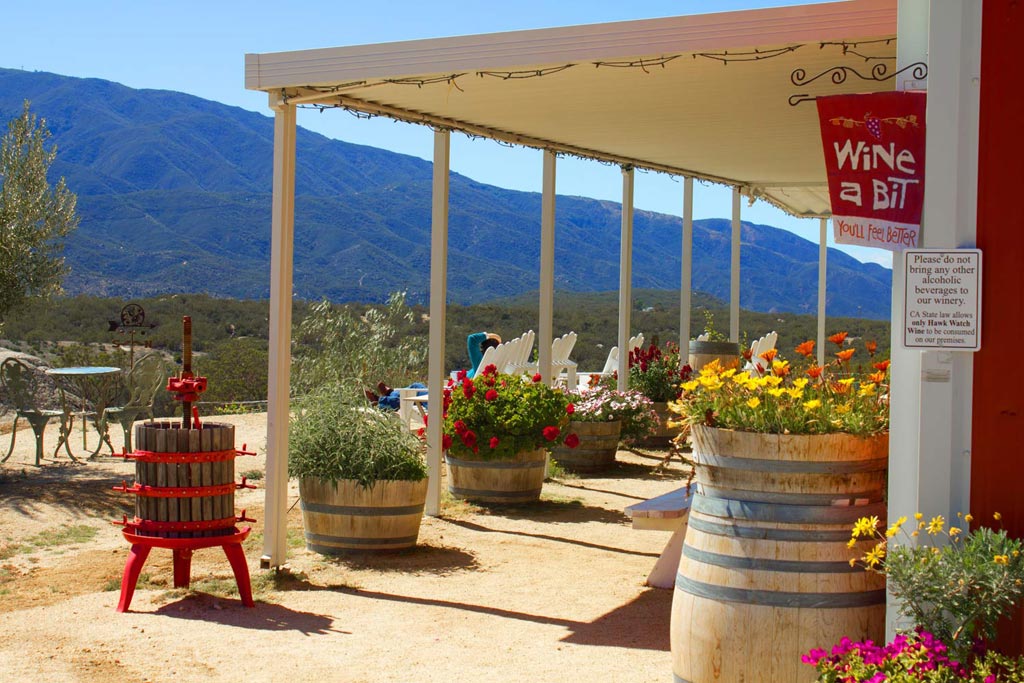
The view from Hawk Watch Winery
SAN DIEGO WINE COUNTRY
A Tasting Guide
Dwight and Lynn Furrow
Published by Dwight and Lynn Furrow
Roving Decanter
Visit official Roving Decanter website at
www.rovingdecanter.com
for the latest news, book details, and other information
Copyright © 2014, Dwight and Lynn Furrow
eBook formatting by Guido Henkel
All rights reserved. No part of this publication may be reproduced, distributed or transmitted in any form or by any means, including photocopying, recording, or other electronic or mechanical methods, without the prior written permission of the publisher, except in the case of brief quotations embodied in critical reviews and certain other noncommercial uses permitted by copyright law.
The view from Hawk Watch Winery
Why San Diego Wines are Exciting
Among the most powerful reasons to love wine is the romantic story of the noble winemaker diligently tilling a small vineyard year after year to produce a wine that tastes of the local soils and climate. Of course, in reality most wine is a massed-produced, industrial product with little connection to local characteristics or customs, a reality that is rapidly expanding as the wine industry in the U.S. consolidates. Just three firms now account for more than half of U.S. wine sales. The romantic story is dying and with it will die that powerful reason to love wine.
But not in San Diego. Artisanal winemaking exists in many wine regions of the world but in San Diego it’s an article of faith, a product of deliberate decisions, and they intend to keep that romantic ideal alive. Why should a wine lover care about small production, hands-on winemaking? Such wine is made with passion and commitment. But more importantly, the visitor to San Diego’s wine regions experiences that passion and commitment first-hand. The case production of most winery operations in San Diego is too small to interest distributors and so supermarket and restaurant sales will be limited. Surviving is a matter of making the winery experience as welcoming and satisfying to visitors as possible. Tasting rooms are typically staffed by the winemaker and his or her family who will be happy to share, not only the wines, but the story behind the wine, and their love of winemaking. And much of the work at harvest is done by friends, family, and volunteers from the wine club who donate their time to get the grapes picked and into the winery. You won’t find many limousines, wine snobs or corporate tasting rooms here; just hardworking folks with interesting stories to tell. It is personal connections that make San Diego a unique wine region.
Although San Diego has a long history of wine production, it was not until the early 2000’s that a vibrant culture of wine began to take off here. In 1995 there were only three bonded wineries in the region. Today there are over one hundred and that number is growing rapidly, helped along by a new ordinance allowing tasting rooms to open in unincorporated areas. Many San Diego vintners are taking a page from the craft beer movement and opening urban wineries that serve food, encourage walk-in business, and provide entertainment.
With that rapid growth comes increased competition that is producing better and better wine as winemakers strive to attract attention to their product. The result is small-production, artisanal wines that rival the wines of better-known regions, lots of innovation and experimentation, and a welcoming attitude toward wine tourists. If you’re curious about how small wineries get started and battle their way to the top driven only by their love of wine, you can satisfy that curiosity in San Diego and drink some great wine as well.
Winemaking is a long-term project; anyone interested in a fast buck should choose a different business. If you were to plant a vineyard today, it would take 20-30 years to understand it and many more years to make the best wines from that site. Much of San Diego County is 10-20 years into their journey, long enough to have made a few teachable mistakes along the way, but early enough so that curiosity and experimentation are rampant; and today you can see the learning curve taking off. It is fascinating to watch growers and winemakers learn about their sites and continually develop the quality of their product. One of the advantages a small winery has is flexibility. They can move quickly when good grapes become available, and they’re always looking for new varieties and blends to pour. So every winemaker has a one-off experiment going on in the cellar that you will get to taste if your timing is right.
Yet despite this growth and innovation, there is a lot of tradition at work as well. Winemakers here use very few mechanical processes. Grapes are often picked and sorted by hand, most pump-overs are by hand, and many winemakers are committed to sustainable farming and minimal use of technology to shape the wine.
All this experimentation and innovation brings with it great diversity. There is a wine venue to cater to almost every taste: urban wineries that serve food, large country estates, small-farm operations, boutique wineries operating out of a house or garage, sophisticated upscale tasting rooms, funky, down-home watering holes, and wineries attached to sculpture gardens. But San Diego’s wine culture stands out because it is situated in a large and diverse, general agricultural community. It is a little-known fact that San Diego has more farms than any other county in the United States. Of course, all wine regions have lots of agriculture because grapes are agricultural products. But San Diego vineyards nestle up to citrus and avocado groves, horse and cattle ranches, ornamental tree and flower nurseries, and organic farms. Especially in the Ramona region you are likely to see bison, llamas, camels and horses as you poke around the vineyards. Rural charm and nature’s bounty are only minutes from San Diego’s famous beaches and night life.
And now as the region’s development takes off there is a decided turn toward quality as everyone is intensely aware that, in the end, what matters is to make great wine. As Terri Kearns, Co-owner of Ramona Ranch Vineyard and editor of Ramona Valley Wine Region Magazine said, “We’re the first generation. We have a responsibility to do it right. There are no rules or traditions holding us back.”
So welcome to the wild west of winemaking. Salute!
How to Use This Guide
Most books on regional wines focus on large regions, list only the best-known wineries, and include lots of photographs. San Diego’s Wine Country: A Tasting Guide is for people who want to explore the nooks and crannies of a small region, get to know the winemakers, and soak up the local flavor. It is specifically devoted to wineries with tasting rooms or that encourage appointments, and includes descriptions of the overall tasting experience, along with some recommendations for restaurants and other attractions that wine lovers might find interesting. Visitors to San Diego as well as local residents who haven’t sampled the wines of San Diego will find this book useful.
We indicate the hours that the wineries are open but many of these wineries are run by busy people with day-jobs so it is best to confirm winery hours by calling ahead—after all in many cases you will be visiting someone’s home. This book is not a work of wine criticism. However we do include comments when we are particularly enthusiastic about a wine or winery. We have tasted most of the wines being made in San Diego as we go to publication (a tough job but someone had to do it). However, we did not taste all of them. And keep in mind that there is a subjective element to wine-tasting; your preferences may be quite different from ours. So where particular wines are not discussed, please do not conclude that the wines are unworthy of your attention.