Copyright © 2012 by Ali Botein-Furrevig
All rights reserved. No part of this book may be used or reproduced in any manner, electronic or mechanical, including photocopying, recording or by any information storage and retrieval system, or otherwise, without written permission from the publisher.
Published by:
ComteQ Publishing
A division of ComteQ Communications, LLC
101 N. Washington Ave. • Suite 2B
Margate, New Jersey 08402
609-487-9000 • Fax 609-487-9099
Email: publisher@ComteQpublishing.com
Website: www.ComteQpublishing.com
ISBN 978-1-935232-59-9
ISBN: 9781935232612
Book & over design by Rob Huberman
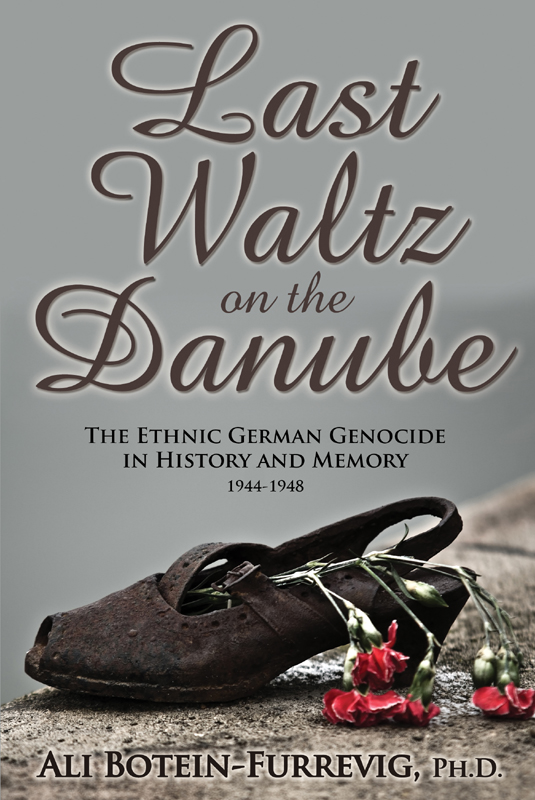
Cover Photo: “Shoes on the Danube” by Nikodem Nijaki, 1/1/2012. Creative Commons Attribution-Share Alike 3.0 license. The monument of the same name by Hungarian Sculptor ,Gyula Pauer, is situated on the bank of the Danube River in Budapest. The memorial contains 60 pairs of iron shoes and is dedicated to the victims of the Fascist Arrow Cross Party, who shot the people right into the river, sparing themselves the hard work of burials. The victims had to take their shoes off, since shoes were valuable belongings at the time. Its tragic symbolism, however, extends to ethnic Germans and Jews who were forced into the frozen river and then shot during and after WWII.
Printed in the United States of America
For Jordan and Jennifer
Dedicated to the Lavundi and Karl Families
in
Loving Memory of Wilhelm Stefan Lavundi, Ph.D. (1937-2010)
With deep affection and gratitude to Mrs. Katharina Karl Marx, for graciously sharing her immense knowledge and remarkable story.
and
For my cherished students:
It is said in the Talmud: “And thou shalt teach thy children that they may remember.”
I am especially indebted to the following individuals:
John R. Schindler and George Wildmann, for their research and expansive histories of the Donauschwaben people, and for meticulously chronicling their expulsion and genocide from 1944-1948.
Frank Schmidt, for his exhaustive scholarship and articles on the Donauschwaben people and for his numerous translations of German texts in this area of study.
Dr. Jakob Schmidt and his translator Doris Feldtanzer, for his detailed history and culture of Batschka Palanka.
Dennis Bauer, for his expertise of, and commitment to, recording the history and genealogy of the Palankan people.
The Donauschwaben Societies of New York, Trenton, and Philadelphia, for their dedication to promoting and archiving Donauschwaben history— and for all they do to preserve their heritage and pass it on to future generations.
Rob Huberman, my publisher, for his creative insights and marketing advice.
Alison Ward, my amazing copy editor, for her meticulous reading of the manuscript.
Philomena Bianca Simonelli, for her friendship and open door. She is always there to make sense out of nonsense over endless cups of black coffee.
Michael Zahler, Professor of History at Ocean County College and Kean University at Ocean (and my loyal sidekick) for his support and for sharing his vast knowledge of the Roman Empire.
And, of course, Allan Peter Furrevig, my husband, for his unwavering support of me and for always understanding the endless hours required to teach, research, and write. His sense of humor and common sense perspective always keeps me grounded.
|
Danube Swabian Associations of America |
Dear Dr. Botein:
On behalf of the Danube Swabian Associations of Philadelphia and Vicinity, Trenton, and New York, we want to extend our heartfelt gratitude to you for your scholarly efforts to shed light on a complex period of East European history. You have meticulously researched a little known aspect of World War Two and postwar history with humanitarian commitment, and sine ira et studio. During the years 1944-48, thousands of Danube Swabians in Yugoslavia were murdered, interned, sent to the Soviet Union, or starved to death because of their German background. In 1947, the surviving internees were transported north to the camps of Gacovo and Krusivl. From there the escape to Hungary and to the West, where they could be classified as Displaced Persons, was easier .Today survivors of this ethnic group can be found all over the world—in the United States, Canada, South America, Australia, New Zealand, and Europe. We are indebted to you for compassionately and lovingly telling the story of our destiny to the world and honoring the memories of those who perished.
Sincerely,
Philadelphia: Rosalie Matico, President; Fred Gauss, Vice-President; Kathe Marx, Secretary
Trenton: Joseph Brandecker, President; Dennis J. Bauer, Vice-President; Hans Martini
New York: George Ritter, President; Adam Metzger, Vice-President; Magdalene Metzger, Secretary
Author’s Preface
Part One: Hitler’s Last Victims
Chapter One: Call It What It is
Chapter Two: The Resettlement Of Ethnic Germans
Chapter Three: When The Danube Flowed Red
Chapter Four: The Jews of the Batschka
Photos & Maps
Part Two: The Katharina Karl Marx Story
Chapter Five: Fields of Sunflowers
Chapter Six: When the Music Stopped
Chapter Seven: Bearing Witness
Chapter Eight: From Homeland to Hell
Chapter Nine: Flight to Freedom
Chapter Ten: Roots
Afterword
Endnotes
Part Three: Teaching Guide
Partial List of Crimes Against Humanity
Research Activities
On a glorious spring afternoon a few years back as I was walking across campus, a Jewish colleague caught up with me. “I’m just curious,” she began, “As a practicing Jew and given your interest in Holocaust studies, how on earth do you reconcile being so close with a German?” She was, I correctly surmised, referring to my dear friend and colleague, my brilliant mentor, Dr. William Stefan Lavundi, affectionately called “Willi” by family and close friends. Though admittedly not surprised by the implications of what was a clearly rhetorical and blatantly judgmental statement, I wanted to shout, “You have no idea who he is and where he has been!” Then, his was not my story to tell; instead, I quietly replied, “Some innocent Germans were also Hitler’s victims.”
One day over lunch at a local pub, I casually asked Willi how he became so fluent in German, French, Russian, and Serbo-Croatian, among other languages. He told me that his mastery of other tongues was born out of necessity from growing up in a multiethnic and multilingual state under various European occupations. That was the first time, too, that he shared painful memories of his shattered childhood, seeing family and friends disappear during the expulsion and annihilation of ethnic Germans of Yugoslavian citizenship by Tito’s Partisans beginning in the year 1944. “My family and extended family lost over 20 people—grandparents, uncles, and cousins—who died in the camps established by the Communists who took over Yugoslavia. We were Yugsolav citizens, but our nationality was German, and our people had been in the northern part of Yugoslavia for over 300 years.”
When introducing Willi at a college event where he was speaking on the high culture of prewar Berlin, I said that knowing him as I did was akin to getting a doctorate in life. “Great people,” he would tell me, quoting Goethe, “talk about ideas. Average people talk about things. Small people talk about other people.” Indeed, we would spend hours talking about ideas, everything from philosophy, history, and religion, to art, music, and literature. After Willi was diagnosed with Leukemia and unable to continue teaching, I would visit him at the home of his life partner and soul mate, Philomena. We examined select passages from the epochal classic of Hindu spirituality, The Bhagavad Gita. We discussed Andrew De Mello’s Last Meditations, Josephus’ Antiquities of the Jews, and the poetry and prose of Goethe. Willi seemed an endless reservoir of scholarly information and insights, oft times humorous, into human nature. Perhaps the best piece of advice I ever received was, “Know who you are. Be who you are. Work on not needing approval from anyone. Then you will be able to live.” Words I live by to this day.
Willi was born in 1937 to Emil Lavundi and Maria Theresia Lavundi (nee Karl) in the Batschka countryside of Palanka, an enchanting landscape along the bank where the Danube River flows by mighty castles, Baroque palaces, and monasteries. According to the Apatin Baptism Registry, his great grandparents were from Apatin in Western Batschka. His grandfather Ferdinand and German grandmother Amalia eventually would move from Apatin to nearby Croatia. Willi was the first Lavundi to call Palanka his birthplace.
At the time of his birth, most of the Germans in the Danube region were farmers, craftsmen, factory owners, or merchants. Emil owned a successful knitting machine manufacturing company. The Lavundis shared the large home owned by the Karl Family, Maria Theresia’s parents. In the fall of 1944, when Willi turned seven, Josip Broz, known as Tito, seized power in Yugoslovia, of which Batschka Palanka was a part.
More than 60 years ago, the German Nazi regime committed atrocities against innocent civilians: Jews, Russians, Poles, Serbs, and other people throughout Central and Eastern Europe. At war’s end, when combat had ceased and peace supposedly reigned, innocent ethnic Germans, in turn, also fell victim to Adolf Hitler’s crimes against humanity. The Donauschwaben, descendants of those Swabians who had sojourned eastward in search of a better life, would now become unwilling scapegoats of the resurgent governments who had suffered under the Fuhrer. German-speaking citizens with only a tenuous link, or really no link at all, to “Germanness” either were expelled or executed using tactics as barbaric as those used by the former Nazi leaders.
Too, as Richard Evans asserts in In Hitler’s Shadow, the expulsions were also a means of defusing ethnic antagonism and reshaping the demographic profile of Europe according to their own preferences. Much like, one may conclude, their governments’ prewar ambition to create ethnically-homogenous nation-states.
During the bloody carnage under the Communist regime, Willi and his parents were imprisoned for six months. His parents later were rearrested and spent two years in the Communist prisons of Knicanin and Pozarevac in Palanka; using the excuse that Emil’s machinery came from Germany, the Communists falsely accused him of collaboration with the German government. “It is difficult to talk about when someone close is taken from you. Our only crime was being in the wrong place at the wrong time; our mother tongue was German, Hitler’s homeland was Germany, and we were living in Tito’s country. The choice was to embrace Communism or Nazism. That is not a choice.”
Between 1944 and 1948, the Danube Swabians in the Pannonian Lowlands were all but eradicated. They were deprived of citizenship, lost their human rights, and had their property confiscated. Thousands were tortured and beaten. Many were executed or mutilated. Of those thrown into local concentration or work camps, 65,000 perished from starvation, maltreatment, and disease, and some 15,000 “disappeared.” Men and women were sent to forced labor in Russia. Women were raped. In the course of the flight and expulsion of 15 million ethnic Germans, two million perished.
Reflecting on his Palankan relatives, friends, and neighbors who died , Willi admitted, “I feel fortunate that am not numbered among them. Not only were innocent lives savagely taken, but so was our ancestral homeland and identity.”
Those who escaped or managed to survive Tito’s reign of terror sought refuge in the Western world. Like tens of thousands of ethnic Germans between 1940 and the1950s, the Lavundis fled their homeland in 1956, eventually coming to America and settling in a modest German neighborhood in Northeast Philadelphia. “Under Tito’s government I was a slave. Now I was a free man.” Speaking little English, the first thing Willi did was flawlessly master yet another tongue. After receiving U.S. citizenship in 1962, he volunteered to join the U.S. Army, where he honorably served his new homeland for six years.
Willi went on to earn a bachelor’s degree in literature from La Salle University in Philadelphia, where he would later teach Central and Eastern European Studies. After receiving his master’s degree, he served as professor of Comparative Cultural Studies at Schiller International University in Heidelberg. In 1970, he joined the faculty at Ocean County College in Toms River, and four years later received a Ph.D. in German literature from the University of Massachusetts at Amherst. A believer in the importance of international education for students, he founded the College Consortium for International Studies and collaborated with numerous universities abroad. During his career at Ocean County College, Willi initiated partnerships with his alma mater Schiller University and X’ian University in China. He established top tier study programs for students throughout the US in Germany, China, and Israel. Professor Emeritus, Shakespearean and Goethe scholar, and Old World gentleman, Willi truly embodied the spirit of Renaissance humanism.
An innocent victim of exile and imprisonment, Willi triumphed over adversity. His parallel journey of rediscovery, educational and professional achievement, love for his new country, and simultaneous pride in his own cultural identity honors the very spirit of immigration in America.
After fighting a long and valiant battle against Leukemia, Willi passed away peacefully in May of 2010. It was at his memorial mass in Philadelphia that I first met the woman he so cherished, and about whom I had heard such wonderful stories: Katharina Marx, his beloved “Aunt Kathe,” whom Willi lovingly referred to as the family genealogist and chronicler of Palankan history.
Today at a spry 84 years old, she still recalls in incredible detail the years she spent in her hometown in the Batschka region, growing up in the same house as Willi. After speaking with her for just a few hours, I knew her story needed to be told. It is but one of many stories about assaults on humanity and man’s infinite capacity for evil. It is also a testimony to the resilience of the human spirit, which enabled a young girl to sustain her courage and faith in the face of pure evil.
When I first began my background research, I wondered why there was a disturbing veil of silence surrounding the annihilation of the ethnic German population in the Batschka region. There are, to be sure, many required Holocaust and genocide education programs in place across the country. Here in New Jersey, former Governor Christine Todd Whitman signed legislation in 1994 mandating the inclusion of Holocaust and genocide instruction in elementary and secondary schools. Why then is the ethnic cleansing, the genocide of Danube Swabians, not mentioned in history textbooks or even taught in schools?
Ironically, these ethnic Germans were not tied directly to a true homeland in Germany. While they had some sense of belonging to a larger German speaking cultural group in Europe, they saw themselves as German speaking inhabitants with strong local and regional identities to the places where they and their ancestors had lived for centuries. During World War II, their ethnicity unfairly marked them as Nazi sympathizers despite their noncombatant status. These hard working and G-d fearing people would find themselves on the wrong side of every border as a wave of anti-German sentiment legitimized their persecution and eradication.
As defined by the system of international law established after World War II, (see Teaching Guide) the genocide of the Danube Swabians bears striking similarities to that of the Armenians and Volga Germans. During the Aghed, the Armenian Genocide during World War I, Ottoman Turkey slaughtered more than one million Armenians and expelled the rest. It has been only recently that the Aghed has been included in genocide education programs. The Russlanddeutsche, or Volga Germans, were ethnic Germans living along the River Volga in the region of Southern European Russia around Saratov and to the south.
Like their Danube brethren and recruited as immigrants to Russia in the eighteenth century, they were allowed to maintain German culture, language, traditions, and churches. Their genocide encompassed 34 years (1915-1949) under three different rulers: Tsar Nicholas II, Lenin, and Stalin, whose forced dispersal of virtually the entire German population of the USSR to special settlements and labor army work sites during the 1940s brought the total death toll up to around one million. After the Nazi invasion of the Soviet Union in 1941 during World War II, the Soviet government considered the Volga Germans potential collaborators. Cursed as traitors and spies, they were transported wholesale to labor camps, where many died. This final phase of what was called a “resettlement,” but was in fact an extermination, permanently destroyed the century-old German communities of the Volga, Ukraine, Crimea, and Caucasus.
The common factor, it appears, driving all of the atrocities that occurred on European soil in modern civilized times, is emotion; all were fired by fear, hatred (both current and ancient), rage, and resentment. The magnitude of the catastrophes and the broad violations of human rights reflect the decimation of human constraints that are accentuated during disruptions of war or modernization.
Today, history books record what is posited as Europe’s deadliest wars since World War II: The 1990s’ civil wars that erupted in the Balkans, the so called Power Keg of Eastern Europe, with the accompanying horrific war crimes and ethnic cleansing resulting from the complex and bitter conflicts between the Serbs, Croats, and Kosovo, and later between various factions in Bosnia. Today, in 2012, Ratko Mladic, the former Bosnian Serbian leader, is on trial at the Hague for the Srebrenica massacre of 8,000 Muslims. It is tragically ironic that the term “ethnic cleansing” is a literal translation of the Serbo-Croatian phrase, etnicko ciscenje, which was employed widely in the 90s to describe the torture and mistreatment of civilian groups in those Yugoslavian conflicts.
However, lest the world forget or ignore, the outbreak of ethnic savagery had happened 50 years earlier to the over 500,000 Danube Swabians living in the national territory of the former Kingdom of Yugoslavia in the Western Banat, the Batschka, Syrmia, Croatia, the Baranja Triangle, as well as in Slovenia on Austria’s border.
What is clear is that this watershed event cannot be shrugged off to the euphemism of displacement or romantic notions of liberation. One fundamental condition that made mass ethnic expulsions and disregard for fundamental human rights possible was the assumption that nations had the right to carry out such atrocities in the name of national interest or national security. The primary impetus for the ethnic cleansing was, according to Alfred de Zayas, a revenge against the despised German minorities based on skewed notions of collective guilt and punishment for Nazi atrocities; that the ethnic Germans who had lived for centuries outside of the Reich had collaborated with and benefitted from the Nazis. Shocked by the Nazi war crimes that had come to light, the world looked away, and the “cleansing” of the Danube Swabians, covered by the silence of the big powers, remained without sanction.
Despite all indications that this is a much neglected area of study, there does exist a corpus of scholarly material on crimes against humanity in the Batschka region. This is primarily due to the diligence of Danube Swabian academics and historians, and the tireless commitment of Donauschwaben organizations throughout the U.S. and world to create an awareness of and compassion for what happened to perhaps the last large group of Hitler’s victims. Indeed, in Hitler’s eyes, the German people had failed the Fuhrer’s belief in their destiny for mastery over Europe, and thus, they did not deserve to live.
The German-Jewish philosopher and literary critic, Walter Benjamin, posits that history usually is interpreted by the victors, but it is when the events are interpreted by the victims that history is redeemed. Indeed, the path to truth lies not in cold facts or statistics. It is through the eyewitness accounts— the letters, diaries, journals, and memoirs of those who experienced the terror and grief. However inadequate words are, human language is all we have to reach across barriers to understanding.
This, then, is the story of the Donauschwaben. In history and memory.
Ali Botein Furrevig
July 7, 2012
There are no nations; there is only humanity. And if we don’t come to understand that soon, there will be no nations because there will be no humanity.
Isaac Asimov (1920-1992)
Author’s Note: Chapters Two and Three focus on the so-called “ethnic Germans,” the Donauschwaben, who lived in the Danube River region under various foreign dominations from earliest times through the post-WWII years. While the history of the German colonists and their descendants in the Batschka area of the Pannonian Lowlands certainly cannot be isolated from events in world history, these chapters should not be read or evaluated as a comprehensive history of WWII or of the Vojvodina areas during those tumultuous times. It is intended, rather, to serve as a cohesive logical narrative and broad framework for understanding the precarious situation of the Danube Swabians living in the Batschka region (particularly in the district of Palanka), as well as the socio-political factors that ultimately led to their expulsion and genocide after WWII.
They fell that year before a cruel foe.
They had little to give but their lives and their passion,
And their longing to live in their way, in their fashion,
So their harvest can thrive and their children can grow.
They fell like flies, their eyes still full of sound—
Like a dove its flight— in the path of rifle
That fell down where it might, that holds on with its might.
As if death were a trifle,
And to bring to an end a life barely begun.
And I am of that race who die in unknown places
Who perished in their pride, Whose blood in rivers ran,
In agony and fright, with courage on their faces
They went in to the night, that waits for every man.
They fell like tears and never knew what for,
In that summer of strife of massacre and war.
Their only crime was life; Their only guilt was feeling.
The children of Armenia, nothing less nothing more.
They Fell: The Children of Armenia by Charles Aznavour (1924-)
“Until the Second World War,” said British Prime Minister Winston Churchill, “genocide was a crime without a name.” The man who coined the term in the post-WWII era, placed it in a global-historical context, and demanded intervention and remedial action was a Polish-Jewish jurist, a refugee from Nazi-occupied Europe named Raphael Lemkin (1900-59). His lengthy book, Axis Rule in Occupied Europe, applied the concept to campaigns of genocide underway in Lemkin’s native Poland and elsewhere in the Nazioccupied territories. He then waged a successful campaign to persuade the new United Nations to draft a convention against genocide, another successful campaign to obtain the required number of signatures, and yet another to secure the necessary national ratifications.
Lemkin’s conviction that genocide needed to be confronted, whatever the context, was endorsed resoundingly with the United Nation’s Genocide Convention (UNCG) of 1948, which provided a detailed and quite technical definition of genocide as follows: [1]
Article I. The Contracting Parties confirm that genocide, whether committed in time of peace or in time of war, is a crime under international law which the undertake to prevent and to punish.
