How to Open & Operate a Financially Successful

How to Open & Operate a Financially Successful
Notary Business

By Kristie Lorette and Mick Spillane
How to Open & Operate a Financially Successful Notary Business
Copyright © 2011 by Atlantic Publishing Group, Inc.
1405 SW 6th Ave. • Ocala, Florida 34471
800-814-1132 • 352-622-1875–Fax
Website: www.atlantic-pub.com • E-mail: sales@atlantic-pub.com
SAN Number: 268-1250
No part of this publication may be reproduced, stored in a retrieval system, or transmitted in any form or by any means, electronic, mechanical, photocopying, recording, scanning, or otherwise, except as permitted under Section 107 or 108 of the 1976 United States Copyright Act, without the prior written permission of the Publisher. Requests to the Publisher for permission should be sent to Atlantic Publishing Group, Inc., 1405 SW 6th Ave., Ocala, Florida 34471.
Library of Congress Cataloging-in-Publication Data
Lorette, Kristie, 1975-
How to open & operate a financially successful notary business / by Kristie Lorette.
p. cm.
Includes bibliographical references.
ISBN-13: 978-1-60138-281-8 (alk. paper)
ISBN-10: 1-60138-281-2 (alk. paper)
1. Notaries--United States--Popular works. 2. New business enterprises--United States--Management. I. Title.
KF8797.L67 2010
347.73'16--dc22
2010039591
LIMIT OF LIABILITY/DISCLAIMER OF WARRANTY: The publisher and the author make no representations or warranties with respect to the accuracy or completeness of the contents of this work and specifically disclaim all warranties, including without limitation warranties of fitness for a particular purpose. No warranty may be created or extended by sales or promotional materials. The advice and strategies contained herein may not be suitable for every situation. This work is sold with the understanding that the publisher is not engaged in rendering legal, accounting, or other professional services. If professional assistance is required, the services of a competent professional should be sought. Neither the publisher nor the author shall be liable for damages arising herefrom. The fact that an organization or website is referred to in this work as a citation and/or a potential source of further information does not mean that the author or the publisher endorses the information the organization or website may provide or recommendations it may make. Further, readers should be aware that Internet websites listed in this work may have changed or disappeared between when this work was written and when it is read.
TRADEMARK DISCLAIMER: All trademarks, trade names, or logos mentioned or used are the property of their respective owners and are used only to directly describe the products being provided. Every effort has been made to properly capitalize, punctuate, identify and attribute trademarks and trade names to their respective owners, including the use of ® and ™ wherever possible and practical. Atlantic Publishing Group, Inc. is not a partner, affiliate, or licensee with the holders of said trademarks.

A few years back we lost our beloved pet dog Bear, who was not only our best and dearest friend but also the “Vice President of Sunshine” here at Atlantic Publishing. He did not receive a salary but worked tirelessly 24 hours a day to please his parents.
Bear was a rescue dog who turned around and showered myself, my wife, Sherri, his grandparents Jean, Bob, and Nancy, and every person and animal he met (well, maybe not rabbits) with friendship and love. He made a lot of people smile every day.
We wanted you to know a portion of the profits of this book will be donated in Bear’s memory to local animal shelters, parks, conservation organizations, and other individuals and nonprofit organizations in need of assistance.
– Douglas and Sherri Brown
PS: We have since adopted two more rescue dogs: first Scout, and the following year, Ginger. They were both mixed golden retrievers who needed a home.
Want to help animals and the world? Here are a dozen easy suggestions you and your family can implement today:
Five years ago, Atlantic Publishing signed the Green Press Initiative. These guidelines promote environmentally friendly practices, such as using recycled stock and vegetable-based inks, avoiding waste, choosing energy-efficient resources, and promoting a no-pulping policy. We now use 100-percent recycled stock on all our books. The results: in one year, switching to post-consumer recycled stock saved 24 mature trees, 5,000 gallons of water, the equivalent of the total energy used for one home in a year, and the equivalent of the greenhouse gases from one car driven for a year.

Table of Contents

Introduction
The first thing that comes to mind when you think of a notary public may be a quiet, older woman who stamps documents for real estate transactions and car deals, but the fact is the notary public profession has been a profound and distinguished profession throughout U.S. history. Notaries have always had close ties to government agencies and the legal profession. The notary public profession is also the type of business that is easy to start and run as a home-based business, which is probably why you are reading this book in the first place. If you are interested in working from home, this book will act as your guide to starting a successful and profitable business as a notary public.
Almost everyone has dreamed of owning his or her own business. Often, these dreams are the result of dealing with difficult bosses, low pay, long hours, swing shifts, and other frustrations that come from working for someone else. In the safe confines of the imagination, the vision of owning a business is immensely satisfying: You are your own boss, you make your own decisions, and you do not have to answer to anyone else.
When you do something you enjoy, it does not feel like a burden as work sometimes does. An added bonus to being your own boss is the control of your own destiny by being as busy as you want and pulling in the income you desire. One of the main benefits of launching a career as a notary is you do not need a college degree to become a successful, in-demand, and practicing notary agent. The notary business also makes a perfect career for a stay-at-home mom, retirees, those re-entering the work force, discharged military, or someone who has an entrepreneurial spirit because it is a career that offers endless possibilities for success and career advancement.
This book is one-of-a-kind in that it is your step-by-step guide to becoming a notary public and launching a successful and lucrative business. Included in the book are state-specific resources, industry terminology, and resources you can use to make the career and business launch seamless and within reach. Whether you are starting out as a notary or already established in the field, you will quickly learn each state’s application process, training, and exam requirements to advance to the next level in your career and your business. This book delves into the state laws that preside over the practice of notaries, which is invaluable at any stage of your notary career.
After moving beyond the notary public career itself, the book then takes you to the heart of what it takes to launch and maintain a successful notary business. You will learn how to open your own notary business, work as a mobile signing agent, how to put your notary business on autopilot, and how to hire and manage employees. You will discover some of the types of industries a notary can provide services to and the fees charged for the notary services. The nuances of the notary business are explained and techniques on how to handle them are provided — from charging for traveling fees and handling no-shows and emergency notarization.
Not only does this book cover the basics of the notary business, but it also includes business forms, contracts, sample business plans, myriad checklists, day-to-day operation information, information on your notary stamp, and valuable time-saving tools that every business owner should have in his or her arsenal. You have embarked on your first step to becoming a notary public business owner by purchasing this book, which is a must have for a novice or a seasoned notary.
Table of Contents

Chapter 1: Notary Basics
The notary public profession dates back to ancient Rome, which makes it one of the oldest legal professions. Though the role of a notary may have altered somewhat from ancient to modern times, today governmental agencies and lawmakers recognize the role of the notary public as an important one.
Before getting too far ahead into the profession, it is beneficial first to understand the role of a notary in a legal transaction. A notary public is expected to assess the mental state of the signer of each legal document pertaining to a transaction and to carefully verify that the person who benefits from the document or is legally bound to sign the document is the person who signs it. Legal documents can range from those pertaining to a real estate transaction to professional license applications and forms. Because notaries confirm the legality of the signer of these transactions, the role is still vital, which means the notary profession will always have significance.
The National Notary Association, which is a professional organization established to meet the needs of the notary public profession, is constantly working to find new avenues where document and signature authentication is required. In the ever-changing world, where identity theft runs rampant, a notary public becomes an even more important protector and authenticator as a deterrent for identity crimes — giving the profession a pivotal role in immigration matters, anti-terrorism efforts, and the prevention of cybercrimes.
Many government and private agencies require notarized verification to ensure the validity of the documents processed on a daily basis. Security agencies, the armed forces, Social Security agencies, immigration, and motor vehicle departments are a few governmental agencies that use notaries public for identity verification and document authentication. Banks, insurance companies, financial institutions, mortgage companies, and Internet companies also need the services of notaries to secure documents.
Forgery and fraud are common methods of victimizing signers of documents. A notary public does not notarize a document without verifying the identity of the signer. A notary public is expected to explain the document to the signer as a means to assess the state of signer's mind and prevent him or her from signing under duress or under false representation. Some of the transactions notaries are required to authenticate include commercial transactions, real estate transactions, adoptions, affidavits, and powers of attorney.
By law, a notary cannot authenticate a document unless the signer is physically present and provides adequate proof of identity, such as a passport or driver's license. The notary public is an independent third-party professional witness to the transactions and does (and cannot) have a vested interest in the transaction. Thus, notarization adds a level of security and assurance that the document(s) involved in the transaction are genuine.
In the past, it was often cumbersome to find a notary. Even when you found a notary, you had to go to the notary, usually at a bank or legal office, and companies typically had to have a notary on staff. Modern times called for modern measures, and the mobile notary service was born in the 21st Century. With the convenience of having a notary come to you, a quick online search typically locates a local notary, and the possibility of hiring a notary at any time of day and any day of the week is possible.
As society becomes more time and cost sensitive, the concept of the mobile notary gains popularity. One reason is because notarizing documents can be a full-time job. Banks and legal offices may employ part-time notaries to handle notarizing documents that are part of daily business transactions or, at the very least, have one of its employees become a notary (depending on the volume of documents requiring notarization).
Who Needs a Notary Public?
Banks, nursing homes, and hospitals are some of the many offices and organizations that require notary services. Car dealerships, insurance companies, title and mortgage companies, and real estate companies are other types of businesses that use notaries to notarize documents such as deeds, wills, contracts, eviction notices, affidavits, and bankruptcy applications.
Why Become a Notary?
A career as a notary public allows you to make your own schedule (either part-time or full-time work) and choose which clients and projects which to accept. Being your own boss as a notary public affords you flexibility, which can allow you to supplement your current income or create a full-time income. The notary profession is an important one in the legal community, as they perform various duties such as:
Being a notary public affords you the flexibility to choose whom you work for, where you work, and even when you work. Whether you are looking for a part-time job, a full-time business opportunity, or a way to supplement your income by doing freelance work, the notary profession can be the perfect career for you.
What Is Notary Document Signing?
Many documents for legal and other purposes require notarization. Notarization affirms the parties involved are willing and able participants, which verifies the validity of the documents. When something has been notarized, it does not necessarily mean the document is considered a legal document; it means the parties signing are agreeing on a certain issue. This issue can be anything from a loan to submitting an application. The process of notarizing requires a few quick and easy steps, which is established as a simple formula that most notaries are required to use in their business.
When documents are notarized, the document requiring notarization must be on hand and a government-issued identification for each signing party must be presented. The notary uses a state-issued notary stamp and seal to complete the transaction. A notary is not allowed to sign a document if he or she believes that one of the parties is entering into the contract unwillingly or if the notary suspects fraudulent activity.
Many different legal situations require notarized documents, such as court documents, affidavits, loans, marriage licenses, and divorce. There are typically three steps involved in notarizing a document:
1. Screening the signer
2. Making a journal entry
3. Completing a notarial certificate
Basic types of certifications include:
Notary Associations
Joining a notary association provides networking opportunities to mingle with and learn from fellow notaries. Associations typically provide seminars, workshops, and training sessions to keep up-to-date with the constantly changing notary laws. Often, these groups and associations offer members benefits including:
You can find a listing and contact information for the various notary associations in existence in Appendix C.
Now you have basic knowledge of the need and importance for the notary profession, it is time to learn about becoming a notary public.
Case Study: The Passion for Becoming a Notary
Deborah Glomb
Deborah Glomb Realty, Inc.
3850 SE 58th Ave. Ocala, FL 34480
Office number:352-624-3151
BUYFLA1@aol.com
For Deborah Glomb, it was destiny. It was in her genes, her blood to become a notary. Glomb’s mother and stepfather had a notary business; she was bitten by the notary bug as a precocious young girl and sought to have her own notary business. Through the guidance of her mother and stepfather, she was able to realize her dream. Glomb was afforded the luxury of being able to take the time to establish herself independently from her family and was able to define herself more clearly. She realized in the beginning of her career that whether or not you stay in the family business or start your own, you will be a happier person for making the decision honestly.
As her parents brought the next generation of their family into the notary business, it was still an innocent time. The business was run out of her mother’s home, but they were one of the first to realize the service of being a mobile notary. They would travel to people’s homes, to their jobs, and even nursing homes and hospitals.
Glomb saw the big picture; she was thinking outside the box. She expanded into the real estate field. Her business is a corporation with two other notaries, three realtors, and a receptionist. Her real estate company notarizes property owner documents, wills, school papers, and loan and refinance documents. It also offers property management and rentals. One of the notaries at her corporation specializes in weddings. To make things run more smoothly in her business, she has incorporated the notary and real estate business into one business instead of two separate businesses, which makes things a lot easier for day-to-day work life.
Glomb is a people person, a trait she learned from being under the guidance of her parent’s notary business. She enjoys meeting the needs of her clients. Of course, working flexible hours is bonus, especially when she has a husband, three grown children, and six grandchildren; she defines her success in balancing her business and family life.
Glomb starts each day at 6:30 a.m. with coffee and a sensible breakfast. She feeds her dogs and cats, tends to her garden, and then leaves for the office by 9 a.m. She takes care of e-mails as soon as she gets to the office, returns calls, and sets up appointments. She plans property inspections for a half a day and completes about five inspections in the afternoon.
The one thing Deborah would like to remind all notaries of, her basic piece of advice, “They are not bankers, lenders, or attorneys; never give advice!”
Table of Contents

Chapter 2: Becoming a Notary
Once you commit to becoming a notary, the next step is to turn to resources such as the American Society of Notaries (ASN), which is the first national nonprofit association for notaries public in the United States as well as the leader in education, support, and supplies for the notary in America (www.asnnotary.org).
Because each state has its own licensing requirements for notaries (minimum age requirements, passing a state-issued exam, the length of a notary’s practicingcommission, and residency requirements), you can uncover the requirements for your state and the duties your state permits notaries to perform.
General guidelines and regulations for notaries in various states:
The Internet and your local library are other rich sources of information on the notary profession. Here are some helpful websites to review:
Although each state is different in terms of licensing notaries, similarities exist as well. The typical step-by-step process to become a licensed notary (See Appendix B for further information on state requirements.):
Step 1: Application. Obtain, complete, and submit the notary application to secretary of state’s office for the state where you will perform notary duties. You must include the application fee payment (about $60.00, although the fee will vary from state to state) Typical questions on the application include:
The application may also include questions such as:
Step 2: Research your state regulations. As stated previously, regulations vary per state. Some of the more rigorous application processes require fingerprinting and a background check because you will work closely with the legal and government communities. However, these scrupulous requirements are necessary only after the applicant passes the state-issuednotary exam; conversely, some states do the fingerprinting process when thenotary exam is administered.
Step 3: Prepare for the test. Several options are available to prepare applicants for their upcoming test, including books, online test prep classes, test prep study guides offered by your state, and even classes given by working notaries at adult education centers or at community colleges.
Step 4: Take anoath of office. Upon successfully passing yournotary exam, the final step to becoming a notary is to take an oath, frequently given by the county clerk, though sometimes the oath is directly incorporated into the application itself. Below is an example of how Pennsylvania’s oath appears:
Notary: Do you solemnly swear that the statements contained in this affidavit are true to the best of your knowledge and belief?
Affiant: I do.
Notary: Do you solemnly swear that the testimony that you are about to give will be the truth, the whole truth, and nothing but the truth.
Affiant: I do.
Notary Public’s Oath of Office
Commonwealth of Pennsylvania (_____________ ) SS: County of ____________ I, Joe Q. Notary, having been duly appointed and commissioned a Notary Public
in and for the Commonwealth of Pennsylvania, do solemnly swear (or affirm)
that I will support, obey and defend the Constitution of the United States and
the Constitution of this Commonwealth and that I will discharge the duties of my office with fidelity.
Even after you take your oath, you are not quite ready to launch your career because you need a few supplies first: anotary stamp seal/embosser and anotary journal.
Tools of the Trade: Notary Supplies
As with any job, certain supplies are required to perform notary duties. Notaries use anotary stamp and anotary journal, which are personal to the notary and under no circumstance can be shared with anyone else because they are the notary’s professional records.
A journal of notarial acts, or yournotary journal, is of vital importance because you must have a permanent record of every notarial transaction you perform. Its sole purpose is to serve as evidence in the case of lost or altered documentation. Yournotary journal should be a bound book with page numbers and blank numbered entries that you fill out in chronological order when you begin notarizing. The page numbers and binding prevent fraudulent insertions and deletions of entries.
Every blank journal entry is identical and self-explanatory (see Figure 2-1). For each notarial act you perform, there should be a corresponding entry in your journal. There should also be a separate entry allotted per signer. You should make sure to fill out each entry in your journal prior to notarizing a document to ensure the signer does not walk away before the transaction is complete.
Fig.2-1. Example of a blank entry in anotary journal
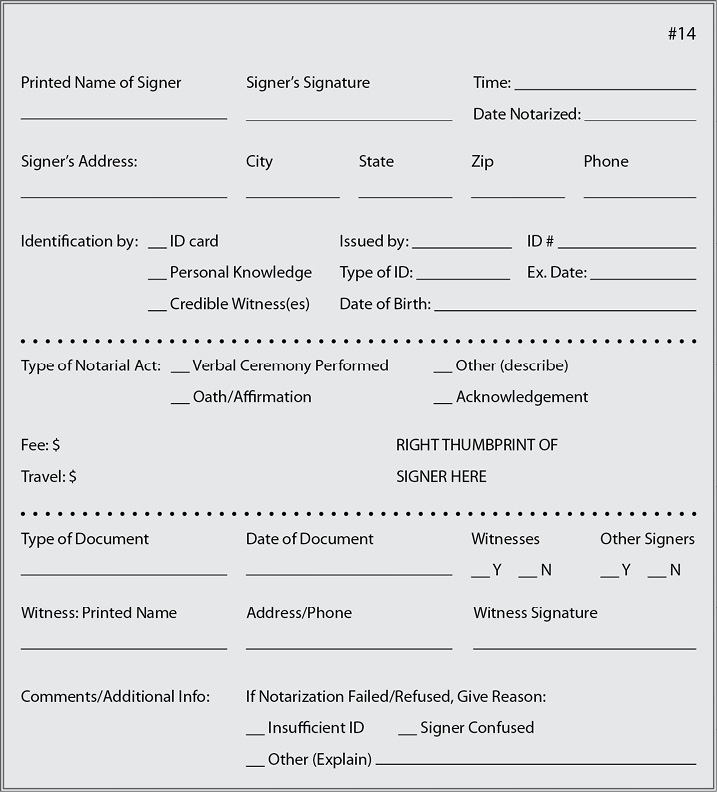
The information for each entry will vary, based on the notarial act you are completing. Be consistent with information to ensure each entry is completed in full and before the signer leaves.
Due to the increasing problems of identity theft, some notaries request a thumbprint as a means to detect fraud. This is an extra safeguard and not required. Use your own discretion with each notarial act for which you are hired.
The information contained within your journal tends to be sensitive legal documents. Therefore, proper safeguards should be in place to protect your journal. It should be kept in a safe and secure location, such as a safe deposit box.
It is a legal requirement to keep yournotary journal current and up-to-date (check with your state for its requirements). To be on the safe side, keep your journal for at least seven years after your notarycommission has expired, revoked, or you decide to resign.
Yournotary stamp/seal and embosser is the next vital piece of equipment you will need once you pass your exam. Yournotary stamp is a stamp with your name, the state and county in which you are commissioned, and the expiration date of yourcommission. Your commission can vary, but usually it expires five years from the date in which it was issued. You usually will apply your stamp directly to the document you are notarizing to prove it as valid. Figure 2-2 is an example:
Figure 2-2.

The stipulations regarding documentation for your stamp seal/embosser vary. You may need the following when ordering your stamp: originalcommission certificate, certificate of authorization, letter of passing, certificate of appointment, letter or appointment, or new law letter (contingent upon state of license). Before ordering your stamp, it is best to check with your state’s notarycommission or notary association for the most up-to-date requirements. You can also check the website for theAmerican Association of Notaries, www.notarypublicstamps.com, to obtain the necessary supplies based on your state’s requirements.
It is important to take good care of your stamp, which means keeping it clean to provide clear, legible, and a legal stamped impression. Following are some tips to keep your stamp clean:
When you order your custom-made embossing tool, it imparts an embossed notary seal on a document. The information included is your name, county, and statecommission (Figure 2-3). A simple Internet search will yield numerous notary supply stores where you can purchase this item. Sites including www.xstamperonline.com, www.notarypublicstamps.com, and www.notarysupplyshop.com provide a wide variety of notary supplies.
Fig. 2-3. Embossed notary seal

Notary Supplies Checklist
It does not matter if you are a freelance notary, employed by a business, working from home, or have an office outside of the home. The following are basic office supplies to get you started and help you become successful:
Once you have your notary business supplies organized, it is just as important to stay organized.
Staying Organized
You studied and passed the exam; you have taken your oath; and now you have all of your tools for the trade. Starting your notary business can be stressful, but keeping things organized will make life easier. Staying organized with the everyday tasks associated with running your business, as well as keeping long-term goals in mind, brings ease to administering tasks. Some ways to stay organized include:
When it comes time to deal with the paperwork associated with being a notary public, assess every notarial document and consider the following:
Does this need to be saved or discarded? Can I research it on the Internet (e.g., a policy change)? Be sure to read the document thoroughly before disposing of it and make notes of any pertinent information that you need for your files.
Once you have met all the basic requirements and purchased the equipment to become a successful notary, it is time for you to explore some of the options available to you and for your business. One of the most popular services notaries offer today is amobile notary service. The next chapter is devoted to exploring what a mobile notary does, so you can decide if it is a service you are interested in adding to your new business venture.
Case Study: Commitment to Being a Notary
Myra Anne Healey
JP-Online Services
Weare, NH 03281
www.JPOnlineNH.com
Myra Anne Healey is a notary in New Hampshire and has been in the business for 28 years. She became a notary because she was self-employed with her ex-husband, and they found the need to have a notary in their office. After her divorce, Healey was interested in continuing self-employment, so she decided to put her notary certification to good use. Now, she offers mobile notary services, works with loan closings, and handles field services.
Healey feels it is much too easy to become a notary in New Hampshire, and she believes there should be more training for prospective notaries. When she received her notary certification, there were few qualifications and no formal training. The only requirements were that you were 18 years of age, a registered voter, and did not have a criminal background. The training consisted of receiving a pamphlet with your certificate.
One of the most important things to know while practicing as a notary is the law that applies in your state, says Healey. She also recommends that you keep accurate records of every notarization, whether it is required or not in your state. It is important to keep your record book,notary stamp, and seal in a safe place. You should always act with confidentiality when performing your duties as a notary. It is also important to remember to never notarize a document if the person does not have proper identification or has expired identification.
Being self-employed definitely has its benefits when it comes to flexibility. Healey makes her own hours and answers only to herself. Her typical hours vary depending on what she has scheduled for that day. If she has no jobs scheduled for mobile services, then she is usually in her office catching up on paperwork or marketing her business via the Internet or
telephone. If she must work on the road, she tries to schedule appointments for the morning or afternoon so that she can be back by the later part of the afternoon to catch up on daily paperwork, invoicing, and answering e-mails (which typically reaches a couple hundred per day). On these days, she tries to get out of the office by 9 p.m.
Healey feels that marketing your business is of the utmost importance when self-employed. In the beginning, she advertised to mortgage companies, title companies, and anyone else that she thought could use her services. Now, her marketing efforts include advertisements, a website, membership in different groups and associations, and continuously searching for new business and new ways of generating business. She is part of several organizations where her services are offered to people who are looking for notaries.
For Healey, the most rewarding aspects of her career are having the ability to meet new people and knowing that her services are much appreciated. There are some difficult aspects of the job, however. It can be difficult when she comes across a document that is confusing but does feel that after all her years as a notary, there really is nothing she has not seen. She enjoys knowing that she is responsible for her own business and that she only has herself to blame if she does not take on jobs. Healey says that sometimes, or most times, the hours are long; you have to wear many hats in the same day, and you have to be flexible and able to multitask.
Healey says that the best advice she can give to anyone looking to start his or her own notary business is to do your best, be consistent, and do not try to rip anyone off. She says that you should make sure to give the same exceptional customer service at all times, even if you have under-bid the job. Make sure to stick to all commitments.
Table of Contents

Chapter 3: Becoming a Mobile Notary
Today, mobile notaries play an even bigger role in the business environment as people’s lives become more hectic. Being a mobile notary is similar to being a notary public; however, as the name suggests, you are traveling to businesses, people’s homes, hospitals, and other locations rather than having them come to you. You can either start out as a mobile notary or expand your service offering to include mobile services.
Before you decide to extend the scope of your business to include mobile notary services, first consider finances, logistics, and emotional factors involved in being ready and on call when a client calls you.
Expanding your notary service does not guarantee profit. In fact, you may be creating more work and expenses by offering mobile services. Working as a mobile notary could mean more overhead: travel, gas, and being on call.
Mobile Notary: The Right Career Move?
Once you have passed the exam and obtained your license, you need to establish your business network. Fortunately, most companies and business organizations prefer a notary on call rather than on the payroll, which gives you the freedom to earn as much as you want (or can). The fee for a notary on call can range from $25 to $200 according to the type of services you are performing for the client. In order to cover some of the additional expenses, such as travel costs, mobile notary fees are higher than the fees charged when clients come to the notary.
When is a mobile notary called to action?
In our ever-shrinking global economy, we never know when the need may arise for the notarization of a document. It can be rather tedious to go all the way to the bank or to visit the neighborhood notary. Sometimes documents need to be notarized, and other notary offices are not open because it is after business hours or a holiday. If you decide to become a mobile notary, these clients turn to you for their after-hour and holiday notarization needs.
What services do mobile notaries offer?
Most mobile notary businesses offer several main services. Many mobile notaries offer the service of loan signing, which is useful if a loan needs to be signed in a place that does not already supply a notary. This could be because the loan is exchanged between two friends who only need the notary for legal purposes or in a pinch when a company’s typical notary cannot meet. Mobile notaries are also used in the mortgage industry, loan closings, adoption papers, and wills and estates situations that may fall outside of normal business hours.
With the services offered by a mobile notary service, it is possible to get something notarized right on the spot. Not only is this good for customers, but it is also good for the notary. It is likely that notaries are able to bring in more business and make more money on their own than they ever would as a part of a larger company or being in a stationary location.
The pros and cons of a mobile notary service
When considering starting a mobile notary business or adding mobile notary services to your new business venture, it is important to look both at the pros and cons to going on the road.