First published in 1996 by
Samuel Weiser, Inc.
P.O. Box 612
York Beach, ME 03910-0612
Copyright © 1991 Gareth Knight
All rights reserved. No part of this publication may be reproduced or transmitted in any form or by any means, electronic or mechanical, including photocopying, recording, or by any information storage and retrieval system, without permission in writing from Samuel Weiser, Inc. Reveiwers may quote brief passages.
Library of Congress Cataloging-in-Publication Data
Knight, Gareth.
The magical world of the tarot: fourfold mirror of the universe / Gareth Knight.
p. cm.
Previously published: London: Aquarian Press, 1991.
Includes index.
ISBN 0-87728-873-9 (paper: alk. paper)
I. Tarot. I. Title.
BF1879.T2K56 1996
133.3'2424--dc20
96-22675
CIP
ISBN 0-87728-873-9
BJ
Cover art is “The Fool's Paradise” by Ray Rue
Copyright © 1996 Ray Rue
Printed in the United States of America
02 01 00 99 98 97 96
10 9 8 7 6 5 4 3 2 1
The paper used in this publication meets or exceeds the minimum requirements of the American National Standard for Permanence of Paper for Printed Library Materials Z39.48-1984
www.redwheelweiser.com
www.redwheelweiser.com/newsletter
This book is dedicated with gratitude and affection to all fellow students of the Tarot who have shared its pleasures and its mysteries with me, by correspondence or in workshops, and in particular to those who set me questions to ponder (some of the replies to which are contained in these pages), or who have contributed in other ways, namely:
Bill, Caryl, Chris, Christine, Christopher, Daphne, David, Dawn, Derek, Diana, Diane, Ernest, Fran, Gareth, Gaye, Gloria, Jacqueline, Janette, Janine, Jenny, Joan, Kalyani, Libby, Mally, Margaret, Marilyn, Maureen, Muriel, Nelson, Pat, Patrick, Peter, Rosemary, Sigurgrimur, Susan, Terence and Tom.
Thank you, and may you always play your cards right.
Introduction to the Tarot
The Fourfold Magic Mirror
Lesson One
The Spirit of the Tarot
How to Approach the Spirit of the Tarot
Working Plan
Knowledge Notes
Notes on The Fool
A Brief Review of Tarot Packs
Questions and Answers
Lesson Two
The Next Step
Variations in the Tarot Images
Working Plan
Knowledge Notes
The Magician
Strength
Justice
Temperance
The World
Divinatory Meanings of the Cards Described So Far
Recommended Books
Questions and Answers
Lesson Three
Strength
Justice
Temperance
The World
Working Plan
Knowledge Notes
Trump Images in the Hall of Strength
Trump Images in the Hall of Justice
Trump Images in the Hall of Temperance
Trump Images in the Hall of the Worlds
Divinatory Meanings
Questions and Answers
Lesson Four
The Basics of Divination
Working Plan
Knowledge Notes
Questions and Answers
Lesson Five
The Four Suits
The Theatre of Wands
Working Plan
Knowledge Notes
Questions and Answers
Lesson Six
The Theatre of Cups
The Theatre of Swords
Learning the Language of the Trumps
Working Plan
Knowledge Notes
Suit of Swords
Suit of Cups
Questions and Answers
Lesson Seven
The Theatre of Coins
Basic Principles of a Tarot Spread
The Court Cards
Working Plan
Knowledge Notes
The Three-dimensional Structure of the Tarot Halls
Questions and Answers
Lesson Eight
Divination Using the Suit Cards
Sample Readings Using the Full Pack
Working Plan
Knowledge Notes
The Celtic Spread
The Attitude of the Querent
Statistical Probabilities
Questions and Answers
Lesson Nine
The Gareth Knight Spiral Spread
Sample Readings
The Face-to-face Reading
The Postal Reading
Working Plan
Afterword
Towards an Advanced Study of the Tarot
The Four Elements
The Powers of Inner Earth
The Powers of Higher Consciousness
The Powers of the Cosmos
Other Paths to Progress
Index
Bibliography
About the Author
Five hundred years ago, northern Italy was the centre of the Western world. Florence, Venice and other towns were thriving city-states in which the famous Renaissance princes ruled. They bustled with artistic creation, international business and politics. For many this was a ‘golden’ age. Artistic creativity was encouraged, and great artists like Botticelli and his master Fra Lippo Lippi flourished. It was during this time and in this place that the Tarot first came into being.
Elsewhere the Western world was in chaos: The Wars of the Roses had broken out in England, and at the further end of Europe, the Turks were besieging Constantinople. They killed the Emperor and took the city and nothing was ever quite the same again. It was the end of the Middle Ages. The Renaissance had begun. With the desecration of the monasteries their great libraries were broken up, and priceless manuscripts released from hidden archives. The Renaissance princes, with their questing minds, bought them up eagerly. These manuscripts included the Hermetic scripts, believed to be the work of an ancient Egyptian priest called Hermes Trismegistus. They included the wisdom of the temples of ancient Egypt but also contained an ancient oral tradition that stemmed from many sources.
The Italian princes were intrigued by these scripts. They showed a new approach to the mind of man and its powers, powers that had been condemned by the medieval church as heretical and tainted with sorcery. These scripts showed that there could be a good and wholesome approach to the traditions of pagan spirituality. This newly-discovered wisdom also had a practical side. Today we might call it applied psychology. The princes learned to meditate upon symbolic pictures as an aid to health and healing. Some of the famous pictures of this time were probably commissioned for this purpose: Botticelli's The Birth of Venus, Venus Overcoming Mars, or The Primavera, which has the Three Graces of classical antiquity as part of its composition, identified by some as the beneficent powers of the Sun, Jupiter and Venus.
It was now that the Tarot first appeared as beautiful, handpainted works of art, encrusted with gold leaf. Highly suitable objects for meditation to bring down the powers of the higher spheres, or, as modern man might prefer to say, to contact the deeper reaches of the human mind. Whether we use the astrological symbolism of the fifteenth century or the psychological assumptions of the twentieth, the images of the Tarot are extremely powerful. They exercise a great fascination for many people to this day.
The Tarot cards became widely known, being linked with playing cards, which had made their appearance in Europe a few decades earlier. Whether by accident or design, the association of the images of the twenty-two Tarot Trumps with the four suits of the playing pack has deep implications, for the four suits of the playing cards mirror the Four Elements of the ancient world: Earth, Air, Fire, and Water. The four Elements also appear in the make-up of the mind of man. The psychologist C.G. Jung equated them with the functions of Intellect, Intuition, Feeling and Sensation. Indeed, he used this fourfold structure to bring healing through the contemplation of images that emerge from the unconscious mind. This leads to a balancing fourfold image of healing that he called a ‘mandala’.
The fourfold structure of the playing card pack is an extended mandala – a healing figure of psychic balance. Add to this the twenty-two figures of the Tarot and we have a powerful tool indeed – the intriguing system of interlocking images that can reveal the inner workings of the mind and the world about us. This system requires no special clairvoyant gifts or other rare abilities, simply a knack for using the creative imagination – which is the common heritage of us all. By these means the Tarot becomes a symbolic language by which we can communicate with a level of consciousness that is different from the everyday mode. Thus the Tarot provides the key to a whole new range of human ability that is not limited by the perceptions of the five physical senses. It is not weird and cultish. It is not superstition. It is a way of evaluating those dynamics of a situation that may not be immediately available to the rational mind. It is a way of cultivating the intuition.
We can consult the Tarot as we would an old friend. We can choose to take its advice or ignore it. However, as with the advice of any old friend, its value can only be discovered by experience. And it is only by trying to work with the Tarot ourselves, in good faith, that we will ever come to that experience. By intelligent use of the system of higher apprehension revealed by the Tarot, we can discover more about ourselves. This equips us to meet the challenges of life more confidently and more surely. The Tarot is a system whereby we can learn to know the inner springs within ourselves and the circumstances in daily life that arise from them. Thus it is truly a fourfold mirror – not only of ourselves but of the Universe.
Let us examine this fourfold structure, which runs through the Trumps as well as the four numbered suits, for it is the basis upon which the whole Tarot functions in an instructive and self-balancing fashion. We commence with two key images. They are key images because they represent between them the principal inner and outer polarity that runs through the whole system. Together, and each in their individual way, they also represent the unified spirit that is at the back of all 78 cards. These two images are the Fool and the Magician (Figure 1).
The Fool is the direct representation of the Spirit of the Tarot itself – the unencumbered, wise and lowly innocent who ventures forth into the world, taking things as he finds them and people as they are, for better or for worse, but instilling within them, by his example, all that is best within themselves. Appropriately numbered 0, the Fool at this level represents the pure human spirit, and at another the divine breath ‘that bloweth where it listeth’, bringing new life and new vision to all things. The Fool is the first character we meet in our acquaintance with the Tarot, for he is its creative fount.
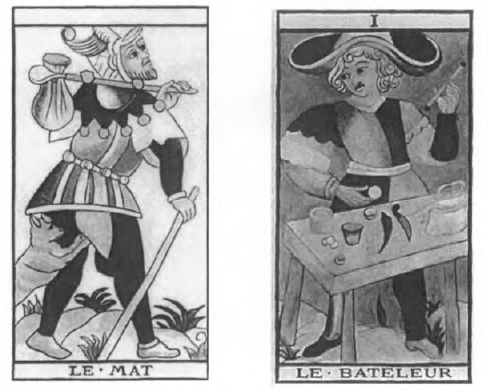
Figure 1: The Fool and the Magician (Grimaud Tarot of Marseilles)
The Magician is another aspect of the same character, this time not wandering free, dancing among all the other images as he danced before they existed, but the controlling focus of them all. All the other cards range up about the Magician in due formation and order. They are all part of his box of tricks, or the balls he juggles in the air, according to the way in which he is depicted.
Fool and Magician therefore represent the principle of creative freedom and the principle of creative organization, both of which are to be found behind all that exists in the world. They are the alchemical principles of Solve and Coagule (dissolving into free-flowing liquid or organizing into crystalline structural form, yet being the same substance). In esoteric philosophies of the world they are the yang and yin, or the pillars Jachin and Boaz, one light and one dark, that stand before the entrance to the temple. However, they are to us no mere metaphysical abstractions. In the Tarot they are living entities that we may get to know.
In the pictorial wisdom of the Tarot they are both wandering mendicants, travellers across the cosmic landscape. The Fool, or beggar man, owns only what he carries in a knapsack at the end of his staff (and in one sense this is the brain and spinal column of all of us who came naked into the world and who in the same way will leave it). The Magician is by contrast a travelling showman, putting up his pitch in every town he comes to, to demonstrate his skills and wares. In cosmic terms the travelling show is to be seen in our own solar system and in all the other star systems that are revealed to us, at a distance, in the night sky.
Both figures are in transit. They have their origins and their goals elsewhere, but each is functioning wholeheartedly in the eternal ever, passing now. In this sense they are not only demonstrators, but teachers, messengers, and prophets, bringing enlightenment to us and news of realms beyond the limitations of our own habitual attitudes and mental walls.
The Four Suits of what is sometimes called the Lesser Arcanum are the building blocks of life, and we represent them here in the four Aces, which signify their root and foundation. They are Wands, Swords, Cups and Coins (Figure 2), to be found to this day as the suits on ordinary playing cards in Italy. (Our own playing cards follow a later French system of Clubs, Spades, Hearts and Diamonds, that is an adaptation of the Italian originals.)
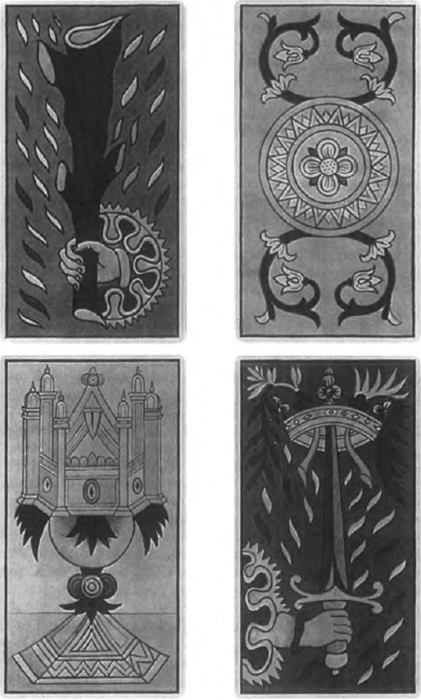
Figure 2: The Four Aces (Grimaud Tarot of Marseilles)
The fourfold division of the elements that make up the world is an ancient conception and shows how we may best organize our further studies as we proceed from the basic principles of pure polarity. In practical human terms they are allocated to the varied interests of:
Each Ace is a fount of each particular aspect of human life, which may be developed into tenfold expression – according to the numerological and Qabalistic philosophy behind much of the Tarot – and into four human modes of expression, signified by Page, Knight, Queen and King.
The cards of the Lesser Arcanum all represent activities expressed in life. The twenty-two Trumps are major principles or archetypes that affect and control these activities from behind the scenes.
Four Trumps especially rule over the four Suits and also over the remaining sixteen Trumps. These especial four are those which represent the Cardinal Virtues, and their particular roles were indicated in one of the early packs of Tarot cards, (known as the Gringonneur), which gave them the angular haloes we see about their heads (Figure 3). They are Temperance (a); Strength (or Fortitude) (b); Justice (c); and Prudence (signified by the World) (d). Strength rules over the Wands, and in certain of the old packs the figure is depicted as Hercules with a club (Figure 4, taken from the Visconti-Sforza Tarot). Temperance rules over the Cups, and it will be seen on most cards that she holds two Cups. Justice rules over Swords, and it will be seen that she always carries a sword. And Prudence is signified by the World, nowadays usually represented as a figure balanced between four principles. She rules over Coins, seen in earlier designs of the card as two cherubs presenting a medallion upon which is depicted the world (Figure 5).
The first four Trumps represent principles of Power, and so fall under the presidency of Strength (Figure 6). The Hierophant or Pope, and the High Priestess or Female Pope, show forth spiritual or inner power, in male and female aspect respectively. The Emperor and the Empress similarly represent outer executive male or female power. We thus have two principles of interlocking polarity displayed; that of the spiritual and temporal, and that of masculine and feminine.
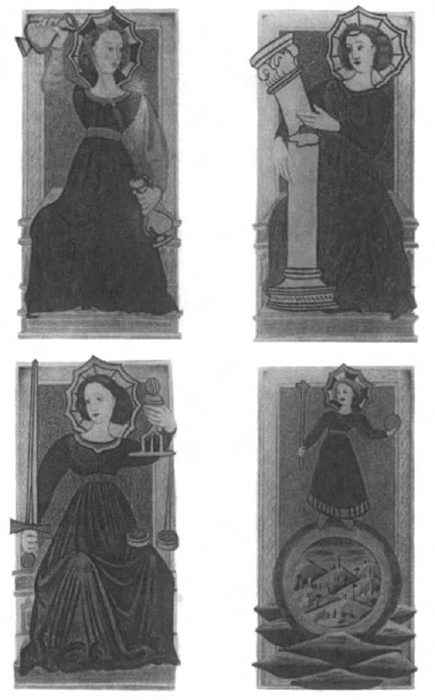
Figure 3: Temperance, Strength, Justice, the World (Gringonneur Tarot)
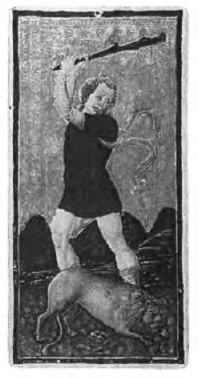
Figure 4: Strength (Visconti-Sforza Tarot)
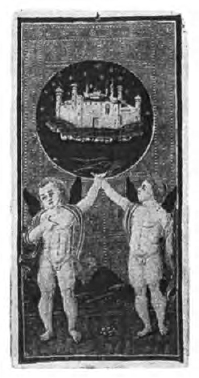
Figure 5: The World (Visconti-Sforza Tarot)
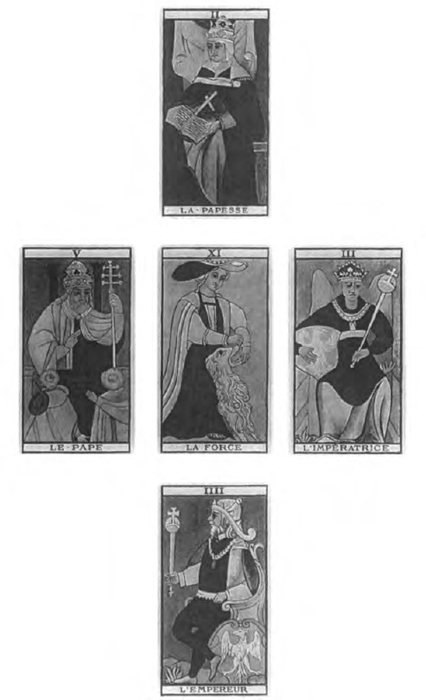
Figure 6: Trumps in the Hall of Strength (Grimaud Tarot of Marseilles)
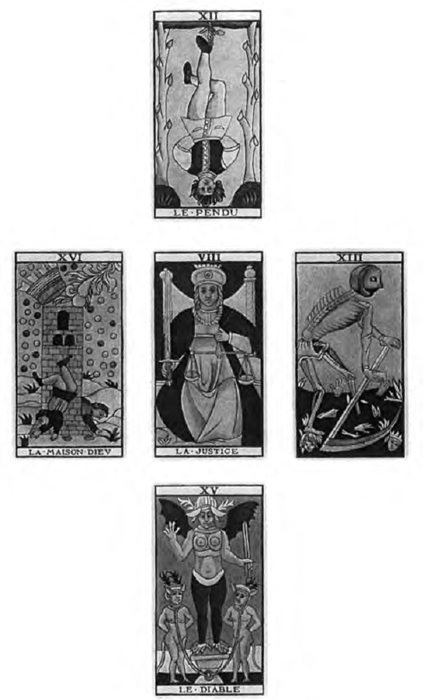
Figure 7: Trumps in the Hall of Justice (Grimaud Tarot of Marseilles)
Four Trumps fall under the presidency of Justice (Figure 7). Here we see the apparently malefic images of the Devil; the Lightning Struck Tower (once often called Hell's Gate or Mouth); also Death; and the Hanged Man, (formerly known as the Traitor). However, these images do have their positive and instructive side. The Devil represents our own shadow self that we can escape from by facing up to it instead of ‘projecting’ it in various pet hates onto other people. The Tower can also be a channel for spiritual realization – a ‘bolt from the blue’ that may upset us but which may also bring, if we receive it aright, enlightenment and transformation. Death represents radical change, but all endings bring new beginnings. And the Hanged Man, although he seems to be in a severe predicament, forms with his body a secret sign (that of inner activity, of alchemical sulphur), and is tranquil in his condition. He knows that however unfortunate outer circumstances may seem, he is in the right.
The four Trumps that fall under the wings of Temperance represent conditions of human life, and have slightly changed their imagery over the years (Figure 8). Now called the Hermit, the Chariot, the Lovers and the Wheel of Fortune, they were originally Father Time and the three goddesses of Victory, Love and Fortune. The Hermit's lantern was once an hourglass and, like Time, he went slowly on crutches, yet also had wings. The figure in the Chariot was once Winged Victory, familiar to the classical worlds of Greece and Rome. The Lovers showed a procession of lovers overshadowed by Cupid, the son of Venus, goddess of Love. And the Wheel had the figure of the goddess Fortuna, who turned it, whilst four figures about its rim rose or fell, or were at the height or depths of their respective fortunes (Figure 9).
The last four Trumps show different states into which the universe is divided, according to the ancient wisdom; hence they come under the presidency of the World (Figure 10). These are the Heavenly World, represented by an angel (and this card is sometimes called the Angel) announcing the Last Judgement. Next, the celestial world, represented by the Star. Then our own system, given warmth, light and life by our star, the Sun. And finally the lowest world, (anciently called the sub-lunary sphere), immediately about our physical Earth and encompassed by the orbit of the Moon.
This tiered vision of the universe was of fundamental importance to ancient philosophy and is still valid today. The discoveries of modern science have never overthrown it because they are concerned only with the structure of the outer world, not the states of being and consciousness within it.
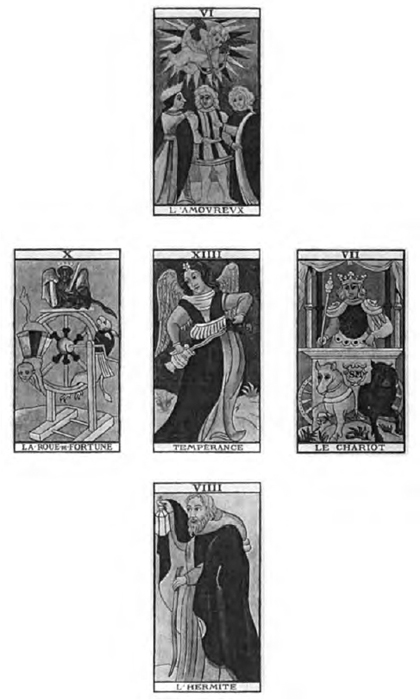
Figure 8: Trumps in the Hall of Temperance (Grimaud Tarot of Marseilles)
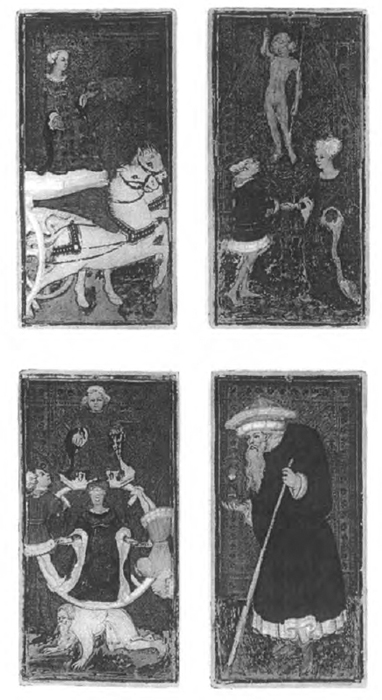
Figure 9: The Chariot (Victory); The Lovers; The Wheel of Fortune; The Hermit (Visconti-Sforza Tarot)
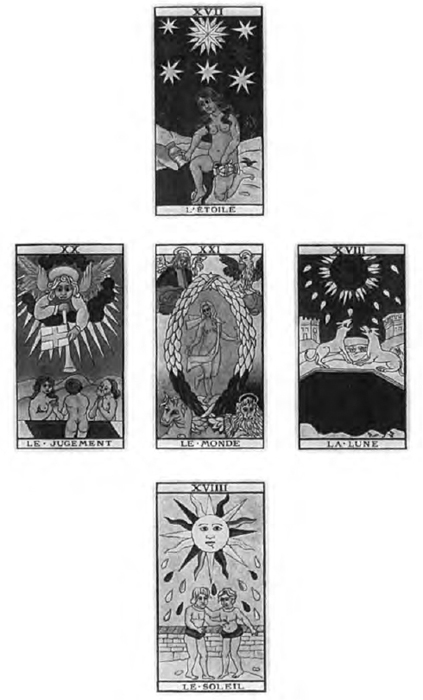
Figure 10: Trumps in the Hall of the World (Grimaud Tarot of Marseilles)
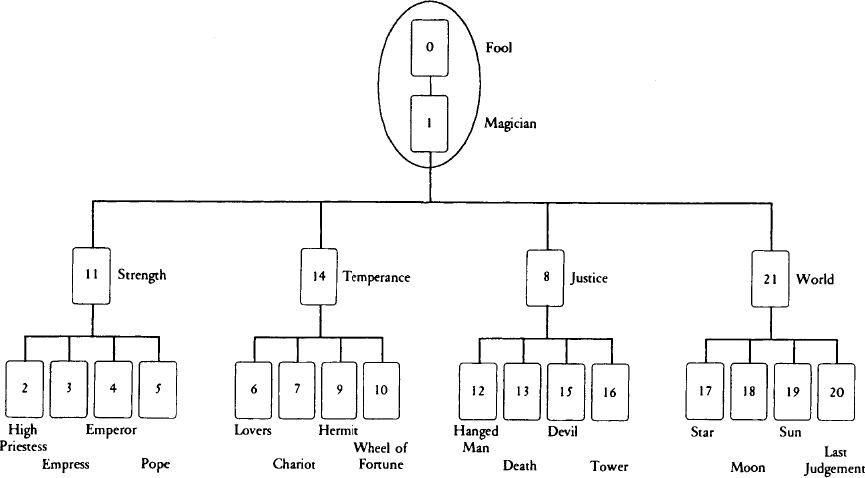
Figure 11: Fourfold Ground-plan of the Tarot
This then is the fourfold ground-plan of our study of the Tarot, and we can spread it out in a comprehensive diagram to clarify our minds. This diagram is laid out rather like a family tree. It is possible to represent it in other, three-dimensional ways, without losing the fourfold pattern. One method is in the various Halls of the Magician which we shall visit in our preparation for Tarot divination. Another is in the form of the Tower of the Fool which we may explore in our more advanced work. But now is the time to make the acquaintance of each and every one of the 78 faces of the Spirit of the Tarot, or to view the 78 facets of this wondrous mental crystal, one by one.
In my earlier book on the Tarot called Tarot Magic (Destiny Books, 1990, first published by The Aquarian Press as The Treasure House of Images, 1986) I acknowledged, in the usual way, all the people who had helped me in writing it, and said:
And finally my thanks to the spirit of the Tarot itself. Despite all the abuse it may have bad from less than spotless hands and intentions in the past, it revealed itself to me as a very wise and gentle source of wisdom and encouragement, deserving much respect.
If you have undertaken the study of the Tarot you have probably realized that there is more to it than meets the eye. There is in fact a hidden mystery behind the Tarot; this is why it has fascinated mankind for at least 500 years. Like all mysteries, this hidden power is not something that is obvious to everyone. Yet it is none the less real for all that, and the way to discover that hidden reality is to find the key that unlocks the door to the mystery. The key is in fact a very simple one. So simple indeed that most people overlook it. It is to approach the Tarot as if it were a real person. This may sound fantastic but the proof is there for anyone who will try it. If you treat the Tarot like a person, it will respond like a person – a very wise and friendly person, to whom you can turn for advice.
Now this requires an act of faith from you. We can show you the key, but it is up to you to put it into the lock of the door and turn it. The secrets of the Tarot will then be revealed. If you refuse to take this first step, for whatever reason, then the door to the companionship of the Spirit of the Tarot will remain closed, for only you can open it. It is no good trying to take a kind of superior, ‘scientific’ attitude and subject the Tarot to psychical or statistical experiments. The Tarot will not be put to the test in this way. It opens up, like a friend, only to human warmth and trust.
Yet you must still be careful as to how you approach it, for it will deal with you exactly as you deal with it. If you go to it just for a laugh or a lark, you will receive only misleading answers, for it will be having a laugh or a lark of its own at your expense. We have said you will find it to be a very wise person. This means it is not easily fooled. And what is more, it will deal with you for your own good if you approach it in the wrong kind of way!
What is the wrong kind of way? Well there are a number, besides the elementary mistakes we have already mentioned. The more serious offences are trying to pry into the affairs of other people without their consent, or seeking information for evil or malicious intent. If you are so foolish as to try anything like this you are likely to find that you are misled in a fashion that brings your own evil intentions right back on your own head. The Spirit of the Tarot will not allow itself to be abused for evil or selfish reasons and is likely to teach you a sharp lesson if you try to make it do so.
Another form of misuse is not so much evil as foolish. This is to begin to rely so much on the Tarot for advice that you are reluctant to do anything without asking its opinion first. This is not at all good for you. You are here on this good Earth to learn to stand on your own spiritual feet, and that is not done by relying for advice on every minor decision in your life. If you pester the Tarot too often in this way it is likely to respond by giving misleading answers, so that you are led in a circular dance of misdirections until you realize the necessity and wisdom of learning how to make up your mind for yourself. This may sound cruel but the Spirit of the Tarot has done you the good service, by this method, of making you self-reliant.
However, if you make up your mind to approach and consult the Tarot as you would approach a wise and trusted friend for advice and discussion, in a balanced and sensible way, you may rest assured that it will respond to you in similar good faith, and prove a friend and wise counsellor indeed.
We make our first approach to the Spirit of the Tarot by making a picture of this person in our mind. The image we shall use is that of Trump 0, called the Fool. And we shall soon find that this figure is by no means as foolish as his name might suggest. Really he is extremely wise, but his wisdom is of the intuition, or higher mind, which is the kind of mentation we need to develop in order to become aware of inner and future trends. He will, in turn, introduce us to the other images of the Tarot that will form a special symbolic language of communication when later we learn to read the cards.
Take this Trump from the pack and prop it up on the table before you. It does not matter very much which set of designs you have. We will base our descriptions on the traditional Marseilles cards because, although they are crude, they are the direct descendants of the earliest designs and they have formed the basis for most of the later esoteric packs.
To begin with, make sure that you have the right conditions for doing the work. You need to be free from the likelihood of disturbance, the atmosphere should be calm and reasonably quiet and the room clean and tidy. Emotional turmoil, noise, dirt and muddle are not conditions under which psychic work can be properly conducted, at any rate until one is considerably experienced in creating an inner quietness and order that can overcome unsatisfactory surroundings.
If you are familiar with the practice of meditation then you have a head start. If not, it is never too late to learn, the rules are quite simple and you will soon find the results effective. Make sure you are sitting comfortably. A position of alert poise is best, sitting on a firm chair, with spine upright but not stiff or tensed, eyes looking straight ahead whether they are open or closed. The hands and forearms can rest along the top of the thighs, which should be parallel to the floor – a small footstool may well be found useful to achieve this.
Spend a little time relaxing your muscles and your mind, breathing gently and slowly. Then gradually forget about your breathing and your physical surroundings, and concentrate upon the images you are going to build in your imagination. You have already taken a good look at the card of The Fool in your Tarot pack. What you need to do now is to see the picture of the Fool in your mind. It need not be exactly the same as the one that is upon the card. In fact it may very well be different in many small ways. The Fool you will come to know in your mind is your own special friend, and although his general image is upon the card, he will appear slightly different to every individual who seeks him.
Begin by imagining that you are standing on a clifftop path. Be aware of the thinness and stillness of the air. Perhaps you can see snowcapped mountain peaks before you and wheeling eagles. On the other hand it may be that you are on a clifftop overlooking the sea, and can hear the sound of the breakers upon the rocks or the beach, and the cry of the sea birds. You may even find the wind gusty. The sun may perhaps be shining, but above all be aware of the expanse of cool clear air and sky. The idea is to let the images arise spontaneously before you, along the general lines described. Do not worry if at first you find it difficult to succeed. Just continue to sit there, and above all do not try too hard! Should wandering thoughts on other subjects come to mind, simply put them aside with the mental note that you will deal with them later, at the proper time. If nothing comes to you, simply build the picture and try to hold it there. Gradually it will take on greater reality and motion.
Now imagine that you hear a merry whistling, and perhaps the jingling of bells as in a jester's cap. See coming towards you along the path the figure of the Fool, dressed in his ragged or motley clothes, a bag and stick over his shoulder. He is accompanied by a barking and capering dog. See him come towards you as you stand by the path. Now the idea is to make contact with him. In fact as he is already in your mind you already have! But we seek to make that contact more conscious and formal. See him stand before you and smile. It is possible that you may hear him say something to you with the ear of your imagination. Although this may not come easily at first, you may well feel an idea come into your mind, and that idea may well come from the Fool rather than yourself! The important thing is whether it is a good idea or not, rather than who first thought of it.
Practise making this contact every day, because it is the first step to becoming an initiated Tarot reader. It is genuine contact with the Spirit of the Tarot that marks the difference between a genuine consultant and a casual fortune-teller who has only learned the ‘meanings’ of the cards by rote, or is relying on a natural psychic facility unconnected with the real source of wisdom that lies behind the Tarot.
When you have completed your period of meditation and contemplation give your farewell greetings to the Fool, and turning away from him in your imagination, feel yourself walk down the cliff path, whilst he turns and returns with his dog up the path to the heights from whence he came. When you have gone a little way down see a large boulder by the side of the path. Within it is a door in the rock. Pass through it, and find yourself sitting in your own room once again, in your normal physical surroundings, with the Tarot cards before you on the table. Open your eyes and draw your mind back to everyday reality. Be aware of being firmly in your own body, flex your muscles and move your feet and hands and head to establish this fact. Now stand and gather up the cards neatly and put them away. Think no more of your inner visions as you do so.
It is important that you make this firm break between outer and inner worlds, otherwise, especially if you have a natural psychic ability, impressions from the inner world may intrude when it is not convenient. By maintaining this simple routine, of only transferring consciousness to the inner worlds when you deliberately sit down before your Tarot cards, and deliberately transferring consciousness back when you have finished, you will always be in control of your developing psychic faculties.
Your cards should be kept in a specially chosen place, not simply thrown into an untidy cupboard or drawer or left lying around in the open. Traditionally they should be kept on a high place – at least above shoulder height. If you can find a nice wooden box for them, so much the better, and it is well worth the trouble of procuring a small piece of black silk in which to enfold the cards inside their box. It can also be helpful, when you work with the cards, to make something of an occasion of it by other small means. You could even have a special robe and light some incense. However, it is by no means necessary to go as far as this, and the same results can be achieved by methods that are less likely to excite unwanted attention from family or close neighbours.
Having a special ring, or other small piece of jewellery, that you wear only when you consult the Tarot, can be a help. Or you could have a particular piece of music on tape or disc that will put you into the appropriate mood. This is entirely a matter of personal choice. Perhaps most effective is to have a special cloth to put upon the table on which to lay the cards. And perhaps a candle or some other symbolic object might be added if it stimulates your imagination. The action of putting these things out carefully and methodically will serve to put you into the right frame of mind for successful divination. However, all are psychological devices, a means to an end, and should not become compulsive fetishes or objects of superstition.
In this first lesson you will only be working upon one image, that of the Fool. Give yourself at least three weeks of practical study before going on to the practical work of the next lesson. (This is an average time. If you are unused to this type of visualizing meditation you may need more time. On the other hand if you are in fact well practised at it or you find that the Fool comes alive for you readily because you have a naturally strong imaginative faculty then you could make do with less time. At any rate, try to get to know the Fool reasonably well before you go on to meet the other images.)
You will gain most from your study of the Tarot if you can arrange to work at regular times, preferably about the same time each day. The time of day, or night, is up to you, according to personal circumstance and preference. However, ten-to-twenty minutes per day, every day, will bring more benefit than irregular work, even over longer periods. It is quite a good idea to take a day off from time to time, say once per week. It is another useful aid to keep a diary of your work, as you will find that this is a stimulus to regularity.
Diary Record
Take a ruled sheet of paper and divide it into headed colums as follows:
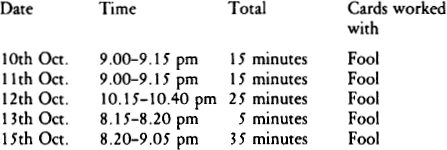
This brief example shows you the kind of thing to aim for. Another psychological aid will be to keep all your practical Tarot work neatly filed in a special loose-leaf folder that can be kept with your Tarot cards.
These notes are not part of the actual practical lesson, but are added to help you to build up your knowledge of the history and most popular forms of the traditional Tarot images. In the last analysis, it is the forms that appeal most to you, or that come to your own mind's eye, that are really important for you. However, it is always best for your imagination to be founded on sound historical tradition, otherwise your work may become too personally biased and idiosyncratic. If this happens, the Tarot ceases to become a vehicle of communication of practical wisdom, but tends merely to reflect your own subjective opinions and fancies, presenting you with a mist of phantasms of your own subconscious instead of the clear mirror of inner perception.
The Tarot Trump called The Fool is perhaps the most profound symbol of the whole Tarot. The Fool is a great archetype that has always played a major part in folk tradition. It is embedded in the collective unconscious of almost every race, whether it appears as the medieval Court Jester, the harlequinade of the Commedia dell' Arte, the puppet Punch and Judy, or the clowns of the modern circus. In the Arthurian cycle there is even a knightly fool, Sir Dagonet, the jester of King Arthur. Again, the Fool and tragedy, as for example in Petrushka or the perennially popular opera I Pagliacci, is something which strikes home deep in the subconscious mind. This is a quality which can be caught by comics of genius, such as Charlie Chaplin or Jacques Tati. Again, there were the Fool's Days of medieval times when the whole court was turned topsy-turvy, a tradition still carried out in some armed services at Christmas, where the officers serve the men their dinner. The idea even entered the Church, with the annual boy-bishop festivities, and attendant vulgarities and blasphemies. For such things to be tolerated and submitted to, a deep level of unconscious motivation must be in force.
The Fool is also an object of some respect – he is a creature of paradox, being at the same time wise as well as a fool. The highest example of this element of paradox and hidden mearnings and motivations is in the third Act of King Lear. Shakespeare created some marvellous fools in his plays but here he surpasses them all, in the situation of a foolish King (Lear) actually losing his wits; accompanied by his Fool, full of double-edged jokes and saws; protected by a disguised Duke of Kent whom Lear had banished and who is posing as an uncouth serving man; and meeting in a hut on a heath during a wild storm Edgar, heir to Gloucester, betrayed by his bastard brother on a false charge and posing as a madman. We have here the quintessence of the archetype and most of its possible combinations. The implications and undertones of this scene defy complete understanding – which is perhaps to be expected when great art is coupled with deep archetypal elements.
All this may help to show how difficult it is to make an adequate summary of this Tarot card. True to type it has frequently been misplaced in esoteric elucidations of the Tarot system, which throw out all or most of its attributions and so reduce comparative systems of occult correspondences to varying degrees of dispute and confusion. For example, some esoteric systems place the Fool at the beginning of the Trump sequence, some at the end, and others between Trumps XX and XXI. None of this need bother us on this course but it demonstrates how the Fool is capable of confusing the wise, or those who think themselves so.
In the game of Tarot The Fool has a special role, for with his Zero designation, he has no scoring capacity in the ranking of the Trumps. Rather, his function is that of being able to overturn all the rules. He is never ‘played’ in the usual sense. The player who holds him shows him at the appropriate moment, and this excuses the player from having to follow suit with a higher card that he may wish to reserve until later. For this reason The Fool is often called the scusi – the excuse.
It is natural to assume that The Fool is the last surviving Trump in the conventional pack of cards, where he now appears, with a similar kind of playing function, as the Joker. It appears however that there was no direct line of descent in this development. The ordinary pack never had a Joker or similar special card, it was a 19th-century American introduction. However, those who have some experience of the psychological power and persistence of the Tarot archetypes may be willing to concede that the Fool has willed his own reinvention or rediscovery and introduction into the ordinary pack of cards. He in particular, of all the Trumps, is too important to be ignored.
The realization of this especial role and significance carries over into the modern tradition of esoteric philosophy. Manly P. Hall makes the suggestion that the Fool contains all the other Trumps. In a full-page illustration to the Tarot section of his Secret Teachings of All Ages (Philosophical Research Society, 1962) he depicts this strikingly. The figure of the Fool has a pyramid of the other Trumps superimposed over his body.
In his novel The Greater Trumps (Eerdmans Publishing Co, 1976) Charles Williams emphasizes the central importance of the Fool in his description of the secret room where the original models of the images are kept. This is, of course, a very real inner condition, although for the conventions of the story it is described as if it were a physical location. Here, on a circular table, the Trump figures move about in a self-propelled endless dance, in a golden haze and humming with power. In this set-up the Fool is described as standing in the centre of all the moving Trumps, a stable focus and indeed Lord of the Dance. However, when someone inherently good, such as the character of Aunt Sybil, looks at the table, she can see that the Fool is in fact also dancing amongst the other cards. Aunt Sybil, in the story, is a remarkable person whose belief in the true and the good is firm and sure, and this is expressed in her daily life. To her the Fool is a living, active being, just as to the enlightened religious person God is not an abstraction somewhere out in the universe, a Cosmic Zero, but actively participating in the whole of his creation.
To put the meaning of the card in its simplest and most profound terms, it signifies the innocent and pure essence of the Spirit. This element was stressed in the A.E. Waite version of the card, and followed by Paul Case in his Builders of The Adytum pack, wherein the Fool is depicted with the innocence of youth, about to walk off a high precipice. In the esoteric version of the Hermetic Order of the Golden Dawn this is stressed even more by depicting the Fool as a naked child, stretching his hand to pluck a golden rose from a tree. These are welcome changes from the coarse and imbecilic appearance of, say, the Oswald Wirth version of the card, or some of the older packs that show the Fool with a half-witted or vacuous expression. He, is, however, considerably more than the complete and utter innocent. Although his actions might appear foolish or ill-considered to the average man of the world, he has a deeper wisdom that only appears as foolishness to those who are too stupid or insensitive to see it. Those who, in the tragic words of Jesus, ‘know not what they do’. Most of the great geniuses of the world, in the arts or the sciences, to say nothing of the saints of God, would, by this token, at some time or another in their lives have been accounted foolish.
In our work on this course our first task is to make personal contact with this archetypal character known as the Fool. In a practical exercise given in another of my books on the Tarot, Tarot Magic (Destiny Books, 1990), I describe a contact with the Fool that may prove helpful here. In the exercise the situation is one of sitting in an upper attic room in a cottage, and the Fool appears, with his dog, up through the trap door. This can be slightly modified to the scenario of our course lesson where we see him on a clifftop. Apart from the location, the character of the Fool and his dog are the same.
... we hear from the direction of the ladder beneath a scrambling sound, it sounds like a small animal scrabbling up the rungs. We look toward the opening and a hairy pointed face appears through it; it is a dapple-coated dog. It climbs into the room and gazes expectantly at us, its tongue lolling out of its mouth, and a mischievous look on its face.
We have not time to speculate on how it got here or from whence it came for it is closely followed by someone else climbing the ladder. Through the trap door we see first the head and shoulders and then the rest of a merry looking young man, with yellow hair, and a coat and breeches of many colours. He carries a staff on the end of which hangs a knotted bag. He sits cross-legged between us and throws down his bag. It seems full of lumpy objects. His dog sits beside him. The young man looks round at each of us in turn. We are very conscious of the personal contact he makes, with his light blue eyes that are full of merriment, yet which also seem able to see far within the deeps of each one of us.
He speaks: ‘Welcome to my mother's house. This is the Cottage of Lost Play and I am the Poor Man who has nowhere to lay his head; the Beggerman who wanders the roads seeking love from strangers; the Fool, because no sensible person would do such a thing; even the Madman, because many would see no sense in what I have to tell them. To the worldly wise I am childish because of my faith in the true and the good, but that is because I am an innocent. And the innocent, the virgin and the pure are not well regarded in a world of corruption. When the sons and daughters of Earth are young they have innocence. That is why you must become as little children to enter the kingdom of heaven. I am like the pied piper who calls all who are young at heart to follow and join in my dance. For I am the Lord of the Dance and I am the Victor of all Games. Follow me, and I will show you a game that is outside your own space and time.’
So saying, he stands, and his dog scurries excitedly round him, jumping up and pawing at his back.
The adventure he is inviting the reader to embark upon is not quite the same as the one that we are exploring on this course, although it can lead in the end to much the same place as is described in our advanced work at the end of this volume. However, as an introduction to the person of the Fool it can serve us well in the beginning of our practical studies.
We recommend for the purposes of this course the use of a standard traditional Marseilles pack. There are a number readily available to choose from these days. The principal traditional packs, produced mainly for the purpose of card playing, are made by the French cardmakers, Grimaud. Besides their full-size set they produce a very useful half-size version which is particularly useful for laying out larger spreads when working in confined spaces.
We would also recommend the Tarot Classic set, produced by the collector and authority Stuart Kaplan, of US Games Systems Inc., author of a book of the same name and of the three-volume Encyclopaedia of Tarot (U.S. Games Systems, 1978). We also find the Spanish Tarot very attractive. This is reproduced from a set in the Museo Fournier, Vitoria, Spain. Both these sets are standard traditional printed ones from the mid-eighteenth century, and have the slight advantage over the Grimaud that they have been marked to identify whether the cards are right way up or ‘reversed’. However, this is a small task, and anyone who needs to can do it for themselves.
The IJJ Swiss Tarot is also traditional; although some find it attractive its style may not be to everybody's taste. It also has jupiter and Juno in place of the Emperor and Empress. The Japanese have produced quite an attractive traditional pack called the Angel Tarot that aims to synthesize the best of many of the old designs.
For those with deep pockets there are also reproductions of early handpainted sets from the fifteenth century. These certainly look impressive but are perhaps not entirely suitable for starting with. The Visconti-Sforza is perhaps more readily appropriate for immediate practical use than the Cary Yale Visconti-Sforza, which is slightly variant from the main stream of tradition in that it has six extra cards (four Court and two Trump) and a suit of Arrows instead of Wands.
Many students will be attracted to more modern, ‘esoteric’ sets. They can certainly be more directly evocative in some of their designs, but have the disadvantage that the particular views of the designer have been impressed quite strongly upon the cards. This may be acceptable if one feels closely enough in sympathy with these ideas. There is also the question of the different numbering systems on the Trumps that different designers use, although this need not concern us in our immediate purposes. The original Trumps were not numbered anyway.