THREE DAYS
THE SEARCH FOR THE BOY MESSIAH
Copyright © 2014, 2012 Christopher L. Stepien
Published by Beacon Publishing
All rights reserved.
No part of this book may be used or reproduced in any manner whatsoever without permission except in the case of brief quotations in critical articles or reviews.
Printed in the United States of America. [1]
ISBN: 978-1-937509-92-7
ISBN: 9781942611103
Scripture texts in this work are taken from the New American Bible, revised edition © 2010, 1991, 1986, 1970 Confraternity of Christian Doctrine, Washington, D.C. and are used by permission of the copyright owner.
All Rights Reserved. No part of the New American Bible may be reproduced in any form without permission in writing from the copyright owner.
Dynamic Catholic® and Be Bold. Be Catholic.® and The Best Version of Yourself® are registered trademarks of The Dynamic Catholic Institute.
Design by Jenny Miller and Leah Nienas
For more information on bulk copies of this title or other books and CDs available through the Dynamic Catholic Book Program, please visit www.DynamicCatholic.com or call 859-980-7900.
The Dynamic Catholic Institute
5081 Olympic Blvd • Erlanger • Kentucky • 41018
Phone: 1–859–980–7900
Email: info@DynamicCatholic.com
DEDICATION
For my family and friends and all those throughout the world who have shown me how much God loves us.
GLOSSARY
ADONAI:
Hebrew for My Lord (God)
MIRIAM:
Hebrew for Mary
SHLAMA:
Aramaic for peace
YAHWEH:
Hebrew for the sacred name of God
YERUSHLEM:
Aramaic for Jerusalem
YESHUA:
Hebrew for Jesus
YOSEF:
Hebrew for Joseph
PREFACE
JESUS WAS JUST 12 YEARS OLD WHEN HE FOUND himself alone in Jerusalem, separated from his parents. As the father of two sons, I have often wondered about that preteen experience. What did Jesus do to survive on his own in Jerusalem for three days? What did he eat and where did he sleep? Who did he meet? Was he ever in jeopardy? How did his parents cope with his disappearance?
Jesus encountered an intense and bustling metropolis — a global trade center — with the most magnificent Temple on earth. Caesar’s Roman army occupied the territory, including its capital city, Jerusalem. It would have been an exhilarating, yet dangerous environment for a youngster. Surprisingly, all we have to describe that adventure are 12 verses in the second chapter of Luke’s Gospel.
This novel is based on that account, my imagination, and love for God and His Word.
I hope it helps you contemplate the Holy Scripture and this event in the boy Messiah’s life.
It’s a story for the child in all of us.
THE JOURNEY TO JERUSALEM
The Boy in the
TEMPLE
EACH YEAR HIS PARENTS WENT TO JERUSALEM for the feast of Passover, and when he was twelve years old, they went up according to festival custom. After they had completed its days, as they were returning, the boy Jesus remained behind in Jerusalem, but his parents did not know it. Thinking that he was in the caravan, they journeyed for a day and looked for him among their relatives and acquaintances, but not finding him, they returned to Jerusalem to look for him.
After three days they found him in the temple, sitting in the midst of the teachers, listening to them and asking them questions, and all who heard him were astounded at his understanding and his answers. When his parents saw him, they were astonished, and his mother said to him, “Son, why have you done this to us? Your father and I have been looking for you with great anxiety.” And he said to them, “Why were you looking for me? Did you not know that I must be in my Father’s house?”
But they did not understand what he said to them. He went down with them and came to Nazareth, and was obedient to them; and his mother kept all these things in her heart.
And Jesus advanced [in] wisdom and age and favor before God and man. (Luke 2:41-52)
chapter
ONE
YESHUA SMILED.
He loved to sit on the roof of his mud brick house after dinner. He’d carve small wooden shapes and toys with his knife, whenever he had time. His father had let him hang out on the flat roof, ever since Yeshua helped repair it last year. They used sycamore branches and covered them with clay plaster. Their fix was holding up well, so far.
Almost every time he climbed the ladder, Yeshua had to promise his mother not to sit on the roof ledge. For safety, it was 18 inches high and ran along the perimeter of the home. Standing at his favorite perch, he had a bird’s-eye view of the surrounding hillsides. The highest point in his hometown, Nazareth, was 1,300 feet above sea level.
There was a nice breeze that skipped along the rooftops. The hot sun would set in an hour or so. Yeshua welcomed the relief. His skin was a deep, dark brown, even under his shirt, which he carefully took off, rolled up, and set on the ledge. He pulled back his dark, curly hair and cinched up his tunic around his hips to cool off. His rich tan made him look even more muscular. The more wood and stonework he did with his father, the more he looked like him, a seasoned carpenter and mason. But his face clearly resembled his mother’s.
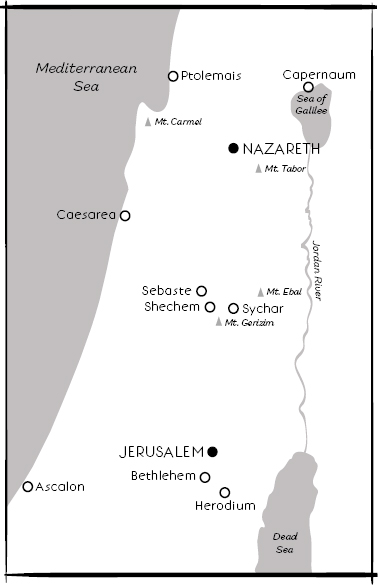
Facing north, Yeshua sat down and leaned back against the ledge. He could see snow atop Mount Hermon on the horizon. The Sea of Galilee was about 15 miles to the east. Mount Carmel stood due west, stretching to the Mediterranean Sea. When he faced east, there was Mount Tabor to his right. And as Yeshua looked over his shoulder and gazed south, he imagined mighty Yerushlem. It was about five days away on foot, across a sprawling plain.
He often waved to travelers in the distance, as they walked along the caravan route to and from Egypt. Occasionally, someone would spot him on the roof and wave back. The path wound its way through the hillsides of Nazareth. Yeshua could sling a stone and almost hit the trail from his roof. That’s where he saw his first horses. Roman soldiers riding them. Rugged. Muscled. Yet, they were gentle and beautiful animals. Horses were his favorite toys to carve.
Yeshua chewed on an olive pit, while he craftily whittled and smoothed a chunk of sycamore wood with his new blade. He had saved the scrap piece from his father’s shop. He was getting really good at making toys. His father, Yosef, had sold a couple recently. But this one was special. It was a gift for his friend, Ezra. They were headed to Yerushlem together for the Passover. How amazing it would be to visit the Temple for the first time. Just thinking about it made him laugh and shout for joy from the rooftop, “Ye-ru-shlem!”
Thousands and thousands of people would be traveling to celebrate the festival in the Holy City. He and Ezra would both turn 13 later this year. Each would make his formal dedication to Judaism in front of Nazareth’s whole Synagogue community. But the rabbi had said their first trip to Yerushlem would be incomparable. They would join Hebrew pilgrims from across the world, see the Temple High Priest, and perhaps meet some of the greatest thinkers anywhere — brilliant Jewish minds. Awesome.
Yeshua’s mom and dad made the Passover pilgrimage every year, but until now, he had been too young to go. It was a little scary and intense at festival time. For every visitor, there was a highwayman, a pickpocket, a professional beggar, or a street hawker. Younger children were vulnerable in big cities. So, every year, Yeshua had stayed behind with his grandmother or one of his great-aunts. They would celebrate the Seder dinner, eat lamb with neighbors, and pray for the safe return of his parents and everyone from the village making the journey.
But this year would be profoundly different. Yeshua would travel to Yerushlem and experience it with his friend. The city would overflow with pilgrims from places like Egypt, Africa, Persia, and Greece. Every Jew dreamed of observing Passover in Yerushlem, and reveling in the festival. There were more than a million Hebrew believers spread across the Roman world, and hundreds of caravans would follow the four roads that led to Yerushlem. And, of course, armies of Roman sentries would stand on duty. Some soldiers would mount battle-tested chargers to better manage the enormous crowds.
Yeshua carved Ezra’s horse with flaring nostrils like the one in the book of Job. He knew the Scripture passage by heart, and recited it as he scraped at the wood with his knife.
“Do you give the horse his strength,
and clothe his neck with a mane?
Do you make him quiver like a locust,
while his thunderous snorting spreads terror?
He paws the valley, he rejoices in his strength,
and charges into battle.
He laughs at fear and cannot be terrified;
he does not retreat from the sword.
Around him rattles the quiver,
flashes the spear and the javelin.
Frenzied and trembling he devours the ground;
he does not hold back at the sound of the trumpet;
at the trumpet’s call he cries, “Aha!”
Even from afar he scents the battle,
the roar of the officers and the shouting.”
(Job 39: 19-25)
As he said the words, he sculpted the steed in his hands. He could easily picture the majestic animal in real life, almost dancing with excitement. He had seen a horse dance once. Hearing the music from a wedding celebration, the stallion pranced in time with the rhythm. The thought made Yeshua’s heart skip with excitement.
When he closed his eyes to imagine the scene again, he saw several horses pressing against a large crowd. There was a man riding a donkey, and people waved palm branches and cheered for him.
“Yeshua!”
He opened his eyes, as if startled from a nap. It was his mother, Miriam, calling him to come down from the rooftop before it got too dark. The sun was setting now, as he put on his shirt and tucked the knife and carving into his belt for the climb down the ladder. He was still too young to sleep on the roof by himself. In the scorching summer months, he would follow his father up the ladder and spend the night under the starry sky. One time, Ezra had been allowed to join them. But it wasn’t quite warm enough to convince his parents to let them sleep outside tonight.
Besides, maybe he could do a little more carving before bed. He had to finish the horse soon if he hoped to give it to Ezra on their trip to Yerushlem. Putting wheels on the toy horse would be the hard part. But he had an idea about how to make them. He had watched his father craft wagon wheels many times. Yeshua would create the horse as if it had reared up on its hind legs. He’d attach its hooves to a wooden, wheeled platform that could be pulled on a string or pushed along by hand. Ezra and Yeshua were very competitive at board games and jacks. They both played to win. The horse would give them something to enjoy together just for fun. No winners and no losers.
Yeshua pulled down the ladder and stowed it inside his father’s shop. Yosef was about to latch the door for the night. His tools were valuable. He had axes and hatchets; an adze for shaping wood; an awl and drill to bore holes; nails; hammers for stone and wood; knives; chisels; wedges; saws; planers; a spoke shave; a rule; plumb-line; and compass. Each one took hours, even days to craft by hand. To make them, Yosef had ordered some of his metal components from a blacksmith in Ptolemais on the coast. The tools had to be carefully secured. The noisy bell on the wood door clanged as he shut it. Yeshua had helped his father fix the leather-strapped hinges. The door hung better now and would frustrate prowlers. Yosef couldn’t afford locks for the shop, but he tied and knotted a strap around the latch. For the most part, Nazareth was a very safe little village.
The family’s donkeys, sheep, and goats were already resting for the night in the outer room of the house, as Yeshua and Yosef ducked their heads to enter through the narrow door. Yosef bolted it. They hurried to step up into the inner room, leaving their sandals at the threshold. Yosef dipped his cup into the water bucket and took a long, slow drink. He sat away from the fire, near his wife to watch her work. Miriam was in the corner near the window, quietly singing while she wound flax on a spool. When the cooling breeze blew through her long, black hair, she leaned back and closed her eyes to savor its comfort. Her oil lamp flickered in the wind. She put down her work to brush her tresses. Miriam had brought the brush back from Egypt years ago. The wooden handle, once decorated with shells, was worn, but the flint bristles still did their job. Yosef put his hand on his wife’s shoulder and offered her some of his water.
Yeshua had settled down in the kitchen area, near the faint glow of another oil lamp. He worked a little more on the wooden horse, his knife reflecting the light.
When Yosef had finished his water, he crossed the room to Yeshua, leaned down and took the carving from his hands. He picked up the lamp and then carefully turned the toy over in the flickering light, inspecting the craftsmanship, smiling and nodding with approval.
“Like father, like son,” said Yosef. He beamed as he handed the toy back. Yeshua blushed at the compliment and smiled.
Yosef wasted no time walking over to his bed with the lamp, and took off his tunic. His body was ruggedly muscled, his hair long and greying. He knelt down at his mat to say his bedtime prayer. Yeshua closed the door to the outer room, and then he and Miriam joined Yosef.
“Praised are You,
Adonai, our God,
Ruler of the universe,
Who closes my eyes in sleep,
my eyelids in slumber.
May it be Your will,
Adonai,
My God and the God of my ancestors,
To lie me down in peace
And then to raise me up in peace.
Let no disturbing thoughts upset me,
No evil dreams nor troubling fantasies
May my bed be complete and whole
in Your sight.
Grant me light
So that I do not sleep the sleep of death,
for it is You who illumines and enlightens.
Praised are You,
Adonai,
Whose majesty gives light to the universe.”1
As Miriam put out the lamp, Yeshua said, “Amen.” The room was now totally dark, but for the dim orange glow of the coals in the kitchen. Yeshua could sense the light and warmth of His heavenly Father. He was in the breeze that blew in through the window, caressing Yeshua’s face as he drifted off to sleep.
chapter
TWO
THE AROMA OF FRESH BREAD BAKING IN THE outdoor oven woke Yeshua. His mom was a good cook. He loved to dip Miriam’s warm, soft bread in the olive oil she had pressed. She would make her loaves from barley, and when they could occasionally afford it, from wheat. Miriam would mix the coarse grain meal with water and salt, adding just a little sour dough from yesterday’s yeasty batch. That would make the bread rise.
“Mmmm!” Yeshua would say at the first bite of a warm and fluffy round loaf. But his favorites were her fried honey cakes. His grandma had taught Miriam how to make them. Every once in a while, she would cook up the sweet, doughy pastries. They would sizzle in the oil of the hot pan. But honey was expensive, so they didn’t have it often. Yeshua’s grandma always made the cakes when he visited.
He could hear Miriam grinding grain to make more flour with the millstone in the courtyard. The sun was barely up, but Miriam always rose with the rooster. She had already been to the well, fed the chickens, gathered eggs, and milked the goats. Later she would make cheese curds, tend the garden, and then do laundry in the stone washtub Yosef had made her.
Before Yeshua even opened his eyes he prayed quietly:
“I thank you, living and eternal king.
For returning my soul within me, in compassion.
Great is your faithfulness.”2
The first thing he saw that morning was his knife and the shape of the toy wooden horse he had been crafting. It looked pretty impressive in the early morning light. He would have liked nothing better than to climb back up on the roof and finish his masterpiece. But it was time to get ready for school.
Like most boys in Nazareth, Yeshua began attending classes when he was five. But Yosef and Miriam had taught him prayers and the stories from the Torah from the moment he could talk. When he was five, they had walked him to the Synagogue for classes that started at daybreak, six days a week. At noon every day, Yeshua met Miriam or Yosef at the door for the walk home.
When he got a little older, he started staying after school. Yeshua often helped classmates with their work. It was not uncommon for him to hang around the Synagogue to tutor Ezra or someone else, or to walk home with a friend to explain the day’s lesson.
“Yeshua, you have been fattened with the Torah,” his teacher would say, although he was not fat at all. Fortunately, he didn’t have a big head either. Most of his classmates really admired him, but he wasn’t popular because of his looks. Yeshua was ordinary on the outside, but his passion for the Word of God was extraordinary, and very contagious.
This morning, Yeshua was running a little late. He hadn’t heard his mother’s first call to wake him. He had been dreaming about the horse he was carving and how much Ezra would like it. When he smelled the bread baking, he knew he had overslept. Yeshua quickly pulled on his tunic.
He was in advanced studies now, and all his classmates were very competitive. Yeshua had morning classes and another session in the late afternoon. The work was demanding. When the boys turned ten years old, the lessons expanded to include both the written law of the Torah, plus the complex Jewish oral law. These were rabbinical, philosophical interpretations about the meaning of the Torah. Many generations of Israel’s spiritual minds had left their marks on Jewish tradition. These insights on the Torah were written down and were eventually compiled hundreds of years after Yeshua was born. They became the Talmud.
Secretly, Yeshua enjoyed these lessons because his teacher often used Midrash, like parables to explain them. Rather than simply raise a question and then refer to the law to answer it, his rabbi told stories. And the stories helped the students understand his teachings. At least it worked for Yeshua.
It was not uncommon for Yeshua to close his eyes and envision the story he was hearing. He had a vivid imagination. Maybe that’s why he was so good at carving. But every time he closed his eyes in class, Yeshua took a risk. The rabbi sternly punished daydreamers, sleepers, and slackers. Sometimes there were even spankings. Yeshua cringed at the thought. Arriving late was not recommended.
Yeshua quickly cleaned up at the water basin behind his home, near the garden. The beans and cucumbers were coming along. When he was done, Yeshua poured the water from the basin into the vegetable patch. He ran around the house and through the courtyard, shaking his hands dry before he grabbed a loaf at the oven. Miriam gave him a date from her apron, and he kissed her on the cheek.
He bowed his head and paused to give thanks as his stomach growled. The loaf had cooled, but it was still a little warm in his hand and would be delicious on the walk to school. Chickens cackled as he ran past them toward the road. Yosef was nowhere in sight, and his wagon and one donkey were already gone. The shop door was closed.
Fortunately, Synagogue school wasn’t far, but Yeshua had to run through the marketplace to take the shortcut. There was always something going on that could slow down a 12-year-old boy. A visiting merchant might be hawking pepper from India or fine olive oil from Palestine. A beggar might have news from a distant town. Maybe the fishmonger had both fresh and dried catch to sell. Everybody had stories. Many of them knew Yeshua because Yosef was the village’s chief carpenter. His father had been a carpenter, too. So had Yosef’s grandfather and his great-grandfather. But Yeshua had other plans. Although he really liked to work with his hands, he was following his heart. He wanted to be a rabbi.
While he munched his breakfast and walked to school, he thought he might be able to do both jobs. After all, the Synagogue always needed repairs and improvements. He could teach and preach on the Sabbath, and then find time to practice his craft between classes during the rest of the week. But as he considered the possibilities, he realized there probably wasn’t enough time in a day to do both jobs well. Yeshua was growing wiser.
Approaching the schoolroom, he noticed there was no one standing outside the door. He ran as fast as he could, his sandals slapping the dirt path. When he looked inside the door, the classroom was empty. What was happening?
Through the window, Yeshua could see his rabbi sitting under the almond tree and the students approaching him. He raced around the building to catch up with them. When he turned the corner, he found Ezra waiting. He had already grabbed Yeshua’s wax writing tablet and stylus. Yeshua patted Ezra on the back and thanked him.
“No problem,” Ezra replied.
The two boys were as close as brothers. Yeshua had met Ezra before they started school. Ezra had trouble walking. Some of the women in the village said he had been swaddled improperly as a baby. Actually, his right leg was just a little shorter than his left.
When Ezra was about two years old, his mother, Deborah, had come to Yosef and asked him to fashion a little crutch for her son. Yosef made the crutch, and he brought Yeshua and Miriam with him to deliver it to Ezra and his mother. Deborah was a widow, so Yosef wouldn’t think of charging her. Deborah insisted on giving him something in return. Miriam suggested that Yeshua and Ezra play together because Yeshua needed a friend. They became inseparable.
As the two boys sat down for the outdoor class, Yeshua made sure Ezra’s cane was in a safe spot. In fact, Yeshua had made it for him, and carved Ezra’s name in the handle.
Today’s lesson was the Passover celebration, and the foods that were either prescribed or forbidden during the special holy season. Immediately, Yeshua and Ezra shared a smile. They knew they would be in Yerushlem in just a week, celebrating the festival in the Holy City. They would visit the Temple and share the Seder of lamb, unleavened bread, wine, bitter herbs and spices, with a multitude of Jewish people.
“Why is this night different from all other nights?” asked the rabbi.
Yeshua had asked the question every year at Passover, since he could remember. It was tradition for the youngest child to be curious and to ask about the divine events that had freed the Jewish people from Egypt and the Pharaoh’s heartless grasp.
Each student in Yeshua’s class was well versed in the questions of the Seder and the correct answers.
The rabbi continued. “Why is it that on all other nights during the year we eat either leavened bread or unleavened bread, but on this night we eat only unleavened bread?”
In his head, every boy could hear his grandfather or father respond, “We eat only unleavened bread because our ancestors could not wait for their breads to rise when they were escaping slavery in Egypt. So, the loaves were flat when they came out of the oven.”
“Why is it that on all other nights we eat all kinds of vegetables, but on this night we eat only bitter herbs?” the rabbi asked.
He reminded the students that they only eat maror, a bitter herb, to remember the bitterness of slavery the Israelites endured in Egypt.
He posed the next question. “Why is it that on all other nights we do not dip our food even once, but on this night we dip them twice?”
The rabbi explained, “The first dip of green vegetables in salt water is a symbol that says we are replacing our tears with gratitude. The second dip of maror in charoses, a fruity paste, represents the sweetening of our burden of bitterness and suffering.”
He continued. “Why is it on all other nights we dine sitting or reclining, but on this night we all recline?”
The answer came from Benjamin, the rabbi’s son. “We recline at the Seder table because in ancient times, a free person reclined at a meal and slaves and servants stood.”
Finally, the rabbi posed the fifth question: “Why is it that on all other nights we eat meat either roasted, marinated, or cooked, but on this night it is entirely roasted?”
He looked directly at Ezra, who was quick to respond with a confident smile. “We eat only roasted meat because that is how the Passover lamb is prepared during sacrifice in the Temple at Yerushlem.”
Yeshua closed his eyes and imagined the aroma of lamb and goats sacrificed at the Temple. Meat was not part of everyday meals. But the Passover festival was a unique celebration, and food had always been an important element of the tradition. It honored God’s glorious salvation of His people. He had rescued them from the Egyptians and their oppressive and stubborn ruler.
When he was very young, Yeshua and his family had spent several years hiding in Egypt. Ironically, instead of running from a Pharaoh, they had to elude the King of Israel who wanted to kill baby Yeshua. That’s how Yosef and Miriam had explained it to their son. He had been born in Bethlehem, his father’s hometown. Yosef and Miriam had travelled there from Nazareth to obey the Roman law and to report for the census. Jews hated the idea of a census. It suggested they were being counted as servants and controlled by men, instead of being God’s people. But most complied.
In fact, there were so many people in Bethlehem when Yosef and Miriam arrived that they couldn’t find a place to stay. And Miriam had already begun to experience labor pains. Yeshua was her first child, so they had a little time. Her labor would likely last all day. However, she had ridden a donkey for days, all the way from Nazareth. The bumpy motion only hastened the process.
When traveling, people stayed with family whenever possible. Everyone knew that roadside inns were risky places. Proprietors were often shady characters, squeezing the most they could out of their patrons. In return, travelers received little food and only basic accommodations. The Romans had adopted a special set of laws designed to protect weary travellers from greedy innkeepers.
Yosef had stopped in on relatives, but their homes were filled with other guests and some were sick. The couple didn’t dare have their newborn where people were ill. The inns overflowed. Every floor mat was taken. The baths and latrines were jammed. Tent cities popped up everywhere. People packed the eateries, so folks had to buy food from street merchants, dining anywhere they could find a little cover. Yosef was parched and beyond hungry, but he could only think about finding a comfortable place for Miriam to rest and have their baby.
As they approached the edge of town, Yosef became concerned for their safety. The sun was setting, and with so many visitors in Bethlehem, a man with a very pregnant woman to protect would be easy prey for robbers. Yosef gripped his staff tightly as he led the donkey past a group of men entering the town from the south. They had camels, so they were likely from Egypt or another desert region.
Bethlehem was a short distance south of Yerushlem, so there were plenty of people moving through, looking for any space near the major city to rest for the night. In fact, Yosef and Miriam had journeyed through Yerushlem just a few hours earlier, stopping for a quick snack on the street. The crowds were enormous, and the traffic was snarled with animals, vehicles, and Roman soldiers. Census takers were lined up, but there were too many heads to count quickly.
The young couple from Nazareth had to register in Bethlehem, but they made time to stop at the Temple gates and pray. It was a little while later that Miriam’s contractions had started.
Now, after traveling through the Holy City, they arrived at Bethlehem’s southern gate; their last hope was an inn near the livery. The inn was always busy because it was so close to the Temple. It hosted caravans, and many people rented two-wheeled and four-wheeled carts and carriages from the livery stable.
Those fortunate enough to be rich traveled in private carriages and parked them under the inn’s few private rooms. Yosef hoped someone would be kind enough to squeeze them in. Oftentimes, many travelers shared a single space, but with the census, plus the typical traffic near the big city, the young family would have to rely on the grace of God to see them through.
Yosef knocked hard at the door, but no one answered. He knocked again, and then again even harder. No answer. But there was plenty of noise coming from upstairs, inside the innkeeper’s apartment. Miriam shrugged her shoulders. Yosef led the donkey with Miriam aboard around the side to stand under the apartment window. He began to shout, “Anyone home?”
Splash!
Water came pouring out of the window above. The innkeeper’s wife had emptied a huge basin, soaking Yosef’s feet.
“Hey, watch what you’re doing!” Yosef yelled, startling the woman.
“Well, it’s hard to find an open piece of dirt in this town tonight,” she shouted. “Why didn’t you come to the door?”
“I did, but no one answered. And I knocked plenty,” Yosef said. “My wife is about to have our son. Can you help us get a room?”
“How do you know it’s a son?” she asked.
“We know. God’s messenger told us it’s a boy,” Miriam responded.
“Well, he should have told you we’re full,” the woman chuckled. “Besides, this is no place to have a baby tonight. Much too crowded and crazy. You’ll be better off in one of the stables. You can use the one here, under our apartment. Of course, I’ll have to charge you for your animal and the price of a room.
“There’s plenty of fresh straw there, and I’ll bring down some water in a few minutes. My sister, Chaviva, is our town midwife. I have some cloth for swaddling,” she offered. “My name is Adina.”
And a few hours later, that very night, Yeshua was born under a heavenly, starry sky. He loved to hear his parents tell that story and many other exciting details of his birth. People had come to visit him that evening, including some from the roads. Others were shepherds from the fields who had heard about his birth. Chaviva and Adina proved to be very helpful. They were astonished to see so many people coming to visit Yeshua. The shepherds said angels had told them of a savior’s birth. He was the long promised Messiah, they claimed. The angels had pointed to Bethlehem, and encouraged them to find the swaddled baby there, lying in a manger. It was “a sign from the Lord,” they rejoiced. Adina remembered what Miriam had said about God’s messenger – how she knew she was going to have a son. Adina was a little shaken by the coincidence.
But there was also a terrifying part of the story. Shortly after Yeshua’s birth, King Herod the Great had ordered his guard to slaughter all male children in and around Bethlehem who were two years old or younger.
It was an unthinkable, evil command. The king was insanely jealous, all because he had heard a prophecy from three travelers. They said that the Messiah, a king sent by God himself, had been born in Bethlehem, the city of David. Herod felt threatened. He had already been forced to share his power with Roman occupiers. And now three wise men, who studied the constellations, were telling him that a brilliant star had stopped over Bethlehem to mark the birthplace of God’s anointed ruler. And Yeshua was that child!
Herod was an enormously proud person. He wanted to be remembered as a greater king than Solomon. Not because he shared Solomon’s love for wisdom and justice. The king was hungry for power and wealth. Herod had actually dismantled much of the Temple and was building anew on its foundation. His objective: a renovation that was even larger and grander than Solomon’s Temple.
Hundreds of years earlier, the Babylonians had destroyed Israel’s first Temple, the one built by King Solomon. Fortunately, after a time, the Babylonians no longer ruled Israel, and the people had been able to construct a new Temple. This second sanctuary was much simpler, but a fitting house of God where everyone could worship.
Hundreds of years later, when Herod became king, he was unsatisfied with the simple house for Yahweh. He set out to create a Temple so large and opulent that it surpassed imagination. Herod really had no idea what Solomon’s Temple had looked like, but he was convinced his would be unparalleled.
Just how big was Herod’s Temple? He had 1,000 wagons built to haul stone. Ten thousand workers and craftsmen were assigned to the job. Among them were 1,000 priests that the king had trained as masons and carpenters. Herod wanted priestly hands to build his majestic house of worship.
But the thought of God sending a new baby boy king made Herod’s blood boil. How could God do this to him? After all, wasn’t he building a magnificent Temple for Yahweh? Of course, Herod’s Temple wasn’t really for God. He was constructing a monument to his own pride. And if he had to kill dozens of babies to defend his throne, so be it.
Yahweh had other plans. He sent an angel to Yosef in a dream, warning him that the evil king was plotting to find and murder baby Yeshua.
So, Miriam and Yosef followed the angel’s instructions and escaped safely to Egypt. Frustrated, Herod would order the slaughter of the innocents in Bethlehem, in hopes of killing the newborn king. Yeshua’s family remained in hiding among the Egyptians until Herod the Great died. That’s when they were able to return to the Holy Land and the town of Nazareth, and to introduce their family and friends to young Yeshua.
Finally, in just a few days, Yeshua would be headed back to Yerushlem. He hadn’t been there since he was a tiny baby, but not much had really changed. At first, Herod’s son, Archelaus, had taken over after his father’s death. He was every bit as evil and oppressive, but unable to maintain peace in the capital. After one Passover riot, Archelaus called in troops. The battle led to 3,000 deaths. Rome took over, and assigned the first of their many military leaders to stabilize and rule Yerushlem with force. As an adult, Yeshua would meet one of Herod’s other sons, Antipas, and the Roman governor, Pontius Pilate.
It didn’t matter who was in charge of the Holy City. Yeshua wasn’t afraid. He knew his heavenly Father would be watching his every step on the road to Yerushlem.
chapter
THREE
EZRA WAS SICK. VERY SICK.
In just a few days, the caravan from Nazareth would begin its Passover pilgrimage, but Ezra wasn’t in school. When Yeshua came home, he immediately ran to see his friend. Deborah met him at the door.
“Your friend is too sick to visit, Yeshua. He has a very high fever,” Deborah warned. “And a terrible headache. The doctor has been here already, but the balsam sap hasn’t relieved his pain. I tried mustard oil, but he’s still hurting so much.”
Yeshua could see Deborah was distraught. She had been crying. He touched her hand to console her, and he told Deborah they should go inside and pray for Ezra. She was grateful for his compassion, but reluctant to allow him to see Ezra. She couldn’t bear the thought of him getting sick, too.
Yeshua reached into his satchel and pulled out the horse he had carved for Ezra. For a moment, a smile lit up Deborah’s face. She knew Ezra would appreciate the toy. The carving was impressive, and it might distract Ezra from his pain. She nodded approval and touched Yeshua’s face to thank him. Quietly, they slipped inside the house.
Ezra lay on a mat in a darkened room, near a small crock with embers burning inside. Flushed with fever, he shivered. As soon as he caught a glimpse of his mother entering the room with Yeshua, he sat up. Yeshua put out his hand and urged him to lie down.
Tears started to run down Ezra’s face. “I’m sorry, Yeshua. My mom says I can’t go to Yerushlem for Passover. I’m too sick. But I think I’m gonna be better after the Sabbath,” Ezra said as he wiped his eyes.
The Sabbath would begin at sundown, in just a few hours. Yeshua and Ezra both knew he would never feel well enough to leave for Yerushlem on Tuesday. The trip would be too demanding, even if he rode in a cart the whole way. He could become a burden for the entire caravan. Even a healthy Ezra would be challenged by the long trip because of his limp. But weakened by fever, Ezra could die.
Yeshua knelt down next to his friend and reached into his shoulder bag. When he pulled out the horse, Ezra could hardly believe his watery eyes. Yeshua handed it to him; then he moved over to the window to remove the shade Deborah had draped over it. The sunlight was a bit too bright for Ezra, but now he could really see the detail in the horse. He lit up and reached for his cane to stand. His mother intervened.
“What a wonderful horse,” said Ezra. “It’s so real!”
Ezra made the sound of a rearing steed. He coughed as he laughed.
Squinting with pain from his headache, and with one eye closed, he said, “The wheels are excellent.” Ezra turned them with his fingertips, admiring their smooth rotation. He set the horse on the dirt floor and pushed it with his hand.
“A rich boy’s father will pay you a whole shekel for this toy in Yerushlem,” he exclaimed. It was a quite an exaggeration, and it made both boys laugh. Ezra loved to joke about becoming rich. His late father, Abram, had been a merchant. Since his death, Ezra and Deborah had been just getting by. The widow and her son had to rely on the generosity of others. Abram had no brother to marry his widow, as was the custom. Fortunately, Abram had saved some of his earnings, but as the years went by, that inheritance grew smaller and smaller.
Yeshua knew just what to say to make Ezra feel a little better. He told him the toy horse was for him. He explained he’d been working on it for a month, and had hoped to give it to Ezra on their journey to the Temple.
“I don’t know what to say,” Ezra responded. “No one ever gave me anything like this. You’re a brother to me, Yeshua.”
Deborah was overwhelmed by the genuine love between the two boys. There was something inspiring, even spiritual about it. It was rare to see such unselfishness and concern between two young men. But she was worried that Ezra was getting too excited, and that his fever might become worse.
In his heart, Yeshua knew he could heal Ezra. He could call on his heavenly Father, and He would grant him any request. But he also knew it was not his time to act as the Messiah. He understood it was not God’s will that he behave like a little magician or a medicine man.
As much as Yeshua loved his dear friend, Ezra, he would not ask his heavenly Father for a miracle to instantly end his suffering. But he would ask for a blessing that would heal his friend, if that healing were his Father’s will.
Yeshua helped Deborah calm Ezra, and then he asked that together they recite the Mi Sheberakh. It was a traditional healing prayer recited at Synagogue after a reading of the Torah. Since Ezra was too sick to attend Synagogue, perhaps Deborah or a friend like Yeshua would be called up to the Torah, and then the rabbi would offer the prayer.
But today, Yeshua stretched out his arms, and raised them to pray as he knelt at Ezra’s side.
“May the One who blessed our ancestors —
Patriarchs Abraham, Isaac, and Jacob,
Matriarchs Sarah, Rebecca, Rachel, and Leah —
bless and heal the one who is ill —
Ezra son of his late father, Abram and his mother, Deborah.
May the Holy Blessed One
overflow with compassion upon him,
to restore him,
to heal him,
to strengthen him,
to enliven him.
The One will send him, speedily,
a complete healing —
healing of the soul and healing of the body —
along with all the ill,
among the people of Israel and all humankind,
soon,
speedily,
without delay,
and let us all say, Amen!”3
Both Deborah and Ezra said, “Amen.” But Deborah didn’t know what else to say after that. She was grateful for the powerful prayer, but so surprised Yeshua had said it outside the Synagogue. He had demonstrated such confidence, reciting it from memory. It was as if he had written it — as if he were having a personal conversation with Yahweh.
Then she noticed Ezra. He was sleeping comfortably. All the excitement must have been too much for him. She touched his face and forehead. They were very hot, but it was good to see him finally relax and rest.
Yeshua helped Deborah up from her knees. She showed him to the door, and offered him cool water and some dried figs for his walk home. Otherwise, she was speechless. The experience had been so calming and yet so untraditional.
“Thank you for your kindness, Yeshua,” she said finally, with a warm smile. “I’ll never forget this day.”
He touched her arm and nodded, asking her to be sure to tell Ezra he’d stop by before leaving for Yerushlem. Yeshua spoke as if he knew Ezra would feel better soon.
This was the journey both boys had been dreaming about their whole lives. If Yeshua had to travel without Ezra, he had to know his friend was well.
chapter
FOUR
IT WAS VERY EARLY TUESDAY MORNING. Yeshua called to Ezra through the open window. The sun had barely risen, but a shaft of light brightened the inner room.
Ezra opened his eyes and saw Yeshua in a shadowy silhouette. He quickly sat up and smiled. No blinding headache. No chilly feeling. No shakes. No sweating. No fever.
“I feel a lot better,” Ezra exclaimed. He picked up the toy horse that had been standing at his bedside.
“I spent the whole Sabbath sleeping,” he said. “Every once in a while, I’d wake up and drink something and eat a little bit. My mother let me play with the horse after sundown. That’s when I felt stronger. The fever broke.”
Yeshua laughed with joy. His friend Ezra grabbed his cane, and hobbled over to the window, holding the horse in his free hand. He set it on the sill in front of Yeshua. They both admired it.
“I have a name for the horse,” said Ezra. “I’m calling him Thunder.”
Yeshua liked the name. He was happy to see his friend enjoying his gift, but he was far more grateful that Ezra was healthy. And then Yeshua reached through the window, and put his hands on his friend’s shoulders. He began to quietly sing a Psalm of thanksgiving from memory:
“Shout joyfully to the LORD, all you lands;
serve the LORD with gladness;
come before him with joyful song.”
Yeshua’s singing voice was about average, but his praise was strong and true. After a few verses, Ezra joined him. His mother heard the boys and stepped into the inner room, as well. They sang together in gratitude for Ezra’s recovery.
“Know that the LORD is God,
he made us, we belong to him,
we are his people, the flock he shepherds.
Enter his gates with thanksgiving,
his courts with praise.
Give thanks to him, bless his name;
good indeed is the LORD,
His mercy endures forever,
his faithfulness lasts through every generation.”
(Psalm 100:1-5)
As they concluded their prayer, Deborah said, “you will make a fine rabbi one day, Yeshua.” Ezra agreed.
Yeshua blushed. He told them that he and his family had gone to Synagogue on the Sabbath, of course. The whole congregation had prayed for Ezra’s health. They would all be delighted to know he had recovered.
Yet, this was a sad moment. Yeshua would have to leave behind his best friend and travel to Yerushlem without him. Ezra was not well enough to make the trip. It would be risky. He needed time to fully recover, to prevent a recurring fever. The trip was out of the question. The friends wouldn’t see each other again for three weeks, with no way to communicate. There were private couriers for the wealthy, but no mail service. Of course, Caesar Augustus and the Roman army had their messengers, but the masses relied on the kindness of strangers to carry their letters. Yeshua might be able to find a friendly traveler headed past Nazareth to deliver a note, but there would be thousands of people in Yerushlem looking for willing messengers. And what would he write on? He couldn’t really afford to buy parchment, unless it was an emergency.
Ezra would be thinking about Yeshua, and Yeshua would miss Ezra. They had planned to enter the Temple together for the first time, hand in hand. Since Ezra’s father was dead, Yosef would give both boys a tour. Next year, they would come of age in the Israelite nation, and be full members of their Synagogue in Nazareth. And then they could make the Passover pilgrimage to the Temple as men. They would be old enough to fully participate in the worship services. In fact, in just a few years, they could even take wives and marry.
In those days, the men of the family typically arranged marriages. Two fathers would get together and negotiate a match between one father’s son and the other’s daughter. The bridegroom was usually between the ages of 17 and 18. His father would approach the bride’s father, and they would haggle over a price for the woman. Most times, the bride was a little younger than her husband, as young as 13.
A daughter had real value because a groom would pay for her hand in marriage. A father expected to be compensated for the loss of a woman in his family and all the work she could do.
Although neither Ezra nor Yeshua was considering marriage at the moment, they were planning their futures. And the time together on the road was going to be invaluable. Ordinarily, they just didn’t have the opportunity to talk like they would on a three-week journey. They were busy with school and work around their homes.
From sun up to sun down, there was always something to do. Life was a full-time job. Everyone in the family had to participate because everything had to be made or built from scratch. And there was very little money to buy things they needed. If you couldn’t make it or grow it, you might have to barter. Yosef could trade his work to make a set of wagon wheels for four pairs of sandals, a few chickens or several jugs of Sabbath wine. Between Yosef’s paying carpentry and masonry jobs, he always had a side project for Yeshua.
Miriam was constantly busy cooking; cleaning; nurturing the garden; spinning fibers and making garments; washing and mending clothes; building fires; fetching water at the well; trimming wicks; and filling lamps with oil.
When Yeshua wasn’t under Yosef’s wing, Miriam would find something for him to do. Even if it was just running to the well for more water, or fixing the doors on the chicken coop. And because there were no bright lights, most work had to be done while the sun was up.
Time with friends was precious.