
Edited by Edward Hall and Roger Warren

OBERON BOOKS
LONDON
WWW.OBERONBOOKS.COM
First published in 2012 by Oberon Books Ltd
521 Caledonian Road, London N7 9RH
Tel: +44 (0) 20 7607 3637 / Fax: +44 (0) 20 7607 3629
e-mail: info@oberonbooks.com
www.oberonbooks.com
Text of Twelfth Night copyright © Propeller, 2012
Individual contributions copyright © the contributors, 2012
Propeller is hereby identified as author of this work in accordance with section 77 of the Copyright, Designs and Patents Act 1988.
Propeller has asserted its moral rights.
All rights whatsoever in this play are strictly reserved and application for performance etc. should be made before commencement of rehearsal to Propeller, Highfield, Manor Barns, Snowshill, Broadway, Worcs., WR12 7JR +44 (0)1386 853206.
No performance may be given unless a licence has been obtained, and no alterations may be made in the title or the text of the play without the editors’ prior written consent.
You may not copy, store, distribute, transmit, reproduce or otherwise make available this publication (or any part of it) in any form, or binding or by any means (print, electronic, digital, optical, mechanical, photocopying, recording or otherwise), without the prior written permission of the publisher. Any person who does any unauthorized act in relation to this publication may be liable to criminal prosecution and civil claims for damages.
A catalogue record for this book is available from the British Library.
PB ISBN: 978-1-84943-422-5
EPUB ISBN: 978-1-84943-659-5
Cover design by James Illman. Mask designed and made by
Michael Pavelka for Propeller’s production of Twelfth Night.
Production images © Manuel Harlan.
Printed, bound and converted
by CPI Group (UK) Ltd, Croydon, CR0 4YY.
Visit www.oberonbooks.com to read more about all our books and to buy them. You will also find features, author interviews and news of any author events, and you can sign up for e-newsletters so that you’re always first to hear about our new releases.
Cast and Production Team
Edward Hall on Propeller
Kinds of Love: Twelfth Night
Designing Twelfth Night
Music in Twelfth Night
Twelfth Night
Propeller’s Twelfth Night was first performed at the Old Vic, London, on 5 January 2007 with the following cast:
FESTE Tony Bell
ORSINO, Duke of Illyria Jack Tarlton
CURIO, his servant Jon Trenchard
VIOLA, later Cesario Tam Williams
SEBASTIAN, her twin brother Joe Flynn
A SEA CAPTAIN Dominic Tighe
OLIVIA Dugald Bruce-Lockhart
MALVOLIO, her steward Bob Barrett
SIR TOBY BELCH, her uncle Jason Baughan
MARIA, her gentlewoman Chris Myles
SIR ANDREW AGUECHEEK, suitor to Olivia Simon Scardifield
ANTONIO, a sea captain Alasdair Craig
A PRIEST Jon Trenchard
ENSEMBLE/UNDERSTUDY Tom McDonald
Other parts played by members of the company.
It was subsequently performed at:
Perth Festival, Australia
Hong Kong Festival
Brooklyn Academy of Music, New York Cambridge Arts Theatre
The Lowry, Salford
The Lighthouse, Poole
Yvonne Arnaud, Guildford
The Everyman, Cheltenham
Oxford Playhouse
Teatro Grassi, Milan
Neuss, Germany
The Watermill, Newbury
Twelfth Night was revived at the Belgrade Theatre, Coventry, on 8 November 2012, with the following cast:
FESTE Liam O’Brien
ORSINO, Duke of Illyria Christopher Heyward
CURIO, his servant Arthur Wilson
VIOLA, later Cesario Joseph Chance
SEBASTIAN, her twin brother Dan Wheeler
A SEA CAPTAIN Benjamin O’Mahoney
OLIVIA Ben Allen
MALVOLIO, her steward Chris Myles
SIR TOBY BELCH, her uncle Vince Leigh
MARIA, her gentlewoman Gary Shelford
SIR ANDREW AGUECHEEK, suitor to Olivia John Dougall
ANTONIO, a sea captain Finn Hanlon
A PRIEST Arthur Wilson
OFFICERS Lewis Hart, Darrell Brockis
Other parts played by members of the company.
PRODUCTION TEAM
Director Edward Hall
Designer Michael Pavelka
Lighting Designer Ben Ormerod
Music by Propeller
Vocal arrangements and additional music direction by Jon Trenchard
Text adapted by Edward Hall and Roger Warren
Sound David Gregory
Associate Director Dugald Bruce-Lockhart
Assistant Director George Ransley
Company Manager Laura Routledge
Production Manager Nick Ferguson
Costume Supervisor Laura Rushton
Stage Manager Edward Salt
Deputy Stage Manager Eleanor Randall
Assistant Stage Manager Janine Bardsley
Wardrobe Mistress Bridget Fell
Assistant to the Editors Angie Kendall
Production Photographer Manuel Harlan
Development Manager Cathy Baker
General Manager Nick Chesterfield
Executive Producer Caro MacKay
It was subsequently performed at:
Yvonne Arnaud Theatre, Guildford
Theatre Nanterre-Amandiers, Nanterre
Festival Temporada Alta, Girona, Spain
Theatre Royal, Norwich
Theatre Royal, Plymouth
The Power Center, Ann Arbour, Michigan
Guthrie Theatre, Minneapolis
The Lowry, Salford
Everyman Theatre, Cheltenham
Rose Theatre, Kingston
Theatre Royal, Newcastle
Teatro Giorgio Strehler, Milan
Theatre Royal, Nottingham
Festival de Otono a Primavera, Madrid
Globe Theatre, Neuss, Germany
Marlowe Theatre, Canterbury
Hampstead Theatre, London
The tour was presented in association with the Touring Partnership, funded by the Arts Council of England and sponsored by Coutts & Co.
Propeller is a theatre company inspired by Jill Fraser, which began life at the Watermill Theatre in Newbury, Berkshire in 1995. Since then we have been touring Shakespeare all over the world and have now grown in scale whilst still managing to retain the close-knit family feel that has always been such an important part of our work. We like to mix a rigorous approach to the text with a modern physical aesthetic. We have been influenced by mask, animation, classic and contemporary film and music from all ages.
Propeller always places the actor at the centre of the story-making process, which is exactly how it was in Shakespeare’s day. The Elizabethans were denied the modern luxuries of elaborate sets and lighting, instead relying on the skills of the actors themselves to help imagine the plays on stage in every way they could. And so it is with us. A Propeller actor is as likely to find himself shifting scenery, singing or playing rock and roll guitar, as he is to be playing his part on stage in a scene. Over the years, actors with many different skills have passed through the company, from tap dancing champions to highly skilled singers and musicians. Our work has become more and more intricate, needing choreography, musical arrangements and fight direction. At no time have we ever used an outside choreographer or composer to help us with this work. It is all generated from within the company, giving them true ownership of the work they are creating. These editions of some of the texts we have performed are designed to give the reader an idea of how we approached each production from text choices down to doubling schemes, design and music.
Edward Hall
Twelfth Night is an ambiguously erotic play. It dramatizes many different kinds of love, ranging from Orsino’s and Olivia’s love for Viola/Cesario, Antonio’s for Sebastian, and the love felt by the twins for one another, to Malvolio’s deluded love for Olivia, and, on a more basic level, the relationship, and eventual marriage, of Sir Toby and Maria. Orsino is wooing Olivia from afar, but has no real relationship with her; much nearer to home is his obvious, and immediate, attraction to his apparent servant, Viola/ Cesario. Viola comes into the claustrophobic world of Orsino and Olivia, and turns it upside down. She awakens, brings to the surface, the potential for emotional fulfilment in Orsino and Olivia, especially in the great central scene where she obliquely declares her love for Orsino in the allegory of a sister who died of love:
She never told her love,
But let concealment, like a worm i’th’ bud,
Feed on her damask cheek; she pined in thought,
And with a green and yellow melancholy
She sat like patience on a monument,
Smiling at grief.
‘Smiling at grief’: the phrase trenchantly summarises the bitter-sweet tone of the play, its beautifully sustained balance between laughter and tears.
Shakespeare probably wrote Twelfth Night in 1601, at roughly the same time as Hamlet, when he was at the height of his powers, so its theatrical mastery is not surprising. But his personal experiences may have contributed to that achievement. The sexually ambiguous figure of Viola/Cesario seems very closely related to the male lover of the Sonnets, whom Shakespeare calls ‘the master-mistress of my passion’. Again, when in her speech quoted above, Viola goes on to say that she is ‘all the brothers’ of her father’s house, she increases its ambiguous potential: she is expressing her love for Orsino, but also for the twin brother she thinks is dead. The twins introduce a vein of particularly intense emotion into Twelfth Night. Shakespeare was the father of twins, Judith and Hamnet. Judith lost her brother at the age of eleven, in 1596, and Shakespeare may have known what modern research into bereaved twins has demonstrated: that the death of a twin seems to cause a particularly intense sense of desolation, so that the surviving twin often tries to ‘compensate’ for the loss by attempting to assume the other’s identity, as Viola does in assuming her brother’s persona for her male disguise.
The Malvolio subplot presents a love story of a different kind — though perhaps with another connection between the play and its author. In Sonnet 62, Shakespeare accuses himself of the ‘sin of self-love’, the very fault Olivia criticises in Malvolio. This plot moves from the broad comedy of the letter and yellow stockings scenes to something much harsher: the attempt to drive Malvolio mad, shutting him up in a ‘dark room’ or prison. In this scene, Malvolio is tormented by his adversary Feste, who subsequently tells him that ‘the whirligig of time brings in his revenges’. But Feste is not merely a revenger; he seems to encapsulate the whole tone of the play: when, for instance, he compares Orsino’s mind to an opal — a gem that changes in the light — he catches its shifting, sweet-sour mood. He holds up mirrors to the other characters, penetrating Viola’s disguise, criticising Orsino’s love-melancholy, or exposing the excess of Olivia’s mourning for her brother. His final song emphasises that the rain raineth every day — but at the same time he tells the audience he wants to please them. So this ambiguous play ends ambiguously: after all, its subtitle in the 1623 Folio is ‘What You Will’.
Roger Warren
For their 2012–13 tour, Propeller revived their pairing of Twelfth Night and The Taming of the Shrew, first seen in 2006–7.
These plays present families in crisis and each puts domesticity under the spotlight. The image of home, something we cherish and regard as a sanctuary, provides a scenic framework to present both plays. Olivia’s household is air space for a family suspended in the holding pattern of liminal mourning, stalked by deadpan satirical comedians and uncles preferably edged out of family snapshots. For me it conjures the existential books, films and dramas of the 1950s, of the Parisian chic intelligentsia of Cocteau or Sartre. The perfect reference point for our scenic world surfaced early on in my design process, a film that had got under my skin thirty years ago, the enigmatic and claustrophobic black and white classic, L’année dernière à Marienbad.
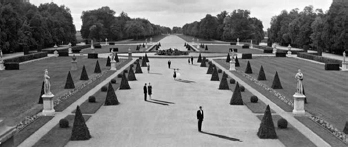
Reference for Propeller’s designed world for Twelfth Night; Alan Resnais’ existential classic movie, L’année dernière à Marienbad.
Desaturated of colour, Feste’s followers, our masked chorus, put on a face, revel and delight in oiling the whirligig of time — they constitute the ‘pack’ that bedevils Malvolio and perhaps anyone else who dares to dream. They’re cool, sometimes menacing. Their clothes could be equally at home in a Tarantino movie.
The play asks us to reflect on the ironies of life and the characters are given chances to scrutinise their attitude to love in all its guises. Illyria is shaped and reshaped by the strangely absent adult generation’s wardrobes. After the possibility of childhood fables in amongst the mothballs, furs and dinner suits, encounters with lions and witches, the occupants have now degenerated into darker recesses where adolescents and young adults question themselves before engineering transformations and springing revelations. I look to the personas projected by twentieth-century artists. Their images and mythologies may have become more firmly fixed in our consciousness than the work they produce: René Magritte, Gilbert and George, Joseph Beuys, and others.
So…this Propeller project’s design brief is about morphing, introspection and celebration — an unusual mix of motivations: but isn’t that why we are continually fascinated by the themes that Shakespeare uniquely offers us to scrutinise, reinvent and make both visually and metaphorically meaningful for our own times?
Michael Pavelka
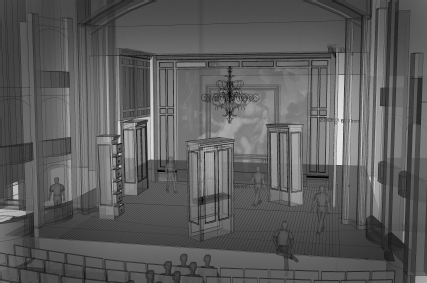
Screen capture of the computer aided design model for the set of Twelfth Night