
This edition first published 2017
© 2017 Christopher B. Strain
Registered Office
John Wiley & Sons, Ltd, The Atrium, Southern Gate, Chichester, West Sussex, PO19 8SQ, UK
Editorial Offices
350 Main Street, Malden, MA 02148-5020, USA
9600 Garsington Road, Oxford, OX4 2DQ, UK
The Atrium, Southern Gate, Chichester, West Sussex, PO19 8SQ, UK
For details of our global editorial offices, for customer services, and for information about how to apply for permission to reuse the copyright material in this book please see our website at www.wiley.com/wiley-blackwell.
The right of Christopher B. Strain to be identified as the author of this work has been asserted in accordance with the UK Copyright, Designs and Patents Act 1988.
All rights reserved. No part of this publication may be reproduced, stored in a retrieval system, or transmitted, in any form or by any means, electronic, mechanical, photocopying, recording or otherwise, except as permitted by the UK Copyright, Designs and Patents Act 1988, without the prior permission of the publisher.
Wiley also publishes its books in a variety of electronic formats. Some content that appears in print may not be available in electronic books.
Designations used by companies to distinguish their products are often claimed as trademarks. All brand names and product names used in this book are trade names, service marks, trademarks or registered trademarks of their respective owners. The publisher is not associated with any product or vendor mentioned in this book.
Limit of Liability/Disclaimer of Warranty: While the publisher and author have used their best efforts in preparing this book, they make no representations or warranties with respect to the accuracy or completeness of the contents of this book and specifically disclaim any implied warranties of merchantability or fitness for a particular purpose. It is sold on the understanding that the publisher is not engaged in rendering professional services and neither the publisher nor the author shall be liable for damages arising herefrom. If professional advice or other expert assistance is required, the services of a competent professional should be sought.
Library of Congress Cataloging-in-Publication Data
Names: Strain, Christopher B., 1970- author.
Title: The long sixties: America, 1955-1973 / Christopher B. Strain.
Description: Chichester, UK; Hoboken, NJ: John Wiley & Sons, 2016. | Includes index.
Identifiers: LCCN 2016000144 | ISBN 9780470673621 (cloth) | ISBN 9780470673638 (pbk.) | ISBN 9781119150442 (ePub) | ISBN 9781119150411 (Adobe PDF)
Subjects: LCSH: United States-History-1953-1961. | United States-History-1961-1969. | United States-Social conditions-20th century.
Classification: LCC E839.S83 2016 | DDC 973.92-dc23
LC record available at http://lccn.loc.gov/2016000144
A catalogue record for this book is available from the British Library.
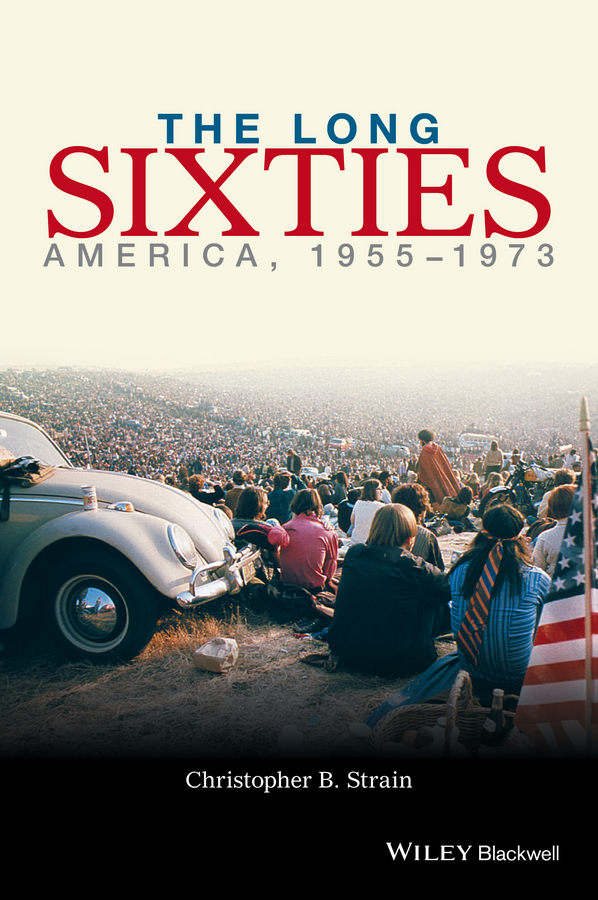
Cover image: Bill Owens Archive
The 1960s was a turbulent decade. On this much we can agree. Beyond this simple assertion, however, what happened is still hotly contested. It was a time of great change and confusion, marked by a profound shift in values and punctuated by a profane and often ugly war, but consensus breaks down on the meanings and lessons therein. For some it was a time of great liberation and freedom, an Age of Aquarius when restrictive constraints fell away. For others it was a period when the United States lost its way, a Pandora’s box that unleashed a host of social ills upon an otherwise idyllic world. For some it was heaven, others hell. For many it was both.
Attempting to explain that paradox, this book aims to provide a brief narrative history of the 1960s—a quick trip, as it were, through a momentous decade. Ironically but intentionally, The Long Sixties is a short book that makes no claim at being inclusive. Rather, it attempts to overlay a coherent narrative on a sometimes incoherent time—providing a feel for the decade while emphasizing some important persons, places, and events along the way.

Figure 0.1 The 1960s are often misunderstood….
(Source: © www.CartoonStock.com, artist: Andrew Toos)
It is important in doing so to distinguish between the 1960s—a discrete period of time beginning in 1960 and ending in 1970—and the Sixties: a collage of people, places, happenings, ideas, beliefs, impressions, feelings, perceptions, and stereotypes. Often used interchangeably, they are in fact two different things, involving different reference points that render different representations. “The 1960s,” for example, connotes datelines and headlines but “the Sixties”—more of an idea than a decade—suggests peace signs, flower power, and Volkswagen Bugs. Unlike the 1960s, the beginning and end of the Sixties are marked less by dates than by symbols and turning points. The 1960s and the Sixties shape and mold one another, often blending together in contemporary understandings of this contentious moment in time.
Since the early 2000s, some civil rights scholars have identified a “long civil rights movement”—not simply the familiar set of events between the 1954 Brown v. Board of Education decision and the 1968 assassination of Martin Luther King, Jr., but the period before the Brown case, when NAACP attorneys battled Jim Crow in the courts and black veterans of World War II returned from fighting against totalitarianism abroad to battle segregation at home. The long civil rights movement also extends beyond King’s death into the Black Power era, understood less as a break with the nonviolent civil rights movement and more as a logical outgrowth and continuation of it. In this framework, antecedents and codas become part of the story itself. This study borrows the same logic to contemplate “the long Sixties” in the hope that doing so might beneficially complicate our understanding of the decade. With scholars now tracing the origins of the civil rights movement at least back to the 1930s, the methodological question becomes: how long is long in contemplating the 1960s? For reasons that will become clear, this study begins rather biddably in 1955 with a discussion of civil rights and ends in 1973 with a discussion of what amounted to uncivil wrongs.
Chapter One, “Tranquility in Turmoil,” discusses the 1950s as a tumultuous decade in its own right. Chapter Two, “From New Frontier to Great Society,” deals with the so-called “good” Sixties: the early part of the decade, stereotypically full of hope and optimism. Chapter Three, “The Cold War,” treats competition with the Soviets. Chapter Four, “The Civil Rights Movement,” details the struggle for black equality, while Chapter Five, “Student Rebellion,” describes campus unrest and the rise of the New Left. Chapter Six, “The Vietnam Quagmire,” summarizes the nation’s military involvement in Southeast Asia. Chapter Seven, “Sex, Gender, and the New Feminism,” covers “women’s lib,” as it was sometimes derogatorily called, and the politics of sexuality and gender. Chapter Eight, “Revolutions Left and Right,” treats not only left-wing radicalism but also right-wing activism as a reaction to it. Against the twin backdrops of the space race and the back-to-earth movement, Chapter Nine—“Small Steps, Giant Leaps, New Concerns”—discusses science, technology, and the environment. Chapter Ten, “Minority Empowerment,” deals with Black Power, the corollary movements that paralleled and spun out of the civil rights movement, and the rise of so-called identity politics. Chapter Eleven, “Sucking in the Seventies, or That ’70s Chapter” (respectively the title of a 1981 Rolling Stones album and an allusion to That ’70s Show, a popular sitcom that aired 1998–2006), describes aftershocks, culminating with the Watergate scandal and the American withdrawal from Vietnam. Chapter Twelve, “Legacies,” focuses on memories and interpretations, particularly the notion of “the unfinished Sixties,” which helps to explain not only that the decade is debated half a century later but also why it is debated, an absorbing question related in part to the powerful ways it continues to define American life.
The 1960s were long in another sense as well. The events that unfolded were often discordant and violent, but even more jarring was the breakneck pace at which they unfolded. In the span of just six days in October 1967, for example, seven Ku Klux Klan members were convicted of conspiracy in the 1964 murders of three civil rights workers in Mississippi; upwards of 30,000 anti-war protesters marched on the Pentagon, with more than six hundred people arrested after they attempted to storm the building; and the federal government eliminated draft deferments for those who burned draft cards or interfered with military recruitment for the war. Or consider that several hundred Vietnamese civilians were massacred at the village of My Lai on March 16, 1968—which was the same day that Robert Kennedy announced his candidacy for president of the United States. Ten weeks later on June 3, Andy Warhol was shot at his New York studio, “The Factory,” and two days after that Robert Kennedy was shot to death in Los Angeles. Major occurrences were happening suddenly in rapid succession, and those who lived through them rode an emotional roller coaster of hope, euphoria, anxiety, and terror. Headlines blared: JFK ASSASSINATED! MALCOLM X ASSASSINATED! DR. KING ASSASSINATED! RFK ASSASSINATED! The tempo was punishing for those seeking comfort or familiarity and difficult even for those who thrived in the chaos. “Gimme shelter,” begged Mick Jagger of The Rolling Stones, “or I’m gonna fade away.” Every period has its ups and downs, but the 1960s seemed and continues to seem particularly acute in the height of its peaks and the depths of its troughs. On some level it took the nation a decade—the 1970s—to mop its brow and catch its breath. There was hardly time to process what was happening—which may explain why we find ourselves still processing today.

Figure 0.2 …and easily lampooned.
(Source: © www.CartoonStock.com, artist: Kes)
Indeed there was little boring about the Sixties, and investigating this decade can be not only exciting but also a little dangerous. In Francis Ford Coppola’s Vietnam War epic Apocalypse Now (1979), the protagonist Captain Willard, played by Martin Sheen, remembers the advice he was given before going upriver to find Colonel Kurtz, played by Marlon Brando. “Never get out of the boat,” he repeats. “Absolutely goddamn right… Unless you’re goin’ all the way.” Such advice remains salient, offering guidance for anyone who would study this helter-skelter decade.
To maintain historical accuracy, I have used the term “Negroes” to refer to African Americans before 1966, when the term “Blacks” began to gain favor.
A number of people had a hand in making The Long Sixties happen, beginning with Peter Coveney, executive editor in history at Wiley-Blackwell. The story of how he contacted me about writing a book on the 1960s (believe it or not) and how I coyly declined is barely plausible, but Peter coaxed, enticed, inveigled, and otherwise cajoled me to write it, eventually convincing me that the world might benefit from one more book about the 1960s. Without Peter there would be no Long Sixties, and I’m so glad I trusted him.
After I “completed” the manuscript, Wiley-Blackwell’s senior editor in history, Andrew Davidson, took what I naively thought was a final draft and gave it a developmental edit that made it into exactly that, with changes big and small over seven months of revisions. At times Andrew felt like the world’s toughest critic but mostly he felt like a co-author, and his sure guidance made the book much stronger than it would have been otherwise. I owe him a huge thank you.
Other people at Wiley-Blackwell played key roles, too. Julia Kirk, the project editor, handled all of the moving parts, while Galen Smith Young, Victoria White, and Maddie Koufogazos all provided editorial assistance and administrative help. Kitty Bocking suggested photos and tracked down permissions. Wiley also marshaled a small army of people unknown to me, including a commissioned survey of college professors teaching courses on the 1960s to assess their wants and needs in the classroom; five reviewers to offer suggestions (anonymously) on the original book proposal; and two reviewers who provided feedback (again anonymously) on the completed manuscript. You know who you are (even if I don’t) and I appreciate your input.
A number of people at Florida Atlantic University deserve thanks. Two research assistants provided invaluable help early on in this project: Megan Allore Bishop and Sandra Lazo de la Vega outlined, fact-checked, suggested topics and photos for inclusion, and more than earned their pay (which came from a generous award from FAU’s Division of Sponsored Research, to whom I also owe a big thanks). My colleagues at FAU have listened to my observances and offered their own. A special thanks to Chris Ely, Michael Harrawood, Kevin Lanning, Tim Steigenga, Mark Tunick, and Dan White for their insights.
I’d like to thank the staff at the Florida Atlantic University Library in Jupiter, where Diane Arrieta, Marilee Brown, and Will Howerton, among others, helped me access the information I needed. As with other major research projects I have undertaken, they have made my job much easier. They are the best.
Much love and thanks to my parents, Dan and Jean Strain, who made it through the 1960s relatively unscathed, and to my daughter, Lily, and wife, Melanie. To complete this book I stole time from Lily and also Melanie, who more than anyone else argued and debated with me about the ideas herein, sharpening my thinking in the process. Knowing I had a lot to say about the 1960s, Melanie encouraged me to undertake the project and she was my greatest supporter throughout. She also made it fun.
As the saying goes, if you remember the 1960s, you weren’t really there; but, to the friends, family, neighbors, and co-workers who shared their Sixties stories with me, I am grateful.