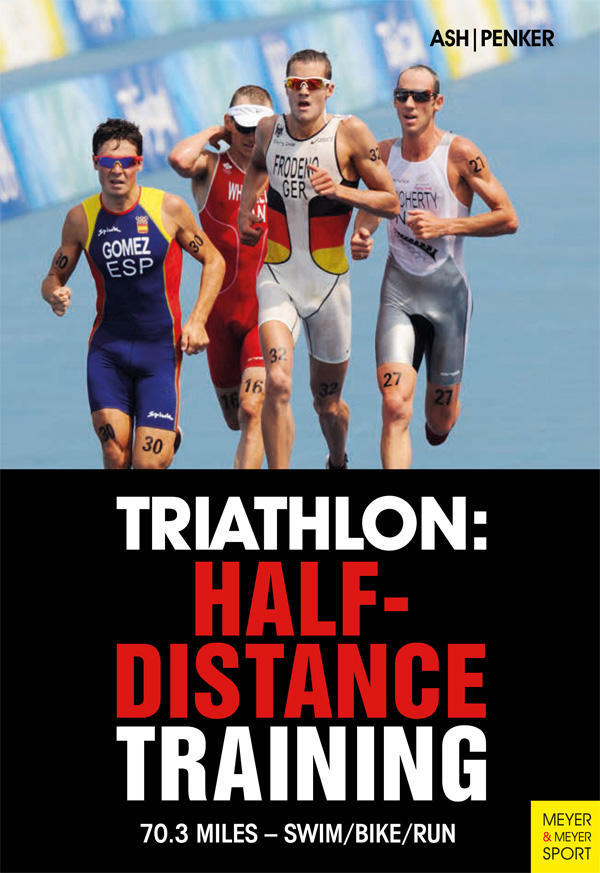
Henry Ash / Marlies Penker
Triathlon: Half-Distance Training
70.3 Miles – Swim/Bike/Run
Meyer & Meyer Sport (UK) Ltd.

© 2009 by Meyer & Meyer Sport (UK) Ltd.
3rd edition of Ironman® 70.3® – Training for the Middle Distance
Aachen, Auckland, Beirut, Cairo, Cape Town, Dubai, Hägendorf, Hong Kong, Indianapolis, Manila, New Delhi, Singapore, Sydney, Tehran, Vienna
Member of the World Sport Publishers’ Association (WSPA)
978-1-78255-414-1
info@m-m-sports.com
www.m-m-sports.com
ISBN 978-1-78255-414-1
Welcome. This book is a thorough guide to preparing for the most popular triathlon racing distance in the world. Spawned from the renowned Ironman® Triathlon series, the half distance, also called Ironman® 70.3®, is booming internationally because these triathlons, raced at half the Ironman® distance over 70.3 miles, provide the challenge of long-distance triathlons but are not as intense a training venture as the full Ironman® distance.
Having personally coached hundreds of athletes successfully at this distance, from beginner to world champion, I can tell you that Henry Ash and Marlies Penker do a fantastic job of skillfully directing you through the intricate steps of preparing for this endurance challenge. Starting your event well prepared physically and mentally will build your confidence and put you at ease, allowing you to enjoy a day that will forever be a memorable milestone in life. Ash and Penker present their information in an easy-to-read, systematic manner.
Whether you are just starting out there or looking to up your game, you will find this guide to be an essential resource in your training library. Get ready to get in the shape of your life!
Lance Watson
Founder, LifeSport Coaching
Triathlon Olympic Gold Medal Coach
Ironman® Champion Coach
“The road to Ironman fame is 70.3 miles long”
This phrase sums up the special challenge of the half-distance triathlon. And it is just one more leap from the Ironman® 70.3® to its big brother, the Ironman® 140.6®, which is the ultimate endurance-sporting accolade.
Ironman® ist a high-quality, recognizable name for a challenging event that, each year, attracts more people who want to conquer it to become known as hardcore athletes.
Ironman® 70.3® does not only mean mastering a long triathlon consisting of a 1.2 mile swim, a 56 mile bike-ride and a 13.1 mile run; Ironman® embodies the “calculated adventure” par excellence, the struggle against water, wind, the course, and yourself. It means uncertainty as to how those 70.3 miles will affect our bodies, the countless highs and lows, the doubt and hope, the moments of strength and weakness that every athlete goes through on their way from start to finish.
Ironman® also embodies motivation, willpower, perseverance, energy, strength, flexibility, the need to be active and the dream of finishing, all qualities that are required in everyday life. The opportunities for transferring these qualities to the Ironman® are therefore unlimited.
So why race 70.3 miles all in one go?
Do you too dream of completing an Ironman® 70.3® or another half-distance triathlon?
Then all you need is good health and passion…
…for the multi-faceted endurance sport, consisting of swimming, cycling and running.
In order to attain your Ironman® goal, it is not essential to:
Be young or unattached
Train 20 hours or more per week
Be a semi- or full-professional athlete
This is exemplified by the following people’s success stories:
46-year-old Dan, who before turning 45 had never exercised regularly apart from a few bike rides.
Patricia, now 42, who took up triathlon because she wanted to get fit. She caught the Ironman® bug four years ago.
36-year-old Doris was an enthusiastic spectator of the Ironman® Austria who hung up her ice hockey skates in order to take up the triathlon.
40-year-old Oliver, whose principal motivations to train are the challenge, his enjoyment of sport and the testing of his performance limits, still manages to be competitive with an average of 8-9 training hours per week.
“It is better to start slowly than to drop out quickly!”
By using realistic training suggestions, specific examples and other tips, we intend to give you the keys to succeeding in the half-distance triathlon. The 70.3-mile course is purely theoretical. In competition, many factors can cause the 1.2-mile swim to become a few hundred yards longer, and almost nobody finds the ideal line during the 56-mile cycling component or the 13.1-mile running course.
Our daily swimming, cycling and running training should be equally flexible. Who knows that better than Henry after 25 years of triathlon training! This makes our half-distance training a little more accessible.
With this book, we – Henry and Marlies – would like to lead you on your personal half-distance triathlon journey. The countless facts, tips, suggestions and hints are intended to ensure that you retain or enhance your enjoyment of endurance sports as well as master your journey to the half-distance triathlon as safely as possible. Unfortunately, we cannot completely save you from slight detours.
We hope that you too will experience the deep satisfaction of completing a half-distance triathlon successfully and in good health. We therefore wish you much fun and enjoyment, for we are absolutely certain that success is sure to follow.
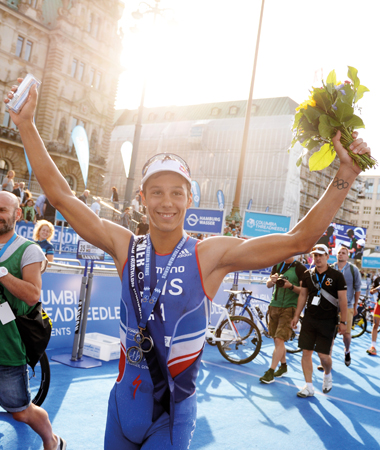
© picture-alliance/dpa
The fascination of the half-distance triathlon can be summed up in two sayings and with a few important facts:
If you want to do triathlon, then do the Olympic distance, but if you want to find a new life (and yourself), then do an Ironman®.
You can buy a house, but not a home.
You can buy a bed, but not sleep.
You can buy a clock, but not time.
You can buy a great bike, but not an IRONMAN®!
More facts that make the half-distance triathlon appealing:
The many hours of training
Getting to know your own body
Discovering and raising your performance limits
Struggling against problems and obstacles during preparation
The length of the course and the weather
The uncertainty of the race’s outcome
The different nature of swimming, cycling and running
Struggling to overcome challenges in the water, on the bike and on the running course
The satisfaction of reaching the long-awaited and eagerly anticipated finish line
Justified pride at having accomplished your goal
The sublime feeling of having conquered the 70.3 mile course
Increased self-confidence, physical well-being and physical capacity
The certainty that one has done something out of the ordinary
Mastering the challenge you have set for yourself
The affirmation of your will power, endurance and perseverance
The fascination with the half-distance triathlon is closely linked to swimming, cycling, as well as running the course length. The Olympic discipline, on the other hand, is considered to be a standard triathlon competition that can easily be mastered with the correct training. However, it is precisely those extra miles on the bike and on foot that make the difference and give the Ironman® its mythical status. They account for the uncertainty and thrilling anticipation typically felt in endurance events (flow) as we head toward the finish. Can we can get our legs, mistreated during the cycling, to cover the 13.1 miles on foot? After the 60.3 miles, will our burning muscles be able to cover the remaining 10 miles? Will we avoid “hitting the wall” until after the finish, or it will be waiting for us at the next aid station? In a half-distance triathlon, we never know what will happen until we actually cross the finish line.
If you are already feeling bad after swimming, you have a problem.
It’s normal to feel exhausted after the cycling.
But it’s not normal if you don’t feel dead after 70.3 miles!
Most half-distance triathlon participants ask themselves just before or during the race, “Why am I doing this? Do I have to? Can’t I live without the half distance?” Many curse themselves, the race, and everything around them and vow never to put themselves through this torture again.
However, after a short recovery phase at the finish, nearly all paticipants become repentant liars, and in typical triathlon fashion, bask in the positive memories and start to plan their next half-distance triathlon.
Here the common saying, “the journey is the reward,” applies. Positive memories of the training for swimming, cycling and running are awakened.
The goals that we were really seeking were overcoming obstacles; the countless hours in the sun, rain, wind and snow; the positive, sociable and exciting hours spent swimming, cycling and running; these are the things that make an Ironman® out of a triathlete.
The rich experience of these hours of training give us the opportunity to let our minds wander, but also to socialize and enjoy the beauty and changing seasons of nature. All of this makes triathlon an event that provides a quality of life that we are not willing to give up.
Follow us on our short, imaginary triathlon journey
You are surrounded by other athletes on the bank of a lake, the atmosphere is tense yet calm, and there are only a few minutes to go before the start. Thoughts are swirling around your head: “Have I trained hard enough?” “Will I make it to the finish?” “How will the swimming, cycling and running go?” But then your train of thought is interrupted by the starting signal and you and your fellow athletes rush into the water. You dive into the water, then come back up to the surface and try to get some air, which is quite hard in the first few yards. You fight for space, get jostled a little but gradually find your swimming rhythm. After a few minutes, you feel better and can maintain your speed. Now and again you try to catch or overtake the leader, and soon notice that the first discipline of the half-distance is nearly over. You can already hear the cheers of the spectators in the transition zone; you climb quite happily out of the water and are relieved to have the swimming section under your belt.
You run into the transition zone, fetch your bike bag and get changed in the transition tent. Full of motivation, you grab your bike, push it out of the transition zone and the race now continues on land. As you start, your legs feel a little tired, but gradually you get into your stride and take over other triathletes here and there. You don’t forget to eat and drink and feel that today your body is capable of great things. You occasionally have phases of fatigue and wonder if you will be able to cover the whole 56 miles. But it’s ok, these moments soon pass and your legs soon feel fresh again. Now the second discipline is ending, and in the last few miles, you are relaxed as you approach the next transition zone.
In this transition zone, you put on your running clothes and then the final discipline is soon under way. Now it is hard, because over the first few miles your legs feel “rubbery” and heavy; you have the feeling that you can’t run properly. But your muscles adjust because you have already practiced the transition from bike to running in training a few times. Now in the race, your legs remember how to run again. The spectators cheer you on here and there and carry you toward the finish. You don’t give up when moments of fatigue occur. If you really can’t run any more, you walk for a while, and are usually able to start running again after a while.
You get nearer and nearer to the finish, the crowd drives you on, you know that you can do it. Only a few more yards, then you cross the finish line. The feeling is indescribable, you want to “hug the world,” all the effort and minor ailments are forgotten. You’ve done it. A wave of happiness flows over you; you smile from ear to ear and are absolutely elated to have accomplished your goal.
Would you like to have this feeling too? In this book, we provide tips and tricks that will enable you to become a happy and successful half-distance triathlon finisher.
There are four good reasons why so many triathletes attempt the half distance:
Exciting for those who are entering new territory with the 1.2-mile swim, 56-mile bike ride and 13.1 mile run and setting themselves new and higher goals for themselves.
Stimulating for those who enjoy a race that lasts 4-6 hours and would like to explore their performance limits in this area.
Interesting for those who use the 70.3-mile race to test their mettle before the long distance.
Challenging for those who have already finished several long-distance races but now want a highly competitive race over a shorter distance.
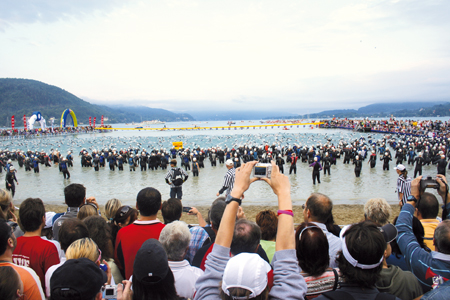
© M. Nüsken
Twenty years ago, when Henry was first preparing for the long distance, he found it helpful to compare the triathlon to a restaurant menu. This idea was his key to the mental preparation necessary to complete the half distance successfully.
This thought will also help you to overcome your fear before a half-distance triathlon. Imagine a menu full of everything that you particularly like to eat, and like this lavish meal, thehalf-distance triathlon is a special occasion.
Our half distance menu: | |
Appetizer | Swim |
Intermediate course | first transition |
Main course | Bike |
Intermediate course | second transition |
Dessert | Run |
As the first discipline, the 1.2-mile swim is considered the “appetizer.” After this warm-up follows the “main course,” the 56-mile bike ride. Our “dessert,” which we save until last, is the 13.1-mile run. Both transitions constitute the “intermediate courses”: the first from swim to bike and the second from bike to run.
Swimming represents the biggest problem for many athletes, as a good technique is necessary to attain reasonable results. At the elite level, good swimming technique is the basic pre-requisite to keep up with the pace. In a race, it is not unusual to see women getting out of the water in front of or at the same time as the fastest men.
The effect of water on the body is different then that of air. When moving through cold water, the blood flows more strongly through the working musculature, which increases heat loss. In the case of swimmers who have low body fat, their body temperature is constantly decreasing, unlike their more corpulent competitors. This can be counteracted, particularly over longer distances, by wearing a Neoprene wetsuit.
For many triathletes, swimming is an unpopular or boring discipline. Athletes who really have a problem with swimming therefore usually prefer the duathlon, which consists of running, cycling, then running again. Advanced swim training is intended both to improve the swimming performance and also to make it easier to cope with the cycling part of the triathlon.
Front crawl is the fastest swimming stroke and, compared to the breaststroke, puts less strain on the legs, which will have to work hard in the second and third disciplines, cycling and running. It is therefore very challenging for many athletes to not just swim along using the breaststroke technique but to keep up with the crawlers. Anyone who is considering a half-distance triathlon should most definitely learn the front crawl in order, as mentioned above, to spare their legs for the cycling and running to come.
Cycling is the second discipline in the triathlon and as the main course, it accounts for the largest portion of the whole race. In general, it is prohibited to draft other cyclists, apart from a few exceptions in the case of elite or young athletes, particularly over the Olympic distance.
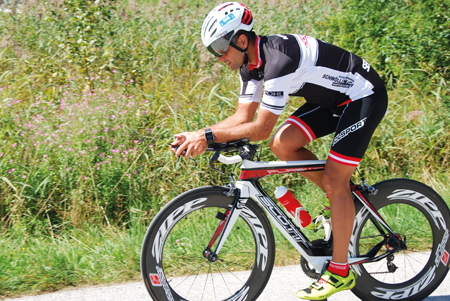
© jolsport.at
Prerequisites for good performances on the bike are an optimal cycling technique and a correct sitting position, which will allow you to run with as little pain as possible afterwards. The “lying” position over the aero handlebars should not hinder breathing or the efficiency of the leg power. Many triathletes adopt the preferred “American position” on the bike, i.e. the tip of the saddle is situated well in front of the bottom bracket.
In cycling, the gluteal muscles support most of the bodyweight, which means that there is little stress on the musculoskeletal system. Even in the case of out-of-saddle riding (riding standing up), the orthopedic load is much lower than when running. In order to avoid general injuries, it is advisable to wear a helmet (a MUST in the triathlon). A helmet should always be worn, whether you are just testing a bike or popping down the road to the store.
Regardless of which triathlon distance you are aiming to compete in, the cycling component is always the longest part of the race. In the half-distance triathlon, the 56-mile bike ride accounts for the majority (50-55 %) of the whole competition time. You should therefore incorporate cycling into your daily routine whenever you can.
Running constitutes the triathlon “dessert.” This discipline is the most taxing for the musculoskeletal system; swimming and cycling are much less stressful for the body. Running most quickly reveals weaknesses in the core trunk musculature, the strengthening of which should not be neglected in training. Only with a strong core will your body be able to accomplish optimal running performances.
As well as strengthening the core trunk muscles, your running time can also be improved with running drills. These exercises give the body a complex workout. In the “bum flick,” from a relaxed trot, the heels are brought up to the glutes.
In the “knee lift,” the front leg is bent at the hip and the knee is raised. The support leg is kept straight and the arms work vigorously. Running backward and to the side is also recommended. Leg crossovers involve twisting the hip and upper body in opposite directions.
For some triathletes, running in a half-distance triathlon turns into a kind of torture. The legs are tired and heavy and the small of the back often hurts, too. It is therefore no disgrace to take a few walking breaks, soon after which it is usually possible to run again.
The change from swimming to cycling and then from cycling to running are the “intermediate courses” on the triathlon menu. They constitute a smaller part of the whole race time. In triathlon circles, the transition is referred to as the “fourth discipline.”