
About the author
Chris Goodall is a world-leading expert on new energy technologies. His previous book for Profile, Ten Technologies to Fix Energy and Climate, was one of the Financial Times’ Books of the Year. How to Live a Low Carbon Life won the 2007 Clarion award for non-fiction. He publishes Carbon Commentary, a website and newsletter on energy efficiency and advances in renewables. He is also an investor in young companies in the low carbon world.
www.carboncommentary.com
The Switch
The Switch

First published in the UK in 2016 by
Profile Books
3 Holford Yard
Bevin Way
London
WC1X 9HD
© Chris Goodall, 2016
The moral right of the author has been asserted.
All rights reserved. No part of this book may be reproduced in any form without permission from the publisher except for the quotation of brief passages in reviews.
A CIP record for this book is available from the British Library.
eISBN 978 1 782832485
Contents
Introduction Cheap solar changes everything
Chapter 1 Inevitable solar: the experience curve
Chapter 2 Predictions and the global switch
Chapter 3 New generation solar advances
Chapter 4 When the sun doesn’t shine
Chapter 5 Demand and supply
Chapter 6 Battery power
Chapter 7 Storing energy as gas or liquids
Epilogue Some conclusions
Appendix: Figures and terms
Index
Introduction
Cheap solar changes everything
‘A cheap, clean source of energy would change everything,’ declared Bill Gates in February 2016. The annual letter from his charitable foundation focused on the need for a revolution that gives abundant power to all without further disruption of the climate. Gates is in no doubt of the importance of the challenge, particularly for those currently without access to electricity, and optimistic that the solution will be found. ‘Within the next fifteen years – and especially if young people get involved – I expect the world will discover a clean energy breakthrough that will save our planet and power our world.’
It won’t take fifteen years. The argument of this book is that the breakthrough that Gates anticipates has already occurred. The world now has a set of technologies that will offer cheap and clean power to all, twenty-four hours a day, twelve months a year. From the favelas of Latin America and villages of India to the cities of Europe, solar power offers electricity that is now competitive with all other energy sources. And it is becoming cheaper each month through predictable technological changes. Researching this book I talked to no one who thought these improvements would slow down, let alone stop.
The speed of change is remarkable, given solar’s somewhat slow beginnings. The basic technology has been around for more than half a century. Vanguard 1 – the fourth satellite ever to be launched – carried six solar panels into orbit in 1958. This was the first time the world had ever used photovoltaics (PV) for a real purpose. The little rectangles of silicon produced a maximum half a watt, a tiny charge that nevertheless enabled the satellite to send data about the composition of the atmosphere back to Earth for the next six years. These primitive panels cost many thousands of dollars per watt. However, by the mid 1970s, the figure had fallen to $100 a watt. Now the cost is about 50 cents and the decline continues. We can generate electricity from the sun’s rays at costs which seemed utterly unimaginable even a few decades ago. Unimaginable even now, it seems, given the conservatism of almost every estimate that appears in financial reports or the press. In my research I found only one historic forecast of future declines in PV costs that had overestimated the speed of the change.
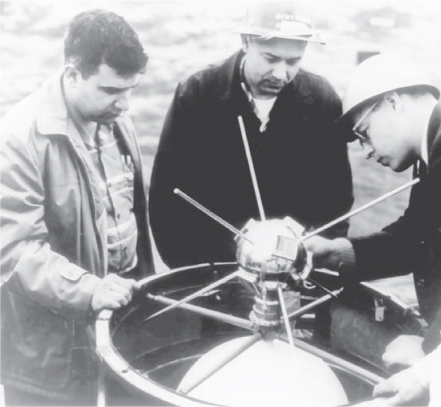
Solar panels with a purpose: GPS pioneer Roger L Easton (left) inspects the Vanguard 1 satellite with its six silicon solar panels.
Nevertheless, perhaps we should have anticipated the rapid decline in solar costs in this decade. Peter Eisenberger, now a professor at Columbia University in New York, co-wrote a paper for his employers at the oil company Exxon in 1989 that predicted solar energy (probably to heat water rather than generate photovoltaic electricity) would become cost competitive with fossil fuels by 2012 or 2013. ‘Technology evolves in a surprisingly regular way,’ he recently told Bloomberg News when explaining his prediction. Much of the first chapter of this book is about why we can be confident that PV cost reductions will continue and make THE SWITCH inevitable. Every time the world’s accumulated total of solar panels has doubled, the cost has reliably declined by about twenty per cent.
In the sunnier parts of the world solar photovoltaics already offer electricity at lower total cost than other forms of power. As I write, a Californian utility has just announced another record US low for the price paid for a megawatt hour of electricity from PV farms. Subsidised by a tax break, the figure of about $37 per megawatt hour is said to be the lowest long-term purchase agreement for US electricity. Recent published prices for solar electricity in places as diverse as Chile, India and Brazil show equally striking declines – and, crucially, to levels lower than conventional electricity generators.
Even in the gloomy countries of northern Europe, light from the sun will soon provide electricity at prices lower than fossil fuel alternatives. Fraunhofer, a sober German research institute, sees the cost of solar power from solar parks in south Germany falling as low as 4 euro cents (about 3.2 pence) per kilowatt hour by 2020, a cost that beats any competing source of electricity from a new power plant. In Britain the dramatic fall in the price of solar panels has already pushed PV almost to cost parity with planned gas-fired power stations. Power from wind turbines in the best locations on Atlantic coasts is currently cheaper but even this will be beaten as PV continues its relentless downward march.
The falling cost of a PV panel is a major part of this change: both in its production costs and financing. Solar farms can now be financed at far lower rates of interest than any other source of electricity. Because PV is so utterly reliable and almost maintenance-free, it is a perfect investment for pension funds seeking consistent yearly returns for the thirty-five years of a panel’s life. As other investment opportunities around the world have dried up in recent years and interest rates have fallen to unprecedentedly low levels, solar farms have become able to raise money at cheaper and cheaper rates. This is surprisingly important. Cutting the annual interest charge from 8 per cent to 5 per cent reduces the underlying cost of producing electricity from solar installations by almost a third.
But, as solar sceptics never tire of saying, cheap daytime-only power isn’t enough. We need the capacity to store solar-generated power for use when the sun isn’t shining, or other renewable sources that complement the sun’s power. In places like the UK, this means using wind and plant material for substantial amounts of energy. Importantly, we’ll also need huge amounts of electricity storage, both for overnight and for throughout the dark seasons of the year.
We also need to be able to manage our electricity grids so that they can cope with the impact of unpredictable supplies during the daylight hours. This means finding ways of adjusting electricity demand to match the available supply, not the other way round.
The good news is that this is all well within our reach now, and at costs that seem reasonable today and which will get less expensive every year. Tesla, for example, the electric car and battery company, is offering energy storage at prices that are falling at least as fast as the costs of PV. Rapid advances in complementary technologies such as wind, hydrogen production and anaerobic digestion mean that the world will not lack power when the sun is down. The second part of this book focuses on these areas of storage and non-solar renewables.
In considering the strengths and vulnerability of solar, it is important to keep in mind where the world’s population is based. About 40 per cent live in consistently sunny tropical countries and at least another fifth inhabit areas with high levels of solar energy. Almost all of those without any electricity today live in areas with good potential for PV. In most of these regions, solar arrays combined with overnight battery storage can give householders reliable twenty-four-hour energy.
In northern countries with long winters, overnight storage isn’t enough. We will need to take surplus energy for solar (or from wind) in times of abundance and turn it into renewable gas and liquid fuels. This will enable us to meet the need for power during the months when solar and other renewables are not producing enough.
The chemistry of producing zero carbon gases and liquids is not complicated and there are innovators already producing hydrogen from electrolysis and reacting this with CO2 to create useful energy sources that can be stored in the existing oil and gas networks. In most countries this will give enough storage to provide for the needs of the entire winter.
So the ingredients for the switch to solar are all in place around the world. We have a cheap source of power, the software to manage the grid in the face of unpredictable electricity production, increasingly inexpensive daily storage in the form of batteries, and new ways of converting light into energy-rich gases and liquid fuels to provide the long-term reservoirs of power that a world reliant on solar PV needs. We have the ability to give everybody what Bill Gates wants: ‘cheap, clean energy’. The only conceivable alternative – a new generation of nuclear power plants – seems far more expensive, riskier and much slower to build than a wholehearted switch to solar.
But will the transition happen? It needs vast amounts of capital to build the PV capacity to provide all the world’s power, peaking at perhaps 3 per cent of annual global income. It requires commitment from governments and their electorates to live with the inevitable difficulties of switching away from fossil fuels to non-polluting alternatives and to back the research needed with the billions of dollars necessary to keep on pushing costs down. Lastly, and perhaps most importantly, it entails the biggest companies still tied to fossil fuels – whether it be the global oil companies, electricity utilities or car manufacturers – deciding that their future is unambiguously based around renewable energy sources. They will have to pivot towards the sun as the main source of the world’s power and away from the carbon sources on which they created their businesses.
A year ago, I might have said that overcoming this last hurdle was impossible to imagine. The industrial dinosaurs of the twentieth century all seemed determined to resist THE SWITCH for as long as they could. It looked as though they would die defending their destructive business models, taking trillions of dollars of capital down with them. But as I revised the draft of this book in spring 2016, the evidence began to build that the monolithic determination to resist the inevitable was ebbing away. More or less explicitly, many of the main utilities began to voice a new strategy of reconstructing their activities around renewable energies.
Within the space of a couple of weeks in February, some of the world’s largest energy businesses confirmed their move into the new world of low carbon energy. AGL (Australia’s single largest emitter of CO2), Engie (a $100 billion French utility operating in 70 countries) and the UK’s electricity trade association all announced strategies of shifting away from coal, gas and oil into a future based on renewables, energy efficiency and smart management of the grid. Australia’s AGL sold its entire gas business while Engie got rid of coal power stations. The UK’s utilities said they wanted to bring an end to the use of coal for generation and asked the government for clear policy frameworks to enable them to move their capital into the new low carbon economy. Utility companies in some US states, such as Oregon, have switched sides and now lobby their legislatures sitting alongside the activist groups seeking to promote ever more demanding targets for renewable energy. These new corporate converts have come to recognise that the move to low carbon sources of energy will happen without them if they don’t get involved early.
Will the large oil companies follow the electricity and gas utilities? They are even more embedded in the last century, and seem blind to the opportunity to lead the switch to renewable gas and liquid fuels. But economics will eventually swing even them towards solar-based energy. The large shareholder-owned global companies spend about $200 billion a year on exploration and production for hydrocarbons. On my calculations the energy produced – in the form of cubic metres of natural gas and barrels of oil – from this vast yearly investment is now less than the amount that would be generated by solar panels on which the same amount of money was spent. That is not a credible business plan. And indeed some of the oil chiefs are aware of it. In September 2015 Shell’s CEO said that solar would become the ‘dominant backbone’ of the energy system. If even Shell is saying this, the arguments for THE SWITCH are truly irrefutable.
In a recent book, the founder of PayPal, Peter Thiel, wrote that ‘most peoples throughout history have been pessimists’. He might have added that pessimistic cultures such as ours find it difficult to deal with intractable problems, such as turning away from carbon-based energy. But now, I would argue, we can become optimists about our ability to address climate change at the same time as providing sufficient energy. And not just for the economies of the richer half of the world. PV provides a realistic prospect of delivering electricity to the billions of people who either have no access to power, or whose supply is fragile and intermittent. THE SWITCH will benefit all of us. It seems no exaggeration to say that in the developing world it will have a similar impact to mobile phones, as countries with little energy infrastructure leapfrog the model of national grids and carbon fuels.
A note on numbers and references
The APPENDIX contains some detail on the key units of measurement in the world of solar and other energy sources. If you are not familiar with quantities such as kilowatt hours or terawatts, it may be helpful to scan these pages first. There is nothing remotely difficult there.
The vast majority of REFERENCES for my research on this book are online and I have therefore provided links to these on my website, for ease of use. Please see:
www.carboncommentary.com