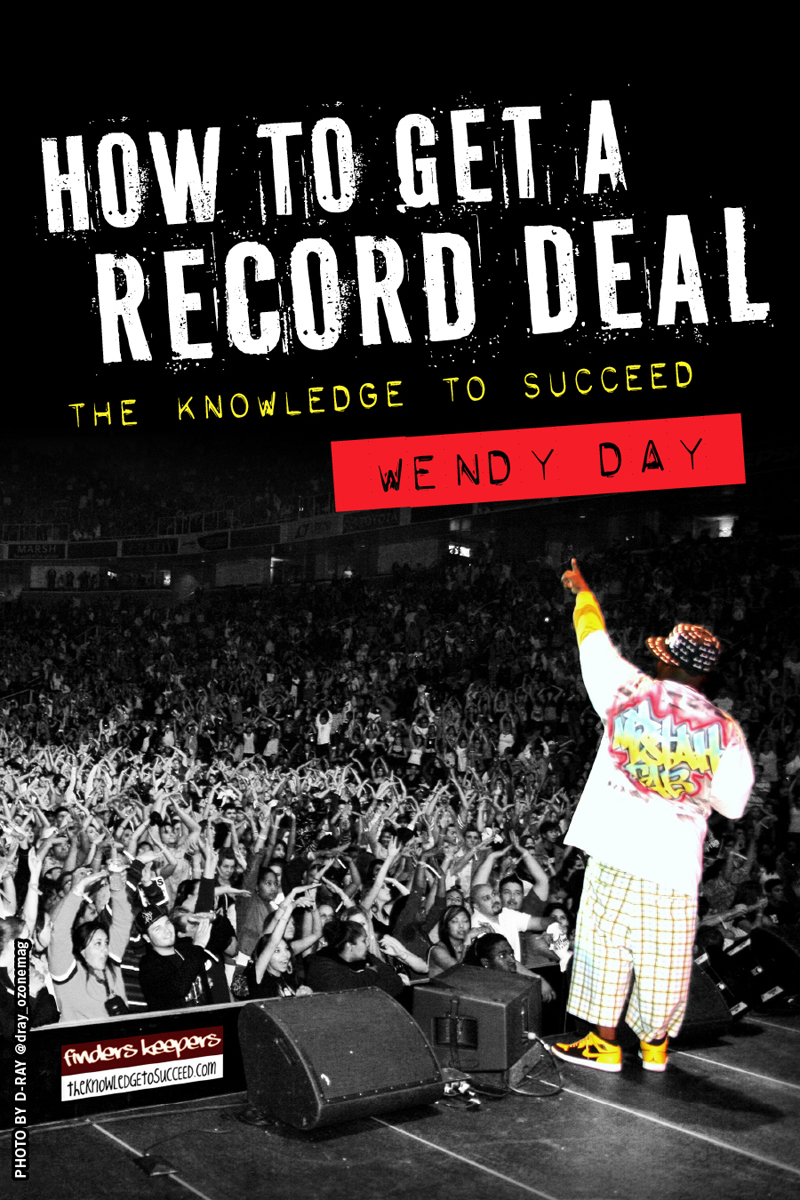
The Knowledge To Succeed
Looking For A Record Deal?
How To Get A Record Deal
Written By Someone Who Has Shopped and Negotiated Many Deals
By, Wendy Day
Copyright 2011 by Wendy Day. All rights reserved.
©2011
Published by Finders Keepers LLC, Atlanta, GA
No part of this publication may be reproduced, stored in a retrieval system, or transmitted by any form or by any means, electronic, mechanical, photocopying, aurally, recording, scanning, or otherwise, except as permitted under Section 107 or 108 of the 1976 United States Copyright Act, without the prior written permission of the Publisher.
Requests to the Publisher for permission should be addressed to the Permissions Department, Finders Keepers, LLC, 3000 Old Alabama Road, Suite 119, Box 171, Alpharetta, GA 30022 USA, or via email at FindersKeepers911@gmail.com.
Limit of Liability/Disclaimer of Warranty:
While the publisher and author have used their best efforts in preparing this book, they make no representations or warranties with respect to accuracy or completeness of the contents of this book and specifically disclaim any implied warranties of merchantability or fitness for a particular purpose. No warranty may be created or extended by sales representatives or written sales materials. The advice and strategies contained herein may not be suitable for your situation. You should consult with a professional where appropriate. Neither the publisher nor author shall be liable for any loss of profit or any other commercial damages, including but not limited to special, incidental, consequential, or other damages.
Finders Keepers publishes its books in a variety of electronic formats. Some content that appears in print may not be available in electronic books.
Library of Congress Cataloging-In-Publication Data:
2011937879
Day, Wendy
The Knowledge To Succeed: Looking for a record deal? How to get a record deal, written by someone who has shopped and negotiated many deals/Wendy Day.
p.cm.
ISBN 978-0-9838894-0-3 (ebk)
1. Music business. 2. Record Deal. 3. Rap Music. 4. Music Marketing. 5. Independent Record Label
The Knowledge To Succeed:
How To Get A Record Deal
Written By Someone Who Has Shopped and Negotiated Many Deals
Contents
1. Who The Heck Is Wendy Day?
2. Turning Music Into Money
3. The Cold Hard Truth
4. Types Of Record Labels
5. Types of Record Deals
360 Deals
Traditional Record Deal
Joint Venture
Distribution Deal
6. Indie Labels VS Major Labels
7. Unsigned VS Indie
8. What Labels Are Looking For
9. Current State Of The Music Business Economy
10. Selling Music In A Changing Economy
11. The Qualities You Need To Succeed
Coming soon from Wendy Day:
The Knowledge To Succeed: Make Money With Your Music 1 (Plan The Work)
The Knowledge To Succeed: Make Money With Your Music 2 (Work The Plan)
The Knowledge To Succeed: Building Your Team
The Knowledge To Succeed: Additional Streams Of Income
The Knowledge To Succeed: Producing Music
The Knowledge To Succeed: DJs Profitability
The Knowledge To Succeed: Songwriting
The Knowledge To Succeed: Managing Artists’ Careers
www.TheKnowledgeToSucceed.com
Who The Heck Is Wendy Day?
If you are anything like me, you’re looking at this book thinking “why should I listen to this person?”
Everyone has an opinion of how to get a record deal or even why you would or wouldn’t want one. There is no ONE right path--there are many. And what works for one artist, may not work for another artist due to timing, access, talent, money, image, physical appearance, team, economy, etc. What I offer is my opinion of how I have personally seen people secure deals and how I personally have shopped, negotiated, and secured record deals for artists from the first deal negotiation I was involved with in the mid 1990s (Master P’s No Limit deal at Priority Records) to the most recent which I am involved with now (Rock City aka R City formerly of Konvict/Interscope).
This book is based on my educated opinion, and from the standpoint of building a successful music career. You see, getting a record deal isn’t actually the goal (although right now you probably think it is--so it’s a good thing you bought this book!), it’s just a possible first step in a long process that leads to building a career in the music industry where an artist can sustain himself or herself while living their dream. The REAL goal is to support yourself and your family through your music. A record deal is just one path to take to get there.
I’ve worked with and helped build the careers of many artists. I’ve shopped and negotiated some of the most successful deals in urban music and I’ve helped build, structure, and organize some of the most successful indie labels in urban music. I’ve helped artists like Eminem, Twista, Do Or Die, Ras Kass, Thirstin Howl III, Young Buck, Blood Raw, Roccett, TMI Boyz, 4ize, R City, David Banner, Killer Mike, Machine Gun Kelly, Cormega, Tupac Shakur, Naughty By Nature, Slick Pulla, Channel Live, Groove Theory, Slick Rick, MJG & 8Ball, UGK, Trae, PsychoDrama, J Diggs, and hundreds of others. And labels like Cash Money (Lil Wayne, Turk, Juvenile, BG, and Mannie Fresh), No Limit (Fiend, Master P, Mia X, C-Murder, Mac, Beats By The Pound), and Trill Entertainment (Lil Boosie, Webbie), etc.
In some cases, I’ve been a sounding board and offered advice, and in other cases I’ve built the foundations, written plans, and worked every aspect of the project. I’d never take full credit for anyone’s success because it takes far more than one person to create a successful artist. I’ve just played my role whether I’ve received the proper credit or not. I will say this: although most people have short memories when the money and fame comes, I get more love from people and artists in this business than most others do and I’m proud of that. I’ve never purposely jerked anyone out of anything, and I’ve done my best in almost all cases. I’m not perfect--I’ve slipped here and there while learning from my mistakes, but I’ve never jerked anyone out of anything…including credit for their contributions.
I’ve never worked on the creative side in this business, so I don’t make music or suggest direction for music or an artist’s image. I work solely on the business side of building careers: marketing, promotion, publicity, advertising--and of course the structure and organization of those careers, brands, and companies that I help build. I am a fan of the music first and foremost, and build everything else around that. I can’t promote or co-sign music that I think is garbage, but I can help any artist move forward with his or her dreams by offering advice, regardless of my opinion of their musical abilities. I stay away from the political posturing and I don’t get involved with lyrical content, historical significance, or subject matter (such as violence or misogyny) in rap. There are pundits out there far more qualified than I am in psychology and pop culture.
I’m given far more credit than I deserve for my contributions to hip hop culture, and far less than is fair for the deals I’ve negotiated and the key roles I’ve played in creating superstars. I do my job and I do it well because I love what I do.
I believe everyone with a dream, some goals, passion, hard work (grind), and dedication (along with a budget to fund these dreams) should have the opportunity to exist within the music industry. Whether I am willing to attach my name to their project is an entirely different story. I spent the bulk of my career passing up projects to work, but would advise and help anyone willing to listen. Some did; some didn’t.
So, if you are still thinking “why should I listen to this person?” here’s my bio that illustrates some of what I’ve accomplished. And if you decide you want to check out what I have to say, read on:
Wendy Day founded the not-for-profit Rap Coalition in March of 1992, out of disgust for the way urban artists are unfairly exploited in the music industry. Wanting to shift the balance of power to favor the artists, Wendy dumped her life savings (selling her condo, her stocks and bonds, and her BMW) into starting the advocacy organization to support, educate, protect, and unify hip hop artists and producers--in other words, to keep artists from getting jerked. She began listening to rap music as a fan in the early 1980s, and turned her passion for rap music into a career in the music business.
Since 1992, Rap Coalition has impacted the urban music industry by helping, for free, thousands of artists, DJs, and producers individually, as well as through monthly panel discussions, seminars, demo listening sessions, cipher sessions, showcases, and fair deal negotiations. Today, Rap Coalition breaks unfairly oppressive contracts (pulling artists out of bad deals with record labels, production companies, and managers), and teaches the business side of the music industry to thousands of artists and industry hopefuls from around the country; in the past Rap Coalition has also offered health care and dental benefits, coordinated the panels at many of the major urban music conventions, and has instituted a mentor program combining up and coming artists with established artists.
Rap Coalition answers to a Board Of Advisors which reads as a veritable Who's Who in the rap music industry, consisting of Chuck D from Public Enemy, Vinnie from Naughty By Nature, David Banner, Keith Murray, Young Buck, Gipp from Goodie Mob, Sticky Fingaz from Onyx, Too Short, Ras Kass, Do Or Die, Killah Priest, Fiend, Pimp C from UGK (RIP), Easy Mo Bee, Shinehead, C-Murder, B.G., Cormega, KLC from Beats By The Pound, 8Ball, MJG, EA Ski, Khao, Shawty Redd, Shorty from Da Lench Mob, Evil Dee from Black Moon, Brotha Lynch Hung, Freddie Foxxx, Bizzy Bone, Mannie Fresh, Cold 187um from Above The Law, Schoolly D, and Kool Kim from UMCs. Prior to his death, Tupac Shakur was the first member of Rap Coalition's Board of Advisors. Rap Coalition is currently based in Atlanta, having relocated from New York City in 2005.
One of Wendy's personal priorities is to consult with and help build regional and national independent urban record labels so artists can regain control of their own art form. She has helped to consult Machine Gun Kelly, Rock City aka R City, Young Buck, BloodRaw, Young Jeezy’s Corporate Thugz Entertainment (CTE), Fiend, C-Murder, Trill Entertainment (Lil Boosie & Webbie), Cash Money Records, No Limit Records, DJ Screw, Trae Tha Truth, TMI Boyz Records, and many others. In 2009, according to SoundScan, TMI Boyz had the distinction of being the #2 independent record label in any genre of music, an accolade not uncommon to Ms Day. She has helped build many of the successful indie labels that still exist in rap today.
Also consistent with this goal, Ms Day has negotiated some stellar distribution deals in urban music. She has played a part in Eminem's deal at Aftermath/Interscope, Master P's No Limit deal with Priority Records, DJ DMD's deal with Elektra, Fiend's deal with Ruff Ryders, Trick-Trick’s joint venture with Universal/Motown, UGK's renegotiation with Jive Records, and Ruff Ryder’s renegotiation with Interscope. She negotiated the incredible joint venture deal for Twista with Atlantic Records in 1996, which both The Source and Rap Pages magazines called "the best deal in the history of Black music," until she topped her own record with the now famous $30 million dollar deal for Cash Money Records with Universal. She has always focused on complete control and ownership for the independent labels or artists in all of her deals. Master P was the first artist to keep control and ownership of 100% of his masters for No Limit. The money Wendy Day has earned negotiating these deals has gone into funding the not-for-profit Rap Coalition.
In the Fall of 1998, tired of the lack of professionalism and inconsistencies in managers for urban artists, Wendy Day started Visionary Management to train up and coming managers in urban music. "Most artists appoint their "boys" (friends and family) to positions of power, and then get frustrated when their careers don't go anywhere. I started Visionary Management as a training ground for people who seriously want to get into management and have the skills and ability to manage, but lack the experience and connections," she states emphatically. Visionary Management has consulted Twista, Fiend, Crooked Lettaz (David Banner), C-Murder, Slick Rick, Ras Kass, reggae producer Dave Kelly and multi-platinum production team: Medicine Men, formerly known as Beats By The Pound. Visionary Management has worked with the managers of Slick Rick, Black Rob, Kane & Abel, Smoothe The Hustler, Canibus, Trigga Tha Gambler, WuTang Clan, and Beats By The Pound. Due to the incredible response to this much needed program, the training program continually had a waiting list of 2 years, but was shut down in the Spring of 2003 due to time constraints.
Wendy Day has written extensively about the urban music industry via numerous monthly columns in underground and mainstream rap publications. She has contributed to the following publications and websites: The Source, RapPages, VIBE, Blaze, Down Low, the RAPCOINTELPRO column in Murder Dog, Tech.Nically Speaking in Tech.Nitions Magazine, The Connection, 4080, Caught In The Middle, The Fever, Beat Down, Props, Flavor, The Bomb, Ego Trip, Straight From The Lip, The Final Call, One Nut, Ignition, Insomniac, Rap Sheet, Word Up, BRE, rapstation.com, manhunt.com, 88hiphop.com, hiphopnow.com, mp3.com, daveyd.com, volume.com, etc. Wendy has most recently written two popular monthly columns: one in Ozone Magazine (“Mathematics”) for over 9 years, and one at AllHipHop.com (“The Day Report”) for close to 3 years. She has a “how to” book series beginning in 2011 that is 100% self-published called “The Knowledge To Succeed,” and she is mentioned extensively in Upski’s “Bomb The Suburbs,” and Dan Charnas’ “The Big PayBack.” She’s hard at work on her next (non-music) book, “Kicking In The Door,” focusing on success for urban youth.
Wendy Day has been at the leading edge of making change in the way the music industry conducts business and her name is synonymous with fairness and education. She is at the forefront of trends and market shifts in today's urban music industry. She has dedicated herself to finding new ways for artists to increase their streams of income, since selling records through a major label is almost never profitable for the artist. The bulk of artists in rap music are coming through her offices, and record labels seek out her opinion on trends, styles, and regions of talent explosion. It is difficult to find an artist today, either established or up and coming, who hasn't been touched by this woman. In the February 2000 Source Magazine, and again in January 2001, she was honored by being inducted into "The Power 30," an annual ranking of the most influential people in urban music. She has received awards from Bigga Rankin’s Ghetto Grammys, the Diamond Awards, NARIP, TJsDJs, The Core DJs Legend Awards, Hood Magazine, the Southern Entertainment Awards, THUG Awards, AllHipHop Awards, etc, although accolades are not what drives this woman.
Ms Day holds an undergraduate degree in Graphic Design, an MBA in Marketing (McGill University), and a Master’s Degree in African American Studies (Temple University). She currently resides in Atlanta, GA with her little five pound chihuahua, Gangster.
She is reachable via email at ThisIsWendyDay@gmail.com, on Twitter @RapCoalition, and Google Plus via http://gplus.to/WendyDay
Turning Music Into Money
“No matter what your goal is, whether it is to get signed to a major label or sell music on your own independently, the path is the same: build a huge buzz regionally and on-line, stand out, and develop a fan base that will support your music. This is today’s music business “formula” for success, if there is such a thing.” –Wendy Day, Founder, Rap Coalition
There are three reasons most artists get into the music business: for fame, sex, and money. If you’re into the culture of Hip Hop then there are four reasons, and you can add to the list: to propel the culture of Hip Hop forward through the artform of music. Today, I can count the number of folks into the culture of hip hop on my fingers and toes. This is a huge change from the 1980s and 1990s (the formative years) when almost everyone knew the history of Hip Hop, was proficient at their craft for the most part, and cared about gaining the respect of one’s peers along with reaping the financial benefits.
All this to say-- if you are getting into the urban music industry at this time, it’s very likely you are doing so because your intention is to be able to feed yourself as an artist (or you are a support person propelling an artist’s career forward). That’s what The Knowledge To Succeed book series is about. It’s not about the culture of Hip Hop, it’s not about who is wack or who is most talented, and it’s not about anything other than my experience of how an artist can build a sustainable and financially viable career in today’s urban music industry (a very overcrowded industry with shrinking sales, where the jokes abound saying that we have more rappers and more producers today than we have actual fans).
But, even in the most over saturated of industries, there are the folks at the top of the pile who are able to make a living by standing out and by being better or smarter than everyone else. For my career, standing out and working harder than everyone else has paid off remarkably.
You don’t have to know anything prior to reading this book (uh, except how to read), and you don’t have to follow any advice I offer. This book is strictly my opinion based on what moves I have made, and what I have accomplished and seen accomplished in this industry over the past two decades that I have been doing this. I would never promise that this book will make you a star, nor can I guarantee success for you. There are so many outside influences that no one can control that will add or detract from your success (like talent, timing, budgets, influence, co-signs, work ethic, tastes of fickle fans, location, style, image, skills, networking ability, connections, attitude, etc). But I will say this: my way has worked for me and for many artists who’ve come before you. There is no blueprint for this and no “one way” to succeed. I have been able to reduce the risk for many artists, labels, and investors over the years, which has led to some of the most successful careers in rap music both nationally and independently. I am not wealthy (only because that was never my goal), but I am extremely good at what I do (contrary to what my haters think). And I’ve been able to sustain longevity with a career for two decades in an industry where almost all others have only been able to eke out a short existence of a few years before they have to go and get a real job in order to survive.
I’ve had the pleasure of working with the early careers of many successful artists and labels, either directly or indirectly. Once the artist has blown up and become famous, I’ ’’