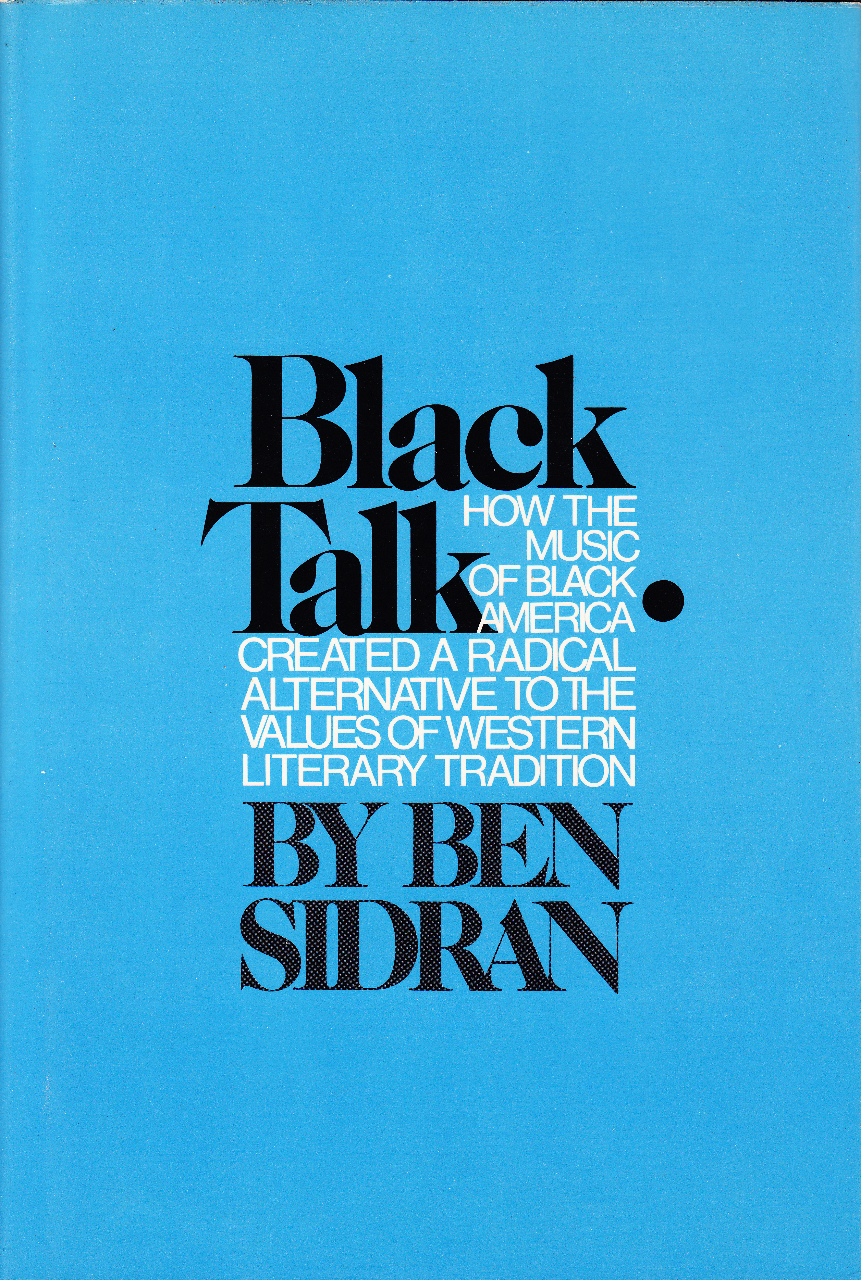
Ben Sidran
BLACK TALK
Copyright © 1971, 1981 and 2010 by Ben Sidran
Foreword copyright © 1981 by Archie Shepp
All Rights Reserved
Grateful acknowledgement is made to Harper & Row, Publishers, Inc., for permission to quote from Aldous Huxley, The Doors of Perception
To my father
CONTENTS
Foreword
Introductions
1.
Oral Culture and Musical Tradition: Prehistory
And Early History (Theory),
2.
The Black Musician in Two Americas:
Early History-1917
3.
The Jazz Age: The 1920s,
4.
The Evolution of the Black Underground:
1930-1947,
5.
Black Visibility: 1949-1969,
Selected Bibliography
Footnotes
FOREWORD
I feel privileged to have been asked by Mr. Sidran to introduce Black Talk. First, because I have known the book almost since its initial publication. It has been featured prominently on my book list and I have made numerous references to its concepts in my various lectures and discussions on the subject of African-American music at the University of Massachusetts where I teach.
Let me say, too, that I consider Black Talk one of the most important works on the social process by which Black music is communicated-certainly since the appearance of Blues People by LeRoi Jones (Baraka). For it illuminates the language of Black music, further clarifying, even updating such earlier classics as Muntu and The Myth of the Negro Past. It examines and puts to trenchant analysis certain ideas that have heretofore been only hinted at-even by Black authors. Harold Cruse came closest in his work, Crisis of the Negro Intellectual, when he made a passionate plea for a dialogue among Black intellectuals for the purpose of establishing a Black "critique" or unified position on art, one that would be politically as well as esthetically cogent.
Sidran, however, goes in another direction. More sociologically oriented, he is able to unearth a different aspect of the truth. For he makes reference to the oral tradition, suggesting its retention in the New World and subsequent transference into a socio-musical entity, with numerous political and symbolic implications. And while this is by no means an attempt on Mr. Sidran's part to give us a complete exegesis of traditional tribal experience, he does offer considerable insight into the functional aspects of the "nommo" factors-if I might inject a Bantu reference.
I spoke with Ben prior to writing this piece and our conversation got me thinking about the oral process and just how it functions among Black musicians. John Coltrane is an excellent case in point. I can remember as a young man in my twenties-with Pharaoh Sanders, Rocky Boyd, George Brown (a drummer now living in Europe), saxophonist Marion Brown (no kin to George) and others-requisitioning the great master's time, which he always gave with infinite grace and aplomb. This, of course, would be something less than astounding were it not that Mr. Coltrane's willingness to share his wisdom and profound insights with a younger generation was not exactly the norm among musicians, as is often asserted. In several instances from my own memory I can report that the matter was quite the contrary. Not to say that the oral tradition had stopped working by the time I came along-not by any means. But the old handkerchief over the trumpet keys not only served to confuse would be "white" imitators, but also Black ones. There is a firm belief in this music that (if I may quote Lester Young, second hand) "to join the throng, you've got to make your own song."
Anthropologists and ethnomusicologists use the term "informants" to describe the people who are essential to the transmission of the oral information. The word's unfortunate resemblance to "informers" (which connotes "stool pigeon," someone who is an unwilling-or willing-dupe of another's ploy) is ironic, for this has often been the situation when innocent, untutored people have shared private, esoteric information with self-seeking scholars and recording companies who exploit their subjects for the furtherance of academic research.
Let us consider Mr. Coltrane not as "informant" but as teacher in the highest pedagogic sense, as "guru." In a conversation I had with George Brown a few years ago in Geneva, he reminded me of the reverence and esteem we all had for John and how this came out in our various conversations with him. We were, mind you, not only awed by Coltrane the virtuoso (whose innovations still baffle would-be imitators) but our taciturnity before him was rooted in basic respect, an understanding of the rules regarding "elders." As Brown so poignantly remembered, "We mostly just sat and listened, maybe offering a comment of acknowledgment every now and then. We all recognized our ignorance in the face of his genius."
For a moment I thought back to those early days on Columbus Avenue, where the Coltrane family had moved after coming from Philadelphia. I thought of myself just as George described. This is not to say that we didn't have searching musical questions to ask. But the questions themselves were part of a spiritual matrix in which the personality of the master was more important to the relationship than the rhetorical handling of academic whys and wherefores. It transpired more in the spirit of the training of a Yaruba apprentice carver, than in the creation of a conservatory product.
For example, I remember spending an entire afternoon with John, just listening to him talk about his admiration for Art Tatum, whom he loved (along with Thelonious Monk and Miles Davis) much the same way we loved him. "Art," he said with informed excitement, "would approach a C seventh from the E-fiat chord or even as far away as the F -sharp (an interval of an augmented fourth) and resolve it within a space of four beats." (This makes a total of six half-steps, and if we assume that a seventh has a minor counterpart, there are at least twelve possibilities for harmonic improvisation in this simple one-bar contest.)
Mr. Coltrane was then developing his famous "sheets of sound," in which he did on the saxophone the things he heard on Tatum's piano-taking the conception further. I barely understood at that time the implications of this informal conversation. In fact, it took me years to realize the effect of that single afternoon on my overall approach to saxophone playing.
From a performer's standpoint Mr. Coltrane, like his mentor Parker, had an incredible technical ability, the product of prodigious and painstaking practice. Yet his artistry was less a matter of speed or technical prowess than of a certain passion, born of a sense of discipline and integrity almost mystical, yet integral to Black improvised music at its highest level. His virtuosity was rooted in a tradition that had developed long before Joplin composed "The Maple Leaf Rag."
I believe the fundamental source of the characteristic Black musical genius derives from three essential areas of experience: (1) The Afro-Christian Church; (2) the functional song (here defined as the work song, arhoolie, cries, etc.) as it evolved under slavery; and (3) the various songs, chants; games that come from Black childhood experience.
Prior to World War II most African-American music, though it offered a strong instrumental component, was essentially dance-oriented. And to this extent the prerequisites of "swing" were paramount. Music, as Ellington said, just didn't mean a thing without it-though he himself foreshadowed development of longer, more instrumental forms, even in his early works. But with the coming of the war the cabaret tax on large dance establishments made it prohibitive to hire big bands.
Several conflicting phenomena grew out of this hiatus. As the music gained a wider, more diffuse audience, the community basis was attenuated and the nomenclature was changed. In the twenties all Black music (except ragtime) was termed "race" music to indicate it was the niggers who made it. Now with increasing commercial acceptance on records, and later radio, it became rhythm and blues, which somehow encompassed "jazz" as well. This resulted in the division of Black music into arbitrary categories-Blues, Classic Blues, Gospel, Jazz, Ragtime, Soul, Pop, Rock 'n Roll-without regard to the indivisible nature of its roots. (Why have we never employed terms like impressionistic, baroque, secular, religious, to describe Black music? And if not those terms, since they seem to have been co-opted to define the "Western experience," why not one that gives credit to the true authors of the music, to the theoretical aspects on which it is based?)
Small wonder that, as Neil Leonard points out (in Jazz and White Americans), there is a general misconception that Black music is in fact "White American Music" – truly ironic in light of the impressive contribution of the Black songsmiths and the oppressive conditions under which they labored, pariahs in the land of their birth. Part of the problem arises from the tags stuck on Black music by some critics – "bop" in the forties and then the "cool school" from the West Coast (depicted by the media as "white" though it was based on the innovations of Lester Young and Miles Davis). Later the Black musicians of the East Coast were pitted as a foil to this cool school, and were themselves dubbed "hard boppers" or the "funk" school. Now I submit-with literary friends like these, does the Black music world need enemies?
But to continue our little historic journey-a metamorphosis occurred when the dancers' images were refocused and dispersed through the plastic medium of sound-imagery. The saxophonist, with his multi-keyed, multi-toned instrument, begat the perfect existential weapon. No one better understood this than Parker, who ultimately unleashed Black music from the prerogatives of dancers. He changed what was essentially a rural music into an urban one. He represented the reintroduction of what Sowande calls the "ritual experience," further identifying this music as diasporic.
The sophistication of this music and its creation in the burning sessions that took place uptown in the forties was a deliberate attempt by the Black composer performer to form an imagery which, in the words of composer-genius Thelonious Monk, could not be imitated (note: imitation is a primary artistic concept) by the "white boys." Or to put it another way, the raison d'etre of this new language was the creation of a medium outside the parameters of Western academic theory (musical in this case, though it has other implications).
Ben is deadly accurate here when he says that Black music has transmitted the seeds of Black experience far more effectively than mere words acquired second hand. McLuhan says that "the medium is the message" and Ellington, with his customary eloquence, observed that "all the world is becoming slightly oriental" The process of Black music, and "Black talk " itself, has been the concerted effort by Blacks to discover "roots" – made possible because, as Herskovits states, music constitutes an area of "unconscious focus." Simply listen to an Ellington or Henderson recording from the twenties and see how they capture more than a thousand Gatsbys the feeling of the so-called "jazz" era. The Black instrumentalist, apart from the vocalist and dancer, was able to do his own thing in a world where his words were music, and his language was his own.
Read this work and make it a part of your permanent library.
ARCHIE SHEPP
Amherst, Massachusetts
September 1980
INTRODUCTION. 2010
At the end of Black Talk, as you will read, I am sitting in a small New York hotel room talking to an old friend about the state of the jazz business and what he perceives to be the end of the world as we knew it. He is a highly gifted drummer who came to New York in the mid-sixties and immediately began playing with America’s best musicians, including Sonny Rollins and Roland Kirk. His name is George Brown. He is the same musician that Archie Shepp refers to in his forward to Black Talk. Now, however, the time is 1969, two years after the death of John Coltrane and many things have changed. Following Coltrane’s passing in the summer of 1967, and the assassination of Martin Luther King Jr. and Bobby Kennedy in 1968, many Black Americans had been thrown into a deep despair. Sitting in that small airless room with George, we were both, in a way, saying goodbye to a golden age we hadn’t even known existed.
Mr. Shepp refers to certain people as "informants" and, for me, George Brown was just such a presence. In the fall of 1963, he had arrived in the small college town where I was attending school. He was part of a trio that was backing a singer billed as "Miss Fallout", not because her singing was so radioactive but because her low cut costumes revealed so much of her upper anatomy. The act had been traveling through the Midwest for some time and when they got to a little second story club on State Street, which overlooked the chaos of campus life, they were happy to settle in for a while. George had played drums with Wes Montgomery the year before and was only a little older than the rest of us. He was one of the best musicians ever to come through town and was given such a warm welcome by the local jazz community that when Miss Fallout left for her next booking, George stayed in Madison.
He was twenty-five years old, a handsome, articulate, impassioned Black man, and when he landed in Madison, it was as if a messenger had been sent to alert the rest of us to the future of the music. We had been dug into the bebop scene pretty hard, buried up to our necks in the swing of Philly Joe Jones, Louis Hayes (his solo album with Yuseff Lateef was a favorite), Roy Haynes ("snap crackle"), Art Blakey, Max Roach, Pete LaRoca, and so many others. But everywhere that George went, he carried a John Coltrane album with him. At all hours of the day or night he would knock on the door, go directly to the record player and put John Coltrane on the box. For the next forty-five minutes, nobody would talk. We would just sit there and go to church on Elvin Jones, Jimmy Garrison, McCoy Tyner and John Coltrane. Coltrane Live At The Vanguard playing, "India", "Spiritual". "Impressions", "Chasin' The Trane", or Live At Birdland, playing "Afro Blue", "the Promise", "Alabama" – of course we had listened to these records when they first came out and recognized their extraordinary level of musicianship. But I don't think we actually heard them until we heard them with George Brown. Listening to music is always like this. It changes depending not only on where you are but also on whom you are with. We are all emotional transmitters, and sometimes, when a 50,000 beacon walks into the room, we suddenly "get" what before we only sensed. Coltrane's music and the implications of playing jazz this way – of playing a music that was about a deep, emotional liberation not just about swing – forced us to rethink everything. People say this is what happened when they first heard Charlie Parker back in the 1940s. Wherever they were, they knew nothing would be the same again. This was serious business, and for us, when we got on the Coltrane, everything we knew to be true had to be re-evaluated.
It was George who introduced me to the Coltrane record Crescent and it was on the song "Lonnie's Lament" from that record that I heard my mother's voice emerge from Coltrane’s horn, the actual moment that launched me on the search to discover how and what Black music can "mean". So in a very real way, George set me on the path that resulted in Black Talk. When his name turned up in Archie Shepp's introduction some years later, it was not only a huge surprise to me (I had no idea George and Archie had been friends) but a kind of shiver went through me; I felt an energy that passed from Coltrane to Shepp to George to me. Informants: the oral tradition was an actual, living thing. And like all living things, it was fragile.
Black Talk is very much a book of its time, written between 1969 and 1970 as a Phd. dissertation when I was 26 years old. In retrospect it was a kind of golden age, but at the time, it was just as difficult as any other, hard and bleak and powdered with mild-altering substances and anger. And whereas at the time I wrote of the "anti capitalistic" nature of Black music, in a few short years, when the record industry took over the music business, with their marketing strategies and technological miracles, the over-riding theme was capitalism, pure and simple. Herbie Hancock's Head Hunters – released just months after Black Talk was published – was one of the first major shots fired across the bow. A big, funky, highly-edited jazz-funk project, it sold in the millions, and Herbie became the idol of most young jazz players, not necessarily because of his brilliant harmonic concept but more because of his huge pop success; and whereas only a year before young musicians would have chosen their musical heroes by virtue of a particular playing style or sentimental cast, after the success of Head Hunters, everyone began to see success in terms of units sold. Then came the disco tsunami and many jazz players, black and white, were pretty much out of work. Jazz clubs closed all around the country, even Blue Note Records went dark (in part because of its attempt to chase the "boogaloo" train, abandoning its hard-core fans) and George Brown, like many others, moved to Europe. As noted at the end of the text, the real danger to cultural traditions and individual relationships comes when people, acting out of despair, cease caring. George died in Paris sometime around the turn of the century, still angry, still waiting for a revolution that never materialized.
The follow up to Black Talk was to have been a book about the impact of technology on Black music and how the marketing machinery of the recording industry co-opted the oral tradition, separating musicians by virtue of demographic category and economic success. By the time of Herbie Hancock's flat-out rock release, Rockit, with it’s popular MTV video, the nation’s ears had surrendered to its eyes (emotions gave way to appetite) and the oral tradition was but a shade of its vital former self. Instead of writing that book, however, I ultimately wrote a memoir that covered the same ground (A Life in the Music). And the vast majority of Americans still could not sing the bridge to the National Anthem but nobody seemed to care anymore. They were too busy watching the cheerleaders on the sidelines.
BEN SIDRAN
August 2010
Madison, Wisconsin
INTRODUCTION. 1980
The idea of considering Black music in America in light of an oral continuum evolved gradually, after years of listening to the music, after reading McLuhan on Western cultures and speculating on non-Western counterparts, after studying Wittgenstein on semantics and noting the general confusion in the field, and finally after listening to a Coltrane solo and hearing my own mother's voice.
Much of what exists in these pages began as a brief glimpse of a greater truth and ended as a quick sketch of the trail that truth left behind.
The musician is the document. He is the information itself. The impact of stored information is transmitted not through records or archives, but through the human response to life. And that response is ongoing, in the air, everywhere, an alternative constantly available to those who have ears to hear.
This perspective certainly is not new. To the contrary, it is everywhere. But it wasn't written down, so it wasn't written about.
There is a tremendous irony in trying to re-capture this essence of the oral tradition in a few typewritten pages. And while concepts such as "psychological territory " and "the politics of perception" are considered in the text, it does not seem possible to communicate these nuances to someone not steeped in the music itself.
And there is an additional irony in the fact that, since the initial publication, the thesis of Black Talk – "how the music of Black America created a radical alternative to the values of Western literary tradition" – has not been developed by scholars more qualified than myself to examine the larger implications. To this day, the book you are holding remains the only one to consider the music of Black America in this light.
BEN SIDRAN
December 1980
Madison, Wisconsin
INTRODUCTION. 1971
This study is both a historical and a thematic approach to the Black music of America. I call it a cultural history because of its slant: it is not concerned with dates and names so much as with general cultural movements. I have therefore had to exclude several Black musicians-many of them are my favorites, and many of them have contributed a great deal to the body of Black music-in order to explain the cultural basis for Black music in America and examine how Black music supports and perpetuates that cultural basis. This study is a radical departure from all other studies on Black American music. There are excellent books telling who did what, where and when. There are no books, with the exception of LeRoi Jones's Blues People, that look into the cultural why of Black music. There are no books at all that consider Black culture in America as an oral culture and none that treat Black music as part and perpetrator of that orality. I should mention here that oral and orality are never used in their capacity as psychoanalytic terms. The category oral culture is used to counter the generic literate culture, and not at any time to oppose, for example, an anal culture. This study, then, owes much to the pioneering work of Marshall McLuhan, who was among the first to note in writing that the literate base of our society was breaking down-an irony carried to even greater extremes in these
pages-and owes very little to the pioneering work of Sigmund Freud.
It should, first of all, be evident that any examination of Black culture in America is necessarily an examination of the relationship between Black and white Americans. This relationship-the images "Black" and "white" that Americans hold of each other-has shaped the cultural evolution of all Americans. Perhaps in the long run, the light shed here on this relationship is more important practically and socially than anyone-sided examination of orality could ever be. Let's take the old bromide: "Negroes have a natural sense of rhythm," which has always been considered a racist stereotype" because it was traditionally used by whites and was based on speculation in genetics for which there was no proof. And yet today, that same bromide, stripped of its genetic implications, has been taken up by militant Blacks who seek to turn the fact of their Blackness into a club. One articulate young Negro, Julius Lester, has written: "Of the minority groups in this country, Blacks are the only one having no language of their own. Language serves to insulate a group and protect it from outsiders... (The Negro) has another language, and that language is rhythm. This has been recognized by Black people for some time, and they call it 'soul.'"{i} If white racists " even at this late date could deliver some genetic evidence for "natural rhythm," nobody, it seems, would be happier than Julius Lester. "Natural rhythm" and genetic evidence aside, how then does one talk about music as the Black American's native tongue? One of the central problems of this book has been the difficulty in generating a vocabulary that would be acceptable to all factions and serve the cause of an objective study at the same time that it served to explain the meaning of Black music as a kind of language.
It was apparent to me from the start that it was possible to combine musical analysis with social analysis. In a sense, the musical group is a prototypical social unit, which evolves prototypical social patterns, rules, relationships, precedents, and initial thought patterns. There is, however, an inherent paradox in this study. I agree with Aldous Huxley, who believes that symbol-systems such as formal language are basically formulated to exclude certain kinds of information, to reduce non-rational experience into rational pigeonholes and to verbalize the nonverbal. Semantics, symbolic logic, and psychoanalysis are all means of refining or bypassing speech to get at meaning. But Black music is a form of oral communication which itself bypasses formal analysis to communicate some kind of empirical meaning and, beyond that, some form of emotional truth. To write about such a form of communication is often to reduce it to nothing very meaningful.
The subject of my investigation, then, is the social function of Black music in America. In these pages, I am mapping the progress of a Black, oral culture in America, how it reacted to white America, how white America reacted to it, and the nature of the relationship itself. I try to point out the distinctive elements of Black music and relate these to the social process. My basic assumption is that Black music is not only conspicuous within, but also crucial to, Black culture. It has often been asserted that music-its place in society and its forms and functions-reflects the general character of the society. It has, however, rarely been suggested that music is potentially a basis for social structure. Yet I contend that music is not only a reflection of the values of Black culture but to some extent, the basis upon which it is built. This places on the importance of musical expression a stress alien to the tradition of Western cultures. Music in Western societies is thought of, in general terms, as either popular (low-brow, vulgar) or classical (exalted or art music). The popular music is then dismissed as inconsequential, while the art music is elevated above the realm of everyday activity. Western theory tends to detach art from life, just as Western man tends to detach himself from both art and life. In Black American culture, popular music is the exalted music; it is art that is vulgar in that it is the creation, responsibility, and property of the total community. In this sense, music begins to emerge as a potential foundation for social activity.
In failing to develop a literate tradition, by maintaining instead the subsequent oral tradition, Black culture came to rely heavily, if not solely, upon oral modes of communication. These modes necessitate the advanced development of the faculties of vocal expression and aural perception. The development of these techniques accompanies corresponding development in the social system, inasmuch as the social process is a function of the separate psychological orientations of its individual members. Black music can be seen as a function and, to some extent, a cause of a peculiarly Black ontology.
(I use ontology in its dictionary meaning: the science of being or reality, i.e., the branch of knowledge that investigates the nature, essential properties, and relations of being.) Thus, the investigation of Black music is also the investigation of the Black mind, the Black social orientation, and, primarily, the Black culture.
The elements of Black music make a particularly strong "mood synchronizer": the music can galvanize a group of individuals on an emotional, nonverbal level of experience. This was true centuries ago in Africa-from what little we know of the relationship of music and African religious experience-and it is true today in American ghettos. This significant aspect of Black music is often overlooked by the historians-with the result that Black music has been a victim of the selective tradition of Western literary disciplines. Selective tradition is the survival of a culture through records, "governed, not by the period itself, but by new periods,"{ii} and thus creates the historical record of a culture at the same time that it omits considerable areas of what once was a living culture. American literary tradition is concerned primarily with American literary traditions and this, by definition, excludes from examination most of the Black experience. The real crisis in American conscience is that there has been no crisis concerning the Black culture. Black music, for example, came to light only after it was sold over the counter on an international scale through predominantly white imitations. And even then, only the increasingly tense Black "situation" in America focused attention on the source of this music. What this suggests is that the selective tradition may be breached either by a quantity that is economically profitable or a quality that is psychologically
threatening to that tradition. Black music has both.
Today, America is confronted with a growing Black tradition, a very different selectivity generated on both oral and literate levels by members of the Black community to whom the process itself is not new. There have always been those Black Americans who sought to reject and reinterpret the traditional view of Afro-American history, notably David Walker followed by Denmark Vesey, Nat Turner, Frederick Douglass, and on down through time to Malcolm X. The only new thing is that today this is happening on a massive scale with the whole Black community participating, to some extent, in the terminology, technique, and tone of the process. As Black music is-and always has been-the most important single socializing element of Black culture, its role in this process is nothing less than considerable.
Yet Black music remains a subject discussed in the streets more often than in the academies. This is perhaps due to a more general failure to examine the implications of Black music as they relate to the oral tradition of Black culture. I use the term oral culture not simply to establish a random category to oppose that of literate culture because, on the one hand, all literate cultures grew out of an oral culture at some point in their evolution: all cultures are more or less oral cultures inasmuch as communication through speech and aural perception is common to all cultures. Orality can be seen as a difference in the degree of stress placed on oral modes of perception and communication. This leads Western tradition to view the oral tradition of Afro-Americans as an inherent lack, a kind of literary vacuum and hinders the acceptance of orality as a valuable mode of perceptual orientation. On the other hand, we know that what begins as a difference in degree can, through centuries of cultural evolution, take on the properties of a difference in kind. It can therefore be suggested that orality, besides being a common denominator for all cultures, is, after extended generations, the basis for an alternative breed of culture.
One can easily understand why white, or Western, historians have tended to minimize or omit the study of orality. They are writers by cultural tradition, a tradition that places no value whatever on the absence of literacy, and, as such, they have little if any experience of the advantages of orality. Also, literacy freezes concepts, as it were, through the use of print, making the more fluent oral modes even more elusive. It is remarkable that Black authors have failed to investigate this point; it is also very telling, for it suggests that in becoming Westernized, in grasping the advantages of literacy, they simultaneously released their hold on the advantages of orality. What makes this maneuver particularly tricky is that the advantages of orality have rarely been recognized by Western tradition, and Black authors are often overly concerned with notions of Western legitimacy. It is also apparent that Black authors tend to rush to the defense of Black traditions through the idiom of literacy and, in their haste, fail to notice what appears to be the rather insignificant fact of an oral tradition. There have been exceptions-most recently the Dunhill record called The Last Poets – but they only serve to prove the rule. The most glaring example of this phenomenon is found in the work of Frantz Fanon, the famous Black revolutionary psychiatrist. In Fanon's monumental and now deified work The Wretched of the Earth, which Eldridge Cleaver calls the Bible of the Black revolution, the chapter on "National Culture" includes a brief two paragraphs on the oral tradition while page after page is devoted to the plastic arts, to painting, to the "African Ballets," and even to Black literature.
The question of the relationship of Black music to the oral traditions of Afro-American culture, then, is still open inasmuch as the latter has been generally ignored and the former more often exploited than explored. Both the association of music with magic in African cultures and the importance of music to the development of Black Christianity in America have been cited as proof of connection between Black music and Black spirituality. But the crucial point that the foundations of that music and that spirituality stem from an oral tradition and that this implies an inherently non-Western perceptual orientation within the Black culture has escaped most Western observers. The end of slavery and the rise of a new Black secular tradition in America found the Black community creating its own social systems out of the patterns lay down during slavery. The social nature of Black music was used to shape both the old and the new social structures. Indeed, future historians may well note that Black music was the element that not only provided the basis for a viable social structure during times of crisis for the Black community, but was at the heart of the ensuing Black social revolution as well.
BEN SIDRAN
September 1971
Los Angeles, CA
"In a world where education is predominantly verbal, highly educated people find it all but impossible to pay serious attention to anything but words and notions. There is always money for, there are always doctorates in, the learned foolery of research into what, for scholars, is the all-important problem: who influenced whom to say what when? ... The non-verbal humanities, the arts of being directly aware of the given facts of our existence, are almost completely ignored.... Verbalists are suspicious of the non-verbal; rationalists fear the given non-rational facts.... Besides, this matter of education in the non-verbal humanities will not fit into any of the established pigeonholes.... Systematic reasoning is something we could not, as a species or as individuals, possibly do without. But neither, if we are to remain sane, can we possibly do without direct perception, the more unsystematic the better, of the inner and outer worlds into which we have been born. This given reality is an infinite that passes all understanding and yet admits of being directly and in some sort totally apprehended. It is a transcendence belonging to another order than the human, and yet it may be present to us as a felt immanence, an experienced participation."
Aldous Huxley
The Doors of Perception
CHAPTER 1.
Oral Culture and Musical Tradition: Prehistory and Early History (Theory)
It is difficult to say anything definitive about the prehistory of the American Negro. The African cultures from which the slaves were taken kept no written records. The information, which did survive in the forms of lore and ritual, was generally considered too primitive or too barbaric to be of importance and, subsequently, was not preserved. Yet, the fact that the African cultures had an oral rather than literate base and the instance of cultural isolation within the United States make it possible to suggest a new method for examining the Afro-American experience as a continuum. If the American Negro managed to preserve his oral culture and to extend its base into the greater American society, then there exists in America even today a "subculture" or "counter-culture" with its own social and value structures and a mode of perceptual orientation capable of supporting such structures. The retention of oral culture means the survival of the necessary perceptual attributes. The examination of these attributes, in, for instance, Black music, can yield important information about the nature of the oral continuum.
Because of several centuries of commingling with a literate culture in the United States, these oral biases manifest themselves subtly and therefore meet with little resistance from the greater American society. Literate society often turns a deaf ear to the implications of an oral culture. A clue to why this is so may lie in the suggestion that "the function of the brain and nervous system is in the main eliminative and not productive.... The function of the brain and nervous system is to protect us from being overwhelmed and confused by this mass of largely useless and irrelevant knowledge, by shutting out most of what we should otherwise perceive or remember at any moment, leaving only that very small and special selection which is likely to be practically useful."{iii} Because the literate culture and the oral culture have alternative views as to what constitutes relevant, practically useful information, they impose alternative modes of perception for gathering information. Western culture, it seems, stresses the elimination of perceptual information. The Western view of the witch doctor or schizophrenic as one who receives "too much" of reality indicates this fear of perceptual excess. Although all people have to do certain kinds and amounts of elimination, in oral cultures, members appear to experience a wider range of emotions on a more immediate level of sensation: it appears that the oral man receives more perceptual information as well as perceptual information of a different kind.