Land of the Gods
How a Scottish Landscape was Sanctified to Become Arthur’s Camelot
Philip Coppens
© Philip Coppens 2012
All rights reserved. No part of this ebook may be reproduced in any form or by any electronic, magical, or mechanical means including information storage and retrieval without written permission from the publisher, except by a reviewer, who may quote brief passages of no longer than fifty words at a time in a review.
DH Lawrence stated: “Every people is polarised in some particular locality,
which is home, the homeland. Different places on the face of the earth have
different vital effluence, different vibration, different chemical exhalation,
different polarity with different stars: call it what you like, but the spirit
of place is a great reality.”
According to Lester Borley, Director of the National Trust of Scotland and an
authority on world tourism, “perhaps the most powerful of all world tourism
motives is the desire to visit special places which have a spiritual quality.”
Some have gone so far as to distinguish these people from “the tourist”
and have labelled them “pilgrims”, as they use the tourist industry
to reach places which for them are of special significance.
Is it possible that a part of Scotland, in particular the Lothians and the Borders,
was once considered by its inhabitants to be a “sacred land”, a
land favoured by the Gods? This concept might seem outrageous to propose at
the beginning of the 21st century. But only half a century ago, the Jews claimed
the land of Israel because they believed that that land had been given to them
by Yahweh 3,000 years earlier. In our 21st century, 400 years after being colonised
by Europeans and nearly 250 after the Declaration of Independence the United
States of America still feels it is specifically favoured by “God”.
More than any other political leader, its presidents use the name of “God”
in their speeches, obviously indicating how they think their decision is favoured
by him, or in his interest, and how he will bless and help the American nation.
The United States are not alone; various other countries believe the same. And
originally, it seems various cultures believed this: from Easter Island, to
Egypt, to Sumer, etc. In all these cases, past and present, the belief in a
special relationship between God or the Gods and the people, and hence the nation,
married the people to the land they lived.
So, to some extent, the answer to the question of this special relationship
that might have applied to the Lothians and the Borders should be a rather uncontroversial
“yes”. But, whereas we have written records of the claims of the
Jews and the Egyptians about their relationship with God, who apparently gave
them their country, such evidence seems to be lacking from the Lothians. So
did it happen, or didn’t it? To ask the well-tried question: “is
absence of evidence, evidence of absence?” Or is there another reason
for this absence?
The evidence is, in fact, lacking throughout the length and breadth of Britain
–– at least it is when we try to find it around 2000 BC. The Lothians
do not form the exception; they are the norm. But to the West, in Ireland, there
is evidence. Ireland, scholars affirm, has the best preserved and richest store
of mythological traditions of any country north of the Alps. Why? The most likely
reason is that Ireland had no exposure to the Roman invasion that changed Britain
forever. The transition in Ireland went from the Celtic religion to the Christian
religion. It is well known that Christian missionaries had specific orders to
make sure that religious places were the prime targets for conversion; the pagan
sanctuaries were often occupied literally by the Christian missionary –
hence the name “Christianisation”.
On mainland Britain, the situation was different. With the Romans, the prime
locations for occupation would be the forts or areas where the local people
did battle with them. The Romans occupied Britain and often erected new towns
to suit their needs. Bath became a prosperous Roman town because the Romans
used it as a spa. At the same time, the Romans brought with them their own religion.
Hence, it is often unclear whether certain locations were “Romanised”
Celtic sanctuaries, or whether the Christians merely “Christianised”
Roman temples in locations where there had been nothing before the arrival of
the Romans. In London, Westminster Abbey and St Paul’s Cathedral are thought
to have been built on Roman Temples – but whether or not those temples
were built on Celtic religious sites, is completely unknown.
Contrary to the Romans, the Christian missionaries also ensured that they left
written records of their conversions: the accounts of the early saints show
evidence of how their work converted a people from worshipping “the devil”
to the worship of God. The missionaries felt it was important to show the process
of Christianisation, to underline the evil of what was there before. Throughout
Christianity, the contrast between the pagan, evil ways and the “good
way” would continue to be underlined – often with painful and lethal
illustrations along the “good path”. The Romans simply did not bother;
their records were administrative: on their way to conquer this and that, they
came across these people, who they fought there, etc. Often, the accounts were
written after the events, and often written by those not witnessing the events.
This difference in approach is one of the primary reasons why the mythology
of Ireland has been well documented and to a large extent remains active to
this day, though often under a layer of veneer, painted and frequently restored
by Christianity. But the underlying imagery remained visible. In Ireland, the
pilgrimage at the end of July to Croagh Patrick clearly reveals its pagan roots.
The hill was sacred in pre-Christian times and the annual pilgrimage is literally
identical to the pagan festival; the only difference is that, as it is performed
by Christians, the pilgrimage now marks the victory over the pagan ways. The
ancient rituals were literally Christianised – but to any neutral observer
watching the progression, little or no difference would be visible.
In contrast to Ireland the imagery in mainland Britain is more dispersed –
but nevertheless it is still traceable. However, there is only so much that
archaeology can uncover. The best way of ensuring the survival of things that
archaeology cannot deal with – language, belief, social organisation and
so on – would be in the local folklore. But in nearly all areas it is
clear that Britain, and specifically Scotland, has suffered more than Ireland.
Therefore, where native evidence has gone missing, analogies will have to be
used. However, it is important to make sure that the analogies used are topical
and close to home.
All too often, both archaeologists and non-scientific authors, draw comparisons
from outside of the framework. Comparisons between the Old World and the New
World, e.g. Egypt and the Maya civilisation of Mexico and surrounding countries,
comes to mind. Several millennia separate both civilisations, as well as the
Atlantic Ocean. The fact that both civilisations built pyramids following the
same general pattern is intriguing, but straightforward comparisons cannot be
made. Arguing, as some have done, that the similarity, small though it is, of
more than one civilisation building pyramids (which are structurally completely
different in each civilisation) is proof for the existence of a “lost
civilisation” is therefore only allowable if extra-ordinary evidence can
be produced to substantiate the claim.
However, for some unknown reason, during the period 3000 BC to 500 AD, from
the era of the megalithic civilisation to the departure of the Romans, the role
of the Lothians and the Borders has remained largely unexplored. Here enters
a second problem: the division between England and Scotland, with the Lothians
and Borders belonging to the latter, though often sandwiched between both. North
of the border, allegations that English historians have always minimised the
importance of Scottish history have never stopped; but they are nevertheless
true. Even when it comes to megalithic monuments, the main focus is on Stonehenge
and Avebury – England. That Scotland has megalithic monuments might be
unknown to a large percentage of the British population. That monuments rivalling
Stonehenge and Avebury are present in the Orkneys and the Isle of Lewis, is
also little appreciated.
There is, therefore, less knowledge of Scottish megalithic monuments than there
is of those located in England. Knowledge of Lothian and border megalithic monuments
is even less. This is very strange, as the area is littered with megalithic
monuments – some of them extreme importance. The Romans discovered a Celtic
tribe living in the area which, uniquely, they did not subjugate, but instead
they entered in partnership with them. The question of “why” the
Votadini received this special treatment is hardly ever asked. When the megaliths
of the Lothians are occasionally looked into, those who are studying them never
release them from their territorial isolation and place them within the framework
of the British Megalithic Era as a whole.
In 1947, Cairnpapple, the most important megalithic site of the Lothians, was
researched by archaeologist Stuart Piggott. He had also done research at Stonehenge,
thus linking the two sites. Furthermore, both sites belonged to the same category
of monument: a henge. But despite all of this, neither Piggott nor anyone else
has placed Cairnpapple within the “Henge tradition” – or Hengeworld
as one archaeologist has recently labelled it. These researchers have pointed
out how the henge phenomenon was typically British, that it was found in Northern
Scotland, and in Wiltshire. Anyone drawing a line from both locations will end
in the Lothians – it is very hard to miss the Lothians and the Border
region when travelling North to South or vice versa in Britain – as the
Romans realised. In the middle, between the Orkneys and the Wiltshire henge,
sits Cairnpapple. But is it ever incorporated into the concept of how the henge
phenomenon spread southward from the Orkneys? The answer is no.
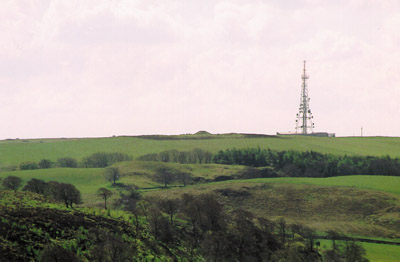
Cairnpapple sits on top of the highest hill in Central Scotland, as evidenced by a modern radio mast
Apart from megalithic remains, the Lothians are rife with accounts of King
Arthur: “Arthur’s Seat” stands tall over the city of Edinburgh.
In literature, J.R.R. Tolkien based Lord of the Rings around Edinburgh and Scotland:
the Lothians were Lothlorien, a magical and timeless kingdom. The returning
King and his wandering company, whom Tolkien called the Dunedain, were named
after the ancient city of Edinburgh.
Tolkien was not the only one who felt the Lothians were a magical kingdom. Tantallon
Castle, just East of North Berwick, is a dramatic setting for any castle. No
surprise then perhaps that it has been identified as the Grail Castle. According
to some, this was the original Camelot, the castle of King Arthur. Attempts
were made in the 1960s to find evidence, treasure or even the Holy Grail in
these ruins, but funding was insufficient to uncover anything. Almost by default,
the results would have been negative.
Similarly, a 19th “historian” was convinced that Edinburgh was the
true site of Jerusalem, and he wrote several lengthy tomes on the subject; Arthur’s
Seat was supposed to be Calvary Mount. The imagination often runs away with
reason, but flights on fancy happen more easily when the soul is moved; and
the natural beauty of the Lothians and the Borders has inspired poets as well,
as history can attest.
Still, the gap created by scientific disinterest in Scotland, has opened the
way for pseudo-scientific theories. Specifically an interest in a connection
between ancient Egypt and Scotland has come to the forefront; a connection which
has been sponsored by Mohammed El Fayed, owner of Harrods’, Egyptian born,
and Scottish castle owner. Some of these Egyptian connections, it has to be
said, are based on medieval records.
Walter Bower, Abbot of Inchcolm Abbey, completed the Scottichronicon, in 1435.
Bower was born in Lothian’s capital, Haddington, in 1385 and entered the
seminary of St Andrews, before becoming abbot of the small Augustinian monastery
off the coast of north-east Scotland. It is often stated that Bower wrote the
history of Scotland, but in truth, he “merely” concluded it. After
the death of Fordoun, the historian Sir David Stewart of Rossyth asked him to
complete the Chronicles of Scotland, which had been brought up by Fordoun only
to the 23rd chapter of the fifth book. In transcribing the part written by Fordoun,
Bower inserted large interpolations. He completed the work in sixteen books,
which brought the narrative to the death of King James I. In describing ancient
Scotland, Bower spoke of a time before the Romans, when the North had been visited
by ancient Egyptians.
He stated: “In ancient times Scota, the daughter of the pharaoh, left
Egypt with her husband Gaythelos by name and a large following. For they had
heard of the disasters which were going to come upon Egypt, and so through the
instructions of the gods they fled from certain plagues that were to come. They
took to the sea, entrusting themselves to the guidance of the gods. After sailing
in this way for many days over the sea with troubled minds, they were finally
glad to put their boats in at a certain shore because of bad weather.”
According to Bower, this shore was in north Britain. He argued that Scota and
her following settled in Scotland. When relations with the natives deteriorated,
they left for Ireland, merging with the local population to form the tribe known
as the Scotti. Many centuries later, they returned to Scotland, defeating the
Picts and conquering the Highlands
Bower names the pharaoh as Achencres, which is the Greek rendering of Akhenaten,
the heretic pharaoh who tried to abandon the Amon centred religion of Thebes
and convert Egypt to the worship of the Aten, the solar disk, the visible aspect
of his religion which seemed to deify the solar light. In recent years, many
authors have touched upon the Egyptian-Scottish connection; one, Lorraine Evans,
has tried to collect evidence from archaeological sites to show that the ancient
Egyptians did visit Britain and that the allegations of Walter Bower are historical
truths.
When Evan’s book, Kingdom of the Ark, was published, some historians felt
compelled to react. One Scottish historian in medieval history, Dr Dauvit Brown,
of Glasgow University, discounted Evans’ theory, saying she had been taken
in by the Scottichronicon, which was a “mythical account”. “She
doesn’t seem to understand historical sources,” he said. “We
might not know where we originated from, but we’re not Egyptians, that’s
for sure.”
This statement underlines the basic problem people like Brown face, but do not
deal with. In a court of law, evidence cannot be divided. And colleagues of
Brown have used this approach with the Scottichronicon: they claimed certain
items are historically true, whereas others weren’t – including
the Egyptian origins of the Scots.
Evans placed the arrival of Egyptians in Scotland at around 1300 BC. A connection
between ancient Egypt and megalithic Scotland might seem fanciful. But, as this
book will show, the entire ancient world from 3000 BC onwards moved towards
a solar religion, not just Egypt. Though the scientific world might be divided
between Egyptologists and archaeologists, history itself is a whole. The new
“solar” trend was visible, at the same time, in both Scotland and
Egypt, and elsewhere. It formed a radical departure towards the modern age,
in which cities and individuals are held in higher esteem than small communities
where decisions were made by the group as a whole, rather than by chosen individuals.
A key point which has to be made is that archaeologists feel that this movement
might have originated in Scotland. Though they will not go as far as to suggest
that the sphere of influence stretched all the way to Egypt (they argue it spread
from Scotland towards the South, reaching Southern England and Brittany, i.e.
the normal sphere of Megalithic Western Europe), it is nevertheless a fact that
the “British solar religion” preceded the building trend linked
with solar religion that hit Egypt in the middle of the 3rd millennia BC –
500 years after it started in Scotland. The question as to whether these two
might be related is never addressed; not even statements like “both developed
the solar oriented religion independently” are heard.
What this book will reveal is that much of the symbolism of solar worship in
Egypt can be traced back to the Lothians. In Egypt, the hieroglyph for the sunset
is the solar disk between the twin peaks of a mountain. The hieroglyph for sunrise
is a solar strip over a conical, so called “primordial” hill. These
features are difficult to observe in Egypt – they are difficult to observe
anywhere in the world. But they do exist in the Lothians. But let us not run
before we can walk. Although this book will not address the question of whether
or not an Egyptian colony settled in Egypt, it will reveal that the Lothians
form an integral part of the spread of the solar religion – and that the
symbolism used by this religion is found both in the Lothians, as in Egypt,
as elsewhere.
In recent years, the romance of yesteryear has been replaced with the hard
knowledge that many of the most significant Scottish and often British archaeological
finds have been made in the Lothians. This was not a scientific reaction to
the “esoteric researches” in search of the New Jerusalem or the
Holy Grail. Like so much of modern archaeology, it was performed purely because
of Mankind’s further intrusion in nature; in this case, the development
of the dual carriageway of the A1. Britain’s policy that any building
developments that may involve sites of potential historical interest must be
accompanied by archaeological research, has been a god-send for many –
and specifically for Lothian archaeology.
In the past, there was idle speculation based on no evidence; lately, there
have been many discoveries, but no interpretation or setting these discoveries
within their proper framework. It is now time to marry both these principles
again. The role of the Lothians within Scottish archaeology and Megalithic religion
has been largely untouched, and the emergence of solar worship and its Scottish
origins has been only briefly touched on by a small handful of authors.
Once the two concepts, archaeology and mythology, are joined together once again, the Lothians will reveal why its ancient people believed the land had been specifically favoured by the Gods. They will reveal the sacredness of the land, and place it within its proper, symbolic context – and not modern ideas of Holy Grails, which, at best, belong more to our era, than to the era of the Megalithic Lothians.
The ancient Egyptians believed their land was the land of the gods; the pharaoh
was the direct link to the gods and their representative on Earth. His rule
would safeguard the nation and maintain the order, with the help of the gods.
They identified all foreigners with the “chaotic powers”. In Egyptian
depictions of warfare, found on many temple walls of Upper Egypt, the foreign
enemies are always portrayed as a chaotic gathering of people, whereas the Egyptian
army is depicted as ordered lines of warriors.
These ideas are in fact quite commonplace in that every nation tries to portray
its unique relationship with “God”. Before every war, the governments
of nations will call upon their people bearing the message that God is on their
side, that they are good and the enemy is evil. In a world where politics and
religion are further and further removed, it is “cheap” to spice
political acts with religious symbolism.
But in some countries, such as the United Kingdom, an echo of an ancient system
is still visible. The political head of state, the king or queen, is also the
titular head of the Church. In most countries, the division between State and
Church has become more and more marked. In France, the separation of Church
and State formed a prime goal of the Revolution at the end of the 18th century.
As in Egypt, the king had been considered to be the High Priest; it was felt
that the people could not rule without the full backing of the gods, and as
such the king also had to be priest.
In those ancient days, the nation was blessed by the gods, but not all places
expressed a unique relationship between the land and god. Only a few locations
did and they became the sites of major religious complexes, be they named temples,
sanctuaries, churches, or otherwise. Most such sites are now taken over by “civilisation”,
or urbanisation: the religious importance of Edinburgh, in particular Edinburgh
Castle, was even by medieval times already obscured. But some writers do now
argue that the oldest part of Edinburgh is still St Margaret’s Chapel,
in the heart of the Castle; the religious importance of the original site has
been eclipsed by the military power of the Rock, and its royal connections.
In more remote areas, however, legends describing the sacred relationship between
the land and the gods survived more easily. The Giant’s Causeway is the
most famous natural wonder of Northern Ireland, on its north coast. Created
by slow cooling basalt some sixty million years ago, it is a dramatic secluded
setting, in some ways reminding the visitor of Land’s End, in Cornwall,
Southern England that other dramatic encounter of land and sea. But whereas
the name Land’s End does not have any mythological overtones, the Giant’s
Causeway has.
Clochan na bhFómharach, Irish for “the stones of the Formorians”,
reveals its association with the Formorians, the earliest mythical inhabitants
of Ireland. The Scottish giant Finn McCool, or Fionn mac Cumhaill, is believed
to have constructed the site, in an effort to come to Ireland for a trial of
strength. Another variation on the story says that the giant built it so that
he could visit his girlfriend in Scotland. The basalt columns form “stepping
stones” that lead from the cliff face and disappear under the sea. They
reappear on Staffa, on the west coast of Scotland – hence the connection
and the legend of a “causeway” connection Scotland with Ireland.
What created this legend are the dramatic, strange and spectacular natural formations.
When we as Mankind encountered this, we noted how peculiar some of these shapes
were. They fired our imagination and became selected as places of importance,
and often of religious significance. Not only in Northern Ireland but everywhere
in the world ancient tribes have connected such formations, most often hills
or rocks, with the legends of their forefathers and their heroes or their gods.
Wherever we go, even to Australia, this connection is apparent; Ularu, formerly
known as Ayer’s Rock, the dramatic hill formation in the middle of Australia,
is at the core of the religion of the Aboriginals.
British author Paul Devereux describes how “myth” in ancient times
was not just stories from the past: “To tribal, non-Western societies,
however, myth was (and in a few cases still is) a living reality, directly informing
their beliefs, view of the universe, social arrangements, rituals – and
landscapes.” Devereux describes how in Australia, in 1933, an elder took
a Western researcher to such a ritual landscape, where he then pointed out the
mythic ancestors as they were seen in the features of the terrain. The Australian
aboriginals stated how in the Dreamtime, the Earth was flat, but then the giants
walked the Earth, creating the landscape. Author Danny Sullivan states: “When
the Dream Time came to an end, the creators marked every place in which they
had performed a task or ceremony with a rock, a hill, a watercourse or some
other natural feature. Each tribe has possession of one part of the whole creation
myth and the finishing place of a ‘line of songs’ is where the myths
and songs change hands to another tribe and hence form a tribal boundary.”
Scotland’s landscape might seem largely void of such mythical connections,
as little or no written history survives that ties the Scots into its surroundings.
What are most remembered are the settings of heroic battles between the Scottish
people and its adversaries: Culloden, Bannockburn, Flodden all feature in this
line, as do the castles and homes of those fighting in these battles. But this
relationship is recent, and does not express the relationship between the people
and their myths. At the same time, Celtic scholar and Highland specialist Anne
Ross states that it is known that one of the prime Celtic characteristics was
their obsession with the landscape, expressed as both a love and an obsession
with the locality.
According to some authors, such as Borders specialist Alistair Moffat, there
is more to this absence. Moffat believes there has been a deliberate and centuries-long
campaign of English rulers to suppress the Scottish people and their identity.
This is definitely true. Take away a person’s history, and you take away
their identity. The same applies to a group of people. Some dictators, like
Adolf Hitler, tried to replace their nation’s history with a mythical
account, of Aryan “super nations” originating in Central Asia, with
a mission to rise to its perceived former glory by conquering and extinguishing
“lower” races. But at the same time, there were other factors. Even
in Scotland, there is a noticeable difference between sites heavily affected
by Protestant ministers preaching, and those largely left intact. It was specifically
the Protestant ministers who objected to “pagan decadence”; since
the 16th century Protestant reformer John Knox was a child of the Lothians (born
in Haddington), did it ever stand a chance of survival?
Scotland has been affected by this removal of cultural identity. One of the
most intriguing Celtic tribes, the Gododdin, lived in what is now the Lothians.
We know that they entertained a special relationship with the Romans: rather
than being conquered by them, as happened to the “English Celts”,
the Gododdin entered into an alliance with the Mediterranean invaders. This
set them apart from the standard pattern of Roman occupation, yet no serious
scholar has ever fully addressed the question as to who these people were, and
particularly why they became the exception. When speculation arises, scholars
often point to the “mystery” of it all, and if pressed they will
agree that indeed the Gododdin are “special”, but that is all. As
a result, the ancient identity of the Lothians is labelled “interesting”,
but does not give back to its people its sense of history.
The belief that the land was favoured by the Gods is often accompanied by
a belief that the land was originally ruled by the Gods. The belief in a mythical
race that ruled the land is universal, though local variations do exist. In
Australia, the Aboriginals believe that in the Dreamtime, when the giants ruled
the Earth, the land was flat. Then, it was walked by the giants, who created
Ularu and the other sacred hills that formed part of a “sacred perambulation”
of the land, whereby the Aboriginals performed a pilgrimage to all sacred sites,
walking in the footsteps of those giants. The land was subdivided by the various
Aboriginal tribes and given into the care of specific tribes, who had to look
after the paths and its sacred sites. Though divided, the entire network remained
alive and continued to form the framework of the myths of the Aboriginals.
The ancient Egyptians also believed that their land was once ruled by the gods
themselves. The Egyptian High Priest Manetho, ordered by the Greek invaders
to write down the history of his nation, incorporated a rule of the Gods over
Egypt that lasted more than twenty thousands of years. This period was followed
by a rule of the “Shemsu Hor”, the Followers of Horus, which again
lasted several thousands of years. These “heroes” (the word originates
from these people) then handed over the rule to the first Pharaoh, Menes, of
the First Dynasty. Manetho’s List of Kings, as this document has become
known, is still used as the foundation of Egyptological timelines. It is the
document that lists Akhenaten, the king which previous Egyptian priests had
tried to carve from memory. The inclusion is just one sign of the solidity of
Manetho’s knowledge of the history of his nation.
Under the rule of Ptolemy III, the Egyptians began the building of the Temple
of Edfu, in 237 BC. It wasn’t completed until 57 BC. The texts inscribed
on its wall speak of how the temple was designed with a divine plan that “dropped
down from heaven to Earth near the city of Memphis” and how the temple
had originally been established as a cult centre by the Shemsu Hor in honour
of their leader, Horus of Behdet, long before the arrival of the Pharaohs.
Nevertheless, although they accept the validity of his king list, Egyptologists
do not give any historical credibility to his statement about a Rule of the
Gods or Followers of Horus. Instead, they are termed “mythical rulers”,
like the giants of Australia, or the Formorians of Ireland. Even though texts
such as The Royal Canon of Turin speak of the reign of the Shemsu Hor as lasting
13,420 years, since they were based on oral tradition alone, their validity
is not even questioned – just denied. Still, the ancient Egyptians believed
in a “First Time”, very much like the Dreamtime, when the gods,
the neteru, such as Osiris and his son Horus, ruled; it was a time of absolute
perfection, “before rage or clamour or strife or uproar had come about.”
That giants built the megaliths was still recorded as fact by English medieval
writers. Geoffrey of Monmouth in Historia Regnum Brittaniae, stated that the
stones of Stonehenge were brought from Africa to Ireland by giants. Later, Merlin
was commissioned by Aurelius Ambrosius to bring the stones to Britain so that
they could be set up as a war memorial.
Fortunately, in recent times the “giants” of the Celtic world have
not been subjected to such a literal interpretation as the gods of the Egyptians,
according to which some authors believe that the Egyptian civilisation started
approximately 30,000 years ago; “recent”, knowing that one author
has labelled by the same reckoning the Sumerian civilisation to be 360,000 years
old – 354,000 years older than artefacts found by archaeologists in the
field.
It is, however, a two-edged sword. Because such literal interpretations of the
myths were never made, people’s attention has never been drawn to the
megalithic monuments that are scattered throughout the Celtic world –
and which predate the Celts.
Many ancient monuments attract controversy and few authors were able to generate
as much controversy as Erich von Däniken in the early 1970s. Von Däniken
travelled around the world, in search of enigmas that science had either been
unable to explain, or where von Däniken found the explanations lacking.
What von Däniken himself stated – and which most of his sceptics
have disregarded – is that his book, Chariots of the Gods, was littered
with several hundred of question marks. He was questioning established science,
asking them whether the enigmas of history might be the result of an extraterrestrial
presence that had visited the Earth; whether the gods were ancient astronauts.
The ensuing spotlight that was thrown on enigmas such as Peru’s Nazca
lines forced archaeologists to come up with a better explanation than had been
offered so far. In this, and other cases, they succeeded. Though the Nazca lines
on the Peruvian altiplano did not turn out to be a spaceport for ET, the new
investigation revealed how the lines and figures interwoven in the network formed
an integral part of the religious life of the local people, who believed that
they were spirit paths, “flown” by the spirits of the dead and the
ancestors. The local people maintained the sites, sweeping them when required,
so that their souls continued to soar, and could be interrogated at the oracle
sites they had built along the network.
The stories of giants building the megalithic monuments of the British Isles,
or the accounts of the Formorians, have never been subjected to such controversy.
If anything, they have always remained firmly in the domain of the imagination,
woven into the stories of the “fairy people”.
Nevertheless, the megalithic stones are factual. The people who built them must
therefore be factual. These megaliths, a Greek word meaning “giant stones”,
were for a long time believed to be of Celtic origins. When they were given
their name, it incorporated their mythical connection, with the giants of prehistory.
The dramatic dolmen Lanyon Quoit in Cornwall is known as The Giant’s Table.
The Harolds Stones near Trellech in Monmouthshire is a stone row, with a folklore
tradition that they were thrown down from the nearby Sugar Loaf mountain by
Jack o’Kent, a giant, when he was playing pitch and toss with the Devil.
In the Orkneys, the Yetnasteen, on Rousay, was labelled Jotunna-steinn, Giant
Stone, by the Norsemen who landed on the islands. This and a number of other
standing stones on the Orkneys were linked with the belief that once upon a
time a giant had been turned to stone by the warm rays of the morning sun. A
local legend stated that the petrified giant has but one release from his eternal
prison. Immediately after midnight each New Year’s Day, the Yetnasteen
was said to come to life and walk the 300 yards to the Loch of Skockness, where
it drank from the water before returning once more to its lonely vigil.
In the Lothians, we find the story of one such giant, Loth. The name “Lot(h)”
means “Lothian ruler”. The interchangeability of titles and names
of rulers is a recurring motif, and this can be said of Lot: it seems that like
the title of “pharaoh” in Egypt, “Lot” was a generic
name for the ruler of the Lothians, the area that fell under his control.
Though tourists identify Scotland mainly with the Highlands, most of its people
have always lived in the South, where Edinburgh, Scotland’s capital, has
formed the centre of Scottish history. Edinburgh is located in what is now termed
Midlothian, after the division of “the Lothians” created three councils:
West, Mid and East Lothian.
Millennia before this administrative division, when the Romans invaded Britain,
the Lothians were occupied by a tribe who called themselves the Gododdin, which
the Romans Latinised to Votadini. The names are similar, with the original name
on first impression containing the words God and Oddin, perhaps a reference
to the Scandinavian god Odin, also known as Wotan. Odin was the Norse supreme
deity, connected with warfare and battle, and their positive outcome, victory.
Odin was a compulsive seeker of wisdom, consumed by his passion for knowledge,
to the extent that he sacrificed one eye and also hung himself from the tree
Yggdrasil, whilst pierced by his own spear, to acquire knowledge. He hung there
for nine days and nights, thereby learning nine magical songs and eighteen magical
runes. The purpose of this strange ritual was to obtain mystical insight through
mortification of the flesh and would be followed by priests in many religions:
fasting, abstaining from intercourse, etc. are all examples of how the physical
body has to be tortured in order to obtain insights into the divine; in some
cults, this went as far as amputation or other forms of bodily alterations,
such as blindness or skull alterations.
Historians, however, believe that name Gododdin is derived from the P-celtic
word Goddeu, which means “the forest” or “the land of trees”.
If so, it is clear that the landscape of the Lothians has radically changed
since then, as the fertile grasslands of its low-lying landscape, interspersed
with gentle sloped hills are now what typifies the Lothians.
The Gododdin fit within the overall framework of accepted history, which states
that before the Romans, the land was occupied by Celtic tribes. Although the
Gododdin were Celtic, they were not a Gaelic tribe; they were Britons, speaking
Brythonic, the forerunner of modern Welsh. Many place names in the Lothians
still reveal a Brythonic (Old Welsh) root, from Traprain in the East to Abercorn
in the West, and Edinburgh itself, still known in modern Gàidhlig (Scottish
Gaelic) as Dun Éideann, a direct transliteration from the original Brythonic
Din Eidyn.
The Gododdin were not unique in this regard; the same was also true in the South-West
of Scotland. In the first millennium, that area formed a second Brythonic kingdom
of Y Strad Glud (Strathclyde), with its capital at Dumbarton, or Din Brython
(Fortress of the Britons). Dumbarton Rock is a prominent landmark and so was
the capital of the Gododdin tribe: Traprain Law, near Haddington, the town that
would for a long time remain one of the most important Scottish towns, including
the birthplace of the above mentioned Walter Bower – today it is still
the centre of power for East Lothian Council.
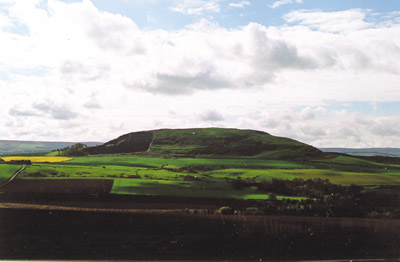
Traprain Law, a sacred hill that is the focus of a sacred landscape in East Lothian, surrounded by megalithic stones
The Gododdin, a Celtic tribe that apparently left no written record themselves,
are nevertheless very important in literature: the first major poem to survive
in the Welsh language, Aneirin’s Y Gododdin (written circa 600 AD), records
the defeat of the Gododdin at the combined hands of the Anglians of Brynaich
(Bernicia, or Northumberland) and the Saxons of Deifr (Deira, or Yorkshire).
This poem is well-known to Welsh schoolchildren today as “the first Welsh
poem”, though it is thought to have been written in or around Edinburgh.
It is one of the lesser known stories of British history, but “Welsh”
was spoken in the Lothians in those days and a massive migration of Welsh speakers
seems to have occurred from that area towards Wales in the first millennium
AD – possibly as a result of this battle.
The account speaks of the heroism, the honour and the beauty of the Gododdin
warriors, their love of huge quantities of mead, and ultimately their downfall
at the Battle of Catraeth, thought to have been at modern Catterick in North
Yorkshire. We know that Din Eidyn, or Edinburgh, was overrun by the combined
Anglo-Saxons of Northumbria around 638 AD. By 638 AD, the Gododdin had relocated
their main centre from Traprain Law to Edinburgh – the town which would,
since that Anglo-Saxon invasion in the 7th Century, remain the capital of Scotland.
But it marked the end of the Gododdin’s rule – and Celtic dominance
– over the Lothians.
In short, the Gododdin occupied the land known as the Lothians and the Borders,
identified with Loth. According to some, the origin of the name Loth is shrouded
in mystery – an easy getaway not to try to explain something.
Some early Latin spellings of Lothian are Lodoneo (11th century), Loeneis (12th
century), Leudonia (12th century), and in 12th century Welsh as Lleudinyawn
(modern Lleuddiniawn). These spellings were then “translated” into
the local Scots, turning them into Lowthyan, Lothiane, eventually becoming the
modern Lothian. Other variations are Luwddoc, Lludd and Lloyd.
Lleuddiniawn, the 12th century Welsh name, means “Land of Lleu”.
In the Y Mabonigi, Lleu is identified as the sun god. He is Llew Llaw Gyffes,
son of Arianrhod, the moon goddess. As such, the Lothians are the “Land
of the Sun God”.
This special relationship between the god and the land can also be found in
Ireland. Manannan Mac Lir is one of the most popular deities in Celtic mythology.
He is Lord of the sea and of the three great waves of Ireland, and son of the
mystical god Lir, ruler of Time and Deep Space. We already know of Fionn Mac
Cumhaill, a form of Manannan, who was said to travel from Ireland to Scotland.
It forms part of the stories of how this giant travelled around Ireland in many
different shapes and guises, in the same tradition of the gods of Egypt or the
Aboriginals.
He was also the foster-father of Lugh, the sun god. He wrapped the young child
in his vast cloak and took him away in his boat to his Otherworld lands beyond
the sea, often an island, a “Land of the Blessed”, literally a land
where people lived in close relationship with their god. The Isle of Man takes
its name from this ancient Celtic deity who has his stronghold on South Barrule
mountain.
To quote Lorraine MacDonald, from Gods of the Celts: “As guardian of the
Blessed Isles of the Celts, he also has strong associations with Emhain Abhlach,
the Isle of Apple Trees, where the magical silver apple branch lies. To the
Celts, the Blessed Isles that lie beyond the sea are the gateways to the Otherworlds,
where the soul journeys to after death. Manannan is the guardian of these gateways
between the worlds. He is the Ferryman, who comes to transport the souls of
the dead through the veils.” This Otherworld often was not somewhere in
a land far away, but the sacred features of the land, the hills or caves, were
often seen as such gateways to the dimension of the soul also.
Already, it shows how the Celtic people in the Lothians, as happened elsewhere,
linked the land with the Gods.
The Celtic deities were primarily associated with the land itself, manifesting
their presence and influence through hills, rivers, caves, trees and even stones.
In Celtic mythology failure to honour the sovereignty of the land itself often
resulted in the loss of sovereign gifts.
In the Lothians, Loth’s name is linked particularly with Traprain Law,
the Celtic capital. In a field on the Western flank of the hill, alongside a
hedge, is a standing stone named Loth’s Stane. Its original position was
in the middle of the field, but at some point the farmer decided to move it
out of the way, to make his field easier to work. This is a shame, as the legend
states that this stone marks the grave of King Loth and as such provides a unique
marker of the identity of the Lothians – yet it was moved because it was
“inconvenient”.
This action fits into a larger scheme which has become apparent across Britain
for many centuries and shows the general disrespect the nation has had towards
its prehistoric past. Megalithic stones, including those of Avebury, were removed,
buried and sometimes even dynamited, to allow for easier maintenance of the
fields. Near Loth’s Stone, the natural beauty of Traprain Law was destroyed
as the East slope of the hill was used as a quarry. From the East, it has left
a surgical, non-cosmetic mark on the outline of the hill. The same fate, though
this time hardly visible, befell that other hill of the Lothians: Berwick Law,
whose red volcanic stone was used, in the early 19th century, for the building
of several houses in North Berwick, including the Granary, in the harbour.
Loth’s Stane is a standing stone of which there are many across the country.
In Oxfordshire a standing stone 73 metres from the Rollright Stones is known
as The King Stone. Like stories of petrified giants, this time the legend says
that all the stones in the area were once human beings: a king and his army.
They were met by a witch who owned the land over which the ambitious conqueror
marched and as a result, they were turned to stone. The King became the solitary
King Stone, his men were turned into the Rollright Stones circle, and his knights
are the Whispering Knights burial chamber. According to the 18th century antiquarian
William Stukeley, near the King Stone was a flat area of turf where young people
met at a special time, possibly Midsummer Eve, “and make merry with cakes
and ale”.
Thus, nothing sets the Loth’s Stone apart from other standing stones and
it is clear that the stone does not mark the tomb of the king – that link
is purely legendary. But rather than discard it, it is clear that the legend
contains information that suggests we should not look at this stone in isolation,
but within the context in which it appears: its relationship with Traprain Law,
the seat of the king of the Celts.
The link between a king, Loth, and a hill is not unique. The apparent fact
that this king was more mythical than historical is also not unique. Again,
the closest parallels can be found in Ireland, but first, let’s visit
Somerset. The most infamous example of a sacred hill is probably Glastonbury
Tor. Rising above the town of Glastonbury, the Tor is crowned with the remains
of the tower of St Michael’s Church. At its foot, the early 20th century
occultist Dion Fortune portrayed the area as Avalon, the refuge of the Grail,
the resting place of King Arthur, and the destination of Joseph of Arimathea,
towing his nephew Jesus along before his rise to become the Saviour of Mankind.
In reality, Glastonbury is nothing of the kind, but what is important is how
people from the 1930s onwards put layer upon layer on the significance of the
landscape, and particularly on the Tor. Whereas the Celts believed that the
Gods never died, but instead were constantly reborn, so it is clear that the
Celtic legends have continued to live on and have been added to. From a sociological
perspective, this is exactly what Erich von Däniken and similar authors
continued to do also.
Originally, the mythology of Glastonbury Tor was much less impressive –
but so much more genuine. In essence, the hill was believed to be an entrance
to the Underworld. The Christian hermit, St Collen, lived in a cell on the slopes
of the hill, thus forming a Christian obstacle to the pagan practices of the
people for whom the hill was part of their sacred landscape, and hence religion.
The story goes that St Collen once met the king of fairyland and the leader
of the Wild Hunt within the Tor. This story, now classified as folklore, was
literally the “lore of the folk”, of the people, whose only way
of maintaining their original beliefs was to store the information in their
“folklore”; Christianity had closed the possibility of maintaining
it in “official records”; the megaliths were part of the pagan religion
which had been conquered and labelled as “devil worship”.
The devil has never been connected with the Irish sacred hill of Knocknarea.
Knocknarea is the magical cairn-decked mountain just West of Sligo town, at
the end of the Coolrea Penninsula. The mountain is a 320 metres high limestone
hum sculpted by the retreating glaciers at the end of the last Ice Age. The
area around Knocknarea is covered in ancient remains, including Carrowmore,
which is one of the largest megalithic sites in Western Europe, and the largest
in Ireland.