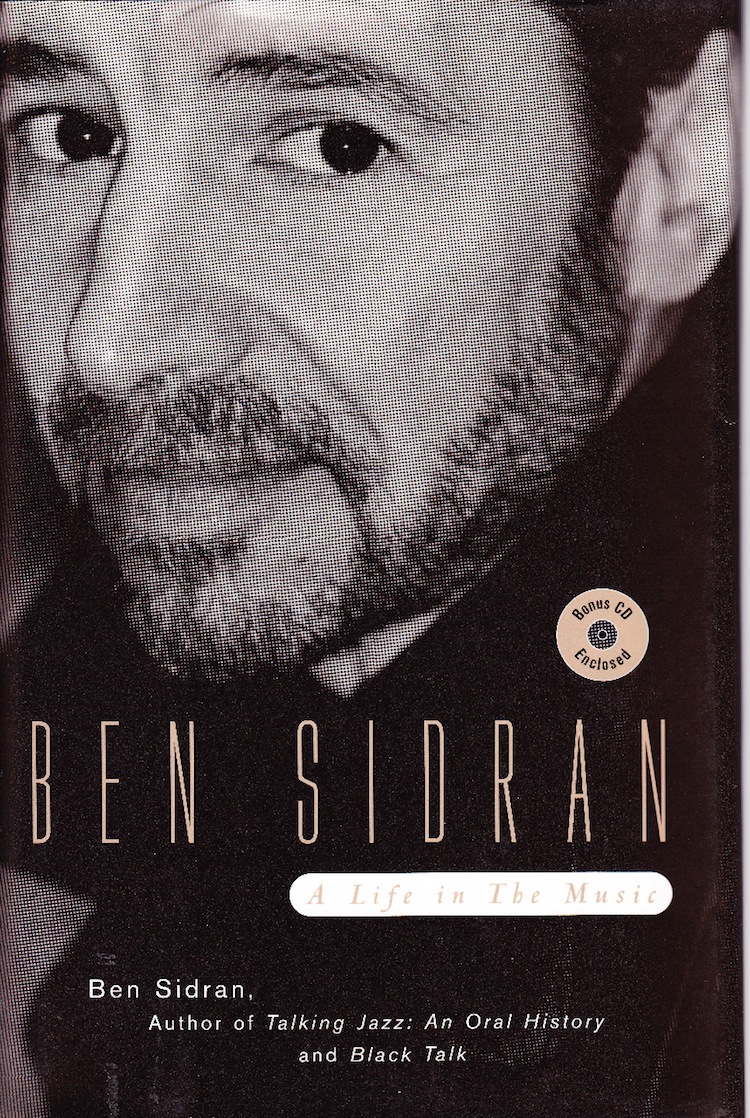
Ben Sidran: A Life in the Music
(The True Story of Everything I Ever Knew)
Nardis Books
A division of Unlimited Media Ltd,
PO Box 2023, Madison, WI 53701
Copyright © 2003 Ben Sidran
All Rights Reserved
LIBRARY OF CONGRESS CATALOGUING-IN-PUBLICATION DATA
Sidran, Ben
Ben Sidran: a life in the music / Ben Sidran
v.cm
ISBN 9781450753616
1. Sidran, Ben 2. Jazz musicians – United States – Biography. I Title.
ML419.S43 A3 2003
786.2/165/092 B 21
ALSO BY BEN SIDRAN
Black Talk
Talking Jazz (Vols. 1, 2 & 3)
There Was a Fire: Jews, Music and the American Dream
For my son, Leo
and my father, Lou
“And I only am escaped alone to tell thee.”
— Herman Melville, Moby Dick
“I'll tell you the true whether I knew or not.”
— Mel Brooks, The Two Thousand Year Old Man
CONTENTS
Electronic Edition Preface
Acknowledgements
Prologue
Part One: Expand, expand, keep expanding
Chapter One: 1943 – 1960
Chapter Two: 1961 – 1967
Chapter Three: 1967 – 1970
Part Two: Becoming the information
Chapter Four: 1970 – 1976
Chapter Five: 1977 – 1979
Chapter Six: 1980 – 1981
Part Three: On the rim of the well
Chapter Seven: 1982 – 1988
Chapter Eight: 1989 – 1993
Chapter Nine : 1994 – 1999
Epilogue
Electronic Edition Preface:
I can honestly say that I have very few regrets with this book, but there is one: I never liked the title, “A Life in the Music”. It was so clearly the result of compromise and indecision, the opposite of everything it took to write the thing in the first place, and I still wince when I see it. It is like that infamous horse designed by committee, only in this case, the committee wasn’t really interested in going for a ride.
I know one should never ask others for advice about titles. I knew it then, but not as well and certainly not as surely as I know it now; compromise on the title and you lose a little piece of sleep every night. The title should be that great leap of faith, the moment when disbelief is suspended and you allow the fates to sing your song.
My friend, the elegant authoress Lorrie Moore, told me during my period of waffling that she recommends closing your eyes, opening the manuscript to any page, and pointing, and wherever your finger lands, there is the title. I told her that’s what I did when I wanted to call the book “Raised by Wolves”. She saw through the ruse immediately. “I don’t think your eyes were closed,” she said. She was right.
Along the way, the list of alternative titles included both “Music, Meaning and the Long Way Home” and “Love, Loss and Desire at Century’s End”. Thankfully, those fevers passed. Then there was “Take Me to the Bridge” and, for a period, “The Rhythm Method”. Both winners but ruled out.
I was adrift. Soon I was caught up in the shoals of “The Jazz Lesson,” “Adventures in the Jazz Trade” and “A Chronicle of the Jazz Years”. But there were those who, perhaps rightly, cautioned against using “jazz” in the title – too restrictive, they said for such a wide-ranging effort – and I heard them, abandoning even “Jazz: the Verb” and “Jazzed”.
As the search continued, “Sing Me a Love Song,” “On Becoming” and “I’m Telling” were thrown into the pot, a pot that was ultimately left to stew unattended when, for a period of time, I insisted the book be called “How I Learned to Read the Trees.” What? I still think it’s a poetic metaphor for trying to parse one’s life. Still, I can see where it might be confusing, perhaps more appropriate for the biography of an arborist. Not unlike “A Runner’s Heart,” the title that seemed like the clear winner until my wife pointed out that people would think it was the memoir of a marathoner. “That’s right!” I said, not entirely convinced myself. “Life is a marathon.”
What makes this confession particularly painful is that I knew what I wanted to call the book all along. It came flying out of my mouth one afternoon while still working on the text. I was sitting in a coffee shop when a friend casually asked me what I was doing. I told her I was working on a book. “What’s it about?” she asked. “It’s the true story of everything I ever knew,” I said.
— Ben Sidran, November 2010
ACKNOWLEDGEMENTS
I would like to thank Judy and Leo, who encouraged me from the beginning and reassured me that the work was sufficient unto itself. I would also like to thank the many friends who took a look at the work in progress, offered suggestions, and did not tell me to turn back, especially Howard Gelman, Jerilyn Goodman, Jeff Greenfield, Jim and Carolyn Hougan, Tommy LiPuma, Dave and Linda Maraniss, Jackie Mitchard, Lorrie Moore, Susan Pigorsch, Ken Robbins, Matt Salinger, Ralph and Emily Simon, Peter and Susie Straub, Robert and Phyllis Kimbrough and Terry Strauss. And finally, my thanks to Elaine Markson, who informed me when it was finally time to stop.
PROLOGUE
August 6th, 1991
Red Rocks, Colorado
I’m standing on stage in front of twelve thousand drunk, screaming teenagers. In the front row, a plastered sixteen-year-old girl is lifting up her T-shirt to flash me. I see her mouth open, she’s screaming but I hear nothing. Up in the sky, up behind the churning sea of bodies, a helicopter lifts off, taking another poisoned kid to the neon room. But I hear nothing. In my ears, I have molded monitors that no sound can penetrate. I’m supposed to be plugged into the module on my belt, listening to the band, listening to myself. The greatest mix ever. On top of the world. But I’m unplugged. I look down at my hands. I’m still playing. But behind dark shades, in my cocoon of silence, on this bright hot August afternoon, I hear nothing, I see nothing, I feel nothing. Way in the distance, Steve Miller is singing “Big old jet airliner, don’t carry me too far away....” But I’m already gone. Almost fifty years old. Man, I’m almost fifty years old. We’re all almost fifty years old. Up on the hill in front of us, they’re all fifteen and sixteen and they are absolutely pissing in their pants. I can only think about that cold November afternoon, some twenty years ago, driving Paul Pena home from the recording studio the day he first recorded “Jet Airliner.” Him blind and me lost and he’s directing me through the streets of Boston, and we get to his house and all his blind friends are there and we all get stoned and start playing music and then it gets dark outside and then there are no light bulbs in the lamps because, of course, they’re blind, and suddenly, I am the one who is blind. And now it’s twenty years later and “Jet Airliner” is one of Steve’s big hits, and I’m on stage and I’m blind again, and deaf too, Oh Lord, up on this stage in front of a howling party mob....
PART ONE
Expand, expand, keep expanding
CHAPTER ONE
“In a world of fugitives
The person taking the opposite direction
Will appear to run away.”
-- T.S. Eliot
* * *
1943 - 1955
In the beginning, you fall in love. It starts in your feet and pretty soon it’s in your chest and then your throat and finally you can’t think about anything else. For me it was boogie-woogie, specifically “Pine Top’s Boogie” by pianist Pine Top Smith. My father had the record, and, by nine, I had it memorized. I played it over and over like some kind of personal litany, rocking back and forth, almost in a trance. I had been playing piano since...well, actually, I don’t remember not playing the piano. My earliest memories include the piano, sitting at the keys, turning the pages of a comic book with my right hand and watching my left hand trace a boogie pattern. Slowly, unconsciously, I fixed the moves into my motor memory while my mind wandered. So even as a small child, jazz was, for me, the great escape: it spoke to me of something better, a world greater than the world I knew. To this day, I believe that alienation is at the heart of every jazzman’s story.
I was born in Chicago in 1943. It was my father’s city, but I didn’t really know him. Sometimes it seems I awoke from a dream and he was gone. I do remember, as a small child, the sour smell of his sweat, the toasty odor of his cigarettes and the roughness of his cheeks. These things are ingrained in me. But he himself is truly a ghost. And maybe he always was.
Before my second birthday, he enlisted in the army and left home. My mother moved us — my sister and me — to Racine, back to her mother and her childhood home. She was born Shirley Gordon in Racine in 1915. The Gordons first landed in Wisconsin around the turn of the century, when great grandpa Charlie Gordon got off the train too soon on his way from New York to somewhere else and decided he had arrived where he was going. He stayed, got a horse and wagon and went around selling vegetables. He had three sons; Max, the oldest, married Ida, who had arrived in Racine after her father abandoned their homestead in the Badlands of North Dakota. As a child, I remember my grandmother saying, “Of course they gave you the land for free if you stayed there; nobody could stay there.” Max and Ida had two children; the youngest was my mother Shirley.
My earliest memories in Racine, then, are of being with the women, with my grandmother in the kitchen, fussing with pots on the stove, or with my mother, who told me a recurring bedtime story about a magic place at the base of a big tree. Each night as she tucked me into bed, she would say, “You slip through a tiny doorway hidden at the base of the tree, and, down a spiral staircase, you go into a world where you can have anything you want.” Each night, as she turned out the light, she would ask me, “Benny, what do you want?” And I always pictured this great-lit chamber with people dressed in fantastic outfits, like cowboys and firemen, and there were fountains of ice cream everywhere...and there was music. Always music; music animated everything. At first it was “Tubby the Tuba,” or “In The Hall of the Mountain King,” but when my father returned from the war, it was Benny Goodman and Nat King Cole and Erroll Garner and Pine Top Smith. He was the one who brought these exotic voices into my head.
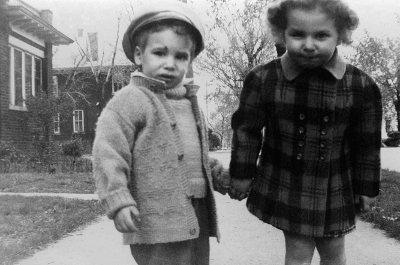
Ben and Maxine on Carmel Avenue
In our living room on Carmel Avenue there was an old upright piano, and it became the center of my universe. That’s where I read my comic books, ate my snacks and watched time pass. I made up little songs and, eventually, I took piano lessons. Then I quit and refused to take any more. But I kept playing the piano. Next to the piano there was a large Magnavox console with a radio and record player, and one day I heard Jimmy Forrest’s “Night Train” come roaring out of the speaker with a huge shouting saxophone and shiny trumpets, and I got so excited that I ran around the room in a kind of ecstatic frenzy until I broke something. It was my father’s prized copy of Benny Goodman’s “King Porter Stomp.” When he found out, he was so angry he couldn’t even look at me, but I didn’t care: I had ridden the night train, and music was now my driving wheel.
In general, I lived a pretty normal life for a Jewish kid growing up in a small Midwestern town — “The Central Stranded Time Zone,” as Del Close once called it. On the High Holy Days and, occasionally, on Saturday mornings, I went to temple with my family and stood amongst a small gathering of Eastern European refugees and pretended to pray. I swayed with them as they davened and made soft chanting sounds, rocking back and forth, almost in a trance. I had no idea what we were saying but I loved the rise and fall of the voices and the feeling of being hypnotized. I’ve come to think of this as my first jam session. My father liked to comment on the action, and my sister and I were his best audience. Talking out of the corner of his mouth, like a bit player in an old gangster movie, he'd say something like, “See that fat narishkeit over there, Mrs. Baumblatt? Ted Savides is going to name a hog after her...”
Ted was my father's best friend. He lived on a farm outside of Baraboo, Wisconsin, a couple of hours north of Racine. Before Ted moved to the farm, he and his family lived around the corner from us on Carmel Avenue. They had a big brick house with a large wooden barn out back. Ted was a Runyanesque character, an old baseball player, and one of my father’s favorite pastimes was sitting with him around the radio on a Sunday afternoon, listening to the Cubs game. Pop would wear his Cubs hat, and the two of them would laugh and talk and swap stories or statistics that went back to Honus Wagner and came all the way forward to put Ernie Banks in his rightful place. In the background, Jack Brickhouse would be announcing, “From Bingo to Bango to Addison Street…” and Ted and my father would both laugh. I don’t know if Ted ever actually had a hog named Mrs. Baumblatt, but I do know that he had a magic black baseball bat, beautifully balanced, easy to swing and rumored to hit a ball all by itself. He kept it in the hayloft out in the old barn.
I climbed up to that loft every chance I had. There I found the most amazing things: boxes full of ribbons and medals from the Civil War, from the D.A.R., and The Grand Army of the Republic. And there were old steel contraptions, small devices with spinning balls and webbed pulleys or wind-up keys that trapped animals or shot missiles or did other ingenious things. It was the long forgotten collection of Ted’s father-in-law, Mr. Edmonds, who had built the house and the barn back in the eighteen hundreds. Mr. Edmonds had been an inventor, and the loft was the final resting place for his work. Now, like the ribbons and the beautiful black bat, the contraptions were just gathering dust and waiting for history to claim them. That was me. I first discovered this sanctuary while climbing to the loft with Kathy Foote. We went up there to take off our clothes and hug each other. We must have been seven or eight years old and it is still among my most delicious memories. I can still smell the damp wood of the barn; see the sunlight poking through the walls, as we stood, silently caressing each other’s naked bottom.
One day climbing down from the loft I came face to face with a snake. My sister Maxine and the Savides girls were already huddled around it, frightened and fascinated. I got closer to see what was going on and a small reptile tongue darted out at me. Without thinking, I picked up a brick and dropped it on the snake’s head. Suddenly, the snake was no longer a magical thing. It was a small lifeless piece of skin. I stood there, transfixed. Then my sister and I ran home to tell my father. He was sitting in his favorite chair with his Cubs cap on, reading the paper. After I told him my story, he just kind of reached out and whacked me across the back of the head with the newspaper. “That's for ever killing a living thing,” he said.
* * *
Maxine and I rarely wandered far from home. In the fall, we played on the grassy hill by McKinley Junior High School, a block from our house. We were told never to go down to the creek at the bottom of the hill because tramps came up from the railroad tracks. In the winter, McKinley hill was great for sledding. One winter, the snow piled up so high we could dig tunnels from our front door out to the street and never see the sky.
In the summer we tried to plant grass on the muddy patch we called our front “lawn.” In the beginning we put stakes in the ground and my sister and I hung string between them to keep people off. But we never managed to grow grass. Not even weeds would grow, only ruts from our bicycle tires. By July, the “lawn” was mud, caked hard as stone, and the roots of the big elm by the curb had spread under the sidewalk and jacked up the pavement. One day while riding my bike there, I hit a large crack and went sprawling to the concrete. By the next morning, my arm was swollen up like a vegetable, and several days later my mother became worried about me. I felt okay, but she kept asking me what was wrong. I remember I was lying on the couch, feeling sleepy, drifting in and out of a dream where I was riding in an old convertible, the kind that the Keystone Kops used to drive down the streetcar tracks of L.A., and there were lots of kids in the car with me, and we were having a really good time, but something was wrong somewhere, and there was this loud buzzing sound in my head, and when I opened my eyes I saw the doctor. He was examining the inside of my arm and when he showed my mother a red line that ran from my elbow to the vein in my shoulder, she became frightened.
Quickly, I was wrapped in blankets and carried to the car. My mother acted kind of angry with me, except she was crying. I understood the red line was “blood poisoning,” and if it crept to my heart, only inches away, I could die. The doctor drove very fast, ignoring us in the back seat. I fell back into a swoon as peaceful and happy as I have ever been. Everything was out of my hands.
Something in that moment stayed with me and made me more self-aware. After I had recovered and left the hospital, I still longed for that feeling of surrender, of letting go and falling upward, of trust and release. It was also around this time that I began having the distinct sensation that I was trapped inside a kid’s body, looking out with older eyes. From that moment on, I was just putting in time.
Throughout the summer, our little neighborhood gang — my sister and me, Jimmy Anderson and his sister Heidi, Nancy Ruffalo, John Isbell — would play kick the can in the alley until dark, or ride bikes in the hot afternoon, or play war down on McKinley hill until they called us for dinner. Like the Mel Brooks line, hitting a tree with a stick was a good job back then. A stick could be a gun or a sword or a telekinetic Flash Gordon device, and you could take your stick exploring down by the creek, down where you weren’t supposed to go, and you could use it to push aside the tangle of milkweed and thistle and wild strawberries to make a little clearing for yourself. That clearing would become your own little world for a while, and you could pretend that all of life was as safe and protected as that one small circle.
One day a group of us went to McKinley hill with cardboard boxes. We were going to go “sledding” on the grass, but pretty soon we had destroyed the boxes and we just started rolling down the hill. Standing at the bottom, dizzy and covered with grass, I was about to walk back to the top when I heard a loud “crack” and found myself on the ground. John Isbell had been swinging around an old pair of World War Two binoculars on a leather strap, the strap had snapped and the binocs had hit me square in the head. All the kids ran over to see. I reached up and felt my head, and my hand came away red and wet. I screamed and we all ran to my house. Later that afternoon, after the doctor had put in the stitches and all the kids had gathered around to see them, John said he was sorry, really sorry. That was the day we became best friends. Years later, I also understood it was probably the day he became my protector.
* * *
I didn’t see my father very much. Even before he got the job in Chicago and started riding the train every day he was mostly just a brooding presence. I can picture him standing in a doorway with his legs crossed, one hand on his hip, sticking out his lower lip to catch a peanut he had tossed. I can hear him whistling when he left the room. I don’t know if these are true memories or merely imagined.
Sunday mornings, he would come downstairs and cook salami and eggs for my sister and me. It was his one culinary art but he made a ritual of it. Maxine was a year older than me, clearly his favorite, and a smart, funny girl who had a lot in common with him. They talked and told jokes and kidded around the table, and I felt glad just to be along for the ride. Whatever she had, I wanted too. That’s how I started playing piano: she took lessons so I took lessons.
On Sunday afternoons, the three of us, Maxine, Pop, and me, would take the 49 Buick and go to the bagel store. We were allowed into the back room where there was a huge oven. Inside its large open maw were rows of flames burning deep inside, which always made me think of Shadrach, Meshach and Abednego and the fiery furnace. On the floor were large buckets filled with murky water and pale, white circles of dough floating on the surface. We watched Isabelle as she shoved a big wooden paddle into a bucket, lifted out a row of raw bagels and deftly slid them into the roaring furnace. The smell was heaven. We would buy a bag and eat as many as we wanted before we got home. Then Monday came and my father disappeared for the week.
* * *
Maxine and I loved Pop. He was a very complicated guy, and talking about him is hard, like blind men trying to describe the elephant; the truth depends on what part you were holding onto.
When I was small, he called me “Jonson.” He called me Jonson, because he loved the writer Ben Jonson, but I was actually named for his father Ben, or Boruch, Sidransky. He called my sister “Shorty,” because she was shorter than he was, I suppose, and he called my mother “Chi Chi.” I don’t know why. I wish I did, because it would probably be a cute, loving, sexy story, and, if so, it would make the first and only one I ever heard about the two of them.
Around the house, Pop often seemed ill at ease, but in public, he relaxed and came alive. Out in the world, among his friends and admirers, he was fast and funny, a lady’s man and a man's man. He radiated a hip nonchalance, and he was both playful and hardboiled. Many of my friends thought of him as the coolest guy they knew. He wasn’t like other parents. He talked to you like an adult, and he would talk to you about anything, movies, sports, music, whatever you liked. But when you stepped up to the plate, you had better be ready. His bottom line was that he broached no bullshit.
Some folks say he resembled Jeff Chandler. In the old pictures, he has the same tight black curly hair and swarthy good looks. Even as a child, I remember people pulling me aside and telling me, in a conspiratorial kind of way, that my father “was really something special.” They might be talking about his sense of humor, or his remarkable memory, or his limitless store of anecdotes and information, but what they were really saying was he made them feel special. He was a raconteur, and when he talked to you, when he focused the power of his attention on you, you felt like you were at the center of some great ongoing drama.
But that was not the man I knew. At home, the man I knew was often withdrawn or out of control. It was like living in the eye of a storm and knowing it was gonna happen; it was just a matter of time. His relationship with my mom only made matters worse.
They fought bitterly and often, mostly about money I supposed, but sometimes, behind the closed bedroom door, about unnamed or unnamable things. The roar of their anger was like a distant thunder. Sometimes it burst out of their bedroom, and then Pop would come down loud through the living room where I was sitting at the piano, and, for no apparent reason, he’d smack me across the back of the head. I thought maybe he suspected me of something and was just covering his bets. “Don’t lie to me!” he’d say, and I remember more than once not having a clue what he was talking about. But of course, he wasn’t talking about me. My mom, too, was often in her own world, like the day she stormed out of the house, and, turning to slam the door behind her, said to me, “Tell your father I’ve gone and it’s all your fault!” I had no idea what prompted that either, but I just kept my head down, and when my father came home, I said nothing.
They had met at the University of Wisconsin in the early1930s, when my father was a poor but promising young writer who loved jazz, and my mother was a well-to-do girl from Racine, with a car of her own and a dream of escape. She hoped, no doubt, that her future husband would become a famous writer and rescue her from the mundane life of a scrap-dealer’s daughter; perhaps introduce her to cafe society and confirm her lifelong premonition that she was destined for something special. She had picked a promising candidate all right, but as the years went by, and he failed to deliver on his “promise,” they both became bitter and vengeful, withdrawing into their own personal worlds of recrimination and denial.
To escape, in the cool of a summer evening, Pop and I would go into the alley and toss a baseball around. We had our gloves and our caps. Actually, he put on his Cubs cap the moment he walked in the house, and I was in bed long before he took it off. He wore it when he ate, when he listened to the radio, when he read the paper, and when we played catch, gradually stepping further and further apart from each other until it got too dark to see. When I would bear down with my fastball or try to break off a curve in the dwindling light and the ball sailed over his head, I would shout, “I’ll get it!” and run past him to retrieve the ball. I didn’t want him to chase it. He kind of lumbered when he ran, and it made me uncomfortable to see. It was odd, because he had been an athlete in high school and as a young man had even considered trying to play semi-pro ball. But the weight of the world was clearly upon him, and pretty early on, even though he loved his Cubs and his jazz and his books and his pals, you could tell he was feeling the impending crush of his situation.
* * *
He was born Louis Sidransky in the city of Drohiczyn, Poland, in 1916, and he had come to the United States when he was only four, after his father fled The Pale by walking across Russia, then China, then taking a boat across the Pacific Ocean and a train across America to settle, finally, in Centerville, Iowa. There, Boruch (Ben) Sidransky opened a dry goods store and sent for his wife and children. Years later, my grandmother Tsipora (Cip) told me the story of her harrowing escape with two little children, my father and his sister. Bubby Cip said the only reason they made it past the soldiers on the train was because she had blond hair and blue eyes and didn’t look like a Jew. I have a picture of my father standing with his first-grade class on the steps of his school in Centerville; he is wearing a miniature tuxedo and holding a violin, while all the other kids stand around in shorts and plain shirts, holding a book or a flag, like something out of a Grant Wood painting.
When my father was ten, the family moved to Humboldt Park on the near North side of Chicago, a close-knit neighborhood of Jewish émigrés. Years later, Saul Bellow, one of the kids who grew up on the block with my father, immortalized the underlying culture in Humboldt’s Gift, a book that won the Nobel prize and captured something of Pop’s own essential being. After my father’s death, Bellow sent me a note that read in part, “I often feel, when I’m writing, that I’m a composite person, and your father is certainly part of the mixture. It comes over me now and then that I’m trying to do something he wanted done.” What my father most wanted, of course, was to be a writer himself.
Like the generations that came before them, the kids in Humboldt Park reveled in the written word, but they also embraced the new era of the common man. Chicago in the 1920s and 30s, Sandberg’s city of broad shoulders, was a roaring place of gangsters and jazz clubs, where boogie-woogie piano players rolled 'em nightly, and Benny Goodman was the hero of many a Jewish kid. Goodman was a homeboy in short pants, a new kind of luftmensch, for whom the old status pyramid was inverted and the street action was exalted. Like my father, Goodman also came from Drohiczyn, and they both played the clarinet.
I somehow see this milieu — the jazz, the gangsters, and the young Jewish intellectuals from Poland hitting the New World running — as having a very “Chicago” sensibility. To read, to write, to act, as Bellow wrote in The Adventures Of Augie March, “first to knock, first to enter,” was the culmination of a five-thousand-year-old drama. It was an ingathering of the Jew as street phenomenon, the American Dream fed through the mind of the Marx Brothers, the absurdity of modern life at a time when surrealism vied with socialism, and the soundtrack echoed daily with the latest refrain from a Jewish tin-pan alley. There were Jewish prizefighters, songwriters, musicians, gangsters (one of the Sidranskys was a member of Detroit’s Purple Gang), doctors and merchants; the new American Jew could be anything he wanted to be. Unlike their parents, who fled the old country to avoid conscription, when the great war eventually came, these new Americans were glad to volunteer to hunt down Hitler or Tojo or whatever evil was out there. It was an extension of their visceral love for their everyday freedoms, a new sense of sensuality, of entrance, of, finally, belonging. Think Jimmy Stewart in It’s A Wonderful Life, a Jewish parable, or Irving Berlin (Israel Baline) writing White Christmas. Yankee Doodle meets Henry Roth: never before had being a Jew been as much a state of mind as a fact of life.
My father loved it all. He loved the Gillette Friday Night Fights —”look sharp.... feel sharp...be sharp” — the ball games, the infinite statistics of contemporary life, facts of all sizes that he gobbled up with a photographic memory, the arcane arguments of the Talmud rubbing up against the jokes of S.J. Perelman and the tough guys in Studs Lonnigan. It was all part of his Yiddishkeit, being uncompromisingly Jewish without being religious at all. Like so many Jews of his generation, he was an American first. For him, it was all about language, street culture, and the book. Not any book in particular – not a given philosophy or a particular interpretation of history, not communism or anarchism, or even the Torah. It was the book as an ideal, something that could contain the story of the past and sustain it into the future. Something you could write as well as read.
Intellectuals who could swing were my father's heroes, whether Benny Goodman or Hank Greenberg, and Pop took up both the clarinet and the baseball bat seriously and with total élan. His offhand manner leant itself to playing, whether it was jazz or baseball – he could hit a fungo 300 feet and musically had perfect pitch. He seemed happiest when surrounded by other players. But none of this was his true passion. His real dream was to participate in the creation of a modern literature, to tell a story in the common tongue. This is what he and his friends must have talked about as young men, and surely promised each other they would dedicate their lives to achieving. Bellow did it, my father did not.
Instead, after the war, he moved to Racine, where his wife and children were living in his mother-in-law’s house. There, he took a job as a copywriter at a small local advertising agency and spent his days crafting words to motivate people to buy stuff for their homes or their cars. At the same time, he remained very much aloof from the Racine Jews. He insisted on living on the west side of town, close to the train station and the Danish community, while the upwardly mobile Jews all lived on the north side, next to the lake, and not far from Meadowbrook, the one (restricted) country club. It was both a cultural and a geographical decision on his part. A Jew from Chicago living in Racine, he probably felt, as his hero Groucho Marx had once so famously said, that he didn’t want to be a member of any club that would have him. So while he was in Wisconsin, Wisconsin wasn't in him. A stranger in a strange land, a Jewish prince who, because of his quick mind and dazzling smile, qualified for special privileges, he hung out in Kringleville, cruised as best he could, and ducked life’s daily bullets.
This never made sense to me and remained one of the biggest mysteries of his life: why, given his great sense of history and his breadth of knowledge, did my father not fill his days with more meaningful work? Why did he hide out in the cultural tundra, slowly reading and drinking himself to death?
I remember a sign in the office of my dentist, Dr. Gorsky, which read something like: “Courage is not rushing into great battles with drawn sword. Courage is facing the slings and arrows of everyday life.” I would read that sign every week, as I sat there, counting the holes in the ceiling tiles and waiting for Gorsky to breathe his foul cigarette breath into my face and grind my front tooth into oblivion. I had smashed the tooth in the same alley where Pop and I played catch, falling off my bike one day face first into the concrete. Gorsky had the luxury of constructing my bridge in six or seven leisurely sessions, and I don’t believe he ever used Novocain on me. “Wasn’t necessary,” he told my mother who brought me in. And besides, if he had asked me, I would have said, “No, I don’t want anything for the pain. It’s not that bad.” Why would I say that? The pain of his drill haunted my dreams. It was excruciating. Why would I tell him, no, I’ll just sit here with my mouth open, go ahead and rev that thing up? Because I was my father’s son. Pop always bragged about how nothing hurt him. No pain bothered him. Life doesn’t hurt. Rolls off a man’s back, actually. Just passing through. That’s the posture.
In his last writings, I found, “I was lucky, I got through life and it didn’t hurt at all.” That’s the same manuscript that starts, “Say what you will, cancer is not such a bad way to die....” I don’t actually doubt that it didn’t hurt him. I think maybe he had learned to lock up his feelings when it came to anything personal. Nothing was personal. It was all professional. A professional’s opinion.
For me, however, it was highly personal. I wanted to know my father, and I wanted him to know me. He chose baseball (we never played music together), and he became the coach of my little league team, the Orioles. After school, I rode the bus downtown to the YMCA where tryouts and early practices were held. The Y was not far from his office at Western Advertising, and I would meet him there after tossing the ball around the noisy gym. Just across the street from his office, in the window of Porters Furniture Store, there was a round white rug designed to look like a large baseball, with red stitching and everything. It came to represent something huge to me. I stopped and stared at it every time I passed on the way to my father’s office. It was connected to my desire to be a ballplayer, I guess, and to make my father proud of me. That summer, after I made the team, my mom bought me the rug.
As a coach, my father was tough, more so on me than the other kids. “Get your foot out of the bucket,” he would holler when I stepped away from the ball. Or worse yet, when I hesitated before committing to the cut, “You’ve got a hitch in your swing!” That was the most flagrant violation a hitter could make, hesitating, not being in the moment when the ball met the bat; not flowing to the point of contact. Sometimes I wondered if this was why he was always slapping me across the back of the head, because he knew I had a hitch in my swing, and he was trying to wake me up.
Years later, reading Gurdjieff, I thought of the dreaded hitch — the moment of doubt. Wake up! “Jonson, you got a hitch in your swing. Get your foot out of the bucket, step into it!” I heard that voice in my head for years, not so much the words but the sound of it, the ring of frustration, the sense of disappointment. Long after he was gone, and I was making my first record, that voice seemed to come out of my mouth. Standing there in the vaulted expanse of Capitol Studios, the hallowed space where Sinatra had cut his classic records, to me, I sounded so much like my father that I had to step away from the microphone. I didn't want to hear “that voice” anymore (“Get your foot out of the bucket!”) There are so many ways in which the sins of the father are visited upon the children.
* * *
My twelfth summer was the apogee of my baseball career. My father bought me a real glove and showed me how to form a pocket with prime neatsfoot compound, a ball and some string. After school, I worked lovingly on the glove, rubbing the oil into the palm with a rag, kneading it in, softening up the leather, making it so comfortable that the ball would naturally want to just plop into the pocket. It was almost as if, in time, the glove would catch the ball all by itself, and the hand simply had to deliver it to the right spot at the right moment. The smell of the oil as it ripened the leather was an aphrodisiac to me, and I worked on that glove religiously. Gradually, it lost its stiffness and became like an extension of my own arm. In the evenings when my father and I played in the alley, it didn’t matter if I was pitching or catching, as long as the ball was changing hands.
The Orioles won a lot of games that year, and I was the starting second baseman and the leadoff hitter with a .400 batting average. Due to a great pitcher named Brian Bailee, who threw two no-hitters, we actually made it all the way to Thillens stadium in Chicago and the quarterfinals of the Little League World Series. It was a big deal. Earlier that summer, we had ridden on a float in the 4th of July parade in our Orioles uniforms, waving to friends sitting at the curb in lawn chairs, and now we took the two-hour trip to Chicago. I would like to say that Ted Savides gave me the magic black bat and with it, I won the big game in the last inning. But the truth is that Brian’s arm gave out and we came up against a pitcher who threw 80 miles an hour and had his own no-hitter going against us.
And there was a nice, dramatic twist at the end. In the last inning, I became the first Oriole to get on base by virtue of a walk. Standing on the bag, I had a rising sense of destiny: I was going to steal second. I looked over at my father in the coach's box at third, but he didn't give me the sign to steal. I looked down at second. I took a step off the bag. The pitcher checked me over his shoulder; I crept another foot further, trying to worry him. I looked over at my father again; still no sign. When the pitcher looked back at the batter, I just went for it. In my mind, I saw myself executing a perfect hook-slide into second base, avoiding the glove and the ball, like Ernie Banks on TV, but when I got there, the ball was already waiting. I was thrown out. And that was how it ended. The inning, the game, and my baseball career.
The car ride home was deathly. Pop was obviously sore at me for ignoring his coaching, but he said nothing. And I said nothing too. I wanted to say, “Sometimes, you got to go for it, right, Pop?” But I couldn’t. Or he could have said, “Nice try anyway.” But he didn’t. As the miles passed, the gulf between us just seemed to grow and grow. When we finally pulled up in front of the house on Deane Boulevard, I just jumped out of the car, ran in the basement, threw my glove in a corner, and went straight to the piano. I was actually glad that it was over.
But it wasn't really over. I have spent much of my life in pursuit of my father, or at least the man that I wanted him to be: someone who had it all, street smarts, book learning and a jazzman's cool. Ultimately, I set myself the task of succeeding where I thought he had failed, to imbue this life with some kind of purpose, and to create a loving family, where he had left behind only loneliness and isolation. I was going to be the healer, the prodigal, the revenge. Sometimes I feel like I was put on the path by a man who had no idea of the destination.
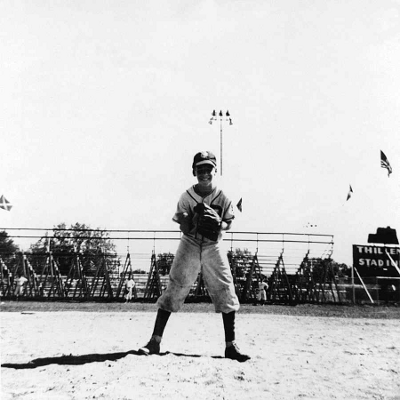
Ben at Thillens Stadium
* * *
1955
The summer of '55, I began my first real job. Three times a week I took the bus across town to my Aunt Sarah’s house, and she paid me ten cents an hour to pull weeds in her garden. I loved it, the freedom of leaving home, riding the bus, showing up as scheduled, sitting in the dirt, inhaling the sharp smell of marigolds. The little patch along the fence where lilies of the valley and black-eyed Susans grew became important to me; I felt proud to be contributing something. I think I learned everything I needed to know about record production by weeding my Aunt Sarah's garden: remove what doesn’t belong, and make what is there beautiful.
In Racine that year, the Cadillacs had fins, the girls wore Angora sweaters, and there was a softness in the air. Life before sound pollution — with fewer cars, less construction and no constant TV chatter — was simply more peaceful: streets were quieter, houses were quieter, the whole world was quieter. Maybe because of this, the sound of a record just seemed to leap out of the phonograph at you, like a wild creature from a distant place, even though you knew it was only a steel needle vibrating in a wax groove. But that was it: I was called by the music. I wanted to be there in the worst way, in that place, that bar, that restaurant, that pad, that studio, that scene — it didn’t really matter where, as long as it was where this sound was happening. Because, before MTV, before FM radio, before just about everything we know of today, there was that magical space where men like Louis Jordan and Erroll Garner and Dave Brubeck and Louis Armstrong and even Spike Jones were carrying on. They lived in many places at once, but they all came from that sound, and that sound came from the phonograph.
In the winters, there was a beautiful whiteness on the streets of Racine. At night, it was so quiet you could hear the snow falling, like the rustle of lace spreading gently over the neighborhood. The round globes cast shadows under the huge elms, and the trees bowed under the weight of the snow, while the occasional Buick hissed softly down the street on fat tires. For fun, I would stand on the corner by the stop sign, pretending to look the other way as a car pulled up. When the driver took off, I would swing down behind and grab on to the rear bumper. We called it “skitching,” and we rode on the soles of our shoes, ten, fifteen, twenty miles an hour down the side streets of Racine, instant transportation over the ice and snow, like water skiers through the tundra. We all knew that one dry patch could kill you, but we were immortal, and I flew for blocks this way, going nowhere and anywhere. I came home later and later each evening having experienced the possibility of death and the feeling of a great motor pulling me forward.
I still rode the bus downtown in the afternoons, but now it was to go to Hebrew school to prepare for my Bar Mitzvah. My father had left his job in Racine and was commuting on the North Shore Railroad to Chicago, where he was a writer for the Leo Burnett Advertising Agency. He would leave home at seven in the morning and come home at seven at night. Now, instead of going to his office when I went downtown, I killed time in Trudy White’s record store. With the money I made pulling weeds for Aunt Sarah, or babysitting for the Kofsky kid, I started to buy records. Trudy White's wasn’t really a record store. They sold everything from vacuum cleaners to sheet music, but they had a little record department in the back and I pawed through the two or three bins every time I was in there. One day, I found an album called The Birdland Stars On Tour. I don’t know why it jumped out at me, probably because of the picture on the cover: four men in matching blazers under a distant spotlight. Maybe it was just the name “Birdland,” which I had heard my father talk about.
I brought the disc home, went into my room, closed the door, and sat right next to my little record player, like an Eskimo huddling by a fire, I felt the heat coming from that music, from New York, Chicago, L.A. There was a saxophone player who was incredible, and I turned the jacket over to discover his name: Phil Woods. I couldn't get over the sound of his horn; it was so human, so physical. How did he do that? I held the album in my hands, staring at the photo and listening to Phil play. In between songs, the emcee, who was a midget, shouted, “Ladies and gentleman, the East meet West Septet! Let’s hear it for ‘em! The East meet West Septet!” Who were these guys?
The next week I went back to Trudy White's and discovered Horace Silver's album, Finger Poppin. That night I listened to Blue Mitchell’s trumpet solo on “Juicy Lucy” so many times in a row that I started to feel like he was related to me; literally. I had the feeling that we were brothers. And I thought that he was calling my name.
* * *
One Friday night while I was babysitting for the Kofskys, I heard a car horn blowing out front. I looked out the window into the rain and sleet and saw a Buick Roadmaster idling at the curb with the windshield wipers going. Somebody inside was waving at me. I ran out of the house and leaned into the open window. It was John Isbell and he had stolen the Buick only minutes before. In those days, car lots simply left the keys in the ignition, and if you wanted to try a car, you just told the man in the office and took it for a ride. John had slipped into the Buick that afternoon, taken the key, had it copied, replaced it, and then returned later in the evening for the car itself. He just drove it off the lot. “Come on, Benny,” he said, “let’s go!” And just like that, I left the Kofsky boy alone in his bed, in the nice warm house with the television murmuring some old horror flick, and away we sped into the Racine night. We fishtailed through the cemetery and spun out at every stoplight, and eventually, afraid that we would be caught by the police, we ditched the car behind McKinley Junior High. I made my way back through the cemetery in the cold rain, and got into the Kofsky’s living room before they returned. They never noticed a thing, paid me $1.50 and drove me home.
This started a round of petty auto theft that was made easier by the fact that my father left his red 1954 DeSoto at the train station every morning. By spring, John and I were regularly skipping school and easing down to the train station to drive off with the DeSoto. I was terrified that my father would notice his car was rarely parked where he left it, but he never said anything. Much later, I understood that when he got off the bar car, braced for his return home, a parking spot was probably the last thing on his mind. When he walked in the front door of our house and he saw me sitting at the piano, he often gave me the ceremonial whack on the back of the head, and I felt we were even.
That spring, Bill Haley and the Comets launched “Rock Around the Clock” like a meteor across the teenage sky. Until then, pop songs on the radio were just tearjerkers like Teresa Brewer’s “Put Another Nickel In,” or trivial, like Perry Como’s “Find A Wheel.” Sometimes, you got lucky and caught Tennessee Ernie Ford singing “16 Tons,” or Peggy Lee singing “Fever” — or maybe even Sinatra singing “Learning The Blues” — inklings of a substream of sophistication. But generally speaking, the radio played confections of the day, fitting the post-war mythology of a happy and safe world. Before Bill Haley, Middle American kids were not fighting to change the buttons on their dad’s car radio. Blackboard Jungle, the movie that closed with the song “Rock Around The Clock,” changed all that. It was a lightning rod for adolescent disaffection. Around the country, kids leaving the movie theater rioted in the streets, a phenomenon which expanded their access to the media, as the media took notice of their actions: rebellion quickly became a consumer item.
Simultaneously, black and white cultures were flowing together. It was no small coincidence that Milt Gabler, the producer of the song “Rock Around The Clock,” was also the producer of Louis Jordan’s earlier hits; his formula for combining the black shuffle groove with a white juvenile delinquent aesthetic became the industry standard for years to come. It was a turning point in American popular music, and it dramatically dialed up the heat. Soon it was Little Richard and Chuck Berry and, within months, duck tail haircuts, switchblade knives, tanker jackets and blue jeans made their appearance at McKinley Junior High School. Everybody wanted a piece of the blackboard jungle.
This new ache, like water, sought its own level. In my case, I was turning thirteen and I had my eye on a hot looking girl with extraordinary breasts named Marilyn. She was sweet and had a speech impediment — she said “w” instead of “l” so that she would pronounce her own name “Mariwyn” — and she never seemed to look at me or notice I existed. Then one night, the phone rang and I answered it and a girl’s voice said, “Hewwo Ben? This is a fwiend of Mariwyn’s. She wikes you.” Suppressing my shock, I stammered that Marilyn should meet me after school and we would “do something”.
The next day at lunch hour I told John my plan. He was torn between coming along “to stand watch” and dissuading me from my madness. My idea was that after school we would walk across the street to where an old lady always hung out her laundry, and there, in those white canyons of waving sheets, I would “do something” with Marilyn. I had no idea what. After school, Marilyn, still pretending not to see me, followed John and myself into the alley, and without saying a word, as John hung back, she and I entered this snowy bower. Once inside the sheets, I simply turned to Marilyn and put my hand inside her fuzzy pink sweater. My heart stopped. Her breast was in my hand, warm and alive. It was an indescribable pleasure, like holding her beating heart itself. She just looked at me and smiled. Not a word was spoken.
Suddenly, an angry old lady appeared from behind the sheets. “What are you kids doing,” she said. “You little criminals!” And then we ran. I didn’t see where Marilyn went but John and I cut through the cemetery. We didn’ ’ ’