Copyright © 2010 Yoga Network International, Inc.
All rights reserved. No part of this book may be reproduced or
transmitted in any form or by any means, electronic or mechanical,
including photocopying, recording or by any information storage and
retrieval systems, without permission in writing from Yoga Network
International, Inc.
Published by Yoga Network International, Inc.
PO Box 5340
Salt Springs, FL 32134
www.amritkala.com
in co-operation with
Red Elixir
27 Lamoree Road
Rhinebeck, NY 12572
Cover design by J. Rogers Design, St. Petersburg, FL
Book design by T. Cruse Design, Philadelphia, PA
Teaching photographs by Peter Goldberg
Back and inside cover portraits by Heather Titus
Painting of Dadaji courtesy of the Kayavarohan Temple
ISBN 9781618420237
Introduction
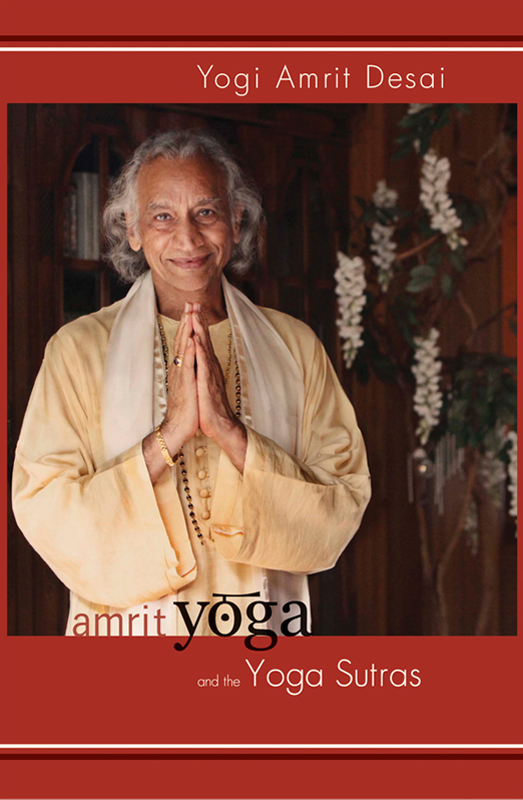
Nothing compares with the direct experience of being in the presence of a great spiritual teacher. There is no substitute for the depth of transformation that can occur for the student who is open and receptive to the wisdom only a true master can impart. Yogi Amrit Desai, known as Gurudev, is one such rare being. He possesses the unique ability to transmit the esoteric scriptural truths of the ages in a profound experiential way that we can all apply to truly transform our lives. Passed down from teacher to student for centuries, usually via the oral tradition, these sacred truths are the very kernel of the essence of life– they provide us with the means to discover what we all seek.
That said, I have nevertheless made a sincere attempt to bring the treasure trove of Yogi Desai’s teachings to the written page. I have faithfully adhered to his sometimes circular style of speaking and writing to maintain the richness of his language. I encourage the reader to feel these teachings rather than try to understand them on a mental level. This is as close as you can come to receiving the depth of these teachings through the medium of the written word. Yogi Desai’s teachings are so vast and all-encompassing, it would be difficult to contain it all in a single book. Therefore, this volume is dedicated to the authentic basis of his teachings in the exposition known as the Yoga Sutras. Its author, Yogi Patanjali, is a vague figure who lived some 2,000 years ago. Little is known about him, except for his invaluable contribution to the study of yoga. Prior to Patanjali, yogic principles were held in secret by a privileged few. For the first time, he codified these precious truths into simple yet mysterious statements that confound students to this day.
In the following pages, Yogi Desai’s brilliant perspective on the hidden meanings behind Patanjali’s mystical phrases are revealed. Absorb them, savor them and discover how pertinent and applicable they are to life today, using the experiential techniques of Amrit Yoga. The writings in this book are the perpetual inspiration of Yogi Desai, but it has come to fruition due to the painstaking diligence of many devotees. I would like to gratefully acknowledge those whose hands, hearts and dedication have contributed to preparing this work: Kamini Desai and Megan Wardrop, associate editors; Malay Desai and Urmila Desai, for their unswerving devotion and selfless service; Karen Bhakti Platt, James Amarish Caruso and Donna Surekha Ireland, senior Amrit Yoga teachers; Marian Yashodhara Betty, Patricia Vrajdipa Stevens, Doug Sanjay Martin and Federico Giller, fellow travelers on this path.
Lila Ivey, Editor
(Modini)
Sumneytown, PA
February 2002
About Yogi Amrit Desai

Yogi Amrit Desai is an internationally renowned yoga master, seminar leader and author in the field of yoga and holistic living. Widely acknowledged for carrying the true and authentic voice of yoga to the world, he has been honored with such rare awards as: “Doctor of Yoga” by H.H. Shankaracharaya, “Jagadacharaya” (Universal Teacher) by the World Religious Parliament in New Delhi, and the “Vishwa Yoga Ratna” awarded by the President of India. He was also nominated for “Padma Vibhushan,” the highest honor of India, by former Prime Minister Chandra Shekhar.
Yogi Desai is one of the earliest pioneers of yoga in America. Following his profound life-transforming Kundalini awakening, he developed a methodology that altered the popular notion of yoga as a physical discipline and reintroduced a spiritual dimension to the practice of Hatha Yoga. He named this approach Kripalu Yoga: Meditation in Motion, in honor of his guru.
The yoga society Yogi Desai founded in 1966 eventually grew into the Kripalu Center for Yoga and Health, one of the largest centers of its kind in America. The methodology he developed has become widely adopted and is taught and practiced by thousands around the world.
Yogi Desai continues to develop and teach his innovative approach in the form of Amrit Yoga. What distinguishes Amrit Yoga from Kripalu Yoga is the refinement and distillation of his methodology over the past 30 years. Amrit Yoga has evolved from Kripalu Yoga just as Kripalu Yoga evolved through Yogi Desai’s teachings over the years.
The most important aspect of Amrit Yoga is receiving it directly from its creator. There is no greater source of inspiration than learning from a living master.
Redesign Your Destiny…
The Amrit Yoga Institute offers Yoga Alliance-approved yoga teacher certifications in two 10-day courses (200 and 500-hours) and the Amrit Method® Yoga Nidra Professional trainings. All our programs, including the new Zero Stress Zone™ and Quantum Breath Meditations have the potential to deepen personal spiritual development, as well as enhance the skills of yoga teachers from all traditions.
In Amrit Yoga, flexibility of the body is secondary to sourcing the powers of the spirit within. Adding the spiritual dimension to yoga practice takes the practitioners to a whole new level of Self-awareness and Consciousness of the Divine that exists within us all. This is a unique opportunity to learn directly for a world-renowned yoga master—it is an experience that can alter your life forever.
Yogi Desai’s CDs, audio and videotapes on guided yoga, meditation, chanting and Yoga Nidra, as well as his lectures on topics about living consciously are available through www.amritkala.com
For more information, contact
The Amrit Yoga Institute
PO Box 5340
Salt Springs, FL 32134
352.685.3001
info@amrityoga.org
Get updated program schedules, new classes and articles on our website: www.amrityoga.org
I
Yoga for the 21st Century
The term “yoga” means union or oneness. It describes a state of unity consciousness that is infinite, whole, ever new and fresh–a state of being that is untouched by time, cultural conditioning, or religious doctrine. The ancient rishis, seers who had a direct experience of God through yogic practices, realized this great truth thousands of years ago. It wasn’t until Yogi Patanjali codified these secret truths that the sacred science of yoga became known. Patanjali provided others with a method to connect with the inner source of life itself.
Yoga has not changed in the past six thousand years, but what we call yoga has changed significantly. As the teachings traveled through time, they collected the dust of human unconsciousness. Eventually, that which lingered in society was merely the form of yoga while much of the spirit was lost. We have been left with a philosophy of oneness rather than an experience of oneness.
Fortunately, there have always been a few great yogis who renewed and revitalized yoga through the centuries, making it available to the world. In 1893, Swami Vivekananda was the first to introduce yoga to the West. Others followed, Paramahansa Yogananda in 1920, then Maharishi Mahesh Yogi and Swami Muktananda in the 1960s. In their own way, they each taught about the unity and connected sacredness of life, which is the foundation of yoga.
For many years, however, there were no masters teaching the true, in-depth practice of Hatha Yoga in the West. The teaching of postures as a physical discipline became very popular. But postures are only the tip of the iceberg–the outermost part of yoga. The subtler, more internal aspects are invisible and are often missed in the current practice of Hatha Yoga.
Still, these yoga practices met the needs of many: holistic health practitioners, athletes, dancers, therapists and businessmen. Yoga programs were developed by stress clinics, health resorts, gymnasiums, spas, diet clinics, and drug rehab centers. As uninformed teachers capitalized on the growing acceptance of yoga, it grew in breadth but not depth. Such popularized versions in some ways undermined and compromised the original intent of yoga.
As yoga continued to be westernized, numerous books were published that focused exclusively on its therapeutic applications. This is not to say those innovative practices were incorrect. On the contrary, the widespread popularity of yoga proves that they had a profound impact. The worldwide adoption of yoga is proof that even the popular versions of yoga did fulfill many needs of society. Now, however, the time has come to recapture the original spirit of yoga without sacrificing the wide range of applications present today.
It is time to explore yoga’s depth in addition to its breadth. The need is emerging throughout our culture. Those from every walk of life are waking up to a deep spiritual hunger. The abundance of new books and magazine articles reveal this craving for deeper values.
Understood correctly, Hatha Yoga is capable of using the body and the mind to transcend the limits ordinarily imposed by both body and mind. That is also the basis of Amrit Yoga. It is a non-aggressive, non-competitive, nonmental response to the primal wisdom of prana–our evolutionary life force. Ultimately, the practice leads to union of the individual soul with the infinite cosmic soul. And that is the real purpose of yoga.
I invite us all to embrace a renewed vision of yoga’s potential. The time is ripe to move into its deeper, unexplored dimensions. Yoga is a complete approach to integrating body, mind and spirit, and that integration is what brings us into unity consciousness. More than ever, the world needs to reconnect with its innate wholeness and divinity. Yoga has both the breadth and the depth to lead the way.
II
Traditional Paths of Yoga
All systems of yoga seek the same final goal–liberation or enlightenment. The various branches may be different entryways, but they arrive at the same destination. Actually, you cannot practice just one branch of yoga exclusively without the other branches of yoga being part of it in the process. For example, you cannot practice Karma Yoga, the yoga of selfless service, without bringing in the Bhakti Yoga of love and devotion. One will remain incomplete without the other. Love and meditative awareness are the two powerful integrative principles that are at the core of all disciplines of yoga. The major branches include:
Patanjali’s Aahtanga (Eight-Limbed) Yoga
Hatha And Raja Yoga
When Yogi Patanjali (circa 200 BC) called his exposition of yoga Ashtanga, he chose this word consciously to describe the eight limbs that are the extensions of the one body of yoga. If he had chosen eight steps of yoga, it would have made yoga a linear practice, one step at a time, like going up a ladder. However, just as all the limbs of the human body function in co-creation for any physical expression, similarly, all limbs of the body of Ashtanga Yoga must function harmoniously for the fulfillment of the purpose of yoga, which is union. Yoga practice that does not integrate the entire body of yoga remains incomplete. When you work with each limb individually you divide the core of yoga. When any one limb is exclusively isolated from the others, it fails to create integration among the conflicting aspects of our being.
This means that the eight-limbed body of Ashtanga Yoga forms a holistic system. Hatha Yoga can be practiced with a primary focus on the external form as a foundation for the spiritual dimensions of the whole body of Ashtanga Yoga. Even when the physical discipline is practiced alone, it can be impregnated with intention to plant the seeds of the mental and spiritual dimensions that expand Hatha Yoga from an exclusively physical discipline into a psychosomatic and bio-spiritual discipline.
Wherever you go, whatever you do, all the limbs of your body function and act in co-creation. Can you enter a room with just one part of your body? Of course not. So just as you cannot walk into a room with only one part of your body, you cannot fulfill the true purpose of the practice of yoga unless you integrate the whole body of Ashtanga Yoga, regardless of which particular limb is predominantly active. When you engage the whole body of yoga you maximize the power of yoga.
Our being represents the integrated expression of all of our bodies: physical body, prana body, mental body, intellectual body, and the bliss body. When every level of our being manifests into active expression, it is the experience of yoga.
Our physical body is the external part of our being; the mind and heart are the internal parts of our being and the soul is the source of life of the body, mind, heart and spirit. When we fully enter our being, it is the harmonious interactive co-creation of the body, mind, heart and soul.
The body alone cannot enter the sacred sanctuary of being. It must be integrated and whole. That is yoga.
Ashtanga Yoga is composed of the yamas and niyamas, asanas, pranayama, pratyahara, dharana, dhyana and samadhi. The yamas and niyamas are the observances and disciplines that protect you from internal and external disturbances and assure the successful practice of Ashtanga Yoga.
Asanas and pranayama represent the discipline of the body (Hatha Yoga). Pratyahara and dharana represent the discipline of the mind; dhyana turns the entire practice of Ashtanga Yoga into a spiritual discipline (Raja Yoga). Dhyana is the only part of Ashtanga Yoga that has the power and the potential to create dynamic integration where the body, mind, heart and soul can function as a harmonious whole. The moment you remove the meditative aspect of the practice, it is impossible to fulfill the intention of the practice of yoga, which is integration of all aspects of our being.
You can divide Ashtanga Yoga into external and internal. In Amrit Yoga, you begin with the external form of asana and pranayama as an entry point to develop the spiritual dimension that transcends the form into formlessness. The practice of yoga leads to transcendence of the limitations of both the body and the mind and into the experience of samadhi where all aspects of our being melt into the integrated experience of yoga.
Hatha Yoga: The Yoga Of Physical Discipline
In Amrit Yoga, asanas and pranayama are performed as a preparation. They establish the foundation for the mental and spiritual dimension of Raja Yoga, which includes pratyahara, dharana and dhyana. Even though Hatha Yoga appears to be a physical discipline, it invariably carries within it the components of Raja Yoga. It is a journey from external to internal; from form to formlessness; from physical to spiritual.
Raja Yoga: Classical Or Royal Yoga
The successful foundation of Raja Yoga is built on internal focus and meditative awareness during the practice of asana and pranayama. You cannot perform any physical act without the mind being part of it; neither can you perform any mental act without the body being an integral part. The body-mind is in co-creation in every action. Devoid of the mental and spiritual components, the discipline of Hatha Yoga remains incomplete.
Bhakti Yoga: The Yoga Of Devotion
The way of transcendent love sees the whole universe, animate and inanimate, as being pervaded by divinity. On this heart-centered path, devotees believe in a Supreme Being that is not separate from the material world and perceive the presence of the Creator in His creation. They embrace all of creation with unconditional love. Practitioners perform ritual offerings such as flowers, incense, chanting and meditating on the Supreme Being with whom they feel moved to connect. They use the chanting of mantras, music and dance as integral parts of their practice to express their devotion and love for God. The devotees of Bhakti Yoga predominantly follow the path of love and devotion to merge with the divine.
Jnana Yoga: The Yoga Of Wisdom
The Jnana yogi finds God through knowledge. It teaches the ideal of non-dualism–that reality is singular and your perception of countless distinct phenomena is a basic misconception. At enlightenment, everything melts into one, and you become one with the divine, immortal spirit. Jnana Yoga is the yoga of the philosopher and thinker who wants to go beyond the visible, material reality. This is the path of the yogi who wishes to realize the underlying unity behind diversity predominantly through the path of intellect.
Karma Yoga: The Yoga Of Selfless Service
Karma yogis remove the separation of the ego-self from the all pervading Self by performing selfless service to humanity and all living beings. This is their way of transcending their separative egos and achieving union with God through right action. This path’s most important principle is to act unselfishly and perform service for its own sake, without attachment, and with integrity. Practitioners believe that our actions, whether bodily, vocal or mental, have far-reaching consequences (karma) for which we must assume full responsibility. By letting go of the self-image in the service of the Self that is the Self of all, karma yogis experience union with the higher Self.
Mantra Yoga: The Yoga Of Sound
Mantras are sacred sounds of power. When they are practiced with love, faith, dedication, meditative attention and absorption, they become vehicles of transformation of body, mind, heart and soul. Each mantra corresponds with a specific force and holds within it a magical potency that can be released through the continuous, one-pointed, meditative absorption in the practice of mantra. This power of mantra is unlocked through repetition that purifies all of the bodies–physical, mental and emotional–transforming consciousness. Traditionally, practitioners receive a mantra from a guru during a formal initiation.