Copyright © 2011 by David E. Stanley
All rights reserved.
No part of this book may be reproduced, stored in a retrieval system, or
transmitted by any means, electronic, mechanical, photocopying, recording, or
otherwise, without written permission from the author.
EPIPHANY NOW PUBLISHING, SAN DIEGO, CALIFORNIA
ISBN: 978-0-578-10000-5
Printed in the United States of America
All Scripture quotations unless indicated otherwise are taken from the New International Version of the Holy Bible. Copyright © 1973, 1978, 1984 Biblica. Used by permission of Zondervan. All rights reserved.
To KATY…
YOUR LOVE HAS TRANSFORMED MY LIFE
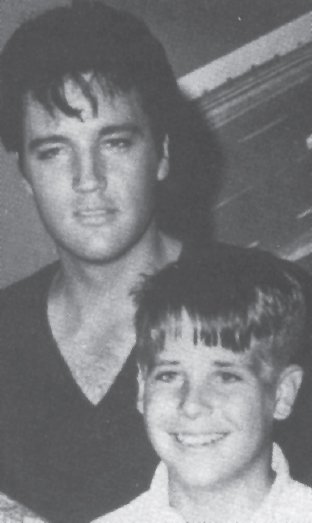
ELVIS & DAVID ~ 1967
Preface
Introduction
CHAPTER ONE
The Last Conversation
CHAPTER TWO
The First Conversation
CHAPTER THREE
The Authentic King
CHAPTER FOUR
The Other Side of Greatness
CHAPTER FIVE
Trying Everything But God
CHAPTER SIX
From The King of Rock & Roll To The King of Kings
CHAPTER SEVEN
Isolation: The Enemy of Authenticity
CHAPTER EIGHT
The Teachable Spirit
CHAPTER NINE
Embracing The Gift
CHAPTER TEN
Walking The Labyrinth
CHAPTER ELEVEN
The Price of Inauthenticity
CHAPTER TWELVE
Life in a Different Place on a Higher Plane
“Transparency is the essence of Authenticity.”
~ David E. Stanley
I am in gratitude always to the special and talented individuals that have been a huge part of my personal spiritual journey and who have helped to make this book possible.
Elvis Presley: You were the Master that took me on as a young apprentice. You left me a legacy and a message that goes out to the world in this literary work. I love you… the conversations continue.
Dr. David Gruder: My friend, you helped me peel back the layers of my inner self and put them into the words that filled the pages of this book.
BJ Dohrmann: You set the example of what real cooperation in the corporate world can be. You opened the door to a new way of life by providing a haven where dreams can and do come true. You encourage me by nurturing my God-given gifts.
Eve Hogan: You are that special soul who led me to the Labyrinth and met me when I came out. The miracle continues.
Dr. Richard Kaye: You are the one I first discussed the miracles and messages of this book with, back in 2005. You have been with me ever since supporting my journey and quietly making sure that message never died.
IN DEEP APPRECIATION
David M. Corbin/Dean Parks/Tri Ma Gia/JulieAnn Engel
Lauren E. Miller/Dean Fulford/James M. Blakemore/Patrick S. Durkin
David Wallace/Allen Taylor/Kimberly A. Kunasek/Nadine Lajoie
Marie Hue Nguyen/Heidi Fischer/Michal Mael/Paul Fischer
James T. Niemeyer/Craig Newell/Dennis Gauba/Linda Fischer
~
SPECIAL THANKS TO
Chris Collins/ Laura Rubinstein/Tom Jurgensen/Maria Speth
Lauren Solomon/Bob LaBine/Laurie Morse Gruder
Larry Geller/Roger Anthony
Ken Rutt/Samar Waterworth/Johanna Gratz/Laura Rutt
“Are you satisfied with the image you’ve established?” a reporter asked Elvis Presley during a press conference in New York City in June of 1972. We were there for a series of concerts he was doing at Madison Square Garden.
Elvis replied, “Well, the image is one thing, and a human being is another, you know. So, it’s very hard to live up to an image. I’ll put it that way.”
Elvis never told the press or the public who he was as a human being. His privacy was all that preserved his ultimately unsuccessful efforts to hold onto what remained of his authentic self.
Five years later, I was among the first to discover Elvis’s lifeless body in the mansion that he had lovingly and selflessly shared with me since 1960. I had arrived at Graceland as a four-year-old boy, along with my two brothers and my mother. My mother had just become the new wife of Elvis’s widowed father, Vernon Presley.
When I met him, I knew nothing of Elvis the icon. To me, he was simply my new big brother. I felt an instant love from this total stranger that went far deeper than anything I had experienced in my young life. His embrace felt complete and unconditional.
From the beginning, Elvis always referred to me as his brother. But, he became far more to me than the new big brother of an emotionally confused young boy. Over time he became my father figure, mentor, spiritual advisor, and ultimately, my boss. In June of 1972, two months before I turned seventeen and after having grown up with him at Graceland for twelve years, I was one of his full-time personal aides when he talked at the New York press conference about his public image and private self.
Just weeks after I had begun traveling with him full-time, Elvis took me aside at his Beverly Hills home for what would become one of our many private conversations. He was wearing an ankh around his neck that he often wore. It contained a beautiful black onyx. (The ankh is the ancient Egyptian symbol for eternal life.) Noticing that I was admiring it, he excused himself for a moment. When he returned, he held another ankh in his hands. As the master told his young apprentice about the meditation he wanted me to start doing, he presented me with this ankh, inviting me to wear it as a symbol of our spiritual bond.
Although I was aware of the icon, I knew the man. A man the public never knew. A man who was galaxies different from his public persona. A man who the masses remain mesmerized by to this day; for reasons that go far beyond who the icon appeared to be.
During our private conversations Elvis expressed things to me that he never shared with the press, the public, or the vast majority of those with whom he was closest. Now, it is time to lift the veil on those conversations.
This book is about the extraordinary lessons that Elvis the private mystic and healer taught me during my seventeen years as his young apprentice. It is also about the equally important lessons I learned from witnessing his titanic struggle between his most authentic spiritual self, his private demons, and his feeling imprisoned by the public icon he had become.
This is the one Elvis story that has never been written because I’m the only one who could tell it. Only now do I at last understand that story well enough to share it in ways that will be healing to many, perhaps including you.
Why does Elvis continue to hold sway with millions around the world for reasons they don’t understand, even thirty-four years after his death? Conversations with the King: Journals of a Young Apprentice is your doorway into the secrets behind that mystery. This book gives you never-before-available access to the wisdom and gifts Elvis never openly discussed in public. The untold stories each chapter contains revolve around a life lesson that invites you into discovering your answers to the mysteries of your life. At the end of each chapter you will find questions about these lessons that you might find valuable to ponder.
Whether you’ve been touched by Elvis or not, you’ll be enthralled by the lessons this book illuminates. They are for all who seek to become more authentic, wise, and enduringly happy.
These lessons transformed my life. I believe that Elvis Presley, the mystic and healer, passed them on to me for reasons that go far beyond my personal growth and spiritual development. Through my journey from apprentice to master, it became clear that my mission is to bring these lessons to you. My heartfelt wish is that you find them to be as beneficial throughout your spiritual journey as they continue to be on mine.
As I drove up the driveway to Graceland with my family, it was very much different than it had been fifty-one years before, when I was just a four-year-old boy. A sense of wonder was no longer there. The hope of acceptance wasn’t an issue. Driving through the gates of the Graceland Mansion during Elvis Week of 2011, with thousands of fans there from all over the world for their annual pilgrimage, felt unfamiliar.
Though I have been to Graceland many times since his passing, something was very different: I was different.
As I strolled the grounds of my old home, along with my wife Katy, and stepdaughter Mya, I noticed that we were being accompanied by dragonflies.
In that moment we couldn’t help but recall the dragonflies that had been showing up in many unexpected moments during the writing of this book, and especially in the weeks prior to our visit to Memphis.
I particularly recalled the stunning red dragonfly that spent the day with Dr. Gruder and me in his garden at his home in San Diego as we were writing one day.
Katy would later inform me about the symbolic significance of the dragonfly. It apparently is recognized around the world as a symbol of change and specifically in relation to self-realization, which includes mental and emotional maturity and embracing life’s deeper meaning.
Upon entering the Meditation Gardens, Elvis’s final resting place, the number of dragonflies intensified into the hundreds. They were literally swarming above our heads.
Katy took my hand and said, “Look, David, look at all the dragonflies!!”
Approaching the grave, everyone’s mood shifted, including that of my brother, Billy, and his wife, Monica. All appeared to be suffering from a sense of loss… except for Katy and me. We found ourselves more in gratitude than in mourning. As I stood, silently communicating with my famed master, my conversation was intuitively interrupted by Katy, who said, “David, did you hear that? Did you hear what he said? Did you get your validation?”
“I did,” I answered.
I was no longer the apprentice. I was now the teacher.
In that moment, I was flooded with an awareness of the surprising way that I had lived my life, far more in Elvis’s image than I had realized. This revelation was more powerful because of the transformation that had begun months before. Now it was confirmed. Now I understood more than ever the unspoken meaning behind why people all over the world still love Elvis all these decades after his death.
Many have struggled to put into words why Elvis continues to have such sway over their hearts. For example, we ran into Linda Moore, who has never missed an Elvis week in the thirty-four years since his death. I asked her, “What do you love the most about Elvis?”
Her answer was simple and clear. “His soul, David. His soul.” She then added, “Understand, David, I don’t have him, he has me.”
Just the week before, Katy and I, while on a business trip in Las Vegas, dropped in to an Elvis Tribute Artists’ convention at the Hilton, where Elvis performed twice a year throughout the seventies. I got into a conversation with a fan, and asked her, “What do you love most about Elvis?” Her response was the same.
“His soul. He could have been a postman, a milkman, or selling phone books. I still would have loved him. It is his soul.”
There was a time during my spiritual journey when I would have considered this seemingly over-the-top adoration the most outrageous act of idolatry I had ever seen. No longer. At Elvis’s graveside, I received full confirmation about what his fans felt so deeply and yet had so much difficulty putting into words.
Elvis was a prototype of spiritual transformation in the modern age. The twentieth century marked the end of enlightenment only being available to monks in monasteries. Suddenly, secret spiritual wisdom was becoming available to the masses. The problem was that the public had no template for how to step into this. Neither did spiritual elders, political leaders, or entertainers.
Elvis did. He was far more than the prototype of the rock star and entertainer. He was the model of a newly emerging path of spiritual struggling and development. He was the personification of the challenges of coming out of the spiritual closet that many millions of people have been dealing with. His life embodied the journey all of us take as we try to reconcile living our deepest spiritual wisdom with the expectations of the people around us.
I was blessed to privately witness and experience the profound gifts that Elvis kept from the public eye, as well as his dark struggles to bridge the gulf between his extraordinary spiritual awareness and his very human challenges that were magnified by his icon status.
In our earthly life we have jobs, careers, family, and other obligations and expectations. This calls us to create strong individual personalities. Society’s collective consciousness is much grounded in survival, appearance, and material gain. In contrast, the measuring stick of the mystic is our beingness, of never losing connection with our essence, which is the blend of our authentic self with our unity with all. The inner split that these two sets of priorities commonly create can cause the greatest of people to lose their way.
I know because after Elvis died I lost my way, too. But I always continued to feel his presence and to know that I had an unmet calling in my life. That calling came from the most authentic spiritual side of me. But, it was crowded out during the period of my life that I spent focused on worldly survival.
All of this began to change in June of 2010. The Bible, in Matthew 7:7 it says, “Knock and the door shall be opened to you; seek and you shall find.” What people often don’t understand is that frequently those answers come in the most unlikely of ways.
My first answer came in the form of an intuitive healer who lovingly slipped past my barriers to gain my trust. My second came in the form of a psychologist who happened to be an integrity expert. As unlikely as it is, this ex rock-and-roller and former evangelist bonded with the intuitive spiritual healer and the integrity-driven shrink.
What you’re about to read is what has come out of this unlikely collaboration. It has finally integrated my seventeen years as Elvis’s apprentice, the life experiences I had following his death, and the subsequent transformation that enabled me to see why Elvis continues to have such a huge impact, not only on my life but the world’s as well.
Elvis once said that if his spiritual quest could reach just one life then it would have been worth it. For me, if this book can reach just one person it will be worth it. My prayer is that reading this will help you embody the greatness of your authentic spiritual self in the fabric of your everyday life.
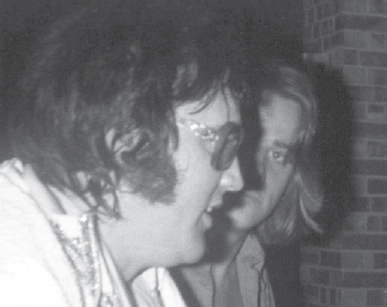
ELVIS & DAVID ~ 7977
“David, who am I?” Although Elvis had asked me this question many times over the years, on this day he asked it with such a strong a sense of urgency that it rattled me.
“You’re ‘The King’,” I answered, trying not to show how I felt.
Elvis lifted his Bible in his right hand, saying, “David, there is only one King. Come sit with me.” So began my final conversation with the king.
It was August 14, 1977. Elvis was sitting on his bed in his Graceland mansion reading the Bible, as he so often did. The effects of years of prescribed medication abuse had turned him from the once gorgeous sex symbol millions had adored into an isolated, lonely, shell of a man.
“Gosh, a lot’s happened over the year.”
“Yeah, Boss, it has.”
We spent a few minutes talking about some challenges going on in our family. He was concerned about his dad’s impending divorce from my mother. He wondered how I was feeling about it and wanted to assure me that this would not affect our relationship.
“What do you think about Daddy and Dee?”
“I don’t. Ain’t none of my business, Boss. I’m with you all the way.”
Elvis had been far more of a parent to me than my mom, my dad, or even my stepfather, Vernon. My loyalty was to him.
However, that’s not what Elvis most wanted this conversation to be about. He stood up, and I followed his lead. He then brought me fully into his arms, saying, “I love you, David.”
I responded with, “I love you, too.” My emotions brought me back to Elvis’s hug seventeen years earlier, when he first welcomed me into his family. Today’s heartfelt embrace, two weeks shy of my 22nd birthday, felt eerily like that first one.
As we broke from our embrace we stood face-to-face, man-to-man. “Listen,” said Elvis, “I want you to know something. The next time you see me I’m going to be in a different place, on a higher plane.”
Puzzled by his words, I glanced at the stacks of books on spirituality and personal development that were next to his bed. They accompanied him wherever he went, along with his Bible. I figured he was quoting from one of them.
“No, Boss,” I fumbled, “the next plane is going to be yours on the 16th.” We were scheduled to leave in two days on his next concert tour, which was to begin in Portland, Maine. He dismissed my response, sat back down on the bed, and returned to his reading.
I moved toward the door and looked back at him, haunted by his profound words. “Hey, Boss….”
“The 16th, David,” he interrupted before I could complete my unformed thought, “the 16th.”
With that, I left his bedroom, closing his door behind me, not yet knowing that I had just closed the door on a chapter of my life.
When Elvis said what would turn out to be his final words to me, he had for years lived as though a prisoner in solitary confinement. He had become suffocated by the expectations that the iconic public self demanded, which stood in stark contradiction to both his light and dark private selves. His dark, self-destructive private self exerted ever-increasing domination as he approached his appointment with death.
Even so, all the way through his final conversation with me, he had never stopped yearning to find—and live his life from—his authentic, higher self. “David, who am I?” rings in my ears to this day. Not only as his question to me, but for many years as my question to myself.
“It’s not that I’m not liked; it’s that I’m misunderstood.” ~ Elvis Presley
What most people didn’t understand about Elvis is that he had three distinctly different selves. The first was his public self: his carefully created icon status. The second was his extraordinary spiritually authentic seeker, who few knew about or understood. And the third was his equally private self-destructive side that ultimately led to his death.
“There are too many people that depend on me. I’m too obligated. I’m in too far to get out. ” ~ Elvis Presley
On August 16, 1977, my friend Mark and I drove through the Graceland gates. I had some free time before we needed to prepare Elvis for our departure later that evening to Portland, Maine.
Mark asked me, “Is Elvis here now?” So powerful was Elvis’s presence, and so deep was my intuitive connection with him that I could feel when we were in the same building.
I felt unsettled, just as I had been two days before. “No he’s not,” I reluctantly replied, knowing full well that I was saying the opposite of what I had every reason to believe was true.
Something definitely wasn’t right, but I didn’t know what to make of my feeling. I had not yet developed a trust in my intuition when it didn’t match what my head knew. It would be many years before I would accept that even had I trusted my intuition that day, it would not have changed the outcome.
Mark and I went downstairs and began shooting pool. Moments later, Amber, the niece of Ginger Alden, Elvis’s current girlfriend, entered the room.
“David, Elvis is sick. He’s asleep on the bathroom floor and won’t wake up.”
Having seen him in this state many times over the prior several years, I assumed he had once again taken too much medication and that he would ultimately sleep it off. I also knew that this news would probably mean that we would need to make arrangements to cancel his upcoming concert tour. Knowing from Amber that others were already tending to Elvis, my first task was to get Mark off the premises immediately.
I whisked him home. As I raced back to the Graceland gates not five minutes after having left, an ambulance was entering from the opposite direction. My heart dropped; although I also knew that standard operating procedure was that if a concert needed to be cancelled, Elvis needed to go to the hospital to verify that the cancellation was legitimate.
Following the ambulance as it proceeded to the front of the house, I saw Elvis’s cousin, Patsy Gamble, running out the front door screaming hysterically. That was the first moment I realized this situation could be quite different from all the others I’d been through with Elvis over the years. I thought to myself, “This could be serious.”
I took the driveway to the back. Jumping out of the car, I raced through the house, up the steps, and into Elvis’s bathroom.
There I saw the sight that has since haunted me. Elvis was lying unconscious in a fetal position. Charlie Hodge and Joe Esposito along with Al Strada hovered over him. Moments after I arrived, they rolled Elvis over onto his back. His face and chest were blue and bloated. His black tongue was vice-gripped by his clenched teeth.
I moved toward his body at the exact moment the ambulance attendants burst into the bathroom. They immediately began frantic efforts to try to revive him. But, “too late” had arrived long before any of us had.