Kindle Edition Copyright © 2013. All rights reserved. No part of this book may be reproduced in any form or by any means, unless it is stated otherwise, without written permission from the publisher, Kindle for Stobaugh Publishing, 510 Swank Rd., Hollsopple, PA 15935. Efforts have been made to conform to US Copyright Law. Any infringement is unintentional, and any file that infringes copyright, and about which the copyright claimant informs me, will be removed pending resolution.
Scripture quotations are from the Holy Bible, New International Version®, Copyright © 1973, 1978, 1984, 2011 by Biblica, Inc.®. Used by Permission. All rights reserved worldwide.
Font family: Palatino, serif.
Special thanks to my students including John Micah Braswell, Alouette Greenidge, Daniel Greenidge, Anna Grace Knudtsen, Claire Atwood, Chris Lloyd, Callie Lloyd, and Joseph Stahl, for their diligent work and generosity in allowing me to use their essays as samples.
Thanks to Julie Atwood, Julie Braswell, and Karen Stobaugh for editing my manuscript.
Special note: The present tense is used to refer to memorable works of the past and to narrate a fictional work’s plot. “Characters in books, plays, and films do things.”—Chicago Manual of Style, 16th edition
For Further Information:
Stobaugh Publishing, 510 Swank Rd., Hollsopple, PA 15935
(814-479-7710)
ISBN 9781624887970
E-mail: jim@forsuchatimeasthis.com
Website: http://www.forsuchatimeasthis.com
Facebook: http://www.facebook.com/jpstobaugh
Twitter: http://twitter.com/jamespstobaugh
This book is dedicated to this new generation of young believers whose fervor and dedication to the purposes of the Lord shall yet bring a great renewal!
Stand tall, young people, and serve our Lord with alacrity and courage!
Turning and turning in the widening gyre
The falcon cannot hear the falconer;
Things fall apart; the centre cannot hold;
Mere anarchy is loosed upon the world,
The blood-dimmed tide is loosed, and everywhere
The ceremony of innocence is drowned;
The best lack all conviction, while the worst
Are full of passionate intensity.
Surely some revelation is at hand;
Surely the Second Coming is at hand.
The Second Coming! Hardly are those words out
When a vast image out of Spiritus Mundi
Troubles my sight: a waste of desert sand;
A shape with lion body and the head of a man,
A gaze blank and pitiless as the sun,
Is moving its slow thighs, while all about it
Wind shadows of the indignant desert birds.
The darkness drops again but now I know
That twenty centuries of stony sleep
Were vexed to nightmare by a rocking cradle,
And what rough beast, its hour come round at last,
Slouches towards Bethlehem to be born?
—William Butler Yeats (1865–1939)
James P. Stobaugh and his wife, Karen, have four homeschooled adult children. They have a growing ministry, For Such a Time As This Ministries, committed to challenging this generation to change its world for Christ. His academic credentials include the following: BA, cum laude, Vanderbilt University; Teacher Certification, Peabody College for Teachers; MA, Rutgers University; MDiv, Princeton Theological Seminary; Merrill Fellow, Harvard University; DMin, Gordon-Conwell Theological Seminary.
Dr. Stobaugh’s books include the following:
The SAT and College Preparation Course for the Christian Student
The ACT and College Preparation Course for the Christian Student
Encouraging Thoughtful Christians to be World Changers (series)
Handbook for Literary Analysis
Skills for Rhetoric
American Literature
British Literature
World Literature
High School History Courses (series)
American History
British History
World History
Epoch I–IV History
Companion to 50 Classics
Devotions for Thoughtful Christians (series)
Fire That Burns But Does Not Consume
A Gathered Inheritance
(See Interactive Contents below. You may also use the search capability of your reading device.)
1. Allegory
2. Characterization
3. Narration
4. Plot
5. Setting
6. Theme
7. Tone
8. Poetry
Appendix A: Glossary of Literary Terms
Appendix B: Book List
Younger Students
Older Students
Appendix C: Index of Subjects
Appendix D: Index of Excerpted Works
General Literature
Bible Selections
“The Second Coming, ” by William Butler Yeats
About the Author
Preface
CHAPTER 1: ALLEGORY
Background
Suggested Literary Works
Terms
Examples of Allegory
The Scarlet Letter, by Nathaniel Hawthorne (1850)
“The Allegory of the Cave,” in Plato’s Republic
Comments on Plato’s “Allegory of the Cave”
The Greatest Is Love: 1 Corinthians 13
Archetype: A Special Kind of Allusion
Parody
Wandering with the Human Heart
Allegories in the Bible
Student Essays
Allegory in Ethan Frome , by Edith Wharton
Allegory in Faerie Queene, by Sir Edmund Spenser
Allegory in The Divine Comedy, by Dante
Allegory in Uncle Tom’s Cabin , by Harriet Beecher Stowe
Allegory in The Idylls of the King, by Alfred Lord Tennyson
CHAPTER 2: CHARACTERIZATION
Background
Suggested Literary Works
Terms
The Oedipus Rex Character
All the King’s Men, by Robert Penn Warren
Literary Works with Oedipus Rex Protagonists
Oedipus Rex Characters in the Bible
Saul as Tragic Hero: 1 Samuel 13:5–14
Samson as Tragic Hero: Judges 16:23–30
Greek or Ancient Tragic Hero versus Modern Tragic Hero
Protagonists Who Change
Bible Characters Who Change
Bad, Bad Boys: The Antagonists
Biblical Antagonists
Nonpersonal Antagonists
Biblical Obstacles
Foils in Literature
Biblical Foils
Internal Conflict
Heathcliff in Wuthering Heights, by Emily Bronté
The Joseph Story in Genesis 45:1–13
Jesus in Gethsemane: Luke 22:39–46
Abraham’s Sacrifice of Isaac: Genesis 22:1–3
External Conflict
King Solomon’s Mines, by H. Rider Haggard
“The Masque of the Red Death,” by Edgar Allan Poe
David and Goliath: 1 Samuel 17:26–50
Peter and John before the Sanhedrin: Acts 4:1–22
Round and Flat Characters
Round and Flat Characters in General Literature
Round and Flat Characters in the Bible
Narration Describing Characters in Vivid Detail
From The Vicar of Wakefield, by Oliver Goldsmith
How the Narrator Rounds Out the Characters
Cassius Characterized: In Julius Caesar, by William Shakespeare
Dialogue Revealing the Protagonist’s Personality
The Adventures of Huckleberry Finn, by Mark Twain
Alice’s Adventures in Wonderland, by Lewis Carroll
The Red Badge of Courage, by Stephen Crane
Plot Revealing the Character’s Development
Metamorphosis, by Franz Kafka
Sensory Impressions Revealing Character
“I Hear America Singing,” by Walt Whitman
Protagonist’s Stream of Consciousness Reveals Character
Ethan Frome, by Edith Wharton
Walden; or, Life in the Woods, by Henry David Thoreau
Student Essays
Characterization for Idylls of the King
Characterization of Lady Macbeth
Characterizations in Sir Gawain and the Green Knight
Characterization in Oedipus Rex
Characterization in Homer’s Iliad
Characterization in the Biblical Story of Joseph: Genesis 37, 39–50
CHAPTER 3: NARRATION
Background
Suggested Literary Works
Terms
Narrative Point of View
Ethos ( θος): Appeal to Reason
“Letter from a Birmingham Jail,” by Martin Luther King Jr.
Logos (λ γος): Based on Credibility
Marco Polo’s Journals
“The Tell-Tale Heart,” by Edgar Allan Poe
Pathos (Π θος): Evoking Emotion
“I Have a Dream,” by Martin Luther King Jr.
Pathos in Psalm 137
Pathos in Isaiah 6:1–8
First-Person Narration
Moby Dick, by Herman Melville
The Adventures of Huckleberry Finn, by Mark Twain
Confessions, by Augustine of Hippo
Omniscient Narration
A Tale of Two Cities, by Charles Dickens
The Three Musketeers, by Alexandre Dumas
Limited Omniscient Narration
The Count of Monte Cristo, by Alexandre Dumas
The Call of the Wild, by Jack London
The Tale of Peter Rabbit, by Beatrice Potter
“Miss Brill,” by Katherine Mansfield
Objective Third-Person Narration
Billy Budd, by Herman Melville
“The Blue Hotel,” by Stephen Crane
“The Lottery,” by Shirley Jackson
Second-Person Narration
Star Wars: Revenge of the Sith, by Matthew Woodring Stover
Winnie the Pooh, by A. A. Milne
Dramatic Monologue
“The Love Song of J. Alfred Prufrock,” by T. S. Eliot
“The Hollow Men,” by T. S. Eliot
Soliloquy
Hamlet, by William Shakespeare
Narration in the Bible
The Book of Ezra
Psalm 23
The Letter to the Galatians 1:1–10
Student Essays
Narration in Cold Sassy Tree, by Olive Burns
Narration in “The Jilting of Granny Weatherall,” by Katherine Ann Porter
Narration in How Green Was My Valley, by Richard Llewellyn
Narration in A Farewell to Arms, by Ernest Hemingway
Narrative Credibility in “The Tell-Tale Heart,” by Edgar Allan Poe
CHAPTER 4: PLOT
Background
Suggested Literary Works
Terms
Exposition
“The Most Dangerous Game,” by Richard Connell
Frankenstein, by Mary Shelley
“An Occurrence at Owl Creek,” by Ambrose Bierce
“The Prologue” of The Canterbury Tales, by Geoffrey Chaucer
Rising Action
“The Most Dangerous Game,” by Richard Connell
Rising Action: Dramatic Question
David Copperfield, by Charles Dickens
“Everything That Rises Must Converge,” by Katherine Anne Porter
Five Examples of Conflict
Types of Plots: Managing Time and Space
Paranoid Fiction
Climax
“The False Gems,” by Guy de Maupassant
Peter Pan, by J. M. Barrie
“The Most Dangerous Game,” by Richard Connell
“The Rime of the Ancient Mariner,” by Samuel Coleridge
Falling Action
Alice’s Adventures in Wonderland, by Lewis Carroll
The Adventures of Tom Sawyer, by Mark Twain
Anne of Green Gables, by Lucy Maud Montgomery
Denouement (Resolution)
A Christmas Carol, by Charles Dickens
Macbeth, by William Shakespeare
The Strange Case of Dr. Jekyll and Mr. Hyde, by Robert Louis Stevenson
Romeo and Juliet, by William Shakespeare
Didactic Literature
Pilgrim’s Progress, by John Bunyan
A Wise Ruling: 1 Kings 3:16–28
A Woman of Noble Character: Proverbs 31:10–31
Fables
“The Tortoise and the Hare,” a Fable by Aesop
“The Goose That Laid the Golden Egg,” a Fable by Aesop
“The Nun’s Priest’s Tale,” by Geoffrey Chaucer
Parables
The Prodigal Son: Luke 15:11–32
Jerusalem as a Useless Vine: Ezekiel 15
A Vine in Egypt: Psalm 80:8–16
The Song of the Vineyard: Isaiah 5:1–7
Plot in the Bible
The Joseph Narrative: Genesis 37, 39–45
Moses Dies on Mt. Nebo: Deuteronomy 32:48–52; 34:1–12
The Death and Resurrection of Jesus: Luke 22–24; John 20:11–18
Student Essays
Plot in Pride and Prejudice, by Jane Austen
Internal Conflict in A Separate Peace, by John Knowles
Plot in the Odyssey, by Homer
Plot Development in Oedipus Rex, by Sophocles
CHAPTER 5: SETTING
Background
Suggested Literary Works
Terms
Examples of Story Settings
“A Rose for Emily,” by William Faulkner
The Call of the Wild, by Jack London
“The Fall of the House of Usher,” by Edgar Allan Poe
“A Worn Path,” by Eudora Welty
Alternative-History Settings
The Time Machine, by H. H. Wells
1984, by George Orwell
Comments on Orwell’s Themes
“Comparing Visions of New Worlds,” by James P. Stobaugh
Science Fiction
20,000 Leagues under the Sea, by Jules Verne
Fahrenheit 451, by Ray Bradbury
Fantasy
Gilgamesh Epic, Anonymous Origin
Sir Gawain and the Green Knight, Anonymous
The Lord of the Rings Trilogy, by J. R. R. Tolkien
Comments on The Lord of the Rings
Social Reform Literature
The Jungle, by Sinclair Lewis
Animal Farm, by George Orwell
Uncle Tom’s Cabin, by Harriet Beecher Stowe
Western Settings
The Virginian: A Horseman of the Plains, by Owen Wister
Comments on the American West
“The Luck of Roaring Camp,” by Bret Harte
Developing the West
War Settings
Visions of War as Judgment: Revelation 9:1–21
Paradise Lost, by John Milton
With Lee in Virginia, by G. A. Henty
All Quiet on the Western Front, by Erich Maria Remarque
The Diary of Anne Frank, by Anne Frank
Settings in the Bible
Esther and Mordecai: Esther 4:9–16
Noah and the Flood: Genesis 8:1–14
Elijah on Mount Carmel: 1 Kings 18:16–39
Paul’s Shipwreck at Malta: Acts 27:1–28:10
The Resurrection: Luke 24:1–12
Paul in Prison: Philemon
Pastoral Settings in the Bible
A Song by David: Psalm 23
David the Shepherd Boy Anointed: 1 Samuel 16:6–13
The Good Shepherd: John 10:1–18
Student Essays
The Setting in The Crucible, by Arthur Miller
The Setting in The Diary of Anne Frank
Change in Nectar in a Sieve, by Karmala Markandaya
The Setting in Their Eyes Were Watching God, by Zora N. Hurston
The Setting in “Outcasts of Poker Flat,” by Bret Harte
The Setting in Lord of the Rings, by J. R. R. Tolkien
CHAPTER 6: THEME
Background
Suggested Literary Works
Themes
Terms
“The Dream,” by John Donne: Love as a Theme
The Individual in Nature
“To Build a Fire,” by Jack London
“The Snow-Storm,” by Ralph Waldo Emerson
Individual and Nature in the Bible
Moses and the Red Sea: Exodus 14:10–31
Jesus Calms the Storm: Matthew 8:23–27
Feeding the Five Thousand: John 6:1–14
Jesus Walks on the Water: John 6:16–24
The Star of Bethlehem: Matthew 2:1–9
The Individual and Society
Crime and Punishment, by Fyodor Dostoyevsky
Comments on Crime and Punishment
Pride and Prejudice, by Jane Austen
The Individual and Society in the Bible
The Sermon on the Mount: Matthew 5–6
The Cost of Discipleship, by Dietrich Bonhoeffer
An Individual’s Relation to the Cosmos
Lord of the Flies, by William Golding
Heart of Darkness, Joseph Conrad
Comments on Heart of Darkness
The Emperor Jones, by Eugene O’Neill
Comment on The Emperor Jones
“Brother Palmer Garner,” by James P. Stobaugh
The Individual and the Cosmos in the Bible
God’s Speech to Job: Job 41
Comment on Leviathan, by Matthew Henry
Satire
Gulliver’s Travels, by Jonathan Swift
Comments on Gulliver’s Travels
The Screwtape Letters, by C. S. Lewis
Story with a Moral, a Lesson
“The Brave Quail,” a Panchatantra Indian Folktale (Adapted)
Motif
The Great Gatsby, by F. Scott Fitzgerald
Comments on The Great Gatsby
“Worldview in Literature,” by James P. Stobaugh
Foundations of Major Worldviews
Seven Major Worldviews
Theism
Iliad, by Homer
Deism
The Life and Morals of Jesus of Nazareth, by Thomas Jefferson
Romanticism
Faust, by Johann Wolfgang von Goethe
Comments on Faust
Naturalism
“The Open Boat,” by Stephen Crane
Comments on Crane
Realism
The Old Man and the Sea, by Ernest Hemingway
A Doll’s House, by Henrik Ibsen
Comments on A Doll’s House
Existentialism
The Stranger, by Albert Camus
Comments on Camus
Absurdism
The Big Trip Up Yonder, by Kurt Vonnegut Jr.
Comments on Vonnegut
Student Essays
Themes in Anne of Green Gables
The Theme of Alice in Wonderland
Use of Songs to Set Up the Theme in The Lord of the Rings
Morals in Panchatantra
Augustine’s Confessions Compared with Virgil’s Aeneid
Plato’s Three Main Questions in the Republic
The Use of Language to Develop the Theme in Their Eyes Were Watching God, by Edith Hurston
Themes in Silas Marner, by George Eliot
CHAPTER 7: TONE
Background
Suggested Literary Works
Terms
Irony
Verbal Irony
The Adventures of Huckleberry Finn, by Mark Twain
Comments on The Adventures of Huckleberry Finn
Situational Irony
The Wonderful Wizard of Oz, by Frank Baum
Comments on The Wonderful Wizard of Oz
Dramatic Irony
The Scarlet Letter, by Nathaniel Hawthorne
Comments on The Scarlet Letter
Gothic Tone and Mood
“The Cask of Amontillado,” by Edgar Allan Poe
Humor
“The Ransom of Red Chief,” by O. Henry
Comments on O. Henry
Thriller
Odyssey, by Homer
Treasure Island, by Robert Louis Stevenson
Romance
Jane Eyre, by Charlotte Bronté
Comments on Jane Eyre
Tone in the Bible
Sisera and Deborah: Judges 4
Legalism: Galatians 3
Love Song: Song of Solomon 1
Adoration and Praise: Psalm 150
Drama
Student Essays
Tone in Stephen Crane’s The Red Badge of Courage
Feelings of Evil in Tolkien’s Lord of the Rings
The Tone in Herman Melville’s Billy Budd
“Days,” by Ralph Waldo Emerson
Irony in “The Blue Hotel,” by Stephen Crane
“Mood and Substance: A Comparison of Buddhism and Christianity,” by James P. Stobaugh
Humor in The Adventures of Tom Sawyer, by Mark Twain
Awe in William Bradford’s Of Plimoth Plantation
Comparison in Tone between Job and Plato’s Apology of Socrates
CHAPTER 8: POETRY
Background
Suggested Literary Works
Terms
Language: Denotation and Connotation
“Loveliest of Trees, the Cherry Now,” by A. E. Housman
Theme
“After Apple Picking,” by Robert Frost
“To My Dear and Loving Husband,” by Anne Bradstreet
“Verses upon the Burning of Our House,” by Anne Bradstreet
Comments on Anne Bradstreet
Narrative Poems
“The Death of a Hired Hand,” by Robert Frost
Epic Poems
“Casey at the Bat,” Ernest Lawrence Thayer
“The Charge of the Light Brigade,” by Alfred Lord Tennyson
Humorous Poems
“Thoughts fer the Discuraged Farmer,” by James Whitcomb Riley
“The Owl Critic,” by James T. Fields
Imagery
“Spring and Winter,” by William Shakespeare
“Silver,” by Walter de la Mare
“In Flanders Fields,” by John McCrae
Metaphors and Related Figures of Speech
“A Psalm of Life,” by Henry Wadsworth Longfellow
“Concord Hymn,” by Ralph Waldo Emerson
“Lepanto,” by G. K. Chesterton
“Honky Tonk in Cleveland, Ohio,” by Carl Sandburg
Tone
“The Second Coming,” by William Butler Yeats
“War Is Kind,” by Stephen Crane
Sounds in Poetry
Terms
“The Tyger,” by William Blake
“Don’t Delay Dawns Disarming Display,” by Paul McCann
“Bells,” by Edgar Allan Poe
Poetry in the Bible
The Songs of Moses and Miriam: Exodus 15:1–21
David Laments the Death of Saul and Jonathan: 2 Samuel 1:19–27
A Mighty Fortress: Psalm 18
Like an Eagle: Deuteronomy 32:10–12
Every Knee Shall Bow: Philippians 2:5–11
Student Essays
Beowulf: Medieval Epic Poem
Comments on Beowulf
“The Collar,” by George Herbert
“The Charge of the Light Brigade,” by Alfred Lord Tennyson
“The Midnight Ride of Paul Revere,” by Henry Wadsworth Longfellow
“I Loved Her Like the Leaves,” by Kakinomoto no Asomi Hitomaro
Poems of Gabriela Mistral
The Epic Poem The Song of Roland
The “Rubaiyat,” by Omar Khayyám
APPENDIX A: GLOSSARY OF LITERARY TERMS
APPENDIX B: BOOK LIST
Younger Students
Older Students
APPENDIX C: SUBJECT INDEX
APPENDIX D: INDEX OF EXCERPTED WORKS
General Literature
Bible Selections
Literary analysis is literary criticism. They are the same.
What is literary criticism? Literary criticism is talking and writing about literature. Any literature, at any age. In that sense, literary analysis is a critical discussion of literature. To be “critical” is not necessarily to be “negative.” It is to be intentional in one’s evaluation of literature. Indeed, “evaluation” is the highest form of thoughtful analysis.
When children read Margaret’s Wise Brown’s Runaway Bunny and ask, “Do I like this book?” and “Why?” they are, in effect, analyzing the literary piece. They are doing literary criticism. As they get more adept, students ask, “Who are the central characters? What conflict do they face? Where is the climax? Is there a theme?” But further sophistication and advanced metacognition in no way diminishes the intentional, informed opinions of the most unsophisticated, readers.
Literary critics, no matter what their age, use a special “language” to talk about literature. This book is a reference book about that language.
For example, in The Runaway Bunny the protagonist (the main character), a little runaway bunny, is pursued by his loving mother, a mother bunny, an important foil (a character who develops the main character). The protagonist experiences several layers of internal conflict as he tries to escape his mother. Along the way, the author, Margaret Wise Brown, uses several setting changes to develop her characters. And so forth. Now readers have a way to discuss this literary work.
At the heart of literary analysis is rhetoric. At the heart of rhetoric is apologetics. If we teach literary analysis, we are going a long way toward teaching apologetics.
The person who examines, interprets, and analyzes literature is a critic. A critic is a guide to the reader, not a prophet or therapist. Although it is the critics’ right to express their preferences, and even their privilege to influence others, it is not their job to tell the reader what to like or not like. However, the critic is a helper, a guide who helps the reader better understand the author’s intention and art.
In fact, the critic is concerned about the structure, sound, and meaning of the literary piece. These structures are described as genres: prose, poetry, nonfiction (e.g., essays, speeches), drama.
Literary analysis or criticism is a way to talk about literature. Literary analysis is a way to understand literature better. If we really want to understand something, we need to have a common language with everyone else. If we talk about cooking, for instance, we need to know certain terminology and use it when describing the process. How lost we might be without knowing what “to cream the butter and sugar” means!
Like thatching or clog dancing, literary criticism seems to be something of a dying art. —Terry Eagleton
Parenthetically, to born-again, Christian readers, literary analysis or criticism is an extremely important skill to learn. It is the first cousin of Christian apologetics. Christian apologetics is the considered defense of Christian dogma, Scripture, and worldview. Learning to evaluate literature, literary analysis, prepares readers to be Christian apologists. After all, it is no coincidence that the greatest apologists are not theologians: they are English teachers! C. S. Lewis did not teach systematic theology: he taught literature.
Besides, literary analysis helps readers to evaluate and to reclaim the “metaphor.” What I mean by metaphor, is “a comparison between something completely different from something else.” In literature, a metaphor enables readers to understand very difficult things by illustrating those things with other simple things more familiar to the audience.
Christians desperately need to reclaim the metaphor! Again, a metaphor is a literary concept where the author compares a dissimilar thing to a similar thing so that readers will grasp the meaning and import of the dissimilar thing. Jesus calls himself the “Good Shepherd.” If readers and listeners grasp the importance and meaning of “Good Shepherd,” they will be on the way to understanding the role of Jesus Christ. When Jesus spoke these metaphors, he knew that he was using images and concepts that were familiar to his agrarian, pastoral audience. What we Christians need to do is to take age-old Christian dogmas of “faith,” “love,” “forgiveness,” and especially “hope” and find contemporary metaphors to make these concepts come alive in our post-Christian, sorry world.
Fundamentally, literary criticism, then, will help readers reclaim the metaphor in their psyche, language, and writing. This will presage laudable outcomes in the kingdom of God. My goodness, it will presage laudable outcomes in the kingdom of man!
Therefore, amid so many competing media options, readers must learn to analyze, to evaluate, to appreciate great literature. The propagation of the gospel will not be enhanced by how quickly we can appreciate and text messages to one another; however, it will be enhanced by how well we grasp the critical nuances of Bible stories. We cannot suppose that our unsaved world will grasp concepts like “love” and “faith” unless we have words, rhetoric, to tell them what these things are. If we learn how to do literary analysis well, we will be better able to create and to share vital truths to future generations.
The Handbook for Literary Analysis: How to Evaluate Prose Fiction, Drama, and Poetry reclaims the metaphor, reclaims rhetoric, reclaims literary analysis. It has a high view of the reader, the critic, and the student. All three are invited to think critically, to discuss thoroughly, the great literary works of all civilizations. Systematically, this Handbook defines, explains, and illustrates a wide range of significant literary terms in fiction, drama, and poetry. Along the way, readers explore copious, inspired examples, including biblical examples. Finally, readers read real literary analytical essays by American high school students. Caution: these are real, slightly edited versions of my students’ essays. They are not perfectly written essays. But they perfect vehicles for learn how to write literary analysis, which, after all, is the laudable purpose of this book. Enjoy!
I cannot see that poetry can ever be separated from something which I should call belief. —T. S. Eliot

Allegory, or symbolism, a sort of extended metaphor where dissimilar things are compared, is a central part of our lives. When we are grouchy, we symbolize ourselves as “bears.” When we are passive, we symbolize ourselves as “sheep.”
Allegory has enriched world literature. Whether it was the ancient Anglo-Saxon poet who wrote “The Sea-farer,” or George Orwell in The Animal Farm, who subtly castigated communism, allegory has been used by authors to enrich, to inspire, to challenge. Allegory is, as it were, one of the most fruitful forms of rhetorical interpretation. It invites the reader to compare the familiar with the unfamiliar and in the process to gain insightful understandings. Allegory is at the intersection of life and insight. Leo Tolstoy wrote, “Happiness is an allegory, unhappiness a story.”
Adams, Richard. Watership Down.
Alighieri, Dante. The Divine Comedy.
Bunyan, John. Pilgrim’s Progress.
Cervantes. Don Quixote.
Conrad, Joseph. Heart of Darkness.
Goldman, William. Lord of the Flies.
Hawthorne, Nathaniel. The House of the Seven Gables.
Hawthorne, Nathaniel. The Scarlet Letter.
Irving, Washington. “The Devil and Tom Walker.”
Lewis, C. S. The Chronicles of Narnia.
London, Jack. The Call of the Wild.
London, Jack. Sea Wolf.
Orwell, George. Animal Farm.
Plato. “The Allegory of the Cave,” in The Republic.
Poe, Edgar Allan. “The Fall of the House of Usher.”
Spenser, Edmund. The Fairie Queen.
Stevenson, Robert Louis. Dr. Jekyll and Mr. Hyde.
Stowe, Harriet Beecher. Uncle Tom’s Cabin.
Tennyson, Alfred Lord. The Idylls of the King.
Tolkien, J. R. R. The Hobbit.
Tolkien, J. R. R. The Lord of the Rings trilogy.
An allegory is a story or tale with two or more levels of meaning—a literal level and one or more symbolic levels. The events, setting, and characters in an allegory are symbols for ideas or qualities.
Allegory, or symbolism, is a form of extended metaphor in which objects, persons, and actions in a narrative are equated with the meanings that lie outside the narrative itself. The underlying meaning has moral, social, or political significance, and characters are often personifications of abstract ideas such as charity, greed, or envy. Ebenezer Scrooge in The Christmas Carol, by Charles Dickens, represents or symbolizes greed.
A symbol is a sign or token of something. A lion, for instance, is a symbol of courage. Culture has a way of creating its own symbols: Pepsi Cola® represents youth and vitality. Some symbols have multiple meanings: the golden arches represent McDonald’s® restaurants and familiarity, where people know that they will find the same food no matter where the restaurant is located.
The bald eagle is a symbol of America. A white bridal gown is a symbol of chastity and purity. The cross represents Christianity. Symbols are a part of our everyday experience.
Objects can change their symbolic meaning. In Nathaniel Hawthorne’s Scarlet Letter, for instance, the protagonist Hester Prynne wears a scarlet letter A, which eventually stands for redemption, forgiveness, and wholeness. That was not its first purpose: originally it represented “Adultery” and “sin.”
Thus the young and pure would be taught to look at her, with the scarlet letter flaming on her breast,—at her, the child of honorable parents,—at her, the mother of a babe, that would hereafter be a woman,—at her, who had once been innocent,—as the figure, the body, the reality of sin. —Nathaniel Hawthorne, in The Scarlet Letter
The perduring symbol of a scarlet letter has passed into wider culture: “City Councilman Bill Peduto wants to post the names and phone numbers of people who own dilapidated properties on signs around Pittsburgh. Calling his legislation Operation Red, Peduto said … he’s using the ‘scarlet letter approach’ in pressuring owners to fix the most blighted properties” (Tribune-Review [Greensburg, Pa.], November 14, 2012).
Hawthorne contrasts the colorless, judgmental lives of the Puritans to Hester’s vital, emergent person. A wild rose-bush blossoms by the prison door. A natural thing, the rose-bush suggests a world beyond the narrow confines of the Puritan community, where beauty and vibrant color flourish and mistakes find mercy, forgiveness, and pity.
Chapter 1: The Prison-Door
A throng of bearded men, in sad-colored garments and grey steeple-crowned hats, intermixed with women, some wearing hoods, and others bareheaded, was assembled in front of a wooden edifice, the door of which was heavily timbered with oak, and studded with iron spikes.
The founders of a new colony, whatever Utopia of human virtue and happiness they might originally project, have invariably recognized it among their earliest practical necessities to allot a portion of the virgin soil as a cemetery, and another portion as the site of a prison. In accordance with this rule it may safely be assumed that the forefathers of Boston had built the first prison-house somewhere in the Vicinity of Cornhill, almost as seasonably as they marked out the first burial-ground, on Isaac Johnson’s lot, and round about his grave, which subsequently became the nucleus of all the congregated sepulchres in the old churchyard of King’s Chapel. Certain it is that, some fifteen or twenty years after the settlement of the town, the wooden jail was already marked with weather-stains and other indications of age, which gave a yet darker aspect to its beetlebrowed and gloomy front. The rust on the ponderous iron-work of its oaken door looked more antique than anything else in the New World. Like all that pertains to crime, it seemed never to have known a youthful era. Before this ugly edifice, and between it and the wheel-track of the street, was a grass-plot, much overgrown with burdock, pig-weed, apple-peru, and such unsightly vegetation, which evidently found something congenial in the soil that had so early borne the black flower of civilized society, a prison. But on one side of the portal, and rooted almost at the threshold, was a wild rose-bush, covered, in this month of June, with its delicate gems, which might be imagined to offer their fragrance and fragile beauty to the prisoner as he went in, and to the condemned criminal as he came forth to his doom, in token that the deep heart of Nature could pity and be kind to him.
This rose-bush, by a strange chance, has been kept alive in history; but whether it had merely survived out of the stern old wilderness, so long after the fall of the gigantic pines and oaks that originally overshadowed it, or whether, as there is far authority for believing, it had sprung up under the footsteps of the sainted Ann Hutchinson as she entered the prison-door, we shall not take upon us to determine. Finding it so directly on the threshold of our narrative, which is now about to issue from that inauspicious portal, we could hardly do otherwise than pluck one of its flowers, and present it to the reader. It may serve, let us hope, to symbolize some sweet moral blossom that may be found along the track, or relieve the darkening close of a tale of human frailty and sorrow.
“The Allegory of the Cave” is used by the Greek philosopher Plato in his work The Republic to illustrate “our nature in its education and want of education” (514a). It is written as a fictional dialogue between Plato’s teacher Socrates and Plato’s brother Glaucon at the beginning of Book VII (514a–520a). “The Allegory of the Cave” is presented after the metaphor of the sun (507b–509c) and the analogy of the divided line (509d–513e).
Book 7
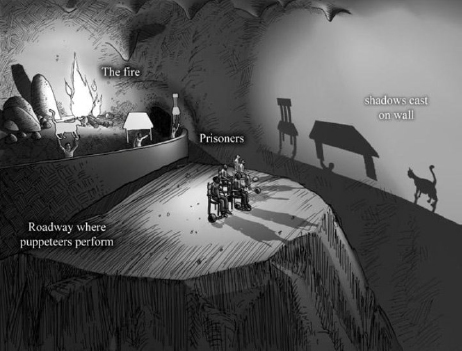
And now,” I said, “let me show in a figure how far our nature is enlightened or unenlightened: —Behold! human beings living in a underground den, which has a mouth open towards the light and reaching all along the den; here they have been from their childhood, and have their legs and necks chained so that they cannot move, and can only see before them, being prevented by the chains from turning round their heads. Above and behind them a fire is blazing at a distance, and between the fire and the prisoners there is a raised way; and you will see, if you look, a low wall built along the way, like the screen that marionette players have in front of them, over which they show the puppets.”
“I see.”
“And do you see,” I said, “men passing along the wall carrying all sorts of vessels, and statues and figures of animals made of wood and stone and various materials, which appear over the wall? Some of them are talking, others silent.”
Credit: http://quitepossiblythelongestinternetaddressofalltime.files.wordpress.com/2011/08/platoscave-copy.jpg
“You have shown me a strange image, and they are strange prisoners.”
“Like ourselves,” I replied; “and they see only their own shadows, or the shadows of one another, which the fire throws on the opposite wall of the cave?”
“True,” he said; “how could they see anything but the shadows if they were never allowed to move their heads?
“And of the objects which are being carried in like manner they would only see the shadows?”
“Yes,” he said.
“And if they were able to converse with one another, would they not suppose that they were naming what was actually before them?”
“Very true.”
“And suppose further that the prison had an echo that came from the other side, would they not be sure to fancy when one of the passers-by spoke that the voice they heard came from the passing shadow?”
“No question,” he replied.
“To them, “ I said, “the truth would be literally nothing but the shadows of the images. That is certain.”
A man’s life of any worth is a continual allegory—and very few eyes can see the mystery of his life. —John Keats
“And now look again, and see what will naturally follow if the prisoners are released and disabused of their error. At first, when any of them is liberated and compelled suddenly to stand up and turn his neck round and walk and look towards the light, he will suffer sharp pains; the glare will distress him, and he will be unable to see the realities of which in his former state he had seen the shadows; and then conceive someone saying to him, that what he saw before was an illusion, but that now, when he is approaching nearer to being and his eye is turned towards more real existence, he has a clearer vision,—what will be his reply? And you may further imagine that his instructor is pointing to the objects as they pass and requiring him to name them,—will he not be perplexed? Will he not fancy that the shadows he formerly saw are truer than the objects which are now shown to him?”
“Far truer.”
“And if he is compelled to look straight at the light, will he not have a pain in his eyes that will make him turn away to take refuge in the objects of vision that he can see, and that he will conceive to be in reality clearer than the things which are now being shown to him?”
“True,” he said.
“And suppose once more, that he is reluctantly dragged up a steep and rugged ascent, and held fast until he is forced into the presence of the sun himself, is he not likely to be pained and irritated? When he approaches the light, his eyes will be dazzled, and he will not be able to see anything at all of what are now called realities.”
“Not all in a moment,” he said.
“He will require to grow accustomed to the sight of the upper world. And first he will see the shadows best, next the reflections of men and other objects in the water, and then the objects themselves; then he will gaze upon the light of the moon and the stars and the spangled heaven; and he will see the sky and the stars by night better than the sun or the light of the sun by day?”
“Certainly.”
“Last of all he will be able to see the sun, and not mere reflections of him in the water, but he will see him in his own proper place, and not in another; and he will contemplate him as he is.”
“Certainly.”
“He will then proceed to argue that this is he who gives the season and the years, and is the guardian of all that is in the visible world, and in a certain way the cause of all things that he and his fellows have been accustomed to behold?”
“Clearly,” he said, “he would first see the sun and then reason about him.”
“And when he remembered his old habitation, and the wisdom of the den and his fellow-prisoners, do you not suppose that he would felicitate himself on the change, and pity them?”
“Certainly, he would.”
“And if they were in the habit of conferring honors among themselves on those who were quickest to observe the passing shadows and to remark which of them went before, and which followed after, and which were together; and who were therefore best able to draw conclusions as to the future, do you think that he would care for such honors and glories, or envy the possessors of them? Would he not say with Homer, ‘Better to be the poor servant of a poor master,’ and to endure anything, rather than think as they do and live after their manner?”
“Yes,” he said, “I think that he would rather suffer anything than entertain these false notions and live in this miserable manner.”
“Imagine once more,” I said, “such an one coming suddenly out of the sun to be replaced in his old situation; would he not be certain to have his eyes full of darkness?”
“To be sure,” he said.
“And if there were a contest, and he had to compete in measuring the shadows with the prisoners who had never moved out of the den, while his sight was still weak, and before his eyes had become steady (and the time which would be needed to acquire this new habit of sight might be very considerable), would he not be ridiculous? Men would say of him that up he went and down he came without his eyes; and that it was better not even to think of ascending; and if any one tried to loose another and lead him up to the light, let them only catch the offender, and they would put him to death.”
“No question,” he said.
“This entire allegory,” I said, “you may now append, dear Glaucon, to the previous argument; the prison-house is the world of sight, the light of the fire is the sun, and you will not misapprehend me if you interpret the journey upwards to be the ascent of the soul into the intellectual world according to my poor belief, which, at your desire, I have expressed—whether rightly or wrongly, God knows. But, whether true or false, my opinion is that in the world of knowledge the idea of good appears last of all, and is seen only with an effort; and, when seen, is also inferred to be the universal author of all things beautiful and right, parent of light and of the lord of light in this visible world, and the immediate source of reason and truth in the intellectual; and that this is the power upon which he who would act rationally either in public or private life must have his eye fixed.”
“I agree,” he said, “as far as I am able to understand you.”
In the allegory, Plato compares people untutored in the theory of forms to prisoners chained in a cave. All they can see is the wall of the cave. Behind them burns a fire. Between the fire and the prisoners there is a short wall, along which puppeteers can walk. The puppeteers, who are behind the prisoners, hold up puppets that cast shadows on the wall of the cave. The prisoners are unable to see these puppets, the real objects, that pass behind them. What the prisoners see and hear are shadows cast by objects that they do not see. Such prisoners would mistake appearance for reality. They would think the things they see on the wall (the shadows) were real; they would know nothing of the real causes of the shadows.
In the Greek understanding, rhetoric—or communication—consists of three elements: ethos (credibility), logos (argument), and pathos (spirit or heart). Take any one of these out, and there was no rhetoric. The form, to Plato, was the sonorous merging of all three. This laudable alliance could only happen, ultimately, in the metaphysical realm.
So when the prisoners talk, what are they talking about? If an object (a book, let us say) is carried past behind them, and it casts a shadow on the wall, and a prisoner says. “I see a book,” what is he talking about?
He thinks he is talking about a book, but he is really talking about a shadow. Yet he uses the word “book.” What does that refer to?
Plato’s point is that the prisoners will be mistaken if they think that the shadow of an object is the right thing. To see the book, he will need to turn his head around.
In a sense, then, in Plato’s mind everything is an allegory. Our language does not give “names” of the physical objects that we can see. They are actually names of things that we cannot see, things that we can only grasp with the consciousness, such as ethos, logos, pathos.
When the prisoners are released, they can turn their heads and see the real objects. Then they realize their error.
Likewise, we may acquire concepts by our perceptual experience of physical objects. But we will be mistaken if we think that the concepts we grasp are on the same level as the things we perceive. In literature, then, an allusion introduces a “form” to the reader that transcends the “words” on the page. That is the richness of this wonderful literary technique!
How can humans live fulfilling, happy lives in a transient, changing world? How can the world appear to be both permanent and changing? The world we perceive through the senses seems to be always changing. The world that we perceive through the spirit, mind, and heart is permanent and immutable. Plato splits up existence into two realms: the material realm and the transcendent realm of forms. To Plato, without a doubt, the reality of the forms is far more important than the material realm.
Clearly the apostle Paul was deeply impacted by Plato and his “Allegory of the Cave.” Witness the following passage from 1 Corinthians 13. What sort of allegories exist in this lyric chapter?
If I speak in the tongues of men or of angels, but do not have love, I am only a resounding gong or a clanging cymbal. If I have the gift of prophecy and can fathom all mysteries and all knowledge, and if I have a faith that can move mountains, but do not have love, I am nothing. If I give all I possess to the poor and give over my body to hardship that I may boast, but do not have love, I gain nothing.
Love is patient, love is kind. It does not envy, it does not boast, it is not proud. It does not dishonor others, it is not self-seeking, it is not easily angered, it keeps no record of wrongs. Love does not delight in evil but rejoices with the truth. It always protects, always trusts, always hopes, always perseveres.
Love never fails. But where there are prophecies, they will cease; where there are tongues, they will be stilled; where there is knowledge, it will pass away. For we know in part and we prophesy in part, but when completeness comes, what is in part disappears. When I was a child, I talked like a child, I thought like a child, I reasoned like a child. When I became a man, I put the ways of childhood behind me. For now we see only a reflection as in a mirror; then we shall see face to face. Now I know in part; then I shall know fully, even as I am fully known.
And now these three remain: faith, hope and love. But the greatest of these is love.
Love, to Paul, is a form that transcends geography and matter. It is beyond human understanding. Love is personified. “Love is patient, love is kind. It does not envy, it does not boast, it is not proud….”
Archetype is the original pattern or model from which all other things of the same kind are made; a perfect example of a type or group (e.g., the biblical character Joseph is often considered an archetype of Jesus Christ).
Archetypal Characters as Heroes
Archetypal Plots: The Love Story Archetype
Scholar Joseph Campbell has argued that most stories begin with an ordinary person minding his own business. Suddenly and unexpectedly, usually by chance, this character is either pulled out of his ordinary life or chooses to leave his ordinary life to launch into a great and dangerous adventure, whose ending he cannot know at the beginning.
The adventure, according to Campbell, then goes through several specified stages. The hero (or heroine) will journey into a challenging world, usually on a noble quest, where he (or she) meets various forces that he needs to confront. Along the way he encounters a teacher or wise person who gives him the instruction in new skills he will need in learning to achieve his goal. The character matures as the journey continues. Striving for his goal, the hero is challenged to his limit, reaching a peak defining experience, which Campbell calls a “supreme ordeal.” The result is that the hero “gains his reward” and is forever changed by the experience. At the same time, the world is changed, history is altered. He often gains some new powers and uses them on behalf of his world.
Archetype Monster Plots
1. Bad Science: Due to science run amok, an malevolent creature, usually a dinosaur, has been disturbed and lashes out at the world: Godzilla.
2. The Misunderstood Monster: The monster is not that bad, only misunderstood: Frankenstein; Shrek.
3. The Invader: A monster journeys from another world to threaten Earth: The War of the Worlds.
4. The Lost: A lost world or a distant planet is discovered and is full of heretofore undiscovered monsters: King Kong.
5. Monster versus Monster: Two monsters fighting each other: Alien vs. Predator.
6. The Mother: Something precious has been stolen from a monster, usually the mother monster, and she is not happy: Beowulf; Jurassic Park; Lost World.
7. Metamorphosis: Normal creatures (and sometimes people) are altered by science for purposes either benign or terrible: Dr. Jekyll and Mr. Hyde.
8. The Lost Homesick Monster: The monster is not all that bad, just homesick: E. T.
Parody is a literary work imitating another in order to make a point.
In form and substance, Alice’s Adventures in Wonderland pokes fun at Victorian English political writings and social morality. The characters are caricatures of real public officials (e.g., the King and Queen of Hearts are King Albert and Queen Victoria). The whole book itself is a parody of a futile Victorian quest toward perfection. Parodies, of course, are very subjective: other Victorian scholars could have and did disagree with Carroll’s vision. In a previous generation, Jonathan Swift did the same thing in his book Gulliver’s Travels. Like Alice’s Adventures in Wonderland, on one level Gulliver’s Travels is a children’s story. On another level, Gulliver’s Travels attacks contemporary politicians. Swift pokes fun at the hypocrisy of English leaders at this time. Eventually, parody utilizes satire. With the desire to ameliorate and to inform, satire uses irony and understatement to ridicule people and institutions.
Anyone who wants to know the human psyche will learn next to nothing from experimental psychology. He would be better advised to abandon exact science, put away his scholar’s gown, bid farewell to his study, and wander with human heart throughout the world. There in the horrors of prisons, lunatic asylums and hospitals, in drab suburban pubs, in the salons of the elegant, the Stock Exchanges, socialist meetings, churches, revivalist gatherings and ecstatic sects, through love and hate, through the experience of passion in every form in his own body, he would reap richer stores of knowledge than text-books a foot thick could give him, and he will know how to doctor the sick with a real knowledge of the human soul. —Carl Jung