
DEALMAKING
for CORPORATE
GROWTH
The 7P Approach to Successful
Business Deal Execution
SIMON P HAIGH
BA (HONS LAW), MBA, FAIM, GAICD
Foreword by New York Times Bestseller
Marshall Goldsmith

Published by NuBooks, an imprint of Oak Tree Press, Ireland.
www.oaktreepress.com / www.SuccessStore.com
© 2016 Simon P Haigh
A catalogue record of this book is available from the British Library.
ISBN 978 1 84621 184 3 (PDF)
ISBN 978 1 84621 185 0 (ePub)
ISBN 978 1 84621 186 7 (Kindle)
All rights reserved. No part of this publication may be reproduced or transmitted in any form or by any means, including photocopying and recording, without written permission of the publisher. Such written permission must also be obtained before any part of this publication is stored in a retrieval system of any nature. Requests for permission should be directed to info@oaktreepress.com.
Cover image: Copyright: shutter999 / 123RF Stock Photo.
CONTENTS
Acknowledgements
Dedication
Foreword
Marshall Goldsmith
Introduction
1Principles
2Planning
3Power
4Players
5Performance
6Putting it all to Bed
7Pay-out or Post-mortem
8Conclusion
Appendices
1Example Deal Summary Sheet
2Example Close Checklist for a Joint Venture
About the Author
Oak Tree Press
NuBooks
ACKNOWLEDGEMENTS
A sincere “Thank You” to my wife, Margaret Geraghty, and colleagues, Jeremy Balius, Celia Jordaan and Matt Nile, for taking the time to review this book – and for being brutally honest in the process.
DEDICATION
To Margaret, Kathryn and Alice.
FOREWORD
In Dealmaking for Corporate Growth, Simon Haigh gives us a rich and thoroughly comprehensible framework for making successful deals in business. It’s a step-by-step guide to successful corporate dealmaking for, as Simon says, “anyone who needs to make a deal.”
What is very interesting to me is that the 7 Ps Simon describes in his book are quite similar to what I teach my executive coaching clients.
For instance, I teach them about the importance of listening, the importance of partnering, and one of my all-time favorites, value. Simon writes that “there is a tendency to think that a dealmaker must ‘win’ and the other side must ‘lose’.” As I talk about in my book What Got You Here Won’t Get You There, one of the most rampantly bad habits among successful people is the need to win, to prove we’re right, to squash the other guy into oblivion. I’ll leave it to you to read more about Simon’s take on creating value and fairness as it pertains to dealmaking. Suffice it to say, we are of like mind on this topic!
Here is one last piece of advice that I have for you before you venture into reading this wonderfully concise and matter-of-fact book. When it comes to dealmaking and influencing the other party(ies) in the deal, remember that every decision is made by the person who has the power to make that decision. This will not necessarily be the “right” person, the “smartest” person, or the “best” person. If you can influence the key decision-makers involved in the deal, you can make a positive difference. If you cannot influence these decision-makers, you will make much less of a difference. Once you make peace with this fact, you will become more effective at every deal you attempt to make.
So, now I hope you’ll read, learn, and practice these wonderful 7 Ps of Dealmaking for Corporate Growth and remember to enjoy the journey!
Life is good.
Marshall Goldsmith – The international best-selling author or editor of 35 books including What Got You Here Won’t Get You There and Triggers.
INTRODUCTION
The Cambridge Business English Dictionary defines dealmaking as:
The activity of making business agreements or arrangements.
2015 was a record year for global corporate deals, with nearly US$5 trillion worth of corporate deals transacted, surpassing the previous record in 2007. Record low interest rates in Western economies helped to fuel a large part of this deal activity amongst all levels of companies as they took advantage of “cheap money” to buy, or merge with, competitors as a way to spur growth.
In July 2016, the shareholders of Dow Chemical and DuPont approved a US$130 billion merger that would combine two of the oldest, largest and most successful US chemical manufacturers and was described as the “deal of three centuries.” Other major corporate deals during 2015 included:
Deals are pivotal to corporate growth and are being struck all the time. While different cultures and nationalities use different methods, processes and communication styles in dealmaking, from the beginning of time humans have been striking deals to facilitate family, trade, community and national best interests. Although cultural differences make the deal landscape even more interesting and sometimes challenging, the key elements that facilitate a deal – selling, persuading, negotiating and signing a contract – are the same the world over. Companies around the world will continue to grow, refocus, merge – and, sometimes, retrench – through making deals. As a result, given the increasing interconnectivity – technological and otherwise – of the world’s businesses, the risks of not having a good dealmaker at the helm will increase. The need for business leaders and decision-makers to be able to effectively identify a deal’s strategic, financial and operational value and then to execute and manage it efficiently will only accelerate in this ever-competitive world.
But dealmaking is not limited to CEOs. To varying degrees and at different times, we all strike deals in business. Every person or organization engages in dealmaking at some point. From as far back as our childhood, we possessed the innate ability to get what we want through selling and negotiating and other means – remember when you used to stamp your feet to make sure you got your own way! We are born with an instinct for dealmaking. Some people retain that dealmaking instinct and develop it as they age, while others lose it for many reasons such as social conditioning or lack of practice. And so, many of us are poorer at dealmaking and thus miss out on better outcomes.
Don’t you dare underestimate the power of your own instinct.
Businesswoman and author, Barbara Corcoran
Everyone has the potential to be a good dealmaker and it is clear that every person, organization or nation state, needs to make deals at some point, and usually quite regularly. So, it is important to be open to a potential deal and recognize that, if you rely on your instinct, as supplemented by your experience and the skills offered by this book, you give yourself the best chance of success. Also, even if you are already an accomplished dealmaker, it is easy to slip into bad habits, so constantly calibrating where you stand in your dealmaking skills is beneficial.
Dealmaking is not about being brilliant. It does take a certain intelligence, but mostly it’s about instinct.
Businessman and US Presidential candidate, Donald Trump
Dealmaking is an active and deeply practical skill. It requires flexible and adaptable listening, reading, absorbing and summarizing skills. Given that selling and negotiating are innate human abilities, the premise of this book is that these, and other related, dealmaking skills can be significantly enhanced by following some proven steps. This book explains the dealmaking process in a logical, step-by step way, and will help the reader to successfully execute business deals.
The 7 Ps of successful business deal execution are:
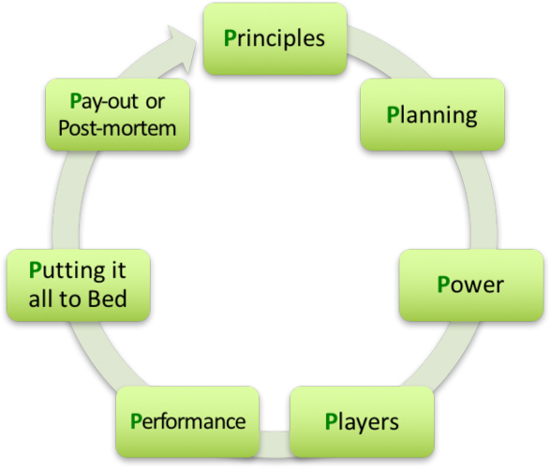
As we explore these 7 Ps, I have included some practical lessons I have learned, and examples from global business leaders I have worked with, over my quarter of a century spent making deals.
Good luck with your own deals!
Simon Haigh
Perth, Western Australia
August 2016