Copyright © 2017 by John Wiley & Sons, Inc. All rights reserved.
Published by Jossey-Bass
A Wiley Brand
One Montgomery Street, Suite 1000, San Francisco, CA 94104-4594—www.josseybass.com
No part of this publication may be reproduced, stored in a retrieval system, or transmitted in any form or by any means, electronic, mechanical, photocopying, recording, scanning, or otherwise, except as permitted under Section 107 or 108 of the 1976 United States Copyright Act, without either the prior written permission of the publisher, or authorization through payment of the appropriate per-copy fee to the Copyright Clearance Center, Inc., 222 Rosewood Drive, Danvers, MA 01923, 978-750-8400, fax 978-646-8600, or on the Web at www.copyright.com. Requests to the publisher for permission should be addressed to the Permissions Department, John Wiley & Sons, Inc., 111 River Street, Hoboken, NJ 07030, 201-748-6011, fax 201-748-6008, or online at www.wiley.com/go/permissions.
Permission is given for individual classroom teachers to reproduce the pages and illustrations for classroom use. Reproduction of these materials for an entire school system is strictly forbidden.
Limit of Liability/Disclaimer of Warranty: While the publisher and author have used their best efforts in preparing this book, they make no representations or warranties with respect to the accuracy or completeness of the contents of this book and specifically disclaim any implied warranties of merchantability or fitness for a particular purpose. No warranty may be created or extended by sales representatives or written sales materials. The advice and strategies contained herein may not be suitable for your situation. You should consult with a professional where appropriate. Neither the publisher nor author shall be liable for any loss of profit or any other commercial damages, including but not limited to special, incidental, consequential, or other damages. Readers should be aware that Internet Web sites offered as citations and/or sources for further information may have changed or disappeared between the time this was written and when it is read.
Jossey-Bass books and products are available through most bookstores. To contact Jossey-Bass directly call our Customer Care Department within the U.S. at 800-956-7739, outside the U.S. at 317-572-3986, or fax 317-572-4002.
Wiley publishes in a variety of print and electronic formats and by print-on-demand. Some material included with standard print versions of this book may not be included in e-books or in print-on-demand. If this book refers to media such as a CD or DVD that is not included in the version you purchased, you may download this material at http://booksupport.wiley.com. For more information about Wiley products, visit www.wiley.com.
Library of Congress Cataloging-in-Publication Data
Names: Clapp, Edward P., author. | Ross, Jessica, 1966- author. | Ryan, Jennifer Oxman, 1974- author. | Tishman, Shari, author.
Title: Maker-centered learning : empowering young people to shape their worlds / Edward P. Clapp, Jessica Ross, Jennifer Oxman Ryan, Shari Tishman.
Description: San Francisco, CA : Jossey-Bass ; Hoboken, NJ : John Wiley & Sons, 2016. | Includes bibliographical references and index.
Identifiers: LCCN 2016031587| ISBN 9781119259701 (pbk.) | ISBN 9781119263661 (epub)
Subjects: LCSH: Maker movement in education. | Active learning. | Student-centered learning.
Classification: LCC LB1029.M35 C53 2016 | DDC 371.39—dc23
LC record available at https://lccn.loc.gov/2016031587
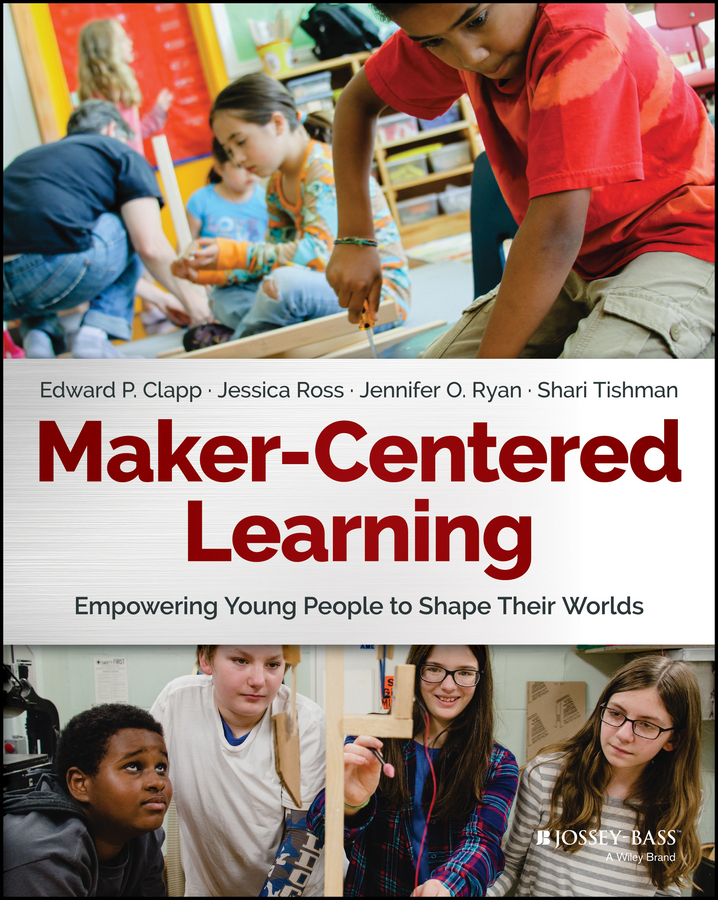
Cover images: Top image, photo by Jeanine Harmon
Bottom image, photo by Melissa Rivard
Cover design: Wiley
FIRST EDITION
Foreword by Ron Berger
Afterword by Wendy Donner

This book is the result of a three-year research project called Agency by Design that was funded by the Abundance Foundation and conducted at Project Zero, a research center at the Harvard Graduate School of Education. The project has put us in touch with more talented and interesting people than we ever could have imagined, and this book would not have been possible without the generous contributions of scores of collaborators every step of the way.
To begin at the beginning, we would like to thank Stephen Kahn of the Abundance Foundation for his ongoing support, his enthusiasm, and his ever present creative spirit. Without him this work would truly not have taken the shape it did. We also want to thank Liz Kahn, whose early vision illuminated the way, and Wendy Donner, for her early and ongoing leadership of the Agency by Design project in the San Francisco Bay Area. We are also especially grateful to Emi Kane, Benita Kline, Hal Leventhal, and the Abundance Foundation Board of Directors, without whose support this project would not have been possible.
We are most grateful for the time, energy, and openness to new experiences expressed by the many members of the Temescal and Oakland Learning Communities, in particular Maite Barloga, Kurt Kaaekuahiwi, Reggie Richardson, and Ronnie Richardson at Claremont Middle School; Carla Aiello, Michelle Beal, Jennifer Dunn, Danielle Erwin, Kathy Hatzke, and Marian Woodside at Emerson Elementary School; Tatum Omari at North Oakland Community Charter School; Thi Bui, Raquel Franker, Carmelita Reyes, and Brooke Toczylowski at Oakland International High School; Tara Austin, Richard Fairly, Natalia Cooper, and Casey Fern at Oakland Technical High School; Beatriz Calderon-Rivera, Harriet Cohen, Jenny Ernst, Jeanine Harmon, Alex Kane, Tom Little, Ilya Pratt, Renee Miller, and Meena Srinivasan at Park Day School; and Ryan Lewis at 826 Valencia. We additionally owe our gratitude to the many maker educators who helped us pilot test early drafts of our thinking routines through their membership in the Agency by Design Learning Community. In particular, we would like to thank Mariah Landers at the Alameda County Office of Education in Hayward, CA; Bruce Hamren at the Athenian School in Danville, CA; Andrea Sachdeva at the Boston ArtScience Prize in Boston, MA; Jeremy Boyle and Melissa Butler at the Children’s Innovation Project in Pittsburgh, PA; Rebecca Grabman at the Children’s Museum of Pittsburgh, PA; Kurt Kaaekuahiwi at Claremont Middle School in Oakland, CA; David Clifford, Corinna Hui, and Kyle Metzner at the East Bay School for Boys in Berkeley, CA; Karen Wilkinson at the Exploratorium in San Francisco, CA; Peter McKenna and Duncan Wilson at the Fox Meadow School in Scarsdale, NY; Darlease Monteiro at the Global Learning Charter Public School in New Bedford, MA; Steve Teeri at the HYPE Teen Center in Detroit, MI; Gus Goodwin at King Middle School in Portland, ME; Aaron Vanderwerff at the Lighthouse Community Charter School in Oakland, CA; Steve Davee at the Maker Education Initiative in Oakland, CA; Andy Forest at MakerKids in Toronto, ON; Jaymes Dec at the Marymount School of New York in New York City, NY; Amos Blanton at the Massachusetts Institute of Technology in Cambridge, MA; Alison Rinner Fullerton at MsBiz in Nashville, TN; Tatum Omari at North Oakland Community Charter School in Oakland, CA; Brooke Toczylowski at Oakland International High School in Oakland, CA; Mariano Ulibarri at the Parachute Factory in Las Vegas, NM; Jeanine Harmon, Jenny Ernst, Alex Kane, Renee Miller, and Ilya Pratt at the Park Day School in Oakland, CA; William MacFarlane and Bryce Taylor at Parts and Crafts in Somerville, MA; Lisa Yokana at the Scarsdale High School in Scarsdale, NY; and Tobey Balzer, Vince Durnan, and Jeff Greenfield at the University School of Nashville in Nashville, TN. In addition to the thoughtful educators we worked with, we also extend our warmest gratitude to all of the educators and thought leaders who have generously shared their time, knowledge, and experience throughout the interview strand of this inquiry: Jeremy Boyle, Melissa Butler, David Clifford, Steve Davee, Jaymes Dec, Youssou Fall, Andy Forest, Gus Goodwin, Bruce Hamren, Peter McKenna, Pamela R. Moran, Jeff Sturges, Steve Teeri, Gever Tulley, Mariano Ulibarri, Karen Wilkinson, Duncan Wilson, and Susie Wise.
We would further like to express our appreciation to the people and places that invited us into their making, design, and learning environments and engaged us in informal conversations about the work they do, especially Molly Rubenstein at Artisan’s Asylum in Somerville, MA; Andrea Sachdeva at the Boston ArtScience Prize in Boston, MA; Ellen Hathaway, Justine Macauley, and Gever Tulley at the Brightworks School in San Francisco, CA; Jessica Hobbs and Catie Magee at the Flux Foundation in Oakland, CA; Michelle Hublinka and Parker Thomas at the Maker Education Initiative in San Francisco, CA; and Kim Saxe at the Nueva School in Hillsborough, CA. We would also like to thank the wonderful people we met at American Steel Studios in Oakland, CA; Breakwater School in Portland, ME; the Crucible in Oakland, CA; King Middle School in Portland, ME; NIMBY in Oakland, CA; and Tech Shop in San Francisco, CA. Thanks as well to Brad Gentile at Propel McKeesport, Pittsburgh, PA, for sharing his documentation of student work with us.
Many individuals have played a variety of important behind-the-scenes roles to bring our research on this project—and this book—to fruition. Among them are the host of talented graduate students we have had the privilege to work with as research assistants. We would like to especially thank Cami Gordon, Amy Hachigian, Raquel Jimenez, Sarah May, and Chandell Stone for their exceptional contributions to the ideas expressed in this book. We also thank Peter “Bridge” Bridgford and Gabrielle Santa Donato for pilot testing our nascent interview questions with us and Oskar Kelly, Samuel Rallis, and Max Ryan for serving as our youth tool testers whenever we needed to experiment with an emergent activity or thinking routine. We would like to also thank our colleagues Ron Berger for his inspiration and endorsement, Alex Coppola for his videographic wizardry, Melissa Rivard for helping us make the work of our project visible, Matthew Riecken for graphically organizing our ideas, Andrea Tishman for designing our iconic logo, Christina Smiraglia and Liz Dawes Duraisingh for supporting us with their methodological expertise, Carla Lillvik for serving as a research librarian guide, the CASIE team for helping us share our work with educators around the world through the Project Zero Perspectives conference series, and David Stephen for working so closely with our teacher partners in considering how to incorporate making and design into their learning environments. Of course, it goes without saying that our work on this project would not have been possible without the camaraderie and intellectual administrative support of our many colleagues at Project Zero. In particular, we would like to thank Faith Harvey, Jordy Oakland, and Dami Seung.
Though not directly involved in the inner workings of the Agency by Design research initiative, we additionally offer our thanks to the many friends of our project, including Karen Brennan at the Harvard Graduate School of Education; Kylie Peppler at Indiana University Bloomington; Tiffany Tseng at the Massachusetts Institute of Technology; Stephanie Chang, Lisa Regalla, and Dale Dougherty at the Maker Education Initiative; the Open Bench Project in Portland, ME; the Open Portfolio Project; Natasha Bhalla and Jim Reese at the Washington International School; the #makered Twitter community; and all of the passionate teachers who have attended our conference presentations and professional development workshop sessions across the United States and around the world.
As we look to the future, we would like to especially thank Wendy Donner, Ilya Pratt, Brooke Toczylowski, and Aaron Vanderwerff for carrying the Agency by Design torch forward and Jeff Evancho and Megan Cicconi for sparking enthusiasm for this work in new audiences.
We would like to additionally express our gratitude to our editor Kate Bradford and to all of her staff at Jossey-Bass, especially Lily Miller, Pete Gaughan, Connor O’Brien, and Haritha Dharmarajan. Last but not least, we would like to thank our families for all of the love, support, and patience they have offered throughout the process of writing this book. We are especially grateful to our spouses Angela Mittiga, Bryan Polashenski, Jake Ryan, and Bob Sowa.
I live in a rural town where most of the roads are dirt, where there are no traffic lights or stores, where the firefighters are volunteer citizens. Other than homes, the town has few buildings: a town hall, a post office, a church, a bar, and a school. For 25 years I was one of the few teachers in our small public school; almost everyone in my town under the age of 50 is a former student of mine. Students from this school have done remarkably well, by almost any measure: test scores, college, careers, and adult lives.
Here is an important thing: students in the school spent much of their time making things. Students worked hard at literacy and math skills, knowledge of the world, just like at any school. But they did not focus that learning toward preparing for tests; instead, they used that learning to make great things. Mothers and fathers in this town, many of whom worked hard all day with their hands, took tremendous pride that their children were not just getting smart but also were developing a strong work ethic, problem-solving skills, and high standards for quality.
With almost no town employees beyond a two-person road crew, the students stepped in to help. They created demographic maps of housing and roads; they created field guides to local species; they created books to honor the lives of local veterans, workers, and citizens; they created scientific reports of home radon levels, water quality in home wells, water quality in streams; they built recycling sheds and playground structures; they created road signs and public art. They were building the same academic skills as students in other schools, but with much deeper purpose and passion.
Today, that passion in making great things suffuses the national school network where I now work—EL Education—which comprises over 150 public schools across 30 states, some of which are featured in this book. Most of these schools are situated in low-income urban settings, and the results of this approach to learning are profound. Many of these schools, sited in cities where high school graduation rates are alarmingly low, are getting almost every student to graduation on time and getting every single graduate into college every year. Other school networks that share this approach, such as the High Tech High Schools in California, are getting these same results. This success is something we as a nation need to understand.
This book, Maker-Centered Learning, takes on the fundamental question of how making things connects to the learning process and to student empowerment. With depth, integrity, and insight that are hallmarks of Project Zero, this analysis of making and learning explodes the shallow binary debate about whether the new maker movement is a groundbreaking answer to transforming schools, or simply a distraction. It instead dives deeply into the questions no one is asking: What constitutes “making”? How does the process of making instantiate learning? What are the characteristics of successful making experiences? In what conditions is making a transformational learning experience for students?
This book is not an advertisement or an indictment of the maker movement but rather a balanced look at what the movement represents and where it lives in the educational landscape. The current movement, as this book points out, was primarily a white, male initiative centered on new technology that is now filtering into schools—disproportionately schools that serve economically privileged students. But the power of making things, within school and outside of it, is not in any way limited to this sector, and the underlying potential of a maker-centered pedagogy can cut across gender, class, age, and setting. Understanding the conditions in which making is transformative for children can improve learning during school and after school and can make makerspaces effective centers of learning.
Maker-Centered Learning should be required reading for any school or district that is considering building a makerspace. As an educator who has spent a lifetime focused on student craftsmanship, I am sad to say that I am as often depressed as inspired when I am brought into a contemporary school makerspace. It is not that a well-designed makerspace does not have potential. I have seen students creating originally designed, stress-tested, low-cost wheelchair components to be sent to a developing country. I was humbled. But much of the time when I enter a school makerspace I see students using 3-D printers to create sloppy plastic versions of their names, without purpose or craftsmanship. Those schools need this book.
But it is not that schools and districts need to read this book just to improve their new makerspace. Educators need to read this book to consider how we can elevate and support the power of maker-centered learning throughout the school day, in every classroom, and outside of school as well. To understand the conditions of learning in which students from all backgrounds can be engaged and supported to make great things and transform their learning and their lives.
Ron Berger, Chief Academic Officer, EL Education