
How The ZEBRA Got Its Stripes
LÉO GRASSET is the French punk scientist par excellence, founder of the website Dirty Biology and author of the blog ‘Dans les testicules de Darwin’ devoted to biology, testosterone and rock’n’roll (danslestesticulesdedarwin.blogspot.co.uk). He is also one of France’s leading up-and-coming evolutionary biologists: see him in action on YouTube giving a paper at the École normale supérieure conference in Lyon in April 2015 on ‘Les hommes hybrides – des chimphumains à Denisova’.
How The ZEBRA Got Its Stripes
And Other Darwinian Just So Stories

First published in Great Britain in 2016 by
PROFILE BOOKS LTD
3 Holford Yard
Bevin Way
London WC1X 9HD
www.profilebooks.com
First published in France in 2015
entitled Le coup de la girafe: Des savants dans la savane by Éditions du Seuil
25 Boulevard Romain Rolland
75014 Paris
France
© Éditions du Seuil 2015
© English translation Barbara Mellor 2016
The moral right of the author has been asserted.
All rights reserved. Without limiting the rights under copyright reserved above, no part of this publication may be reproduced, stored or introduced into a retrieval system, or transmitted, in any form or by any means (electronic, mechanical, photocopying, recording or otherwise), without the prior written permission of both the copyright owner and the publisher of this book.
A CIP catalogue record for this book is available from the British Library.
eISBN 978 1 78283 243 0
Contents
PART I Evolution in its Guises
1 The Female Hyena’s Penis
2 The Giraffe’s Long Neck
3 The Random Flight of the Gazelle
4 How the Zebra Got its Stripes
PART II The Mysteries of Animal Behaviour
5 The Air-Conditioning of the Termite Mound
6 The Impala’s Mexican Waves
7 Elephant Dictatorship vs Buffalo Democracy
8 The Antelope Art of Sexual Manipulation
PART III Extraordinary Creatures
9 Dung Beetle Navigation
10 Seismic Signalling in the Elephants’ Sound-World
11 Honey Badger – Weapon of Mass Destruction
12 The Truth about the Lion King
PART IV The Human Factor
13 How to Turn a Lion into a Cub-Killer
14 Catastrophic Change
15 Human Evolution and its Impact
Epilogue: The Zebras and Me
Further investigations
Colour images
Acknowledgements
Index
PART I
Evolution in its Guises
‘Nothing in biology makes sense except in the light of evolution,’ wrote the eminent geneticist Theodosius Dobzhansky. But sometimes, when the questions being explored are at the cutting edge of scientific research, the light of evolution casts shadows that are hard to decipher!
Chapter 1
The Female Hyena’s Penis
WHY DO COWS HAVE HORNS? Why is it that most small antelope females do not have them? Why do men have nipples? Why does a female hyena have a clitoris that is, to the naked eye, indistinguishable from a male hyena’s penis?
More generally, the question is this: why do some morphological characteristics that appear to have a function exclusive to one sex also exist in the other? Nipples are a good example: in women they serve to suckle infants, grouping the milk ducts together and providing an interface between the baby’s mouth and the mother’s mammary glands. But in men their function isn’t clear: what is the point of a pair of nipples if they’re not for feeding a baby? Perhaps we should simply say, ‘Why not? Does everything have to have a function?’
Of the laws that govern the evolution of living beings, selection is the most powerful. This, as we’ll see, is especially evident on the great African savannah. If one individual possesses a slight advantage over another, it will produce more young. If these offspring inherit and pass on the same advantage, the descendants of the advantaged individual will eventually dominate the species’ gene pool, while those of its erstwhile rival will be consigned to evolutionary oblivion. This, of course, is a simplification: in the real world things are never that straightforward. But to illustrate the theory, let’s turn back to the evolution of the nipple.
Suppose that, in the beginning, all men have flat pectorals. Then, one day, a man appears sporting a pair of nipples which emit an intoxicating pheromone. This scent has such a seductive effect on the women he encounters that he fathers 50 per cent more children than his nippleless rivals. If his aphrodisiac nipples are heritable, the children of this fortunate mutant will also be able to sire 50 per cent more offspring, who in turn will go on to produce 50 per cent more great-grandchildren for the mutant and so on down the generations. After five centuries, or twenty generations of twenty-five years, the ‘nipples and pheromones’ human will have some 3,325 times (1.520) more descendants than the flat-pectorals type: a colossal difference. As long as it can be inherited, even the slightest advantage in the number of offspring will have major repercussions down the generations. Minor effects become cumulative, and in this case, would eventually result in a human population in which all males were equipped with nipples.
In this view of the world, if an organ exists it must have a function. If it appears to be redundant, it is only because we have not yet discovered what that function is. Biologists with this turn of mind might propose that women prefer men who have nipples to men who do not. Or they might suggest a social function: in mothers we know that as a baby suckles it releases a surge of the hormone oxytocin, which promotes feelings of wellbeing and social cohesion and is thought to strengthen the bonding process between mother and baby. In other words, more suckling equals more love for infants, who therefore have better survival rates, which means more babies. These explanations and others like them derive from the belief that everything exists for a reason.
But another school of thought proposes that there are possible evolutionary scenarios in which the male nipple has no practical function at all. All human embryos start out as female: the female sex is the basic form from which the male sex will differentiate itself. The first male hormones do not appear until the eighth week of pregnancy. In other words, the male embryo has to make its male organs using the material available to it, which already tends to the feminine. As the nipples are present from the sixth week, the male embryo is stuck with them. At this point you can reverse the logic: every exclusively male characteristic is an additional attribute, hard won by means of major surges of testosterone and bursts of androgens – the classic male hormones. If a female attribute lingers on, and doesn’t get in the way or put the male at a disadvantage, it will stay put.
Stringent selection could circumvent this constraint, of course, and drastically favour the male without nipples over his rival who has them but, as this is clearly not the case, we have no reason to lose them.
Understanding the factors resulting in a characteristic that appears extraneous is a challenge for biologists. Here are two more examples, both from the savannah: the penis-shaped clitoris of the female hyena, and the horns of the female buffalo.
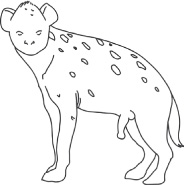
Viewed with the naked eye, the female hyena’s clitoris is indistinguishable from the male’s penis.
No, you did not misread that: the female spotted hyena (Crocuta crocuta, photograph 2) has a clitoris shaped like a penis. It is known in scientific jargon as a pseudo-penis. An imitation, basically, but a seriously good one. In fact, the female hyena imitates the male genitalia in their entirety: she also has a faux scrotum and faux keratin spines (a very widespread characteristic in mammals) on her faux penis, and not only can she get an erection with her clitoris but she also urinates through it. She has no separate vaginal entrance: her entire external genitalia take the form of a male penis. With the naked eye, it is hard to tell the difference between the male hyena and the female.
When it comes to giving birth, this organ causes the female serious difficulty, because her offspring enter the world via this narrow pseudo-penis. As a result, 15 per cent of mothers die during their first labour, and no fewer than 60 per cent of hyena cubs die at birth. From the evolutionary point of view, therefore, there has to be a pretty persuasive upside to justify the presence of this organ. One advantage is that it is difficult for the males to mate with the females by force; even when she is willing. It will take several attempts before the couple manages to find the right position, because he has to insert his penis into her pseudo-penis. For hyenas, successful mating is a whole art in itself, demanding a degree of expertise from the male and so allowing the female all the time she needs to choose her preferred partner.
For a long time it was thought that the female hyena’s pseudo-penis was a consequence of the social hierarchy among hyenas: the females are dominant over the males (they are bigger, which helps), and the more aggressive females dominate the sisterhood. Their aggression is controlled by male hormones, and it used to be thought that the struggle for dominance released a higher level of androgens in the females, leading to the ‘accidental’ appearance of male organs.
This tortuous explanation – in a nutshell, ‘aggressiveness equals androgens equals male organs’ – no longer holds water, as we now know that androgens play no part whatever in the appearance of the pseudo-penis. There must be another explanation.
The female genitalia are faithful copies of the male ones, and some theorise that the organ’s mimicry is too perfect to be simply a hormonal accident. Instead, they believe that the sexes’ resemblance is the result of natural selection, possibly to cut down on rivalry among females. As yet, there is no consensus over the reason for this bizarre mimicry; our only certainty is that there must have been a very strong process of selection underlying it.
Continuing this exploration of bizarre sexual attributes, consider the behaviour of male impalas (Aepyceros melampus) in the rutting season. These antelopes of the bovid family use their horns in aggressive displays, clashing them together violently as they fight for dominance over a harem of as many as a hundred females (photograph 15). The females of this species do not have horns, the sole purpose of which is generally agreed to be for competition among males. Strikingly, the horns point backwards, showing that the goal of these confrontations is not to kill or wound the opposing male, but simply to give him a hefty shove. The function of the horns is thus the same as in numerous other members of the deer family: to provide the males with appendages used primarily for thumping each other and for demonstrating to the females which of them is the most deserving of their attentions. In some deer species horns and antlers can attain dimensions that defy belief. In an example of evolution being pushed to the limits, the extinct Irish elk (Megaloceros giganteus) boasted antlers with a span of up to 3.6 metres and weighing as much as forty kilos.
But there are other bovine species in which the females do have horns, such as the African buffalo (Syncerus caffer, photograph 5) and the domestic cow. As is often the case, ingenious biologists have come up with several different hypotheses to explain why. One might suspect a ‘genetic correlation’ between males and females, meaning that males and females are built to the same blueprint (at the start of life, at least), and that this similarity is maintained subsequently. But although such an explanation might hold good for male nipples, it is not the reason that some female ungulates have horns and others do not.
Instead, there is another explanation, for once a fairly simple one. It is that females need horns as a defence when they are unable to hide from predators. Impala coloration serves as camouflage in the tall grass, for instance, whereas buffalo are very large, very dark and very visible. When she is hunted, the female buffalo cannot hide, and her only option is to fight for her life. Unlike those of the impala, the buffalo’s horns are necessarily lethal weapons. Not for nothing is the animal known in Africa as the ‘widow-maker’ or the ‘black death’: they are responsible for over 200 human fatalities a year across the continent. The moral of this story is that if you are too big to hide, you have to be able to defend yourself.
To summarise: men’s nipples seem to have no function; their presence is generally explained as the result of a foetal developmental constraint that is too strong and an evolutionary selection process that is too weak to eliminate them. In the case of the hyena, it seems there must be a very strong selection process for the sexual characteristics of the female to mimic those of the male and that this could be associated with a reduction of conflict within the social group. In large bovines the females have horns, although among other ungulates this characteristic is typically male. The presence of horns in the females has been strongly selected as a defence against predators. In short, apparently ‘natural’ characteristics, such as male nipples, do not necessarily have a function whereas others that at first glance seem to serve no purpose are in fact the fruit of an important process of selection and very definitely do have a function.
Evolution is a complicated phenomenon: it makes organs and appendages disappear, creates new ones and repurposes existing ones for different functions. In the face of these constant changes, it is sometimes difficult for biologists to understand the functions of the shapes and appearances of the creatures they study: they are all too ready to put forward multiple hypotheses, some of which are contradictory. Perhaps researchers are looking for simple explanations, whereas the exuberant creativity of evolution requires something far more complex.
Chapter 2
The Giraffe’s Long Neck
THE CHALLENGE OF EVOLUTIONARY BIOLOGY is to explain the origin and function of adaptations. Sometimes things can prove to be more complicated than they appear at first sight. One example is the giraffe, or rather its improbably long neck. It appears obvious: the giraffe’s neck, which can grow to as much as two metres in length, has been selected because it gives its owner exclusive access to the topmost leaves of the trees, and no other animal can reach them. This, then, is an adaptation designed to avoid competition for food with other animals. For many years this was the accepted version – after all, Charles Darwin, no less, touched on the question in The Origin of Species. Darwin explained that the species had obtained its very long neck by small, successive stages, each individual with a slightly longer neck being able to survive on average a little better than their shorter-necked relatives:
The giraffe, by its lofty stature, much elongated neck, fore legs, head and tongue, has its whole frame beautifully adapted for browsing on the higher branches of trees. It can thus obtain food beyond the reach of the other ungulata or hoofed animals inhabiting the same country; and this must be a great advantage to it during dearths …. So under nature with the nascent giraffe, the individuals which were the highest browsers and were able during dearths to reach even an inch or two above the others, will often have been preserved.
Subsequently, the giraffe’s neck became a textbook case, featuring as an example of natural selection in numerous books and popular articles. In the mid-1990s, however, some biologists raised a major objection to this argument: observations suggested that giraffes did not use their long necks much at all to browse at heights. In fact, at times when competition for food was fiercest, the females could spend up to half their time with their necks held horizontally rather than exploiting their height advantage. These biologists put forward a different scenario, one which revolutionised the classic view of the evolutionary history of the giraffe.
The purpose of a giraffe’s neck, they argued, is primarily as a weapon to be wielded in fights between males, just as a male antelope uses its horns or a stag its antlers. Male giraffes indulge in bouts of ‘neck fighting’ to gain access to the females, swinging their necks at each other violently and using their heavy heads as coshes. The male’s skull is extremely thick, and when used as a weapon is capable of breaking vertebrae: the Republic of Niger has only a tiny giraffe population, but in 2009 it recorded two deaths following bouts of neck fighting. In this context, it is clearly an advantage for a male giraffe to have a thicker neck than its rival, and a longer neck provides greater flexibility and torque, thereby making it a more effective weapon. The males that reproduce most successfully also have the longest necks, and so the evolution of the giraffe’s neck turns, quite literally, into a tall story.
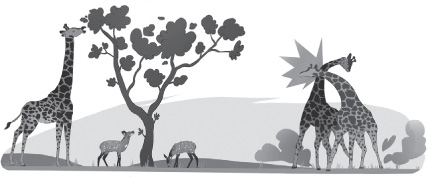
The giraffe’s neck serves a number of functions: which of these functions shaped its evolution is the subject of much debate among biologists.
If this is the case, however, why are female giraffes’ necks also long? The only explanation so far offered is that it might be a case of ‘genetic correlation between the sexes’ – the hypothesis that is so often dragged out when no other explanation seems to fit. Although persuasive, this idea does not explain things very well. If sexual selection is the cause, males should have noticeably longer necks than females, but a study in 2013 found that males’ necks were only slightly longer than the females’, a difference too small to be explained by sexual selection alone.
To confuse matters further, a study undertaken in 2007 had concluded that giraffes do indeed use their necks to graze the topmost branches. The researchers fenced off some trees with wire netting so that smaller herbivores could not reach the lower branches, but giraffes could still graze by reaching over the top of the netting. When the fenced-off trees were compared with unfenced trees, the researchers found that the giraffes did, in fact, browse the higher branches when other species were competing for the lower leaves. So perhaps Darwin was right after all: giraffes use their long necks in order to avoid competition. Fossil evidence supplies further backing for his hypothesis: it appears that giraffes developed their long necks between fourteen and twelve million years ago, a period during which Africa underwent a general aridification and its forests gave way to savannah. As the number of trees diminished, competition for each tree must have increased, so favouring the selection of a long neck.