
Additional clarification can be obtained from the Oliver Wight International website (www.oliverwight.com), where a glossary and the definitions to support Performance Measurements can be found.

Class A Business Excellence
For
 Managing the Strategic Planning Process
Managing and Leading People
Driving Business Improvement
Integrated Business Planning
Managing the Products and Services Portfolio
Managing Market Demand
Managing the Supply Chain
Managing Internal Supply
Managing External Sourcing
Seventh Edition

Cover design: Wiley
Copyright © 2017 by Oliver Wight International, Inc. All rights reserved.
Published by John Wiley & Sons, Inc., Hoboken, New Jersey.
Published simultaneously in Canada.
No part of this publication may be reproduced, stored in a retrieval system, or transmitted in any form or by any means, electronic, mechanical, photocopying, recording, scanning, or otherwise, except as permitted under Section 107 or 108 of the 1976 United States Copyright Act, without either the prior written permission of the Publisher, or authorization through payment of the appropriate per-copy fee to the Copyright Clearance Center, 222 Rosewood Drive, Danvers, MA 01923, (978) 750–8400, fax (978) 646–8600, or on the web at www.copyright.com. Requests to the Publisher for permission should be addressed to the Permissions Department, John Wiley & Sons, Inc., 111 River Street, Hoboken, NJ 07030, (201) 748–6011, fax (201) 748–6008, or online at www.wiley.com/go/permissions.
Limit of Liability/Disclaimer of Warranty: While the publisher and author have used their best efforts in preparing this book, they make no representations or warranties with respect to the accuracy or completeness of the contents of this book and specifically disclaim any implied warranties of merchantability or fitness for a particular purpose. No warranty may be created or extended by sales representatives or written sales materials. The advice and strategies contained herein may not be suitable for your situation. You should consult with a professional where appropriate. Neither the publisher nor the authors shall be liable for damages arising herefrom.
For general information about our other products and services, please contact our Customer Care Department within the United States at (800) 762–2974, outside the United States at (317) 572–3993, or fax (317) 572–4002.
Wiley publishes in a variety of print and electronic formats and by print-on-demand. Some material included with standard print versions of this book may not be included in e-books or in print-on-demand. If this book refers to media such as a CD or DVD that is not included in the version you purchased, you may download this material at http://booksupport.wiley.com. For more information about Wiley products, visit www.wiley.com.
Library of Congress Cataloging-in-Publication Data:
Names: Wight, Oliver W. | Oliver Wight International, inc., author.
Title: The Oliver Wight Class A standard for business excellence / Oliver Wight International, Inc.
Description: Seventh edition. | Hoboken, New Jersey : John Wiley & Sons, Inc., [2017].
Identifiers: LCCN 2017007061 (print) | LCCN 2017015847 (ebook) | ISBN 9781119404477 (pbk.) | ISBN 9781119404484 (epdf) | ISBN 9781119404491 (epub)
Subjects: LCSH: Industrial productivity—Measurement. | Strategic planning. | Total quality management. | Manufacturing resource planning. | Production control.
Classification: LCC HD56.25 (ebook) | LCC HD56.25 .O38 2017 (print) | DDC 658.4/013—dc23 LC record available at https://lccn.loc.gov/2017007061
Welcome to the seventh edition of The Oliver Wight Class A Standard for Business Excellence.
The seventh edition continues our focus on Business Excellence. It describes the distinguishing characteristics of the high-performing companies, how these attributes were achieved and, important, how they are sustained. The answers were gathered from the accumulated experiences of the Oliver Wight global group and their relationships with thousands of successful businesses. The outcome is a new standard for evaluating business excellence at your company.
For those executives challenged to raise their companies' level of performance, doing so starts with a commitment to a long-term journey, strategically focused and supported with a series of improvement programs. Each program has a milestone marking its achievement. Collectively, they lead to The Oliver Wight Class A Standard for Business Excellence.
In the l970s, Ollie created the first checklist. The test of what to include remains the same; in the hands of educated users, do they produce the desired results? Only proven, practical solutions become standards.
Many folks have contributed to the know-how in this book. Deserving special recognition are:
Lloyd Snowden, Andrew Purton, Jim Correll, Jon Minerich, Mike Reed, and Susan Hansen provided the global leadership.
Each chapter had contributors: Paul Archer, Debbie Bowen-Heaton, Les Brookes, Stephen Bucksey, Zoe Davis, Eric Deutsch, Paul Ducie, Michael Effron, Todd Ferguson, Mike Gray, David Goddard, Susan Hansen, Don Harding, Stuart Harman, Anne Hilton, Robert Hirschey, Robert Howard, Dawn Howarth, Rod Hozack, Anne-Marie Kilkenny, Stewart Kelly, Donald McNaughton, Peter Metcalfe, Jon Minerich, Andrew Purton, Mike Reed, Timm Reiher, Jerry Shanahan, Lloyd Snowden, Jason Stanton, and Andrew Walker.
For those executives eager to take up the challenge of raising their companies' performance to heights of excellence, this standard will show them the way.
—Walt Goddard
Chairman Emeritus,
Oliver Wight International, Inc.
This seventh edition of The Oliver Wight Class A Standard for Business Excellence follows the same structure as the previous edition but has transitioned from a checklist format to focus solely on the characteristics of Business Excellence—the Standard. This is in recognition that, for most businesses, the quest to attain the Business Excellence standard is a transformational journey, not a single initiative but a series of improvement programs known as Class A Milestones to facilitate the journey. The milestones are based on the elements in the Standard required to support the business objective to be achieved. Oliver Wight has created a series of workbooks designed to define typical Class A Milestones. The Standard and the workbooks answer the what required for Business Excellence. The how is answered through the Oliver Wight Proven Path for Business Transformation, which is founded on best-practice education, facilitated workshops to apply best practices to specific businesses, and implementation coaching.
The Journey to Business Excellence is demanding, and this latest edition has been updated to address changes in business practices since the sixth edition was updated in 2010. Moreover, the changes in business expectations continue apace. Companies holding back from keeping up with the pack may be found wanting in the race to win in business.
Every company that achieves a Class A Milestone is rewarded with bottom-line results and an energized and empowered workforce—life gets better, if for no other reason than completing the day with a feeling of accomplishment. Achieving a Class A Milestone takes more than just this Standard. Having worked with companies on Class A since 1978, we recognize what is required to be successful. It isn't as simple as buying a book and then setting out to meet the requirements. The seven steps for success are:
The Standard encompasses all business sectors and business processes. Manufacturing and service sectors are growing closer together in their characteristics. In many ways, the new best-practice manufacturing companies may be considered service companies but whose service is to sell products. Business differentiators have moved to managing products and services, managing the supply chain (often without manufacturing any of the product), managing the procurement of externally sourced items, and developing more effective relationships with employees, suppliers, customers, and consumers. All these dimensions are extensively covered, alongside the more traditional foundation elements you would expect to find in the Standard for Business Excellence. Further technology advances now permit dynamic business management, where business performance, including financials, can be reviewed daily and where agility permits the business to respond and move with market forces in days, not weeks or months.
At the start of each chapter, a Purpose statement describes the purpose and scope of the chapter process. There is also a Positioning statement in recognition that we are not attempting to describe the characteristics of every transition in maturity. This Standard consists of defining characteristics, competencies, and performance requirements of a business positioned toward the top of Phase 2 of the Business Maturity Map (see Foundation, Figure I.1). Many good practices developed in Phase 1 are now assumed rather than expressed while, in other cases, there is a transition of processes and roles from Phase 1 to Phase 2. The Phase 1 characteristics and performance requirements are captured in the respective Phase 1 Milestone Workbooks, not in this Standard. Please read the Positioning statement so that you are orientated to understand which characteristics, behaviors, capabilities, performance levels, and organizational challenges have already been addressed in Phase 1 before reading the new or continued requirements of Phase 2.
The chapter structure in the Standard is aligned with the Integrated Business Model. It begins with “Managing the Strategic Planning Process” as the driver of the business, followed by the two enabling disciplines of “Managing and Leading People” and “Driving Business Improvement.” Chapters 4 through 9 address the core processes, commencing with Integrated Business Planning.
At the foundation of IBP is Sales & Operations Planning (S&OP), originally developed by Oliver Wight as a vehicle to engage the Senior Management Team in integrated management of the Supply Chain.
The IBP process is becoming the unique and, increasingly, the de facto best-practice approach to deploy business strategy and manage integration with day-to-day activity; it is the prime tool for keeping all parts of the company on a common agenda and set of priorities; and it manages the entire business through one set of numbers—dynamically tuned to the latest market situation that ensures timely actions to maintain management control of business performance. IBP provides long-term visibility and, through modeling and rigorous risk management tools, enables optimized outcomes with suitable contingency planning.
Performance Measures are identified within each chapter, but we have not always specified absolute requirements or metrics. At the level of business maturity represented by the Standard, we expect Performance Measurement to be relevant to delivery of your strategy and, thereby, specific to each business. Typical performance measures are identified and defined in the individual workbooks for the appropriate milestone.
Class A starts with people. To be more effective and productive, you must implement new practices (people, processes, and tools) into the company. Your people create the processes but, to be effective, it is crucial that the required behaviors are recognized and designed into new practices. Your people also select or design the tools to enable these new practices. Fundamentally, all users and participants must then be educated (why) and trained (how) on their use, but sadly there is often under-investment in this crucial internal education and training activity. Without the disciplined integration of people, processes, and tools, your designed practices will not drive the desired improvement.
You will also be challenged to manage integrated processes rather than perform in functional silos. These processes will need people to work together in a team-based culture of multiple disciplines and functions, and your people will face ever-more complex tools with which to run the business. People are your biggest business differentiator now and will be more so as your excellence program matures. Treasure, develop, and educate them. They are the future.
Milestone programs will not only substantially improve business performance but will act as catalysts for Business Transformation. It is important at the completion of key milestones on the business journey that Leadership steps back and celebrates contributions and successes. By taking the time to celebrate the completion of a milestone, the company can both recognize the magnitude of the improvement journey to date, and satisfy and leverage the need for recognition. It is like any sporting event—it may be fun to play the game, but it is a lot more fun when you win. Celebrations should be something people look forward to—they will energize and motivate. This is extremely important when you are on a Class A Journey. As success both in business results and team achievement builds, so will the enthusiasm for tackling future milestones.
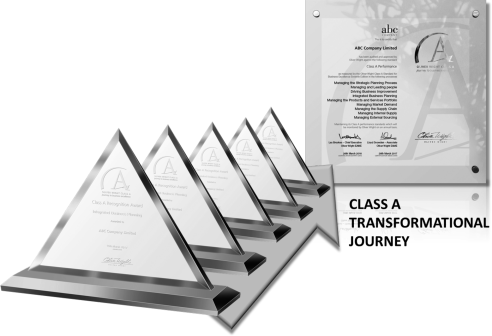
The Class A Standard achievement is extremely demanding (and rewarding) and typically requires a long period for implementation. When you start the Class A Journey to Excellence, we recommend that you outline a Business Excellence program aligned to strategic and competitive priorities. Design incremental milestone initiatives to provide business gains in a relatively short timescale while taking you a step further toward those longer-term business goals. Milestones enable the Journey to Class A and serve as major points of recognition of your people. Oliver Wight recognizes the achievement of these milestones and their deliverables with a Class A Milestone Award.
Oliver Wight Class A Milestone Awards come in three forms: