
This edition first published 2018
© 2018 John Wiley & Sons, Inc.
All rights reserved. No part of this publication may be reproduced, stored in a retrieval system, or transmitted, in any form or by any means, electronic, mechanical, photocopying, recording or otherwise, except as permitted by law. Advice on how to obtain permission to reuse material from this title is available at http://www.wiley.com/go/permissions.
The right of JeeLoo Liu to be identified as the author of this work has been asserted in accordance with law.
Registered Offices
John Wiley & Sons, Inc., 111 River Street, Hoboken, NJ 07030, USA
Editorial Office
350 Main Street, Malden, MA 02148‐5020, USA
For details of our global editorial offices, customer services, and more information about Wiley products visit us at www.wiley.com.
Wiley also publishes its books in a variety of electronic formats and by print‐on‐demand. Some content that appears in standard print versions of this book may not be available in other formats.
Limit of Liability/Disclaimer of Warranty
While the publisher and author have used their best efforts in preparing this book, they make no representations or warranties with respect to the accuracy or completeness of the contents of this book and specifically disclaim any implied warranties of merchantability or fitness for a particular purpose. It is sold on the understanding that the publisher is not engaged in rendering professional services and neither the publisher nor the author shall be liable for damages arising herefrom. If professional advice or other expert assistance is required, the services of a competent professional should be sought.
Library of Congress Cataloging‐in‐Publication Data
Names: Liu, JeeLoo, author.
Title: Neo‐Confucianism : metaphysics, mind, and morality / JeeLoo Liu, California State University Fullerton, CA, US.
Description: First edition. | Hoboken : Wiley, 2018. | Includes bibliographical references and index. |
Identifiers: LCCN 2017016337 (print) | LCCN 2017017858 (ebook) | ISBN 9781118619322 (pdf) | ISBN 9781118619186 (epub) | ISBN 9781118619148 (hardback) | ISBN 9781118619414 (paper)
Subjects: LCSH: Neo‐Confucianism. | BISAC: PHILOSOPHY / Eastern.
Classification: LCC B127.N4 (ebook) | LCC B127.N4 L574 2017 (print) | DDC 181/.112–dc23
LC record available at https://lccn.loc.gov/2017016337
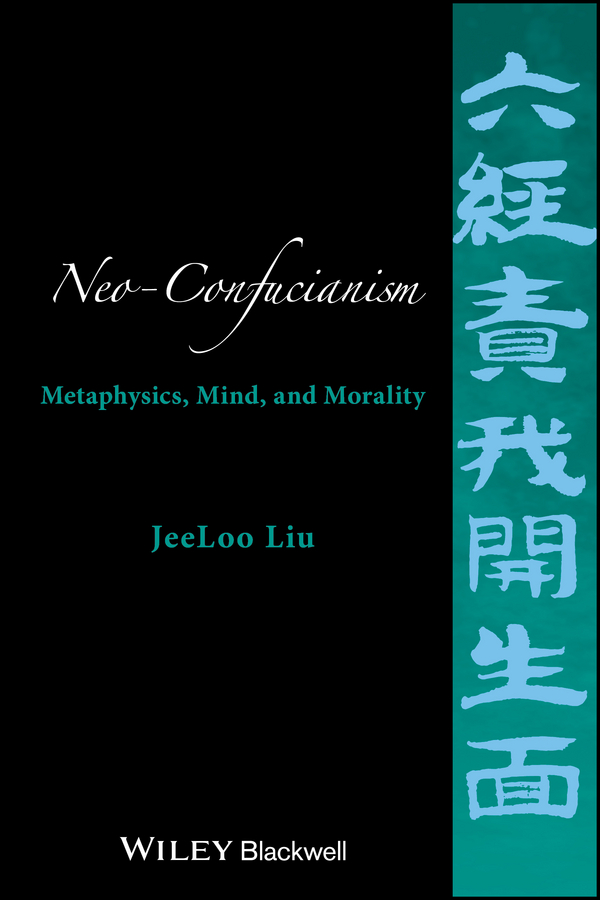
Cover image: (Texture) © Lightspring/Shutterstock; (Caligraphy) Yue Feng (岳峰); (Text) Wang Fuzhi, translating to “The Six Classics make it incumbent upon me to break a new path and present a new facet.”
Cover design by Wiley
This book is dedicated to my mother Chu‐Wei Lin Liu ( 劉林祝闈), whose high standards made me who I am today.
This book is not about the history of Chinese philosophy, and it does not confine neo‐Confucianism to its historical contexts. Instead, it aims to extract the philosophical core of neo‐Confucianism in the Song‐Ming era to make it relevant to contemporary philosophical discourse. The methodology of this book is comparative philosophy, and the angle of comparison is that of analytic philosophy. The analytic reconstruction of neo‐Confucianism is chosen on the grounds of my philosophical training and expertise. It provides one credible analysis of neo‐Confucianism among many other respectable approaches to Chinese philosophy. My intent behind writing this book is not to define what neo‐Confucianism is, but to demonstrate how one could philosophically engage neo‐Confucianism.
In this book, many contemporary philosophical theories in the analytic tradition are employed to provide a hermeneutic entry to the ancient philosophical ideas in neo‐Confucianism. The claim is of course not that neo‐Confucians of the eleventh to the seventeenth century did embrace these contemporary doctrines, since such a claim would result in anachronistic or Procrustean interpretation. The contemporary recontextualization, however, can liberate neo‐Confucianism from its particular historical contexts and make it relate to contemporary readers. I believe that most philosophical ideas, though having their contextual roots, emerge out of shared human concerns, and can thus be recontextualized in different eras. A text should live on through its interpreters and readers.
At the same time, such a comparative approach, that is, using Western philosophical concepts to interpret Chinese philosophy, could incur the criticism of epistemological colonization, or the so‐called reversed matching of meaning (fanxiang geyi 反向格義, borrowing Xiaogan Liu’s terminology), to which many Chinese historians and Sinologists strongly oppose. Some Chinese scholars have vehemently argued against using any Western philosophical ideas to explicate Chinese thought, in that such Westernization would maim “the essence” of Chinese thinking. What I want to challenge in this book is exactly this kind of philosophical nationalism or essentialism that takes Chinese philosophy to be exclusively of Chinese intellectual lineage, and intelligible only to Chinese readers. Using Western terminology to explicate Chinese philosophy is not necessarily to force the latter into the former’s conceptual framework. If the interpretation remains true to the text, and does not distort the philosophical ideas of the philosophers, then the comparative angle can serve as a bridge for outsiders to gain intellectual access to Chinese philosophy. At the same time, scholars familiar with Chinese philosophy can also be motivated to learn more about Western philosophical theses. By reconstructing neo‐Confucianism with the terminology of contemporary analytic philosophy in this book, I hope to render these philosophical ideas accessible and philosophically inspiring. To be true to the philosophical import of neo‐Confucianism, the reconstruction is based on careful textual analysis, in consultation with other relevant interpretations both in English and Chinese secondary sources.1 What I hope to present to the readers is a refreshing, innovative and perspicuous articulation of the philosophical dimension of neo‐Confucianism.
This book was made possible by a generous grant from the John Templeton Foundation. I wish to thank its past and present directors Hyung Choi, Michael J. Murray, and John Churchill for their assistance.
This book serves as the sequel to my first book, An Introduction to Chinese Philosophy: From Ancient Philosophy to Chinese Buddhism (Blackwell, 2006). I am deeply indebted to the former philosophy editor of Wiley‐Blackwell, Jeff Dean, for helping launch my writing career. In the late 1990s, when I was a junior assistant professor at SUNY Geneseo with little writing credentials, I approached Jeff with my idea of writing an introduction to Chinese philosophy with an analytic approach. He embraced the idea enthusiastically and provided me with helpful feedback along the way. I am very grateful to Jeff for trusting me to write the book the way I wanted to write it. We agreed at the time that an introduction that spans into neo‐Confucianism would have made the book too long, so neo‐Confucianism would have to wait for the second volume. It took me nearly 10 years to complete this project. With this book, Jeff was again welcoming and encouraging, and offered his shrewd editorial suggestions including the current title for this book. I was sorry that Jeff left Wiley‐Blackwell before the book could be completed; however, I am thankful that the current editor Marissa Koors took over the project for publication. I would also like to thank the two reviewers of this book for their friendly and very helpful suggestions for improvement.
Neo‐Confucianism has always been my passion. When I was an undergraduate at National Taiwan University, I loved reading neo‐Confucian writings on the rooftop balcony at my parents’ apartment. Watching the sunsets and beautiful clouds, I often thought that this was the same sky that these neo‐Confucians shared hundreds of years ago and felt connected with them. The person who instilled this passion in me was my undergraduate professor and later my master’s thesis advisor, Yongjun Zhang 張永 . He is a living neo‐Confucian in our times, dedicated to learning, teaching, and passing on the torch of Dao. I am extremely grateful to him for opening the door to neo‐Confucianism for me.
In 2009, when my idea for writing this book first emerged, I was invited to conduct an experimental summer course on the same topic at National Chengchi University in Taiwan. I would like to thank the Philosophy Department of National Chengchi University for giving me this great opportunity to develop my thoughts through engaging discussions with students. I must credit the participants for helping make this book possible: my teaching assistant Zili Zhang 張子立, the fellow scholars as well as the students in this class. I am also grateful to the Philosophy Department of the Chinese University of Hong Kong for providing a sponsored sojourn during the final stage of my manuscript revision.
Last, but most important, I also want to thank my husband Michael Cranston and our two sons Collin and Dillon, for they have provided a loving, supportive, and stress‐free environment for me to work on my book over the years.