Start Reading
About Battle Royal
About Hugh Bicheno
Reviews
Table of Contents

www.headofzeus.com
FOR KATTY
Grace under pressure
Cover
Welcome Page
Dedication
List of Maps
List of Tables and Family Trees
Protagonists and Marriages
Maps
Princes of the Blood Family Tree
Preface
Prologue · Passionate Princesses
Chapter I · House of Lancaster
Chapter II · House of Beaufort
Chapter III · House of Valois-Anjou
Chapter IV · House of York
Chapter V · Faction and Feud
Chapter VI · Defeat and Humiliation
Chapter VII · Henry and Richard
Chapter VIII · House of Neville
Chapter IX · Marguerite
Chapter X · Mitre and Crown
Chapter XI · Richard
Chapter XII · Henry
Chapter XIII · Coup d’état
Chapter XIV · Marguerite’s Counter-coup
Chapter XV · Lord of Calais
Chapter XVI · Here be Dragons
Chapter XVII · Marguerite and Henry
Entr’acte · The English Way of War
Chapter XVIII · Marguerite’s Army
Chapter XIX · Lancaster Resurgent
Chapter XX · Warwick’s Apotheosis
Chapter XXI · Betrayal
Chapter XXII · Marguerite and Son
Chapter XXIII · Richard’s Humiliation
Chapter XXIV · Edward of March
Chapter XXV · The Bubble Reputation
Chapter XXVI · Two Kings
Chapter XXVII · Knight’s Gambit
Chapter XXVIII · Endgame
Coda · Checkmate
Plate Section
Appendix A · English Peerage 1440−62, by date of creation
Appendix B · English Peerage 1440−62, alphabetical
Appendix C · Archbishops and Bishops 1440−62
Appendix D · Beauchamp Inheritance
Works Consulted
Acknowledgements
Image Credits
Index
About Battle Royal
Reviews
About Hugh Bicheno
An Invitation from the Publisher
Copyright
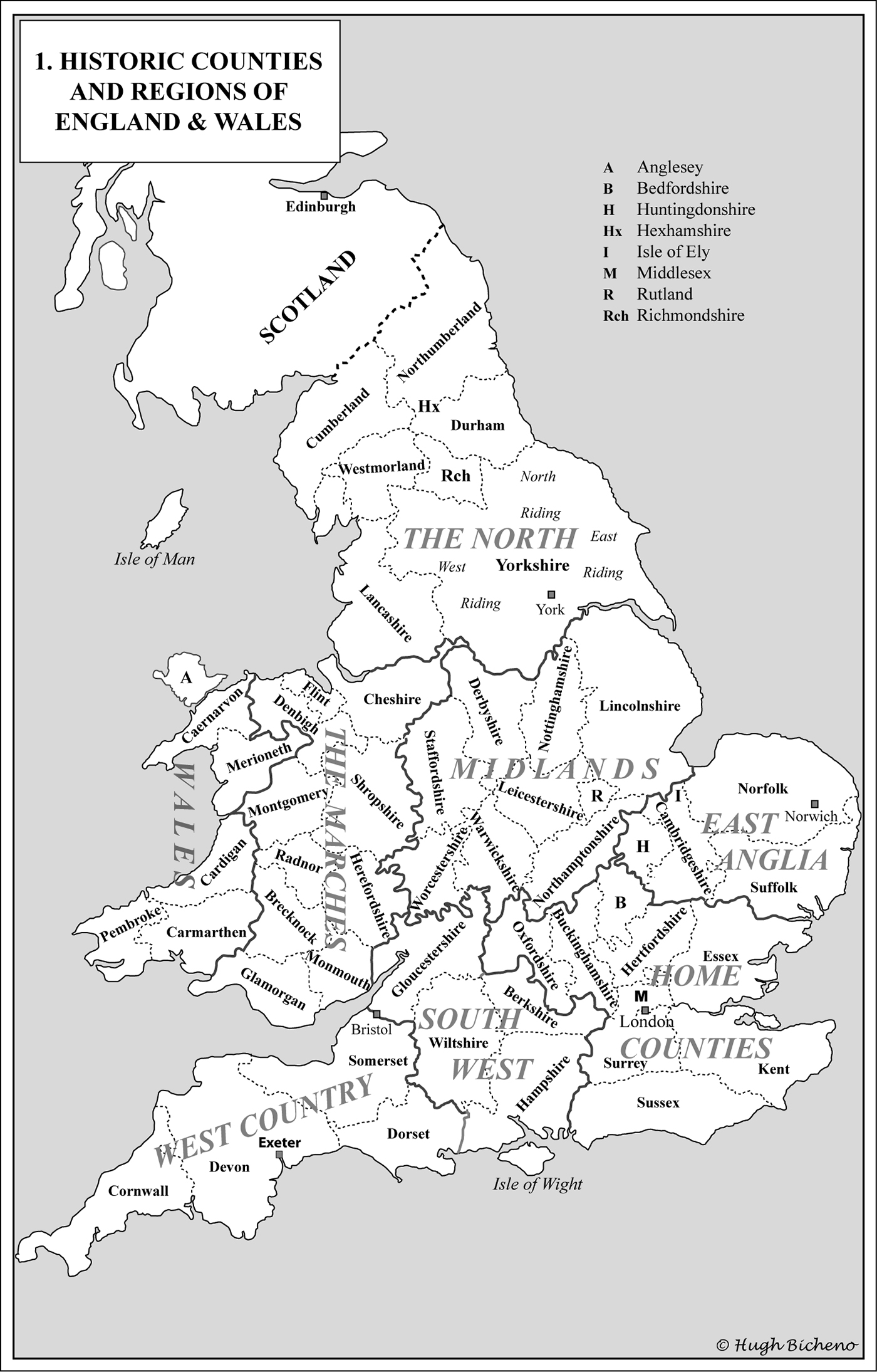
1. Historic Counties of England and Wales
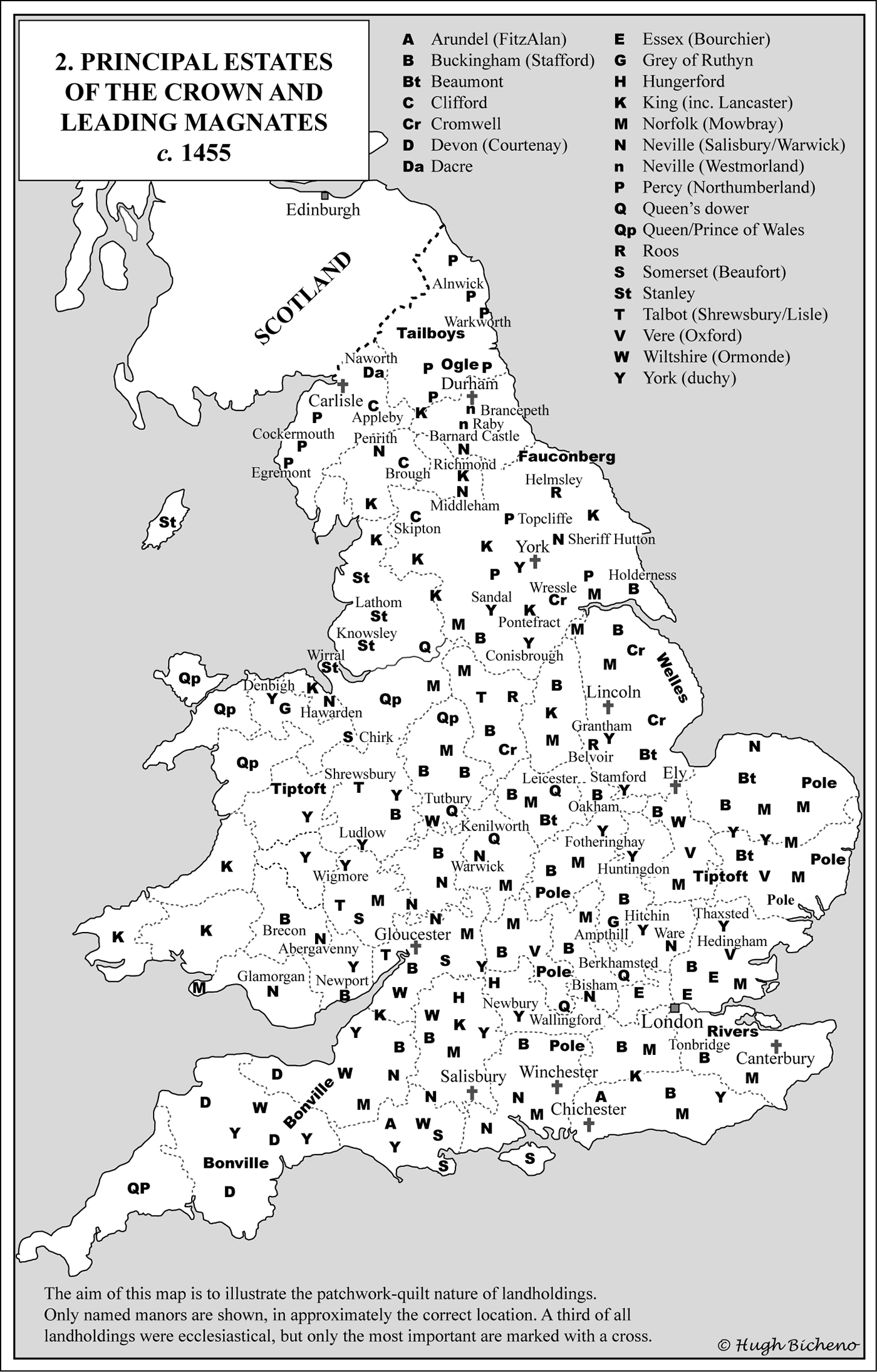
2. Principal Estates of the Crown and Leading Magnates c. 1455
3. Roads, Rivers, Sieges and Battlefields
4. Great North Road and Western Spur
5. Half-conquered France, c. 1429
6. Fall of Normandy 1449−50
7. Archdioceses and Dioceses of England & Wales
8. The North: Neville and Percy
9. Approach to St Albans, May 1455
10. Battle of St Albans, 22 May 1455
11. Medieval Calais
12. Wales and the Marches: Royal Domains outlined
13. The Approaches to Blore Heath
14. Close Approach to Blore Heath
15. Blore Heath, 23 September 1459
16. Ludford Campaign, South and Central Welsh Marches
17. Battlefield of Northampton
18. Battlefield of Wakefield
19. Mortimer’s Cross Campaign, Jan−Feb 1460
20. Battle of Mortimer’s Cross, 2 February 1461
21. Approach to St Albans, February 1461
22. Battle of St Albans, First Phase, 17 February 1461
23. Battle of St Albans, Second Phase, 17 February 1461
24. Approach to Towton, March 1461
25. Road Distances and Marching Times
26. Towton Artefacts
27. Battle of Towton, 29 March 1461
Peerage Participation in Selected Campaigns 1415–53
Partisan Peers in 1461
Timings of dawn and nightfall in Yorkshire, 6 April 2014
Princes of the Blood
House of Lancaster
House of Beaufort
House of Valois-Anjou
House of York
House of Neville
Houses of Stafford and Bourchier
With few exceptions, mainly titles held by elderly or ill men, single women or minors, the entire peerage was drawn into the first phase of the conflict.
PRECURSORS
Beauchamp, Richard (1382–1439), 13th Earl of Warwick. Dominant lord in south Wales and west Midlands. Married (1st) Elizabeth Berkeley and (both 2nd) Isabel Despenser.
Beauchamp, Richard (d.1422), 1st Earl of Worcester and 2nd Baron Bergavenny. Welsh Marcher lord. First husband of Isabel Despenser. Sole heir married Edward Neville (see Yorkists).
Beaufort, Henry (d.1447), Cardinal Archbishop of Winchester.
Beaufort, Joan (d.1440). Her marriage to Ralph Neville created much of the tinder for the Wars of the Roses.
Beaufort, John (1404–44), 1st Duke of Somerset. Married Margaret Beauchamp of Bletsoe.
Bedford, John (1389–1435), Duke of. Brother of Henry V. Heirless.
Gloucester, Humphrey (1390–1447), Duke of. Brother of Henry V. Heirless.
Montacute, Thomas (1388–1428), 4th Earl of Salisbury. Sole heir Alice married Richard Neville (see Yorkists).
Mowbray, John (1415–61), 3rd Duke of Norfolk, also Earl of Nottingham and Surrey. Nationwide landowner, main holdings in East Anglia diluted by the dower of his mother Katherine née Neville. Married Eleanor, sister of Henry, John, Thomas and William Bourchier.
Neville, Ralph (1364–1425), 1st Earl of Westmorland. His second marriage to Joan Beaufort created much of the tinder for the Wars of the Roses.
Pole, William de la (1396–1450), 1st Duke of Suffolk. East Anglian and, through marriage to Alice Chaucer, Oxfordshire lord. Chief minister of Henry VI until 1450.
Valois, Catherine de (1401–37), dowager queen. Henry VI’s mother. Lover of Owen Tudor.
LANCASTRIANS
Henry VI, King of England (1421–71) (r. 1422–61; 1470–71).
Marguerite d’Anjou (1430–82), Henry VI’s queen.
Edward of Westminster (1453–71), Prince of Wales.

Audley – see Tuchet, James.
Beauchamp, Alice – see Yorkists.
Beauchamp, Eleanor (1408–67). Daughter of Richard and Elizabeth Berkeley. Dowager Baroness Roos, mother of Thomas, 9th Baron Roos. Married (2nd) Edmund Beaufort. See Appendix D.
Beauchamp, Elizabeth (1415–48), 3rd Baroness Bergavenny by right. Sole heir of Richard and Isabel Despenser. Married Edward Neville. See Appendix D.
Beauchamp, Elizabeth (1417–80). Daughter of Richard and Elizabeth Berkeley. Married George, dubious Baron Latimer, son of Ralph Neville and Joan Beaufort. See Appendix D.
Beauchamp, Margaret (1404–67). Daughter of Richard and Elizabeth Berkeley. Married John Talbot, 1st Earl of Shrewsbury.
See Appendix D.
Beauchamp of Bletsoe, Margaret (1405–82). Wealthy Bedfordshire, Wiltshire and Dorset landowner. Married (2nd) John Beaufort, by whom Margaret Beaufort, and (3rd) Lionel, 6th Baron Welles.
Beaufort, Edmund (1406–55), 2nd Duke of Somerset. Lieutenant of Normandy. Younger brother and heir of John. Added estates in Gloucestershire, Denbigh and Isle of Wight. Married Eleanor Beauchamp.
Beaufort, Henry (1436–64), 3rd Duke of Somerset. Eldest son of Edmund and Eleanor Beauchamp.
Beaufort, Margaret (1443–1509). Daughter of John. Married (1st) Edmund Tudor, by whom the future Henry VII, and (2nd) Henry Stafford, younger son of the Duke of Buckingham.
Beaumont, John (1410–60), 1st Viscount. East Midlands and East Anglian lord. Lifelong friend of Henry VI. Married (2nd) Katherine Neville, dowager Duchess of Norfolk.
Beaumont, William (1438–1507), 2nd Viscount. Son of John’s first marriage.
Boteler/Butler, Ralph (1394–1473), 1st Baron Sudeley. Lord Treasurer 1443–6. Gloucestershire lord. Member of William de la Pole’s affinity. His only son Thomas, who predeceased him, was married to Eleanor, daughter of John Talbot, 1st Earl of Shrewsbury, who was later betrothed to Edward IV.
Bromflete, Henry (1412–69), 1st Baron Vescy. Father-in-law of Thomas, 8th Baron Clifford.
Buckingham – see Stafford, Humphrey.
Butler, James (1420–61), 1st Earl of Wiltshire, later 5th Earl of Ormonde. Estates in the West Country, Gloucestershire, Staffordshire, Oxfordshire and Cambridgeshire. Close friend of Henry VI. Married Eleanor, daughter of Edmund Beaufort and Eleanor Beauchamp.
Chaucer, Alice (1404–75), dowager Duchess of Salisbury. East Anglian and Oxfordshire landowner. Married William de la Pole. Their son first betrothed to John Beaufort’s daughter Margaret, later married Elizabeth, Richard of York’s second daughter.
Clifford, Thomas (1414–55), 8th Baron. Northern lord. Married Joan, daughter of 6th Baron Dacre.
Clifford, John (1435–61), 9th Baron. Married Margaret, sole heir of Lord Vescy.
Courtenay, Thomas (1432–61), 14th Earl of Devon. West Country magnate. See entry for his namesake father under Yorkists. Married Marie of Anjou, illegitimate daughter of Charles, Count of Maine, Queen Marguerite’s uncle.
Dacre of the North, Randolph (1412–1461), 1st Baron. Scots Marcher lord. Son of 6th Baron Dacre. Henry VI created new title for him after the barony went with his niece to Yorkist Richard Fiennes.
Devon – see Courtenay, Thomas.
Dudley – see Sutton, John.
Exeter – see Holland, Henry.
Fiennes, James (1390–1450), 1st Baron Saye and Sele. Kent lord. Close friend of Henry VI. Murdered 1450 during Cade’s Rebellion. His son became a Yorkist.
Grey of Codnor (1435–96), Henry, 7th Baron. Midlands lord.
Grey of Groby, John (1432–61). Son of Elizabeth, 6th Baroness Ferrers of Groby by right, and Edward Grey. First husband of Elizabeth Woodville, later Edward IV’s queen.
Holland, Henry (1430–75), 3rd Duke of Exeter and Earl of Huntington. Hereditary Admiral of England, minor landowner. Married Anne, Richard of York’s eldest daughter.
Hungerford, Robert (1431–64), 2nd Baron, also Lord Moleyns by marriage. Mainly West Country lord.
Kemp, John, (1380–1454), Cardinal Archbishop of Canterbury.
Lisle – see Talbot, John.
Lovell, John (d.1465), 8th Baron, plus several other titles. Wealthy Midlands lord. Married Joan, daughter of John, 1st Viscount Beaumont.
Luxembourg, Jacquetta (1416–72), dowager Duchess of Bedford. Lands in Normandy and Richmondshire. Married (2nd) Richard Woodville.
Moleyns – see Hungerford, Robert.
Neville, John (d.1461), 1st Baron. Northern lord. Brother of Ralph, 2nd Earl of Westmorland, acted as his guardian after he became demented.
Northumberland – see Percy.
Ormonde – see Butler, James.
Oxford – see Vere, John.
Percy, Henry (1394–1455), 2nd Earl of Northumberland (attainted title restored 1416). Dominant lord in Northumberland, major landowner in Cumberland and Yorkshire. Married Eleanor, second daughter of Ralph Neville and Joan Beaufort.
Percy, Henry (1421–61), 3rd Earl of Northumberland. Through marriage to Eleanor, Baroness Poynings, acquired lands in Sussex and Kent.
Rivers – see Woodville, Richard.
Roos, Thomas (1427–64), 9th Baron. East Midlands and Yorkshire lord. Son of Eleanor Beauchamp by her first marriage, half-brother to her sons by Edmund Beaufort. Married Philippa Tiptoft, sister of Yorkist John, 1st Earl of Worcester.
Rougemont Grey, Thomas (d.1461), 1st Baron. Minor West Country lord. Brother of the Yorkist Edmund, Lord Grey of Ruthyn. Married Margaret, daughter of 5th Baron Ferrers of Groby.
Saye and Sele – see Fiennes, James.
Scales, Thomas (d.1460), 7th Baron. Mainly Norfolk lord. Leading commander in Normandy. Godfather of Edward, Richard of York’s eldest son. Sole heir Elizabeth married (2nd) Anthony Woodville.
Shrewsbury – see Talbot, John.
Stafford, Humphrey (1402–60), 1st Duke of Buckingham. Nationwide landowner. Lieutenant of Calais. Married Anne, daughter of Ralph Neville and Joan Beaufort.
Stafford, Humphrey (1424–58), courtesy earldom of Stafford. Eldest son of the Duke of Buckingham whom he predeceased. Married Margaret, daughter of Edmund Beaufort and Eleanor Beauchamp.
Stafford, Henry (1455–83). Younger son of the Duke of Buckingham. Second husband of Margaret, daughter of John Beaufort and Margaret Beauchamp of Bletsoe.
Stourton, John (1454–85), 3rd Baron. West Country lord.
Sudeley – see Boteler/Butler, Ralph.
Sutton, John (1400–87), 1st Baron Dudley. Cheshire lord. Close associate of William de la Pole, changed sides after being severely wounded while fighting for Lancaster.
Talbot, John (1384–1453), 1st Earl of Shrewsbury. Welsh Marcher lord. Outstanding commander in Normandy. Married (1st) Maud Nevill (sic), Baroness Furnivall, and (2nd) Margaret Beauchamp.
Talbot, John (1413–60), 2nd Earl of Shrewsbury. Eldest son of 1st Earl and Maud Nevill. Married Elizabeth, daughter of James Butler.
Talbot, John (d.1453), 1st Viscount Lisle. Gloucestershire lord. Son of 1st Earl of Shrewsbury and Margaret Beauchamp.
Talbot, Thomas (d.1470), 2nd Viscount Lisle. See Appendix D.
Trollope, Andrew (d.1461). Talbot and later Somerset retainer. Immensely experienced Normandy veteran.
Tuchet, James (1398–1459), 5th Baron Audley. East Midlands lord. Married (1st) Margaret, daughter of 6th Baron Roos, and (2nd) Eleanor, daughter of Edmund Holland, 4th Earl of Kent, and Constance of York.
Tudor, Edmund (d.1456), 1st Earl of Richmond. Eldest son of Owen and Catherine de Valois. Married Margaret, daughter of John Beaufort and Margaret Beauchamp of Bletsoe.
Tudor, Jasper (1431–95), 1st Earl of Pembroke. Second son of Owen and Catherine de Valois.
Tudor, Owen (1400–61), Lover of dowager Queen Catherine de Valois.
Vere, John (1408–62), 12th Earl of Oxford. Mainly Essex lord.
Vescy – see Bromflete, Henry.
Welles, Lionel (1406–61), 6th Baron. Lincolnshire lord. Married (2nd) Margaret Beauchamp of Bletsoe.
Welles, Richard (1428–70), 7th Baron Willoughby by marriage. Also a Lincolnshire lord. Heir to Lionel.
Willoughby – see Welles, Richard.
Wiltshire – see Butler, James.
Woodville, Richard (1405–69), 1st Baron Rivers. Minor Kent lord. Married Jacquetta of Luxembourg. Eldest child Elizabeth married (1st) John Grey of Groby and (2nd) Edward IV.
YORKISTS
York, Richard (1411–60), 3rd Duke. Nationwide estates, main concentrations in the Welsh Marches and East Anglia. Lieutenant of Normandy and of Ireland. Married Cecily Neville.
Neville, Cecily (1415–95), known as ‘Proud Cis’. Youngest daughter of Ralph Neville and Joan Beaufort, sister to Richard, Earl of Salisbury and aunt to Richard, Earl of Warwick.
March, Edward (1442–83), Earl of. Richard of York’s eldest son. Later King Edward IV.
Rutland, Edmund (1443–60) Earl of. Richard of York’s second son.
Arundel – see FitzAlan, William.
Audley – see Tuchet, John.
Beauchamp, Anne (1426–92), 16th Countess of Warwick by right. Married Richard Neville. See Appendix D.
Bergavenny – see Neville, Edward.
Berners – see Bourchier, John.
Bonville, William (1392–1461), 1st Baron. West Country magnate. Married (1st) Margaret, sister of Edmund, Lord Grey of Ruthyn, and (2nd) Elizabeth Courtenay, daughter of the 3rd Earl of Devon. Initially Lancastrian, he became Yorkist through alliance with the Nevilles.
Bonville, William (d.1460), Eldest son of 1st Baron Bonville and Margaret Grey. Married Elizabeth, heir to the barony of Harington in Dorset.
Bonville, William (1442–60), 6th Baron Harington. Son of William Bonville and Elizabeth Harington. Married Katherine, daughter of Richard Neville and Alice Montacute.
Bourchier, Henry (1406–83), 1st Viscount. Dominant lord in Essex and Middlesex. Eldest of the Bourchier brothers. Married Isabel, Richard of York’s only sister.
Bourchier, John (1415–74), 1st Baron Berners. Younger brother of Henry and William, older brother of Thomas and of Eleanor, Duchess of Norfolk.
Bourchier, Thomas (1413–86), Cardinal Archbishop of Canterbury. Youngest of the Bourchier brothers.
Bourchier, William (1412–71), 9th Baron FitzWarin by marriage. Devon lord.
Brooke, Edward (d.1464), 6th Baron Cobham. Kent lord. Married Elizabeth, daughter of James Tuchet.
Cobham – see Brooke, Edward.
Clinton, John (1410–64), 5th Baron. Northamptonshire and Staffordshire lord. Married Joan, daughter of 5th Baron Ferrers of Chartley.
Courtenay, Thomas (1414–58), 13th Earl of Devon. West Country magnate. Married Margaret, sister of John and Edmund Beaufort. Initially strongly Yorkist he became Lancastrian when York allied with the Nevilles, allies of his deadly rival William Bonville.
Cromwell, Ralph (d.1456), 3rd Baron. Rapacious east Midlands lord.
Dacre – see Fiennes, Richard.
Devereux, Walter (1432–85), 7th Baron Ferrers of Chartley by marriage. Lands around Weobley, Herefordshire, and in Staffordshire, Leicestershire and Lincolnshire. York retainer.
Devon – see Courtenay, Thomas.
Dudley – see Sutton, John.
Fauconberg – see Neville, William
Ferrers of Chartley – see Devereux, Walter and Clinton, John.
Fiennes, Richard (d.1483), 7th Baron Dacre by marriage to Joan, granddaughter of the 6th Baron, initiating a feud with her Lancastrian uncle Humphrey Dacre.
Fiennes, William (d.1471), 2nd Baron Saye and Sele. Kent lord. Became Yorkist after his father was abandoned by Henry VI and murdered in 1450.
FitzAlan, William (1417–87), 16th Earl of Arundel. Prominent lord in south-east England. Married Joan, eldest daughter of Richard Neville and Alice Montacute.
FitzHugh, Henry (d.1472), 5th Baron. Yorkshire lord. Neville retainer. Married Alice, daughter of Richard Neville and Alice Montacute.
FitzWarin – see Bourchier, William.
Grey of Ruthyn, Edmund (1416–90), 4th Baron. Welsh Marcher and Bedfordshire lord. Married Katherine, daughter of Henry Percy, 1st Earl of Northumberland, and Eleanor Neville.
Grey of Wilton, Reginald (d.1494), 7th Baron. Herefordshire lord. Married (1st) Tacinda, daughter of Owen Tudor and dowager Queen Catherine de Valois, and (2nd) Thomasine, illegitimate daughter of John Beaufort, Duke of Somerset.
Greystoke, Ralph (1414–87), 5th Baron. Yorkshire lord. Neville retainer. Married Elizabeth, sister of 5th Baron FitzHugh.
Herbert of Raglan, William (1423–69), 1st Baron. Monmouth lord. Lifelong Yorkist retainer, also key man in Glamorgan for Richard Neville, Earl of Warwick. Married Anne, sister of Walter Devereux. Half- brother to the Vaughans by his mother’s first marriage.
Montacute, Alice (1406–62), 5th Countess of Salisbury by right. Extensive estates in Warwickshire, the South West and around Bisham, Berkshire. Married Richard Neville.
Montagu – see Neville, John.
Mowbray, John (1444–76), 4th Duke of Norfolk. Landownings diluted further by his mother’s dower. Married Elizabeth, daughter of John Talbot, 1st Earl of Shrewsbury, and Margaret Beauchamp.
Neville, Edward (1407–76), 3rd Baron Bergavenny by marriage to Elizabeth Beauchamp. Youngest son of Ralph and Joan Beaufort. When his wife died he was dispossessed by his nephew Richard, Earl of Warwick, but remained a loyal Yorkist.
Neville, George (1432–76), Bishop of Exeter. Youngest son of Richard and Alice Montacute.
Neville, John (1431–71), 1st Baron Montagu. Second son of Richard and Alice Montacute.
Neville, Katherine (d.1483), eldest daughter of Ralph and Joan Beaufort. Married (1st) John Mowbray, 3rd Duke of Norfolk, (2nd) Thomas Strangeways, (3rd) John, 1st Viscount Beaumont and (4th) John Woodville, forty-six years her junior.
Neville, Richard (1400–60), 5th Earl of Salisbury by marriage to Alice Montacute, adding her lands to his dominant lordships in Yorkshire and Richmondshire. Eldest son of Ralph and Joan Beaufort.
Neville, Richard (1428–71). Became 16th Earl of Warwick and dominant lord in the east Midlands and south Wales by marriage to Anne Beauchamp. Eldest son of Richard and Alice Montacute.
Neville, Robert (1404–57), Bishop of Durham. Third son of Ralph and Joan Beaufort.
Neville, William (d.1463), 6th Baron Fauconberg by marriage. Second son of Ralph and Joan Beaufort. The most experienced Yorkist commander.
Norfolk – see Mowbray, John.
Ogle, Robert (1406–69), 1st Baron. Northumberland lord. Experienced commander and lifelong Neville retainer.
Oldhall, William (d.1460). Speaker of the Commons 1450−51. Much persecuted Yorkist retainer.
Pole, John de la (1442–92), Earl of Suffolk (father’s dukedom forfeited in 1450). Infant betrothal to Margaret, daughter of John Beaufort, annulled. Married Elizabeth, Richard of York’s second daughter.
Salisbury – see Montacute, Alice and Neville, Richard.
Saye and Sele – see Fiennes, William.
Scrope of Bolton, John (1437–98), 5th Baron. Yorkshire lord. Neville retainer. Married Joan, sister of 5th Baron FitzHugh.
Scrope of Masham, Thomas (1429–75), 5th Baron. Yorkshire lord. Neville retainer. Married Elizabeth, daughter of 5th Baron Greystoke.
Stafford of Hooke, Humphrey (1439–69). Captured at Calais and defected to become one of Edward of March’s closest companions.
Stanley, Thomas (d.1504), 2nd Baron and titular King of Mann. Dominant lord in Lancashire. He betrayed, successively, Henry VI, Edward IV, Henry VI again, Edward V and Richard III. Married Eleanor, daughter of Richard Neville and Alice Montacute.
Stanley, William (d.1495). Younger brother of Thomas. Totally loyal to the Yorkist cause.
Suffolk – see Pole, John de la.
Sutton, John (1400–87), 1st Baron Dudley. Cheshire lord. A close companion of Henry VI, he changed sides after being severely wounded in battle.
Tiptoft, John (1427–70), 1st Earl of Worcester. Welsh Marcher and Cambridgeshire lord. Married Cecily Neville, dowager Duchess of Warwick and daughter of Richard and Alice Montacute. Heartbroken when she died a year later. On pilgrimage to the Holy Land and in Italy 1457–61.
Tuchet, John (1426–90), 6th Baron Audley. Father killed at Blore Heath. John changed sides after being captured at Calais and became one of Edward of March’s closest companions.
Vaughan, Roger (d.1471), of Tretower Court and Crickhowell in Radnor. Half-brother of William Herbert. Lifelong Yorkist retainer. Youngest of the Vaughan brothers.
Vaughan, Thomas, (d.1400–69), of Hergest and Kington in Herefordshire. Half-brother of William Herbert. Lifelong Yorkist retainer. Second of the Vaughan brothers.
Vaughan, Thomas (n.d.), son of Walter. Fanatical Yorkist.
Vaughan, Walter/Watkin (d.1456), of Bredwardine in Herefordshire. Lifelong Yorkist retainer. Eldest of the Vaughan brothers.
Warwick – see Beauchamp, Anne and Neville, Richard.
Wenlock, John (d.1471), 1st Baron. Speaker of the Commons. Lancastrian suborned by Warwick.
Worcester – see Tiptoft, John.
OTHER
Anjou, Marie d’ (1404–63), aunt of Queen Marguerite. Married Charles VII of France.
Anjou, René (1409–80), Duke of. Father of Queen Marguerite. Married Isabelle of Lorraine.
Aragón, Yolande de (1384–1442), grandmother of Queen Marguerite.
Brézé, Pierre de (d.1465). Fiercely loyal to Yolande de Aragón, her daughter Isabelle and granddaughter Marguerite. Rose to high office in France thanks to the influence of Agnès Sorel.
Burgundy, Philippe (1396–1467), Duke of (r. 1419−67).
Charles VII (1403–61), King of France (r. 1422–61). Married Marie d’Anjou.
Charolais, Charles ‘the Bold’ (1433–77), Count of. Heir to Philippe III of Burgundy.
Coppini, Francesco (d.1464). Papal Legate.
Dauphin – designation of French heir- apparent.
Louis XI (1423–83), King of France (r. 1461–83).
Guelders, Mary of (1434–63). Queen to James II of Scotland, regent for her son 1460–3.
James I (1394–1437), King of Scotland (r. 1406–37). Married Joan Beaufort, John of Gaunt’s daughter.
James II (1430–60), King of Scotland (r. 1437–60). Married Mary of Guelders, cousin of Philippe II of Burgundy.
James III (1451–88), King of Scotland (r. 1460–88).
Lorraine, Isabelle (1400–53), Duchess of. Mother of Queen Marguerite.
Luxembourg, Louis (1418–75), Count of Saint-Pol. Brother of Jacquetta of Luxembourg.
Maine, Charles (1414–72), Count of. Uncle of Queen Marguerite. Married Isabelle of Luxembourg, sister of Jacquetta and Louis.
Richemont, Arthur de (1393–1458). Breton prince. As Charles VII’s Constable of France he was the architect of France’s first standing army and of the campaign that expelled the English from France. Duke of Brittany for one year in 1457–8.
Sorel, Agnès (1422–50), Charles VII’s official mistress.
Pius II (1405–64), Pope (r. 1458–64).
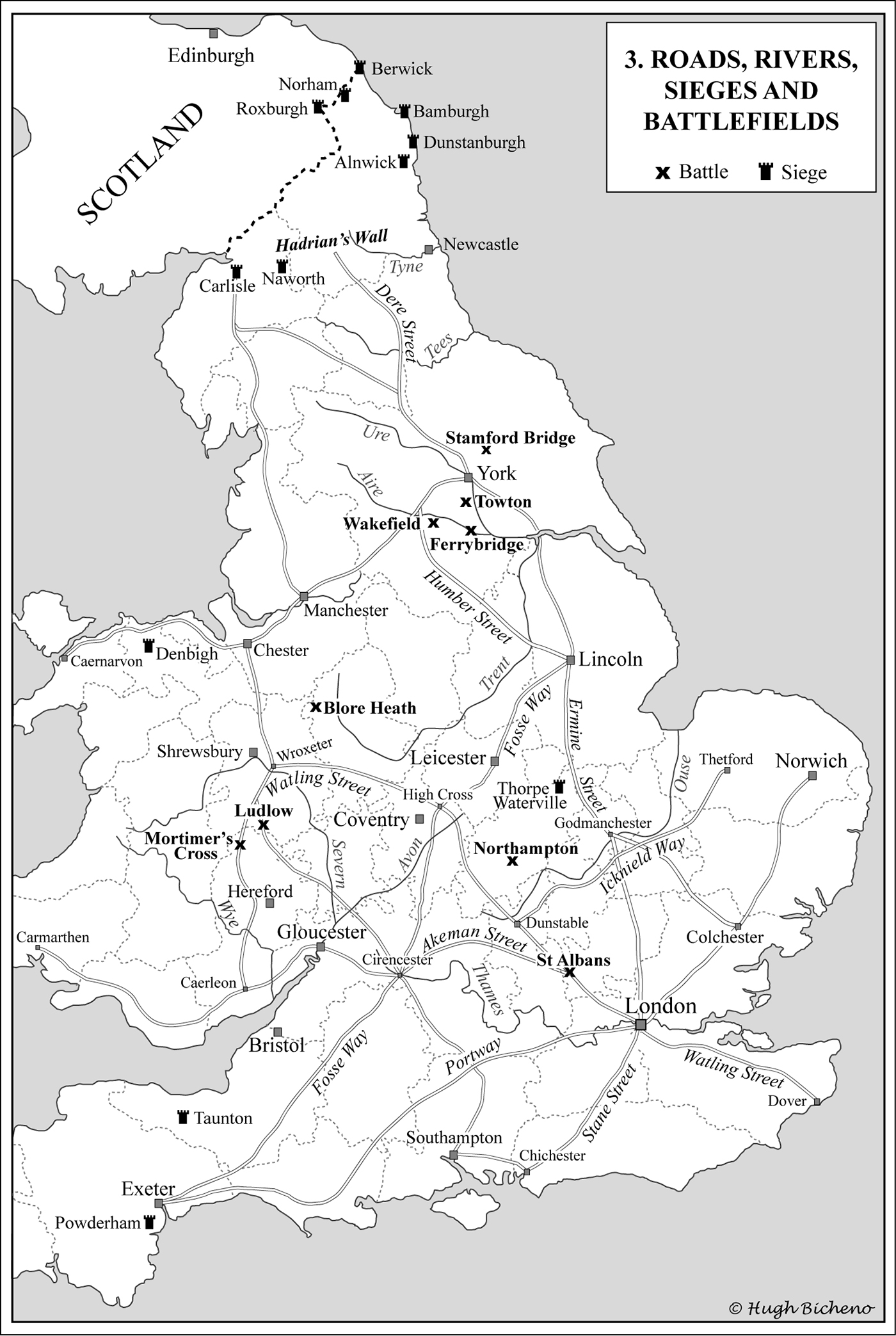
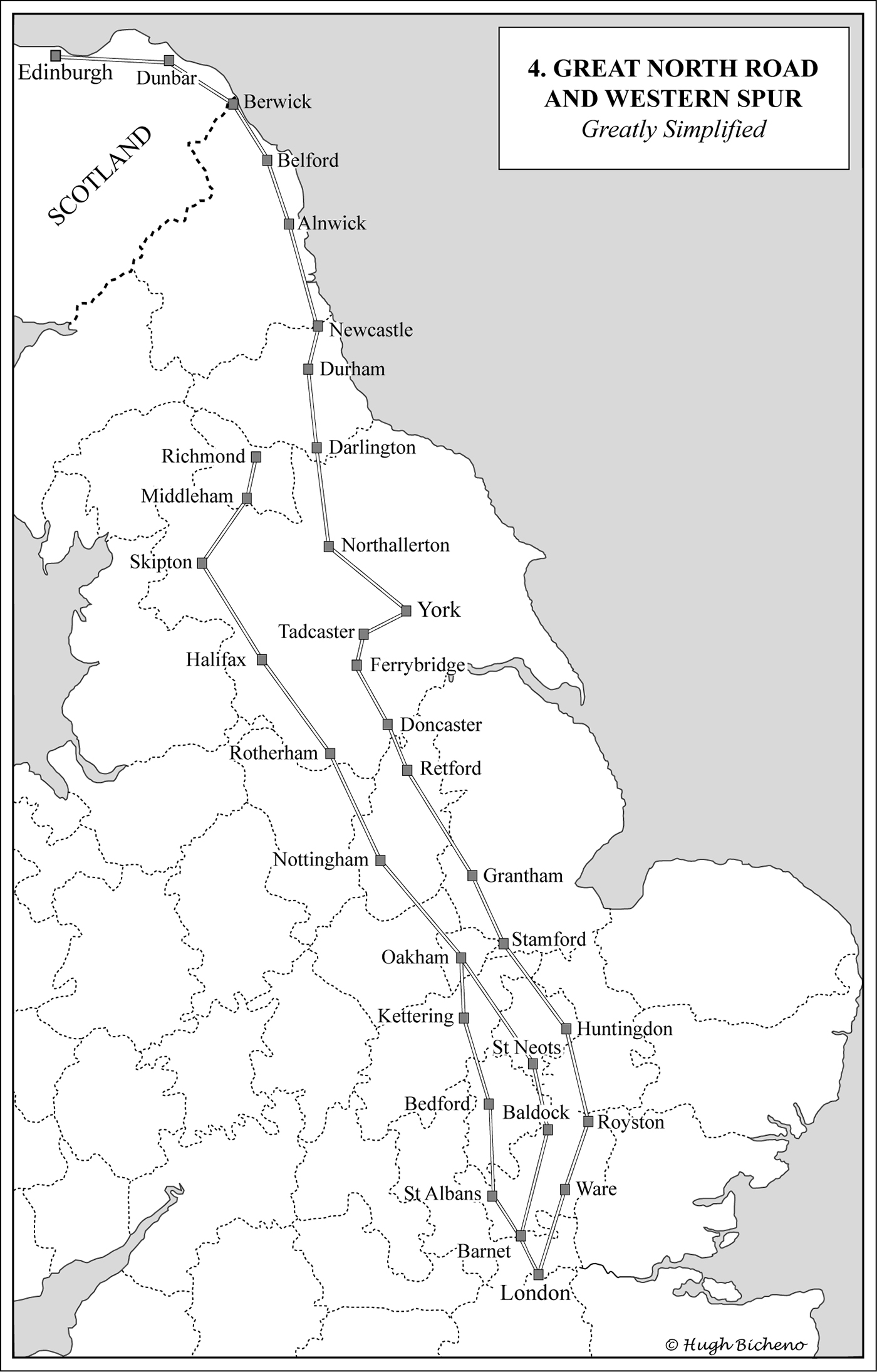
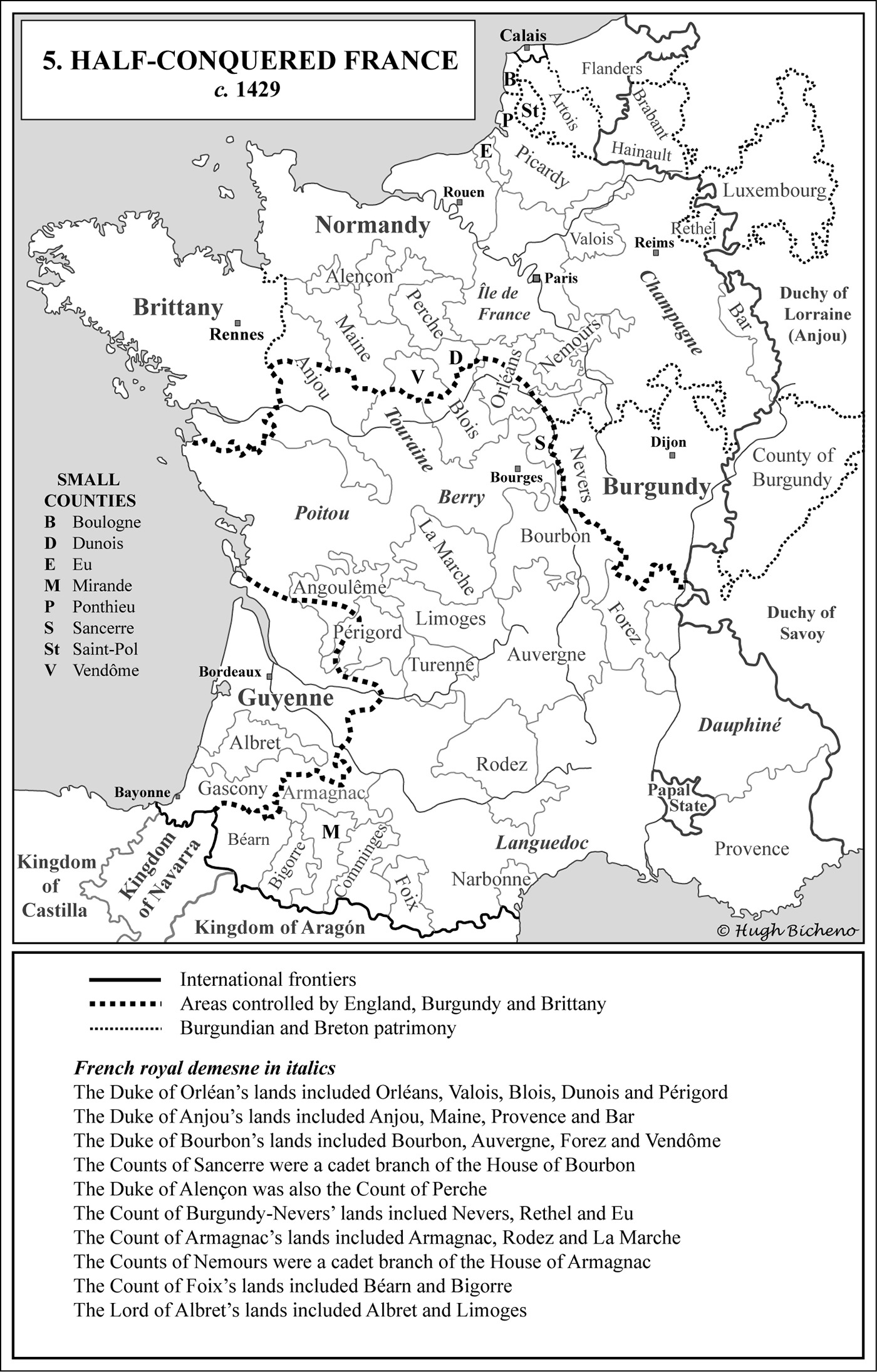
At an early stage of my research I found it necessary to create two reference lists of the English peers, by seniority (A) and alphabetically (B), and another of the senior clergy (C). Appendix D details the most violently divisive of all the many inheritance disputes.
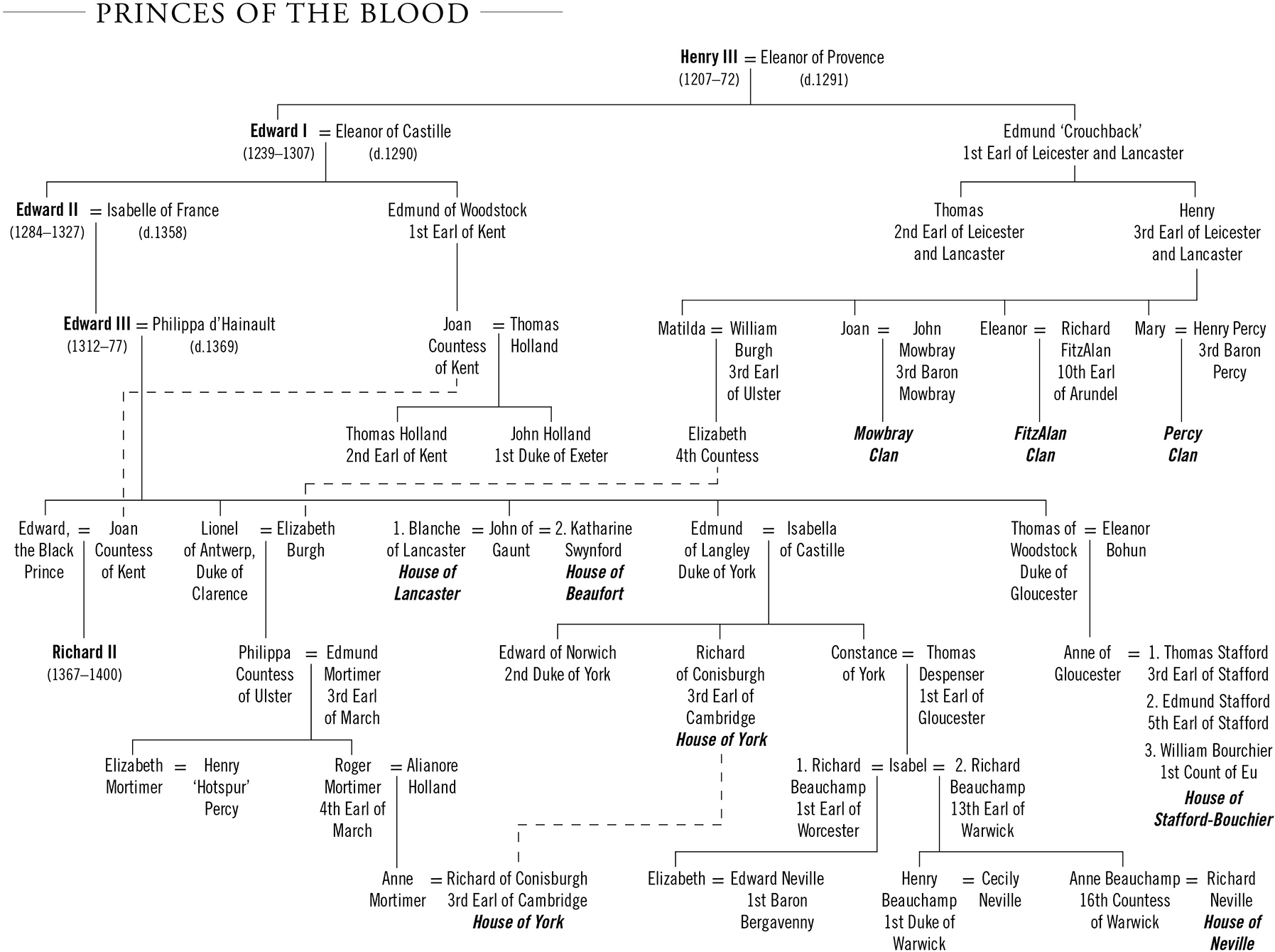
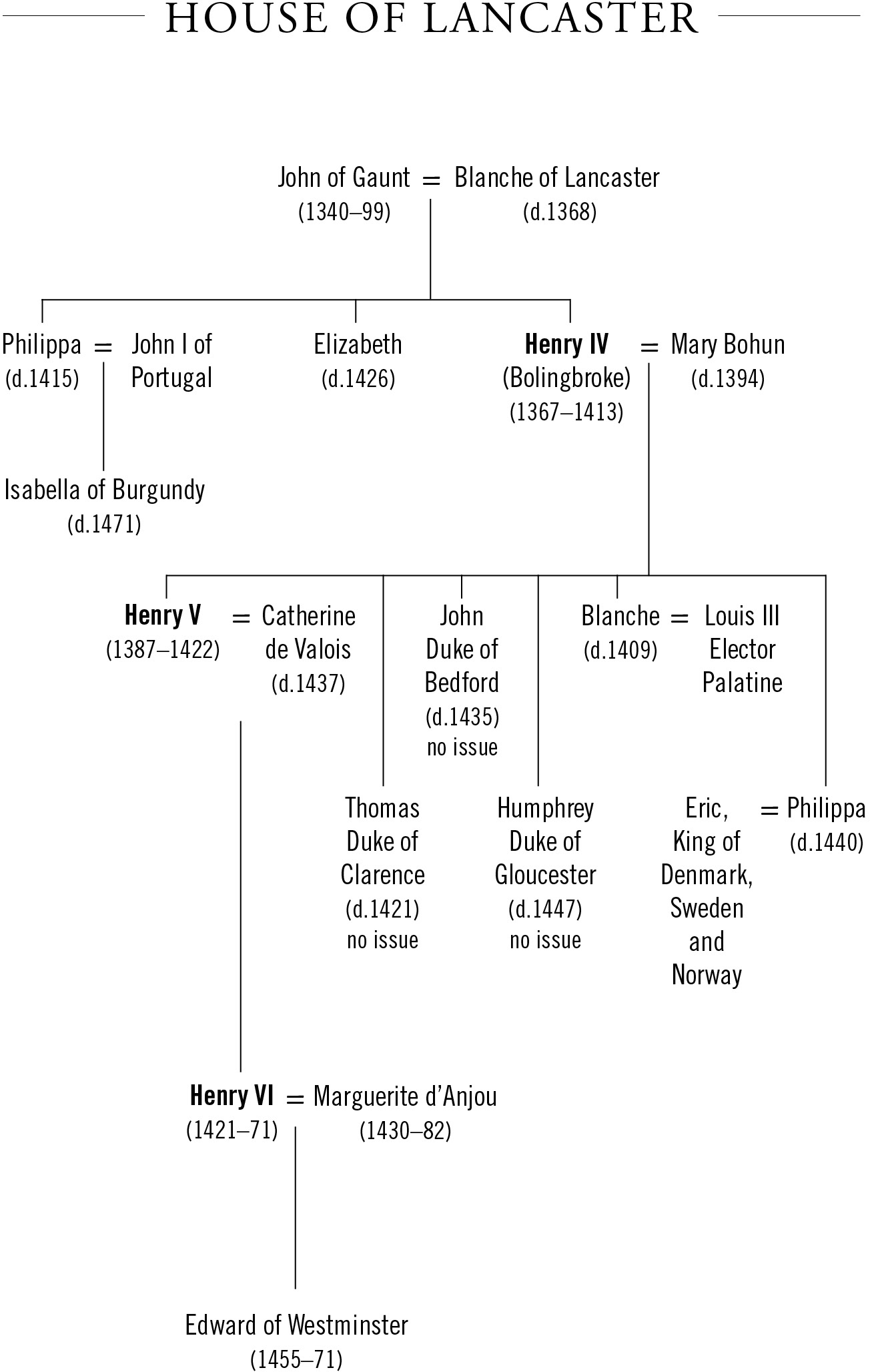
The Protagonists and Marriages list and the family trees in the appropriate chapters illustrate networks of kinship too burdensome to stress sufficiently in the text. Genealogy defined status and title to property, and also the alliances and disputes that exploded into the Wars of the Roses. It really was a ‘Cousins’ War’.
The French participle ‘de’ was still commonly used by the English nobility well into the fifteenth century, but for simplicity’s sake I have omitted it while retaining the more distinctive ‘de la’. I have anglicised most non-English titles, while retaining the participle for French names only when stated in full (thus Pierre de Brézé).
The pound sterling (£), the mark, and the livre tournois were not coins, but units of account. The mark was two-thirds of a pound sterling. The livre tournois to pound sterling exchange rate fluctuated from 6.6 = £1 in the 1420s to 11.3 = £1 in 1436–7, and then back down again. The continental gold crown was a coin worth one-fifth of a pound sterling.
To provide the 2012 standard of living equivalence given in [square brackets] after the sums in contemporary units, I averaged the figures from MeasuringWorth.com at ten-yearly intervals to arrive at a rough and ready rate of £1 = £636 for the period 1430–85. Had I used the ‘economic status’ equivalence instead, it would have been £1 = £18,166.
None of the contemporary or near-contemporary accounts are entirely dependable, and some are deliberately misleading. When even an accurate factual narrative is elusive, character and motive is almost entirely speculative. Modern facial reconstruction techniques can put flesh on skulls, but only imagination and empathy can suggest what went on inside them.
The ultimate winners of the Wars of the Roses were the grandchildren of two enchanting women. The quality was so strong in one of them that she was accused of witchcraft in 1469 and again, post mortem, in 1484. The first, potentially lethal accusation was made at the instigation of Richard ‘the Kingmaker’ Neville, Earl of Warwick, following a coup d’état during which he murdered her husband and one of her sons.
The woman thus accused was Jacquetta (christened Jacqueline) de Luxembourg, widow of John, Duke of Bedford, the eldest surviving uncle of King Henry VI of England and at the time of their marriage the next in line for the throne. He was so taken with 17-year-old Jacquetta that in 1433 he married her with indecent haste five months after the death of his first wife Anne, the sister of the Duke Philippe of Burgundy, thereby deeply offending a crucial English ally in the endgame of the Hundred Years War.
After Bedford died two years later, childless Jacquetta was granted permission to enjoy her generous dower lands on condition she not remarry without a royal licence. This she omitted to obtain in 1437, when she secretly married the famously handsome 32-year-old Sir Richard Woodville, by whom she was pregnant. While she risked losing her dower, technically he committed treason by changing the legal status of a member of the royal family without the king’s permission.
The couple were fortunate that 15-year-old King Henry VI was mourning the recent death of his mother Catherine, who had blazed a wide trail by cohabiting with her Welsh major-domo Owen Tudor without benefit of clergy. Catherine de Valois was the youngest daughter of King Charles VI of France and Isabeau of Bavaria. When Charles first lapsed into paranoid schizophrenia, Isabeau was forced to play a leading role in the uniformly disastrous subsequent events of her husband’s reign.
Between 1407 and 1435 the Valois endured a ‘Cousins’ War’ among the many branches of the French royal family that was far more threatening to the survival of the kingdom than the divisions among the English Plantagenets. Isabeau steered a pragmatically shifting course among the factions and was accused by her enemies of every vice imaginable, sometimes without cause.
Anarchy in France encouraged Henry V to assert his claim to the French throne after he became king of England in 1413. After his crushing victory at Agincourt two years later, he conquered Normandy, lost to the English crown over 200 years earlier. Rouen, the Norman capital, fell to the English in January 1419, and in September, after the Dauphin Charles had his cousin Duke Jean II of Burgundy treacherously assassinated, Jean’s heir Philippe joined the assault on his Valois cousins’ territories. The Anglo-Burgundian alliance became formal in May 1420, when Charles VI signed the Treaty of Troyes, a near total capitulation to Henry’s demands.
The lynchpin of the treaty was Henry’s marriage in June to Catherine, but Charles VI also disinherited his 17-year-old namesake son (whom Isabeau said was not his at all) in favour of Henry. Disaffected French nobles rallied around the disowned dauphin and invoked alliances with Castille and with Scotland, whose uncrowned King James I, a captive in England since 1406, served with the English army in 1420−21. Spanish ships transported a Scots army led by the Earl of Buchan, son of the regent Duke of Albany, to the dauphin’s capital at Bourges.
Catherine’s eldest sister Isabelle, then 7 years old, had been married to Richard II of England in 1396. After Richard was overthrown and murdered by his cousin Henry IV (Bolingbroke) three years later, Isabelle bravely refused to marry Henry’s namesake heir. Almost from the moment Catherine was born the two Henrys had seen her as a suitable dynastic alternative. When Henry V finally met the 17-year-old in the summer of 1419 he was so captivated by her that he abandoned his demand for a huge dowry in addition to the territorial concessions he and Duke Philippe won at Troyes.
After their marriage at Troyes Cathedral in June 1420 and a honeymoon spent on campaign, Henry and his bride crossed to England, where Catherine was crowned queen at Westminster Abbey in February 1421. The couple embarked on a royal progress through the kingdom, but a month later, at about the time Catherine became pregnant, shocking news from France interrupted their journey.
Henry’s brother Thomas, Duke of Clarence, lieutenant in France during the king’s absence, had been killed at Baugé in Anjou, leading a hot-headed charge by men-at-arms unsupported by archers against the elite Scots component of a larger Franco-Scots army.*1 Henry returned to France in June to retrieve the situation and never saw his namesake son, who was born on 6 December.
The king regained the initiative with two successful sieges, of Dreux in the late summer of 1421 and Meaux from October until May 1422, when Catherine joined him. It was not to be a happy reunion. Henry had contracted cholera and died at Vincennes, just outside Paris, on 31 August 1422, sixteen days short of his thirty-sixth birthday.
Four miles away and less than two months later his father-in-law Charles VI also died. In 1435, to justify breaking his alliance with England, Duke Philippe of Burgundy was to argue that the line of succession agreed at Troyes became void when Henry predeceased Charles.
Both 9-month-old Henry VI and 19-year-old Charles VII were proclaimed kings of France. Neither was crowned until the visionary teenager Jeanne d’Arc shamed Charles out of his defeatist lethargy. In July 1429, following Jeanne’s tide-turning victory over the English at Orléans in May, he was crowned at newly recovered Reims Cathedral, France’s Westminster Abbey.
Henry was not even crowned king of England until four months later. Two years later he was crowned king of France at Nôtre-Dame Cathedral in Paris by his uncle Cardinal Henry Beaufort, Bishop of Winchester. The royal party had spent the previous eighteen months at Rouen, the capital of occupied Normandy. Also at Rouen was Jeanne d’Arc, captured in May 1430 and sold to the English by Jacquetta’s uncle Jean, Count of Ligny. Despite having evaded the theological traps set for her, to the lasting shame of the House of Lancaster she was condemned for heresy by a French ecclesiastical court suborned by Bedford, with Cardinal Beaufort presiding. She was burned at the stake in Rouen marketplace on 30 May 1431.
When Henry V died there was no chance that his widow, a 21-year-old woman and sister to the rival claimant to the French throne, would be permitted to play any political role; nor was there any indication she wished to do so. Catherine was a devoted mother and gave no cause for concern until 1427, when she fell in love with the dashing Edmund Beaufort, six years her junior, who had been setting hearts aflutter ever since arriving at court.
Like the ruling House of Lancaster, the Beauforts were descendants of John of Gaunt, Edward III’s third son. However, while the royal family were descended from his marriage to Blanche of Lancaster, the Beauforts were the product of his subsequent love affair with Katherine Swynford. Although the Beaufort children were legitimated by papal decree and royal charter after John and Katherine married in 1396, in 1407 Henry IV added the proviso excepta regali dignitate, barring his half-siblings and their descendants from inheriting the throne. Whether or not he had the right to alter what was supposed to be a fair copy of the original charter was a moot issue as long as the legitimate Lancastrian succession was assured.
The second generation of Beauforts were an attractive brood. The hostage King James I of Scotland fell in love with Edmund’s sister Joan. Dowager Queen Catherine was dame of honour at the wedding. At his long-delayed coronation in 1424 James obliged the surly Scots nobles to swear allegiance to Joan as well as himself.
So, even before falling for Edmund, Catherine de Valois was well acquainted with the Beauforts and would have known that Edmund’s older brother John, Earl of Somerset, had been taken prisoner after following his stepfather the Duke of Clarence to defeat at Baugé. Irrespective of Catherine’s charms, Edmund must have regarded dalliance with the richest woman in England, who might influence the court to help ransom his brother, as practically a fraternal obligation, while the prospect of marriage was mouth-watering.
The possibility was far from appealing to Henry VI’s uncle Humphrey, Duke of Gloucester, the youngest son of Henry IV and the senior member of the Council that governed England during the king’s minority. Bedford, Gloucester’s one-year-older brother, was regent in France. None of Henry V’s brothers had legitimate issue and the survival of their dynasty was vested in the boy Henry VI. The prospect of a royal stepfather from the bastard Beaufort line was intolerable.
Bishop Henry Beaufort, by 1424 the last male survivor of the first generation of Beauforts, was the crown’s principal creditor. He had been instrumental in denying Gloucester the regency in England and was his main rival in the Council. Their retainers came close to doing battle at London Bridge in October 1425, when Gloucester blocked what he believed was an attempt to take the infant king into the bishop’s custody. At issue were not only influence and power, but also surety for the bishop’s loans, on which the crown had defaulted.
Bedford was obliged to return from France to mediate during 1426. There were many strands to the compromise eventually reached, including the appointment of the neutral Richard Beauchamp, Earl of Warwick, to be the young king’s governor. The core deal, however, was a partial financial settlement with Bishop Beaufort. In return the bishop resigned from the office of lord chancellor and the ruling Council.
Bedford also required Beaufort to travel back with him to France in March 1427. As regent, Bedford was empowered to grant Beaufort permission to accept promotion to cardinal, which Henry V had refused him when the pope first proposed it in 1419. Beaufort’s career in papal service only briefly diverted his attention from English politics, but it gave Gloucester grounds to accuse him of divided loyalties when he resumed his place in the Council.
With the new cardinal out of the way, Gloucester dealt with the threat from Edmund by an Act of Parliament stating that if Catherine remarried without the king’s consent, the husband would be stripped of his lands. The Act also specified that permission could only be granted by the king, then 6 years old, once he reached his majority. Finally, the Act also declared that any children of an unsanctioned marriage would still be members of the royal family, a proviso designed to give the royal uncles control over them. With his hopes thus dashed, Edmund departed for France to begin a long military career.
In rebellion, Catherine left the court and moved to Wallingford Castle in Oxfordshire, part of her dower. There she proceeded to raise a family with her servant Owen Tudor, a man with no lands to lose, furthermore without benefit of clergy, thus finessing the letter of Gloucester’s act. Henry IV had deprived Welshmen of many civil rights during the last great Welsh revolt led by Owain Glyn Dŵr in 1400−12, but Owen Tudor had earned English rights by military service in France, even though his father was Glyn Dŵr’s nephew.
The couple produced a child almost every year from about 1429. The first we can be sure of was named Edmund, which has led some to speculate that Beaufort might have been the true father. A second son, Jasper, was to be a major player in the Wars of the Roses. Another son and two daughters followed them. It is possible a last daughter died in childbirth along with her 35-year-old mother in January 1437, although by then Catherine had retired to Bermondsey Abbey outside London, and in her will wrote of a ‘grievous malady, in the which I have been long, and yet am, troubled and vexed’.
Catherine was buried in Westminster Abbey. Her painted wooden funeral effigy in the abbey museum is one of the oldest surviving life-like depictions of any member of the royal family. We cannot be sure the original of a much-copied portrait profile of Henry V was painted from life (his right profile was disfigured by a near-fatal arrow wound at the 1403 Battle of Shrewsbury), but it fits a contemporary description of an oval face, a long straight nose, straight dark hair and a ruddy complexion.
Apart from the nose his son fits this description barely at all, whereas the similarities between Catherine’s effigy and another much-copied portrait of Henry VI when he was 19 years old are striking. Mother and son shared the same hair, complexion, cheekbones, jaw-line, chin, rosebud mouth and arching eyebrows. More remarkably, a portrait of Catherine’s Tudor great-grandson Henry VIII at about the same age also shows a strong family likeness.
Did Henry VI inherit his maternal grandfather’s schizophrenia? The condition commonly peaks between the ages of 15 and 25, with women experiencing a second peak between 25 and 35, and this may have been Catherine’s ‘grievous malady’. Even so, the heritability of schizophrenia from a single parent is low. It is much higher when both parents are afflicted, and Henry VI may also have inherited a predisposition to mental illness from his father, who had a messianic delusion that he could unite Christendom under his banner.
Following Catherine’s death, Tudor took sanctuary at Westminster Abbey when summoned by Gloucester to appear before the Council. He was assured he could depart in safety, but was then arrested and locked up like a common criminal in Newgate prison. His confiscated worldly wealth was £137 10s. 4d, no small amount [about £87,500 in today’s purchasing power], but minuscule in comparison with Catherine’s dower.
In a manifest charade Tudor ‘escaped’ early in 1438, was allegedly recaptured by John, Baron Beaumont, one of the king’s closest friends, taken to Windsor Castle and held there under the protection of none other than Catherine’s former suitor Edmund Beaufort. Owen was later pardoned and his property restored, and he became a member of the king’s household. Meanwhile his sons were placed in the care of the Abbess of Barking, sister of William de la Pole, Earl of Suffolk, the king’s chief minister. Owen never married and many years later, on learning he was to be executed, his last words were ‘that head shall lie on the stock that was wont to lie on Queen Catherine’s lap’.
Upon the death of the king’s mother 20-year-old Jacquetta, dowager Duchess of Bedford, became the highest ranking lady in the royal family, with precedence over Gloucester’s ambitious second wife Eleanor Cobham. Eleanor had previously been Gloucester’s mistress when she was a lady-in-waiting to his first wife, Jacqueline d’Hainault, whom he brutally discarded in 1428. Consequently the duke was not in a position to adopt a high moral tone when a pregnant Jacquetta revealed she had married Richard Woodville not long after Catherine’s death.
Also, Gloucester was once again struggling for influence with Cardinal Beaufort, who was delighted to see Gloucester’s highly eligible sister-in-law Jacquetta take herself off the political chessboard. Better still, although Woodville was the son of one of the late Duke of Bedford’s closest officials, and knighted by the duke himself, he had subsequently served under Suffolk – who began his service to the king as a protégé of the cardinal. Suffolk was also, by marriage, lord of the Woodville estate at Grafton in Northamptonshire.
We may presume the newly orphaned young king was inclined to leniency towards a young woman whose conduct mirrored his late mother’s. It was in his gift to legitimate Jacquetta’s marriage, and he did so. However, in contrast to Jacquetta’s first visit to England after marrying Bedford, when she was inducted into the Order of the Garter, on this occasion the couple was not received at court and Woodville was fined £1,000 [£636,000].
Cardinal Beaufort put up the money, nominally in exchange for a few of her manors, but clearly to bind the couple to his interest. Their exclusion from court may have been at the suggestion of Gloucester, but it also resolved the problem of protocol posed by the gross imbalance of rank between Jacquetta and Richard Woodville.
If the noble councillors believed Richard had married Jacquetta for her money, they could not have been more wrong. Theirs was a lastingly passionate relationship, and she bore him fourteen children over the next twelve years. Given how dangerous childbirth was, that Jacquetta’s dower was for her life only and how politically exposed he would become if she died, Richard would certainly have restrained his enthusiasm if cold calculation played any part in the marriage.
The couple returned to France, he to pursue his military career and she to attempt to secure her income from lands in Normandy that constituted a major part of her Bedford dower. With Burgundy now hostile, the English position in northern France was precarious, which kept Richard busy but would have made Jacquetta’s task difficult even if she had not been almost constantly pregnant. She appears to have shuttled across the Channel to give birth at Grafton, leaving the babies in her father-in-law’s household while she returned to France to pursue her claims – and get pregnant again.
It is to be expected that two such beautiful people as Jacquetta and Richard would produce stunningly good-looking offspring. Sadly, presumption is all we have, as no likenesses from life survive of either of the parents or any of their fourteen children – save one. Three copies survive of a lost original portrait of Elizabeth, their eldest child, painted after she married Edward IV. The least over-painted is at Queens’ College, Cambridge – she and her ill-fated predecessor Marguerite d’Anjou being the founders for whom the college is named. Although crudely executed, the portrait conveys a luminous quality, which helps to explain why Elizabeth Woodville became the first commoner queen regnant of England.
The distinctive course taken by English history under Henry VIII may well have owed something to the mitochondrial DNA of Catherine and Jacquetta. Having acquired financial independence by fulfilling their dynastic duty as daughters, they found fulfilment with men who prized them as women above all. We know Owen Tudor’s last thoughts were of long-dead Catherine, and we may safely assume Richard Woodville’s were of Jacquetta in the grim hours before he, too, was beheaded.
Sometimes love does conquer all: despite having turned their backs on the game of power, Catherine and Jacquetta became the common ancestors of every English monarch since 1485. Before that could happen, all those with a superior claim to the throne had first to wipe each other out. This they did in what was in essence a decades-long, murderously sordid dispute over an inheritance within a deeply dysfunctional extended family. It became merciless not despite but because the combatants had so much in common, and projected their own darkest intentions onto each other.
This was something so humanly fascinating that the greatest author to adorn the English language wrote eight plays about it. Prudent sycophancy towards the dynasty under which he lived gave Shakespeare the unifying theme of his first historical series, three-part Henry the Sixth and Richard the Third, namely that divinely ordained order was overthrown by the deposition and murder of Richard II by his cousin Henry of Bolingbroke, Duke of Lancaster. Decades of strife ensued before the restoration of divine order under the Tudors.
The theme is absent from his subsequent, more accomplished series from Richard the Second through two-part Henry the Fourth, leading to the patriotic apotheosis of Henry the Fifth. The final chorus laments that after Henry V’s early death, ‘so many had the managing, that they lost France, and made his England bleed’. The plays have indelibly coloured popular perception of late medieval England, and historians cannot ignore them.
Nor should they: it was an extraordinary period in English history. Four of the six kings crowned between 1399 and 1485 were usurpers who killed their predecessors, undermining the concept of divine right as well as the prestige of the ruling class. A more mature appreciation of history and of human nature led Shakespeare to discount the role of divine judgement when he wrote the second, more psychologically penetrating series.
*1 Buchan was killed and the Scots army annihilated by Bedford at Verneuil, the ‘second Agincourt’, in August 1424.
In his Commentaries Pope Pius II dismissed his contemporary Henry VI of England as ‘a man more timorous than a woman, utterly devoid of wit or spirit, who left everything in his wife’s hand’. The verdict of history is equally implacable: he was one of the most ineffectual and divisive monarchs with which any nation has ever been cursed. The only open question is how many of the disasters that characterized his reign can be attributed to his wife or his proverbial ‘evil councillors’, and how many to personal initiatives.
Henry was at the younger end of the age bracket in which schizophrenia commonly declares itself when he assumed the full powers of personal kingship in November 1437. A portrait of him four years later shows the staring, vacant facial expression characteristic of the disease, and he ticked many other diagnostic boxes long before disabling symptoms became apparent. Chief among them were an inability to feel normal joy or pleasure (later portrayed as saintliness), extreme sensitivity to disagreement, inappropriate emotional responses to serious events (such as giggling at bad news), and no facility to weigh the likely consequences of his decisions, from which came a cavalier disregard for abiding by them.
The word ‘childlike’ was often applied to him, which explains why he commanded (often exasperated) affection from so many. Children, however, are often cruel, and on occasions Henry acted in a way that can only be described as sadistic. One such was his vindictive persecution in 1441 of Eleanor Cobham, wife of his uncle the Duke of Gloucester, for treasonable necromancy. Suffolk was behind the prosecution, but he would not have dared attack a prince of the blood without the king’s support. Eleanor was paraded through the streets of London in her shift like a prostitute, and then imprisoned for life. Her alleged accomplices were first tortured to implicate her, and then cruelly executed.
It was not the first time a Lancastrian king employed an accusation of witchcraft against an inconvenient woman. Henry V used it against his stepmother Joan of Navarre, but spared her a trial after legally stealing much of her dower. She was under house arrest first at Pevensey Castle in Kent, where her youngest stepson Gloucester was a frequent visitor. In 1429 Joan gifted her chapel and its furnishings to Gloucester’s wife Eleanor Cobham.
Although Gloucester was not implicated in his wife’s supposed crimes and divorced her, his status as the king’s heir presumptive was irrevocably compromised. He was forced into retirement, leaving the way clear for Suffolk and other members of the king’s inner circle, to whom Henry began to grant the reversion of crown lands and offices held by the duke. For these to take effect Gloucester had to die. In 1447 he was arrested on a charge of treason and conveniently died in custody two days later. Suffolk was made a duke the following year.
In July 1447 a court presided over by Suffolk convicted the late duke’s illegitimate son and eight others of plotting to kill the king and sentenced them to be drawn, hanged and quartered. Suffolk only appeared with a royal pardon after they had been dragged through the streets, cut down alive after hanging and stripped naked in preparation for ritual disembowelment. A visiting French delegation was disgusted by the charade, and reported that the people of London shared the sentiment.
The episode marked the start of the cult of ‘Good Duke Humphrey’ among the common people, and a corresponding hatred of Suffolk. It is an error to believe that, like many another chief minister before and after him, Suffolk was simply the lightning rod for growing popular discontent with the king. Although many others shared in the ill-gotten spoils from Gloucester’s estate, Suffolk’s greed was particularly flagrant.
Nonetheless, he undoubtedly did get blamed for the king’s failings. The once canonical view of Henry as a well-meaning soul misled by self-seeking courtiers has been comprehensively demolished.*1 Contemporary French and other non-English sources reveal that the manner in which England lost its French empire, which destabilized Henry’s reign, bears the imprint of the king’s own dithering personality.