Copyright © 2017 by Kimberly Miles
All rights reserved.
No part of this book may be reproduced in any form or by any electronic, photographic or mechanical means including information storage and retrieval systems, transmitted, or otherwise be copied for public or private use without permission in writing from the author. The only exception is by a reviewer, who may quote short excerpts in a review.
The information and procedures contained in this book are based on the personal experiences, opinions, ideas and research of the author. This book has been published to share the author’s story and is intended for informational and reference uses only, and not for use as, or a substitute for, diagnosis or treatment of any dental, medical or health problem or condition of any kind. The information in this book is in no way a substitute for examination, diagnosis, advice and treatment by a qualified dentist, physician, or other licensed health care professional. The reader of this book should consult with a qualified dentist, physician, or other licensed health care professional before any treatment. The publisher and the author shall have neither liability nor responsibility to any person or entity with respect to any loss, damage or injury caused, or alleged to be caused directly or indirectly by the information and procedures discussed in this book. References in this book are provided for informational purposes only and do not constitute any form of endorsement.
Printed in the United States of America
First Printing: 2017
Published by Kimberly Miles Communications, LLC
Visit our website at www.kimberlymiles.com
Library of Congress Control Number: 2016918563
ISBN: 978-1-62747-008-7
Digital ISBN: 978-1-62747-014-8
eISBN:9781543925265
For my daughters who inspire me
and
who taught me that it is never too late
I wish to express my sincere appreciation and gratitude to those pioneers whose vision and contributions to health and dentistry have made the world more beautiful: Dr. Michael Margolis, Dr. Hal A. Huggins, Dr. Weston Price, Dr. Frank Billings, Dr. E.C. Rosenow, Dr. Martin H. Fischer, Dr. Melvin Page, Dr. George E. Meinig, Mr. Walter J. Clifford, Dr. Boyd Haley, Dr. Christopher Hussar, Dr. J.E. Bouquot, Dr. Thomas E. Levy and Dr. Robert Kulacz.
A heartfelt thanks goes to Dr. Daniela Hutyrova who never stopped encouraging my quest for health. To Karen Von Merveldt-Guevara whose expertise and tenacity put me on the path to finding the root cause of my symptoms. I greatly value our friendship. To you both I am eternally grateful.
To Robin Bailey, Michi Nadler, Dr. Steven Johnson, the late Dr. Mark Viafora, William Gajewski, Rinzai, Sarah Tewhey, Hayley Merchant, William Hanrahan, Debbie Crick and Gwenn Langmack for being there when I needed you most. Thank you for your loving support and sharing your gifts.
It took a small village of professionals to support me in my dream of writing and publishing this book. To Tom Bird and his staff: I could not have done this without you!
I would also like to thank Dr. Jeannine Kinney from Oak Creek Small Animal Clinic for her compassion and knowledge and for taking good care of the Wiggs. To my loving companion Mr. Wiggles, a small rescue dog who has been by my side through the latter half of my story and as I wrote this book. Thank you, dear Wiggs, for reminding me that love is always the answer.
Thank you to artist and artisan Ann Allen for crafting my two beautiful heart pendants that became my good-luck charms and continued inspiration.
Last but not least, my thanks to my husband Forrest Davis for his efforts in editing the many renditions of this manuscript. Your red pen inspired me to become a better writer and gave me the courage to find my voice. Thank you for your support.
By Dr. Michael Margolis
Do you have unexplained health problems that doctors can’t treat –– or even worse, tell you it’s all in your head? With this book, Kim takes you on her journey that so many others have traveled. Far too many have suffered similar health issues that have torn their lives apart.
Kim excelled in high school, especially in writing and athletics. Upon graduation, she was looking forward to a promising college career in writing. However, this all came to an abrupt stop halfway through college –– and she had no idea why. She became unable to write or think the way she could just a few short years earlier. Her college experience fell into the depths of despair, anguish, devastation and disappointment. But why did this happen? What was the underlying reason?
Like thousands of teenagers and students, Kim had her wisdom teeth extracted. That appointment dictated the remainder of Kim’s college career –– and the start of her personal health decline. It took thirty years for her to realize how much this simple procedure had affected her health.
Although Kim’s story is unique to her, it plays out similarly for thousands of patients with unexplained health problems. Kim’s health problems increased exponentially, and she saw physician after physician, dentist after dentist. No one could offer her a solution until she met an alternative, European-trained physician who asked her one key question no one had asked before: “What is your dental history?” Shortly after that, Kim was referred to me for treatment.
Kim has a unique writing style that allows you to travel with her through her journey, but it is also filled with fact and science that far too many are unaware of. This book may be the key for you to start making informed decisions for yourself and for your health.
Kim found her key to good health through the tooth-body connection. Will you?
Michael D. Margolis, DDS
Doctor of Integrative Medicine
My Dentist, PC
Mesa, AZ 85210
Every tooth in a man’s head is more valuable than a diamond.
Miguel de Cervantes
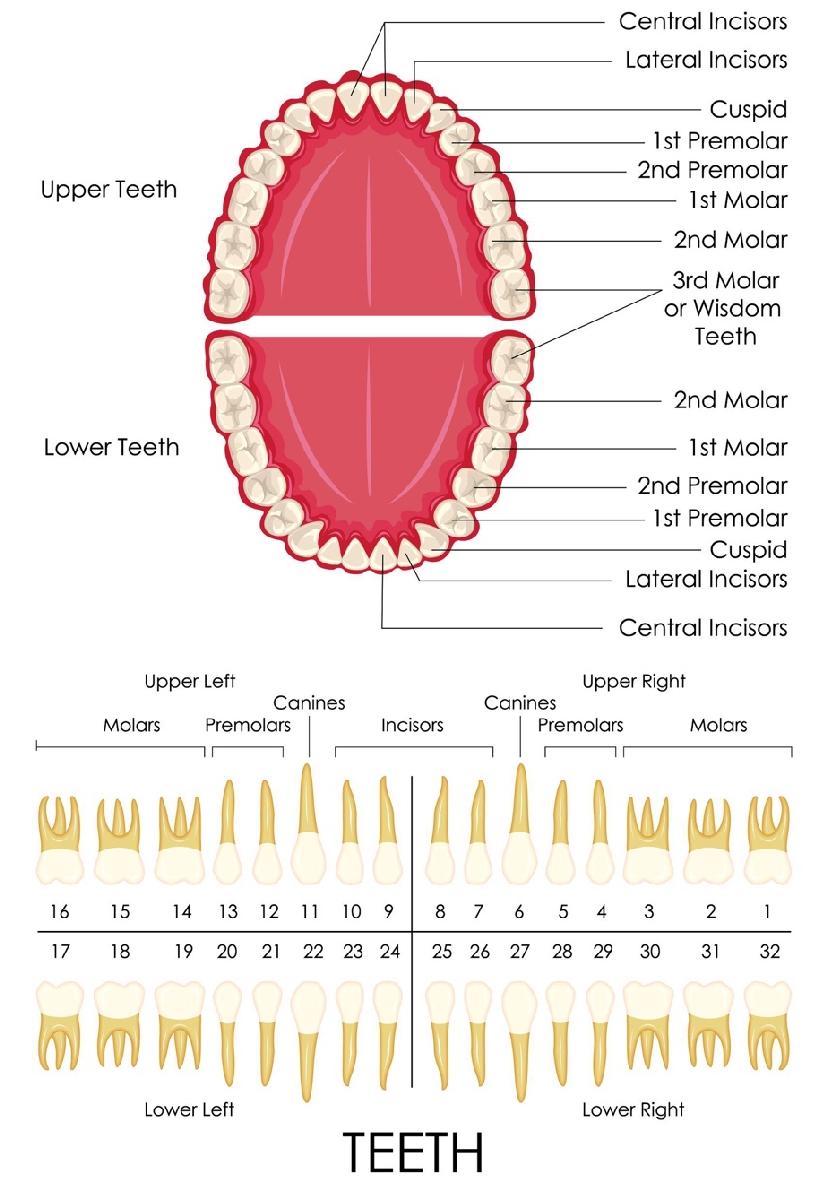
Fig. 1 Anatomy of the mouth
Boldly go into the great and vast unknown.
Ann Allen
I stood at my bathroom sink, staring into the face in the large mirror before me. My left cheek was slightly swollen and my jawbone tender from the oral surgery I had just gone through that morning. This was the last of my three dental surgeries, which had spanned over a year. On this memorable morning, my dentist had opened up and cleaned out the extraction sites of two of the four wisdom teeth that had been removed when I was twenty. Now that these cavitations were properly treated, my jawbone could fully heal.
At a very basic level, cavitations are voids in the jawbone, or –– more simply — holes. More than that, cavitations can be highly toxic holes in the jawbone, because they potentially can harbor chronic infection. For the last thirty years, these cesspools of pathogenic bacteria and their toxic waste had continuously seeped from my jawbone into my body. I believe these toxins burdened my immune system and changed my body’s chemistry, causing a myriad of symptoms. The remedy I chose for this problem was to surgically clean out the dead bone tissue and toxic waste from the boney socket so that the area could permanently heal.
For the past thirty years I strove to live a normal, productive and happy life amid mysterious illnesses that were my constant companion. Today’s final surgery turned off this fountain of toxins. The majority of my symptoms I had struggled with for so many years were finally gone.
Sighing deeply, I felt the last bit of tension in my shoulders give way. I was tired and sore, but a deep sense of appreciation welled up inside me as soft, gentle chills cascaded through my body. Absent-mindedly, I reached for the heart pendant that rested against my chest. The necklace, a gift from my husband, had accompanied me on all three surgeries. This striking pendant had several small semi-precious stones embedded into the surface, with cutout gold stars, a half moon and engraved shapes. On the back of the heart the artist had engraved, in a feminine script, “Boldly go into the great and vast unknown.”1
Shifting my gaze, I focused on the view in the mirror out the window that was behind me. I could see the dark-green pine trees in my neighbor’s yard. Further beyond I saw the brilliant blue sky, red rocks and rough terrain of Sedona, Arizona. In the mirror I watched two hawks climb in the sky and glide out of view. I had been a pioneer, boldly going into the great and vast unknown to explore the connection between the health of my mouth and the health of my body.
In my many years of going to doctors, with one exception, not once did a doctor look into my mouth to examine my teeth or gums or even to ask me about my dental history. Doctors overlook the mouth when they assess health and well-being. The mouth has been exiled by the medical community and sent off to the exclusive domain of the dentist.2 I strongly believe that the mouth can become the origin of, or at least a factor in, chronic disease and debilitating illness.
The mouth has a great deal to tell us about our health. It is the gateway to the body and to physical, mental, emotional and spiritual health. The oral cavity, with its seven hundred types of bacteria, is home to approximately ten to fifty billion bacteria, which is the immune system’s first line of defense. The oral cavity takes in nourishment and prepares it for digestion and the assimilation of nutrients that keep the body running smoothly.
One of my favorite Greek mythologies illustrates the importance of what goes into our mouth. Zeus and his wife Metis, the Goddess of Prudence who acted as his advisor, were expecting their first child. Zeus worried about the prophecy that foretold the overthrow of his rule by his second child, as Zeus had done to his own father. Zeus’s solution was to trick Metis into turning herself into a fly –– and then he swallowed her. Their daughter Athena, the Goddess of Wisdom, later sprang from his head as a full-grown woman dressed in armor. As for Metis, the goddess lived inside of Zeus, nurturing and nourishing him with her wise counsel.
Metis symbolically portrays the inner resources of wisdom, insight and clarity that reside within our own body, heart and soul. We have been taught to discount and distrust these critical gifts, which are an important pathway to self-acceptance, self-love and self-care. We all have access to these inner resources, but what we place in our mouth, whether it be food, drink, medications or dental work, influences how well we can hear the authentic voice of our own wise and loving inner counsel. Placing unhealthy things in the mouth affects the body and mind in undesirable ways that distort and turn down the volume of our inner counsel into an inaudible whisper. This ability to connect with our inner counsel –– in the form of our heart, gut instincts, knowing or intuition — is critical to the overall quality of our lives. It affects how we think and feel, and whether we can express ourselves authentically. To keep the mouth as healthy as possible is a sacred responsibility, and an act of supreme self-love.
The mouth is a sacred organ. The King James version of the Bible tells us, “For of the abundance of the heart his mouth speaketh” (Luke 6:45): the heart being the channel for gratitude, kindness, forgiveness, resilience, and most of all, the power of love. The mouth is the avenue for the flow of wisdom from our soul. The Bible says, “For I will give you a mouth and wisdom” (Luke 21:15). Through the mouth we express our creativity, ideas, thoughts and emotions. The mouth gives clarity and form to our hopes, dreams and desires. The mouth connects us to family and friends and allows us to share, support, nurture, and pass on the stories and the wisdom of others.
Our culture is full of idioms of the mouth that colorfully describe different concepts. We say:
The mouth may well be the root of all evil, as well as a megaphone that announces our humanity, love and thirst for connection and knowledge. The mouth is a critical instrument of pleasure and pain that shapes and defines us throughout our lives. By what we choose to communicate to others, our lives become a matter of discovery or denial. Despite the importance the mouth plays in our culture, we do not understand the ramifications of placing things into the mouth that have no business being there. We have not figured out that what goes into our mouth affects the overall functioning and health of both the body and the mind.
Through the art of dentistry, many people still have mercury fillings. Others have combinations of dissimilar metals such as copper, titanium, cadmium, beryllium, zinc, nickel and mercury. Dissimilar metals act as a battery to create a “galvanic current.” I believe we allow dead, “non-vital” teeth to remain in our midst through a process called root canal treatment. We are taught to believe that anything that is done to the mouth does not affect our overall health.
I have learned a great deal as I sought optimal health these many years. One of my favorite presidents, Ronald Reagan, said “Trust, but verify.” I wanted to understand the possible causes behind my symptoms. On this journey, I did my own research and asked hard questions that the medical community could not answer: What is the root cause of my illness or disease? Would the medicine they prescribed give my body what it needed to heal, so that I could permanently resolve the problem? Would the treatment make my body stronger and more resilient?
The medical community could help me manage symptoms, but could not give me solutions. We were speaking in two different languages. Left with no choice, I had to depend upon my own inner resources. As I studied the human body, I found answers in natural health, nutrition and functional medicine. Through research, and trial and error, I tried different supplements, herbs and natural therapies in order to help myself heal. I realized along the way that I often made decisions with my mind but without consulting my heart. This never ended well. Slowly, I learned to ask myself “Is this really best for me?” and “What are the different options I can explore?” and “What would best meet my needs?” I learned to be patient and wait for the answers in order to take inspired action.
The words “decision” and “choice” are used interchangeably, but I now see them as two different steps of the same process. The mind makes decisions. The heart makes choices, through knowing that at this very moment nothing else will do. Choices can only be made after decisions have been decided upon. Decisions take work, research and effort. Decision-making is a process for the mind as it gathers and sifts through information in order to present acceptable options. Once these options are understood, the next step is to make a choice. A choice is a yes or no from the heart that originates from a feeling of what is authentically correct at that moment.
As I used this decision-making model, I observed that joy always followed in the unfolding of the path that I had chosen through my heart’s intuition. Along the way, synchronicities surprised me, desires were fulfilled and questions answered. The result has been a profound sense of satisfaction, peace and success. I absolutely know that I have taken the right steps for me to reclaim and assume control of my health and well-being. My results speak for themselves.
After thirty years, my search led to biological dentistry, which solved the majority of my problems and I believe revealed the root causes of my symptoms. I experienced first hand that the answers I sought about my health and life ultimately reside within myself. I strove to live authentically, to have my external world reflect my inner one in which I wanted to live. My decisions and actions flowed from my own inner values and what was meaningful to me, instead of from the status quo of other people and organizations that have their own agendas. I learned not to fear the judgment of others, or even my own. I became free to be in the moment to choose what was most life-giving to me. Living authentically can be a challenge, but it is also a joyful and useful pursuit.
The culture of medicine and dentistry is slowly changing. No longer are the doctor and dentist the authority of knowledge and decision-making. We are beginning to move towards a patient-centered approach where the doctor and patient work as a team. I believe this can empower the patient and result in better outcomes. But this is only a first step of many that must be taken. Patients are responsible to create and live healthy lifestyles and constructively manage stress.
Patients must take responsibility for their health and treatment by doing research, gathering information and asking questions. It is critical to fully understand the benefits and risks of procedures and how they will affect the entire body. Unfortunately, it is up to the patient to search out alternatives or adjunct therapies that support the body during standard medical treatment. Ultimately, patients have the right to access treatments that directly address the root cause of their problems rather than just manage symptoms.
The fact of the matter is that most people do not know anything about their body — the anatomy or physiology or even how it functions. We are at a disadvantage because our bodies do not come with a care and instruction manual. The body is a sacred temple that needs to be treated and viewed as such. We are ready for a paradigm shift about how we view and care for our bodies. Change is inevitable, but there is great resistance because of what we do not know, are afraid of or do not understand.
Today we have incredible access to information, thanks to both the Internet and the many books about others’ experiences, expertise and research. The freedom to choose comes with the responsibility to gain clarity. First, we must understand our needs. Second, we must do the research to become educated. Then, we can use that clarity to make inspired choices. Decision-making requires wisdom: the ability to confidently allow the process to unfold before us with options that are most supportive. This is accomplished by the combined guidance of both the heart and the mind.
As I stood looking into my bathroom mirror that afternoon after my last surgery, I felt so appreciative and blessed for the things I had learned and experienced, and for the people I had met. I now value patience. I discovered that I had to live into the answers I sought. Each bit of information I found, and each experience I had, led me to the next discovery and to new ways to help myself. As I looked for different ways to achieve vitality and better health, my search led me through a long and winding maze of education, lifestyle changes, personal growth, experiences, decisions and choices. Over time, I developed a strong sense of what was correct for me and what might work for my body.
I learned to nurture and support my body naturally. I used natural therapies and supplements to help my body rid itself of wastes and toxins, since my body struggled to accomplish this most basic function. Organic whole foods nourished my body’s natural ability to heal. Functional tests gave me information about what my body needed, and what it was able or not able to do at that moment. I made my mind an advocate for my own well-being. I stopped listening to my mind criticize, judge or condemn me. I began to choose my thoughts the way I do my friends, allowing in only those that would be supportive and helpful. I chose thoughts that would make me feel good about my life, my choices and myself.
My mantra for those thirty years was “When in doubt, throw it out.” I got rid of all kinds of clutter in my life. I sought to reduce the stress on my body, and any stressful situations. I often felt betrayed and thought my body was doing things that were wrong. I now know that my body was doing everything it could to keep me as healthy and safe as possible under the circumstances. I just did not understand the intelligence my body possessed, or the language it used to communicate. It was not until many years later that I was able to “give mouth” to what was ultimately causing the deterioration of my health and vitality –– so that I could eradicate it.
But let no man say what they would or would not do, since we are not judges for ourselves until circumstances call us to act.
Abigail Adams
Two weeks after that final surgery with my biological dentist, I sat on the deck outside my bedroom. The air was crisp and clean. I was surrounded by darkness, but out in the large blanket of the night sky above Sedona, millions of stars quietly twinkled and kept me company. Occasionally a shooting star interrupted the peacefulness as it streaked across the sky. I closed my eyes and made the same wish over and over again on each star. I marveled at the magic and beauty all around me. Out on my deck this evening, anything seemed possible. Life was a gift to be cherished.
Memories flooded back about all I had done over the years to handle my health, and to live as best I could. I started to connect the dots to all the strange health ailments I had experienced over the past thirty years. Before my visit to a biological dentist, I had never heard of cavitations, those infected, stagnant holes in the jawbone. I pictured these cavitations as toxic fountains in my extracted wisdom teeth and two root canals. I felt that my immune system was not only being accosted daily by waste from my own body and the environment, but it also had to deal with an abundant, never-ending array of toxins generated from my mouth. I thought that was why my diets, cleanses and all the therapies and modalities I worked with over the years never gave me results. Everything I did certainly helped to take the edge off, but because the “root cause” was not addressed and removed, my symptoms always came back, and even worsened over time. The answer to my health problems indeed had its origins in my mouth.
Questions that had no answers poured through my mind. I wondered how my life would have unfolded had I not been so sick for these many years. Who would I have been if only there had been biological dentists to remove my wisdom teeth when I was twenty? Where would I be? Strong emotions of sorrow and grief began to surface. I allowed myself to feel and observe them. My body shivered in order to release these emotions one by one. I focused on my breath as I slowly inhaled and exhaled to the rhythm of the twinkling stars.
As I watched the expansive night sky, I experienced sadness, then anger, and finally a sense of relief. I felt sadness for all the lost possibilities and time, anger for having had my health and well-being compromised. I felt relief because this chapter of my life had come to an end. Tears of joy and anticipation for a healthier future quietly rolled down my checks. I embraced my legs in my arms and placed my chin on my knees. I gave myself a much-needed hug as the feeling of appreciation welled up in me. I had entered another transitional phase in my life, which I welcomed. The end of health problems and lack of well-being had come to a close; a new adventure of healing was about to begin. I was curious to see what my body would do now and what it could achieve.
Being sick is a lonely venture. No one could really understand what I went through and its impact on me. Well-meaning people told me that my problems were not that bad, and that I should give up my search and accept the diagnoses my doctors gave me. After all, doctors are the authorities. But I could not ignore the conviction that there was a solution that would bring my body back to optimal health, and that I would find it. This conviction resonated through every bone in my body. It was an absolute knowing that transcended belief. I always knew the answer was out there, waiting for me to find it.
The heart pendant that hung around my neck was a constant reminder that I could not rely solely on the accepted authority of other people and institutions. “Boldly go into the great and vast unknown,” inscribed in a feminine script, reminded me that I had entered territory for which I had no point of reference. I had to become more heart-felt, to go inside myself, and to trust my own inner authority. I had to believe in myself. I learned to remain open, to be receptive and to be mindful of the unconditional love that guided me throughout my journey.
As I went through my surgeries, there were a handful of people who supported me, but many of my friends and family did not share my enthusiasm. They thought I had lost my mind. They consulted their dentists and doctors about my “cavitations” and root canals. They were told that what I planned to do was unnecessary, and that cavitations are not a problem in the mouth. My dental work just could not have any connection to my overall health. To them, my intended course of action was unorthodox.
Dr. Mark Breiner, in his book Whole Body Dentistry, mentions that dentists are not taught about cavitations in dental school even though they are referred to in dental pathology.3 I discovered through my experience that I had cavitations, which were silent lesions, in my jawbone. I learned that cavitations are quite common, often found in the sockets of extracted teeth and root canals. “All cavitations are toxic. If they were not toxic, the jawbone would have healed,” according to scientist Dr. Boyd Haley who has studied these toxins.4 Cavitation surgeries are then the only way for healing of the jawbone to occur and can offer improved health to patients.