Start Reading
About this Book
About the Author
Reviews
Also by this Author
Table of Contents

www.headofzeus.com
To Jack and Flora, with love
Cover
Welcome Page
Dedication
Prologue
The wisdom of trees

1
Thinking about trees
Enlightenment—Autumn—Brown and sticky—Trees of liberty—Foresight
TREE TALE: THE BIRCH

2
Ingenious trees
What trees do—Trees with latitude—Solar panels—Family tree—Pioneers
TREE TALE: THE ROWAN

3
Offspring
Sex before insects—Spring—Making babies—Pioneers—Massive oak—The human hand
TREE TALE: THE APPLE

4
Trees at war
This means war—Conventional weapons—Plan B—Battle of the trees—The wood of life
TREE TALE: THE YEW

5
Trees in company
A palette of forests—Life in the woods—Saint Columba’s coppice—The rarest tree—Woodwards and Pallisters
TREE TALE: THE SCOTS PINE

6
Innovation
Useful lessons—Getting the point—Terraforming Ascension Island—The luthier
TREE TALE: THE HAZEL

7
The Wood Age
Axe, adze and wedge—Summer—The first carpenters—Stonehenge decoded?—The Nobel Prize-winning woodworker
TREE TALE: THE BEECH

8
Engineers
Hormones—Machines—Hydraulics—Bodgers—How tall can a tree be?—Standing up straight
TREE TALE: THE HAWTHORN

9
The Charcoal Age
Material gain—Making charcoal—The sword in the stone—Seahenge—Riddley Walker—Colemen and Colliers
TREE TALE: THE HOLLY

10
Architects
Size matters—The first house—Houses for the dead—Firewood—At home with Saint Columba
TREE TALE: THE OAK

11
Tree pasts
How old is it?—Trees of Middle-earth—Chesapeake—End of the age—How to spot an ancient wood
TREE TALE: THE ELM

12
Tree futures
Heroes—A few words on paper—How to buy a woodland—Forest gardens—Ashington—Winter
TREE TALE: THE ASH
Epilogue
Woodlanders
Preview
Glossary
Acknowledgements
Index
About this Book
Reviews
About the Author
Also by this Author
An Invitation from the Publisher
Copyright
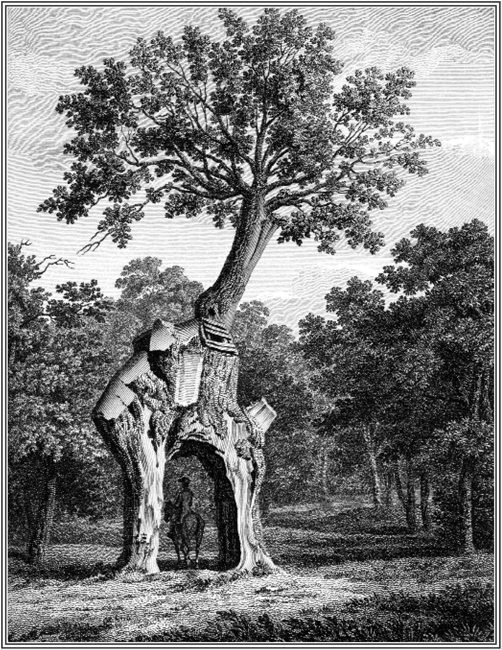
THE GREENDALE OAK
(north-west view)
This venerable oak tree used to grace the estate of Welbeck Abbey, Nottinghamshire, on land enclosed from Sherwood Forest. So vast was the tree’s girth that its owner, the Duke of Portland, decided to gut it in 1724; he promptly won a bet that a coach and six could be driven through it. Sadly, his drastic sculpting set in an inevitable decline and, like an enfeebled invalid, the once virile oak came to depend on crutches in its later years.
Truly trees are beings. We feel that to be so. Hence their silence, their indifference to us is almost exasperating.
JOHN STEWART COLLIS
HUMANS HAVE a natural empathy with their fellow creatures. They will rescue a stranded ladybird and fish a carrot out of their pocket for a lonely donkey. They know that dogs like to play and be part of the gang; that cats look down on them; that pigs regard them as equals. Things have their place. Heaven knows, humans can be sentimental about even the most unprepossessing animals: we credit them with all sorts of emotions and intelligences on the basis that they too can feel pain, conceive of the world around them and have some sort of attachment to their offspring. We think, therefore we are; animals are, therefore they think.
What about trees? Trees are an alien life-form. Like all living things they breathe and reproduce, but do they feel pain like animals? Do they think? The answer is simple: they do not think, because they have no brains; they do not ‘feel’, because they have no nervous systems. They cannot, in any sense, be described as intelligent. They have no plan or strategy for defence or reproduction; they cannot choose their sexual partners, nor decide where to live their lives. Trees do not make choices. They share no organs with members of the animal kingdom, unless one offers the superficial analogy that bark is like skin. Trees know, literally, nothing. And so the whole idea of trees possessing wisdom is pathetic fallacy.
And yet, a lifelong admiration and affection for trees, woods and forests can hardly dispel the impression that they are damned clever. Those ‘plants with a stick up the middle’ (in Colin Tudge’s words), sixty-thousand species of them, are chemically and mechanically sophisticated, sometimes dazzlingly so. They are more resilient than any animal, and some live for several thousand years. Their reproductive capacities are so subtle and refined that it is hard not to credit them with cunning. Trees communicate with one another and strike up partnerships and alliances that one yearns to call ‘strategic’, or ‘purposeful’. There are rumours in the scientific community that they may be able to manipulate sunlight in quantum parcels to make their leaves more efficient.
Hundreds of generations of humans have regarded trees as a source of wisdom: they have been consulted by holy men, by kings, queens and wise women. They have been thought of as sacred, as embodying the spirits of dead ancestors. They are deployed as metaphors for youth and old age; for solidity and sagacity; for fertility, virility and sterility, and for ancestry and evolution. Trees can seem chaste, like the graceful, slender rowan on a rocky hillside; irascible, like an ancient stag-headed oak standing apart in a field; magnificent, like a hundred-foot-tall beech tree with its elephantine muscular grey trunk. In Allouville, Normandy, the chapel of Chêne is built into a living oak tree which is more than eight-hundred years old. On the slopes of Mount Etna the Hundred Horse Chestnut is so vast that it could shade in its hollow trunk the hundred men of a mounted party in a thunderstorm (hence its name). More modestly, the writer and woodsman John Stewart Collis used a favourite ash tree as a summer tool shed. In Africa baobab trees have been used as prisons and classrooms, sanctuaries and water reservoirs; in Ireland, hollow trees became hermitages for Dark Age monks seeking solitude. In Germany, early Christian missionaries cut down trees that had been sacred to the native pagans, as if afraid to let them live. In India, the fig tree is not only sacred but also an embodiment of the human psyche and a dwelling for the gods: the tree beneath which the Buddha gained enlightenment. Trees have their practical uses, to be sure; but they are never just practical. Our affinity with them runs deep, and it is complex.
It is a mere two hundred and fifty years since wood was superseded by iron as the fundamental material on which the great human experiment was founded, and for almost all of our cultural history trees and woods have played the role of provider and teacher. Only in that last quarter of a millennium have we begun to look beneath the bark of the tree with instruments unavailable to our curious prehistoric forebears, whose interest was intimate but largely practical. They knew that you could split a log lengthways but not across its grain; that you could work it green, and bend and shape it with fire and steam. They knew that some woods burn better than others, while some are more useful for building. They knew which trees and woods were poisonous or tainted food and which could be processed for medicines such as those we call aspirin and quinine. They knew which trees came into leaf and fruit at different times and which attracted different birds and insects. Knowing trees and their materials was our first survival tool and it was a knowledge acquired empirically. Trees behave, and our hunter-gatherer ancestors were keen observers of behaviour in the natural world. Since the eighteenth century scientists have begun (but only begun) to decode the secrets of trees’ success. It turns out that they are more subtle and extraordinary than we could have imagined.
If you live in a packed modern city like Hong Kong you might manage to live much of your life without seeing trees. Even in the leafy cities of Europe you could be forgiven for not noticing them—until they are felled or die. But for much of our shared past, trees and the materials we harvest from them have been intimate, even decisive, partners in our own cultural and physical evolution. Our prehistoric ancestors came out from the forests of a drying Africa to embark on their remarkable biological and cultural journey towards a new species, so in a sense we are the children of forests. If trees are not our teachers, we are at least their pupils. They have given us shelter, medicine, shade, food and fuel in great abundance. Forests are the earth’s lungs and climate-regulators, habitat-protectors and the greatest reserves of biodiversity. Most importantly, I think, the brilliance with which trees have evolved and adapted over the last 200 million years and more offers us an open-air interactive classroom and laboratory from which to learn about survival and defence, partnership and sustainability, conservation and the endless creative possibilities of nature.
This book is called The Wisdom of Trees not because trees are wise, but because we would be wise to learn from them.
Enlightenment—Autumn—Brown and sticky—Trees of liberty—Foresight—
TREE TALE: THE BIRCH
Then I spake to the tree Were ye your own desire What is it ye would be? Answered the tree to me I am my own desire; I am what I would be.
ISAAC ROSENBERG
EMBARK ON A TOUR of the Uffizi Gallery in Florence and you might get a little bored, if you take it in chronological order, looking at all those idealized portraits of madonnas with their improbable-looking child. It is worth the tedium, though, because when you get to the room in which the Botticellis hang, it stops you in your tracks. Primavera, the Florentine artist’s 1482 masterpiece depicting a stellar line-up of Venus, the three Graces, the goddess Flora and assorted wood nymphs, is quite stunning. As with all great paintings, you really have to see it in the flesh. Here is the essence of the Renaissance distilled into heady spirit; here, for the first time since the faded glories of the Roman Empire, the female form is painted not as an objectified icon but as sexy, fertile, provocative and alluring. The portrait of Flora, the goddess of plants, bedecked in flowers and heavy with child, seems to mark something new in art, a step-change in enlightenment: human, imperfect, utterly real and absolutely recognizable and attractive to the modern eye. One of the many fascinating aspects of the painting is its portrayal of plants—more than a hundred-and-fifty species, according to those who have studied it. But looking at the trees in the background the arborist must be disappointed: they are mere stage scenery. If the Renaissance rescued humans from an unattainable medieval ideal of sinless piety, then trees had to wait another three-hundred years, at least in Europe, for their artistic liberation.
Move on three-hundred years. James Ward’s much more modest watercolour sketch of An ancient oak, painted perhaps in the early years of the nineteenth century (and now in the Garman Ryan Collection at Walsall Art Gallery, West Midlands) does for trees what Botticelli’s Flora did for women. So far as I can tell, it is the first portrait of a real tree in the Western art tradition. This is no idealized representation of the tree as a metaphor for anything so crude as fertility or liberty; it is no wistfully Romantic natural furniture, of the sort that decorates much early British landscape painting. This is a tree shorn of its setting in the years of its dotage: stag-headed, lightning-blasted, stunted and hunched, a crabby geriatric bearing few branches and fewer leaves, and which reminds one of nothing so much as the ageing Voltaire, sculpted by Houdon in marble in 1781, during the grand philosophe’s last years; he is dying but still full of fire and, like Ward’s decrepit oak, deeply wise. The similarity is perhaps intentional: maturity and its twin, decline, evoke sympathy and admiration, pity even, and the Age of Enlightenment was an age of pity and compassion as well as of revolution. It was also the age of the individual, an era of reflection in which thoughtful men and women pondered the question: what has all this change brought us? What have we gained… and what have we lost?
James Ward’s ancient, knowing oak might easily have grown from an acorn dropped from a tree during the Renaissance.
It is autumn: one of the most beautiful that I can remember. Every shade and hue in nature’s paintbox is on display, all saturated by the low sun or by each passing shower. The days are shortening, and from beneath the dripping rain-soaked yellow and orange leaves of a spreading beech tree the woodsman looks out on a damp, musky, mizzly world, which appears—to the casual walker—as if it is shutting down ready for winter, like an ice-cream parlour at the seaside. A gust of wind barges through the canopy and a shower of raindrops clatters onto the bed of leaves covering the woodland floor. All the colours from yellow to brown, red and purple, faded green to orange are there in an artless, unrepeatable pattern. Then, silence; at least, for a minute, until the ear tunes into another range, more subtle. The wood is not, as it first seems, silent. Nor is it passively waiting for the snow and ice of January. It is a busy place; and the woodsman has a billhook in hand.
Animals and birds are in a race against time: fighting over bright red berries on holly trees, rowans and whitebeams, on hawthorns and guelder rose, over shiny black sloes on blackthorn (if the sloe-gin makers have not beaten them to it) and over the hard red hips of the briar. Pigs, if we allowed such beauties in our woods once again, would be snuffling under leaves for beech mast and acorns. In their place, squirrels are burying hoards of hazelnuts, and jays—those splendid, squawky, blue-flashed robbers—are prodding acorns into the ground in small clusters. Without these animals there would be no natural oak or beech woods; they are unwitting partners in the cycle of reproduction in which trees rely on the rest of nature to do their work for them. And as if to reinforce the message, another gust of wind brings down a veritable squadron of helicopters, as sycamores shower the rides and glades of the wood with their propellered seeds.
Small mammals like hedgehogs and dormice are fattening up ready to hibernate; others are on the prowl and missing the summer vegetation that gives them cover. Badgers, especially this year’s young, are enjoying the drawing-in evenings and are out foraging for worms, nuts and anything else they can get their greedy claws on. Many summer-breeding birds have flown to milder lands; but tits and chaffinches are gathering into winter flocks and will take any opportunity throughout the cold months to feed on whatever insects they can find. Robins begin to stand out with their red breast feathers and penchant for human company; wrens in pairs are looking for discreet nesting sites. Occasionally, two-footed animals can be seen basket in hand, picking berries off brambles or looking for mushrooms that have emerged mysteriously in the night. In my first wood, where my partner and I lived for three years in a caravan with our baby son, we jealously guarded the secret of a patch of parasol mushrooms, which used to grow under a very broad, dense holly tree just next to a footpath. People often used to come in and take holly for their Christmas wreaths; that was alright, so long as they didn’t find the mushrooms, which we fried in butter: they tasted like the juiciest steak.
Trees are busy too, if one takes a careful look. The colours in those autumn leaves are produced by bespoke recipes of hormones designed to extract the last sun-kissed sugars and nitrogen before a lethal dose of abscissin seals off the leaf stem from the twig and allows wind or rain to pluck it away. Broadleaved trees get so little light in our northern winters that it is not worth their expending the energy needed to keep their leaves until spring. Besides, as every good sailor knows, in a dangerous wind one reduces sail: trees are taking in a reef, so that the deadly blasts of December gales do not bring them down. The only great storm of my lifetime, and I remember it vividly (windows and doors blowing in; chaos on the streets of South London; dazed people standing in the road and staring at the aftermath), happened during October 1987, before the trees were ready for it.
Trees are not just getting rid of leaves and dispersing seeds. They are preparing for the following spring. Take a close look at a twig which still has leaves on it and you will see that next year’s buds have already formed—tiny, green and shiny on sycamores and hazels, orange on the little knuckles of oak buds, and like fine pen-nibs on the beech, or, in the case of the ash tree, jet matt black. It takes a lot of energy to create the bud, and that is done with the last of the autumn’s solar power. It must be done in good time so that buds harden off before the first heavy frosts. Come spring, the tree gets a head start as it draws on reserves of sugars and fats stored in its wood and roots to turn those buds into leaves.
For the woodsman, this is a time of anticipation. Summer is a season for making and mending, building and selling; for leaving the trees to get on with what they do best. Once the leaves have fallen it is time to cut wood: to stack and season it for the following autumn when it will be used as firewood; or for the spring after that, when it can be burned in a kiln to produce charcoal. Most broadleaved trees will, when cut clean down to the ground, grow again; but timing is all. Coppicing, as it has been called for at least a thousand years, is best undertaken when the leaves have gone: the trees are easier to get at with billhook or chainsaw; the woodsman can see better to decide which shoots to cut and which to leave to grow into mature timber trees. And then, one must be careful not to disturb trees’ natural rhythm. Cut too early and the stump will produce shoots that then don’t have time to harden off; cut too late in spring and, aside from the possibility of disturbing nesting birds, the tree will have used precious energy on sap which it needs for re-growth and which the woodsman doesn’t want in the log (or on the hands or clothes). So I wait impatiently for those damp, dank days of November when I can join the rest of the woodland community quietly, or not so quietly, going about our mutual business.
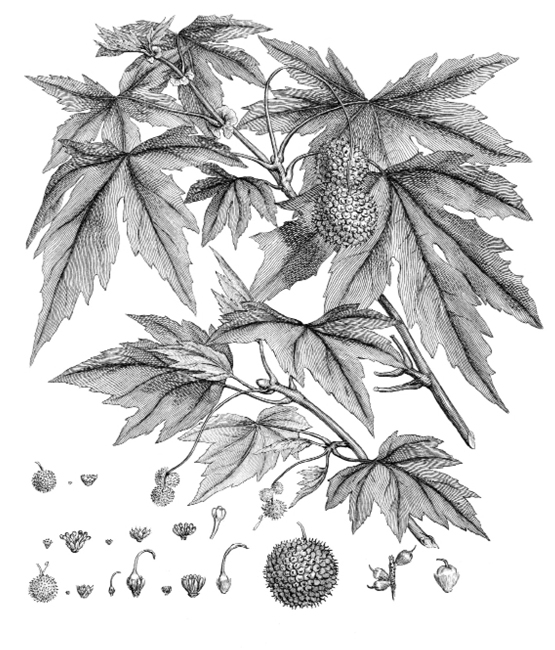
ORIENTAL PLANE
Famously, if erroneously, called by the English the London Plane (which is, in fact, a hybrid), this tree sheds its bark (and urban pollutants) in large scales to create beautiful patterning on its trunk. I have sat under the plane tree on Kos beneath whose branches Hippocrates taught medicine. I doubt if the same tree has been there all the time; but it still provides wonderful shade from the hot Aegean sun.
‘What’s brown and sticky?’ ‘A stick’. So goes the children’s joke about the humblest of playthings. It is amazing what you can do with a simple stick. Chimpanzees use them to tease ants from holes, so it’s a fair bet that the very earliest humans used sticks for all sorts of useful jobs. A few animals employ sticks in one way or another, but only humans have ever learned to dig for luscious edible roots with them, turn them into spears or arrows, or rub them together to make fire.
Sticks are also very useful for measuring things. Have you ever wondered how tall a tree is? You aren’t allowed to chop it down to find out, so what do you do? First, find a stick, about the same length as a ruler, or a bit longer. Stand back from the tree you want to measure, close one eye and hold the stick out in front of you as far as you can in one hand. With your eye, line up the bottom of the stick with the bottom of the tree and the top of the stick with the very top of the tree. You might have to move nearer or further away, until you get it just right.
Now, rotate your hand ninety degrees so that the bottom of the stick is still in line with the bottom of the tree, but the stick is now parallel with the ground. Get a friend to stand at the bottom of the tree with their back against the trunk. Then, tell them to walk directly away from the tree at right angles from your line of sight until you see that they are in line with the far end of the stick. Ask them how many paces they have walked. The distance they have covered is the same as the height of the tree. If you want to be really accurate you could measure how far they have walked with a long tape, or work out the average length of your friend’s pace. To double-check, swap roles to see if you and your friend get the same result.
This might seem a trivial use for a stick. But early navigators realized that, with a similar method, the sailor could achieve an idea of distance and speed by measuring the changing size of a landmark at sea and its relationship to the ever-cycling angles of sun, moon and stars.
The tree, which spans the gap between the underworld and heaven, between birth and death, ignorance and wisdom, has provided a potent symbol through all the human ages. Genesis tells how the first people, Adam and Eve, were expelled from the Garden of Eden for tasting the fruit of the tree of knowledge of good and evil: that is to say, knowledge forbidden them by their master. This is not a tale of sin, but of wilful disobedience and the desire for humans to liberate themselves, as Prometheus did when he stole the secret of fire. But the tree represents more, much more, than mere knowledge. As a sacrificial scaffold it is older than Christianity. The grim irony of identifying the skull of a defeated enemy or criminal, impaled on a stake, as a fruiting tree taps into a very ancient and dark iconography that runs through the Christian crucifixion and the martyrdom of Northumbria’s seventh-century King Oswald at Oswestry (‘Oswald’s tree’, or Croesoswald in Welsh) to the medieval gibbet and gallows and, in more recent times, to the Strange Fruit hanging from the Southern poplar trees, in Billie Holliday’s tragic lament for the African American. Each time, it is a sacrifice for the freedom of a greater humanity, as Odin sacrificed himself on Ygdrassil, the great World Tree (an ash) of Norse mythology.
The tree has also been appropriated by revolutionaries seeking a more concrete form of liberation than Adam and Eve, whose curiosity was theoretical. In 1765, beneath an elm tree that stood close to Boston Harbor, a group of radicals calling themselves the ‘Sons of Liberty’ congregated to demonstrate their hatred of British tax laws. They hanged an effigy of a British government representative from the branches of this tree, and their ironic inversion of the gallows as a symbol of death into an icon of freedom stuck when they nailed a sign to it: ‘The Tree of Liberty’. In 1787, in a Paris simmering with insurrectionist tension, Thomas Jefferson wrote that ‘The tree of liberty must be refreshed from time to time with the blood of patriots and tyrants. It is its natural manure.’ And so sacrifice and ultimate freedom, the grim twin sides of knowledge, are combined in the tree. Liberty elms were planted in many communes across France, and in American towns. For Scots poet Robert Burns, tapping into this idealistic sentiment in his own Tree of Liberty, such freedoms were not yet to be found in the country buttressed by the wooden walls of its navy...
Let Britain boast her hardy oak,
Her poplar and her pine, man,
Auld Britain ance could crack her joke,
And o’er her neighbours shine, man.
But seek the forest round and round,
And soon ’twill be agreed, man,
That sic a tree can not be found
’Twixt London and the Tweed, man.
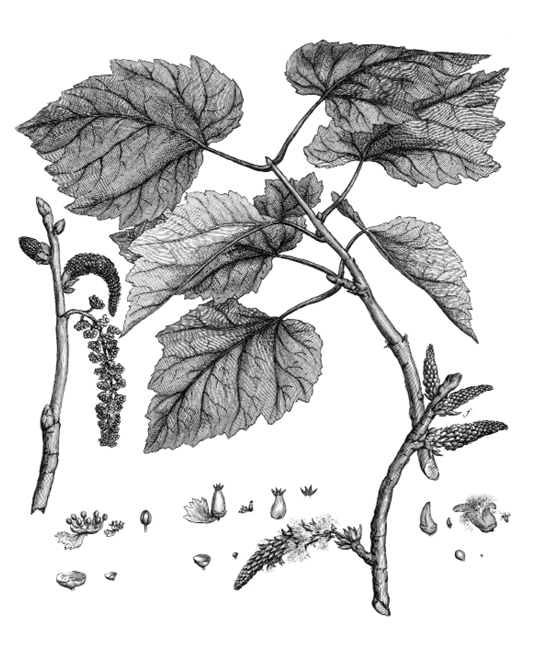
WHITE POPLAR
A line of these tall, elegant trees shades my garden in the evening. Their leaves, in early spring, have the colour of verdigris; but the white poplar is not a native of the British Isles.
In a James Gillray cartoon of 1798, Satan—a serpent in the guise of Whig Opposition leader Charles James Fox—tempts John Bull, the honest soul of England, with luscious fruit bearing the labels ‘slavery’, ‘treason’, ‘atheism’, ‘plunder’ and so on, growing from branches inscribed with the ‘Rights of Man’ and ‘Profligacy’, which sprout from a withered, stunted trunk of Opposition. The marvellous ironies of James Ward’s portrait of An Ancient Oak are lost here beneath suffocating polemic. The roots are ‘Envy’, ‘Ambition’ and ‘Disappointment’. But loyal John Bull already has his pockets bulging with juicy pippins, the fruits of honest labour. In the background stands a noble royal oak (a reference to Charles II) with a trunk labelled ‘Justice’; its roots are ‘Commons’, ‘Lords and King’, its fruits ‘happiness’ and ‘freedom’.
The metaphor stuck. During the Great Reform debate of the early 1830s, a cartoon entitled The Reformers’ Attack on the Old Rotten Tree took an easy swipe at the notorious ‘rotten boroughs’, whose electors were and had always been ludicrously unrepresentative of the population as a whole. (Old Sarum in Wiltshire, for example, returned two members to Parliament; but the constituency was home to no humans at all, only cows and sheep, it being the long-abandoned remnants of an Iron Age hillfort.) In the etching, the king and his cronies sit on Constitution Hill, looking down on the Reformers—a motley collection of Whigs, Unionists and general rabble-rousers—taking their axes to the tree, while on the opposite side stand the conservative supporters of the status quo: the Duke of Wellington, Robert Peel and the like. That political tree was cut down in 1832, when the Great Reform Bill offered the promise of a reformed Parliament, an end to corruption and a much-expanded electorate; but a sapling grew in its place which looked very like it.
We do not plant trees for ourselves, but for the generation after next. In Sir Walter Scott’s novel The Heart of Midlothian, the Laird o’ Dumbiedykes advises his son: ‘Jock, when ye hae naething else to do, ye may be aye sticking in a tree; it will be growing, Jock, when ye’re sleeping.’ It is a matter of the greatest satisfaction to find that trees grow even when I am not looking at them.
Literature provides other encouragements, too. The wise men who created the Hindu text Matsya Purana sixteen-hundred years ago wrote that ‘if anyone plants at least one tree, then he will be able to stay in the heaven of Indra for thirty-thousand years’. Giles Winterborne, Thomas Hardy’s ill-fated Woodlander, ‘had a marvellous power of making trees grow. Although he would seem to shovel in the earth quite carelessly there was a sort of sympathy between himself and the fir, oak or beech that he was operating on.’ His unrequited admirer and heroic fellow-woodswoman, Marty South, was so sensitive to the trees’ inner life that when ‘she erected one of the young pines into its hole, and held up her finger, the soft musical breathing instantly set in which was not to cease night or day till the grown tree should be felled—probably long after the two planters should be felled themselves’.
Admiral Lord Collingwood understood the Royal Navy’s reliance on oak trees better than most. After one of his ships, constructed as it turned out by a corrupt shipwright, virtually sank beneath him as he sailed, he remarked that he had been afloat for six months with nothing but six inches of planking between him and eternity. An early, exemplary conservationist, he famously walked the hills and lanes of Northumberland with a pocketful of acorns, planting them in hedgerows and patches of waste ground so that Britain’s navy should not want for oak trees; he adjured all gentlemen to do the same. His oaks still grow in those hedgerows, just in case we ever need them. In 2010, on the bicentenary of his death, his great-great-great niece Susan Collingwood Cameron planted a new Collingwood oak at the mouth of the College Valley in Northumberland, in sight of a plantation that the admiral commissioned from afar during his last, fatal, seven-year deployment as commander-in-chief of the Royal Navy in the Mediterranean.
John F. Kennedy was fond of telling a story about the French Marshal Hubert Lyautey (1854–1934), who once asked his gardener to plant a tree. The gardener objected that the tree was slow-growing and would not reach maturity for a hundred years. The Marshal replied: ‘In that case, there is no time to lose; plant it this afternoon!’
Alfred the Great reigned from 871 to 899, at a time when the Anglo-Saxon kingdom of Wessex was under the direst threat of destruction by Viking armies. But in later life he was able to contemplate some of the simpler joys of life in the preface to his translation of St Augustine’s Soliloquies:
I then gathered for myself staves, and stud-shafts, and cross-beams, and helves for each of the tools that I could work with; and bow-timbers and bolt-timbers for every work that I could perform—as many as I could carry of the comeliest trees. Nor came I home with a burden, for it pleased me not to bring all the wood home, even if I could bear it. In each tree I saw something that I needed at home; therefore I exhort every one who is able, and has many wains, to direct his steps to the self-same wood where I cut the stud-shafts. Let him there obtain more for himself, and load his wains with fair twigs, so that he may wind many a neat wall, and erect many a rare house, and build a fair enclosure, and therein dwell in joy and comfort both winter and summer, in such manner as I have not yet done.
I have been cutting birch this last winter. It is a woodsman’s pleasure, pre-eminent among many others. Birch trees grow slender single trunks for the most part; and since their branches are admirably angled at forty-five degrees to the trunk, when you trim them with a billhook a single satisfying thwack does the trick: you are left with a clean, smooth straight trunk to be cut into four-foot lengths. These are stacked in cords, four feet wide by eight feet long by four feet high. At one end the logs rest against the trunk of a tree; at the other a stake is driven into the ground and a cord (hence the name, perhaps) is tied between it and the tree. A cord of hardwood, when dry, weighs about a ton and has been the forester’s measure of underwood for centuries. Walking through a well-managed wood among ripening cords is immensely satisfying. Birch wood burns hot, although it can spit on an open fire and is best kept for stoves. It makes good charcoal and the wood has often been used to make light-sounding, resonant drum shells (I have a lovely birch snare-drum) as well as charming rustic furniture.
After the cord wood has been stacked, the long thinning remnant of the main stem goes onto a neat pile destined for the stove in the cabin. The feathery tops can be bundled into faggots to fire an oven or kiln; they can equally be used to make the broom heads called ‘besoms’—the traditional witches’ broom—or sold to racecourses for their jumps; in Scotland they were traditionally cut short and used as whisks. Nothing is wasted. Even the leaves can be used to make a green dye.
The birch will grow again from its stump, this time with several shoots, and meanwhile the leafy earth has been opened up to the light and next spring all sorts of plants will make use of the sun: primroses, wood anemone, ramsons and, if we are lucky, bluebells. I leave plenty of the older trees in, because they play host to all sorts of insects; a really mature birch tree will have holes in its trunk to accommodate nests, and when dead and hollow it makes a terrific drumming tree for any woodpecker after a mate or wishing to advertise a territorial claim. My aim is to nurture a birch wood with trees of differing ages, otherwise there would be, in a generation or so, lots of dying trees and none to replace them. Unlike an oak or beech wood, birch woods tend not to self-regenerate in the long term because the seeds prefer open, disturbed soil to germinate successfully and the trees are eventually shaded out by oaks and beeches, the bullies of the woodland playground. One must think ahead: woods are a gift for our grandchildren.
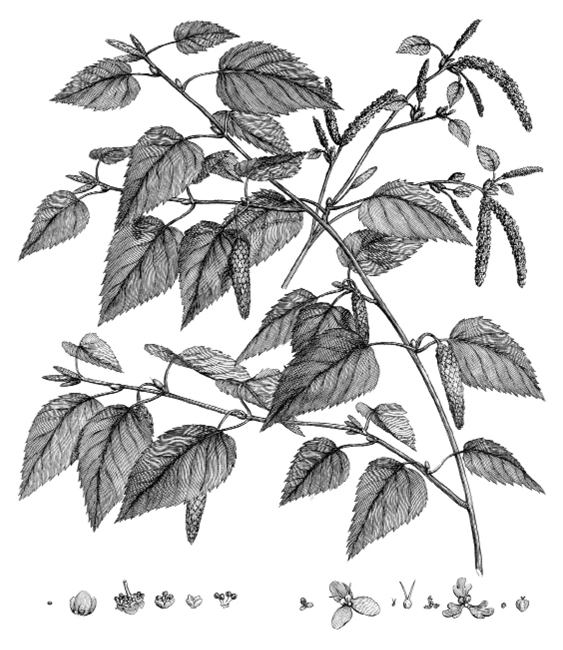
BIRCH
This modest tree has often been undervalued as a component of our woods; but I like to think that if it were ever in danger of disappearing, our poets would come to its rescue.
Samuel Taylor Coleridge described the silver birch (Betula pendula) as the ‘lady of the woods’ and, to be sure, at its best it is a most elegant creature, wonderful to watch in a breeze in late spring when the leaves are fresh and delicate. But the lady does not mature like an oak or beech; birch forests are the forests of the far north. Graceful it may be, and hardy too, for birch is a colonizer of broken ground like railway embankments, or previously frozen lands, and was the first tree to arrive in Britain after the last Ice Age; but once its job of preparing the ground for other trees is done, it surrenders to them, rarely living beyond eighty or a hundred years. The pollen is spread by wind and so are the tiny, prolific seeds—the birch has no need of animal or insect partners in its reproductive cycle. Because it is not prized for construction timber it has often been undervalued as a component of our woods; but I like to think that if it were ever in danger of disappearing, our poets would come to its rescue.
Even so, birch is prized in other ways. Hunter-gatherers of the northern lands have used birch bark as a strong, flexible and durable material for making lightweight canoes and punts as well as delightful boxes and baskets; the tree can be tapped in spring for an ‘interesting’ sugary wine. Indeed, the name ‘Birk’, found frequently in Scotland (including Birk Hall on Deeside, once owned by Prince Albert, now by Prince Charles), records such ancient value of the birch to small communities. The shiny white or light-brown outer bark peels in a satisfying way like sheets of paper, a use to which it has been put in the past. This peeling layer allows the tree to shed pollutants and clean out its breathing pores. For the woodsman it has the crucial property of storing waxy resins. The Mesolithic hunter-gatherers of Star Carr, North Yorkshire, used pitch from birch bark to glue arrow-points to their shafts. On a recent walk off the beaten track across the Anglo-Scottish border I carried a very small compact wood-gas stove, which I was able to fuel with sticks as I found them; but I carried a waterproof bag of precious (and almost weightless) birch bark to make sure I would never want for an instant, very hot, firelighter. In almost two-hundred miles it never failed me, rain or shine.
What we learn from the modest birch is that someone has to put the hard work in first before all the glory is reaped; but also that being good at a few small things is just as important as being the showstopper on the big stage. Birch is our set-builder. Perhaps its most unusual and showiest role in the grand theatre of history was as the material with which ninety-five per cent of Howard Hughes’s notorious—and mis-named—Spruce Goose wooden flying boat was constructed. It flew just once, in 1947. At the time it was the largest aircraft ever built, bigger than a Jumbo jet.
Britain’s tallest birch, according to the Tree Register of Great Britain and Ireland, is a triple-trunked specimen growing at Gray House in Liff, Angus. At about eighty feet it’s an impressive beast, but it is unlikely to make it past the end of this century.
What trees do—Trees with latitude—Family tree—
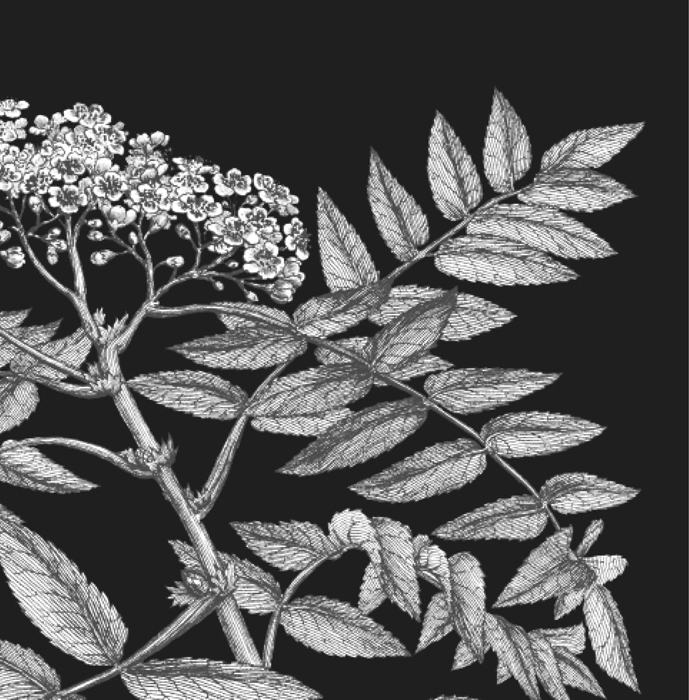
TREE TALE: THE ROWAN
We all travel the Milky Way together, trees and men... trees are travellers, in the ordinary sense. They make journeys, not very extensive ones, it is true: but our own little comes and goes are only little more than tree-wavings—many of them not so much.
JOHN MUIR
TREES ARE SO COMPLICATED and so unlike animals that scientists are only a very small part of the way towards understanding them at the most intimate level. They are biological marvels. But it is worth starting with the basics. What does a tree do? I have heard that clever engineers are trying to construct from ultra-modern materials a device that will trap carbon dioxide, harvest sunlight and not pollute the planet. (Good luck!) In case these engineers want some idea of how to go about it, here is a specification for such a device. The task is to construct a manufactory in which sunlight, water and air are harvested and sugars are produced and refined. Production must be sustained indefinitely; the machine should be able to replicate itself. Here are the necessary competences:
1. Erect solar panels as high as possible to ensure a good supply of sunlight (the power source)…
2. …but also draw water and minerals from as large a volume of soil as possible. (You already see the problem: Nos 1 and 2 are mutually improbable).
3. Combine with other machines to replicate over a wide area for best survival chances (tricky, if the machine can’t move).
4. Find a way of bridging that gap between the sky (No. 1) and the ground (No. 2). Subsidiary tasks consequent on 1–4 include storing energy because of the variable supply of sunlight and the time it might take to process the raw materials; and protecting the mechanism from mechanical failure and attack.
5. Have a Plan B in case it all goes horribly wrong.
6. Enable the machine to seek help from a third party (or parties).
That is all there is to it: solve those few key engineering problems and you have… a tree.
Trees, rather obviously, have a relationship with light: they need it to provide their energy. But not all trees deal with light in the same way, as anyone will know who has noticed how many different types of leaves there are. Conifers have very narrow leaves, often in pairs or trios of thin, dark-green waxy needles. Most conifers keep most of their needles over winter when they can still photosynthesize, albeit very slowly. Each needle requires a small investment and pays it back over a long time, so slow light-gathering is a reasonable way to go about the coniferous business. Conifers do not produce costly flowers, so there is an economy in everything they do. The larches, rather unusually for conifers, shed their needles in autumn like a broadleaf tree, and grow a new set every year. It’—