~Scientific Endorsements~
“After 2,00 0years of searching for light sources used in Egypt, and at the Great Pyramid of Giza complex, we have real answers! This book is one of the most important breakthroughs on the energy source used in ancient Egypt. The evidence of the salt-water battery, mastered by the ancient Egyptians, is the energetic Rosetta Stone that brings many of the missing pieces of Egypt together.”
Dr. Pat Flanagan, inventor, explorer in Egypt, and renowned author for his early work Pyramid Power on the structure and nature of pyramids.
“This book introduces an intriguing concept of how past civilizations worked with insights comparable to current science. The book provides novel concepts that redefine the purpose of these massive structures, the monumental Pyramids can now be grasped by the science of today. There is much more to learn about the ancient Egyptians!”
Elizabeth Rauscher, PhD, nuclear physicist formerly at Lawrence Berkeley National Laboratory and the University of California, Berkeley.
Ancient Energy Research Center, LLC
2285 Eagle Drive, Suite A
Pagosa Springs, CO 81147
www.AncientEnergyResearch.com
earthmilkae@gmail.com
Academy For Future Science
PO Box FE
Los Gatos, CA 95031 USA
www.keysofenoch.org
Www.futurescience.org
Second edition copyright © January 2019 James Ernest Brown, James Hurtak & Desiree Hurtak
Except where otherwise noted. Based on original material by:
Copyright © 1978, 2011, 2012 James Ernest Brown
Copyright © 1993, 1997, 2012 James Hurtak and Desiree Hurtak
All rights and international rights reserved.
ISBN: 978-1-5439649-5-0
Original Title:
Ancient Egypt’s Electrical Power & Gas Generating Systems
This book is fully protected by copyright and no part of it may be reproduced in any form or by any means, including photocopying, computers, audio, visual or any electronic devices for information storage and retrieval systems with written permission from the copyright owners.
Printed in the USA
Introduction
Chapter 1 The Purpose of the Pyramids as Generators
Chapter 2 Finding of the Tomb of Osiris and The Purpose of the Underground Structures
Chapter 3 The Step Pyramid at Saqqara and the Underground Water Tunnels of Egypt
Chapter 4 The Serapeum: Containment and Storage for Volatile Materials
Chapter 5 The Al-Fayoum Region and Salt Water Batteries
Chapter 6 The Luxor and Hathor Temples
Chapter 7 Amphorae & Electrified Water
Chapter 8 Recapping the Evidence
Conclusions
Bibliography
Acknowledgements
The journey of this book began in 1978 when James Brown visited Egypt for the first time. Brown, founder of the Ancient Energy Research Center, is a builder and contractor, so he understands structures from the ground up. He has overseen the design and building of large complexes for nearly fifty years and is the winner of numerous awards. He describes himself as a practical thinker and believes the logic and results of his research need to make practical sense. Since his first trip to Egypt his perspectives on design and construction led him to question the simplistic assertion that the pyramids were built as tombs. Brown met the Hurtaks in 1978 shortly after he returned from Egypt. They were introduced by a mutual friend who realized their shared interest in ancient Egypt. The collaboration and friendship that has resulted in this book is a four-decade journey.
In January 1997, after traveling many times to Egypt, Drs. J.J. and Desiree Hurtak were part of an expedition to Giza, Egypt in search of underground structures. Using ground penetrating radar (GPR) and remote sensing, they were able to locate underground cavities near the Pyramids on the Giza Plateau. One hundred feet below the surface their team did indeed find what became known as the Tomb of Osiris. Dr. J.J. Hurtak and Dr. Desiree Hurtak with their team exposed the lid of the large granite box. They reported their discovery to the Egyptian authorities but were forbidden to go on with deeper excavations of the site. We believe what was discovered was one of the world’s first and oldest energy-generating or storage systems.
No. 1 The Great Pyramid of Giza is popularly believed to have been built 4,000—5,000 years ago. The structure covers nearly fourteen acres at the base and is 455 feet (140 meters) tall with the pyramidion (the missing capstone) as shown in No. 2 on the next page where James Brown is standing. The original exterior was covered with eight-foot thick, twenty-ton white Tura limestone blocks quarried from the east bank of the Nile. Called “casing stones,” the blocks had a polished finish and were said to shine from a great distance when sunlight illuminated them. Many were shaken loose during a devastating earthquake in 1303 CE and used to rebuild important buildings in Cairo damaged in the earthquake.
Although pyramids are similar in design, many may have had different or dual functions. We are proposing in this book that ancient Egypt developed and controlled an elaborate power system that was centered around Giza and its surrounding areas, while including locations as far as Luxor and beyond. We are further proposing that the underground structures, channels, and cavities that surround the ancient Pyramid structures were part of an energy generating system.
No. 2 James Brown and Hefnawi are standing on top of the Great Pyramid. It is no longer possible to climb to the top of the massive structure. Hefnawi was known as the “Champion” because he could scale the monumental structure in the shortest time.
We believe the evidence indicates that the Great Pyramid on the Giza Plateau had the ability to electrically charge, or change the molecular structure of water, giving it unique properties. Water is the most versatile element in nature. We know it as a gas, a liquid, and a solid. We believe the ancient Egyptians created a fourth form of electrically-charged water that served many purposes, called by James Ernest Brown “Earthmilk Ancient Energy.” All pyramids were connected to the Nile River, and there is physical evidence that water from the Nile River circulated through their passageways and chambers by way of man-made channels both above and under the ground.
The ability to generate and store hydrogen and other gases is a simple scientific feat, which we believe was key to the overall system in ancient Egypt. Our evidence points to the fact that the ancient Egyptians were able to generate large quantities of hydrogen and other gases from water resources (such as we see today as electrolytic gas or hydroxy gas). They were able to generate and store these gases in what have been misidentified as step pyramids and underground tombs, such as mastabas. The step pyramids are different structures both in interior and exterior design from typical pyramids. They house vast underground channels and compartments that would be ideal for generating and collecting gases for long term storage. Miniature versions can be found on the Giza Plateau. There are also other unique generators and storage systems found throughout Egypt.
The world is looking for ways to create free and non-polluting energy. All the research contained in this educational manual indicates the ancient Egyptian civilization created and used various forms of free energy. As there is no accurate recorded information, and many misunderstandings about the ancient hieroglyphics and their interpretations, these ancient structures need to be re-evaluated with an open-mind. We need to consider all the physical evidence accompanied by simple logic.
No. 3 Dr. J.J. Hurtak Ph.D., PhD., along with his wife Desiree Hurtak, Ph.D., are founders of the Academy For Future Science, specialists in remote sensing, and have studied energy technology, including hydroxy gas. They have traveled and explored Egypt since the early 1980s (although Dr. J.J. Hurtak first visited Egypt in the 1960s). Dr. J.J. Hurtak is also a research director for The Great Pyramid of Giza Research Association.
Most of the underground structures misidentified as tombs, mastabas and, sometimes Pharaonic palaces, had a multifunctional purpose, which would have included the production of energy or its storage. Each palace, although similar, is also different. For example, the Great Labyrinth by Al-Fayoum was thought to be a 3,000-room Pharaoh’s palace, or a tomb built close to a Pyramid. Instead, we believe it could be a gigantic salt water earth battery electrically charged by telluric* and local water channel currents that would be capable of generating thousands of volts of direct electrical energy.
Scientists were recently looking at the possibility of building a type of large salt water earth battery in the Amazon Delta in order to produce electricity. We would encourage these scientists to look at the structures left behind by the ancient Egyptians that were built along the banks of the Nile River, where the fresh water of the Nile River flows towards the Mediterranean Sea.
No. 4 Dr. J.J. Hurtak is standing in front of the access to what is called the Tomb of Osiris with the Great Pyramid in the background. The Drs. Hurtak worked with a team of scientists at this site during one of their many trips to Egypt.
No. 5 Dr. Desiree Hurtak is standing on the Giza Plateau with the second of the giant pyramids in the background.
No. 6 James Brown is crouching in a small passageway at the lowest and deepest level of the Subterranean Chamber of the Great Pyramid. He is examining the heavy salt encrustation that was present on the ceiling. Brown personally explored the Great Pyramid from top to bottom to obtain first hand, on-site, information. Where possible, he photographed chambers and passageways to obtain a permanent and reliable record of his research.
No. 7 The 1978 Earthmilk Expedition members from left are: Bruce Martel, Patty Brown, Joann Flanagan, Dr. Patrick Flanagan, Gus Patzner, James Brown, and Arthur Coleman. Cheryl Landers, part of the team, took the photograph.
On December 26th 1977, Brown’s journey began in the USA with a relentless desire to understand the true purpose of the Great Pyramid. After spending countless hours researching what was known about the Great Pyramid, and depictions and descriptions of its physical properties, he knew he would have to take his research to Egypt.
He was able to personally fund an expedition to study the Great Pyramid and surrounding areas in 1978. An exploratory team consisting of James Brown, professional photographers, a mineralogist, a scientist, and several aides spent ten intensive days documenting, recording, and analyzing their findings. They were searching for first-hand information that was real to confirm the information James Brown had researched on the physical properties and design of the Great Pyramid.
Now, about forty years later, Brown’s research has expanded to include all of the different kinds of structures the ancient Egyptians left behind. He contends that what is believed to be true about their entire culture and way of life needs to be reevaluated. Historians and cultural anthropologists have seriously discounted the Egyptian culture by continuing to study and evaluate them based on the belief that they were a society obsessed with death and burial.
Even today, scholars disagree over particular interpretations of hieroglyphics. For example, simply changing one interpretation of the “afterlife” could completely change the way many hieroglyphics are interpreted. Not all of their drawings, carvings, paintings, and reliefs portray the afterlife. Instead their hieroglyphics may also depict how they chose to carry out their daily activities. Through a picture-based language they showed how they did things, and their drawings may be illustrated instructions of how they accomplished their extraordinary feats.
Although James Brown began to develop his theory about the true use of the Great Pyramid during his exploratory visit to Egypt in 1978, it has taken almost forty years, thanks also to contemporary, yet simple scientific breakthroughs, to fully understand some of ancient Egypt’s electrical power and gas generating systems, which we are sharing with you now.
No. 8 Conventional wisdom claims that the pyramids were built as tombs for Egyptian Pharaohs. Despite this, no mummies of ancient Pharaohs have ever been found in the larger, older pyramids and we believe that these pyramids were never intended to serve as tombs. The treasures or mummies that have been found, such as within the Djoser complex at Saqqara, are from a later time when the original use of the pyramids had been all but forgotten. Additionally, the majority of these mummies or other artifacts have been found in smaller brick structures in complexes far different and often disjointed from the sophisticated cut, heavy stone blocks that created the clean lines of the long-standing pyramidal complexes.
However, if the pyramids were not designed as tombs then what was their purpose? As explored in Brown’s book Fire in Middle, we propose that under special conditions, the ancient Egyptians were able to create, for example, piezoelectricity from granite through pressure from the massive stones. Further contact with water from the Nile River would create electrically-charged water. Prior to the 1960s, before the building of the dam in Aswan, Egypt, the Nile River flowed alongside the major pyramids and possibly through some of them. In fact, all the major pyramids were originally built along the banks of the Nile before its course was altered and redirected.
Electrically-charged or energized water, called “Earthmilk” by James Brown, served many purposes from health to energy technology. After much research, we have determined that one of the keys to electrically charging water can be found in the Great Pyramid on the Giza Plateau near Cairo, Egypt. Energized water could be stored and stabilized in special vessels, on a large scale, in specially designed structures like the upper and lower temples at the end of the causeways. Once the energy was used it would dissipate back into the environment with no adverse effects as it was a “clean technology” with no hazards.
We believe that some temples served as energy collectors, incorporating sufficient solar power from the sun, as well as serving as electrical booster stations. Additionally, many of Egypt’s underground chambers and passages were used for storing liquid hydrogen, gases and other volatile materials and, perhaps “Earthmilk,” a unique term we are using to signify electrically-charged water. Many of these huge man-made chambers connect directly with underground water channels, which we believe were also used for the purpose of energy generation.
There were probably over 100 temples and unique structures originally built along the banks of the Nile, most of which have a similar design. The oldest ones have enormous limestone columns that weigh hundreds of tons, some stand eighty feet tall. Giant limestone lintel blocks containing silica are placed on top of the columns adding tons of weight and exerting a downwards force. In most temple areas, especially those in and around Luxor, the limestone columns sit on granite bases with underground granite support columns. Their bases are submerged in water due to the ground water from the Nile River.
As a professional builder and contractor, James Brown was intrigued by these structures until he understood that the physical electrical properties of limestone when it is compressed are able to send electrical impulses only in one direction: straight down. This arrangement would send electricity through the column or shaft into the granite bases which contain quartz composed of silica (as well as small parts of uranium). Granite, on the other hand, when compressed by the tremendous weight of the enormous blocks of limestone, distributes electrical impulses in all directions through the “piezoelectric” effect. The granite support columns which are underwater in some temples were intentionally submerged at their base to electrify the water, sending electricity into the Nile River continually. Due to the level of water in the Sacred Lakes, which came into contact with the many columns in concentrated areas, the temples could be electrically charged through this process.
The ancient Egyptians, we contend, provided for all their energy needs in a safe and nonpolluting way by using electricity they created from a variety of elements using granite, limestone and quartz crystals (SiO2/SiO4), fresh and salt water conduits with electrolysis, as well as solar power and perhaps lightning — which were all utilized as needed. Using these direct forms of electrical current, they were able to cut and shape the large stones used in their temples, pyramids and monuments. The electrically charged water could even have been drunk as an elixir for the health of the “body electric,” something that is being tested through a variety of “structured” waters available through researchers today.
When the electrically charged water flowed out of the Cheops Pyramid and other structures into the Nile River, the river could become an electric conduit. Since all pyramids were connected to the Nile River, this electrically charged water would flow back into the Nile River and would be beneficial to all forms of life that live in the water and would energize the soil during the flooding periods which would create bountiful crops for the Egyptian people all along the Nile. Drs. Hurtak have researched various forms of water technology such as HHO, and also the use of salt water batteries, as well as hydrogen gas since the 1980s. Dr. J.J. Hurtak has also used remote sensing to explore underground areas of archaeological areas from Giza, Egypt, to Yucatan, Mexico to name a few.
James Brown has visited Egypt many times over a period of forty years and it has been his passion as a professional builder to try to make sense of the complex and purposefully designed structures which the ancient Egyptians left behind. In his profession, it is well understood that a truly successful design must meet its function. The belief that many of these structures and complexes were used as tombs does not meet this criteria.
CHAPTER 1
No. 9 shows an east-west cross section of the Great Pyramid that details the perfection of the alignment of the chambers and passageways from this side view. There are over two million stones, each weighing about 2.5 tons. Some stones associated with the King’s Chamber weigh upwards of 50-80 tons each. Most of the pyramid is constructed of cut limestone quarried from about 14 miles away (22.5 km). The King’s Chamber and most passages are lined with red granite, which came from Aswan, Egypt, over 500 miles (800 km) away.
Most major Egyptian pyramids are similar in design and were constructed of the same basic materials. The design similarities include their entrances, typical descending passageways (usually at approximately a 26-degree angle), and interior passageways, which are generally less than four-feet square (1.25 meters).
No. 10 shows the more typical view of the Great Pyramid from a north-south cross section. There are the unusual small passages at 26-degree angles and under four-feet square passageways, as well as other chambers. There are many internal and subterranean chambers, wells, and deep shafts, often interconnected with passageways, some with underground connections to the Nile. Many of these major pyramids, as we see at Giza, have exterior above ground connections that lead directly to the Nile called “causeways,” which is shown in the drawing in No. 13, page 14.
No. 11 shows photographs taken in 2006, where Egyptian authorities believe ground water flowed in front of the Sphinx and Valley Temples. The second Pyramid is seen in the background. There were actually puddles of water in the area inside the oval.
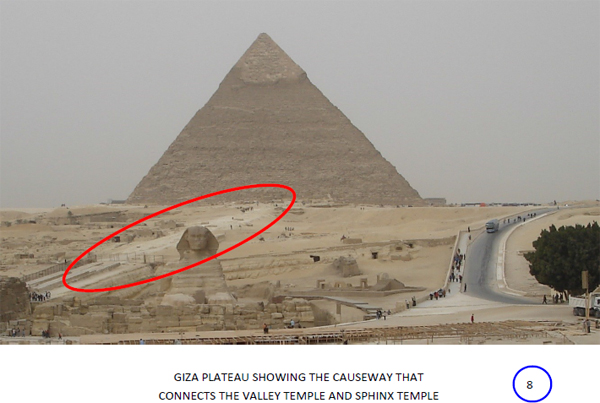
No.12 shows the slope of the covered causeway from the Chephren Pyramid toward the Sphinx and the Nile. All of the pyramids built in the vicinity of the Nile were built above the floodplain, but water seems to pervade the underground structures.
During extensive on-site research in the 1970s, when the Egyptian authorities allowed greater access for exploration and photographing of the different pyramids in and around the Giza Plateau, Brown’s 1978 expedition performed chemical analysis of mineral deposits in an attempt to trace the flow of the Nile alongside and beneath the pyramids. Their research also included other surrounding structures and channels as far as thirty miles away, including the Serapeum at Saqqara. The mineral analysis verified our belief that the Nile River flowed through the causeways and was previously present in the upper and lower temples, as well as inside the pyramid passage ways and chambers.
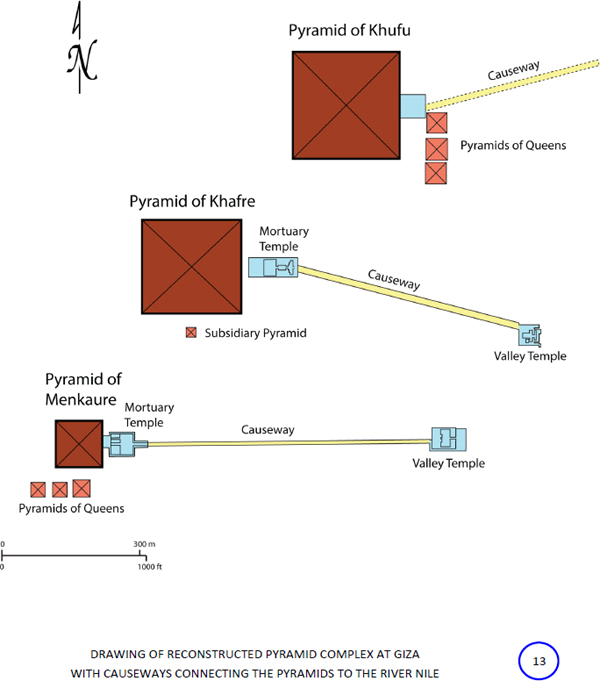
No. 13 shows an artistic rendering of the Giza pyramid complex as it once looked with its exterior temples and causeways that led to the banks of the Nile. The Giza pyramids are set about 75 feet (23 meters) above the banks of the Nile. In earlier times, the Nile River filled what have been called “lower temples” with water.
No. 14 is a photograph from a book titled, Around the World with a Camera: Special War Edition Photographs from the Battlefields, published in 1919. This Hun bi-plane aircraft (inside red circle) was on a bombing mission from Turkey. The picture shows the Nile overflowing close to the Great Pyramid.
No. 15 shows an artist’s rending of the Giza Plateau with its Valley Temple (also called the Lower Temple—red circle) connected to the Khafre (Chephren) or second Pyramid. Khafre’s Valley Temple and its neighboring Sphinx Temple are located in the Nile River floodplain and were filled with water for most of their history. Most causeways that connect the pyramids to the Nile River have not been excavated or have deteriorated beyond recognition. Most aerial views reveal the outlines of the causeways.
Dr. Zahi Hawass, then spokesperson for the Egyptian Supreme Council of Antiquities (1993-2011) announced publically that this area clearly showed that water had once flowed under the causeway in front of the Valley Temple, further confirming our initial investigations and supporting our theory.
No. 16 shows the excavation site in front of the Valley Temple in the early 1990s where explorations were also conducted by Drs. Hurtak and The Academy For Future Science.
No. 17 This photo shows the same excavation site from a different angle.
No. 18 is a photograph taken from inside the lower Valley Temple. Known in French as the Temple de Granit, the Valley Temple is constructed of giant solid granite columns with massive granite lintel blocks on top of the granite columns, creating tremendous pressure. Note also the dark stains that are etched into granite column bases in the Valley Temple. These are circled in red and indicate that some sort of chemical solution once rose to a specific height on the columns.
When granite is compressed electricity is created through the piezoelectric effect. If electrically charged water flowed down the causeways from the Pyramids it could have been controlled in the lower temple areas, where the “piezoelectric effect” would continue to boost or maintain the electrical properties of the water. The water could have been transported by boat in containers or directed into the Nile River. The Nile might have become an electrical conduit with the flow of electrified water, controlled by moveable doors or control gates.
piezo


