Cover and Inside Layout and Design: Chrystique Neibauer | cqgraphicdesign.com
Chapter Illustrations: Jillian Vaughan Graphic Design
Cover Images: shutterstock.com and Jillian Vaughan
Copyright © 2014 by Kenneth Cox Ministries
Scripture quoted from NKJV, THOMAS NELSON
ISBN-13: 978-0-9884487-6-6
Dedication
This book is dedicated to Jesus Christ the Lamb of God, who, in the sanctuary service so beautifully illustrates His marvelous gift of grace. And to “those who follow the Lamb where He goes.”
(Rev 14:4)
Table of Contents
Chapter 1The Court
Chapter 2The Altar of Sacrifice and the Lamb of God
Chapter 3The Laver and Water of Life
Chapter 4Priesthood and the Levites
Chapter 5Tabernacle
Chapter 6The Golden Table of Showbread
Chapter 7The Golden Lampstand
Chapter 8The Golden Altar of Incense
Chapter 9Veils
Chapter 10The Most Holy Place
Chapter 11The Ark of the Covenant
Chapter 12Israel’s Annual Feasts
Chapter 13Christ Our High Priest
Chapter 14Incredible Prophecy
Chapter 15The New Jerusalem
Acknowledgments
To the work of the Holy Spirit in inspiring those who have worked on this publication. Their friendship and contribution has been invaluable. Dona Klein, Bob Hablutzel, Diane Loer, Lindi McDougal. No matter if their part was large or small, I know their motivation was their desire to see men and women come to know Jesus Christ. Thank you for the encouragement and help in the writing of this book.
Introduction
As Abraham, the father of the Jewish nation, made his way into the land of Canaan, he erected an altar at Shechem, at Bethel, and at Hebron. He understood that sacrifices offered upon these altars were a type of the Redeemer who would one day die for his sins. However, it was not until the Lord told him to offer his son Isaac as a sacrifice on mount Moriah that Abraham realized the significance of the sacrifices being offered. Christ, the true sacrifice, spoke of this experience as follows: “Your father Abraham rejoiced to see My day, and he saw it and was glad.” John 8:56. This was something Abraham shared with Isaac, and which was subsequently passed on to Jacob through Isaac. However, it would take more than word of mouth to communicate this great truth to the more than one million people coming out of slavery in Egypt.
To serve as an object lesson to the children of Israel, God told Moses to build a Sanctuary that would teach them the great plan of salvation. When using the word ‘Sanctuary’ I am referring to the entire structure, including the court and the tabernacle. The sanctuary was a portable structure attended to by the Levites, and carried by them when Israel traveled from place to place Numbers 1:50. Everything in the life of ancient Israel revolved around the Sanctuary and the services conducted in it. It was the center of the Jewish economy and the hub of activities during their forty years of wandering in the wilderness. Fittingly, the Sanctuary was erected in the center of Israel’s encampments. Three of Israel’s twelve tribes camped on each of its four sides and the Levites camped immediately around it (Numbers 1:52, 53). This provided it tremendous protection.
The primary purpose of the earthly Sanctuary was to provide a place for God to dwell among His people. As God told Moses on Mount Sinai, “And let them [the children of Israel] make Me a sanctuary, that I may dwell among them. According to all that I show you, that is, the pattern of the tabernacle and the pattern of all its furnishings, just so you shall make it.” Exodus 25:8-9. The earthly Sanctuary was of divine origin, for it was carefully patterned after God’s true Sanctuary in heaven. Hebrews 8:1-2. Although the earthly Sanctuary was made by the hand of man, God provided Moses with a very detailed blueprint for its construction, and the construction of everything associated with it. Every component of the Sanctuary had a specific function, and was to be made exactly according to God’s pattern of the heavenly Sanctuary. No guesswork or supposition was left to the mind of man, not even in the minutest detail. Every element of the Sanctuary had its place and its purpose, and nothing was to be misplaced or overlooked. This would ensure that the symbolism of the Sanctuary, which was to serve as an object lesson for the people, would typify the truths being represented. Just as God told Moses, “let them build Me a sanctuary that I may dwell among them” 1500 years later, the Son of God would once again dwell with mankind: “And the Word became flesh and dwelt among us, and we beheld His glory, the glory as of the only begotten of the Father, full of grace and truth.” John 1:14. In the Sanctuary, Israel was to learn of the sacrifice the Messiah would make for their salvation. Through the Sanctuary services, they were to see the love, mercy, and character of God.
CHAPTER 1
The Court
The Court
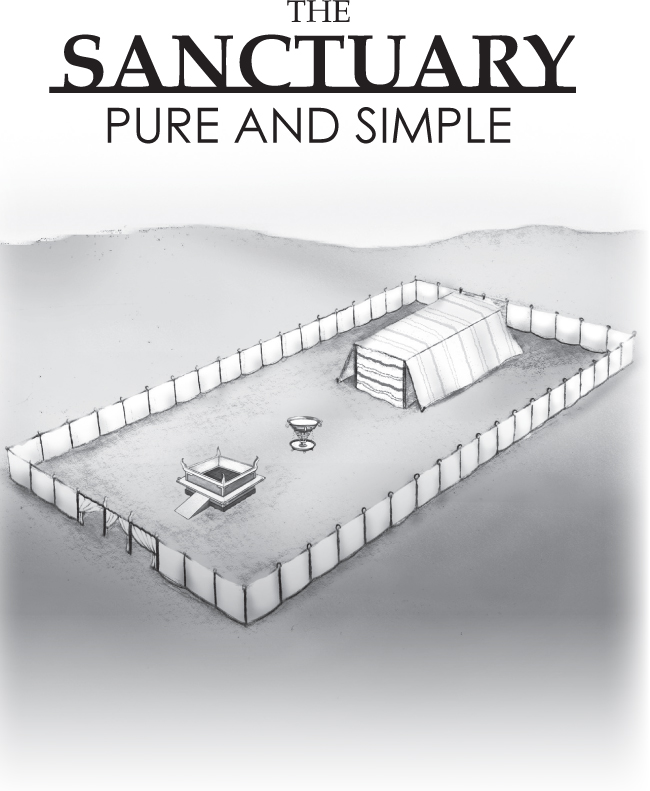
The tabernacle was surrounded by a court that was approximately 150 feet long by 75 feet wide. Exodus 27:9 describes the hangings for the court [the curtains surrounding it] as being made “… of fine woven linen”. They were an impressive sight, very delicate and beautiful. The hangings on the north, south and west sides measured the same as the court, respectively. The hangings on the east side consisted of approximately 22.5 feet of fine woven linen on each side of the gate. Sixty bronze pillars with capitals of silver supported these hangings. The pillars were equidistant from one another, each pillar rested in a socket of bronze. Beautiful silver hooks and inserts secured the hangings to the pillars. Rods of equal height and equal width, covered with silver and joined with tendons resting in silver sockets, composed the rib-work for the hangings which enclosed the court (See Exodus 27:9-19).
The gate provided the entrance to the court. It was approximately 30 feet wide by 7.5 feet high. The screen for the gate opening consisted of intricate needlework of blue, purple and scarlet thread, and fine woven linen (see Exodus 27:16). All materials used in the construction of the screen blended harmoniously. The screen for the gate had four pillars and accompanying hardware to match the rest of the hangings for the Tabernacle. Inside the court and before the Tabernacle were two articles of furniture, the altar of sacrifice and the laver.
The Earth
All the work done in the court typified the work done for man’s salvation on this earth. What took place within the Tabernacle was a type of what Christ is doing for us in heaven. The territory outside the court represented the world. No sacrifice was ever offered inside the Tabernacle; the offering was slain in the court. The priest then carried the blood and flesh into the Tabernacle. Only those who accepted the Lord, and followed Him, were allowed inside the court. It was there that a person would bring a lamb, confess their sins on its head, and then take its life for the remission of sins. All the services that took place in the court found their fulfillment in Christ, and what He has done for us on this earth. Thus, it was on this earth that the Lamb of God shed His blood for the forgiveness of our sins and the justification of sinners.
In Revelation 11:1-2, John explains what the court represented: “Then I was given a reed like a measuring rod. And the angel stood, saying, “Rise and measure the temple of God, the altar, and those who worship there. But leave out the court which is outside the temple, and do not measure it, for it has been given to the Gentiles.” Measuring had to do with judgment. Bear in mind that the Sanctuary, or Temple on earth, was made after the pattern in heaven. We know this text is referring to the temple in heaven, because John wrote the book of Revelation about A.D. 90, and at that time the temple in Jerusalem had already been destroyed. “Those who worship there” refers to God’s people, since this is a judgment picture. 1 Peter 4:17 tells us that the judgment began with God’s people. When Revelation 11:2 states, “But leave out the court which is outside the temple, and do not measure it, for it has been given to the Gentiles,” the word “Gentiles” is the same Greek word that is used for “nations” in Revelation 11:18. It means “people of the world,” or “those who do not follow God”. Not measuring the court (for it has been given to the Gentiles) tells us that the wicked will be judged at a time later than the judgment of the redeemed. All the work that took place within the court was symbolic, and meets its fulfillment in the reality of God’s plan of salvation.
CHAPTER 2
The Altar of Sacrifice and the Lamb of God
Altar of Sacrifice
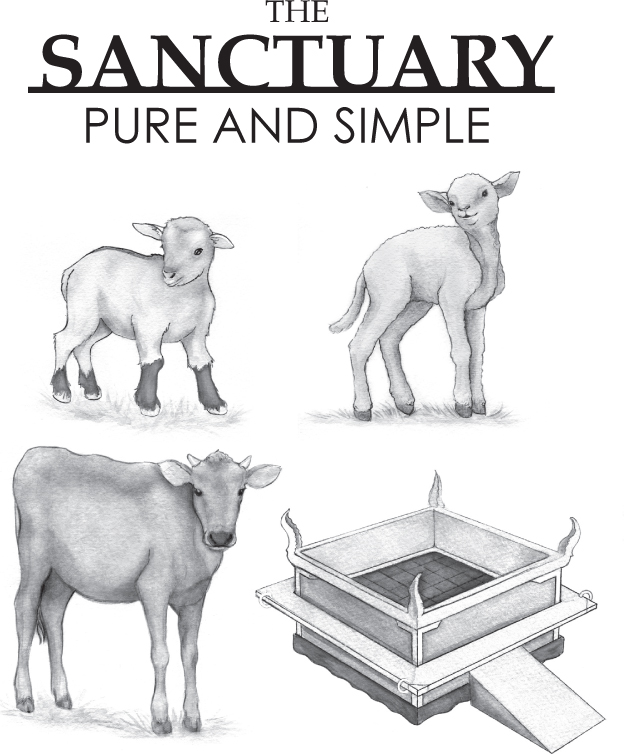
Inside the court and near its entrance was the brazen altar, referred to in Scripture as the altar of burnt offering. It was approximately seven and a half feet long, seven and a half feet wide, and four and a half feet high. On each corner were the “horns of the altar,” representing God’s forgiveness, and a place of refuge. For example, when Solomon ordered that Joab be killed, Joab fled to the tabernacle and took hold of the horns of the altar (1 Kings 2:28), believing it was a place where he could find refuge and receive forgiveness. The altar was made of shittim (acacia) wood, which was used for construction throughout the tabernacle. The altar was then completely covered with brass, which is why some Bible translations refer to it as the brazen altar. A full description of the altar is found in Exodus 27:1-8.
The Lord was also very explicit in His instructions to the Israelites concerning burnt offerings. Almost all offerings were brought to the sanctuary and offered on the altar of sacrifice. There were many different reasons for bringing an offering. The sacrificial procedure varied depending upon the reason for the sacrifice, and the type of animal being sacrificed. For example, individuals were required to bring an animal to the altar of burnt offering for the forgiveness of his or her sins. The animal could be a bull, a lamb, a goat, or even a turtledove, depending upon the person’s financial circumstances, but each animal must be without spot or blemish.
Leviticus 4:1-35 describes the sin offering. When one of the common people sinned unintentionally, the sacrifice of a female sheep or goat was required. He or she would place their hands on the head of the sacrifice and confess their sins. The person then took a knife and cut the throat of the sacrifice, for “… without shedding of blood there is no remission of sin.” Hebrews 9:22. The priest then caught the blood of the sacrifice in a basin and proceeded to the altar of sacrifice. He then dipped his finger in the blood and applied it to the horns of the altar while confessing the person’s sins. The remaining blood was poured at the base of the altar (Leviticus 4:29, 30). All the fat of the sacrifice was removed, and the priest then burned the sacrifice on the altar for a sweet aroma to the Lord. The body of the sacrifice was completely consumed.
In this way, the sins of the individual vicariously passed to the priest through the blood of the animal sacrifice. By demonstrating their faith in the coming Lamb of God who would one day pay the supreme sacrifice to cleanse them from all unrighteousness, the penitent sinner now knew that his sins had been forgiven, and that they were no longer under condemnation. This sacrificial system was the gospel in symbols. It was God’s great object lesson, used to teach the people His plan of salvation.
To read more about specific offerings, please see the Scriptures, and the following explanations:
Sin Offering — Leviticus 1:3, 4:2-35
This offering brought the penitent sinner into close contact with the Lord, since he realized he was placing his hands upon the head of the sacrifice that was being offered for his sins. Two things were required of the individual as he brought the offering: he had to understand his own sinfulness before God, and he had to desire forgiveness enough to bring the sacrifice. Since the blood of bulls and goats could not take away sin (Hebrews 10:4), the penitent must by faith see beyond the offering to the time when the Son of God would pay the supreme price for his sins. As 1 John 1:7 states, “… the blood of Jesus Christ His Son cleanses us from all sin.” After the sacrifice had been slain, the sinner, with his own hands, was to remove all the fat from the various organs and give it to the priest to be burned on the brazen altar. Since the offering represented the spotless Lamb of God in whom there was no sin (Hebrews 4:15), and since the fat represented sin (Leviticus 16:25 and Isaiah 43:23, 24), the symbolism of sin had to be removed from the sacrifice before it could be offered. There are few things more disagreeable to smell than burning fat, but Exodus and Leviticus refer to fat being burned as a sweet aroma to the Lord, because sin was being separated from the sinner. The symbolism of the One the sacrifice represented is why each sacrificial animal was to be without spot or blemish as far as the human eye could detect.
Whole Burnt Offering — Leviticus 1:2, 9:7, 14:19-20
“I beseech you therefore, brethren, by the mercies of God, that you present your bodies a living sacrifice, holy, acceptable to God, which is your reasonable service.”“And to love Him with all the heart, with all the understanding, with all the soul, and with all the strength, and to love one’s neighbor as oneself, is more than all the whole burnt offerings and sacrifices.”


