This series provides sophisticated and authoritative overviews of periods of ancient history, genres of classical literature, and the most important themes in ancient culture. Each volume comprises approximately 25 to 40 concise essays written by individual scholars within their area of specialization. The essays are written in a clear, provocative, and lively manner, designed for an international audience of scholars, students, and general readers.
ANCIENT HISTORY
A Companion to the Roman Army
Edited by Paul Erdkamp
A Companion to the Roman Republic
Edited by Nathan Rosenstein and Robert Morstein‐Marx
A Companion to the Roman Empire
Edited by David S. Potter
A Companion to the Classical Greek World
Edited by Konrad H. Kinzl
A Companion to the Ancient Near East
Edited by Daniel C. Snell
A Companion to the Hellenistic World
Edited by Andrew Erskine
A Companion to Late Antiquity
Edited by Philip Rousseau
A Companion to Ancient History
Edited by Andrew Erskine
A Companion to Archaic Greece
Edited by Kurt A. Raaflaub and Hans van Wees
A Companion to Julius Caesar
Edited by Miriam Griffin
A Companion to Byzantium
Edited by Liz James
A Companion to Ancient Egypt
Edited by Alan B. Lloyd
A Companion to Ancient Macedonia
Edited by Joseph Roisman and Ian Worthington
A Companion to the Punic Wars
Edited by Dexter Hoyos
A Companion to Augustine
Edited by Mark Vessey
A Companion to Marcus Aurelius
Edited by Marcel van Ackeren
A Companion to Ancient Greek Government
Edited by Hans Beck
A Companion to the Neronian Age
Edited by Emma Buckley and Martin T. Dinter
A Companion to Greek Democracy and the Roman Republic
Edited by Dean Hammer
A Companion to Livy
Edited by Bernard Mineo
A Companion to Ancient Thrace
Edited by Julia Valeva, Emil Nankov, and Denver Graninger
A Companion to Roman Italy
Edited by Alison E. Cooley
A Companion to the Etruscans
Edited by Sinclair Bell and Alexandra A. Carpino
A Companion to the Flavian Age of Imperial Rome
Edited by Andrew Zissos
A Companion to Science, Technology, and Medicine in Ancient Greece and Rome
Edited by Georgia L. Irby
A Companion to the City of Rome
Edited by Amanda Claridge and Claire Holleran
A Companion to Greeks Across the Ancient World
Edited by Franco De Angelis
LITERATURE AND CULTURE
A Companion to Classical Receptions
Edited by Lorna Hardwick and Christopher Stray
A Companion to Greek and Roman Historiography
Edited by John Marincola
A Companion to Catullus
Edited by Marilyn B. Skinner
A Companion to Roman Religion
Edited by Jörg Rüpke
A Companion to Greek Religion
Edited by Daniel Ogden
A Companion to the Classical Tradition
Edited by Craig W. Kallendorf
A Companion to Roman Rhetoric
Edited by William Dominik and Jon Hall
A Companion to Greek Rhetoric
Edited by Ian Worthington
A Companion to Ancient Epic
Edited by John Miles Foley
A Companion to Greek Tragedy
Edited by Justina Gregory
A Companion to Latin Literature
Edited by Stephen Harrison
A Companion to Greek and Roman Political Thought
Edited by Ryan K. Balot
A Companion to Ovid
Edited by Peter E. Knox
A Companion to the Ancient Greek Language
Edited by Egbert Bakker
A Companion to Hellenistic Literature
Edited by Martine Cuypers and James J. Clauss
A Companion to Vergil’s Aeneid and its Tradition
Edited by Joseph Farrell and Michael C. J. Putnam
A Companion to Horace
Edited by Gregson Davis
A Companion to Families in the Greek and Roman Worlds
Edited by Beryl Rawson
A Companion to Greek Mythology
Edited by Ken Dowden and Niall Livingstone
A Companion to the Latin Language
Edited by James Clackson
A Companion to Tacitus
Edited by Victoria Emma Pagán
A Companion to Women in the Ancient World
Edited by Sharon L. James and Sheila Dillon
A Companion to Sophocles
Edited by Kirk Ormand
A Companion to the Archaeology of the Ancient Near East
Edited by Daniel Potts
A Companion to Roman Love Elegy
Edited by Barbara K. Gold
A Companion to Greek Art
Edited by Tyler Jo Smith and Dimitris Plantzos
A Companion to Persius and Juvenal
Edited by Susanna Braund and Josiah Osgood
A Companion to the Archaeology of the Roman Republic
Edited by Jane DeRose Evans
A Companion to Terence
Edited by Antony Augoustakis and Ariana Traill
A Companion to Roman Architecture
Edited by Roger B. Ulrich and Caroline K. Quenemoen
A Companion to Sport and Spectacle in Greek and Roman Antiquity
Edited by Paul Christesen and Donald G. Kyle
A Companion to Plutarch
Edited by Mark Beck
A Companion to Greek and Roman Sexualities
Edited by Thomas K. Hubbard
A Companion to the Ancient Novel
Edited by Edmund P. Cueva and Shannon N. Byrne
A Companion to Ethnicity in the Ancient Mediterranean
Edited by Jeremy McInerney
A Companion to Ancient Egyptian Art
Edited by Melinda Hartwig
A Companion to the Archaeology of Religion in the Ancient World
Edited by Rubina Raja and Jörg Rüpke
A Companion to Food in the Ancient World
Edited by John Wilkins and Robin Nadeau
A Companion to Ancient Education
Edited by W. Martin Bloomer
A Companion to Ancient Aesthetics
Edited by Pierre Destrée and Penelope Murray
A Companion to Roman Art
Edited by Barbara Borg
A Companion to Greek Literature
Edited by Martin Hose and David Schenker
A Companion to Josephus in his World
Edited by Honora Howell Chapman and Zuleika Rodgers
A Companion to Greek Architecture
Edited by Margaret M. Miles
SECOND EDITION
Edited by
Daniel C. Snell

This Second edition first published 2020
© 2020 John Wiley & Sons, Inc.
Edition History
Blackwell publishing Ltd (1e, 2005)
All rights reserved. No part of this publication may be reproduced, stored in a retrieval system, or transmitted, in any form or by any means, electronic, mechanical, photocopying, recording or otherwise, except as permitted by law. Advice on how to obtain permission to reuse material from this title is available at http://www.wiley.com/go/permissions.
The right of Daniel C. Snell to be identified as the author of the editorial material in this work has been asserted in accordance with law.
Registered Office
John Wiley & Sons, Inc., 111 River Street, Hoboken, NJ 07030, USA
Editorial Office
111 River Street, Hoboken, NJ 07030, USA
For details of our global editorial offices, customer services, and more information about Wiley products visit us at www.wiley.com.
Wiley also publishes its books in a variety of electronic formats and by print‐on‐demand. Some content that appears in standard print versions of this book may not be available in other formats.
Limit of Liability/Disclaimer of Warranty
While the publisher and authors have used their best efforts in preparing this work, they make no representations or warranties with respect to the accuracy or completeness of the contents of this work and specifically disclaim all warranties, including without limitation any implied warranties of merchantability or fitness for a particular purpose. No warranty may be created or extended by sales representatives, written sales materials or promotional statements for this work. The fact that an organization, website, or product is referred to in this work as a citation and/or potential source of further information does not mean that the publisher and authors endorse the information or services the organization, website, or product may provide or recommendations it may make. This work is sold with the understanding that the publisher is not engaged in rendering professional services. The advice and strategies contained herein may not be suitable for your situation. You should consult with a specialist where appropriate. Further, readers should be aware that websites listed in this work may have changed or disappeared between when this work was written and when it is read. Neither the publisher nor authors shall be liable for any loss of profit or any other commercial damages, including but not limited to special, incidental, consequential, or other damages.
Library of Congress Cataloging‐in‐Publication Data
Names: Snell, Daniel C., editor.
Title: A companion to the ancient Near East / edited by Daniel C Snell.
Description: Second edition. | Hoboken, NJ : John Wiley & Sons, Inc., [2020] | Series: Blackwell companions to the ancient world | Includes bibliographical references and index.
Identifiers: LCCN 2019051981 (print) | LCCN 2019051982 (ebook) | ISBN 9781119362463 (hardback) | ISBN 9781119362487 (adobe pdf) | ISBN 9781119362494 (epub)
Subjects: LCSH: Middle East–Civilization–To 622.
Classification: LCC DS57 .C56 2020 (print) | LCC DS57 (ebook) | DDC 939.4–dc23
LC record available at https://lccn.loc.gov/2019051981
LC ebook record available at https://lccn.loc.gov/2019051982
Cover Design: Wiley
Cover Image: Photo by Daniel Snell
| Maps of the Near East. | |
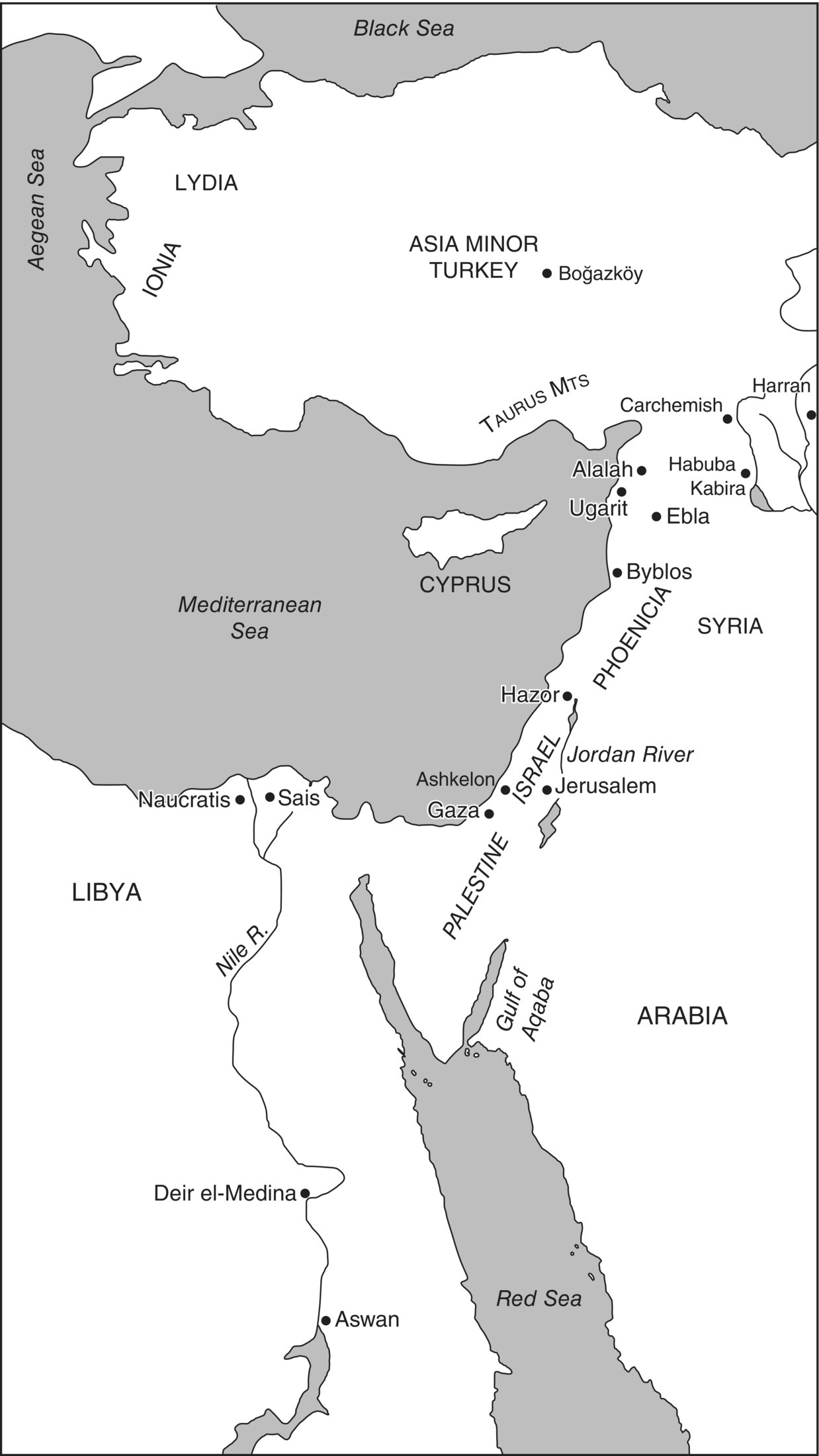
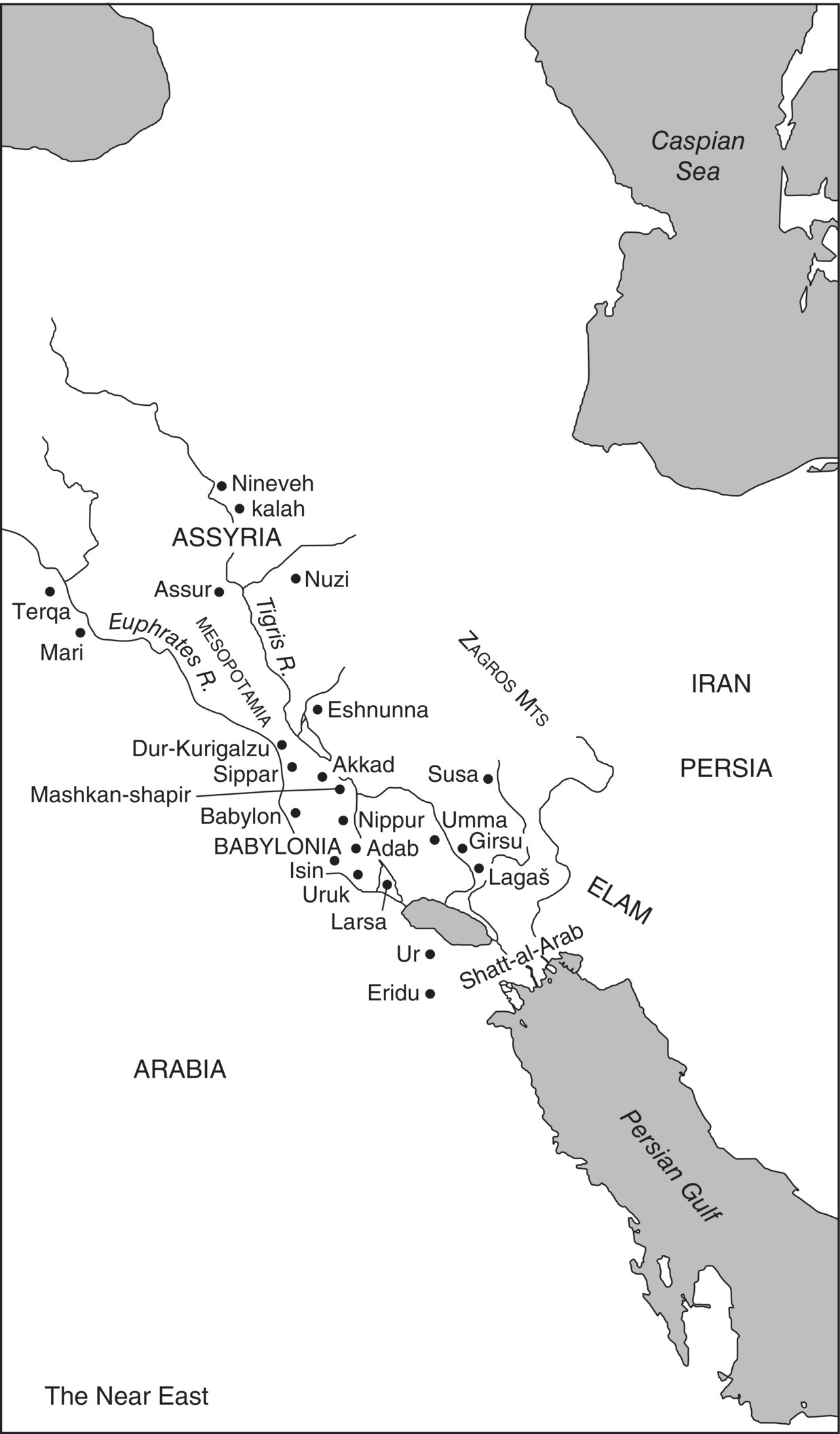
| Map 4.1 | Sites prior to 2500 BCE. |
| Map 4.2 | Sites after 2500 BCE. |
| Map 4.3 | Paleoclimatic information: vegetation regions. |
| Map 4.4 | Paleoclimatic information: the climatic optimum. |
| Samples of scripts and texts, Chapter 20 | |
| 21.1a,b | The Warka Vase, two views. |
| 21.1c | The Warka Vase close up. |
| 21.2 | The Warka Vase, line drawing. |
| 21.3 | Late Uruk seal impression. |
| 21.4 | Votive statues from Tell Asmar. |
| 21.5 | Votive statue of Ur‐Nanshe, the singer, from Mari. |
| 21.6 | Gudea of Lagash standing. |
| 21.7 | Victory stele of Naram‐Sin. |
| 21.8 | Code of Hammurabi. |
| 21.9 | Code of Hammurabi, detail of upper relief. |
| 21.10 | The siege of Lachish, Southwest Palace, Nineveh. |
| 21.11 | Detail of Ashurbanipal’s lion hunt, North Palace, Nineveh. |
| 27.1 | Mahmud Mukhtar’s statue Nahdat Misr (The Revival or Awakening of Egypt), 1928, Cairo.477 |
Nicole Brisch is Associate Professor in the Department of Cross‐Cultural and Regional Studies in the University of Copenhagen. She studies the history of religion especially in its economic aspects. A recent book is Religion and Power: Divine Kingship in the Ancient World and Beyond (Oriental Institute 2008).
Mark Chavalas (PhD University of California at Los Angeles, 1988) is Professor of History in the University of Wisconsin at La Crosse. He studies intercultural connections in the ancient world. His recent book is Women in the Ancient Near East: A Sourcebook (Routledge 2013).
Carlos E. Cordova (PhD University of Texas, Austin, 1997) is Professor of Geography in the Oklahoma State University, Stillwater. He works on the study of pollen in the Middle East, South Africa, Mexico, the Great Plains of the United States, and the Black Sea region and the Volga region of Russia. His latest books are Geoarchaeology: The Human‐Environmental Approach (I.B. Tauris, London, 2018), and Crimea and the Black Sea: An Environmental History (I.B. Tauris, London, 2016). He also published Millennial Landscape Change in Jordan: Geoarchaeology and Cultural Ecology (University of Arizona Press, 2007).
Peter T. Daniels (PhD Chicago) is an independent scholar and the world’s leading expert on writing systems. His latest book is An Exploration of Writing (Equinox 2018).
Marian H. Feldman (PhD 1998 Harvard) is the W.H. Collins Vickers Chair in Archaeology and Professor of the History of Art and Near Eastern Studies at the Johns Hopkins University, Baltimore, Maryland. Her latest book is Communities of Style: Portable Luxury Arts, Identity and Collective Memory in the Iron Age Levant (University of Chicago Press 2014).
Benjamin Foster (PhD 1975 Yale) is Laffan Professor of Assyriology in Yale University, New Haven, Connecticut. His recent book is The Age of Agade: Inventing Empire in Ancient Mesopotamia (Routledge 2015).
Marie‐Henriette Gates is Associate Professor in the Department of Archaeology at Bilkent University (Ankara, Turkey), where she specializes in the Bronze Age cultures of the eastern Mediterranean and Anatolia. She has participated in field projects in Turkey, Iran, and Syria, and directed excavations at Kinet Höyük, near Iskenderun, from 1992 to 2012. Her current research examines the cultural and economic dynamics of ancient seaports like Kinet. Publications include “Southern and Southeastern Anatolia in the Late Bronze Age” in The Oxford Handbook of Ancient Anatolia (ed. Steadman and McMahon 2011).
Steven Grosby (PhD Chicago) is Professor of Religion in Clemson University, Clemson, South Carolina. His latest book is Nationalism and Ethnosymbolism: History, Culture and Ethnicity in the Formation of Nations, edited with Athena Leoussi (University of Edinburgh Press, 2006).
Susan Tower Hollis (PhD Harvard) is Professor Emerita at New York Statue University at Rochester, New York, specializing in Ancient Egypt and its literature. Her latest book is The Ancient Egyptian Tale of Two Brothers: A Mythological, Religious, Literary and Historico‐Political Study (Bannerstone Press 2008). Forthcoming is Five Egyptian Goddesses: Their Possible Beginnings, Actions, and Relationships in the Third Millennium BCE, in the Bloomsbury Egyptology Series. Another project underway is as invited editor of a volume for Oxford entitled Oxford Handbook on Ancient Egypt and the Hebrew Bible.
John Huehnergard (PhD Harvard) is Professor Emeritus of Middle Eastern Studies at the University of Texas at Austin, specializing in Semitic philology. His latest books are An Introduction to Ugaritic (Hendrickson 2012), and The Semitic Languages (2nd ed.), co‐edited with N. Pat‐El (Routledge, forthcoming).
Philip Jones (PhD Johns Hopkins University) is the Associate Curator and Keeper in the Babylonian Section at the University of Pennsylvania Museum of Archaeology and Anthropology, and the Executive Editor of the Pennsylvania Sumerian Dictionary Project.
Mario Liverani is Professor Emeritus at the University of Rome La Sapienza. His latest book is Assyria: The Imperial Mission Eisenbrauns (2017).
Augusta McMahon (PhD Chicago) is Reader in Mesopotamian Archaeology in Newnham College, University of Cambridge. She has excavated in Turkey, Syria, Egypt, and Yemen. Her latest book is Preludes to Urbanism. The Late Chalcolithic of Mesopotamia, with H. Crawford (McDonald Institute, 2015).
Sarah C. Melville (PhD Yale) is Professor of Ancient History at Clarkson University, Potsdam, New York. Her latest book is The Campaigns of Sargon II, King of Assyria, 721–705 BC (Campaigns and Commanders Series, University of Oklahoma Press, 2016).
Christopher M. Monroe (PhD Michigan 2000) earned a Master’s in nautical archaeology at Texas A&M University and a doctorate in Ancient Near Eastern studies at the University of Michigan. He has participated in excavations in Crete, Israel, Syria, and Turkey, and now teaches courses on various aspects of Ancient Near Eastern and Mediterranean history at Cornell University. His recent book is Scales of Fate: Trade, Tradition, and Transformation in the Eastern Mediterranean ca. 1350–1175 BCE (Ugarit‐Verlag, 2009).
John P. Nielsen (PhD Chicago) is Assistant Professor of History in Bradley University, Peoria, Illinois. His research is on the first millennium BCE in Mesopotamia. His latest book is The Reign of Nebuchadnezzar I in History and Historical Memory (Studies in the History of the Ancient Near East, Routledge, 2018).
Tanja Pommerening is Professor of Egyptology in the Johannes Gutenberg University in Mainz. She specializes in Egyptian pharmacy and medicine. Her latest book is Classification from Antiquity to Modern Times: Sources, Methods, and Theories from an Interdisciplinary Perspective, edited with Walter Bisang (de Gruyter 2017).
Anne Porter (PhD Chicago 2000) is Assistant Professor of Near and Middle Eastern Archaeology (Teaching Stream) at the University of Toronto. She has excavated in Jordan and Syria. Her latest book is Mobile Pastoralism and the Formation of Near Eastern Civilizations: Weaving Together Society (Cambridge University Press 2012).
Donald Malcolm Reid (PhD Princeton, 1969) is Professor Emeritus of History at Georgia State University, and an affiliate of the Department of Near Eastern Languages and Civilization, University of Washington. His most recent book is Contesting Antiquity in Egypt: Archaeologies, Museums, and the Struggle for Identities from World War I to Nasser (American University in Cairo Press, 2015).
Francesca Rochberg (PhD Chicago 1980) is Professor of Near Eastern Studies at the University of California, Berkeley. She studies the history of science, especially the history of astronomy. Her most recent book is Before Nature: Cuneiform Knowledge and the History of Science (Chicago 2016).
John Robertson (PhD 1981 Pennsylvania) is Professor Emeritus of Ancient and Middle Eastern Studies at Central Michigan University, Mount Pleasant. His book Iraq: A History (Oneworld 2015) was recognized by History Today as one of the ten best books of the year.
Ann Macy Roth (PhD Chicago 1985) is Clinical Associate Professor at New York University, specializing in ancient Egyptian art, archaeology, and social history, especially in its earliest periods. She has done archaeological and epigraphic work at Giza and Saqqara, and her current projects include the publication of Old Kingdom tomb chapels at the Metropolitan Museum and a book on ancient Egyptian conceptions of gender and fertility.
Daniel C. Snell, Emeritus Professor of History at the University of Oklahoma, Norman, has written about ancient social and economic history and the Book of Proverbs. His latest book is Ancient Near East: The Basics (Routledge, 2014).
S. David Sperling (PhD Columbia) is Professor of Bible in the Hebrew Union College, Jewish Institute of Religion in New York. He is the author of The Original Torah: The Political Intent of the Bible’s Writers (New York University Press 2003). A collection of his articles appeared as Ve‐Eileh Divrei David (Brill 2017).
Marc van de Mieroop (PhD Yale 1983) is Professor of History at Columbia University, New York. His latest book is Philosophy before the Greeks. The Pursuit of Truth in Ancient Babylonia (Princeton University Press 2015).
David A. Warburton (Dr.phil. Bern 1996, Habilitation Paris 2007) is professor of Egyptology at the Institute for the History of Civilizations at Northeast Normal University, Changchun, China. His fields of interest are cognition, religion, warfare, chronology, and economics. He has participated in archaeological projects in Egypt, France, Iraq, Switzerland, Syria, and Yemen. A recent book is Architecture, Power, and Religion: Hatshepsut, Amun and Karnak in Context (LIT 2012).
Bruce Wells (PhD, Johns Hopkins, 2003) is Associate Professor in the Department of Middle Eastern Studies at the University of Texas at Austin. He is the co‐author, with the late Raymond Westbook, of Everyday Law in Biblical Israel (Westminster John Knox, 2009), and, with F. Rachel Magdalene and Cornelia Wunsch, of Fault, Responsibility, and Administrative Law in Late Babylonian Legal Texts (forthcoming from Eisenbrauns/Penn State University Press).
What has changed since 2005? Quite a lot, and it is not possible easily to summarize what we have learned in the interim. I will say that politically in the region there has been great upheaval, and the people of the region have suffered immeasurably, both through physical displacement and psychological trauma. Still, the basic insights into the ancient history of the region have not been altered. In fact, with political changes some of the areas hitherto lightly explored have come into sharper focus, and of course others which once served as a basis for our understandings have been devastated by wars and terrorist groups and cannot soon be expected to inform us again.
Such political change has affected the history of inquiry into the Ancient Near East since the nineteenth century, and that trend will likely continue. It is both a challenge and a delight to note the new knowledge we have found. and to try to share it with a broad community of students and scholars.
Much in our 2005 publication remains valid, and the omission here of particular essays does not mean they have been superseded. Decisions about what not to include were difficult, and many of the essays which were particularly valuable deserve to be consulted in the earlier edition. I surveyed undergraduates using the 2005 edition about their favorite essays, and they agreed that those that were most accessibly written and on crucial topics for today, such as ethnicity and identity, were of most interest. And yet some of these have for various reasons been omitted. New publications still build on those bases.
Why a new edition, though? For me the motivation derived from glowing peer reviews for the suggestion of a second edition. Scholars within and outside the fields which we tried to survey found the first edition to be the first thing to which they turned; they found it very useful. Of course, since 2005, online resources have grown in importance and in value, but a handy guide will always be of use.
Here I have solicited revisions from many of the earlier authors, and in some cases there are considerable revisions. In others, there are none at all. In all we have here six with no revisions, and ten partly or substantially revised. In addition we have 13 totally new essays, which we hope will broaden the scope of our endeavor. I hope students will still consult the 2005 volume for those essays which, for reasons of space, we could not reprint. We did not reprise the chronological survey at the beginning of that volume, nor did we revise or reprint the essays on architecture, the city, and Mesopotamian medicine. But they were particularly valuable, and students I taught liked my efforts on the perception of the individual and on democracy, which likewise are not redone here. Or were they simply being kind?
Here I want to call attention to some important changes for this second edition, as well as highlighting the essays that have not changed or have not changed much. A prime example of change is that two of our colleagues, Henri Limet and Jorge Silva Castillo, have passed away, and their work on ethnicity and nomadism must be supplemented by new scholars. We miss the breadth of understanding and kindness which these two scholars showed their peers, and we recommend their work for continued dialogue.
My divisions are not the same as in the 2005 edition, and there is no question but that things might have been arranged differently. In particular “Thought” and “Culture” might be combined, and elements of my “Inheritances” certainly involve both thought and culture. As ever, much has been omitted. When composing the index to the earlier volume, I found myself thinking what a great tome this would be if it really explained the topics covered instead of, all too often, merely mentioning them. But, unlike on the internet, space is at a premium, and students will be encouraged to go beyond our thoughts here, especially in the works at the end of this introduction; these are studies referred to in multiple essays.
Most interesting is the fact that Mario Liverani decided not to update his historical introduction. Certainly the basic facts and chronology remain the same, although some essays discussed below may over time change our focus from the achievements of states to the feelings and categories revealed by others with access to writing. We have found out a lot since 2005, but not so much as to change Liverani’s views of the whole.
Augusta McMahon was unable to rework her seminal chapter on the move from having settled village communities to having states. Her insights continue to be important to our understanding of the epoch‐making developments in the period from 10,000 BCE, when the Ice Age ended, down to 3000 BCE when we clearly see functioning states in southern Iraq, Syria, and Turkey. We cannot trace all the changes these developments brought about, but it is still important to underline her insight that being settled, not moving about every season but farming right where you were, advanced the acquisition of things, animals, and artifacts, and that acquisition compounded the reluctance to move even when political and physical environmental changes might otherwise have prompted moving. We are still surrounded by, and still love, our things, and they may keep us psychologically centered, but they may also keep us stuck where we are.
Marie‐Henriette Gates has written a major revision of her essay on archaeology and history, indicating the way forward toward a new synthesis partly based on information gained through digital thinking and scientific analysis. This essay may mark the end of an alienation between the dirt archaeologists and the historians; so at least she hopes. She also, as before, places our efforts in the context of modern history and the continuing dearth of money for archaeological research efforts.
Carlos Cordova decided not to update what he sees as a very general introduction to the environmental problems in the Ancient Near East, and his clear prose is a good guide to the issues. In particular he notes deforestation began very early, and the cedars of Lebanon continued in memory longer than on the ground.
Ann Macy Roth’s “Gender Roles in Ancient Egypt” updates her essay with a new bibliography and insights. The basic finding is the same; Egypt was a patriarchal society where women’s influence was not always easy to see.
Sarah Melville has revisited her essay on royal women and power in Mesopotamia and again shown that women occasionally found themselves in control if they were closely related to powerful men who were absent or dead. Women who endured childbirth were at great risk of mortality themselves, but the relative luxury of palace life preserved some women to old age and great consequent influence.
A new and valuable addition is John P. Nielsen’s “The Family in the Ancient Near East,” bringing anthropological insight to the texts. This basic unit of human organization was assumed, of course, in earlier studies, but it is helpful to have Nielsen’s systematic analysis of the institutions underlying the realities of the ancient peoples.
Ann Porter has contributed a sophisticated analysis of nomadism in the Ancient Near East, informed by her own archaeological investigation of the sometimes elusive people who kept moving out of the way of developing states but memorably also intervened in them. In doing so she has clarified terminology and explained that nomads, though constantly present in one form or another in Ancient Near Eastern history, are not of only one kind, and their behavior may be vexing to some city people, but certainly not to all. She rejects the term “tribe” as unhelpful and concentrates instead on the associations that may have political meanings but more basically have family meanings. And especially she shows that identities rooted in families are not incompatible with larger identities rooted in states.
Christopher Monroe has updated his reflections on money and trade, adding new insights from recent publications and reflecting the consensus that all over the Near East we are dealing with mixed economies. This means that some institutions distributed and redistributed their goods to their employees and to the poor, while other people were buying and selling to maximize profit. The question of the existence of a functioning market has, in his view, been settled in the positive, though in many places it may not have been the important force that it later became. Transportation costs could be prohibitive, and the flow of information was inevitably spotty about what was needed where. And merchants, or moneymen (and women) who made it their business to figure out such things, were frequently held in low esteem by the hard‐living sensible farmers who created the surpluses that allowed merchants to cater to elite consumption.
Bruce Wells decided not to update his discussion of Ancient Near Eastern law and practice, and it remains a very helpful introduction, supplemented by his own publications.
David Warburton argues in his reworked contribution on “Working” that the Ancient Near Eastern economies developed tremendous surpluses, unprecedented in the region. But these successes only benefitted the elites in Egypt and Mesopotamia, and the working poor were always kept at a level of consumption far below poverty levels anywhere in the world today. These were not necessarily societies dominated by the work of slaves, but if you were among the poor, the oppression was unremitting even if you were in some respects free.
John Robertson has revised his chapter on social tensions, which was groundbreaking in 2005 and is more so in the new version. He is particularly insightful about the ethnic and religious conflicts which seem to have grown in intensity in our own time because of new media, but such tensions may not have been so significant in the ancient past.
Steven Grosby’s new “Borders and States” emphasizes the continuity between the ancient and the modern in the realm of definition. Grosby argues that, in spite of the lack of border patrols and walls and the other trappings of modern states, the basic ideas were there already, at least among the literate scribes that gave us the texts which have been preserved. The extent to which the scribes’ assumptions may have been shared among others is unknown, and it probably varied with experience, especially of interstate conflicts and tensions. And these definitely feed into our understandings of identity among ancient peoples.
Philip Jones brings his essay on “Divine and Non‐Divine Kingship” up to date, incorporating many recent studies into this basic problem. He points out that divine kingship is more a problem for us than for the ancients, and divinity may not have quite meant what it means to us now.
Benjamin Foster updates his witty examination of how Mesopotamians thought they obtained knowledge, noting finally that van de Mieroop’s new study of philosophy points in the same direction.
The Egyptologist Susan Tower Hollis has a new essay on “Literature of Ancient Egypt and the Ancient Near East.” To survey this area is almost an impossible task, but she presents sensitive readings of far‐flung groups of texts which tend to appeal both to the ancients and to us.
An exciting addition also is Marc Van De Mieroop’s accessible summary of his new book on “Ancient Near Eastern Philosophy.” Van De Mieroop argues that the framework for looking at the world which we call philosophy, and which we unthinkingly take from the Greek texts, has an analog in the Mesopotamian concern for the similarities observed in nature and especially within texts. His work has been interrogated as perhaps not having an exact analogy in today’s philosophical thought, and yet the turn toward texts in modern philosophy does seem to be foreshadowed by the Mesopotamian thinkers.
Francesca Rochberg helpfully revises her answers to several questions about how the Mesopotamians thought about the cosmos and how it worked on the basis of their observations. The answers are pretty much the same as in her earlier effort, but the bibliography is richer.
Nicole Brisch’s new essay on “Ancient Mesopotamian Religion” carefully surveys the kinds of information we have about this important area of life, but notes that religion probably was not a category in Mesopotamian thought. She emphasizes that mythology, the stories about the gods, frequently reverts to the theme of overcoming chaos by constructing order. In modern narratives the emphasis tends to be on good versus evil (compare any cop shows at hand!), and this difference from our tastes probably reflects the greater perceived fragility of Mesopotamian religious and even physical life in contrast to our modern sense of wellbeing threatened by evil. For Hittite religion, Gary Beckman’s essay in the 2005 edition should be consulted.
John Huehnergard in his new contribution elegantly introduces the various languages we find in the Ancient Near East and gives a writing sample for some of them. The progress in our understanding in recent years has been remarkable, especially for the little attested languages.
Marian Feldman decided to reprint her very readable introduction to the high points of Mesopotamian art, along with her illustrations from the earlier volume. Hers is a very accessible tour of some of the classical pieces and an invitation to serious thinking about art and artists in these cultures.
Tanya Pommerening contributes a cogent summary of the types of information available from papyri and potsherds about Egyptian medicine, underlining the use both of therapeutic techniques including prescriptions, along with what seem to us to be magical incantations. There seems to have been a sharing of medical knowledge among the various professions, and though she is careful not to argue for a comparative perspective to modern efforts, her approach does make the reader appreciate the sophistication of Egyptian practice. As many of my older colleagues may appreciate, she quotes the insight, probably not to be generalized, that “It is the vessels of [a patient’s] two knees in which death begins.”
Among the new essays is a brilliant exposition by the Neo‐Assyrian expert Sarah C. Melville on “Warfare in Mesopotamia.” We have omitted Anthony J. Spalinger’s 2005 “Warfare in Ancient Egypt.” Read together, these two essays give a remarkable picture of developments over the three millennia of our concern. The new insight from Melville’s work is the importance of mobile warfare when an earlier impression in scholarship was of siege work only.
Peter Daniels reprises his discussion of how we came to know the scripts and languages of the Ancient Near East in the heroic age of decipherment in the middle of the nineteenth century CE and since. His entertaining notes have much food for thought as well as further research.
And David Sperling has reprinted his reflection on monotheism and Ancient Israel from the earlier volume. I have found his exposition especially accessible on how it might have developed that polytheism led to monotheism as we see it in Israel.
Mark Chavalas helpfully guides us through the many new discoveries of cuneiform tablets found since 2000 CE, noting the proliferation of information especially from Turkey and Iraq. Scholars have not yet exploited all the finds to the extent that they deserve, but they point to a more detailed and nuanced view of the Ancient Near Eastern world which may give us deeper understanding even of the Bible. Noteworthy is the new collection of texts recording the activities of the exiled Judahites in Iraq in the exile of 586 BCE.
A most valuable new contribution is Donald Malcolm Reid’s “Pharaonic Heritage in Modern Egypt.” He traces the concern for the ancient world among Egyptian intellectuals since the nineteenth century CE and in popular culture down to our day. I have tried to get learned Syrians or Iraqis to try something similar for their own cultural area and failed; certainly that is an area that will be of broad interest if someone could undertake the study.
I have not succeeded in finding a scholar to survey the modern legacies of wars and upheavals in the region. We may hope that the current sobering evaluation will be gradually reversed by the efforts to preserve and uncover more of the brilliant archaeological heritage still extant. But it is important to remember exactly how much recent political upheavals have destroyed, and how difficult recent years have been for the modern heirs of the Ancient Near East.
As always, the scholarly community owes to those living in the region support both physical and financial, and intellectually we must continue to train Middle Eastern scholars who can interpret the ancient past to their peoples. The one sure way to avoid imputation of pernicious Eurocentric influence, sometimes sloppily termed “Orientalism,” is to ensure native voices have access to resources and methods that will allow them to interpret the past as sophisticatedly as we think we are trying to do.
This work is again intended to address the advanced undergraduate and the beginning graduate student, and also scholars from outside the field who wish to gain an exposure to current thought about the history of the Ancient Near East, and we also want to give a helpful bibliography on particular areas. We have not covered all aspects of what went on over 3000 very formative years in the region, and inevitably we have been guided by the winds and trends of scholarship. I thank the kind colleagues who have made time to contribute to this second edition of the Companion. I also want to thank the scholars who have pointed me to the work of younger researchers. All deserve my ardent thanks and the thanks of all who in later time pick up this tome and find it helpful, even if it only illustrates the folly of the present age.
I would also like to thank the Honors College of the University of Oklahoma, Norman, for support of my research assistant, Emma Culver, over several semesters, as she helped me beg and cajole, organize and deconstruct, ferret out and rethink what you find here. Will she be a lawyer or a history scholar? Maybe both, we may hope!
As before, Dr Katie Barwick‐Snell tolerated all the agonizing connected with the production of this work, reading drafts for clarity and accessibility. I am as usual in her debt; I would like to blame someone for any remaining errors and inconcinnities (that is, lack of suitability or congruence, inelegance), but I am afraid I cannot think of anyone more to blame than myself.
We have deviated from our earlier practice and printed the bibliography for each article with the essay. This is by popular demand from the authors and will serve to ease circulation of their essays. This practice may lead to some slight duplication of references, but not really very much. Below we have gathered the references that recur frequently, and if the reader cannot find the resource within the references appended to each essay, it will be found here.