© July, 2020, Daniel N. Walters ISBN: 978-1-09831-638-9 Publisher: BookBaby 7905 N. Crescent Blvd. Pennsauken, NJ 08110 All rights reserved. No part of this publication may be reproduced, distributed, or transmitted in any form or by any means, including photocopying, recording, or other electronic or mechanical methods, without the prior written permission of the publisher, except in the case of brief quotations embodied in critical reviews and certain other noncommercial uses permitted by copyright law.
A DEDICATION
A DICKENS OF A LIFE is dedicated to my all-time inspirational teacher, Hilda S. Frame, the many students I taught over the years who helped me become, the State of New Jersey Board of Child Welfare for helping me find a home, Dorothy and William Brown, foster parents who provided security, hope, and lessons for life, Maria Victoria Anna DiGiovanni Walters, my beautiful wife, for daily inspiration for all the years of our lives; and, finally, all the Saints and Poets who influenced me along what has been a remarkable journey.
* * * * * * * * * * * * * * * * * * * * * * * * * * * * * * * * * * * * *
CONNECTIONS
I’D LIKE TO KNOW MORE ABOUT MY ANCESTRY SO I MIGHT SHARE THE ORIGIN OF MY NAME, THE JOURNEYS OF MY ANCESTORS STRUGGLING AGAINST THE TIDE, REACHING OUT, PERHAPS, TO THAT FAIR LADY IN THE HARBOR WHOSE OUTSTRETCHED ARMS AND MOTHERLY WARMTH CRADLED A GENERATION OF HOPES AND DREAMS. BUT, ALAS, THE QUESTIONS OF MY ORIGIN ARE NOT EASILY ANSWERED OR TRACEABLE SINCE MY BEGINNINGS READ MORE LIKE THOSE OF A DICKENSIAN CHARACTER FASHIONED IN FICTION AND FORCED TO SURVIVE THE PITFALLS OF A FRACTURED FAMILY SEPARATED, UNCERTAIN ABOUT TOMORROW’S HOPES AND DREAMS.
DANIEL N. WALTERS
DANIEL, MARGIE, AND VICTOR SOMETIME IN THE 1940’S PRIOR TO THE TRAIN RIDE FROM BALTIMORE TO ATLANTIC CITY
A DICKENS OF A LIFE
A MEMOIR
My all-time inspirational teacher would have turned one hundred and thirteen years old this past June. Happy Birthday, Hilda Frame, from someone whose admiration for you is tantamount to the beauty and majesty of a total eclipse of the sun or the moon! I often wonder how my life would have played out had it not been for you and the countless saints and poets who helped lift me up, encouraging me to reach for the stars, or as Maya Angelou would say, “to rise.” Like a David Copperfield, Oliver Twist, or Pip from Dickens’ Great Expectations, my beginnings had a bumpy start, and I am amazed at how far I have traveled in spite of the bumps and pot holes along the way. I have chosen to tell my story, in part, through original pieces of writing composed during my life. Since I will turn one hundred on June 19, 2040, I figured it was time to document my journey, to date, growing up as a foster child and ward of the state under the guardianship of the State of New Jersey Board of Child Welfare, and striving to become somebody.
CONTENTS
1 Baltimore
2 Playground of the World
3 A Sequence of Moves From 1947 TO 1948
4 New Family and A Rite of Passage
5 A Turning Point, House With A History, Musical and Literary Awakenings, Elvis and The Bells
6 All Saints Be Praised
7 High School and College Recollections
8 A Swinger of Cattails
9 The Best and Worst of Times
10 Graduate Study and Amherst Ventures
11 Unexpected Occurrences
12 Williamstown Integrated Arts Project
13 The Day We Made The Sun
14 A Door Closes and Another Door Opens
15 Noah’s Ark, Groundbreaking, Push Back The Desks
16 Coping With Loss
17 On Typewriters and Dissertations
18 Teacher of The Year Nomination and Other Achievements
19 Middle States Review, Ronald Grunstra, Summer Slips Away, and A Sovereign Cricket
20 People In High Places
21 A Man For All Seasons
22 Storm Chaser
23 Christmas Memories
24 In Memoriam: A Gallery of Eulogies
25 Hands of Gold
26 A Letter To The Board of Education
27 Rising With Maya Angelou, Guest Speaker, and A Broken Shoulder
28 Defining Teachers
29 A Surprise Retirement Dinner
30 June 3, 2005…What Is A Teacher?
31 Student Voices From The Past
32 Heart of Italy
33 Journey’s End
1
BALTIMORE
Before I became a ward of the state in the late 1940’s, I was living in Baltimore and remember the death of President Roosevelt in 1945; I was four years old and have a hazy memory of standing on a back porch feeling sad. I have tried to adjust the ocular of life’s microscope to bring into focus other Baltimore memories. What I remember is sketchy —no clear beginnings or endings, no birthday cakes with candles, no kindergarten, just a collection of fuzzy memories: the music of the Ink Spots, Bing Crosby and the Andrew Sisters singing “Santa Claus Is Coming to Town,” old-fashioned tinsel on a Christmas tree, snow on the roof outside an upstairs window, my red three-wheeler tricycle which I fell off and cut my hand, wetting the bed and wearing a hole in the mattress, reaching into a basketful of live crabs and getting pinched, being sick in bed with whispers of “pneumonia” in the background, waking up to loud talking when my grandmother, Violet Ireland, had been mugged on the way home from her waitressing job, beautiful purple hydrangea bushes which lined the concrete steps of our house on Fairfax Road, my mother’s brothers Nelson and Victor coming home drunk and falling off the concrete steps into the hydrangea bushes, painful boils and someone squeezing them, and, my bold entry into a local grocery store where I picked up an apple, told the cashier to CHARGE IT, and walked out!
I never paid that storekeeper for the apple, and I suspect that it wasn’t long after that incident that I left Fairfax Road and Baltimore. I vaguely recall my mother and Nana, my grandmother, talking about a trip we would be taking. The “we” included my sister Margie, four years older than I; my brother Victor, ten months younger than I; our mother Madeline, and me, Daniel.
When the day came to leave Baltimore, there were no tears, goodbyes or suitcases. I just remember carrying a piece of palm that someone had given me as we made our way to a train station bound for Atlantic City, New Jersey on what I believe to have been Palm Sunday, March 30, 1947. Although I didn’t realize it at the time, the train ride metaphorically transformed my view of the world when a porter gave me a packet of peanut butter crackers wrapped in orange cellophane. Looking through the orange-tinted cellophane, I saw a burst of color, a change in perspective, perhaps foreshadowing what lay ahead for me and my siblings.
Upon arriving in Atlantic City, we walked to a waiting station where I found myself looking up at an unfamiliar tall man who turned out to be my father after whom I was named. I had no recollection of ever having seen him before. I didn’t know what was about to happen to us three kids although it became clearer when my new-found father asked my mother if she wanted to go to have a cup of tea. She declined, and at that moment literally walked away and out of our lives, leaving her three children with a stranger in the Playground of the World.
2
PLAYGROUND OF THE WORLD
Our introduction to Atlantic City, dubbed the Playground of the World, was anything but playful. Separated from us, my sister Margie went to live with a family somewhere in the city. My brother Victor and I took up residence in the garage at Casper’s Trucking Company where our father worked. I recall no schooling at this time but have a pleasant memory of being taken to a 5&10 Cent Store in Atlantic City where there were beautifully wrapped Easter baskets in colorful cellophane. There was a particular scent in the air of that store somehow connected to the cellophane wrapped baskets, or maybe the smell of chocolate. Every once in awhile I have encountered that scent and am carried back to that day and those beautiful baskets. Perhaps that had something to do with my becoming a chocoholic! I’m not sure of that, but I will always be grateful to the lady who took us to the 5&10 and also bought us clothing. I believe she was Marie Price who I later found out lived in Pleasantville and had known my parents when they lived there with us as very young children. She was obviously one of those caring saints who came along just at the right time although I don’t recall seeing her again.
As the days passed, my brother and I played in the garage exploring things, such as a bottle of 7 UP that contained a liquid other than soda. I took a swig and pretended to Victor that it tasted good; he swallowed the liquid and spit it out. I’m still not sure what was in that bottle but remember my brother’s surprised look when he tasted it! Left unattended, it was natural for two curious little boys to get into things, like the day someone left a Casper’s truck in gear, an open invitation for my brother who managed to rev up the engine. Imagine our surprise that afternoon as the Walters boys went rolling across a busy street crashing into a building. I’m sure the incident made headlines in the Atlantic City Press!
At the end of his work day my father left the building, and we found ourselves alone. The garage was our living quarters. I don’t recall sheets or blankets; I remember sleeping on boxes on the floor. I remember mice running about and other creepy sounds that I’m sure were magnified by two little boys with rich imaginations as we tried to fall asleep. I now realize that our father was probably looking for a place to board us. I don’t know how long we lived in Casper’s garage, but before we learned that we would be moving again, something amazing occurred. I wrote about that occurrence for an essay contest sponsored by the Old Farmer’s Almanac in 2010 for which I was awarded third place in the country and published in the magazine. The topic of the essay was THE KINDEST THING ANYONE EVER DID FOR ME. I sub-titled my essay, A Bowlful of Kindness:
I wish I could thank the man whose act of kindness occurred sixty-five years ago in Atlantic City, New Jersey. I was six years old and had recently arrived from Baltimore with my older sister, Margie, and my younger brother Victor. Our mother had traveled by train to Atlantic City with us and then walked out of our lives, leaving us in our father’s care. My sister boarded with a family, and my brother and I spent our days and nights in a garage where father worked as a mechanic. Come the end of the day, father would leave until the next morning. One night as he was about to go, a friend of his, a Black man said, “Let me take your boys home; it’s awfully cold tonight.” That simple act of caring stayed with me throughout my later years as a foster child and ward of the state. I recall that moment as if it were yesterday when my brother and I were given a warm place to sleep and a bowlful of oatmeal with a delicious cinnamon bun the next morning by a stranger whose thoughtful act opened my eyes to the meaning of human kindness.
There would be other such poignant moments in the years ahead but not before an extended period of confusion, unrest and frequent moves from one household to another between 1947 and 1949. I remember wondering if tomorrow would be another moving day. I later found out that my sister was living with the Bonner family on Maryland Avenue. Victor and I were boarded with a family on Massachusetts Avenue. Even though we were living just seven streets apart, we never saw our sister.
Once again, Victor and I found ourselves sleeping on the floor, but this time it was on a mattress in the kitchen. Active during the day, we roamed the neighborhood, played on sand lots and docks, watched fishing boats come in, saw a huge sea turtle on one of the boats one day, and spent some time on the Boardwalk. One night-time Boardwalk incident has stayed with me all these years. Someone gave me money to purchase a container of those delicious potato fries that were served in a paper funnel cup. Running down the Boardwalk to make the purchase, I accidentally dropped the coins which fell through the cracks. Fearful of the consequences, I hurried down to the beach and crawled in the sand under the Boardwalk to see if I could find the money. Talk about looking for a needle in a haystack, I came up empty-handed; I recall getting whacked for my carelessness.
There were other dark nights during this time, such as the plan to have me steal a baby carriage located in the lobby of a building. I don’t know who was behind the plan, but I did what I was told; I stole that carriage and ran down the street as fast as I could! It was a time of turmoil and chaos, a lot of drinking and yelling with someone collapsing from time to time and falling down an outdoor staircase at the house where we were living. I remember police arriving and someone giving Victor and me money to go purchase ice cream. The ice cream part of that scenario was the best!
While living on Massachusetts Avenue, I vividly recall a frightening incident when Victor and I were playing near the docks, and he decided to jump into the water. I began yelling, “Mr. Scoopy, Mr. Scoopy, help, help!” Whoever Mr. Scoopy was, he saved my brother from drowning. Thank you, Mr. Scoopy.
Although the sequence is not clear, I remember occasions when my father stopped by the house where we were living to take me with him into neighborhood bars. He carried me on his shoulders where bar patrons made a fuss over me. That memory lingers because of the aromatic smell of a taproom, a scent that I have since encountered upon walking past an open door of a bar or saloon. That scented memory carries me back to my father’s shoulders and those little white seals holding tiny red balls hanging from bottles of liquor.
Several months had passed since we left Baltimore, and our stay on Massachusetts Avenue was coming to an end. One day we woke up to find out that we would be moving again. Someone claimed that a gas burner had been turned on in the kitchen. I don’t remember smelling any gas, and I’m not sure but I think it may have been a pretext for getting rid of us. I don’t recall who came to get us, but the train station this time was a street corner where we stood waiting. WAITING—that reminds me of a song I composed for an original play entitled O.B.E.. In the play, Bartholomew, the lead character is searching for his identity. In the opening scene of the play, we find him in a bus station strumming a guitar while composing the lyrics to a song as he waits.
Bartholomew sings:
Life is just a game of waiting
Waiting for the mail delivery
Hoping something will arrive
Standing on a corner somewhere
For that someone who should be there
I am waiting, watching, shifting with the time
Sitting on a lonely bench in depots
Seeing people buying looks and times
Or passing life savers to melt away
Heads turn when doors revolve
Turn again and look away
“Excuse me, do you have the time?”
Just to check the day
It is just a game of waiting
Pacing in maternity Hoping soon it will arrive
Charging knights across a chess board
Planning moves to cheat my landlord
I am waiting, watching
Waiting, waiting, waiting, waiting
Watching, watching, watching, watching,
Shifting with the time
The lyrics of that song partially reflect my personal struggle as a little boy hoping and waiting for his mother’s return. Like Bartholomew, I often found myself standing on a corner somewhere, waiting and wondering who I was, where I was going, and when the next move would be.
3
A SEQUENCE OF MOVES FROM 1947 TO 1948
In November 1947, my sister, brother and I found ourselves together again living in Port Republic, New Jersey with the Strickland family. From what I gather, my father initially paid for us to board there but at some point stopped paying, and his whereabouts were unknown. A complaint of abandonment was filed, and we children were referred to an agency and temporarily placed on a short term basis with the Stricklands. A state welfare agency had officially entered our lives. As of July, 1948, we were wards of the state living in a foster home.
Living in Port Republic had a stabilizing effect. I attended public school there as a second grader. I have absolutely no recollection of any formal schooling before that. The Stricklands were kind to us, and although our stay was short-lived, they provided a positive environment. Recollections during our stay included attending the steepled church on Church Street up on the hill from where we were living, a trip to the Philadelphia Zoo, a huge blizzard in the winter of 1947, sled riding hooked to the back of a car, hunting for tadpoles in a pond near the school, going to see a film starring the Andrew Sisters at the Port Republic Fire Hall, and falling in love with Helen Loveland, my first girlfriend. What fun we had!
Unfortunately, it all came to an end shortly after we children were questioned about a watch that someone had taken apart. That mischievous act may well have been the catalyst to our saying good-bye. I definitely felt sad when I knew we were going to move again. The saddest moment came for me when I was singing “Jesus Loves Me” in church at our last Sunday morning service and began to cry. Some lady from the congregation walked up and handed me a handkerchief. Little did I know what role handkerchiefs would play in my later life; that’s for a later chapter. I kept that handkerchief from the church lady for a long time—sentimental, I guess.
The case record showed that our father wanted to take the three of us to live with him, but at the time he had no job or place to live. And so, a Mrs. Elizabeth Coffee, a state child welfare case worker, came to Port Republic to transport us to our new foster homes in Cape May County. Yes, foster homes, for we were to be separated once again; Margie went to live with the Wilson Family somewhere in Cape May, and Victor and I were placed with a family in Cold Springs, also in Cape May County. There we lived on a farm where there were goats; we drank goat milk and fed the chickens and ducks. We also drank home-made root beer. One night someone with a lighted candle peered into Vic’s and my bedroom with Halloween masks and scared us to death. I remember talk about a storm coming and going to see a turbulent ocean caused by an approaching tropical storm. That may well have foreshadowed my future fascination with weather and storms.
I didn’t go to school in Cape May but remember another dark moment when someone coached me about going into a store to steal items and how to conceal them. I don’t know what the items were, but I stole things. Between the baby carriage incident back in Atlantic City and further stealing lessons in Cold Springs, I was on my way to becoming a master thief! Looking back, my training was something like a page out of Dickens’ Oliver Twist with Fagin teaching his boys how to pick a pocket or two. I don’t remember much in the way of family life in Cold Springs, but like those geese that the lady we lived with claimed flew down to the ocean every morning, we found out one day that we, too, would be taking flight once again.
The happy days of Port Republic seemed far away, and Cold Springs had hardly warmed our hearts as we made our journey north to Hammonton, New Jersey in Atlantic County. Imagine Vic’s and my surprise when the state agency case worker came to pick us up; Margie was in the car, and we were all going to be together again. According to a written record, the case worker commented that we three children seemed happy to be together again, sang hymns they had learned in church, and had very pleasant voices. Those pleasant voices would make their mark in the future, especially Margie’s. Our new home in Hammonton was with the Aichelmann family on First Road. Most often I found it awkward knowing what to call the people we moved in with. The Aichelmanns helped us make that bridge. We called them Aunt Tress and Uncle Ott.
Aunt Tress cautioned me one day that if I wanted a piece of fruit, specifically an apple that I was reaching for, I needed to ask for it. Unlike Baltimore, I couldn’t charge it! The Aichelmanns’ daughter, Adele, who lived elsewhere was visiting one time and observed me moving my hands in response to music. She asked me to repeat the motions again; I did but didn’t know why she wanted me to. Adele’s brother David lived next door to the Aichelmanns and had a son who was born with club feet and wore casts. Across the street from David lived the Willingmeir girls, Edith and Lila, whose parents owned a florist shop. Once again I fell in love; they were very pretty majorettes in the high school band, and I can still see them practicing baton twirling routines. Down the street from us lived the Wentzel family who also had foster children living with them with whom we played. I went to school, third grade, and Ms. Erichetto was my teacher. At Christmas time, members of a local Moose Club distributed stockings filled with toys and goodies. All three of us got one of those red mesh stockings. Sometime in the spring of the year I came down with old-fashioned measles, a really bad case that probably affected my vision. I can remember looking into a mirror and seeing blotches all over my face.
The most memorable moment at the Aichelmanns occurred sometime in the spring when Margie, Victor and I were at the Rivoli Theatre in Hammonton watching a Flash Gordon film. Suddenly, out of nowhere came a voice over a loud speaker requesting that the three of us go to the rear of the theatre. What a startling moment it was! There in the lobby was our grandmother, Violet Ireland, who had traveled all the way from Baltimore to see her grandchildren. She hugged and kissed us. Somewhere in the case records was a notation that she had wanted to take Margie to live with her but could not because she had to work full time. We didn’t know about her interest in doing that, but the fact that she reached out to find us spoke volumes. I will never forget her visit. Who could give a hoot about the adventures of Flash Gordon and Ming when you have a grandmother who traveled all those miles with all that love in her heart!
A case record showed that we were doing well in school in February, 1949, although Victor’s teacher didn’t think that he was learning as quickly as he should. It was noted that he was deeply affected by the instability he had experienced. Unfortunately, a variety of problems led to another separation, and Victor was moved in late February to live with the Wescoat family in Nesco, New Jersey. A few months later, Margie and I found that we, too, were to leave Hammonton. What we didn’t know was that we were moving to the same town where Victor was living. I believe it was the same state child welfare case worker, Elizabeth Coffee, who drove us to our new destination where we were introduced to the Browns, William and Dorothy, our new foster parents who lived on Pleasant Mills Road in Nesco, New Jersey. The date was June 13, 1949, perhaps the luckiest thirteenth day of any month in our lives! Hallelujah!
William and Dorothy Brown
4
NEW FAMILY AND A RITE OF PASSAGE
In Thornton Wilder’s play, Our Town, Emily, who has died, is asked to choose one day in her life to return to Grover’s Corners. She chose her twelfth birthday. If I were asked that question, I would most likely choose June 13, 1949, the day that Margie and I arrived in Nesco at our new foster home with the Browns. I choose that day because it opened the door to opportunity, stability, security, and hope for the future. Naturally, I didn’t realize all of those things immediately, but there was something different about this move, something special about this town and this set of foster parents whom we initially called Aunt Dot and Uncle Bill.
Aunt Dot’s sister Hazel, who readily became my favorite aunt, arrived at the house to welcome us the day we arrived. Bill and Dorothy had no children of their own; Aunt Hazel and Uncle Leo Landy had two young children, Leo Jr. and Theresa. Uncle Leo, a natural florist with whom I would have a special relationship in the future, had been in the Army Air Corps in World War 2 where he was a tail gunner on a flying fortress. His plane was shot down on January 5, 1943. Missing in action and wounded, he spent fifteen months in a German prison camp before he was released. On May 6, 1945, he wrote the following letter to his wife:
May 6, 1945
Dearest Hazel,
I am free now. I was taken by the British
May the 2nd. I can’t think of much to say honey.
I’ll save all the gab till I am back with you which won’t be long I hope.
How’s my little red head doing? I can’t wait till I see him as he must be some size, take good care of him honey.
Well dear say hello to all the folks for me and don’t worry as I’ll be with you soon.
How’s mom? Tell her we’ll have that spree for sure soon. Hoping you’re all okay and healthy.
Yours forever Lots of Love
Leo
While recovering from his wounds, Uncle Leo was awarded the Army Air Medal for Exceptional Meritorious Service while in action. And on March 7, 1945, Aunt Hazel was presented the Purple Heart for Staff Sergeant Leo Landy for wounds received while in combat over Germany.
Aunt Hazel and Uncle Leo were like a second set of parents to me. My family was expanding. Rounding out that family were Louisa and Tom Craig, the parents of Dorothy, Hazel, Rebecca and Alton. Louisa and Tom Craig became foster grandparents to us kids. The only missing family member was our brother Victor, and lo and behold, when September arrived for us to start school we found him on the playground at the two-room Nesco Grammar School which housed Grades K through 4 in one classroom and Grades 5 through 8 in the other. Margie and I begged our new guardians to allow Victor, who was living about a mile away, to come live with us. Thanks to the Browns and the New Jersey State Board of Child Welfare, Victor arrived in March, 1950, although suffering from malnutrition. At least the three of us were together again, and although we didn’t know it, we would remain together with the Browns and our extended family until we grew up, married, and moved away some years down the road. A lot happened between our arrival in Nesco and growing up. I celebrated my ninth birthday on June 19, 1949, and for the first time that I could remember, I blew out the candles on a birthday cake.
Thanks to my fourth grade teacher, Lillian Jewett, I got my first pair of prescription glasses. She observed that I had a problem seeing the blackboard and sent a note home. Off to Atlantic City Aunt Dot and I went to see Dr. Jay Mischler, Ophthalmologist, and Freund Brothers, Guild Opticians where I was fitted with my first pair of glasses at age nine. What a difference eye glasses made! I probably should have worn them long before Saint Lillian Jewett and I struggled together over my learning fractions. Looking back, I believe she was very caring and perceptive, for one day she arranged for me to go into the “big” classroom which at that time housed Grades 5 through 8 taught by that extraordinary teacher mentioned in the introduction to this memoir, Hilda S. Frame. I didn’t know why I was going to meet Mrs. Frame, but I found out that Mrs. Jewett wanted her to hear me read aloud. What amazes me when I think back to that Reading Lesson is that I have no recollection whatsoever of being taught to read: no A B C’s, no Dick, Jane, or Spot, no phonics-- none of those rudimentary elements. Those eyeglasses not only improved my vision but also, like that orange cellophane that I looked through on the train ride from Baltimore to Atlantic City, opened my eyes to a clarified world that I could now see and explore without squinting. Little did I realize the seeds that were being planted for my future. The Reading Lesson, initiated by Mrs. Jewett, set the stage for a love of literature, language, and words that would have an enormous impact on my future development and educational career. That Reading Lesson was a rite of passage for me, a bridge leading to Mrs. Hilda Frame whom I grew to love as someone who sparked life and interest in learning as only the great teachers know how. She was my teacher for grades five through seven, all taught together in one classroom.
The lessons learned in the Nesco Grammar School (now the Hilda S. Frame School) served me well as I found myself back in the town of Hammonton for my eighth grade instruction. That turned out to be a terrific year! I was selected to be a class speaker at graduation, and much to my surprise, I was given an award at the graduation ceremony for achieving the highest grades in English. Can you imagine that? I didn’t know much about awards. I wasn’t trying to win an award. I just loved school and learning. Mrs. Leroy Klitch, the President of the Hammonton P.T.A., presented me with a dictionary for my achievement. Over the years, I had made good use of a reddish brown leather-covered dictionary kept in an old mahogany desk drawer at the Browns. How often I would ask about the meaning of a word, and we would look it up. Now I had an additional resource to build upon my growing interest in language, word meanings, and etymology.
My eighth grade English class with Mrs. Gloria Scaffidi was memorable. She, too, took an interest in me; I recall her instilling an interest in the structure of language which I found fascinating. I also credit her with nurturing my growing interest in poetry. I still remember the lines of a poem that I wrote which she had me recite to the class:
Daylight Saving
Daylight Saving Time is here, that’s fine,
But don’t think you’re really going to bed at nine.
Papa says, “Time to go to bed”
What’s the use of shaking your head!
Well, I’ve given up as you can see
Daylight Saving has crept past me.
It wasn’t a great poem but a youthful attempt, a stepping stone to more sophisticated creative expression to come in the future.
With my elementary school days coming to a close, I looked back on them with a sense of accomplishment. There were some rough times when I was taunted, called four eyes, and the “state kid”; there were bullies who were either bigger than I was, or just liked picking on somebody for their own egos. I would run into some of that even as I made my way into high school, but my standout accomplishments in eighth grade and my intellect seemed to garner some respect. Back at the Nesco Grammar School, Mrs. Frame was very proud of me for the English award that I had received. I know that I owe the achievement, in large measure, to her influence. I sought to capture the nature of her influence and the impact of her classroom dynamic in a published Letter to the Editor of the Atlantic City Press which I wrote shortly after her death on April 17, 1989:
Ex-Student Recalls Mrs. Frame Fondly (May 4, 1989)
I would like to express my personal gratitude and love for Hilda S. Frame, an exceptional teacher and human being. I am certain that I also express similar thoughts and fond recollections for many others in the area who were fortunate enough to have experienced elementary days at the Hilda S. Frame School. Ritual, I have come to learn, is an essential part of life. I learned its meaning thirty-five years ago in the Hilda S. Frame School, a two-roomer located in the pines of rural Nesco, just outside of Hammonton. It was just Nesco School when I went there but was renamed for Mrs. Frame after she retired, having taught for forty-seven years and having served as the school’s principal for forty of those years. She was a wonderful lady whose passing on April 17, 1989 marked the end of an era for all of us who were privileged enough to have her as our teacher. Teacher she was, as she led us to autumn leaves to be pressed, identified and preserved for a lifetime. Lady of tradition she was as she sent me out with Richard Nelke to chop down our school’s tree for the Christmas season. Primavera she was as she led a band of excited students into the woods in search of Trailing Arbutus in the spring of the year. Having woven together a garland of flowers one spring, we crowned her Queen of the May. Yes, we loved her, for you see she sparkled and sparked life and interest in learning as only the great teachers know how. There was something about that beautiful voice of hers; it was a musical instrument. With it, she took us down the Mississippi with Tom Sawyer and Huck Finn. With it, she taught us how to spell and articulate. With it, she flashed the silver skates of Hans Brinker and dug up history, both ancient and American. With it, she led us into a world of books, questions and answers, and all of the wonders of the universe. That she changed my life is an understatement, for you see, I too became a teacher, and today I weep a little, for my favorite teacher has passed away. Hilda Frame was, indeed, a teacher ahead of her time. She orchestrated as many as four grades in a single classroom which emerged into an “open” learning environment. Open it was, open to a universe of possibilities where eighth graders mingled with fifth graders, where students were also teachers, where ideas of science, literature and the arts melded together and forged a collection of rich images and never-to-be-forgotten firsts in the hallowed halls of our school and minds. Among those images stands Hilda S. Frame, a teacher’s teacher, my most memorable. Sleep, pretty lady. In your memory I offer spring’s awakening: Daffodils, Forsythia, Trailing Arbutus, and the anticipated redolence of Purple Lilacs. In your passing I am reminded, again, that ritual is an essential part of life.
In sadness, I whisper, “Sleep pretty lady, sleep.”
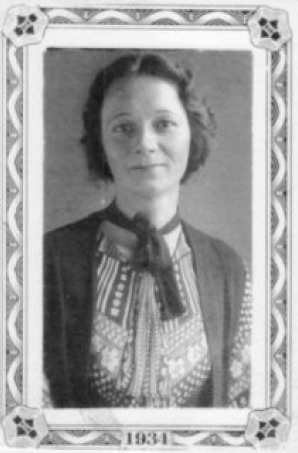
Hilda S. Frame…1906-1989
5
A TURNING POINT, HOUSE WITH A HISTORY, MUSICAL AND LITERARY AWAKENINGS, ELVIS AND THE BELLS
Like the Stage Manager in Thornton Wilder’s play, Our Town, I need to take you back in time before Mrs. Frame’s death and after it. I recall a turning point one day upon arriving home from grammar school. I asked Aunt Dot if she thought we would be living with her a year from then. I so feared that tomorrow or sometime soon would mark the end of our stay, and we would be moving on again. That may have been the day that Aunt Dot and Uncle Bill became Mother and Father to me, for I was hugged and assured that we would be staying for a long time. A poem I wrote on a June 13th, the anniversary of our arrival at the Browns, expresses the passage of time and adolescent concerns:
It was this day several years past
When I came for a visit and repast
To spend some days as spent before
With a family to care and nothing more.
To feed, to clothe and to be schooled
Were the duties to be desultorily ruled.
To the “state kid” the stigma so harshly stated
Whenever he was around outsiders berated.
But a year after the day of his stay
He sensed a feeling of a brighter day
Since one year had passed but he had not
He remained with the people he loved a lot.
They’d given him love and dried his tears
And this home has been his for eleven years.
And what a great home it was! The house we lived in had an amazing history. Built in the 1700’s, it was an old Colonial structure with fire-places in several rooms, downstairs and upstairs. At one point in time it had functioned as both a general store and as the local post office (1892). It was originally the Old Union Hotel where stage coach travelers stopped for overnight stays. It was also the historic inn where the reputed Tory outlaw, Joseph Mulliner, who roamed the Jersey Pine Barrens in the late 1700’s, was apprehended at a dance one night before he was tried and later hanged in 1781 for his loyalty to England in the Revolutionary War. Those old Colonial wide pine floorboards of the house probably creaked a lot on that dance floor above the old country store where Joe Mulliner danced the night away before he was captured. I remember reading Bram Stoker’s Dracula late at night in the 1950’s and being spooked by the occasional creaking, unsettling sounds of the house. Mrs. Frame had told us about Joe Mulliner and the Old Black Stove that was seen crossing the road at midnight on certain nights near Blacks’ Farm, about a mile down the road where the Lamonacas lived when I was growing up. I never saw that stove but would have liked to.
Mrs. Frame’s parents, Berta and John Stewart, lived just a few houses down the street from us with their daughter Carolyn who played the organ at the New Columbia Methodist Church which we attended and where I was baptized by Revered Ebel sometime in the early 50’s. The good reverend had a hearing problem and, fortunately, did get my name right when he baptized me in the name of the Lord. Bernice Watson wasn’t quite so lucky. When he went to baptize her, instead of calling her by her rightful name, he baptized her Ben Schweitzer. I must say that we kids couldn’t stop laughing and wondered what would happen to poor Bernice with the name Ben Schweitzer for the rest of her life!
Getting back to Carolyn, she taught me to drive a car although I had some practice driving a Farmall tractor as part of our farm work and 4-H activities. In one of my auto driving practice sessions, I almost took out a section of a white picket fence running along River Road in Green Bank. I turned out to be a fairly decent driver although one late afternoon I managed to lose control of Father Brown’s Chevy truck in soft sand driving on Moore’s Avenue with Teeny Bell in the truck. Nobody was hurt, and I ran to the Lamonaca farm where they calmed me down and contacted my parents. Teeny and her sisters never let me forget that accident!
When I graduated from Hammonton High School in 1958, I was awarded the Anthony Esposito Award for Literature which included a plaque with a quotation from Thomas Carlyle that read: “Literature is the thought of thinking souls.” This was an exciting time, for Carolyn Stewart gave me a set of the Harvard Classics as a graduation gift. What a perfect gift! Just imagine a collection of the world’s greatest literature for me, a “thinking soul.” Carolyn’s gift further augmented a rich collection of books that Father Brown had inherited from the Parkers, Aunt Margaret and Uncle Morris, who lived in Atlantic City before their deaths in the 50’s. When that collection of books arrived, I was beyond the beyond exploring Richard Haliburton’s Royal Road to Romance, Rudyard Kipling’s The Light That Failed, and Hervey Allen’s Anthony Adverse. Fascinated with weather, and snow, in particular, I fell asleep one night in the bathtub reading one of the books from the Parkers; it was John Greenleaf Whittier’s Snowbound. To say the least, I awoke a bit chilled! Both the Harvard Classics collection and the Parkers’ vast library helped foster my love for reading as I internalized Thomas Carlyle’s “Literature is the thought of thinking souls.” Carolyn Stewart and Aunt Margaret and Uncle Morris were three more saints whose influence I will never forget.


